


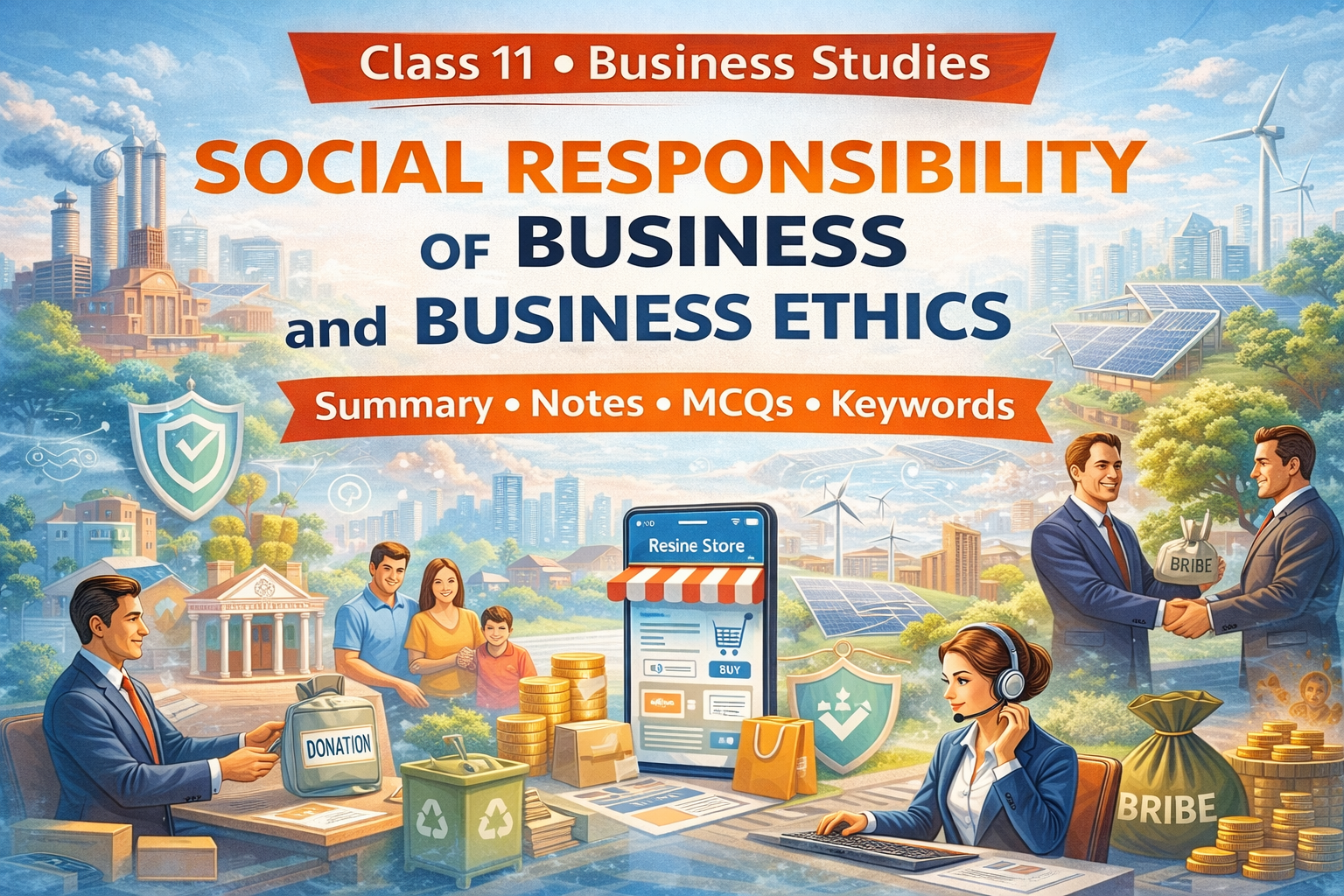
Meta Description
Complete Social Responsibility of Business and Business Ethics Class 11 notes, summary, important questions, MCQs, keywords, and exam tips based on the latest NCERT Business Studies syllabus.
Introduction of the Chapter
The chapter Social Responsibility of Business and Business Ethics in Class 11 Business Studies explains the role of business in society and the importance of ethical practices in business operations. In modern economies, businesses are not only expected to earn profits but also contribute to social welfare and sustainable development.
The concept of Social Responsibility of Business and Business Ethics emphasizes that businesses should act responsibly toward various stakeholders such as consumers, employees, government, society, and the environment. Companies must follow ethical values, honesty, fairness, and transparency in their operations.
In today’s global business environment, organizations that practice social responsibility and business ethics gain public trust and long-term success. This chapter explains the meaning, need, arguments for and against social responsibility, responsibilities toward different stakeholders, environmental protection, and the importance of ethical behavior in business.
Understanding Social Responsibility of Business and Business Ethics helps students develop awareness about responsible business practices and prepares them for future managerial roles.
Short Notes (Key Points)
Meaning of Social Responsibility
- Social responsibility refers to the obligation of business to protect and promote the welfare of society.
- Businesses must consider the interests of stakeholders and the environment while making decisions.
Concept of Business Ethics
- Business ethics refers to moral principles and values that guide business behavior.
- It ensures honesty, fairness, and integrity in business dealings.
Need for Social Responsibility
- Protect consumer interests
- Improve company reputation
- Promote sustainable development
- Maintain ethical standards
- Build trust with society
Responsibilities Toward Stakeholders
Businesses have responsibilities toward:
- Consumers
- Employees
- Government
- Community
- Environment
Environmental Protection
Businesses must reduce pollution, conserve natural resources, and follow environmental laws.
Benefits of Social Responsibility
- Improved public image
- Customer loyalty
- Long-term sustainability
- Employee satisfaction
Limitations of Social Responsibility
- Increased operational costs
- Conflict with profit objectives
- Lack of clear standards
Importance of Business Ethics
- Prevents unethical practices
- Improves corporate reputation
- Builds trust among stakeholders
- Ensures legal compliance
Detailed Summary (Social Responsibility of Business and Business Ethics)
The chapter Social Responsibility of Business and Business Ethics highlights the role of businesses in contributing to society and maintaining ethical conduct. Businesses operate within a social environment and depend on society for resources, labor, and customers. Therefore, they have certain responsibilities toward society.
Meaning of Social Responsibility
Social responsibility refers to the duty of businesses to protect the interests of society while carrying out their economic activities. It means that businesses should not focus only on profits but also consider social welfare and environmental protection.
For example, companies should ensure product safety, fair pricing, and responsible advertising. They should also support community development programs and environmental sustainability.
Need for Social Responsibility
There are several reasons why social responsibility is important in modern business:
1. Protection of Consumer Interests
Businesses must provide quality products and honest information to consumers. Social responsibility ensures that consumers are not exploited.
2. Environmental Protection
Industrial activities can harm the environment through pollution and resource depletion. Responsible businesses take measures to reduce pollution and conserve resources.
3. Long-Term Business Success
Companies that follow social responsibility practices gain public trust and long-term profitability.
4. Compliance with Laws
Businesses must follow government regulations related to consumer protection, labor laws, and environmental standards.
5. Ethical Obligations
Businesses are part of society and therefore have a moral responsibility to contribute to social welfare.
Arguments for Social Responsibility
Several arguments support the concept of social responsibility:
- Businesses use society’s resources, so they should give back to society.
- Responsible practices improve public image and reputation.
- Social responsibility reduces government intervention.
- It helps build strong relationships with stakeholders.
Arguments Against Social Responsibility
Some critics argue that businesses should focus only on profit-making. The main arguments against social responsibility include:
- It increases business costs.
- Businesses may lack expertise in social activities.
- It may reduce economic efficiency.
However, modern businesses increasingly recognize that social responsibility contributes to long-term success.
Responsibilities Toward Stakeholders
Businesses must fulfill responsibilities toward different groups in society.
Responsibility Toward Consumers
Businesses must provide safe and high-quality products. They should avoid misleading advertisements and ensure fair pricing.
Responsibility Toward Employees
Companies must provide fair wages, safe working conditions, and opportunities for growth.
Responsibility Toward Government
Businesses must follow laws, pay taxes, and cooperate with government policies.
Responsibility Toward Community
Businesses should support community development programs such as education, healthcare, and infrastructure.
Responsibility Toward Environment
Companies must reduce pollution, conserve natural resources, and adopt eco-friendly practices.
Environmental Protection
Environmental protection is an important part of Social Responsibility of Business and Business Ethics. Industrial pollution can harm air, water, and land. Businesses must adopt sustainable practices such as waste management, recycling, and energy conservation.
Government regulations also require companies to comply with environmental standards.
Business Ethics
Business ethics refers to the moral values that guide business decisions and behavior. Ethical businesses follow principles such as honesty, transparency, fairness, and accountability.
Examples of ethical practices include:
- Honest advertising
- Fair pricing
- Respect for employee rights
- Compliance with laws
Importance of Business Ethics
Business ethics plays a crucial role in modern organizations.
- It builds trust with customers and stakeholders.
- It prevents fraud and corruption.
- It improves corporate reputation.
- It ensures long-term business sustainability.
Companies that follow strong ethical values are more likely to succeed in competitive markets.
Flowchart / Mind Map (Text-Based)
Social Responsibility of Business and Business Ethics
Business Responsibility
│
├── Responsibility Toward Consumers
│ ├ Quality products
│ ├ Fair prices
│ └ Honest advertising
│
├── Responsibility Toward Employees
│ ├ Fair wages
│ ├ Safe workplace
│ └ Training and development
│
├── Responsibility Toward Government
│ ├ Payment of taxes
│ └ Compliance with laws
│
├── Responsibility Toward Community
│ ├ Social welfare
│ └ Infrastructure development
│
└── Responsibility Toward Environment
├ Pollution control
└ Sustainable practices
Business Ethics
│
├ Honesty
├ Fairness
├ Transparency
└ Accountability
Important Keywords with Meanings
Social Responsibility – Duty of business to protect and promote the welfare of society.
Business Ethics – Moral principles guiding business behavior.
Stakeholders – Individuals or groups affected by business activities.
Environmental Protection – Actions taken to prevent environmental damage.
Corporate Responsibility – Business commitment toward social and environmental welfare.
Ethical Behavior – Acting honestly and fairly in business operations.
Consumer Protection – Safeguarding the interests of customers.
Sustainable Development – Development that meets present needs without harming future generations.
Important Questions and Answers
Short Answer Questions
1. What is social responsibility of business?
Social responsibility of business refers to the obligation of businesses to protect and promote the welfare of society while conducting economic activities.
2. Define business ethics.
Business ethics refers to moral values and principles that guide business behavior and decision-making.
3. Why is social responsibility important?
Social responsibility helps protect consumer interests, improve company reputation, and promote sustainable development.
4. What are stakeholders?
Stakeholders are individuals or groups who are affected by the activities of a business organization.
Long Answer Questions
1. Explain the responsibilities of business toward consumers.
Businesses must provide safe and high-quality products to consumers. They should ensure fair pricing, avoid misleading advertisements, and provide accurate product information. Companies should also establish grievance redressal systems to address consumer complaints. Protecting consumer rights helps build trust and long-term customer relationships.
2. Explain the importance of business ethics.
Business ethics ensures honesty and fairness in business operations. It prevents unethical practices such as fraud, corruption, and exploitation. Ethical businesses gain customer trust, improve their reputation, and ensure legal compliance. Strong ethical standards also contribute to long-term organizational success.
20 MCQs with Answers
- Social responsibility refers to
A Profit maximization
B Obligation toward society
C Government control
D None
Answer: B - Business ethics refers to
A Moral principles
B Government laws
C Profit-making
D Trade policy
Answer: A - Responsibility toward employees includes
A Fair wages
B Safe working conditions
C Training opportunities
D All of these
Answer: D - Environmental protection is part of
A Social responsibility
B Marketing
C Finance
D Production
Answer: A - Ethical business practices help in
A Building trust
B Reducing reputation
C Increasing corruption
D None
Answer: A - Stakeholders include
A Employees
B Customers
C Government
D All of these
Answer: D - Honest advertising is part of responsibility toward
A Consumers
B Employees
C Government
D Shareholders
Answer: A - Pollution control is related to
A Environmental responsibility
B Consumer rights
C Production cost
D None
Answer: A - Business ethics promotes
A Fairness
B Honesty
C Integrity
D All of these
Answer: D - Paying taxes is responsibility toward
A Government
B Employees
C Consumers
D Community
Answer: A - Social responsibility improves
A Public image
B Customer trust
C Business sustainability
D All of these
Answer: D - Misleading advertisements violate
A Ethics
B Marketing
C Finance
D Production
Answer: A - Sustainable development focuses on
A Long-term welfare
B Short-term profits
C Competition
D Sales promotion
Answer: A - Safe working conditions benefit
A Employees
B Consumers
C Government
D Competitors
Answer: A - Ethical businesses gain
A Public trust
B Reputation
C Loyalty
D All
Answer: D - Community development is part of
A Social responsibility
B Marketing
C Finance
D Production
Answer: A - Consumer protection laws protect
A Buyers
B Sellers
C Competitors
D Government
Answer: A - Ethical practices reduce
A Fraud
B Corruption
C Misconduct
D All
Answer: D - Environmental sustainability means
A Protecting natural resources
B Increasing pollution
C Ignoring environment
D None
Answer: A - Social responsibility leads to
A Long-term success
B Short-term failure
C No growth
D None
Answer: A
Exam Tips / Value-Based Questions
Exam Tips
- Understand the difference between social responsibility and business ethics.
- Learn the five responsibilities toward stakeholders.
- Practice case-based questions related to ethical decisions.
- Use examples of responsible companies in long answers.
Value-Based Questions
- Why should businesses protect the environment even if it increases costs?
- How can ethical practices improve business reputation?
- Why should companies prioritize consumer safety?
Conclusion
The chapter Social Responsibility of Business and Business Ethics highlights the importance of responsible and ethical behavior in modern business. Businesses must balance profit-making with social welfare and environmental protection.
By fulfilling their responsibilities toward stakeholders and following ethical practices, organizations can build trust, maintain a positive reputation, and achieve long-term success. Understanding the principles of Social Responsibility of Business and Business Ethics helps students develop awareness about sustainable and ethical business practices in the global economy.
Here is an 80 Marks Question Paper based on the chapter “Nature and Purpose of Business” (Class 11 – Business Studies, NCERT). This format follows the CBSE board pattern with different sections.
Class 11 Business Studies
Chapter: Nature and Purpose of Business
80 Marks Question Paper
Time: 3 Hours
Maximum Marks: 80
Section A – Very Short Answer Questions
(1 × 10 = 10 Marks)
Answer in one sentence or a few words.
- Define business.
- What is meant by economic activity?
- State any two characteristics of business.
- What is meant by profit in business?
- Define profession.
- What is employment?
- What is meant by industry?
- Give two examples of commerce activities.
- What do you mean by risk in business?
- Define trade.
Section B – Short Answer Questions
(3 × 10 = 30 Marks)
Answer in about 60–80 words.
- Explain the concept of business activities.
- Distinguish between economic and non-economic activities.
- Explain any three characteristics of business.
- What are the objectives of business?
- Differentiate between business, profession, and employment.
- Explain the classification of industries.
- What is commerce? Explain its components.
- Explain the concept of profit in business.
- What are the social responsibilities of business?
- Explain the role of business in economic development.
Section C – Long Answer Questions
(5 × 8 = 40 Marks)
Answer in about 150–200 words.
21. Explain the important characteristics of business in detail.
OR
Explain the difference between economic activities and non-economic activities with examples.
22. Explain the classification of industries with suitable examples.
23. Explain the auxiliaries to trade and their role in commerce.
24. Discuss the economic and social objectives of business.
25. Explain the importance of business in modern society.
If you want, I can also create:
- Solved 80 Marks Question Paper (Detailed Answers)
- 50 MCQs with explanations
- 3000+ word passage-based worksheet
- SEO featured image for blog/WordPress.
Solved 80 Marks Question Paper (Detailed Answers)
Class 11 – Business Studies (NCERT)
Chapter: Nature and Purpose of Business
Maximum Marks: 80 | Time: 3 Hours
Section A – Very Short Answer Questions
(1 × 10 = 10 Marks)
1. Define Business.
Business refers to an economic activity involving the production or purchase and sale of goods and services with the objective of earning profit.
2. What is meant by economic activity?
Economic activities are activities performed to earn money or livelihood, such as business, profession, and employment.
3. State any two characteristics of business.
- Sale or exchange of goods and services
- Profit motive
4. What is meant by profit in business?
Profit is the financial gain earned when revenue from sales exceeds the cost of production and other expenses.
5. Define Profession.
A profession is an occupation requiring specialized knowledge, training, and qualifications, such as doctors, lawyers, and chartered accountants.
6. What is employment?
Employment is a type of economic activity where a person works for an employer in return for wages or salary.
7. What is meant by industry?
Industry refers to economic activities related to the production or processing of goods and extraction of natural resources.
8. Give two examples of commerce activities.
- Banking
- Transportation
9. What do you mean by risk in business?
Risk refers to the uncertainty of loss due to changes in demand, competition, natural calamities, or market conditions.
10. Define Trade.
Trade refers to the buying and selling of goods and services between people, firms, or countries.
Section B – Short Answer Questions
(3 × 10 = 30 Marks)
11. Explain the concept of business activities.
Business activities are activities undertaken to produce or distribute goods and services to satisfy human needs while earning profit. These activities involve the production, purchase, and sale of goods or services. Business activities are mainly classified into industry and commerce. Industry deals with production and processing of goods, while commerce helps in the distribution of goods through trade and auxiliaries to trade such as banking, transport, and insurance. Business activities contribute to economic development by creating employment opportunities and providing goods and services to society.
12. Distinguish between Economic and Non-Economic Activities.
| Basis | Economic Activities | Non-Economic Activities |
|---|---|---|
| Meaning | Activities done to earn income | Activities done out of love, affection, or social service |
| Motive | Profit motive | Service motive |
| Example | Business, profession | Charity, helping others |
Economic activities generate income, whereas non-economic activities are done without expecting financial return.
13. Explain any three characteristics of business.
1. Economic Activity
Business is an economic activity carried out with the purpose of earning money.
2. Sale or Exchange of Goods and Services
Business involves the transfer of goods or services for value between buyers and sellers.
3. Profit Motive
The main objective of business is to earn profit as it ensures survival and growth.
14. What are the objectives of business?
Business objectives are the goals that a business organization aims to achieve.
Economic Objectives
- Earning profit
- Growth and expansion
- Market leadership
Social Objectives
- Providing quality goods
- Creating employment
- Protecting the environment
A successful business balances both economic and social objectives.
15. Differentiate between Business, Profession, and Employment.
| Basis | Business | Profession | Employment |
|---|---|---|---|
| Meaning | Production and sale of goods/services | Specialized occupation | Working for salary |
| Qualification | Not always required | Specialized education needed | Depends on job |
| Risk | High risk | Moderate risk | Very low risk |
16. Explain the classification of industries.
Industries are classified into three main categories:
1. Primary Industry
Related to extraction of natural resources.
Example: Agriculture, fishing, mining.
2. Secondary Industry
Involves processing raw materials into finished goods.
Example: Manufacturing factories.
3. Tertiary Industry
Provides services that support production and trade.
Example: Transport, banking, insurance.
17. What is commerce? Explain its components.
Commerce refers to activities that help in the distribution of goods and services from producers to consumers.
It has two main components:
1. Trade
Buying and selling of goods.
2. Auxiliaries to Trade
Activities that help trade such as:
- Banking
- Transport
- Insurance
- Warehousing
- Advertising
These services facilitate smooth business operations.
18. Explain the concept of profit in business.
Profit is the excess of revenue over expenses. It is the reward for the entrepreneur’s effort and risk. Profit helps businesses survive, grow, and expand. It allows businesses to invest in new technology, improve quality, and create employment. However, businesses should earn profit ethically and not exploit consumers or society.
19. What are the social responsibilities of business?
Businesses have responsibilities towards society, including:
- Providing quality goods and services
- Avoiding unfair trade practices
- Protecting the environment
- Providing safe working conditions
- Contributing to community welfare
A socially responsible business builds trust and long-term success.
20. Explain the role of business in economic development.
Business plays an important role in the development of an economy by:
- Creating employment opportunities
- Producing goods and services
- Promoting innovation and technology
- Generating government revenue through taxes
- Improving the standard of living
Thus, business is a major driver of economic growth.
Section C – Long Answer Questions
(5 × 8 = 40 Marks)
21. Explain the important characteristics of business.
Business has several essential characteristics:
1. Economic Activity
Business involves activities performed to earn income.
2. Production or Procurement of Goods and Services
Businesses produce or purchase goods for sale to consumers.
3. Sale or Exchange of Goods and Services
Business involves selling goods for money.
4. Profit Motive
Profit is the main motivating factor behind business activities.
5. Uncertainty of Return
Profit cannot be guaranteed because market conditions constantly change.
6. Element of Risk
Business involves risks due to competition, demand fluctuations, or natural disasters.
7. Regularity in Dealings
Business activities are carried out continuously and regularly.
These characteristics differentiate business from other economic activities.
22. Explain the classification of industries with suitable examples.
Industries are broadly classified into the following categories:
1. Primary Industry
This industry extracts natural resources from nature.
Examples
- Agriculture
- Mining
- Fishing
It provides raw materials for other industries.
2. Secondary Industry
This industry converts raw materials into finished goods.
It includes:
Manufacturing Industry – Produces goods like cars, clothes, and electronics.
Construction Industry – Builds roads, bridges, and buildings.
3. Tertiary Industry
This industry provides services that support production and trade.
Examples include:
- Banking
- Insurance
- Transportation
- Communication
These industries help the economy function smoothly.
23. Explain auxiliaries to trade and their role in commerce.
Auxiliaries to trade are services that facilitate trade and help in the smooth movement of goods.
Major auxiliaries include:
1. Transport
Helps in the movement of goods from producers to consumers.
2. Banking
Provides financial assistance and credit facilities.
3. Insurance
Protects businesses from risks and losses.
4. Warehousing
Stores goods until they are needed in the market.
5. Advertising
Creates awareness about products.
These services ensure efficient distribution of goods.
24. Discuss the economic and social objectives of business.
Business organizations pursue both economic and social objectives.
Economic Objectives
- Earning profit
- Business growth
- Market expansion
- Innovation and productivity
Social Objectives
- Supplying quality goods
- Creating employment opportunities
- Protecting the environment
- Supporting community development
Balancing both objectives helps businesses achieve sustainable success.
25. Explain the importance of business in modern society.
Business plays a vital role in society:
1. Provides Goods and Services
Businesses satisfy the needs and wants of people.
2. Generates Employment
It provides jobs to millions of people.
3. Promotes Economic Growth
Business activities contribute to national income.
4. Encourages Innovation
Businesses introduce new technologies and products.
5. Improves Living Standards
People enjoy better products and services due to business development.
Thus, business is an essential pillar of modern economic and social development.
✅ If you want, I can also create:
- 50 MCQs with explanations (exam-oriented)
- 3000+ word passage-based worksheet (CBSE board pattern)
- 10 case studies for Business Studies
- SEO Featured Image for your WordPress blog.
50 MCQs – Social Responsibility of Business and Business Ethics
Class 11 – Business Studies (NCERT)
(With Answers for Exam Preparation)
1. What is the primary objective of social responsibility of business?
A. Profit maximization
B. Serving society
C. Increasing sales
D. Reducing costs
Answer: B. Serving society
2. Social responsibility refers to the obligation of business to:
A. Earn profits only
B. Protect and improve society’s welfare
C. Focus only on shareholders
D. Increase production
Answer: B. Protect and improve society’s welfare
3. Which of the following is an argument in favor of social responsibility?
A. Increased cost
B. Long-term survival
C. Government burden
D. Lack of accountability
Answer: B. Long-term survival
4. Business ethics refers to:
A. Government rules
B. Moral principles guiding business behavior
C. Marketing strategies
D. Profit-making techniques
Answer: B. Moral principles guiding business behavior
5. Which responsibility relates to producing quality goods?
A. Responsibility toward customers
B. Responsibility toward government
C. Responsibility toward employees
D. Responsibility toward society
Answer: A. Responsibility toward customers
6. Which responsibility ensures fair wages and safe working conditions?
A. Responsibility toward employees
B. Responsibility toward investors
C. Responsibility toward government
D. Responsibility toward environment
Answer: A. Responsibility toward employees
7. Which of the following is a responsibility toward the government?
A. Paying taxes honestly
B. Advertising products
C. Providing employment
D. Producing goods
Answer: A. Paying taxes honestly
8. Which activity helps in environmental protection?
A. Recycling waste
B. Increasing pollution
C. Overusing resources
D. Ignoring environmental laws
Answer: A. Recycling waste
9. Which of the following promotes ethical behavior in business?
A. Code of ethics
B. Corruption
C. Tax evasion
D. Bribery
Answer: A. Code of ethics
10. Social responsibility includes responsibility toward:
A. Customers
B. Employees
C. Government
D. All of the above
Answer: D. All of the above
11. Which concept states that business should serve society beyond profit?
A. Profit maximization
B. Social responsibility
C. Marketing concept
D. Competition
Answer: B. Social responsibility
12. Business ethics are important for:
A. Building trust
B. Improving reputation
C. Long-term success
D. All of the above
Answer: D. All of the above
13. Which responsibility relates to protecting the environment?
A. Social responsibility
B. Legal responsibility
C. Ethical responsibility
D. Environmental responsibility
Answer: D. Environmental responsibility
14. Providing correct product information is responsibility toward:
A. Customers
B. Government
C. Society
D. Employees
Answer: A. Customers
15. Which practice is unethical in business?
A. Fair pricing
B. Adulteration
C. Honest advertising
D. Customer satisfaction
Answer: B. Adulteration
16. CSR stands for:
A. Corporate Social Responsibility
B. Corporate Sales Regulation
C. Customer Service Rule
D. Corporate Service Record
Answer: A. Corporate Social Responsibility
17. Which group provides capital to business?
A. Customers
B. Employees
C. Investors
D. Government
Answer: C. Investors
18. Fair wages should be provided to:
A. Customers
B. Employees
C. Investors
D. Government
Answer: B. Employees
19. Avoiding misleading advertisements is responsibility toward:
A. Government
B. Society
C. Customers
D. Employees
Answer: C. Customers
20. Business should provide safe products to:
A. Customers
B. Investors
C. Government
D. Competitors
Answer: A. Customers
21. Which activity promotes community development?
A. Building schools
B. Polluting rivers
C. Tax evasion
D. Hoarding goods
Answer: A. Building schools
22. Which of the following improves company reputation?
A. Ethical behavior
B. Fraud
C. Corruption
D. Black marketing
Answer: A. Ethical behavior
23. Which responsibility ensures payment of dividends?
A. Responsibility toward investors
B. Responsibility toward employees
C. Responsibility toward society
D. Responsibility toward customers
Answer: A. Responsibility toward investors
24. Which is an ethical practice?
A. Transparency in business
B. Bribery
C. Hoarding
D. Black marketing
Answer: A. Transparency in business
25. Social responsibility helps in:
A. Building goodwill
B. Increasing trust
C. Sustainable growth
D. All of the above
Answer: D. All of the above
26. Which responsibility focuses on environmental protection?
A. Economic responsibility
B. Social responsibility
C. Environmental responsibility
D. Financial responsibility
Answer: C. Environmental responsibility
27. Which of the following is unethical?
A. Selling defective goods knowingly
B. Honest pricing
C. Paying taxes
D. Providing quality goods
Answer: A. Selling defective goods knowingly
28. Businesses must follow government laws related to:
A. Taxes
B. Labor
C. Environment
D. All of the above
Answer: D. All of the above
29. Which practice supports employee welfare?
A. Providing medical facilities
B. Paying low wages
C. Ignoring safety
D. Exploiting workers
Answer: A. Providing medical facilities
30. Ethical behavior leads to:
A. Long-term success
B. Loss of reputation
C. Customer dissatisfaction
D. Legal issues
Answer: A. Long-term success
31. Which group benefits from social responsibility?
A. Society
B. Environment
C. Business
D. All of the above
Answer: D. All of the above
32. Which concept promotes fairness in business practices?
A. Business ethics
B. Competition
C. Marketing
D. Production
Answer: A. Business ethics
33. Which of the following is a social responsibility activity?
A. Charity donations
B. Pollution
C. Tax evasion
D. Price manipulation
Answer: A. Charity donations
34. Which activity harms society?
A. Black marketing
B. Recycling
C. Honest trade
D. Social welfare
Answer: A. Black marketing
35. Businesses should avoid:
A. Adulteration
B. Quality production
C. Customer service
D. Innovation
Answer: A. Adulteration
36. Social responsibility encourages:
A. Sustainable development
B. Pollution
C. Exploitation
D. Corruption
Answer: A. Sustainable development
37. Business ethics are based on:
A. Moral values
B. Government rules only
C. Marketing strategies
D. Advertising techniques
Answer: A. Moral values
38. Which of the following improves employee motivation?
A. Fair wages
B. Unsafe conditions
C. Exploitation
D. Low salaries
Answer: A. Fair wages
39. Environmental protection helps in:
A. Sustainable future
B. Pollution increase
C. Resource wastage
D. Environmental damage
Answer: A. Sustainable future
40. Which is responsibility toward society?
A. Reducing pollution
B. Paying wages
C. Advertising products
D. Increasing sales
Answer: A. Reducing pollution
41. Which practice builds customer loyalty?
A. Honest dealings
B. Fraud
C. Adulteration
D. Misleading advertisements
Answer: A. Honest dealings
42. Which of the following is an unethical business practice?
A. Black marketing
B. Fair pricing
C. Honest advertising
D. Quality production
Answer: A. Black marketing
43. Which responsibility ensures employee safety?
A. Employee welfare
B. Customer service
C. Profit making
D. Marketing
Answer: A. Employee welfare
44. Businesses must follow ethical practices to:
A. Maintain goodwill
B. Avoid legal problems
C. Gain trust
D. All of the above
Answer: D. All of the above
45. Which of the following supports sustainable business?
A. Environmental protection
B. Pollution
C. Resource wastage
D. Exploitation
Answer: A. Environmental protection
46. Which practice protects customer rights?
A. Honest information
B. Misleading advertising
C. Adulteration
D. Hoarding
Answer: A. Honest information
47. Business ethics guide:
A. Employee behavior
B. Business decisions
C. Company policies
D. All of the above
Answer: D. All of the above
48. Which responsibility improves community welfare?
A. Social responsibility
B. Economic responsibility
C. Financial responsibility
D. Marketing responsibility
Answer: A. Social responsibility
49. Ethical companies usually have:
A. Strong reputation
B. Customer trust
C. Long-term success
D. All of the above
Answer: D. All of the above
50. Social responsibility and business ethics together promote:
A. Sustainable development
B. Economic growth
C. Social welfare
D. All of the above
Answer: D. All of the above
If you want, I can also generate 20 Case-Based MCQs (very important for CBSE board exams) or a 3000+ word passage-based worksheet for Class 11 Business Studies to make your content even stronger for exams and SEO.
Class 11 Business Studies
Chapter: Social Responsibility of Business and Business Ethics
3000+ Word Passage-Based Worksheet (Board Pattern)
Passage 1: Business and Its Responsibility Toward Society
Business organizations play an important role in the development of modern society. Traditionally, businesses were primarily concerned with earning profits. Profit was considered the main objective of business activities. However, with the growth of industries, globalization, and increased awareness among people, the role of business has expanded. Today, businesses are expected to fulfill not only economic objectives but also social responsibilities.
Social responsibility of business refers to the obligation of businesses to make decisions and take actions that contribute to the welfare of society. Businesses operate in a social environment where they utilize resources provided by society such as land, labor, and capital. Since businesses depend on society for their survival and growth, they must also give back to society.
Modern business organizations recognize that long-term success cannot be achieved by focusing only on profits. Instead, they must maintain a balance between profit-making and social welfare. Responsible businesses take steps to protect the environment, provide fair wages to employees, supply quality goods to customers, and follow ethical practices.
Social responsibility also includes activities such as community development, supporting education, protecting natural resources, and contributing to social welfare programs. Many companies participate in corporate social responsibility (CSR) initiatives such as building schools, hospitals, and promoting environmental sustainability.
Another important aspect of social responsibility is transparency and honesty in business dealings. Customers today are well informed and expect businesses to act responsibly. If a business engages in unethical practices such as adulteration, misleading advertising, or exploitation of workers, it can lose public trust and reputation.
Governments across the world have also introduced laws and regulations to ensure that businesses behave responsibly. Environmental protection laws, consumer protection laws, and labor laws are examples of such regulations. These laws ensure that businesses operate in a manner that protects the interests of society.
In recent years, social responsibility has become a key factor in determining the reputation and success of a business. Companies that demonstrate responsible behavior gain the trust of customers, employees, investors, and the community. As a result, social responsibility is now considered an essential part of modern business management.
Questions Based on Passage 1
Very Short Answer Questions
- What was the traditional objective of business?
- Define social responsibility of business.
- Why should businesses give back to society?
- What does CSR stand for?
- Name two social welfare activities done by companies.
Short Answer Questions
- Explain the concept of social responsibility of business.
- Why is social responsibility important for modern businesses?
- How does social responsibility improve the reputation of a business?
- What role does government play in ensuring responsible business behavior?
- Explain the relationship between business and society.
Case-Based Questions
- A company decides to invest money in building schools and hospitals in rural areas. Identify the concept reflected in this decision and explain its importance.
- A manufacturing company reduces pollution by installing eco-friendly machines. Which responsibility of business is being fulfilled here?
Passage 2: Responsibilities of Business Toward Different Groups
Businesses operate in an environment where they interact with many groups such as customers, employees, investors, government, and society. Each of these groups has certain expectations from businesses. Therefore, businesses have responsibilities toward all these groups.
One of the most important responsibilities of business is toward customers. Customers are the foundation of any business. Without customers, businesses cannot survive. Therefore, businesses must provide good quality products at reasonable prices. They should avoid unfair practices such as adulteration, black marketing, and misleading advertisements. Providing accurate product information and good after-sales service are also important responsibilities toward customers.
Businesses also have responsibilities toward employees. Employees are valuable assets of an organization. Businesses should provide fair wages, safe working conditions, job security, and opportunities for growth. Employee welfare measures such as medical facilities, training programs, and retirement benefits help improve employee motivation and productivity.
Investors are another important group associated with business organizations. Investors provide the capital required for business operations. Therefore, businesses should protect the interests of investors by ensuring transparency, fair returns, and proper use of funds.
The government plays a crucial role in regulating business activities. Businesses must follow government laws and regulations related to taxation, labor welfare, environmental protection, and consumer rights. Paying taxes honestly and complying with legal requirements are important responsibilities toward the government.
Businesses also have responsibilities toward society and the environment. They must ensure that their activities do not harm the environment. Proper waste management, pollution control, and conservation of natural resources are essential responsibilities. Businesses should also participate in community development programs.
By fulfilling these responsibilities, businesses can create a positive impact on society and ensure long-term success.
Questions Based on Passage 2
Very Short Answer Questions
- Name any two groups toward which businesses have responsibilities.
- Why are customers important for businesses?
- What should businesses provide to employees?
- Why must businesses pay taxes?
- Give one example of environmental responsibility.
Short Answer Questions
- Explain the responsibilities of business toward customers.
- What responsibilities do businesses have toward employees?
- Explain the responsibilities of business toward investors.
- Why is environmental protection important for businesses?
- How can businesses contribute to community development?
Case Study Questions
- A company advertises a product claiming it has health benefits, but the claim is false. Identify the unethical practice involved.
- A factory provides free medical facilities and training programs for workers. Which responsibility of business is being fulfilled?
Passage 3: Business Ethics and Ethical Practices
Business ethics refers to the moral principles and values that guide the behavior of individuals and organizations in the business world. Ethical behavior is essential for building trust and maintaining a good reputation.
Business ethics ensures that businesses conduct their activities honestly and fairly. Ethical practices include honesty in advertising, fair pricing, transparency in financial dealings, and respect for employee rights.
Unethical practices such as bribery, corruption, tax evasion, adulteration, and black marketing harm society and damage the reputation of businesses. These practices may bring short-term profits but lead to long-term losses due to legal penalties and loss of customer trust.
Many organizations establish a code of ethics to guide the behavior of employees and managers. A code of ethics is a written document that outlines the values and standards expected in the organization.
Training programs are also conducted to promote ethical behavior in the workplace. Employees are educated about ethical standards and encouraged to follow them in their daily work.
Ethical businesses often enjoy higher customer loyalty and employee satisfaction. They build strong relationships with stakeholders and maintain a positive brand image in the market.
Therefore, business ethics is essential for sustainable business growth and long-term success.
Questions Based on Passage 3
Very Short Answer Questions
- Define business ethics.
- What is a code of ethics?
- Name one unethical business practice.
- Why is ethical behavior important for businesses?
- What does transparency mean in business?
Short Answer Questions
- Explain the importance of business ethics.
- What are the advantages of ethical business practices?
- How does unethical behavior affect business reputation?
- Explain the role of a code of ethics in an organization.
- How can training programs promote ethical behavior?
Case-Based Questions
- A company refuses to pay bribes to secure a contract. Which principle of business ethics is demonstrated here?
- A business sells adulterated food products to increase profits. Identify the unethical practice and explain its impact on society.
Passage 4: Arguments For and Against Social Responsibility
The concept of social responsibility has been widely discussed in the business world. Many people support the idea that businesses should contribute to social welfare. However, some critics argue that the main objective of business should be profit-making.
Supporters of social responsibility believe that businesses have a duty to protect the interests of society. Businesses use natural resources and benefit from social infrastructure such as roads, electricity, and communication systems. Therefore, they should contribute to social development.
Another argument in favor of social responsibility is that responsible businesses gain customer trust and loyalty. This improves their reputation and ensures long-term success.
Social responsibility also helps in solving social problems such as unemployment, poverty, and environmental pollution. Businesses can contribute by creating jobs, supporting community programs, and adopting eco-friendly practices.
However, some critics argue that social responsibility increases the cost of business operations. They believe that spending money on social activities reduces profits.
Another argument against social responsibility is that businesses lack expertise in solving social problems. Critics argue that social welfare activities should be handled by governments and non-profit organizations.
Despite these arguments, most experts agree that businesses cannot ignore their social responsibilities. In today’s world, responsible business practices are essential for sustainable development.
Questions Based on Passage 4
Very Short Answer Questions
- What is the main argument against social responsibility?
- Name one argument in favor of social responsibility.
- Why do critics oppose social responsibility?
- How does social responsibility help businesses?
- What is sustainable development?
Short Answer Questions
- Explain two arguments in favor of social responsibility.
- Explain two arguments against social responsibility.
- How does social responsibility improve customer loyalty?
- Why is sustainable development important?
- Do you think businesses should focus only on profits? Explain.
Long Answer Questions
- Discuss the arguments for and against social responsibility of business.
- Explain how social responsibility contributes to sustainable business development.
Value-Based Questions
- Why should businesses avoid misleading advertisements?
- How can ethical business practices help build a better society?
- Why should businesses protect the environment?
- How can businesses contribute to social welfare?
- Why is honesty important in business?
Activity-Based Questions
- Identify a company known for social responsibility and explain its initiatives.
- Prepare a short report on CSR activities of a famous company.
- Discuss how businesses in your local area contribute to society.
- Create a poster promoting ethical business practices.
- Write a paragraph explaining why social responsibility is important for modern businesses.
This passage-based worksheet is designed according to CBSE board patterns and helps students practice:
- Case-based questions
- Analytical thinking
- Application-based questions
- Exam-oriented writing skills
If you want, I can also create a high-quality featured image (WordPress thumbnail) for this chapter to improve SEO and click-through rate.




Leave a Reply