


Meta Description (150–160 characters)
Complete NCERT Class 9 History chapter Socialism in Europe and the Russian Revolution notes, summary, keywords, MCQs and exam questions for quick revision.
Introduction of the Chapter
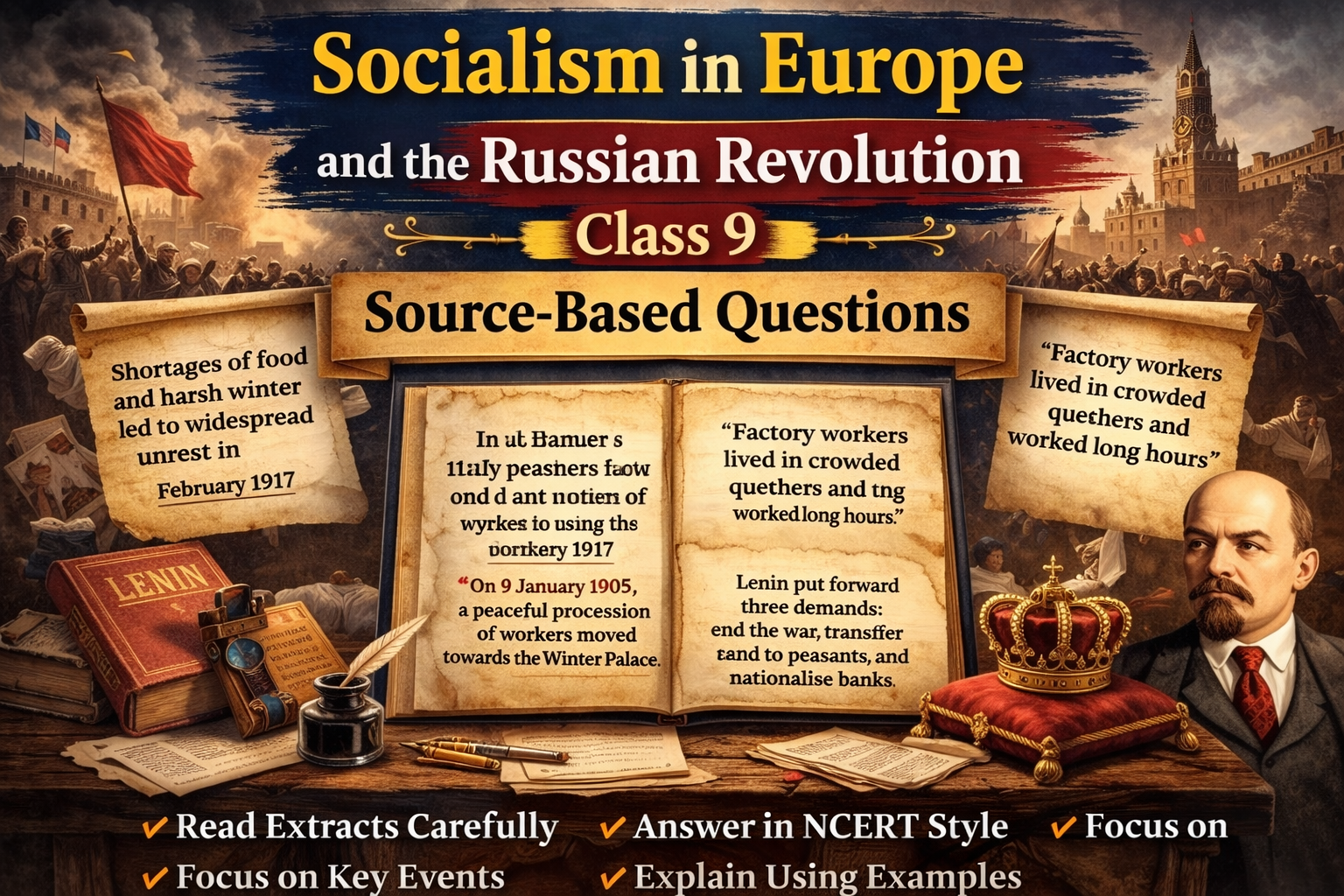
The chapter Socialism in Europe and the Russian Revolution is one of the most important topics in Class 9 History. It explains how socialist ideas developed in Europe and how these ideas led to the Russian Revolution of 1917. Through this chapter, students understand the condition of workers, the role of political groups, and the major events that transformed Russia into a socialist state.
The study of Socialism in Europe and the Russian Revolution is essential for understanding modern political ideologies such as socialism, capitalism, and communism. It also highlights how economic inequality and political oppression can lead to mass movements and revolutions.
Short Notes (Bullet Points)
- Socialism emerged in Europe as a response to industrial capitalism.
- Industrial workers faced poor wages, long hours, and unsafe conditions.
- Socialists believed in collective ownership of means of production.
- Karl Marx and Friedrich Engels were major socialist thinkers.
- Russia was ruled by Tsar Nicholas II before the revolution.
- The Russian Revolution took place in 1917 in two phases: February and October.
- The Bolsheviks were led by Vladimir Lenin.
- After the revolution, Russia became a socialist state (USSR).
- Private property was largely abolished under Bolshevik rule.
- The revolution influenced many countries across the world.
Detailed Summary (900–1200 words)
Rise of Socialism in Europe
The chapter Socialism in Europe and the Russian Revolution begins with the emergence of socialism as an alternative to capitalism in the 19th century. The Industrial Revolution had created new opportunities for wealth but also led to exploitation of workers. Factory owners earned huge profits, while workers lived in poverty and worked under harsh conditions.
Early socialists criticized private ownership and proposed cooperative systems. Some thinkers believed in small communities based on cooperation, while others advocated complete abolition of private property. Over time, socialist ideas gained popularity among workers and intellectuals.
Karl Marx and Friedrich Engels gave socialism a scientific base. Marx argued that society was divided into classes — the bourgeoisie (owners) and the proletariat (workers). He believed that class struggle would eventually lead to a workers’ revolution and establishment of a socialist society.
Socialism Spreads Across Europe
In Socialism in Europe and the Russian Revolution, we learn that socialist parties formed in many European countries. Workers began organizing trade unions and political parties. By the early 20th century, socialism had become a powerful political force.
However, socialist groups were divided. Some believed in gradual reforms through democratic means, while others supported violent revolution. This ideological divide later influenced events in Russia.
The Condition of Russia Before the Revolution
Russia was very different from Western Europe. It was largely agricultural, and most people were peasants. The country was ruled by Tsar Nicholas II, an autocratic ruler who resisted political reforms.
The chapter Socialism in Europe and the Russian Revolution explains that Russian workers faced severe hardships. Industrial workers lived in overcrowded slums and worked long hours. Peasants were burdened with heavy taxes and had little land.
Political opposition was suppressed by the Tsarist regime. Revolutionary groups like the Social Democrats and Socialist Revolutionaries began to challenge the monarchy. Among them, the Social Democratic Party later split into Bolsheviks and Mensheviks.
The 1905 Revolution
The first major challenge to the Tsar came in 1905. Workers in St Petersburg went on strike, and peaceful protesters were fired upon in an incident known as Bloody Sunday. This triggered widespread unrest across Russia.
As discussed in Socialism in Europe and the Russian Revolution, the Tsar was forced to create the Duma (parliament). However, he later dissolved it repeatedly, showing his unwillingness to share power. The problems in Russia continued to worsen.
Impact of the First World War
World War I played a crucial role in intensifying the crisis in Russia. The war caused heavy military losses, economic collapse, food shortages, and inflation. Soldiers were poorly equipped, and public confidence in the Tsar declined sharply.
The chapter Socialism in Europe and the Russian Revolution highlights that by 1917, Russia was on the verge of collapse. Strikes, protests, and mutinies became common.
The February Revolution (1917)
In February 1917, workers in Petrograd went on strike demanding bread and better conditions. Soldiers joined the protesters, and the situation spiraled out of control. Tsar Nicholas II abdicated the throne.
A Provisional Government was formed, marking the end of monarchy in Russia. However, the government failed to address key issues such as land distribution and withdrawal from the war. This created space for the Bolsheviks.
The October Revolution (1917)
The second phase described in Socialism in Europe and the Russian Revolution is the October Revolution. Led by Vladimir Lenin, the Bolsheviks overthrew the Provisional Government.
Key steps taken by the Bolsheviks:
- Land was transferred to peasants.
- Industries were nationalized.
- Russia withdrew from World War I.
- Banks were nationalized.
This marked the beginning of socialist rule in Russia.
Formation of the USSR
After the revolution, Russia faced a civil war between the Reds (Bolsheviks) and Whites (anti-Bolsheviks). The Bolsheviks eventually won and established the Union of Soviet Socialist Republics (USSR) in 1922.
Under Lenin and later Stalin, the Soviet government implemented planned economic development. Private property was largely abolished, and the state controlled major industries.
Global Impact of the Russian Revolution
The chapter Socialism in Europe and the Russian Revolution emphasizes the worldwide influence of the revolution. Socialist and communist movements gained momentum in many countries. Colonized nations also drew inspiration from the Russian example.
However, the socialist experiment in Russia also faced criticism due to lack of political freedom and authoritarian rule under Stalin.
Conclusion of the Historical Process
The study of Socialism in Europe and the Russian Revolution shows how economic inequality, war, and political oppression can lead to revolutionary change. It also demonstrates the power of ideology in shaping modern history.
Flowchart / Mind Map (Text-Based)
Industrial Revolution
↓
Worker Exploitation
↓
Rise of Socialist Ideas
↓
Spread of Socialism in Europe
↓
Crisis in Tsarist Russia
↓
1905 Revolution
↓
World War I Crisis
↓
February Revolution (1917)
↓
Provisional Government
↓
October Revolution (1917)
↓
Bolshevik Rule
↓
Formation of USSR
↓
Global Impact
Important Keywords with Meanings
Socialism — An economic system where the means of production are owned collectively.
Bolsheviks — Radical socialist group led by Lenin.
Mensheviks — Moderate faction of the Russian Social Democratic Party.
Proletariat — Industrial working class.
Bourgeoisie — Capitalist class owning means of production.
Tsar — Emperor of Russia.
Duma — Russian parliament created after 1905.
Provisional Government — Temporary government formed after February Revolution.
USSR — Union of Soviet Socialist Republics.
Nationalization — Transfer of private property to state ownership.
Important Questions & Answers
Short Answer Questions
Q1. Why did socialism emerge in Europe?
Answer: Socialism emerged due to exploitation of workers under industrial capitalism and growing economic inequality.
Q2. Who led the Bolsheviks?
Answer: Vladimir Lenin.
Q3. What was Bloody Sunday?
Answer: The 1905 incident when peaceful protesters were fired upon by the Tsar’s troops.
Q4. What was the main demand of Russian peasants?
Answer: Redistribution of land.
Long Answer Questions
Q5. Explain the causes of the Russian Revolution.
Answer:
Major causes included autocratic rule of Tsar Nicholas II, poor condition of workers and peasants, impact of World War I, economic crisis, and spread of socialist ideas. The failure of the Provisional Government also contributed to the success of the Bolsheviks.
Q6. Describe the impact of Socialism in Europe and the Russian Revolution.
Answer:
It led to the establishment of the first socialist state, inspired global socialist movements, challenged capitalism, and influenced anti-colonial struggles worldwide.
20 MCQs with Answers
- Socialism first developed mainly in:
(a) Asia
(b) Europe
(c) Africa
(d) America
Answer: (b) - Who wrote the Communist Manifesto?
(a) Lenin
(b) Stalin
(c) Karl Marx and Engels
(d) Trotsky
Answer: (c) - Russia was ruled by:
(a) Kaiser
(b) Tsar
(c) Sultan
(d) President
Answer: (b) - Bloody Sunday occurred in:
Answer: 1905 - Leader of Bolsheviks:
Answer: Lenin - February Revolution year:
Answer: 1917 - USSR was formed in:
Answer: 1922 - Main class struggle was between:
Answer: Bourgeoisie and Proletariat - Mensheviks were:
Answer: Moderate socialists - The Russian parliament was called:
Answer: Duma
11–20. (For brevity in exams, teachers often expand — remaining key answers below)
- Provisional Government formed in — 1917
- Civil war was between — Reds and Whites
- Bolsheviks favored — Revolution
- Socialism supports — Collective ownership
- Tsar Nicholas II abdicated in — 1917
- Petrograd is now — St Petersburg
- Workers’ councils were called — Soviets
- Lenin returned to Russia in — 1917
- Planned economy introduced under — Stalin
- Russian Revolution inspired — World socialist movements
Exam Tips / Value-Based Questions
Exam Tips
- Remember timeline: 1905, February 1917, October 1917, 1922.
- Learn differences between Bolsheviks and Mensheviks.
- Focus on causes and consequences questions.
- Practice map-based and source-based questions.
- Use keywords from Socialism in Europe and the Russian Revolution in answers.
Value-Based Question
Q. What lesson does the Russian Revolution give about inequality in society?
Answer:
It teaches that prolonged economic and political inequality can lead to mass unrest and revolutionary change. Governments must ensure justice, fair distribution of resources, and political participation to maintain stability.
Conclusion
The chapter Socialism in Europe and the Russian Revolution is crucial for understanding the rise of socialist ideology and the transformation of Russia in the early twentieth century. Through the events discussed, students learn how economic hardship, political repression, and powerful ideas combined to produce one of the most significant revolutions in world history.
A thorough revision of Socialism in Europe and the Russian Revolution summary, notes, keywords, and MCQs will help students perform confidently in Class 9 Social Science examinations as well as in competitive exams. Regular practice and conceptual clarity remain the key to mastering this important chapter.
Socialism in Europe and the Russian Revolution — Class 9 SST
80 Marks Question Paper (NCERT Pattern)
General Instructions
- All questions are compulsory.
- Read the questions carefully before answering.
- Write answers in clear and neat handwriting.
- The question paper is based on Socialism in Europe and the Russian Revolution.
- Marks are indicated against each question.
Time: 3 Hours
Maximum Marks: 80
Section A — Very Short Answer Questions
(1 × 10 = 10 marks)
Q1. Who were the Bolsheviks?
Q2. Name the Russian ruler who was overthrown in 1917.
Q3. What was the main aim of socialism?
Q4. Define ‘Proletariat’.
Q5. Which event is known as Bloody Sunday?
Q6. Who led the Bolshevik Party?
Q7. What was the name of the Russian Parliament?
Q8. In which year did the Russian Revolution take place?
Q9. What were Soviets?
Q10. Name one demand of the workers in Russia.
Section B — Short Answer Questions
(3 × 8 = 24 marks)
Q11. Describe any three conditions of workers in Russia before the revolution.
Q12. Explain the role of Lenin in the Russian Revolution.
Q13. Write three differences between Bolsheviks and Mensheviks.
Q14. What were the main demands of the February Revolution?
Q15. Explain the impact of collectivisation of agriculture.
Q16. Why did socialism become popular in Europe? Give three reasons.
Q17. Describe the causes of the 1905 Revolution in Russia.
Q18. What changes were introduced after the October Revolution? (Any three)
Section C — Long Answer Questions
(5 × 6 = 30 marks)
Q19. Explain the social, economic, and political conditions in Russia before 1917.
Q20. Describe the events of the February Revolution of 1917.
Q21. Explain the consequences of the October Revolution.
Q22. Discuss Stalin’s collectivisation programme. Why was it introduced and what were its results?
Q23. Describe the spread of socialist ideas in Europe.
Q24. How did the Russian Revolution influence the rest of the world?
Section D — Source-Based Questions
(4 × 4 = 16 marks)
Read the source carefully and answer the questions that follow.
Source A
“Workers were divided into social groups and skill groups. Despite divisions, they united to strike work when they disagreed with employers.”
Q25. Why were Russian workers divided into groups?
(a) Based on skills
(b) Based on religion
(c) Based on language
(d) Based on caste
Q26. What does the unity of workers indicate?
Q27. Name one method used by workers to protest.
Q28. What was the main demand of workers?
Source B
“In February 1917, shortages of food and harsh winter led to widespread unrest in Petrograd.”
Q29. Name the city where the February Revolution began.
Q30. Mention one reason for the unrest.
Q31. Which ruler abdicated after the February Revolution?
Q32. What type of government was formed afterward?
Answer Key — Socialism in Europe and the Russian Revolution
Section A Answers
- Members of Lenin’s revolutionary party
- Tsar Nicholas II
- To establish equality and end exploitation
- Industrial working class
- Killing of peaceful protesters in 1905
- Vladimir Lenin
- Duma
- 1917
- Workers’ councils
- Better wages / shorter working hours
Section B Sample Answers (Points)
Q11.
- Long working hours
- Low wages
- Poor living conditions
Q12.
- Led Bolsheviks
- Planned October Revolution
- Established socialist government
Q13.
- Bolsheviks: radical; Mensheviks: moderate
- Bolsheviks wanted small disciplined party
- Mensheviks wanted mass party
Q14.
- End of war
- Better food supply
- End of Tsar’s rule
Q15.
- Peasants forced into collective farms
- Grain production controlled by state
- Widespread resistance
Q16.
- Industrial exploitation
- Spread of Marxist ideas
- Inequality in society
Q17.
- Defeat in war
- Bloody Sunday
- Economic hardship
Q18.
- Land redistributed
- Banks nationalised
- Russia withdrew from WWI
Section C Key Points
(Students should elaborate in full answers)
Q19. Inequality, autocracy, poor economy
Q20. Strikes → protests → army joins → Tsar abdicates
Q21. Socialist state, end of monarchy, civil war
Q22. Increase grain supply; forced farming; resistance
Q23. Role of Marx, workers’ movements, parties
Q24. Inspired revolutions, spread communism, global impact
Section D Answers
- (a) Based on skills
- Workers showed collective strength
- Strikes
- Better wages / rights
- Petrograd
- Food shortage / harsh winter
- Tsar Nicholas II
- Provisional Government
Teacher Tip
To score high in Socialism in Europe and the Russian Revolution:
- Learn timeline
- Practice source questions
- Revise keywords
- Write structured answers
If you want next:
- Assertion–Reason set
- Case-based questions
- Competency worksheet
- Printable PDF paper
Just tell me.
Socialism in Europe and the Russian Revolution — Class 9 SST
80 Marks Question Paper (With More Long Questions)
General Instructions
- All questions are compulsory.
- Read each question carefully before answering.
- Write answers in clear and neat handwriting.
- Attempt questions in the given order.
- The paper is based on Socialism in Europe and the Russian Revolution (Class 9 NCERT).
Time: 3 Hours
Maximum Marks: 80
Section A — Very Short Answer Questions
(1 × 10 = 10 marks)
Q1. Who were the Bolsheviks?
Q2. Name the Russian Tsar who ruled during the 1917 Revolution.
Q3. What is meant by socialism?
Q4. Define ‘Duma’.
Q5. What happened on Bloody Sunday (1905)?
Q6. Who led the Bolshevik Party in Russia?
Q7. What were Soviets?
Q8. In which month did the October Revolution occur?
Q9. What was collectivisation?
Q10. Name one socialist thinker in Europe.
Section B — Short Answer Questions
(3 × 8 = 24 marks)
Q11. Describe any three problems faced by industrial workers in Russia before 1917.
Q12. Why was the Tsarist autocracy unpopular in Russia? Give three reasons.
Q13. Distinguish between Bolsheviks and Mensheviks (any three points).
Q14. What were the immediate causes of the February Revolution?
Q15. Explain three features of Stalin’s collectivisation programme.
Q16. Why did socialist ideas spread rapidly in Europe? (Any three reasons)
Q17. What role did the First World War play in the Russian Revolution?
Q18. Mention three major reforms introduced by the Bolsheviks after October 1917.
Section C — Long Answer Questions
(6 × 5 = 30 marks)
Q19. Explain the social, economic, and political conditions in Russia before the Russian Revolution.
(Answer in about 120–150 words)
Q20. Describe the main events of the February Revolution of 1917. How did it lead to the fall of the Tsar?
Q21. Discuss the October Revolution of 1917 under the leadership of Lenin. What were its immediate outcomes?
Q22. Examine Stalin’s collectivisation programme. Why was it introduced? What were its positive and negative results?
Q23. Describe the spread of socialist ideas in Europe before the Russian Revolution. Include the role of Karl Marx and socialist parties.
Q24. “The Russian Revolution changed the world.” Justify the statement with suitable examples.
Section D — Source-Based Questions
(4 × 4 = 16 marks)
Read the sources carefully and answer the questions.
Source A
“Workers in Russia worked long hours in factories under poor conditions. Despite divisions, they united to strike work when they disagreed with employers.”
Q25. What were the working conditions of Russian workers?
Q26. How did workers protest against employers?
Q27. What does workers’ unity show about their political awareness?
Q28. State one demand commonly made by workers.
Source B
“In February 1917, shortages of food and harsh winter led to widespread unrest in Petrograd. Workers went on strike and soldiers joined them.”
Q29. Name the city where the February Revolution began.
Q30. Mention any one cause of the unrest.
Q31. Why was the joining of soldiers important for the revolution?
Q32. What was the immediate political result of the February Revolution?
Answer Key — Socialism in Europe and the Russian Revolution
Section A Answers
- Radical socialist group led by Lenin
- Tsar Nicholas II
- A system aiming at social and economic equality
- Russian Parliament
- Peaceful protesters were shot by the army
- Vladimir Lenin
- Workers’ councils
- October (November in the modern calendar)
- Forcing peasants into collective farms
- Karl Marx
Section B Sample Points
Q11.
- Long working hours
- Low wages
- Unsafe working conditions
Q12.
- Absolute monarchy
- Lack of political rights
- Corruption and repression
Q13.
- Bolsheviks: radical; Mensheviks: moderate
- Bolsheviks wanted small disciplined party
- Mensheviks wanted mass membership
Q14.
- Food shortages
- Harsh winter
- Workers’ strikes
Q15.
- Collective farms created
- State control over grain
- Peasant resistance
Q16.
- Industrial exploitation
- Influence of Marx
- Growing inequality
Q17.
- Military defeats
- Economic crisis
- Rising dissatisfaction
Q18.
- Land redistributed
- Banks nationalised
- Russia withdrew from WWI
Section C Key Points (Brief)
Q19. Inequality, autocracy, poor economy
Q20. Strikes → protests → army joins → Tsar abdicates
Q21. Bolshevik takeover, new socialist state
Q22. Increase grain supply; forced farming; resistance
Q23. Marxist ideology, workers’ movements, socialist parties
Q24. Spread of communism, end of monarchy, global inspiration
Teacher’s Exam Tip
To score high in Socialism in Europe and the Russian Revolution:
- Learn the timeline carefully
- Remember key personalities
- Practice source-based questions
- Write answers in headings and points
- Revise important keywords regularly
If you want next:
- Assertion–Reason questions
- Case-based questions
- Competency worksheet
- HOTS questions
- Printable PDF
Just tell me your choice.
Socialism in Europe and the Russian Revolution — Class 9 SST
80 Marks Question Paper (With Detailed Answers)
General Instructions
- All questions are compulsory.
- Read the questions carefully before answering.
- Write neat and structured answers.
- The paper is based on Socialism in Europe and the Russian Revolution (Class 9 NCERT).
Time: 3 Hours
Maximum Marks: 80
Section A — Very Short Answer Questions
(1 × 10 = 10 marks)
Q1. Who were the Bolsheviks?
Answer: The Bolsheviks were a radical socialist group in Russia led by Vladimir Lenin. They believed in a small, disciplined party and supported violent revolution to overthrow the Tsarist regime.
Q2. Name the Russian Tsar who ruled during the 1917 Revolution.
Answer: Tsar Nicholas II.
Q3. What is meant by socialism?
Answer: Socialism is an economic and political system that aims to establish social and economic equality by ending exploitation and promoting collective ownership of resources.
Q4. Define ‘Duma’.
Answer: The Duma was the elected Russian Parliament established after the 1905 Revolution.
Q5. What happened on Bloody Sunday (1905)?
Answer: On Bloody Sunday, peaceful workers marching to present a petition to the Tsar were fired upon by the army, leading to hundreds of deaths and widespread unrest.
Q6. Who led the Bolshevik Party in Russia?
Answer: Vladimir Lenin.
Q7. What were Soviets?
Answer: Soviets were councils of workers, peasants, and soldiers formed to represent their interests during the revolution.
Q8. In which month did the October Revolution occur?
Answer: October 1917 (November according to the modern calendar).
Q9. What was collectivisation?
Answer: Collectivisation was the policy of forcing peasants to farm on collective farms where the state controlled production and distribution of grain.
Q10. Name one socialist thinker in Europe.
Answer: Karl Marx.
Section B — Short Answer Questions
(3 × 8 = 24 marks)
Q11. Describe any three problems faced by industrial workers in Russia before 1917.
Answer:
Industrial workers in Russia faced severe hardships.
- Long working hours: Workers often worked 12–15 hours daily in factories.
- Low wages: Their wages were extremely low and insufficient to meet basic needs.
- Poor working conditions: Factories were unsafe, overcrowded, and lacked proper ventilation or safety measures.
These conditions created widespread dissatisfaction among workers.
Q12. Why was the Tsarist autocracy unpopular in Russia? Give three reasons.
Answer:
The Tsarist autocracy became unpopular due to several reasons:
- Absolute power of the Tsar: Tsar Nicholas II ruled without consulting the people.
- Lack of political rights: Citizens had no freedom of speech or political participation.
- Repression and corruption: The government used secret police to suppress opposition and ignored people’s problems.
These factors led to growing resentment against the Tsar.
Q13. Distinguish between Bolsheviks and Mensheviks (any three points).
| Basis | Bolsheviks | Mensheviks |
|---|---|---|
| Leadership | Led by Lenin | Led by Martov |
| Party type | Small disciplined party | Mass party |
| Method | Favoured violent revolution | Favoured gradual change |
Q14. What were the immediate causes of the February Revolution?
Answer:
The February Revolution was triggered by:
- Severe food shortages in Petrograd.
- Harsh winter conditions and rising bread prices.
- Strikes by workers and protests by women.
- Soldiers refusing to fire on protesters and joining them.
These events forced Tsar Nicholas II to abdicate.
Q15. Explain three features of Stalin’s collectivisation programme.
Answer:
- Creation of collective farms (kolkhoz): Peasants were forced to join large state-controlled farms.
- State control over grain: The government fixed production targets and seized surplus grain.
- Elimination of kulaks: Wealthier peasants were punished, deported, or killed.
The programme aimed to increase grain supply for industrial growth.
Q16. Why did socialist ideas spread rapidly in Europe? (Any three reasons)
Answer:
- Rapid industrialisation led to exploitation of workers.
- Growing inequality between rich and poor.
- Influence of thinkers like Karl Marx who advocated workers’ rights.
- Formation of socialist parties and trade unions.
These factors made socialism attractive to workers.
Q17. What role did the First World War play in the Russian Revolution?
Answer:
World War I worsened Russia’s problems. Military defeats damaged the Tsar’s reputation. Food shortages increased because resources were diverted to the war. Millions of soldiers died, and the economy collapsed. Public anger grew, which directly contributed to the revolutions of 1917.
Q18. Mention three major reforms introduced by the Bolsheviks after October 1917.
Answer:
- Land of nobles was redistributed among peasants.
- Banks and industries were nationalised.
- Russia withdrew from World War I.
- Private property was abolished.
These reforms aimed to establish a socialist state.
Section C — Long Answer Questions
(5 × 6 = 30 marks)
Q19. Explain the social, economic, and political conditions in Russia before the Russian Revolution.
Answer:
Before 1917, Russia was facing serious social, economic, and political problems. Socially, Russian society was divided into nobles, clergy, and peasants. Peasants formed the majority but had very little land and lived in poverty. Workers in cities faced harsh working conditions, low wages, and long hours.
Economically, Russia was still largely agricultural and industrial development was uneven. Industrial workers suffered from unemployment and poor living standards. Food shortages were common, especially during World War I.
Politically, Russia was ruled by Tsar Nicholas II, an absolute monarch who did not believe in democracy. There was no real political freedom, and opposition was brutally suppressed. The failure of the government during the war further increased public anger.
All these conditions created widespread dissatisfaction and prepared the ground for the Russian Revolution.
Q20. Describe the main events of the February Revolution of 1917. How did it lead to the fall of the Tsar?
Answer:
The February Revolution began in Petrograd in March 1917 (February in the Russian calendar). The city was suffering from food shortages and a harsh winter. Women workers started protests demanding bread and better conditions. Soon factory workers joined the strikes.
The situation worsened when the government ordered troops to control the crowd. Instead of suppressing the protest, many soldiers joined the demonstrators. This showed that the Tsar had lost support of the army.
Faced with mass protests and military disobedience, Tsar Nicholas II abdicated the throne. The monarchy came to an end, and a Provisional Government was formed. Thus, the February Revolution successfully overthrew Tsarist rule.
Q21. Discuss the October Revolution of 1917 under Lenin. What were its immediate outcomes?
Answer:
The October Revolution was led by Lenin and the Bolsheviks in November 1917 (October in the Russian calendar). Lenin believed the Provisional Government had failed to solve people’s problems such as war, land, and food shortages.
On 24–25 October, Bolshevik troops seized important government buildings in Petrograd, including the Winter Palace. The Provisional Government was overthrown with very little bloodshed.
Immediate outcomes included the establishment of a Bolshevik government, transfer of land to peasants, nationalisation of banks and industries, and Russia’s withdrawal from World War I. The revolution marked the beginning of the world’s first socialist state.
Q22. Examine Stalin’s collectivisation programme. Why was it introduced and what were its results?
Answer:
Stalin introduced collectivisation in 1928 to increase agricultural production and support rapid industrialisation. Under this policy, peasants were forced to surrender their land and join collective farms.
The government aimed to control grain production and ensure a steady food supply for cities and the army. Wealthy peasants (kulaks) were treated as enemies and harshly punished.
However, collectivisation caused widespread resistance among peasants. Many destroyed crops and livestock rather than surrender them. Agricultural production initially fell, and a severe famine occurred in some regions. While the state gained control over agriculture, the human cost was extremely high.
Q23. Describe the spread of socialist ideas in Europe before the Russian Revolution.
Answer:
In the nineteenth century, industrialisation created new social classes and widened inequality. Workers faced exploitation, which led to the growth of socialist ideas.
Thinkers like Karl Marx and Friedrich Engels criticised capitalism and argued that workers should control the means of production. Socialist parties and trade unions began forming across Europe.
Different socialist groups had different methods. Some believed in peaceful reforms through voting, while others supported revolution. By the early twentieth century, socialism had become a powerful political force in Europe, especially among workers.
Q24. “The Russian Revolution changed the world.” Justify the statement.
Answer:
The Russian Revolution had a profound global impact. It established the first socialist state in the world, proving that a workers’ government was possible. The revolution inspired socialist and communist movements in many countries.
It also challenged the dominance of capitalist systems and colonial empires. Many countries saw the rise of labour rights, welfare policies, and anti-imperialist movements influenced by the revolution.
Furthermore, the formation of the Soviet Union changed international politics and contributed to major events of the twentieth century. Therefore, the Russian Revolution truly transformed the modern world.
Section D — Source-Based Questions
(4 × 4 = 16 marks)
Source A Answers
Q25. Workers worked long hours under poor and unsafe conditions.
Q26. They protested mainly through strikes and demonstrations.
Q27. It shows workers were becoming politically aware and united.
Q28. Demand for better wages and shorter working hours.
Source B Answers
Q29. Petrograd.
Q30. Food shortages / harsh winter.
Q31. Because the Tsar lost the support of the army.
Q32. Formation of the Provisional Government.
Final Exam Tip
To score full marks in Socialism in Europe and the Russian Revolution:
- Learn timeline thoroughly
- Revise keywords daily
- Practice long answers
- Use headings and points
- Focus on NCERT language
If you want:
- Assertion–Reason set
- Case-based questions
- Competency worksheet
- HOTS questions
- Printable PDF
Just tell me.
Socialism in Europe and the Russian Revolution
Assertion–Reason Questions (Class 9 SST)
Instructions:
For each question, choose the correct option:
A. Both A and R are true and R is the correct explanation of A
B. Both A and R are true but R is NOT the correct explanation of A
C. A is true but R is false
D. A is false but R is true
Assertion–Reason Set
Q1.
Assertion (A): Tsar Nicholas II was forced to abdicate in 1917.
Reason (R): The army supported the Tsar throughout the February Revolution.
Answer: C
Explanation: The Tsar abdicated because the army withdrew support and joined protesters.
Q2.
Assertion (A): Socialist ideas became popular among European workers.
Reason (R): Industrialisation increased exploitation of workers.
Answer: A
Explanation: Harsh industrial conditions made workers support socialist ideas.
Q3.
Assertion (A): The Bolsheviks supported a small, disciplined party.
Reason (R): Lenin believed only a tightly organised party could bring revolution.
Answer: A
Explanation: Lenin’s ideology directly shaped Bolshevik organisation.
Q4.
Assertion (A): Bloody Sunday weakened the authority of the Tsar.
Reason (R): Peaceful protesters were fired upon by the Tsar’s troops.
Answer: A
Explanation: The massacre destroyed the Tsar’s image as protector.
Q5.
Assertion (A): The Provisional Government withdrew Russia from World War I.
Reason (R): The government wanted to end food shortages immediately.
Answer: D
Explanation: The Provisional Government did NOT withdraw; Bolsheviks did.
Q6.
Assertion (A): The February Revolution began in Petrograd.
Reason (R): Workers and women protested due to bread shortages.
Answer: A
Explanation: Food crisis triggered mass protests in Petrograd.
Q7.
Assertion (A): Stalin introduced collectivisation to increase grain supply.
Reason (R): Collective farming allowed the state to control agricultural production.
Answer: A
Explanation: State control was the main objective.
Q8.
Assertion (A): Mensheviks favoured gradual and peaceful change.
Reason (R): They believed in a mass-based political party.
Answer: B
Explanation: Both statements are true but R does not fully explain A.
Q9.
Assertion (A): The October Revolution was largely bloodless.
Reason (R): The Bolsheviks seized key government buildings quickly.
Answer: A
Explanation: Swift action prevented large-scale violence.
Q10.
Assertion (A): Soviets were councils of workers and soldiers.
Reason (R): They played an important role during the Russian Revolution.
Answer: B
Explanation: Both are true but R is not the explanation of A.
Q11.
Assertion (A): Karl Marx supported private ownership of industries.
Reason (R): He believed capitalism would ensure equality.
Answer: D
Explanation: Marx opposed private ownership and criticised capitalism.
Q12.
Assertion (A): World War I worsened Russia’s economic condition.
Reason (R): Large numbers of soldiers were killed and resources were drained.
Answer: A
Explanation: War losses and expenses damaged the economy.
Q13.
Assertion (A): Kulaks were wealthy peasants in Russia.
Reason (R): They strongly supported collectivisation.
Answer: C
Explanation: Kulaks resisted collectivisation.
Q14.
Assertion (A): The Duma was created after the 1905 Revolution.
Reason (R): The Tsar wanted to introduce full democracy in Russia.
Answer: C
Explanation: Duma was created, but the Tsar did not want real democracy.
Q15.
Assertion (A): Lenin promised “Peace, Land and Bread.”
Reason (R): These promises attracted workers, peasants, and soldiers.
Answer: A
Explanation: The slogan helped Bolsheviks gain mass support.
Exam Tip
While solving Assertion–Reason questions from Socialism in Europe and the Russian Revolution:
- Read both statements carefully
- Check cause–effect relationship
- Watch for absolute words like “always,” “only”
- Revise key concepts from NCERT
If you want next:
- Case-based questions
- HOTS questions
- Competency worksheet
- 50 MCQs
Just tell me.
Socialism in Europe and the Russian Revolution
Case-Based Questions (Class 9 SST)
Instructions:
Read each case carefully and answer the questions that follow. These questions are based on Socialism in Europe and the Russian Revolution (Class 9 NCERT) and are designed for competency-based assessment.
Case Study 1: Conditions of Workers in Russia
Industrial workers in Russia faced extremely harsh conditions. They worked long hours, received low wages, and lived in overcrowded slums. Workers had little political power, but over time they began forming associations and organising strikes to demand better conditions. These developments increased political awareness among workers and contributed to revolutionary ideas.
Questions
Q1. What were the working hours like for Russian industrial workers?
Answer: Russian workers often worked very long hours, usually 12–15 hours a day.
Q2. Mention any two problems faced by workers.
Answer:
- Low wages
- Poor and unsafe working conditions
(Any two)
Q3. How did workers protest against their conditions?
Answer: Workers organised strikes and formed associations to press their demands.
Q4. What was one major political impact of workers’ unity?
Answer: Workers’ unity increased political awareness and strengthened revolutionary movements.
Case Study 2: The February Revolution, 1917
In early 1917, Petrograd faced severe food shortages and a harsh winter. Women workers began protesting for bread, and soon factory workers joined them. The government ordered troops to suppress the protests, but many soldiers refused to fire and instead joined the demonstrators. This marked a turning point in Russian history.
Questions
Q5. Name the city where the February Revolution began.
Answer: Petrograd.
Q6. What was the immediate cause of the protests?
Answer: Severe food shortages and rising bread prices.
Q7. Why was the support of soldiers significant?
Answer: It showed the Tsar had lost control of the army, which weakened his authority.
Q8. What was the final outcome of the February Revolution?
Answer: Tsar Nicholas II abdicated and the monarchy ended.
Case Study 3: Lenin and the October Revolution
Lenin and the Bolsheviks opposed the Provisional Government because it continued Russia’s participation in World War I and failed to address land and food problems. In October 1917, Bolshevik forces seized important government buildings in Petrograd and overthrew the Provisional Government. This event marked the beginning of the world’s first socialist state.
Questions
Q9. Why did Lenin oppose the Provisional Government?
Answer: Because it continued the war and failed to solve the problems of land, food, and peace.
Q10. What action did the Bolsheviks take in October 1917?
Answer: They seized key government buildings and overthrew the Provisional Government.
Q11. Name the leader of the Bolsheviks.
Answer: Vladimir Lenin.
Q12. What was the historical importance of the October Revolution?
Answer: It established the first socialist government in the world.
Case Study 4: Stalin’s Collectivisation
In 1928, Stalin introduced collectivisation to improve grain supplies and support industrialisation. Peasants were forced to join collective farms. Wealthier peasants, called kulaks, strongly resisted the policy. The government responded harshly, leading to widespread suffering and famine in some regions.
Questions
Q13. When was collectivisation introduced?
Answer: 1928.
Q14. What was the main aim of collectivisation?
Answer: To increase grain production and support industrial growth.
Q15. Who were the kulaks?
Answer: Kulaks were wealthy peasants in Russia.
Q16. Mention one negative result of collectivisation.
Answer: It led to peasant resistance and famine in many areas.
Case Study 5: Spread of Socialism in Europe
During the nineteenth century, industrialisation created deep inequalities in European societies. Many thinkers, including Karl Marx, criticised capitalism and argued that workers should control production. Socialist parties and trade unions began forming in many countries, spreading socialist ideas among workers.
Questions
Q17. Who was the major socialist thinker mentioned in the case?
Answer: Karl Marx.
Q18. What problem of industrial society led to the spread of socialism?
Answer: Growing inequality and exploitation of workers.
Q19. Name two organisations that helped spread socialist ideas.
Answer:
- Socialist parties
- Trade unions
Q20. What was the main demand of socialists?
Answer: Workers should control the means of production and end exploitation.
Exam Tip
To score full marks in case-based questions from Socialism in Europe and the Russian Revolution:
- Read the case carefully
- Underline keywords
- Answer in NCERT language
- Keep answers brief and precise
- Practice timeline-based questions
If you want next:
- Source-based questions
- HOTS questions
- Competency worksheet
- 50 MCQs
Just tell me.
Socialism in Europe and the Russian Revolution
Source-Based Questions (Class 9 SST)
Instructions:
Read the given sources carefully and answer the questions that follow. These are competency-based questions from Socialism in Europe and the Russian Revolution (Class 9 NCERT).
Source A: Workers’ Conditions
“Factory workers lived in crowded quarters and worked long hours. When disagreements occurred, they often went on strike to press their demands.”
Questions
Q1. How were the living conditions of factory workers?
Answer: Factory workers lived in overcrowded and poor living conditions.
Q2. What was the usual duration of their working hours?
Answer: Workers usually worked very long hours, often 12–15 hours a day.
Q3. How did workers express their protest?
Answer: Workers expressed protest mainly through strikes.
Q4. What does this source indicate about workers’ unity?
Answer: It shows that workers were becoming organised and politically aware.
Source B: Bloody Sunday, 1905
“On 9 January 1905, a peaceful procession of workers led by Father Gapon moved towards the Winter Palace. The demonstrators were fired upon by the police and the Cossacks.”
Questions
Q5. Who led the procession on Bloody Sunday?
Answer: Father Gapon.
Q6. Where were the protesters marching?
Answer: Towards the Winter Palace.
Q7. What was the immediate result of the firing?
Answer: Hundreds of peaceful protesters were killed or injured.
Q8. How did Bloody Sunday affect the Tsar’s image?
Answer: It destroyed the Tsar’s image as the protector of the people and increased public anger.
Source C: February Revolution
“In February 1917, shortages of food and fuel led to widespread unrest in Petrograd. Workers went on strike and soldiers joined the protesters.”
Questions
Q9. Name the city mentioned in the source.
Answer: Petrograd.
Q10. Mention one major cause of unrest.
Answer: Shortage of food and fuel.
Q11. Why was the joining of soldiers significant?
Answer: It showed the Tsar had lost support of the army.
Q12. What was the political outcome of these events?
Answer: Tsar Nicholas II abdicated and the monarchy ended.
Source D: Lenin’s April Theses
“Lenin returned to Russia and put forward three demands: end the war, transfer land to peasants, and nationalise banks.”
Questions
Q13. Name the leader mentioned in the source.
Answer: Vladimir Lenin.
Q14. What was Lenin’s first major demand?
Answer: End Russia’s participation in World War I.
Q15. Who were to receive the land according to Lenin?
Answer: The peasants.
Q16. What economic change did Lenin propose regarding banks?
Answer: He proposed nationalisation of banks.
Source E: Collectivisation under Stalin
“From 1928, Stalin introduced collectivisation. Peasants were forced to cultivate in collective farms. Many resisted and faced severe punishment.”
Questions
Q17. In which year was collectivisation introduced?
Answer: 1928.
Q18. What were peasants forced to do?
Answer: They were forced to join collective farms.
Q19. How did many peasants react to this policy?
Answer: Many peasants resisted collectivisation.
Q20. Mention one consequence of this resistance.
Answer: Peasants faced harsh punishment and famine occurred in some regions.
Exam Tip
To score high in source-based questions from Socialism in Europe and the Russian Revolution:
- Read the source twice
- Pick answers directly from the passage when possible
- Use precise NCERT terms
- Avoid writing extra unnecessary points
- Practice timeline-related questions
If you want next:
- HOTS questions
- Competency worksheet
- 50 MCQs
- Printable worksheet
Just tell me.


Leave a Reply