


Meta Description (120–140 characters)
Complete Sound Class 9 notes, summary, MCQs, keywords, questions, answers, and exam tips based on NCERT Physics.
Introduction of the Chapter
The chapter Sound Class 9 from NCERT Physics explains how sound is produced, how it travels, and how we hear it. Sound is a form of energy that produces the sensation of hearing in our ears. It is produced by vibrating objects and requires a material medium for its propagation.
In daily life, we hear sounds from musical instruments, vehicles, human voices, and nature. The study of the Sound chapter helps students understand vibration, wave motion, frequency, amplitude, speed of sound, reflection of sound, and applications like echo and SONAR.
The chapter is important for school exams and competitive exams because it introduces wave concepts that are used in higher classes. These Sound Class 9 notes and summary will help students revise quickly and score better marks.
Short Notes (Bullet Points)
- Sound is produced by vibrating objects.
- Sound needs a medium (solid, liquid, or gas) to travel.
- Sound cannot travel in vacuum.
- Sound travels as a longitudinal wave.
- Compression: Region of high pressure.
- Rarefaction: Region of low pressure.
- Frequency is the number of vibrations per second (unit: Hertz).
- Time period = 1 / Frequency.
- Amplitude determines loudness.
- Speed of sound is highest in solids and lowest in gases.
- Audible range for humans: 20 Hz to 20,000 Hz.
- Reflection of sound causes echo.
- SONAR is used to measure sea depth.
Detailed Summary of Sound Class 9 (1000–1200 Words)
The Sound Class 9 chapter explains the basic concept of sound as a form of energy. Sound is produced when an object vibrates. For example, when we strike a tuning fork, its prongs vibrate and produce sound. Similarly, vocal cords in humans vibrate to produce speech.
Production of Sound
Sound is always produced by vibrating bodies. When a guitar string is plucked, it moves to and fro rapidly. This back-and-forth motion is called vibration. These vibrations disturb the particles of the surrounding medium.
Propagation of Sound
Sound travels through a medium in the form of waves. It cannot travel in vacuum because there are no particles to carry the vibrations. This is why astronauts cannot hear each other directly in space.
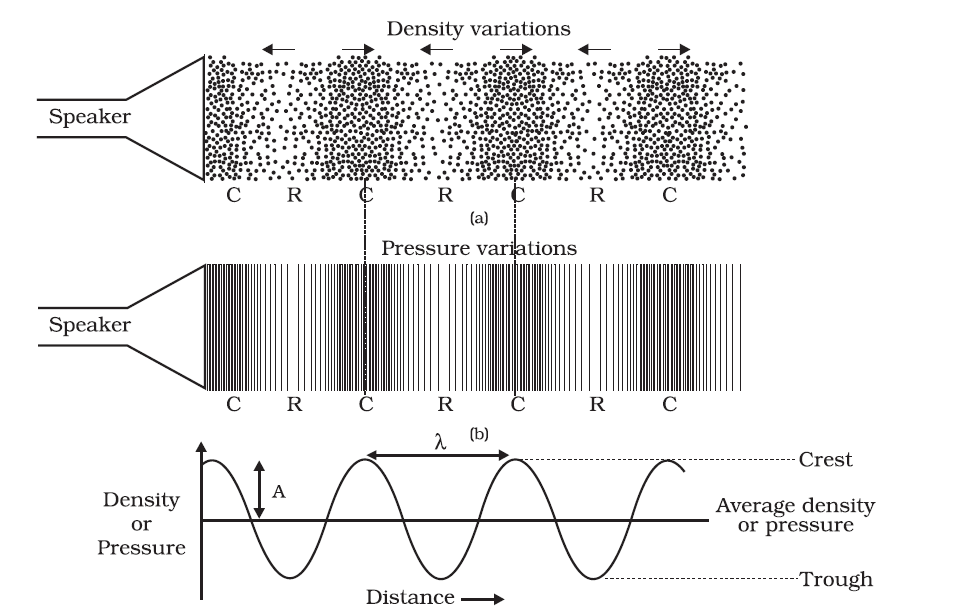
Sound waves are longitudinal waves. In these waves, particles of the medium vibrate parallel to the direction of wave propagation. During this process:
- Compression is formed when particles come closer.
- Rarefaction is formed when particles move apart.
These compressions and rarefactions move forward, transferring energy from one place to another.
Characteristics of a Sound Wave
The Sound chapter introduces important wave parameters:
- Frequency (f)
Frequency is the number of oscillations per second.
Unit: Hertz (Hz).
Higher frequency means higher pitch. - Time Period (T)
Time taken to complete one vibration.
T = 1/f. - Amplitude (A)
Maximum displacement from mean position.
Larger amplitude means louder sound. - Wavelength (λ)
Distance between two consecutive compressions or rarefactions. - Velocity (v)
Speed of sound depends on medium and temperature.
v = f × λ.
Speed of Sound
The speed of sound varies in different media:
- Fastest in solids
- Slower in liquids
- Slowest in gases
In air at room temperature, speed is approximately 343 m/s. The speed increases with temperature.
Reflection of Sound
Just like light, sound also reflects. When sound waves strike a hard surface, they bounce back. This phenomenon is called reflection of sound.
Echo
An echo is heard when reflected sound reaches our ears after a time gap of at least 0.1 seconds. For an echo to be heard clearly, the reflecting surface should be at least 17.2 meters away.
Applications of Reflection of Sound
- Megaphones
- Soundboards
- Stethoscope
- SONAR
SONAR
SONAR stands for Sound Navigation And Ranging. It is used to measure the depth of the sea and detect underwater objects. It works on the principle of reflection of sound.
Range of Hearing
Humans can hear sounds between 20 Hz and 20,000 Hz.
- Infrasonic: Below 20 Hz
- Ultrasonic: Above 20,000 Hz
Animals like dogs can hear ultrasonic sounds.
Structure of the Human Ear
The ear has three parts:
- Outer ear
- Middle ear
- Inner ear
The eardrum vibrates when sound waves strike it. These vibrations are transmitted to the brain through auditory nerves.
The Sound Class 9 summary is essential for understanding wave motion and its applications. These concepts form the foundation for higher physics topics.
Flowchart / Mind Map (Text-Based)
Sound
│
├── Production of Sound
│ └── Vibrations
│
├── Propagation
│ ├── Medium Required
│ ├── Longitudinal Waves
│ ├── Compression
│ └── Rarefaction
│
├── Characteristics
│ ├── Frequency
│ ├── Time Period
│ ├── Amplitude
│ ├── Wavelength
│ └── Velocity
│
├── Speed of Sound
│
├── Reflection
│ ├── Echo
│ └── SONAR
│
└── Human Ear
Important Keywords with Meanings
- Vibration – To and fro motion of an object
- Longitudinal Wave – Wave in which particles vibrate parallel
- Compression – High pressure region
- Rarefaction – Low pressure region
- Frequency – Vibrations per second
- Amplitude – Maximum displacement
- Wavelength – Distance between compressions
- Echo – Repetition of sound
- SONAR – Device using sound waves
- Ultrasonic – Frequency above 20,000 Hz
Important Questions & Answers
10 Short Answer Questions
- What is sound?
Sound is a form of energy that produces sensation of hearing. - What produces sound?
Vibrations produce sound. - Can sound travel in vacuum?
No, it requires a medium. - Define frequency.
Number of vibrations per second. - Unit of frequency?
Hertz. - What is echo?
Repetition of sound due to reflection. - What is SONAR?
Device to detect underwater objects. - Audible range of humans?
20 Hz to 20,000 Hz. - What is amplitude?
Maximum displacement from mean position. - Write formula of speed of sound.
v = f × λ.
10 Long Answer Questions
- Explain propagation of sound.
- Describe characteristics of sound waves.
- Explain reflection of sound with examples.
- Write a note on echo and its conditions.
- Explain working of SONAR.
- Describe human ear structure and function.
- Compare infrasonic and ultrasonic sound.
- Derive relation between speed, frequency and wavelength.
- Explain how loudness and pitch are determined.
- Why speed of sound differs in different media?
30 MCQs with Answers
- Sound is a form of:
a) Matter
b) Energy
c) Force
d) Light
Answer: b - Sound travels fastest in:
a) Gas
b) Liquid
c) Solid
d) Vacuum
Answer: c - Unit of frequency is:
a) Watt
b) Joule
c) Hertz
d) Newton
Answer: c - Human audible range is:
Answer: 20 Hz to 20,000 Hz
Exam Tips / 5 Value-Based Questions with Answers
Exam Tips
- Learn formulas of Sound chapter clearly.
- Practice numerical problems daily.
- Draw neat diagrams of wave and ear.
- Revise Sound Class 9 summary before exam.
- Write definitions with correct units.
Value-Based Questions
- Why should loudspeakers not be used at high volume?
High volume causes noise pollution and hearing damage. - Why should we avoid unnecessary honking?
It disturbs others and increases noise pollution. - How does SONAR help society?
It helps in navigation and disaster management. - Why is silence important in hospitals?
Patients need quiet for recovery. - How can students reduce noise pollution?
Avoid loud music and promote awareness.
Conclusion (SEO Friendly)
The chapter Sound Class 9 is one of the most important chapters in NCERT Physics. It explains how sound is produced, how it travels, and how we hear it. Understanding the Sound chapter summary and notes helps students build a strong foundation in wave motion.
Through this chapter, students learn about vibrations, longitudinal waves, compressions, rarefactions, frequency, amplitude, wavelength, and speed of sound. These concepts are essential not only for school exams but also for competitive exams.
The applications of sound like echo and SONAR show how science is useful in daily life. Knowledge of sound also helps us understand noise pollution and its harmful effects.
By revising these Sound Class 9 notes, keywords, MCQs, and important questions, students can confidently attempt exams. Regular practice of numerical problems and clear understanding of formulas will ensure high scores.
In conclusion, the Sound Class 9 summary provides complete knowledge about sound waves and their properties. Mastering this chapter strengthens conceptual clarity and prepares students for advanced physics topics in higher classes.
Long Answer Questions with Detailed Answers
Chapter: Sound Class 9 (NCERT Physics)
1. Explain the propagation of sound.
Propagation of sound means the travel of sound from one place to another. Sound travels through a material medium such as solid, liquid, or gas. It cannot travel through vacuum because there are no particles to transmit vibrations.
Sound is produced when an object vibrates. These vibrations create disturbances in the surrounding medium. The particles of the medium start vibrating and pass the energy to neighboring particles. This process continues, and sound travels in the form of longitudinal waves.
During propagation, two types of regions are formed:
- Compression: Region where particles are close together (high pressure).
- Rarefaction: Region where particles are far apart (low pressure).
Thus, sound travels through successive compressions and rarefactions.
2. Describe the characteristics of sound waves.
The main characteristics of sound waves are:
- Frequency (f):
Number of vibrations per second. Its unit is Hertz (Hz). Higher frequency means higher pitch. - Time Period (T):
Time taken to complete one vibration.
Formula: T = 1/f - Amplitude (A):
Maximum displacement of a particle from its mean position. Greater amplitude means louder sound. - Wavelength (λ):
Distance between two consecutive compressions or rarefactions. - Velocity (v):
Speed of sound in a medium.
Formula: v = f × λ
These characteristics help in understanding pitch, loudness, and speed of sound.
3. Explain reflection of sound with examples.
Reflection of sound is the bouncing back of sound waves when they strike a hard surface. The laws of reflection of sound are similar to the laws of reflection of light:
- Angle of incidence = Angle of reflection
- Incident wave, reflected wave, and normal lie in the same plane
Examples of reflection of sound:
- Echo
- Sound heard in large halls
- Megaphone
- Stethoscope
- Soundboard
Reflection helps in directing sound and increasing its intensity.
4. Write a note on echo and its conditions.
An echo is the repetition of sound heard after reflection from a distant surface. For an echo to be heard clearly:
- The minimum time gap between original and reflected sound must be 0.1 seconds.
- The reflecting surface must be at least 17.2 meters away (at room temperature).
- The surface should be large and hard.
Echo is commonly heard near hills, tall buildings, or empty halls.
Echo is also used in applications like SONAR to measure sea depth.
5. Explain the working of SONAR.
SONAR stands for Sound Navigation And Ranging. It is a device used to detect underwater objects and measure the depth of the sea.
Working principle:
- It works on the principle of reflection of sound.
- Ultrasonic waves are sent into the sea.
- These waves strike an object and reflect back.
- The time taken for reflection is recorded.
Using the formula:
Distance = (Speed × Time) / 2
The depth of the sea or distance of the object is calculated.
SONAR is used in submarines and ships.
6. Describe the structure and working of the human ear.
The human ear has three main parts:
- Outer Ear: Collects sound waves.
- Middle Ear: Contains eardrum and three small bones (ossicles).
- Inner Ear: Converts vibrations into electrical signals.
Working:
- Sound waves enter the outer ear and strike the eardrum.
- The eardrum vibrates.
- Vibrations are amplified by three small bones.
- The inner ear converts vibrations into electrical signals.
- Signals are sent to the brain through auditory nerve.
The brain interprets these signals as sound.
7. Compare infrasonic and ultrasonic sounds.
| Basis | Infrasonic | Ultrasonic |
|---|---|---|
| Frequency | Below 20 Hz | Above 20,000 Hz |
| Hearing | Not audible to humans | Not audible to humans |
| Produced by | Earthquakes, elephants | Bats, dolphins |
| Uses | Detecting natural disasters | Medical imaging, SONAR |
Humans can hear only between 20 Hz and 20,000 Hz.
8. Derive the relation between speed, frequency and wavelength.
Let:
v = speed of sound
f = frequency
λ = wavelength
Frequency is the number of waves passing per second.
Wavelength is the distance between two compressions.
If one wave travels a distance equal to wavelength in one time period:
Speed = Distance / Time
Since Time period T = 1/f,
v = λ / T
v = λ × f
Thus,
v = fλ
This formula is important for numericals in Sound Class 9.
9. Explain how loudness and pitch are determined.
Loudness depends on amplitude.
Greater amplitude → Louder sound.
It is measured in decibels (dB).
Pitch depends on frequency.
Higher frequency → Higher pitch.
For example:
- A child’s voice has high pitch (high frequency).
- A man’s voice has low pitch (low frequency).
Thus, amplitude determines loudness and frequency determines pitch.
10. Why does the speed of sound differ in different media?
The speed of sound depends on:
- Density of the medium
- Elasticity of the medium
- Temperature
Sound travels fastest in solids because particles are closely packed and transmit vibrations quickly.
It travels slower in liquids and slowest in gases.
In vacuum, sound cannot travel because there are no particles.
Thus, speed of sound varies from one medium to another.
50+ MCQs on Sound Class 9 (NCERT Physics)
Chapter: Sound Class 9
Primary Keywords: Sound Class 9 MCQs, Sound notes, Sound summary, Sound objective questions
Below are 60 important MCQs from the Sound Class 9 chapter. These MCQs cover all key topics including vibration, wave motion, reflection, SONAR, and human ear.
MCQs on Sound Class 9
1. Sound is a form of:
a) Matter
b) Energy
c) Force
d) Light
Answer: b
2. Sound is produced by:
a) Rotation
b) Friction
c) Vibrations
d) Heat
Answer: c
3. Sound cannot travel through:
a) Solid
b) Liquid
c) Gas
d) Vacuum
Answer: d
4. Sound travels in air as:
a) Transverse wave
b) Longitudinal wave
c) Electromagnetic wave
d) Surface wave
Answer: b
5. The region of high pressure in a sound wave is called:
a) Rarefaction
b) Compression
c) Reflection
d) Echo
Answer: b
6. The region of low pressure in a sound wave is called:
a) Compression
b) Reflection
c) Rarefaction
d) Refraction
Answer: c
7. The number of vibrations per second is called:
a) Amplitude
b) Frequency
c) Wavelength
d) Velocity
Answer: b
8. Unit of frequency is:
a) Joule
b) Hertz
c) Watt
d) Newton
Answer: b
9. Time period is:
a) 1/frequency
b) f × λ
c) λ/f
d) f/λ
Answer: a
10. Amplitude determines:
a) Pitch
b) Loudness
c) Speed
d) Frequency
Answer: b
11. Frequency determines:
a) Loudness
b) Pitch
c) Speed
d) Echo
Answer: b
12. The speed of sound in air at room temperature is about:
a) 150 m/s
b) 343 m/s
c) 500 m/s
d) 1000 m/s
Answer: b
13. Speed of sound is highest in:
a) Gas
b) Liquid
c) Solid
d) Vacuum
Answer: c
14. Audible range for humans is:
a) 10–1000 Hz
b) 20–20,000 Hz
c) 50–10,000 Hz
d) 100–50,000 Hz
Answer: b
15. Sound below 20 Hz is called:
a) Ultrasonic
b) Supersonic
c) Infrasonic
d) Audible
Answer: c
16. Sound above 20,000 Hz is called:
a) Audible
b) Infrasonic
c) Ultrasonic
d) Supersonic
Answer: c
17. Reflection of sound produces:
a) Refraction
b) Echo
c) Noise
d) Pitch
Answer: b
18. Minimum distance to hear an echo clearly is about:
a) 5 m
b) 10 m
c) 17.2 m
d) 25 m
Answer: c
19. SONAR works on the principle of:
a) Refraction
b) Diffraction
c) Reflection
d) Absorption
Answer: c
20. SONAR is used to measure:
a) Temperature
b) Pressure
c) Sea depth
d) Speed of light
Answer: c
21. The formula for speed of sound is:
a) v = f/λ
b) v = fλ
c) v = λ/f
d) v = f + λ
Answer: b
22. Pitch of sound depends on:
a) Amplitude
b) Frequency
c) Velocity
d) Time period
Answer: b
23. Loudness of sound is measured in:
a) Joule
b) Hertz
c) Decibel
d) Newton
Answer: c
24. The human ear converts sound waves into:
a) Light waves
b) Electrical signals
c) Heat energy
d) Magnetic waves
Answer: b
25. The eardrum starts vibrating when:
a) Light strikes it
b) Sound waves strike it
c) Heat reaches it
d) It is touched
Answer: b
26. Wavelength is the distance between:
a) Two crests
b) Two troughs
c) Two compressions
d) Two amplitudes
Answer: c
27. Sound travels slowest in:
a) Steel
b) Water
c) Air
d) Vacuum
Answer: c
28. In longitudinal waves, particles vibrate:
a) Perpendicular to wave direction
b) Parallel to wave direction
c) In circular motion
d) Randomly
Answer: b
29. If frequency increases, time period:
a) Increases
b) Decreases
c) Remains same
d) Becomes zero
Answer: b
30. If amplitude increases, loudness:
a) Decreases
b) Increases
c) Remains same
d) Becomes zero
Answer: b
31–60 (Additional Important MCQs)
- Sound needs a ______ to travel.
Answer: Medium - Sound is a ______ wave.
Answer: Mechanical - The unit of wavelength is:
Answer: Meter - Speed = Distance / ______
Answer: Time - The outer part of ear collects ______ waves.
Answer: Sound - Three small bones in middle ear are called:
Answer: Ossicles - Dogs can hear ______ sound.
Answer: Ultrasonic - Elephants communicate using ______ sound.
Answer: Infrasonic - Echo is heard after ______ seconds.
Answer: 0.1 - Sound energy travels through ______.
Answer: Vibrations - Higher frequency means ______ pitch.
Answer: Higher - Lower amplitude means ______ sound.
Answer: Softer - The SI unit of speed is:
Answer: m/s - Sound cannot travel in space because there is no ______.
Answer: Medium - Reflection follows the law of ______.
Answer: Reflection - Compression has ______ pressure.
Answer: High - Rarefaction has ______ pressure.
Answer: Low - Time period and frequency are ______ related.
Answer: Inversely - The device used in ships to detect submarines is ______.
Answer: SONAR - Sound travels faster in hot air than in cold air.
Answer: True - Sound waves carry ______ but not matter.
Answer: Energy - Amplitude is measured in:
Answer: Meter - The human ear is sensitive between ______ Hz.
Answer: 20–20,000 - Hard surfaces reflect sound better than soft surfaces.
Answer: True - Vibrations stop, sound ______.
Answer: Stops - Sound waves are mechanical because they require ______.
Answer: Medium - The distance between two rarefactions is one ______.
Answer: Wavelength - Pitch is independent of ______.
Answer: Amplitude - Greater elasticity means ______ speed of sound.
Answer: Higher - Sound chapter is important for understanding ______ motion.
Answer: Wave
30 Case-Based Questions on Sound Class 9 (NCERT Physics)
Primary Keywords: Sound Class 9 case based questions, Sound notes, Sound summary, Sound MCQs
Secondary Keywords: NCERT Sound chapter questions, Sound assertion case study, Sound numerical case questions
Case Study 1: Vibrating Tuning Fork
Riya strikes a tuning fork and brings it near her ear. She observes that the prongs vibrate and produce sound. When she touches the prongs lightly, the sound stops.
Q1. What produces sound in the tuning fork?
Answer: Vibrations of prongs.
Q2. Why does sound stop when she touches it?
Answer: Vibrations stop.
Case Study 2: Sound in Space
Astronauts on the Moon cannot hear each other directly without communication devices.
Q1. Why can’t sound travel on the Moon?
Answer: Because there is no medium (vacuum).
Q2. What type of wave is sound?
Answer: Mechanical wave.
Case Study 3: Echo Near a Hill
A boy shouts near a hill and hears his voice again after some time.
Q1. What is this phenomenon called?
Answer: Echo.
Q2. What is the minimum distance required to hear echo clearly?
Answer: About 17.2 meters.
Case Study 4: SONAR in Ships
A ship uses SONAR to detect underwater rocks.
Q1. On which principle does SONAR work?
Answer: Reflection of sound.
Q2. What type of sound waves are used in SONAR?
Answer: Ultrasonic waves.
Case Study 5: Loudspeaker at a Party
During a party, loud music is played at high volume.
Q1. Which property determines loudness?
Answer: Amplitude.
Q2. Name one harmful effect of loud sound.
Answer: Hearing damage or noise pollution.
Case Study 6: Child and Adult Voice
A child’s voice is sharper than an adult’s voice.
Q1. Which property makes the child’s voice sharp?
Answer: Higher frequency.
Q2. What does frequency determine?
Answer: Pitch.
Case Study 7: Sound in Different Media
A student observes that sound travels faster in iron than in air.
Q1. In which medium does sound travel fastest?
Answer: Solid.
Q2. Why?
Answer: Particles are closely packed.
Case Study 8: Clapping in a Large Hall
A student claps inside a large empty hall and hears repeated sound.
Q1. What is this effect called?
Answer: Multiple reflection or reverberation.
Q2. Why are curtains used in halls?
Answer: To absorb sound and reduce reflection.
Case Study 9: Dogs Hearing Whistle
A dog responds to a whistle that humans cannot hear.
Q1. What type of sound is this?
Answer: Ultrasonic sound.
Q2. Human hearing range is?
Answer: 20 Hz to 20,000 Hz.
Case Study 10: Elephant Communication
Elephants communicate using very low frequency sounds.
Q1. What are such sounds called?
Answer: Infrasonic sounds.
Q2. Are they audible to humans?
Answer: No.
Case Study 11: Wave Motion
A sound wave travels through air forming compressions and rarefactions.
Q1. What type of wave is formed?
Answer: Longitudinal wave.
Q2. Compression is a region of ______ pressure.
Answer: High pressure.
Case Study 12: Speed Formula
A sound wave has frequency 500 Hz and wavelength 0.68 m.
Q1. Find speed of sound.
Answer: v = fλ = 500 × 0.68 = 340 m/s.
Case Study 13: Time Period
A sound wave has frequency 250 Hz.
Q1. Find time period.
Answer: T = 1/f = 1/250 = 0.004 s.
Case Study 14: Eardrum Function
Sound waves strike the eardrum.
Q1. What happens to the eardrum?
Answer: It vibrates.
Q2. These vibrations are converted into?
Answer: Electrical signals.
Case Study 15: Noise Pollution
Continuous honking in traffic causes irritation.
Q1. What type of pollution is this?
Answer: Noise pollution.
Q2. Suggest one preventive measure.
Answer: Avoid unnecessary honking.
Case Study 16: Vacuum Experiment
A bell inside a glass jar stops being heard when air is removed.
Q1. Why?
Answer: No medium to carry sound.
Case Study 17: Reflection Laws
A sound wave strikes a wall at a certain angle.
Q1. What is the relation between angle of incidence and reflection?
Answer: They are equal.
Case Study 18: Increase in Temperature
On a hot day, sound travels faster.
Q1. Why?
Answer: Speed increases with temperature.
Case Study 19: Wavelength
Distance between two compressions is 0.5 m.
Q1. What does this distance represent?
Answer: Wavelength.
Case Study 20: Low Amplitude
A person speaks softly.
Q1. What is the amplitude of the sound?
Answer: Low amplitude.
Case Study 21: Mechanical Nature
Sound cannot travel without medium.
Q1. Therefore sound is a ______ wave.
Answer: Mechanical wave.
Case Study 22: Middle Ear Bones
Three tiny bones amplify vibrations.
Q1. What are they called?
Answer: Ossicles.
Case Study 23: Pitch Variation
A flute produces higher pitch than a drum.
Q1. Why?
Answer: Higher frequency.
Case Study 24: Sea Depth Measurement
Echo returns after 4 seconds. Speed of sound in water is 1500 m/s.
Q1. Find depth.
Answer: Distance = (1500 × 4) / 2 = 3000 m.
Case Study 25: Soft Surfaces
Carpet reduces echo in a room.
Q1. Why?
Answer: It absorbs sound.
Case Study 26: Loudness Unit
Sound intensity is measured in:
Answer: Decibel (dB)
Case Study 27: Energy Transfer
Sound waves transfer energy but not matter.
Q1. True or False?
Answer: True.
Case Study 28: Inverse Relation
Frequency increases.
Q1. What happens to time period?
Answer: Decreases.
Case Study 29: High Elasticity
Steel has high elasticity.
Q1. Speed of sound in steel is?
Answer: High.
Case Study 30: Wave Direction
Particles move parallel to wave direction.
Q1. Name the wave type.
Answer: Longitudinal wave.
Assertion–Reason Questions on Sound
Primary Keywords: Sound Class 9 Assertion Reason, Sound notes, Sound summary, Sound MCQs
Secondary Keywords: NCERT Sound chapter questions, Sound exam practice, Sound important questions
Each question has two statements:
Assertion (A) and Reason (R).
Choose the correct option:
a) Both A and R are true, and R is the correct explanation of A.
b) Both A and R are true, but R is not the correct explanation of A.
c) A is true, but R is false.
d) A is false, but R is true.
Assertion–Reason Questions
1.
Assertion (A): Sound is a form of energy.
Reason (R): Sound produces sensation of hearing in our ears.
Answer: a
2.
Assertion (A): Sound cannot travel in vacuum.
Reason (R): Sound requires a material medium to propagate.
Answer: a
3.
Assertion (A): Sound travels faster in solids than in gases.
Reason (R): Particles in solids are closely packed.
Answer: a
4.
Assertion (A): Sound waves in air are transverse waves.
Reason (R): Particles vibrate perpendicular to direction of wave.
Answer: d
5.
Assertion (A): Frequency determines the pitch of sound.
Reason (R): Higher frequency produces higher pitch.
Answer: a
6.
Assertion (A): Amplitude affects loudness of sound.
Reason (R): Greater amplitude means louder sound.
Answer: a
7.
Assertion (A): Time period and frequency are inversely related.
Reason (R): Time period = 1 / Frequency.
Answer: a
8.
Assertion (A): Echo is heard due to reflection of sound.
Reason (R): Sound waves bounce back after striking a hard surface.
Answer: a
9.
Assertion (A): The minimum distance for hearing echo is about 17.2 m.
Reason (R): The human ear can distinguish two sounds separated by 0.1 second.
Answer: a
10.
Assertion (A): Sound travels faster in hot air than in cold air.
Reason (R): Increase in temperature increases speed of sound.
Answer: a
11.
Assertion (A): Ultrasonic sounds are audible to humans.
Reason (R): Ultrasonic sounds have frequency above 20,000 Hz.
Answer: d
12.
Assertion (A): Infrasonic sounds have frequency below 20 Hz.
Reason (R): Humans cannot hear infrasonic sounds.
Answer: b
13.
Assertion (A): Sound waves are mechanical waves.
Reason (R): They require a medium for propagation.
Answer: a
14.
Assertion (A): Wavelength is the distance between two compressions.
Reason (R): Compression is a region of high pressure.
Answer: b
15.
Assertion (A): SONAR works on reflection of sound.
Reason (R): Ultrasonic waves are used in SONAR.
Answer: b
16.
Assertion (A): The eardrum vibrates when sound waves strike it.
Reason (R): Vibrations are converted into electrical signals in the inner ear.
Answer: b
17.
Assertion (A): Hard surfaces reflect sound better than soft surfaces.
Reason (R): Soft surfaces absorb sound.
Answer: a
18.
Assertion (A): Loudness is measured in decibels.
Reason (R): Frequency is measured in Hertz.
Answer: b
19.
Assertion (A): Speed of sound depends on medium.
Reason (R): Density and elasticity affect speed of sound.
Answer: a
20.
Assertion (A): If frequency increases, time period decreases.
Reason (R): Frequency and time period are directly proportional.
Answer: c
21.
Assertion (A): Sound cannot travel through space.
Reason (R): There is no air in space.
Answer: a
22.
Assertion (A): Particles in longitudinal waves vibrate parallel to wave direction.
Reason (R): Sound waves in air are longitudinal waves.
Answer: b
23.
Assertion (A): Dogs can hear ultrasonic sound.
Reason (R): Dogs have hearing range beyond 20,000 Hz.
Answer: a
24.
Assertion (A): Greater elasticity increases speed of sound.
Reason (R): Elastic materials restore shape quickly.
Answer: a
25.
Assertion (A): Echo can be reduced by using curtains in a hall.
Reason (R): Curtains absorb sound.
Answer: a
26.
Assertion (A): The formula for speed of sound is v = fλ.
Reason (R): Speed equals wavelength divided by frequency.
Answer: c
27.
Assertion (A): Sound waves transfer energy but not matter.
Reason (R): Particles only vibrate about their mean positions.
Answer: a
28.
Assertion (A): Pitch and loudness are the same.
Reason (R): Both depend on amplitude.
Answer: d
29.
Assertion (A): The middle ear contains three small bones.
Reason (R): These bones amplify sound vibrations.
Answer: a
30.
Assertion (A): Sound intensity decreases as distance increases.
Reason (R): Energy spreads over a larger area.
Answer: a
Sample Question Paper
Sound Class 9 – Physics (NCERT)
Chapter: Sound
Time: 3 Hours
Maximum Marks: 70
General Instructions:
- All questions are compulsory.
- Draw neat and labeled diagrams wherever required.
- Use proper units in numerical questions.
- The question paper is based on the complete Sound Class 9 syllabus.
Section A – MCQs (1 × 10 = 10 Marks)
- Sound is produced due to:
a) Rotation
b) Friction
c) Vibrations
d) Heat - Sound travels fastest in:
a) Air
b) Water
c) Steel
d) Vacuum - The unit of frequency is:
a) Newton
b) Hertz
c) Joule
d) Watt - The audible range of human hearing is:
a) 0–100 Hz
b) 20–20,000 Hz
c) 100–10,000 Hz
d) 50–5,000 Hz - The distance between two consecutive compressions is called:
a) Amplitude
b) Time period
c) Wavelength
d) Frequency - Echo is caused due to:
a) Refraction
b) Diffraction
c) Reflection
d) Absorption - The formula for speed of sound is:
a) v = f/λ
b) v = fλ
c) v = λ/f
d) v = f + λ - Amplitude determines:
a) Pitch
b) Loudness
c) Frequency
d) Velocity - Ultrasonic sound has frequency:
a) Below 20 Hz
b) Between 20–20,000 Hz
c) Above 20,000 Hz
d) Equal to 20 Hz - SONAR is mainly used to measure:
a) Temperature
b) Sea depth
c) Pressure
d) Wind speed
Section B – Very Short Answer Questions (2 × 5 = 10 Marks)
- Define vibration.
- What is compression in a sound wave?
- State the relation between time period and frequency.
- Why cannot sound travel in vacuum?
- Write any two uses of ultrasonic sound.
Section C – Short Answer Questions (3 × 8 = 24 Marks)
- Explain how sound is produced and propagated in air.
- Define amplitude and frequency. How do they affect sound?
- State the laws of reflection of sound.
- What are infrasonic and ultrasonic sounds? Give one example of each.
- Explain the structure of the human ear with a neat diagram.
- Why is speed of sound different in solids, liquids, and gases?
- A sound wave has a frequency of 400 Hz and wavelength 0.8 m. Calculate its speed.
- An echo is heard after 2 seconds. If speed of sound is 340 m/s, find the distance of the reflecting surface.
Section D – Case-Based Questions (4 × 3 = 12 Marks)
24. Case Study: Echo in a Valley
A student shouts in a valley and hears his voice after some time.
a) What is this phenomenon called?
b) What is the minimum time gap required to hear echo clearly?
c) Why are soft materials used in auditoriums?
25. Case Study: SONAR in a Ship
A ship uses SONAR to detect underwater objects.
a) On which principle does SONAR work?
b) What type of waves are used in SONAR?
c) Write the formula used to calculate depth.
26. Case Study: Loud Music at a Function
During a school function, loud music is played for a long time.
a) Which property of sound determines loudness?
b) In which unit is loudness measured?
c) Mention one harmful effect of loud sound.
Section E – Long Answer Questions (5 × 2 = 10 Marks)
- Describe the characteristics of sound waves. Derive the relation between speed, frequency, and wavelength.
- Explain reflection of sound and discuss its applications such as echo and SONAR.
Section F – Value-Based / Application-Based Questions (2 × 2 = 4 Marks)
- Why should we avoid unnecessary honking in traffic areas? Explain with reference to sound pollution.
- Suggest two measures to reduce noise pollution in public places.
End of Question Paper
Solution
Solution – Sample Question Paper
Sound Class 9 – Physics (NCERT)
Chapter: Sound
Maximum Marks: 70
This solution covers the complete Sound Class 9 syllabus including formulas, definitions, numericals, and applications from the Sound chapter.
Section A – MCQs (1 × 10 = 10 Marks)
- c) Vibrations
- c) Steel
- b) Hertz
- b) 20–20,000 Hz
- c) Wavelength
- c) Reflection
- b) v = fλ
- b) Loudness
- c) Above 20,000 Hz
- b) Sea depth
Section B – Very Short Answer (2 × 5 = 10 Marks)
11. Define vibration.
Vibration is the to and fro motion of an object about its mean position.
12. What is compression in a sound wave?
Compression is the region in a longitudinal wave where particles are close together and pressure is high.
13. State relation between time period and frequency.
Time period (T) = 1 / Frequency (f)
14. Why cannot sound travel in vacuum?
Sound requires a material medium for propagation. In vacuum, there are no particles to transmit vibrations.
15. Two uses of ultrasonic sound:
- SONAR
- Medical imaging (ultrasound)
Section C – Short Answer Questions (3 × 8 = 24 Marks)
16. Production and Propagation of Sound
Sound is produced by vibrating objects. When an object vibrates, it disturbs the surrounding medium. The particles of the medium vibrate and pass energy to neighboring particles. This forms compressions and rarefactions. Sound travels as a longitudinal wave and requires a medium.
17. Amplitude and Frequency
- Amplitude: Maximum displacement from mean position. It determines loudness. Greater amplitude means louder sound.
- Frequency: Number of vibrations per second. It determines pitch. Higher frequency means higher pitch.
18. Laws of Reflection of Sound
- Angle of incidence = Angle of reflection.
- Incident wave, reflected wave, and normal lie in the same plane.
19. Infrasonic and Ultrasonic Sound
- Infrasonic: Frequency below 20 Hz (Example: Earthquakes, elephants).
- Ultrasonic: Frequency above 20,000 Hz (Example: Bats, SONAR).
20. Structure of Human Ear
The ear has three parts:
- Outer ear: Collects sound waves.
- Middle ear: Contains eardrum and three small bones (ossicles) that amplify sound.
- Inner ear: Converts vibrations into electrical signals sent to brain.
21. Speed of Sound in Different Media
Speed of sound depends on density and elasticity.
- Fastest in solids
- Slower in liquids
- Slowest in gases
Particles in solids are closely packed, so vibrations transfer quickly.
22. Numerical
Given:
Frequency (f) = 400 Hz
Wavelength (λ) = 0.8 m
Formula: v = fλ
v = 400 × 0.8
v = 320 m/s
Speed = 320 m/s
23. Numerical
Given:
Time = 2 s
Speed = 340 m/s
Distance = (Speed × Time) / 2
Distance = (340 × 2) / 2
Distance = 340 m
Distance of reflecting surface = 340 m
Section D – Case-Based Questions (12 Marks)
24. Echo in a Valley
a) Echo
b) 0.1 second
c) Soft materials absorb sound and reduce reflection.
25. SONAR in a Ship
a) Reflection of sound
b) Ultrasonic waves
c) Distance = (Speed × Time) / 2
26. Loud Music at a Function
a) Amplitude
b) Decibel (dB)
c) Hearing damage or noise pollution
Section E – Long Answer Questions (10 Marks)
27. Characteristics of Sound Waves
Main characteristics:
- Frequency – Determines pitch
- Amplitude – Determines loudness
- Time Period – Time for one vibration
- Wavelength – Distance between compressions
- Velocity – Speed of sound
Derivation:
Speed = Distance / Time
Distance = Wavelength (λ)
Time = Time period (T)
v = λ / T
Since T = 1/f
v = λ × f
Thus,
v = fλ
28. Reflection of Sound and Applications
Reflection of sound is bouncing back of sound waves from a surface.
Applications:
- Echo
- SONAR
- Megaphone
- Stethoscope
Echo occurs when reflected sound is heard after 0.1 second. SONAR uses ultrasonic waves to measure sea depth.
Section F – Value-Based Questions (4 Marks)
29. Avoid Honking
Unnecessary honking increases noise pollution, causes stress, and affects hearing health.
30. Measures to Reduce Noise Pollution
- Use silencers and avoid loudspeakers.
- Plant more trees and use sound-absorbing materials.
Sound Class 9 – Important Formulas (NCERT Physics)
Primary Keywords: Sound formulas, Sound Class 9 formulas, Sound notes, Sound summary
Secondary Keywords: NCERT Sound chapter formulas, Sound numericals, Speed of sound formula
1. Wave Speed Formula
Speed of Sound
v = f \lambda
Where:
- v = speed of sound (m/s)
- f = frequency (Hz)
- λ (lambda) = wavelength (m)
2. Frequency Formula
f = \frac{1}{T}
Where:
- f = frequency (Hz)
- T = time period (seconds)
3. Time Period Formula
T = \frac{1}{f}
Where:
- T = time period (seconds)
- f = frequency (Hz)
4. Distance Traveled by Sound
\text{Distance} = \text{Speed} \times \text{Time}
d = v \times t
Where:
- d = distance (m)
- v = speed (m/s)
- t = time (s)
5. Echo Formula
Since sound travels to the reflecting surface and comes back:
\text{Distance} = \frac{v \times t}{2}
Where:
- v = speed of sound
- t = total time for echo
- Divide by 2 because sound travels twice (to and fro)
6. Minimum Distance for Echo
Minimum time gap required = 0.1 second
\text{Minimum Distance} = \frac{v \times 0.1}{2}
At 340 m/s:
= \frac{340 \times 0.1}{2}
= 17 \text{ m (approx 17.2 m)}
7. Relation Between Wavelength, Frequency and Speed
v = \frac{\lambda}{T}
Since:
T = \frac{1}{f}
Therefore:
v = f\lambda
8. Loudness and Amplitude Relation
- Loudness ∝ Amplitude²
(Conceptual relation for understanding)
Greater amplitude → Louder sound
9. Range of Human Hearing
20 \text{ Hz} \leq f \leq 20{,}000 \text{ Hz}
10. Speed of Sound in Air (Important Value)
At room temperature:
v = 343 \text{ m/s (approx)}
For exam purposes often taken as:
v = 340 \text{ m/s}
Quick Revision Table – Sound Formulas
| Concept | Formula |
|---|---|
| Speed of sound | v = fλ |
| Frequency | f = 1/T |
| Time period | T = 1/f |
| Distance | d = vt |
| Echo distance | d = vt/2 |
Important Exam Tips for Sound Formulas
- Always write formula first in numericals.
- Substitute values with correct units.
- Write final answer with proper unit (m/s, Hz, m).
- Remember to divide by 2 in echo problems.
Sound Class 9 – Quick Revision Sheet (NCERT Physics)
Primary Keywords: Sound Class 9 quick revision, Sound notes, Sound summary, Sound formulas
Secondary Keywords: NCERT Sound chapter revision, Sound important points, Sound MCQs preparation
1. What is Sound?
- Sound is a form of energy that produces the sensation of hearing.
- It is produced by vibrating objects.
- Sound requires a material medium (solid, liquid, or gas) to travel.
- Sound cannot travel in vacuum.
- Sound waves are mechanical waves.
2. Production of Sound
- When an object vibrates, it moves to and fro about its mean position.
- These vibrations disturb the surrounding particles.
- The disturbance travels in the form of sound waves.
Examples:
- Plucking a guitar string
- Beating a drum
- Human vocal cords vibrating
3. Propagation of Sound
Sound travels as a longitudinal wave in air.
In longitudinal waves:
- Particles vibrate parallel to the direction of wave propagation.
- Two regions are formed:
- Compression – High pressure region (particles close together)
- Rarefaction – Low pressure region (particles far apart)
Sound travels through successive compressions and rarefactions.
4. Characteristics of Sound Waves
(i) Frequency (f)
- Number of vibrations per second
- Unit: Hertz (Hz)
- Determines pitch
- Higher frequency → Higher pitch
(ii) Time Period (T)
- Time taken for one vibration
- Formula: T = 1/f
(iii) Amplitude (A)
- Maximum displacement from mean position
- Determines loudness
- Greater amplitude → Louder sound
(iv) Wavelength (λ)
- Distance between two consecutive compressions or rarefactions
- Unit: Meter (m)
(v) Velocity (v)
- Speed of sound
- Formula: v = fλ
5. Speed of Sound
- Fastest in solids
- Slower in liquids
- Slowest in gases
- In vacuum, sound cannot travel
At room temperature:
Speed of sound in air ≈ 340 m/s
Speed increases with increase in temperature.
6. Reflection of Sound
Reflection of sound is the bouncing back of sound waves from a surface.
Laws of Reflection:
- Angle of incidence = Angle of reflection
- Incident wave, reflected wave, and normal lie in the same plane
Hard surfaces reflect sound better than soft surfaces.
7. Echo
Echo is the repetition of sound due to reflection.
Conditions for hearing echo:
- Minimum time gap = 0.1 second
- Minimum distance ≈ 17.2 m
Formula for echo distance: Distance = (Speed × Time) / 2
8. Applications of Reflection of Sound
- Echo
- SONAR
- Megaphone
- Stethoscope
- Soundboard in halls
9. SONAR
SONAR stands for Sound Navigation And Ranging.
- Uses ultrasonic waves
- Based on reflection of sound
- Used to measure sea depth and detect underwater objects
Formula: Distance = (Speed × Time) / 2
10. Range of Hearing
- Human hearing range: 20 Hz to 20,000 Hz
- Infrasonic: Below 20 Hz
- Ultrasonic: Above 20,000 Hz
Animals:
- Dogs hear ultrasonic sounds
- Elephants produce infrasonic sounds
11. Structure of Human Ear
Three parts:
- Outer Ear – Collects sound waves
- Middle Ear – Contains eardrum and three small bones (ossicles)
- Inner Ear – Converts vibrations into electrical signals
Eardrum vibrates when sound waves strike it. The brain interprets signals as sound.
12. Important Formulas for Sound Class 9
- v = fλ
- f = 1/T
- T = 1/f
- Distance = vt
- Echo Distance = vt/2
13. Important Exam Points
- Sound is a mechanical and longitudinal wave.
- Pitch depends on frequency.
- Loudness depends on amplitude.
- Always divide by 2 in echo numericals.
- Write units clearly (Hz, m/s, m).
- Draw neat diagrams of wave and human ear.




Leave a Reply