


Meta Description
Learn Sources of Business Finance Class 11 BST with easy summary, short notes, MCQs, important questions, keywords, and exam tips for better understanding and revision.
Introduction of the Chapter
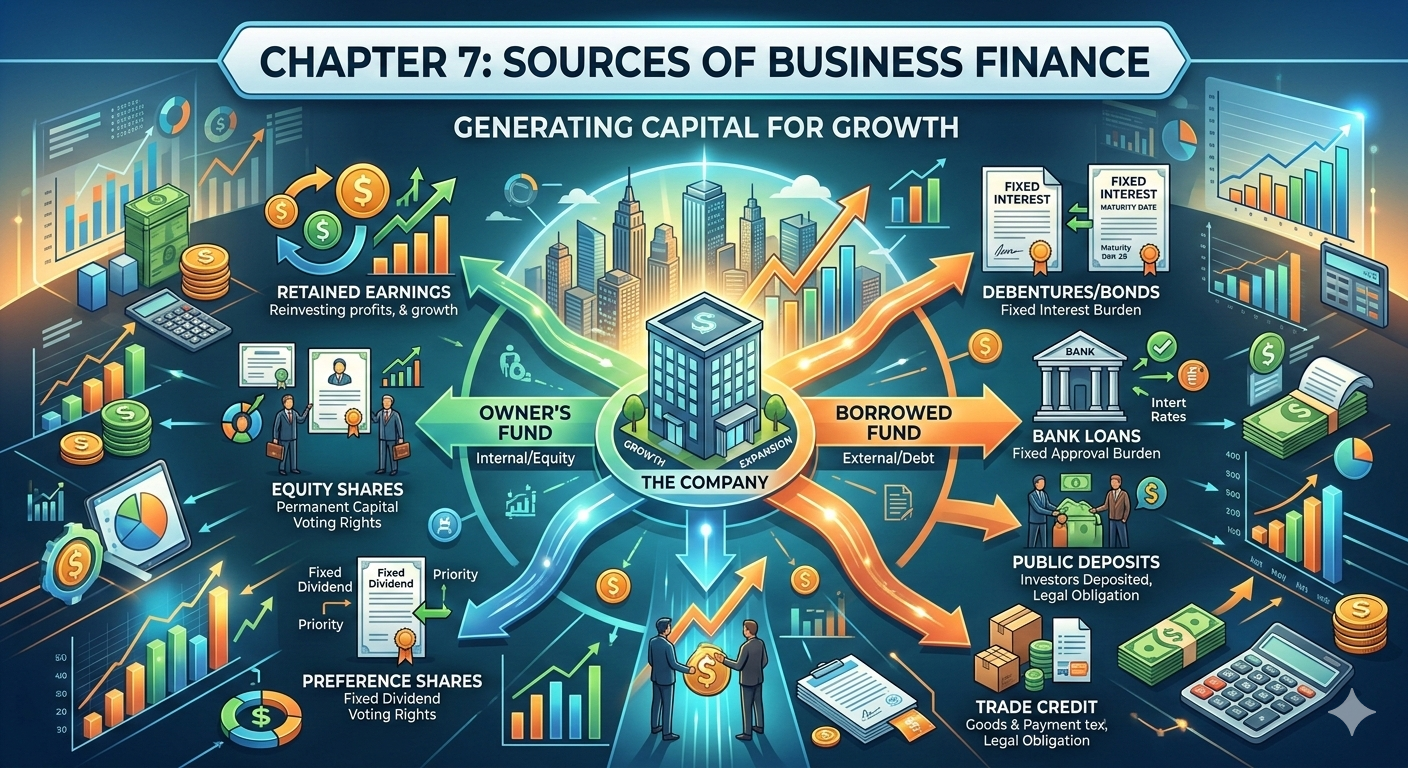
The chapter Sources of Business Finance Class 11 BST explains how businesses obtain funds to start, operate, and expand their activities. Every business requires money for purchasing assets, paying salaries, buying raw materials, and expanding operations. These funds are known as business finance.
Business finance refers to the funds needed for establishing, running, and expanding a business enterprise. Without adequate finance, a business cannot function effectively. Therefore, choosing the right sources of business finance is very important for business success.
The chapter Sources of Business Finance Class 11 BST discusses different types of finance and the various sources from which businesses can obtain funds. These sources are broadly classified into internal sources and external sources. The chapter also explains long-term and short-term finance options such as equity shares, debentures, loans, trade credit, and retained earnings.
Understanding Sources of Business Finance Class 11 BST helps students learn how businesses manage funds efficiently and select appropriate financial sources according to their needs.
Short Notes (Key Points)
- Business Finance refers to funds required to carry out business activities.
- Finance is necessary for starting, operating, and expanding a business.
- The chapter Sources of Business Finance Class 11 BST explains different financial sources available to businesses.
- Sources of finance are classified into Internal Sources and External Sources.
- Internal Sources include retained earnings.
- External Sources include shares, debentures, bank loans, and trade credit.
- Finance may be short-term, medium-term, or long-term.
- Equity Shares represent ownership in the company.
- Preference Shares provide fixed dividends.
- Debentures are long-term borrowings of a company.
- Commercial Banks provide loans and overdraft facilities.
- Trade Credit is credit given by suppliers.
- Businesses must select the most suitable source of business finance based on cost, risk, and control.
Detailed Summary of Sources of Business Finance Class 11 BST
Meaning of Business Finance
Business finance refers to the money required for business operations. Every business organization needs funds for purchasing machinery, raw materials, paying wages, marketing products, and expanding activities.
Finance is considered the lifeblood of business because it supports all business operations. Without adequate finance, business activities cannot be carried out effectively.
The chapter Sources of Business Finance Class 11 BST explains the various methods through which businesses raise funds.
Importance of Business Finance
Finance plays an essential role in business success. Its importance includes:
1. Starting a Business
Finance is required to establish a business, purchase assets, and set up infrastructure.
2. Day-to-Day Operations
Businesses need funds to pay salaries, buy raw materials, and manage working capital.
3. Expansion and Growth
Finance helps companies expand production, enter new markets, and adopt new technologies.
4. Business Stability
Adequate finance helps businesses survive during difficult economic conditions.
Understanding Sources of Business Finance Class 11 BST helps businesses maintain proper financial planning.
Classification of Sources of Finance
The chapter Sources of Business Finance Class 11 BST classifies sources of finance into different categories.
1. Internal Sources
Internal sources refer to funds generated within the business.
Example:
- Retained earnings
Retained Earnings
Retained earnings are profits that are reinvested in the business instead of being distributed as dividends.
Advantages:
- No interest payment
- No ownership dilution
- Easy availability
Limitations:
- Limited amount of funds
- May cause shareholder dissatisfaction
2. External Sources
External sources refer to funds raised from outside the organization.
External sources include:
- Equity shares
- Preference shares
- Debentures
- Bank loans
- Trade credit
- Commercial paper
- Public deposits
The chapter Sources of Business Finance Class 11 BST explains each of these sources in detail.
Equity Shares
Equity shares represent ownership in the company. Equity shareholders are the real owners and have voting rights.
Features:
- No fixed dividend
- High risk
- Voting rights
Advantages:
- Permanent source of capital
- No obligation to pay fixed dividends
Disadvantages:
- Dilution of control
- Costly and complex process
Preference Shares
Preference shares provide preferential rights to shareholders regarding dividends and repayment of capital.
Features:
- Fixed dividend
- Preference over equity shareholders
Types of preference shares:
- Cumulative
- Non-cumulative
- Participating
- Non-participating
- Convertible
- Non-convertible
Preference shares are an important topic in Sources of Business Finance Class 11 BST.
Debentures
Debentures are long-term borrowing instruments issued by companies.
Debenture holders are creditors of the company and receive fixed interest.
Features:
- Fixed interest rate
- No voting rights
- Repayment after a specific period
Advantages:
- No dilution of ownership
- Tax benefits
Disadvantages:
- Interest must be paid regularly
- Financial burden during losses
Commercial Banks
Commercial banks provide financial assistance to businesses in the form of:
- Term loans
- Cash credit
- Overdraft
- Discounting of bills
Banks play a major role in providing short-term and medium-term finance.
In the chapter Sources of Business Finance Class 11 BST, bank finance is considered one of the most common sources of funds.
Trade Credit
Trade credit refers to the credit extended by suppliers to businesses.
For example, a supplier may allow payment after 30 or 60 days.
Advantages:
- Easy and flexible
- No formal agreement required
Limitations:
- Limited amount
- Higher cost if discounts are lost
Public Deposits
Public deposits are funds raised by companies directly from the public.
Features:
- Fixed interest
- Specific maturity period
Public deposits are cheaper compared to bank loans.
Commercial Paper
Commercial paper is an unsecured short-term promissory note issued by large companies.
Features:
- Short-term finance
- Issued by financially strong companies
- Usually used for working capital needs
Factors Affecting Choice of Source of Finance
Businesses consider several factors before choosing a source of finance.
Important factors include:
- Cost of finance
- Financial risk
- Control over management
- Flexibility
- Tax benefits
- Business size
These factors are explained in detail in Sources of Business Finance Class 11 BST.
Flowchart / Mind Map
Sources of Business Finance
Business Finance
│
├── Internal Sources
│ └── Retained Earnings
│
└── External Sources
├── Equity Shares
├── Preference Shares
├── Debentures
├── Bank Loans
├── Trade Credit
├── Public Deposits
└── Commercial Paper
Important Keywords with Meanings
Business Finance – Funds required for business operations.
Equity Shares – Shares representing ownership in a company.
Preference Shares – Shares that provide priority in dividends.
Debentures – Long-term borrowing instruments issued by companies.
Retained Earnings – Profits reinvested in the business.
Trade Credit – Credit given by suppliers.
Public Deposits – Money collected from the public by companies.
Commercial Paper – Short-term unsecured promissory note.
Overdraft – Bank facility allowing withdrawal beyond balance.
Working Capital – Funds required for daily business operations.
Important Questions and Answers
Short Answer Questions
1. What is business finance?
Business finance refers to the funds required for establishing, running, and expanding business activities.
2. What are internal sources of finance?
Internal sources of finance are funds generated within the business such as retained earnings.
3. What is trade credit?
Trade credit is the credit provided by suppliers to businesses for purchasing goods.
4. What are debentures?
Debentures are long-term borrowing instruments issued by companies to raise funds.
5. What are equity shares?
Equity shares represent ownership in the company and provide voting rights to shareholders.
Long Answer Questions
1. Explain the different sources of business finance.
The chapter Sources of Business Finance Class 11 BST explains that businesses can obtain finance from internal and external sources.
Internal sources include retained earnings. External sources include equity shares, preference shares, debentures, bank loans, trade credit, public deposits, and commercial paper.
Each source has different features, advantages, and limitations. Businesses select the most appropriate source depending on their financial needs and business conditions.
2. Explain the advantages and disadvantages of equity shares.
Advantages
- Permanent source of capital
- No obligation to pay fixed dividends
- Improves creditworthiness
Disadvantages
- Dilution of control
- High cost of issue
- Risk for investors
Equity shares play a significant role in Sources of Business Finance Class 11 BST.
20 MCQs with Answers
- Business finance refers to
A. Marketing funds
B. Funds required for business operations
C. Government funds
D. Sales income
Answer: B
- Internal source of finance is
A. Debenture
B. Retained earnings
C. Bank loan
D. Trade credit
Answer: B
- Equity shareholders are
A. Creditors
B. Owners
C. Debenture holders
D. Suppliers
Answer: B
- Debenture holders receive
A. Dividend
B. Interest
C. Bonus
D. Profit share
Answer: B
- Trade credit is given by
A. Banks
B. Government
C. Suppliers
D. Shareholders
Answer: C
- Preference shareholders get
A. Fixed dividend
B. Variable dividend
C. Profit share
D. Commission
Answer: A
- Commercial paper is
A. Long-term finance
B. Short-term finance
C. Internal finance
D. Government grant
Answer: B
- Retained earnings are
A. Borrowed funds
B. Business profits reinvested
C. Bank loans
D. Public deposits
Answer: B
- Debenture holders are
A. Owners
B. Creditors
C. Managers
D. Customers
Answer: B
- Business finance is called
A. Lifeblood of business
B. Marketing tool
C. HR resource
D. Advertising tool
Answer: A
- Which source does not dilute ownership?
Answer: Debentures - Which source involves fixed interest?
Answer: Debentures - Which source provides voting rights?
Answer: Equity Shares - Commercial banks provide
Answer: Loans - Public deposits are raised from
Answer: General Public - Trade credit is usually
Answer: Short-term finance - Retained earnings belong to
Answer: Internal source - Preference shareholders have
Answer: Priority dividend - Debentures represent
Answer: Company debt - Business finance helps in
Answer: Business expansion
Exam Tips / Value-Based Questions
Exam Tips
- Remember the classification of Sources of Business Finance Class 11 BST.
- Learn differences between equity shares, preference shares, and debentures.
- Practice MCQs and long answer questions regularly.
- Understand advantages and disadvantages of each source.
Value-Based Question
Why should businesses carefully choose sources of finance?
Businesses should carefully choose sources of finance because incorrect financial decisions may increase costs, reduce control, and create financial risks.
Conclusion
The chapter Sources of Business Finance Class 11 BST is an important part of business studies. It helps students understand how businesses raise funds for their operations and growth. Various sources such as equity shares, preference shares, debentures, bank loans, and retained earnings provide financial support to organizations.
Understanding Sources of Business Finance Class 11 BST enables students to analyze financial decisions and choose the most suitable source of finance. This knowledge is useful not only for board exams but also for competitive exams and real business situations.
Sources of Business Finance Class 11 BST – 80 Marks Question Paper
Class: XI
Subject: Business Studies
Chapter: Sources of Business Finance
Time: 3 Hours
Maximum Marks: 80
Section A – Very Short Answer Questions
(1 × 10 = 10 Marks)
Answer the following questions in one sentence.
- Define business finance.
- What are retained earnings?
- What is trade credit?
- Who are equity shareholders?
- What are debentures?
- Define preference shares.
- What is commercial paper?
- What is meant by public deposits?
- What is overdraft facility?
- Name any one internal source of business finance.
Section B – Short Answer Questions
(3 × 10 = 30 Marks)
Answer the following questions in about 60–80 words each.
- Explain the meaning of business finance.
- Distinguish between equity shares and preference shares.
- Explain any three advantages of retained earnings as a source of business finance.
- Explain the concept of trade credit.
- What are debentures? Explain their features.
- Explain the role of commercial banks in providing business finance.
- What is commercial paper?
- Explain the meaning of internal sources of finance.
- What are public deposits?
- State three factors affecting the choice of sources of business finance.
Section C – Long Answer Questions
(5 × 6 = 30 Marks)
Answer the following questions in about 150–200 words each.
- Explain the importance of business finance for a business enterprise.
- Explain the different external sources of business finance.
- Explain the advantages and limitations of equity shares.
- Discuss the features, advantages, and limitations of debentures.
- Explain the different types of preference shares.
- Explain the factors affecting the choice of sources of business finance.
Section D – Case Study Based Questions
(5 × 2 = 10 Marks)
Read the case carefully and answer the questions.
Case Study
A manufacturing company wants to expand its production capacity. For this purpose, the company requires a large amount of long-term finance. The management is considering different sources such as equity shares, debentures, and bank loans. The company wants a source of finance that does not create too much financial burden and allows flexibility in dividend payments.
Questions
- Which source of finance allows flexibility in dividend payments?
a) Debentures
b) Equity Shares
c) Bank Loans
d) Public Deposits - Debentures represent
a) Ownership capital
b) Borrowed capital
c) Trade credit
d) Internal finance - Which source of finance provides voting rights to investors?
a) Preference shares
b) Debentures
c) Equity shares
d) Public deposits - If a company wants funds without giving ownership rights, which source is suitable?
a) Equity shares
b) Debentures
c) Retained earnings
d) Trade credit
Internal Choice Questions (Optional Practice)
- Explain retained earnings OR explain trade credit.
- Write advantages of equity shares OR advantages of debentures.
If you want, I can also create:
- Solved 80 Marks Question Paper (Detailed Answers)
- 50 MCQs for Sources of Business Finance
- Case-Study Based Questions for Board Exams
- 3,000+ word Passage-Based Worksheet
- SEO Featured Image for your WordPress blog.
Sources of Business Finance Class 11 BST – Solved 80 Marks Question Paper
Class: XI
Subject: Business Studies
Chapter: Sources of Business Finance
Time: 3 Hours
Maximum Marks: 80
Section A – Very Short Answer Questions
(1 × 10 = 10 Marks)
1. Define business finance.
Answer:
Business finance refers to the funds required by a business to start, run, and expand its activities.
2. What are retained earnings?
Answer:
Retained earnings are the profits of a company that are reinvested in the business instead of being distributed to shareholders as dividends.
3. What is trade credit?
Answer:
Trade credit is the credit provided by suppliers to businesses for purchasing goods and services with payment made at a later date.
4. Who are equity shareholders?
Answer:
Equity shareholders are the owners of the company who invest capital and have voting rights in the company.
5. What are debentures?
Answer:
Debentures are long-term borrowing instruments issued by companies to raise funds from the public at a fixed rate of interest.
6. Define preference shares.
Answer:
Preference shares are shares that give shareholders priority in receiving dividends and repayment of capital over equity shareholders.
7. What is commercial paper?
Answer:
Commercial paper is a short-term unsecured promissory note issued by large companies to raise short-term funds.
8. What is meant by public deposits?
Answer:
Public deposits are funds raised directly by companies from the public for a fixed period at a fixed rate of interest.
9. What is overdraft facility?
Answer:
An overdraft facility allows businesses to withdraw more money from their bank account than the available balance up to a certain limit.
10. Name any one internal source of business finance.
Answer:
Retained earnings.
Section B – Short Answer Questions
(3 × 10 = 30 Marks)
11. Explain the meaning of business finance.
Answer:
Business finance refers to the money required for establishing, operating, and expanding business activities. Every business organization needs funds for purchasing machinery, raw materials, paying wages, and managing day-to-day operations. Finance is considered the lifeblood of a business because it supports all business functions. Without adequate finance, businesses cannot operate efficiently or achieve their objectives.
12. Distinguish between equity shares and preference shares.
| Basis | Equity Shares | Preference Shares |
|---|---|---|
| Dividend | Variable dividend | Fixed dividend |
| Voting Rights | Have voting rights | Usually no voting rights |
| Risk | High risk | Lower risk |
| Ownership | Real owners of the company | Not real owners |
| Priority | Paid after preference shareholders | Paid before equity shareholders |
13. Explain any three advantages of retained earnings.
Answer:
- No Interest Payment: Retained earnings do not require payment of interest like loans.
- No Dilution of Ownership: The company does not have to issue new shares, so control remains with existing owners.
- Easy Availability: Funds are readily available since they come from company profits.
14. Explain the concept of trade credit.
Answer:
Trade credit refers to the credit given by suppliers to businesses for purchasing goods and services. Instead of paying immediately, the buyer is allowed to pay after a certain period such as 30 or 60 days. It is a common source of short-term finance and helps businesses manage working capital.
15. What are debentures? Explain their features.
Answer:
Debentures are long-term debt instruments issued by companies to raise funds. Investors who purchase debentures are called debenture holders.
Features:
- Fixed rate of interest
- Long-term source of finance
- Debenture holders are creditors
- No voting rights in company management
16. Explain the role of commercial banks in providing business finance.
Answer:
Commercial banks provide financial assistance to businesses in various ways. They offer loans for purchasing machinery, expanding production, or meeting working capital requirements. Banks also provide facilities such as overdraft, cash credit, and discounting of bills. These services help businesses maintain liquidity and manage daily financial needs effectively.
17. What is commercial paper?
Answer:
Commercial paper is a short-term unsecured financial instrument issued by large and financially strong companies. It is generally used to meet short-term financial needs such as working capital. It has a maturity period ranging from a few months up to one year.
18. Explain the meaning of internal sources of finance.
Answer:
Internal sources of finance are funds generated from within the business organization. These sources do not involve borrowing money from external parties. The main example is retained earnings. Internal sources are reliable and do not involve interest payments or dilution of ownership.
19. What are public deposits?
Answer:
Public deposits are funds raised by companies directly from the public. People deposit money with the company for a fixed period and receive interest on their deposits. This method is often cheaper than bank loans and provides an additional source of finance.
20. State three factors affecting the choice of sources of business finance.
Answer:
- Cost of Finance: Businesses prefer sources with lower costs.
- Control: Some sources may reduce the control of existing owners.
- Financial Risk: Borrowed funds increase financial risk due to interest obligations.
Section C – Long Answer Questions
(5 × 6 = 30 Marks)
21. Explain the importance of business finance for a business enterprise.
Answer:
Business finance plays a crucial role in the success and growth of any business organization.
Importance of Business Finance
- Starting a Business
Finance is required to establish a business, purchase machinery, land, buildings, and other assets. - Day-to-Day Operations
Businesses need funds to buy raw materials, pay wages and salaries, and meet daily expenses. - Expansion and Growth
Finance helps businesses expand production capacity, introduce new products, and enter new markets. - Research and Development
Companies need finance to develop new technologies and improve product quality. - Business Stability
Adequate financial resources help businesses survive during economic difficulties.
Thus, business finance is essential for the establishment, operation, and expansion of business enterprises.
22. Explain the different external sources of business finance.
Answer:
External sources of finance refer to funds raised from outside the business organization.
Main external sources include:
- Equity Shares
Shares representing ownership in a company. - Preference Shares
Shares that provide priority in dividend payment. - Debentures
Long-term borrowing instruments with fixed interest. - Bank Loans
Loans provided by commercial banks for business purposes. - Trade Credit
Credit given by suppliers. - Public Deposits
Funds collected directly from the public. - Commercial Paper
Short-term unsecured promissory notes issued by companies.
These sources help businesses raise large amounts of funds for various activities.
23. Explain the advantages and limitations of equity shares.
Answer:
Advantages
- Permanent source of capital
- No obligation to pay fixed dividends
- Improves company credibility
Limitations
- Dilution of ownership and control
- Higher cost of issue
- Risk for investors due to uncertain dividends
24. Discuss the features, advantages, and limitations of debentures.
Answer:
Features
- Fixed interest rate
- Long-term borrowing
- Debenture holders are creditors
Advantages
- No dilution of ownership
- Interest is tax deductible
- Useful for raising large funds
Limitations
- Interest must be paid even during losses
- Increases financial burden
25. Explain the different types of preference shares.
Answer:
- Cumulative Preference Shares – Unpaid dividends accumulate and are paid later.
- Non-Cumulative Preference Shares – Dividends do not accumulate.
- Participating Preference Shares – Shareholders share additional profits.
- Non-Participating Preference Shares – No share in extra profits.
- Convertible Preference Shares – Can be converted into equity shares.
- Non-Convertible Preference Shares – Cannot be converted into equity shares.
26. Explain the factors affecting the choice of sources of business finance.
Answer:
Businesses consider several factors while choosing sources of finance.
Important factors include:
- Cost of Finance
Businesses prefer sources that involve lower interest or dividend costs. - Financial Risk
Borrowed funds increase financial risk due to fixed interest payments. - Control
Issuing shares may reduce the control of existing owners. - Flexibility
Some sources offer greater flexibility in repayment. - Business Size and Requirements
Large businesses may use different sources compared to small businesses.
Section D – Case Study Based Questions
(5 × 2 = 10 Marks)
Case Study
A manufacturing company plans to expand its production. For this purpose, the company requires a large amount of finance. The management is considering different sources such as equity shares, debentures, and bank loans.
27. Which source of finance allows flexibility in dividend payments?
a) Debentures
b) Equity Shares
c) Bank Loans
d) Public Deposits
Answer: b) Equity Shares
28. Debentures represent
a) Ownership capital
b) Borrowed capital
c) Trade credit
d) Internal finance
Answer: b) Borrowed capital
29. Which source of finance provides voting rights?
a) Preference shares
b) Debentures
c) Equity shares
d) Public deposits
Answer: c) Equity shares
30. If a company wants funds without giving ownership rights, which source is suitable?
a) Equity shares
b) Debentures
c) Retained earnings
d) Trade credit
Answer: b) Debentures
If you want, I can also create:
- 50 MCQs with detailed explanations
- 20 Case Study Questions for Board Exams
- 3000+ word Passage-Based Worksheet
- Mind Maps and Revision Notes for Sources of Business Finance
- SEO Featured Image for your WordPress blog.
Sources of Business Finance Class 11 BST – 50 MCQs with Answers
Multiple Choice Questions
1. Business finance refers to
A. Human resources
B. Money required for business activities
C. Government policies
D. Marketing strategies
Answer: B
2. Which of the following is an internal source of finance?
A. Bank loan
B. Debentures
C. Retained earnings
D. Public deposits
Answer: C
3. Retained earnings are
A. Borrowed funds
B. Profits reinvested in the business
C. Government grants
D. Bank deposits
Answer: B
4. Equity shareholders are known as
A. Creditors
B. Owners of the company
C. Debenture holders
D. Bankers
Answer: B
5. Preference shareholders receive
A. Fixed dividend
B. Variable dividend
C. No dividend
D. Profit sharing only
Answer: A
6. Debenture holders are
A. Owners of the company
B. Creditors of the company
C. Employees of the company
D. Managers
Answer: B
7. Debentures provide
A. Dividend
B. Commission
C. Interest
D. Bonus
Answer: C
8. Trade credit is provided by
A. Government
B. Suppliers
C. Banks
D. Shareholders
Answer: B
9. Commercial paper is a
A. Long-term instrument
B. Short-term unsecured instrument
C. Internal source of finance
D. Government bond
Answer: B
10. Public deposits are collected from
A. Banks
B. Shareholders
C. General public
D. Government
Answer: C
11. Equity shareholders have
A. No voting rights
B. Voting rights
C. Limited rights
D. Temporary rights
Answer: B
12. Preference shares get priority in
A. Voting rights
B. Dividend payment
C. Management
D. Business decisions
Answer: B
13. Which source does not dilute ownership?
A. Equity shares
B. Preference shares
C. Debentures
D. Bonus shares
Answer: C
14. Retained earnings are also known as
A. Borrowed capital
B. Ploughed back profits
C. Fixed capital
D. Loan capital
Answer: B
15. Commercial banks provide finance through
A. Loans
B. Cash credit
C. Overdraft
D. All of these
Answer: D
16. Overdraft facility means
A. Withdrawing less than balance
B. Withdrawing more than balance
C. Depositing extra funds
D. Closing bank account
Answer: B
17. Trade credit is generally
A. Long-term finance
B. Medium-term finance
C. Short-term finance
D. Permanent finance
Answer: C
18. Debentures are issued for
A. Short-term finance
B. Long-term finance
C. Internal finance
D. Government finance
Answer: B
19. Which source represents ownership capital?
A. Debentures
B. Equity shares
C. Bank loans
D. Public deposits
Answer: B
20. Which of the following is an external source of finance?
A. Retained earnings
B. Depreciation fund
C. Debentures
D. Reserves
Answer: C
21. The lifeblood of business is
A. Marketing
B. Finance
C. Production
D. Advertising
Answer: B
22. Preference shares usually
A. Have voting rights
B. Do not have voting rights
C. Have unlimited rights
D. Have no dividend
Answer: B
23. Which instrument carries fixed interest?
A. Equity shares
B. Debentures
C. Bonus shares
D. Retained earnings
Answer: B
24. Debenture holders are paid before
A. Creditors
B. Equity shareholders
C. Government
D. Employees
Answer: B
25. Which of the following is not a source of finance?
A. Equity shares
B. Debentures
C. Trade credit
D. Advertisement
Answer: D
26. Preference shares combine features of
A. Equity and debt
B. Shares and debentures
C. Loans and deposits
D. Government and banks
Answer: B
27. Which source is cheapest for a company?
A. Retained earnings
B. Bank loan
C. Debentures
D. Public deposits
Answer: A
28. Trade credit is useful for
A. Fixed capital
B. Working capital
C. Land purchase
D. Machinery purchase
Answer: B
29. Commercial paper is issued by
A. Small firms
B. Large companies
C. Government only
D. Banks only
Answer: B
30. Debentures are a form of
A. Share capital
B. Borrowed capital
C. Owner’s capital
D. Internal capital
Answer: B
31. Equity shareholders bear
A. No risk
B. Moderate risk
C. Highest risk
D. No financial risk
Answer: C
32. Preference shareholders get dividend
A. After equity shareholders
B. Before equity shareholders
C. At the same time
D. Never
Answer: B
33. Which source gives fixed return?
A. Equity shares
B. Debentures
C. Retained earnings
D. Bonus shares
Answer: B
34. Public deposits are usually
A. Short to medium term
B. Long-term only
C. Permanent
D. Internal source
Answer: A
35. Retained earnings increase
A. External borrowing
B. Internal funds
C. Liabilities
D. Interest payments
Answer: B
36. Equity shares are issued by
A. Government only
B. Companies
C. Banks
D. Suppliers
Answer: B
37. Debenture interest must be paid
A. Only during profits
B. Only during losses
C. Irrespective of profit
D. Never
Answer: C
38. Which source involves least financial risk?
A. Equity shares
B. Debentures
C. Bank loans
D. Public deposits
Answer: A
39. Trade credit depends on
A. Business reputation
B. Government policy
C. Employee strength
D. Location
Answer: A
40. Commercial paper is
A. Secured instrument
B. Unsecured instrument
C. Government loan
D. Internal source
Answer: B
41. Retained earnings come from
A. Profit
B. Loan
C. Government grant
D. Share capital
Answer: A
42. Preference shares usually carry
A. Fixed dividend
B. No dividend
C. Variable dividend
D. Unlimited dividend
Answer: A
43. Debentures are shown as
A. Assets
B. Owner’s capital
C. Liability
D. Revenue
Answer: C
44. Which source increases financial risk?
A. Retained earnings
B. Equity shares
C. Debentures
D. Reserves
Answer: C
45. Equity shares provide
A. Fixed interest
B. Ownership rights
C. Loan facility
D. Trade credit
Answer: B
46. Bank loans are generally
A. External source
B. Internal source
C. Owner source
D. Government source
Answer: A
47. Public deposits provide
A. Short-term finance
B. Medium-term finance
C. Both short and medium term
D. Permanent finance
Answer: C
48. Commercial paper is issued for
A. Fixed capital
B. Working capital
C. Land purchase
D. Machinery
Answer: B
49. Debentures are repaid after
A. Specific period
B. Immediately
C. Never
D. Only during profit
Answer: A
50. Which of the following is the most risky source for investors?
A. Preference shares
B. Debentures
C. Equity shares
D. Public deposits
Answer: C
If you want, I can also create the next high-traffic SEO sections for your WordPress post, such as:
- 20 Case Study MCQs (Board Pattern)
- 3000+ Word Passage-Based Worksheet
- Extra 30 Assertion–Reason MCQs
- SEO Featured Image for Sources of Business Finance (to improve Google ranking).
Sources of Business Finance Class 11 BST – 3000+ Word Passage-Based Worksheet
Introduction
The chapter Sources of Business Finance Class 11 BST explains how businesses obtain funds for starting, operating, and expanding their activities. Every business enterprise needs financial resources to purchase raw materials, machinery, and equipment, pay wages and salaries, and manage day-to-day operations.
Business finance refers to the funds required for business activities. Without adequate finance, a business cannot survive or grow. Therefore, selecting the right sources of business finance is an important decision for every business organization.
The chapter Sources of Business Finance Class 11 BST discusses different types of finance and explains the various sources available to businesses. These sources may be classified as internal sources and external sources. Internal sources include funds generated within the business, while external sources include funds obtained from outside institutions and investors.
The main objective of this worksheet is to help students understand the concept of Sources of Business Finance Class 11 BST through passage-based questions. These questions are designed to improve analytical thinking, comprehension skills, and exam preparation.
Passage 1: Meaning and Importance of Business Finance
Business finance refers to the money required to start, run, and expand a business enterprise. Finance is considered the lifeblood of business because all business activities depend on the availability of funds. A business requires finance to purchase assets such as land, buildings, machinery, and equipment. It also needs funds for day-to-day activities such as buying raw materials, paying wages and salaries, and meeting other operational expenses.
The importance of business finance is increasing in the modern business environment. Businesses operate in a competitive market where they need financial resources for expansion, modernization, and innovation. Adequate finance enables businesses to introduce new products, adopt new technologies, and enter new markets.
Another important function of business finance is maintaining business stability. During economic downturns or market fluctuations, businesses require financial support to continue operations. Therefore, the availability of sufficient finance ensures smooth functioning and long-term survival of the business.
The chapter Sources of Business Finance Class 11 BST highlights that proper financial planning helps businesses use funds efficiently and achieve organizational goals. It also helps in managing risks and maintaining financial discipline within the organization.
Questions
- What is meant by business finance?
- Why is finance called the lifeblood of business?
- Name any two uses of business finance.
- How does finance help businesses grow and expand?
- Why is financial planning important for businesses?
Passage 2: Internal Sources of Finance
Internal sources of finance refer to funds generated within the business organization. These funds do not involve borrowing money from external institutions or investors. The most common internal source of finance is retained earnings.
Retained earnings are the profits that a company keeps for future use instead of distributing them to shareholders as dividends. These earnings are reinvested in the business to support expansion and development activities.
Internal sources of finance have several advantages. First, they do not require payment of interest, which reduces financial burden on the business. Second, internal sources do not dilute the ownership of existing shareholders. Third, these funds are easily available and involve minimal formalities.
However, internal sources also have some limitations. The amount of funds available through retained earnings is limited. In addition, shareholders may be dissatisfied if the company retains too much profit instead of paying dividends.
Despite these limitations, retained earnings remain an important source of finance for many companies. The chapter Sources of Business Finance Class 11 BST emphasizes that businesses should maintain a balance between distributing profits and retaining them for future growth.
Questions
- What are internal sources of finance?
- What are retained earnings?
- State two advantages of internal sources of finance.
- Why may shareholders feel dissatisfied with retained earnings?
- Why are retained earnings considered a convenient source of finance?
Passage 3: Equity Shares
Equity shares represent the ownership of a company. People who purchase equity shares become shareholders and are considered the real owners of the business. Equity shareholders have voting rights, which allow them to participate in the management of the company.
One of the important features of equity shares is that they do not carry a fixed dividend. The dividend paid to equity shareholders depends on the profits earned by the company. When the company earns high profits, shareholders may receive higher dividends. However, if the company suffers losses, they may receive no dividend.
Equity shares are a permanent source of capital because they are not repaid during the lifetime of the company. This makes them a reliable source of long-term finance. However, issuing equity shares may lead to dilution of control, as new shareholders gain voting rights.
The chapter Sources of Business Finance Class 11 BST explains that equity shares are suitable for companies that require large amounts of capital and are willing to share ownership with investors.
Questions
- What do equity shares represent?
- Who are equity shareholders?
- Do equity shareholders receive a fixed dividend? Explain.
- Why are equity shares considered a permanent source of capital?
- What is one disadvantage of issuing equity shares?
Passage 4: Preference Shares
Preference shares are a special type of share that provides certain preferential rights to shareholders. Preference shareholders receive priority over equity shareholders in receiving dividends and repayment of capital during liquidation.
Preference shares usually carry a fixed rate of dividend. This means that preference shareholders receive a fixed return on their investment. However, they generally do not have voting rights in the management of the company.
Preference shares combine the features of both equity shares and debentures. Like equity shares, they represent ownership in the company. Like debentures, they provide a fixed return.
There are different types of preference shares, including cumulative, non-cumulative, participating, and convertible preference shares. These different types provide flexibility to companies in raising capital.
The chapter Sources of Business Finance Class 11 BST explains that preference shares are suitable for businesses that want to raise funds without giving full control to new investors.
Questions
- What are preference shares?
- What advantage do preference shareholders have over equity shareholders?
- Do preference shareholders usually have voting rights?
- Name any two types of preference shares.
- Why are preference shares considered a hybrid source of finance?
Passage 5: Debentures
Debentures are long-term borrowing instruments issued by companies to raise funds from investors. When investors purchase debentures, they become creditors of the company rather than owners.
Debenture holders receive a fixed rate of interest at regular intervals. This interest must be paid by the company regardless of whether it earns profits or suffers losses. Debentures are usually repaid after a specific period.
One of the main advantages of debentures is that they do not dilute ownership of the company. Since debenture holders are creditors, they do not have voting rights in company management. This allows the existing shareholders to maintain control over the business.
However, debentures also increase financial risk because the company must pay interest regularly. If the company fails to pay interest, it may face financial difficulties.
The chapter Sources of Business Finance Class 11 BST highlights that debentures are a common source of long-term finance for companies.
Questions
- What are debentures?
- Are debenture holders owners or creditors of the company?
- What return do debenture holders receive?
- Why do debentures not dilute ownership?
- What is one limitation of debentures?
Passage 6: Commercial Banks and Trade Credit
Commercial banks play an important role in providing finance to businesses. They offer various financial services such as term loans, cash credit, overdraft facilities, and discounting of bills. Businesses often rely on banks for both short-term and medium-term finance.
Trade credit is another important source of short-term finance. It refers to the credit provided by suppliers to businesses for purchasing goods and services. Under trade credit, the buyer is allowed to pay for goods after a certain period.
Trade credit is a convenient source of finance because it involves minimal formalities and does not require collateral. However, the amount of credit available depends on the reputation and financial position of the business.
Both commercial banks and trade credit are widely used sources of finance in modern business. The chapter Sources of Business Finance Class 11 BST explains that businesses must choose the most suitable source based on their financial needs and capacity.
Questions
- What role do commercial banks play in business finance?
- Name any two services provided by commercial banks to businesses.
- What is trade credit?
- Why is trade credit considered a convenient source of finance?
- On what factor does trade credit mainly depend?
Passage 7: Public Deposits and Commercial Paper
Public deposits are funds raised by companies directly from the public. Individuals deposit money with the company for a fixed period and receive interest on their deposits. Public deposits are generally used by companies to meet medium-term financial requirements.
Commercial paper is another source of short-term finance used by large companies. It is an unsecured promissory note issued by financially strong companies. Commercial paper is generally issued for periods ranging from a few months up to one year.
Commercial paper is considered a convenient and flexible source of finance for large organizations. However, only companies with strong credit ratings can issue commercial paper.
The chapter Sources of Business Finance Class 11 BST explains that both public deposits and commercial paper are useful financial instruments for businesses seeking funds from external sources.
Questions
- What are public deposits?
- Who provides funds in public deposits?
- What is commercial paper?
- Which companies can issue commercial paper?
- For what purpose is commercial paper generally used?
Passage 8: Factors Affecting the Choice of Sources of Finance
Businesses must carefully select the appropriate sources of finance. Several factors influence this decision.
One important factor is the cost of finance. Businesses prefer sources that involve lower interest or dividend payments. Another factor is financial risk. Borrowed funds increase financial risk because interest must be paid regularly.
Control is also an important factor. Issuing equity shares may reduce the control of existing owners because new shareholders gain voting rights.
Flexibility and business size are other factors that influence the choice of finance. Large companies may have access to more sources of finance compared to small businesses.
The chapter Sources of Business Finance Class 11 BST emphasizes that businesses must evaluate all these factors before selecting a source of finance.
Questions
- Why is the cost of finance an important factor?
- How does borrowing increase financial risk?
- Why may issuing equity shares reduce control?
- How does business size affect the choice of finance?
- Why should businesses carefully select sources of finance?
Additional Higher-Order Questions
- Explain the difference between internal and external sources of finance.
- Why are retained earnings considered a reliable source of finance?
- Compare equity shares and debentures.
- Explain the advantages of trade credit.
- Why do companies issue preference shares?
- How do commercial banks support business activities?
- Why is financial planning important for businesses?
- Explain the importance of long-term finance.
- What problems may arise if a business has insufficient finance?
- Suggest two ways businesses can raise funds for expansion.
Conclusion
The chapter Sources of Business Finance Class 11 BST helps students understand how businesses raise and manage funds. Different sources such as retained earnings, equity shares, preference shares, debentures, trade credit, public deposits, and commercial paper provide financial support to business enterprises.
Through this passage-based worksheet on Sources of Business Finance Class 11 BST, students can strengthen their conceptual understanding and develop analytical skills. These questions are useful for board exam preparation and help students practice comprehension-based questions commonly asked in examinations.






Leave a Reply