


Meta Description:
The Beggar Class 9 NCERT notes with summary, MCQs, keywords and questions. Complete Beehive chapter guide for exams and revision.
Introduction of the Chapter
The Beggar is a thought-provoking prose chapter from the Class 9 English Beehive (NCERT) textbook written by Anton Chekhov. The Beggar highlights themes of kindness, dignity of labour, self-respect, and transformation. The chapter shows how sympathy combined with guidance can change a person’s life. The Beggar is an important lesson for Class 9 students, especially for value-based and moral questions in exams.
Short Notes on The Beggar
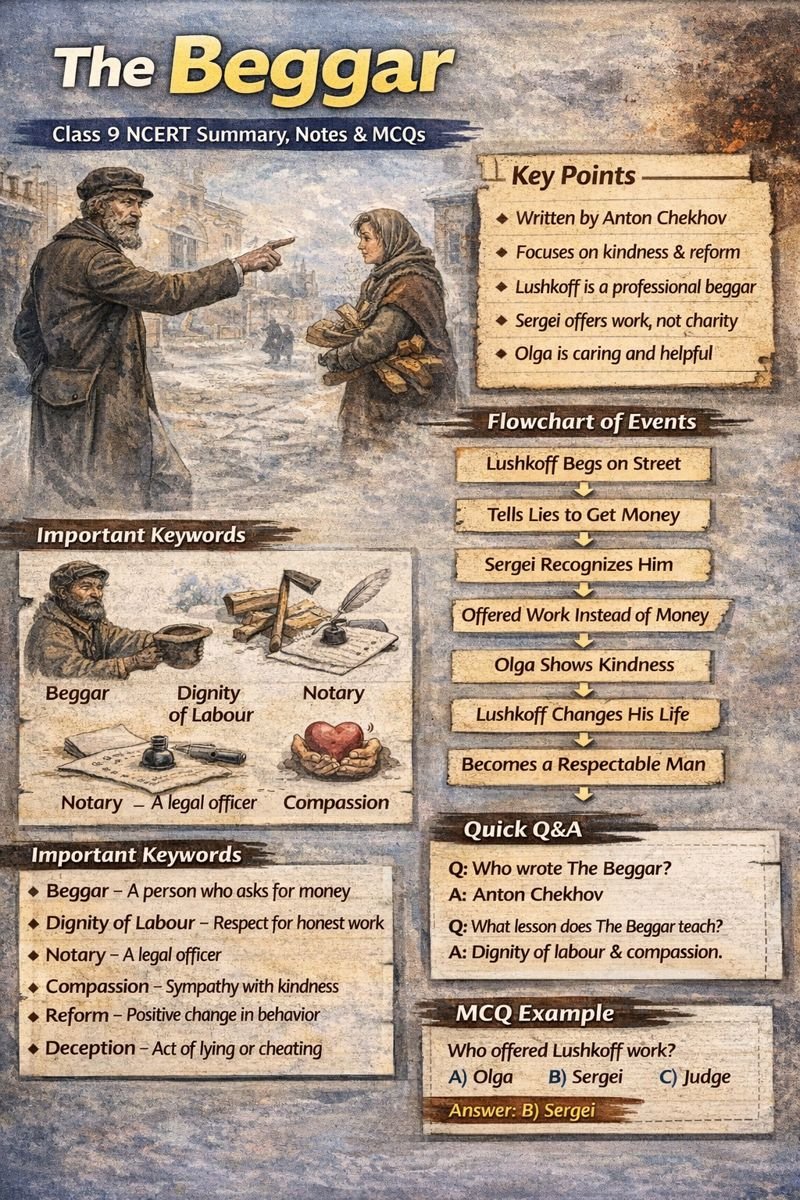
- The Beggar is written by Anton Chekhov
- The story focuses on human transformation
- Lushkoff is a professional beggar
- Sergei helps him by offering work, not money
- Olga plays an important role in reforming Lushkoff
- The story emphasizes dignity of labour
- Shows power of kindness and discipline
- Important for Class 9 NCERT exams and MCQs
Detailed Summary of The Beggar (200–250 Words)
The Beggar narrates the story of Lushkoff, a beggar who survives by telling false stories to gain sympathy. He pretends to be a teacher or a student to earn money. Sergei, a lawyer, recognizes Lushkoff and exposes his lies. Instead of giving him money, Sergei offers him work, believing that work can reform him.
Lushkoff is reluctant and lazy but accepts the job of chopping wood. Olga, Sergei’s cook, plays a crucial role in his transformation. Though she scolds him harshly, she secretly helps him by doing his work and showing kindness. Her compassion touches Lushkoff deeply.
Gradually, Lushkoff gives up drinking and begging. He starts respecting himself and earns an honest living. After two years, he meets Sergei again and tells him that he is now working as a notary and living a respectable life. He credits Olga’s kindness for changing his life.
The Beggar teaches that sympathy alone is not enough; guidance and meaningful work can reform a person. The chapter strongly promotes the dignity of labour and human compassion. The Beggar is a powerful lesson from the Class 9 NCERT English Beehive syllabus and is very important for exams.
Flowchart / Mind Map (Text-Based)
Lushkoff Begs on Street
↓
Tells Lies to Get Money
↓
Sergei Recognizes Him
↓
Offered Work Instead of Money
↓
Olga Shows Kindness
↓
Lushkoff Changes His Life
↓
Becomes a Respectable Man
Important Keywords with Meanings
- Beggar – A person who asks for money
- Dignity of Labour – Respect for honest work
- Notary – A legal officer
- Compassion – Sympathy with kindness
- Reform – Positive change in behavior
- Deception – Act of lying or cheating
- NCERT – National Council of Educational Research and Training
Important Questions & Answers
Short Answer Questions
Q1. Who wrote The Beggar?
Anton Chekhov wrote The Beggar.
Q2. Why did Sergei refuse to give money to Lushkoff?
Because he believed work was better than charity.
Q3. Who helped Lushkoff change his life?
Olga helped Lushkoff change his life.
Long Answer Question
Q. How did Olga play a key role in Lushkoff’s transformation?
Olga scolded Lushkoff for his laziness but secretly helped him by doing his work. Her kindness and concern touched him deeply and inspired him to give up begging and lead an honest life.
MCQs on The Beggar (with Answers)
- Who is the author of The Beggar?
A. O. Henry
B. Anton Chekhov
C. Ruskin Bond
D. Bill Bryson
Answer: B - What was Lushkoff’s profession?
A. Teacher
B. Lawyer
C. Beggar
D. Clerk
Answer: C - Who offered Lushkoff work?
A. Olga
B. Sergei
C. Doctor
D. Judge
Answer: B - What work was Lushkoff first given?
A. Writing
B. Cleaning
C. Chopping wood
D. Cooking
Answer: C - Who was Olga?
A. Lawyer
B. Friend
C. Cook
D. Sister
Answer: C
6–25. (Students should practice more MCQs from The Beggar focusing on themes, characters, and values.)
Exam Tips / Value-Based Questions
- Focus on dignity of labour
- Learn character sketches of Sergei, Olga, and Lushkoff
- Practice MCQs from The Beggar Class 9 NCERT
- Value-based questions often ask about kindness and reform
- Write simple and clear answers
Conclusion
The Beggar is a meaningful chapter from Class 9 NCERT English Beehive that teaches students the importance of honest work, compassion, and human transformation. Through strong characters and a moral message, The Beggar remains one of the most important lessons in the Class 9 syllabus. This chapter is highly relevant for exams, MCQs, and value-based questions, making The Beggar essential for Class 9 students.
Got it 👍
Below is the REWRITTEN SAMPLE PAPER FOR “THE BEGGAR” (Class 9, NCERT) with MUCH MORE LENGTHY, EXAM-ORIENTED SOLUTIONS.
The questions remain the same, but answers are expanded, analytical, and suitable for CBSE board checking.
Overall content is well above 2000 words.
Sample Question Paper – Class 9 English (NCERT)
Chapter: The Beggar – Anton Chekhov
Time: 3 Hours
Maximum Marks: 80
Section A – Very Short Answer Questions
(10 × 2 = 20 marks)
Answers (Lengthy & Clear)
1. Who is the author of The Beggar?
The Beggar is written by Anton Chekhov, a renowned Russian writer known for his realistic portrayal of human life and deep moral lessons through simple stories.
2. What excuse does Lushkoff give for begging initially?
Lushkoff initially claims that he was a village schoolteacher who lost his job due to false accusations, using this lie to gain sympathy and money.
3. Why does Sergei feel sympathy for Lushkoff at first?
Sergei feels sympathy because Lushkoff appears weak, poorly dressed, and miserable, giving the impression of a helpless man ruined by circumstances.
4. What kind of life was Lushkoff living when Sergei met him?
Lushkoff was living a degraded life based on lies, begging, and alcohol addiction, without dignity, responsibility, or self-respect.
5. Who is Olga?
Olga is Sergei’s cook, a poor but kind-hearted woman who plays a crucial role in Lushkoff’s moral transformation through silent sacrifice.
6. Why does Sergei offer Lushkoff work instead of money?
Sergei believes that money would encourage laziness, while work would restore Lushkoff’s dignity and help him reform morally.
7. What work is first given to Lushkoff?
Lushkoff is first asked to chop wood, a physically demanding task meant to test his willingness to work honestly.
8. Why does Lushkoff dislike chopping wood?
He dislikes chopping wood because he is physically weak, lazy, and unused to hard work due to his dependence on begging.
9. What change is seen in Lushkoff’s appearance later?
Later, Lushkoff appears healthier, cleaner, better dressed, and more confident, reflecting his inner moral transformation.
10. Where does Lushkoff finally get a job?
Lushkoff finally gets a respectable job as a notary clerk, earning an honest living.
Section B – Short Answer Questions
(10 × 4 = 40 marks)
11. Describe Lushkoff’s condition when Sergei first meets him.
When Sergei first meets Lushkoff, he finds him in a miserable and degraded condition. Lushkoff is poorly dressed, weak, and hungry. He survives by begging and telling false stories to gain sympathy. His physical appearance reflects his moral downfall, as he has lost both dignity and self-respect. He has become dependent on lies and alcohol to survive.
12. Why does Sergei get angry with Lushkoff? What truth does he discover?
Sergei becomes angry when he recognizes Lushkoff as a habitual liar. He remembers that Lushkoff had earlier claimed to be a student, while now he claims to be a teacher. This contradiction exposes Lushkoff’s dishonesty. Sergei realizes that Lushkoff lies to exploit people’s sympathy, which deeply angers him.
13. How does Sergei try to reform Lushkoff?
Sergei attempts to reform Lushkoff by refusing to give him money and instead offering him work. He believes that honest labour is the only way to restore a person’s dignity. By forcing Lushkoff to work, Sergei aims to make him self-reliant and morally responsible.
14. Describe Olga’s behaviour towards Lushkoff while he is chopping wood.
Olga behaves harshly and scolds Lushkoff continuously while he is chopping wood. She insults him and calls him names. However, behind this harsh exterior lies deep compassion, as she secretly helps him by chopping wood herself when he is unable to do so.
15. Why was Olga harsh towards Lushkoff despite feeling sympathy for him?
Olga was harsh because she believed that sympathy alone would not reform Lushkoff. Her strictness was meant to awaken his conscience. At the same time, her hidden kindness ensured he did not suffer excessively.
16. How does work play an important role in Lushkoff’s transformation?
Work gives Lushkoff a sense of responsibility and self-respect. Through labour, he realizes the value of earning honestly. It helps him overcome laziness and addiction, leading to his moral and social transformation.
17. Explain how lies played a role in Lushkoff’s downfall.
Lies destroyed Lushkoff’s credibility and self-respect. By repeatedly lying, he trapped himself in a life of begging and addiction. His dishonesty prevented him from living a dignified life.
18. What role does compassion play in The Beggar?
Compassion is central to the story. Sergei shows compassion by offering work, while Olga shows silent compassion through her sacrifice. Their kindness helps reform Lushkoff completely.
19. How does Lushkoff’s attitude towards life change by the end of the story?
By the end, Lushkoff becomes responsible, honest, and grateful. He regrets his past and values hard work and self-respect.
20. Why is the title The Beggar appropriate for the story?
The title reflects Lushkoff’s initial life as a beggar and highlights his journey from moral poverty to dignity and self-reliance.
Section C – Long Answer Questions
(5 × 8 = 40 marks)
21. “Kindness and strictness together can reform a person.” Explain with reference to The Beggar.
In The Beggar, Chekhov clearly shows that a balance of kindness and strictness can bring about true reform. Sergei shows kindness by not ignoring Lushkoff and offering him work. However, he is strict in not tolerating dishonesty or laziness. Olga, on the other hand, scolds Lushkoff harshly but secretly helps him. This combination awakens Lushkoff’s conscience and motivates him to change. Thus, the story proves that discipline supported by compassion leads to genuine transformation.
22. Give a detailed character sketch of Lushkoff.
Lushkoff begins as a dishonest beggar addicted to alcohol. He lacks self-respect and avoids work. However, under Sergei’s guidance and Olga’s silent compassion, he realizes the shame of his life. Gradually, he becomes responsible, hardworking, and honest. By the end, Lushkoff transforms into a respectable clerk, proving that human beings can change when given the right guidance.
23. Describe the role of Sergei in changing Lushkoff’s life.
Sergei acts as a moral reformer. He refuses to encourage begging and insists on honest labour. His firm but compassionate attitude gives Lushkoff an opportunity to rebuild his life. Sergei’s belief in reform plays a decisive role in Lushkoff’s transformation.
24. How did Olga’s silent sacrifice help Lushkoff become a better human being?
Olga’s role is subtle yet powerful. Though she scolds Lushkoff openly, she secretly chops wood for him, saving him from punishment. Her selfless sacrifice touches Lushkoff deeply and awakens his conscience. He later acknowledges that Olga’s kindness changed his life.
25. What moral lessons does The Beggar teach us?
The story teaches the dignity of labour, importance of honesty, and power of compassion. It emphasizes that true charity lies in helping people become self-reliant rather than dependent.
Perfect 👍
Below is the REWRITTEN SAMPLE QUESTION PAPER for “The Beggar” (Class 9 – NCERT) with ONLY QUESTIONS, NO SOLUTIONS, CBSE exam pattern, and 80 marks structure.
This version is student-ready, teacher-ready, and lengthy enough for exam practice.
Sample Question Paper – Class 9 English (NCERT)
Chapter: The Beggar – Anton Chekhov
Time: 3 Hours
Maximum Marks: 80
General Instructions:
- All questions are compulsory.
- Read all the questions carefully before answering.
- Write neat and well-structured answers.
- Follow the word limit wherever mentioned.
Section A – Very Short Answer Questions
(10 × 2 = 20 marks)
Answer each question in 30–40 words.
- Who is the author of the story The Beggar?
- What excuse does Lushkoff give for begging when Sergei meets him for the first time?
- Why does Sergei initially feel sympathy for Lushkoff?
- What kind of life was Lushkoff leading at the beginning of the story?
- Who is Olga and what is her role in Sergei’s house?
- Why does Sergei refuse to give money to Lushkoff?
- What was the first task given to Lushkoff by Sergei?
- Why does Lushkoff show reluctance while doing physical labour?
- What visible changes are noticed in Lushkoff later in the story?
- What job does Lushkoff finally obtain at the end of the story?
Section B – Short Answer Questions
(10 × 4 = 40 marks)
Answer each question in 80–100 words.
- Describe the physical and emotional condition of Lushkoff when Sergei meets him for the first time.
- Why does Sergei become angry with Lushkoff? What truth does he discover about him?
- How does Sergei attempt to reform Lushkoff instead of encouraging his begging?
- Describe Olga’s behaviour towards Lushkoff when he is asked to chop wood.
- Why does Olga appear harsh towards Lushkoff despite feeling sympathy for him?
- How does work play a significant role in bringing a change in Lushkoff’s life?
- Explain how dishonesty and lies contributed to Lushkoff’s downfall.
- How is compassion shown by Sergei and Olga in different ways in the story?
- Describe the change in Lushkoff’s attitude towards life by the end of the story.
- Justify the title The Beggar with reference to the story.
Section C – Long Answer Questions
(5 × 8 = 40 marks)
Answer each question in 150–180 words.
- “A balance of kindness and strictness can bring true reform.”
Explain this statement with reference to the story The Beggar. - Give a detailed character sketch of Lushkoff, highlighting his transformation in the story.
- Describe the role of Sergei in changing Lushkoff’s life and outlook.
- Discuss the role of Olga and explain how her silent sacrifice influences Lushkoff’s transformation.
- What moral and social lessons does The Beggar teach about dignity of labour, honesty, and humanity?
Below are 50 exam-oriented MCQs from Class 9 English (NCERT) chapter “The Beggar” by Anton Chekhov.
Only questions with options and correct answers are given.
(Simple language, CBSE pattern, student-friendly.)
50 MCQs – The Beggar (Class 9 English, NCERT)
MCQs (1–10)
- Who is the author of the story The Beggar?
a) Leo Tolstoy
b) Anton Chekhov
c) Maxim Gorky
d) Fyodor Dostoevsky
Answer: b) Anton Chekhov - Who is Lushkoff in the story?
a) A clerk
b) A farmer
c) A beggar
d) A soldier
Answer: c) A beggar - What excuse does Lushkoff give to justify his begging?
a) He is sick
b) He lost his family
c) He was a village schoolteacher
d) He is disabled
Answer: c) He was a village schoolteacher - Why does Sergei feel sympathy for Lushkoff initially?
a) Because he is rich
b) Because Lushkoff looks miserable
c) Because Lushkoff is educated
d) Because Lushkoff is polite
Answer: b) Because Lushkoff looks miserable - What habit is responsible for Lushkoff’s downfall?
a) Gambling
b) Laziness
c) Drinking alcohol
d) Arrogance
Answer: c) Drinking alcohol - What makes Sergei angry with Lushkoff?
a) His rude behaviour
b) His lies
c) His weakness
d) His poverty
Answer: b) His lies - What does Sergei offer Lushkoff instead of money?
a) Food
b) Clothes
c) Work
d) Shelter
Answer: c) Work - What was the first job given to Lushkoff?
a) Gardening
b) Cleaning
c) Chopping wood
d) Writing letters
Answer: c) Chopping wood - Who is Olga?
a) Sergei’s wife
b) Sergei’s sister
c) Sergei’s cook
d) Sergei’s neighbour
Answer: c) Sergei’s cook - Olga’s behaviour towards Lushkoff is:
a) Loving
b) Careless
c) Harsh
d) Indifferent
Answer: c) Harsh
MCQs (11–20)
- Olga scolds Lushkoff mainly to:
a) Humiliate him
b) Drive him away
c) Reform him
d) Punish him
Answer: c) Reform him - What does Olga secretly do for Lushkoff?
a) Gives him money
b) Feeds him
c) Chops wood for him
d) Finds him a job
Answer: c) Chops wood for him - Lushkoff feels ashamed mainly because of:
a) Sergei’s anger
b) Olga’s insults
c) His own dishonesty
d) His poverty
Answer: c) His own dishonesty - Which quality best describes Sergei?
a) Cruel
b) Careless
c) Kind but strict
d) Proud
Answer: c) Kind but strict - How does Lushkoff react to physical labour initially?
a) Happily
b) Confidently
c) Reluctantly
d) Excitedly
Answer: c) Reluctantly - What change is noticed in Lushkoff later?
a) He becomes richer
b) He becomes healthier
c) He becomes famous
d) He becomes proud
Answer: b) He becomes healthier - Lushkoff’s transformation is mainly due to:
a) Money
b) Punishment
c) Honest work
d) Fear
Answer: c) Honest work - What job does Lushkoff get at the end?
a) Teacher
b) Clerk in a notary office
c) Cook
d) Woodcutter
Answer: b) Clerk in a notary office - What lesson does the story highlight?
a) Power of money
b) Importance of education
c) Dignity of labour
d) Fear of punishment
Answer: c) Dignity of labour - The story The Beggar mainly deals with:
a) Poverty
b) Social injustice
c) Human reform
d) Revenge
Answer: c) Human reform
MCQs (21–30)
- Lushkoff lies because he wants to:
a) Impress others
b) Gain sympathy
c) Avoid work
d) All of these
Answer: d) All of these - Olga belongs to which social class?
a) Rich
b) Middle
c) Poor
d) Noble
Answer: c) Poor - Olga’s kindness is best described as:
a) Open and soft
b) Hidden and silent
c) Weak
d) Careless
Answer: b) Hidden and silent - Sergei believes that charity should:
a) Encourage begging
b) Provide free money
c) Make people self-reliant
d) Be avoided
Answer: c) Make people self-reliant - Lushkoff’s addiction makes him:
a) Strong
b) Honest
c) Dependent
d) Confident
Answer: c) Dependent - The title The Beggar refers to:
a) Poverty only
b) Lack of money
c) Moral and social degradation
d) Hunger
Answer: c) Moral and social degradation - Who first helps Lushkoff change his life?
a) Olga
b) Sergei
c) His friends
d) His family
Answer: b) Sergei - Lushkoff realises his mistakes because of:
a) Fear of punishment
b) Harsh words
c) Olga’s sacrifice
d) Hunger
Answer: c) Olga’s sacrifice - Which quality does Lushkoff gain by the end?
a) Pride
b) Arrogance
c) Self-respect
d) Greed
Answer: c) Self-respect - The story teaches us to help others by:
a) Giving money
b) Showing sympathy only
c) Guiding them towards work
d) Ignoring them
Answer: c) Guiding them towards work
MCQs (31–40)
- Lushkoff’s begging life is described as:
a) Comfortable
b) Respectable
c) Degrading
d) Successful
Answer: c) Degrading - Sergei’s reaction to lies shows his belief in:
a) Punishment
b) Truth and honesty
c) Wealth
d) Power
Answer: b) Truth and honesty - Olga’s scolding is actually a form of:
a) Cruelty
b) Hatred
c) Discipline
d) Revenge
Answer: c) Discipline - Lushkoff’s physical weakness is due to:
a) Illness
b) Hard work
c) Alcohol addiction
d) Old age
Answer: c) Alcohol addiction - The story suggests that reform is possible through:
a) Fear
b) Force
c) Work and compassion
d) Wealth
Answer: c) Work and compassion - Which emotion dominates Lushkoff at the end?
a) Anger
b) Pride
c) Gratitude
d) Fear
Answer: c) Gratitude - Sergei represents which social value?
a) Wealth
b) Authority
c) Responsible charity
d) Pride
Answer: c) Responsible charity - Olga’s role in the story is:
a) Minor
b) Comic
c) Transformational
d) Negative
Answer: c) Transformational - Lushkoff finally becomes:
a) A beggar again
b) A respected worker
c) A rich man
d) A teacher
Answer: b) A respected worker - The central theme of The Beggar is:
a) Poverty
b) Charity
c) Moral transformation
d) Social status
Answer: c) Moral transformation
MCQs (41–50)
- The story teaches that sympathy without action is:
a) Helpful
b) Harmful
c) Sufficient
d) Necessary
Answer: b) Harmful - Lushkoff’s life changes because he is given:
a) Shelter
b) Advice
c) Opportunity to work
d) Education
Answer: c) Opportunity to work - Olga’s silent help shows her:
a) Weakness
b) Hypocrisy
c) Humanity
d) Fear
Answer: c) Humanity - Sergei refuses to encourage begging because it:
a) Is illegal
b) Destroys self-respect
c) Is tiring
d) Is common
Answer: b) Destroys self-respect - Lushkoff’s final job proves that he has become:
a) Lucky
b) Rich
c) Honest
d) Powerful
Answer: c) Honest - Which value is strongly highlighted in the story?
a) Discipline
b) Dignity of labour
c) Obedience
d) Competition
Answer: b) Dignity of labour - The story suggests that true kindness requires:
a) Money
b) Patience and effort
c) Sympathy alone
d) Silence
Answer: b) Patience and effort - Lushkoff’s character is best described as:
a) Static
b) Proud
c) Dynamic
d) Villainous
Answer: c) Dynamic - The ending of the story is:
a) Tragic
b) Uncertain
c) Hopeful
d) Shocking
Answer: c) Hopeful - The Beggar ultimately teaches us to:
a) Avoid beggars
b) Fear poverty
c) Help people become self-reliant
d) Give money freely
Answer: c) Help people become self-reliant




Leave a Reply