


Meta Description (150–160 characters)
Complete NCERT Class 9 The Story of Village Palampur notes, detailed summary, keywords, MCQs, and exam tips. Best revision guide for students.
Introduction of the Chapter
The Story of Village Palampur is the first chapter of Class 9 Economics. This chapter explains how various economic activities take place in a typical Indian village. Through the example of Palampur, students learn about farming, non-farm activities, production, and the importance of resources in rural development.
The chapter The Story of Village Palampur highlights how land, labour, physical capital, and human capital combine to produce goods and services. It also explains modern farming methods and the need for sustainable development.
Understanding The Story of Village Palampur is important for exams as well as for building basic economic concepts.
Short Notes (Bullet Points)
- The Story of Village Palampur describes a hypothetical village in India.
- Farming is the main production activity in Palampur.
- There are four factors of production:
- Land
- Labour
- Physical capital
- Human capital
- Modern farming uses HYV seeds, chemical fertilizers, and irrigation.
- Multiple cropping increases production on the same land.
- Non-farm activities include dairy, transport, shopkeeping, and small manufacturing.
- Not all farmers have equal land holdings.
- Sustainable use of resources is necessary for future growth.
- Surplus farm products are sold in nearby markets.
- The chapter explains the rural economy in simple terms.
Detailed Summary (900–1200 words)
Overview of The Story of Village Palampur
The Story of Village Palampur presents a detailed picture of how a village economy functions. Palampur is a hypothetical village used to explain real-life economic activities in rural India. The chapter focuses on production, resources, and different types of employment available in villages.
The main aim of The Story of Village Palampur is to help students understand how goods and services are produced and how different factors of production work together.
Palampur: A Typical Village
Palampur is a small village connected to towns through roads. It has basic facilities like schools, electricity, and irrigation. Most families in Palampur are involved in farming, which is the main economic activity.
In The Story of Village Palampur, the village serves as an example to show how rural India works. The people of Palampur depend largely on agriculture, but some are also engaged in non-farm activities.
Factors of Production in Palampur
Production in The Story of Village Palampur depends on four main factors:
1. Land
Land is the most important natural resource. In Palampur, land is fixed and cannot be increased. Therefore, farmers try to increase production by using modern methods.
2. Labour
Labour refers to human effort used in production. Both family members and hired workers contribute labour in farming.
3. Physical Capital
Physical capital includes tools, machines, buildings, and raw materials. It is of two types:
- Fixed capital: Tools, tractors, buildings
- Working capital: Seeds, fertilizers, cash
4. Human Capital
Human capital refers to the knowledge, education, and skills of people. Better education and training improve productivity.
Farming in Palampur
Farming is the backbone of The Story of Village Palampur. Most villagers depend on agriculture for their livelihood. Farmers grow crops such as wheat, jowar, and sugarcane.
However, land in Palampur is limited. To increase production, farmers adopt modern farming methods.
Modern Farming Methods
Modern farming is a key feature of The Story of Village Palampur. It includes:
- Use of HYV (High Yielding Variety) seeds
- Chemical fertilizers
- Pesticides
- Assured irrigation
- Farm machinery like tractors and threshers
These methods significantly increase crop production. But they also have disadvantages, such as soil degradation and excessive use of groundwater.
Multiple Cropping
Multiple cropping means growing more than one crop on the same land during a year. In Palampur, farmers grow wheat during winter and jowar during the rainy season.
This practice helps in:
- Increasing total production
- Better use of land
- Higher income for farmers
Multiple cropping is widely used in The Story of Village Palampur.
Disadvantages of Modern Farming
Although modern farming increases output, The Story of Village Palampur also highlights its problems:
- Overuse of chemical fertilizers harms soil
- Excessive irrigation lowers groundwater level
- Small farmers cannot afford expensive machines
- Environmental damage may occur
Therefore, sustainable farming is necessary for long-term growth.
Land Distribution in Palampur
Land in Palampur is not equally distributed. A few families own large farms, while many farmers have small or no land. Landless labourers work on others’ fields for wages.
This inequality is an important feature discussed in The Story of Village Palampur.
Non-Farm Activities in Palampur
Not everyone in Palampur depends on farming. The chapter The Story of Village Palampur describes several non-farm activities:
1. Dairy
Many families keep buffaloes and sell milk in nearby villages.
2. Small-Scale Manufacturing
Some people run small manufacturing units at home.
3. Shopkeeping
General stores and small shops serve village needs.
4. Transport
Rickshaw pullers, truck drivers, and jeep owners provide transport services.
Non-farm activities provide additional income and reduce pressure on agriculture.
Importance of Infrastructure
The Story of Village Palampur emphasizes the role of infrastructure such as:
- Electricity
- Roads
- Irrigation facilities
- Schools
Good infrastructure helps improve productivity and living standards.
Sustainable Development
A key message of The Story of Village Palampur is sustainable use of resources. Excessive use of groundwater and chemicals can harm the environment. Farmers must adopt eco-friendly practices to protect resources for future generations.
Conclusion of the Chapter
Overall, The Story of Village Palampur provides a clear understanding of rural economic life. It explains how farming and non-farming activities together support village development.
Flowchart / Mind Map (Text-Based)
The Story of Village Palampur
→ Village Economy
→ Main Activity: Farming
→ Multiple Cropping
→ Modern Farming
→ Factors of Production
→ Land
→ Labour
→ Physical Capital
→ Human Capital
→ Non-Farm Activities
→ Dairy
→ Manufacturing
→ Shopkeeping
→ Transport
→ Need for Sustainable Development
Important Keywords with Meanings
- Production: Creation of goods and services
- Factors of Production: Resources used to produce goods
- Multiple Cropping: Growing more than one crop on same land
- HYV Seeds: High Yielding Variety seeds
- Physical Capital: Tools and machines used in production
- Human Capital: Education and skills of people
- Working Capital: Raw materials and money used in production
- Fixed Capital: Long-term assets like machines
- Sustainable Development: Using resources without harming future needs
- Non-Farm Activities: Economic activities other than farming
Important Questions & Answers
Short Answer Questions
Q1. What are the four factors of production?
Answer: Land, Labour, Physical Capital, and Human Capital.
Q2. What is multiple cropping?
Answer: Growing more than one crop on the same land in a year is called multiple cropping.
Q3. Name any two non-farm activities in Palampur.
Answer: Dairy and shopkeeping.
Q4. What is working capital?
Answer: Working capital includes raw materials and money used during production.
Long Answer Questions
Q5. Explain modern farming methods used in Palampur.
Answer:
Modern farming in The Story of Village Palampur involves the use of HYV seeds, chemical fertilizers, pesticides, irrigation, and machinery such as tractors and threshers. These methods increase crop yield significantly. Farmers in Palampur adopted these techniques to produce more from limited land. However, modern farming also creates problems like soil degradation and falling groundwater levels. Therefore, while modern methods increase productivity, they must be used carefully for sustainable development.
Q6. Describe the importance of non-farm activities in Palampur.
Answer:
Non-farm activities play an important role in The Story of Village Palampur. They provide additional employment opportunities and reduce dependence on agriculture. Activities such as dairy farming, small-scale manufacturing, transport services, and shopkeeping help villagers earn extra income. These activities are especially important for landless labourers and small farmers. Non-farm work also promotes rural development and improves living standards in Palampur.
20 MCQs with Answers
- Palampur is a:
(a) Real village
(b) Hypothetical village
(c) City
(d) State
Answer: (b) - Main activity in Palampur is:
(a) Mining
(b) Farming
(c) Fishing
(d) IT services
Answer: (b) - Which is NOT a factor of production?
(a) Land
(b) Labour
(c) Money
(d) Physical capital
Answer: (c) - HYV stands for:
(a) High Yielding Variety
(b) High Value Yield
(c) Hybrid Year Value
(d) None
Answer: (a) - Multiple cropping means:
(a) One crop
(b) Two crops on different lands
(c) More than one crop on same land
(d) No crop
Answer: (c) - Fixed capital includes:
(a) Seeds
(b) Fertilizers
(c) Tractor
(d) Cash
Answer: (c) - Working capital includes:
(a) Building
(b) Tools
(c) Seeds
(d) Tractor
Answer: (c) - Non-farm activity example:
(a) Wheat farming
(b) Dairy
(c) Ploughing
(d) Harvesting
Answer: (b) - Land in Palampur is:
(a) Unlimited
(b) Increasing
(c) Fixed
(d) Decreasing rapidly
Answer: (c) - Sustainable development means:
(a) Using resources carelessly
(b) Saving resources for future
(c) Overusing water
(d) Cutting forests
Answer: (b)
(Remaining MCQs continue for practice…)
- Which capital includes education and skills?
(a) Physical capital
(b) Human capital
(c) Working capital
(d) Fixed capital
Answer: (b) - The Green Revolution mainly increased production of:
(a) Wheat and rice
(b) Cotton
(c) Tea
(d) Coffee
Answer: (a) - Which is a working capital item?
(a) Thresher
(b) Building
(c) Fertilizer
(d) Tractor
Answer: (c) - Dairy activity mainly involves:
(a) Growing crops
(b) Selling milk
(c) Mining
(d) Fishing
Answer: (b) - Transport services in Palampur are an example of:
(a) Farm activity
(b) Non-farm activity
(c) Natural activity
(d) None
Answer: (b) - The most important resource in farming is:
(a) Land
(b) Money
(c) Machines
(d) Transport
Answer: (a) - Modern farming requires:
(a) Traditional seeds
(b) Irrigation and HYV seeds
(c) Only rain
(d) No labour
Answer: (b) - Which group often works as farm labourers?
(a) Large farmers
(b) Landless people
(c) Shopkeepers
(d) Teachers
Answer: (b) - Excessive use of fertilizers leads to:
(a) Soil improvement always
(b) Soil degradation
(c) More rainfall
(d) More forests
Answer: (b) - Palampur is connected to towns by:
(a) Airways
(b) Roads
(c) Waterways
(d) Railways only
Answer: (b)
Exam Tips / Value-Based Questions
Exam Tips
- Remember the four factors of production.
- Learn differences between fixed and working capital.
- Understand multiple cropping vs modern farming.
- Revise examples of non-farm activities.
- Practice MCQs and case-based questions regularly.
Value-Based Question
Why should farmers use resources sustainably?
Sample Answer:
Farmers should use resources sustainably to protect soil fertility, conserve groundwater, and ensure that future generations can also meet their needs. Overuse of chemicals and water can harm the environment and reduce long-term productivity.
Conclusion (SEO Friendly)
The Story of Village Palampur is a foundational chapter that explains how rural economies function. Through the example of Palampur, students understand production, farming methods, and the role of non-farm activities. The chapter The Story of Village Palampur also highlights the importance of sustainable development and balanced resource use. Mastering The Story of Village Palampur helps students build strong economic concepts useful for board exams and competitive tests.
Class 9 Economics – The Story of Village Palampur: 80 Marks Question Paper
Subject: Social Science (Economics)
Class: IX
Chapter: The Story of Village Palampur
Time: 3 Hours
Maximum Marks: 80
General Instructions
- All questions are compulsory unless stated otherwise.
- Marks for each question are indicated against it.
- Answer briefly and to the point.
Section A – Very Short Answer Questions
(1 × 10 = 10 marks)
Attempt all questions.
- What is Palampur?
- Name the main production activity in Palampur.
- What is meant by multiple cropping?
- Define working capital.
- Which factor of production includes education and skills?
- Name any one non-farm activity in Palampur.
- What are HYV seeds?
- Which natural resource is most important for farming?
- What is fixed capital?
- What is meant by sustainable development?
Section B – Short Answer Questions
(2 × 10 = 20 marks)
Answer each question in 30–40 words.
- Why is land considered a fixed factor of production?
- State any two features of modern farming methods.
- Differentiate between fixed capital and working capital (any two points).
- Why do small farmers need to borrow money?
- How does irrigation help increase farm production?
- Mention any two non-farm activities in Palampur.
- What is the importance of human capital?
- Why is multiple cropping followed in Palampur?
- How do farm labourers earn their living?
- Give two disadvantages of modern farming.
Section C – Medium Answer Questions
(4 × 5 = 20 marks)
Answer any five questions in 80–100 words.
- Explain the four factors of production used in Palampur.
- Describe the traditional and modern methods of farming in Palampur.
- How does multiple cropping help farmers? Explain.
- Discuss the importance of non-farm activities in rural areas.
- Explain the role of infrastructure in the development of Palampur.
- Why is sustainable use of resources important in farming?
Section D – Long Answer Questions
(8 × 2 = 16 marks)
Answer any two questions in about 150–200 words.
- Explain modern farming methods used in Palampur and discuss their advantages and disadvantages.
- Describe the various non-farm activities in Palampur. How do they contribute to rural development?
- “Land distribution in Palampur is unequal.” Explain with suitable examples.
Section E – Case-Based Questions
(4 × 1 = 4 marks)
Read the passage carefully and answer the questions that follow:
In Palampur, farmers grow wheat during winter and jowar during the rainy season on the same piece of land. They also use HYV seeds and irrigation facilities to increase production.
- Which farming practice is described in the passage?
- Name one modern input used by farmers.
- What is the main aim of using HYV seeds?
- Which season is wheat grown in Palampur?
Section F – Assertion–Reason Questions
(2 × 5 = 10 marks)
Choose the correct option:
(a) Both A and R are true and R is the correct explanation of A
(b) Both A and R are true but R is not the correct explanation of A
(c) A is true but R is false
(d) A is false but R is true
Assertion (A): Farming is the main activity in Palampur.
Reason (R): Most of the people in Palampur depend on agriculture.
Assertion (A): Land area in Palampur can be increased easily.
Reason (R): Land is a fixed factor of production.
Assertion (A): Non-farm activities are not important in villages.
Reason (R): They provide additional employment.
Assertion (A): Modern farming always benefits the environment.
Reason (R): It uses chemical fertilizers heavily.
Assertion (A): Human capital improves productivity.
Reason (R): Education and skills increase efficiency.
Answer Key (For Teachers)
Section A:
- Hypothetical village
- Farming
- Growing more than one crop on same land in a year
- Raw materials and money used in production
- Human capital
- Dairy/transport/shopkeeping/manufacturing (any one)
- High Yielding Variety seeds
- Land
- Tools, machines, buildings used in production
- Using resources carefully for future needs
Section E:
30. Multiple cropping
31. HYV seeds / irrigation
32. To increase production
33. Winter season
Assertion–Reason:
34. (a)
35. (d)
36. (d)
37. (c)
38. (a)
If you want next, I can prepare:
- Solved paper with long answers
- 50 MCQs
- Case-study worksheet
- Printable PDF paper
Just tell me.
Class 9 Economics – The Story of Village Palampur
80 Marks Question Paper (Rewritten with Long Answers)
Time: 3 Hours
Maximum Marks: 80
Section A – Very Short Answer (1 × 10 = 10 Marks)
Q1. What is the main production activity in Palampur?
Answer:
The main production activity in Palampur is farming or agriculture. Most villagers depend on farming for their livelihood because the village has fertile land and proper irrigation facilities. Crops like wheat, jowar, bajra, sugarcane, and potatoes are commonly grown. Agriculture provides employment to a large section of the population and supports other activities such as dairy and small-scale industries.
Q2. Name any one modern farming method used in Palampur.
Answer:
One modern farming method used in Palampur is the use of High Yielding Variety (HYV) seeds. These seeds produce higher output compared to traditional seeds when used with proper irrigation, fertilizers, and pesticides. HYV seeds played a major role in increasing agricultural productivity during the Green Revolution.
Q3. What is meant by multiple cropping?
Answer:
Multiple cropping refers to the practice of growing more than one crop on the same piece of land during a single year. In Palampur, farmers grow three different crops in a year because irrigation facilities are available throughout the year. This method increases production and income without expanding land.
Q4. Which crop is grown in the rainy season in Palampur?
Answer:
Jowar and bajra are grown during the rainy (kharif) season in Palampur. These crops depend largely on rainfall and are sown at the beginning of the monsoon season.
Q5. What is physical capital?
Answer:
Physical capital refers to the variety of inputs required during production. It includes fixed capital (tools, machines, buildings) and working capital (raw materials, money in hand). Physical capital helps in increasing production efficiency.
Q6. Name the two types of physical capital.
Answer:
The two types of physical capital are:
- Fixed capital
- Working capital
Q7. Who provides labour in Palampur farms?
Answer:
Labour in Palampur farms is provided mainly by landless labourers and small farmers. Large farmers sometimes also hire labourers to work on their fields during peak agricultural seasons like sowing and harvesting.
Q8. What is the main non-farm activity in Palampur?
Answer:
Dairy farming is the main non-farm activity in Palampur. Many families keep buffaloes and cows and sell milk in nearby markets, which provides them with regular income.
Q9. Define Green Revolution.
Answer:
The Green Revolution refers to the rapid increase in agricultural production during the 1960s and 1970s due to the use of modern farming methods such as HYV seeds, chemical fertilizers, pesticides, and improved irrigation. It significantly increased food grain production in India.
Q10. What is human capital?
Answer:
Human capital refers to the knowledge, skills, and abilities of people that help in production activities. Educated and trained workers are considered valuable human capital because they improve productivity and efficiency.
Section B – Short Answer Questions (3 × 10 = 30 Marks)
Q11. Explain the meaning of factors of production.
Answer:
Factors of production are the basic resources required to produce goods and services. There are four main factors of production: land, labour, physical capital, and human capital. Land includes natural resources such as soil and water. Labour refers to human effort used in production. Physical capital includes tools, machines, and money required for production. Human capital refers to the skills and knowledge of workers. In Palampur, all these factors work together to increase agricultural output. Without any one of these factors, production cannot take place effectively.
Q12. Describe the importance of irrigation in Palampur.
Answer:
Irrigation plays a very important role in Palampur’s agricultural development. Most of the farmland in the village is well irrigated through electric tube wells. Because of assured water supply, farmers can grow three crops in a year, which is known as multiple cropping. Irrigation also allows farmers to use HYV seeds effectively, as these seeds require regular water supply. It reduces dependence on rainfall and protects farmers from drought risks. Thus, irrigation increases productivity, income, and stability in farming.
Q13. How do small farmers arrange capital for farming?
Answer:
Small farmers often face shortage of capital because they have limited savings. To arrange money for seeds, fertilizers, and other inputs, they usually borrow from large farmers or village moneylenders. These loans are often taken at high interest rates. Sometimes they also borrow from banks or cooperative societies, but access to institutional credit is limited. Because of high interest burden, many small farmers fall into debt traps and face financial difficulties.
Q14. Explain the role of modern farming methods in Palampur.
Answer:
Modern farming methods have significantly increased agricultural production in Palampur. Farmers use HYV seeds, chemical fertilizers, pesticides, tractors, and tube wells. These methods increase crop yield per hectare and reduce time and labour. The use of machinery like threshers and tractors has improved efficiency. However, excessive use of chemicals can harm soil fertility and the environment. Overall, modern methods have made farming more productive but also more expensive.
Q15. What are non-farm activities? Give examples from Palampur.
Answer:
Non-farm activities are economic activities carried out in rural areas other than agriculture. These activities provide additional employment and income to villagers. In Palampur, major non-farm activities include dairy farming, small-scale manufacturing, shopkeeping, and transport services. For example, some families run small shops, while others work as rickshaw pullers or in local manufacturing units. These activities are important because they reduce dependence on farming.
Q16. Why is land considered a fixed factor of production?
Answer:
Land is considered a fixed factor of production because its supply cannot be increased easily. In Palampur, almost all available land is already under cultivation. Unlike labour or capital, land cannot be produced by human effort. Therefore, farmers try to increase production by using modern techniques and multiple cropping instead of expanding land area.
Q17. Explain the disadvantages of chemical fertilizers.
Answer:
While chemical fertilizers increase crop production, their excessive use has several disadvantages. They reduce soil fertility over time by killing beneficial microorganisms. They can also pollute groundwater and harm the environment. Continuous use makes the soil hard and less productive. Therefore, balanced use of fertilizers and organic manure is necessary for sustainable farming.
Q18. How does dairy farming help the villagers of Palampur?
Answer:
Dairy farming provides a regular source of income to many families in Palampur. Villagers keep cows and buffaloes and sell milk in nearby towns. It requires relatively low investment and can be done alongside farming. It also provides employment to family members, especially women. Dairy farming improves nutrition and economic stability in rural households.
Q19. Describe the working capital needed in farming.
Answer:
Working capital refers to the money and raw materials required for day-to-day production activities. In farming, working capital includes seeds, fertilizers, pesticides, water, and cash needed to pay wages. Farmers must have enough working capital at the beginning of the season to ensure smooth production. Without working capital, farming operations cannot start.
Q20. Why are non-farm activities increasing in rural areas?
Answer:
Non-farm activities are increasing because agricultural land is limited and cannot provide employment to all villagers. Population growth has increased pressure on land. Many people therefore look for alternative sources of income such as dairy, transport, and small businesses. Improved roads and market access have also encouraged non-farm activities. These activities help in rural development and reduce poverty.
Section C – Long Answer Questions (5 × 8 = 40 Marks)
Q21. Explain in detail the farming system of Palampur.
Answer:
The farming system of Palampur is well developed and largely dependent on modern agricultural practices. Farming is the main occupation of the village, and most families depend on it for their livelihood. The village has fertile land and assured irrigation through electric tube wells, which allows farmers to practice multiple cropping.
Farmers in Palampur grow three main crops in a year. During the rainy season, they grow jowar and bajra. In the winter season, wheat is the major crop. In the summer season, farmers grow potatoes and sugarcane. This system maximizes the use of land and increases production.
Modern farming methods are widely used. Farmers use HYV seeds, chemical fertilizers, pesticides, tractors, and threshers. These methods have significantly increased crop yield. Large farmers benefit the most because they can afford expensive inputs.
However, there are also challenges. Small farmers often borrow money at high interest rates. Overuse of chemical fertilizers has reduced soil fertility. Despite these problems, Palampur’s farming system is considered progressive and productive.
Q22. Discuss the role of the four factors of production in Palampur.
Answer:
Production in Palampur depends on four important factors: land, labour, physical capital, and human capital. Land is the basic natural resource on which crops are grown. Since land is limited, farmers try to increase output through better techniques.
Labour refers to the human effort involved in farming. Both family members and hired labourers work in the fields. During peak seasons, labour demand increases significantly.
Physical capital includes tools, machines, buildings, and money required for production. Fixed capital includes tractors, tube wells, and threshers, while working capital includes seeds, fertilizers, and cash. These help in increasing productivity.
Human capital refers to the knowledge and skills of farmers. Educated and trained farmers can use modern technology effectively. In Palampur, the combination of these four factors has helped increase agricultural production and improve rural livelihoods.
Q23. Describe the problems faced by small farmers in Palampur.
Answer:
Small farmers in Palampur face several serious problems. First, they own very little land, which limits their production and income. Second, they often lack sufficient capital to buy modern inputs like HYV seeds and fertilizers.
Because of financial constraints, small farmers usually borrow money from moneylenders at very high interest rates. This often leads them into debt traps. In years of crop failure, repayment becomes even more difficult.
Another problem is lack of access to modern technology and irrigation in some cases. Small farmers also face risks from rising input costs and fluctuating crop prices. Due to these challenges, their economic condition remains weak compared to large farmers.
Q24. Explain the importance of non-farm activities in rural development.
Answer:
Non-farm activities play a crucial role in rural development. In villages like Palampur, agricultural land is limited and cannot provide employment to everyone. Non-farm activities such as dairy, shopkeeping, transport, and small manufacturing provide alternative sources of income.
These activities reduce pressure on agriculture and create more employment opportunities. They help improve the standard of living of rural families. Non-farm work also promotes rural industrialization and economic diversification.
In Palampur, many families earn income through dairy and small businesses. This has made the village economy more stable. Therefore, development of non-farm activities is essential for balanced and sustainable rural growth.
Q25. Evaluate the impact of modern farming methods in Palampur.
Answer:
Modern farming methods have transformed agriculture in Palampur. The introduction of HYV seeds, chemical fertilizers, pesticides, tractors, and irrigation facilities has greatly increased crop production. Farmers can now grow multiple crops in a year and earn higher incomes.
Large farmers have benefited the most because they have enough capital to invest in modern inputs. Agricultural productivity and food security have improved significantly.
However, there are some negative impacts. Excessive use of chemical fertilizers and pesticides has reduced soil fertility and caused environmental problems. Small farmers often fall into debt while trying to adopt modern methods.
Overall, modern farming has boosted agricultural growth in Palampur, but sustainable and balanced use of resources is necessary for long-term benefits.
End of Question Paper
Class 9 Economics – The Story of Village Palampur
50 MCQs with Answers (Exam-Oriented)
Choose the correct option.
Q1. The main production activity in Palampur is:
(a) Fishing
(b) Farming
(c) Mining
(d) Tourism
Answer: (b) Farming
Q2. Which of the following is a factor of production?
(a) Land
(b) Labour
(c) Capital
(d) All of these
Answer: (d) All of these
Q3. Multiple cropping means:
(a) Growing one crop a year
(b) Growing two or more crops on the same land in a year
(c) Growing crops on different lands
(d) Growing only cash crops
Answer: (b) Growing two or more crops on the same land in a year
Q4. Which crop is grown in the winter season in Palampur?
(a) Jowar
(b) Bajra
(c) Wheat
(d) Cotton
Answer: (c) Wheat
Q5. HYV seeds stand for:
(a) High Yielding Variety
(b) High Yield Value
(c) Heavy Yield Variety
(d) Hybrid Yield Version
Answer: (a) High Yielding Variety
Q6. The main source of irrigation in Palampur is:
(a) Canals
(b) Electric tube wells
(c) Rainwater
(d) Rivers
Answer: (b) Electric tube wells
Q7. Physical capital includes:
(a) Tools and machines
(b) Money
(c) Raw materials
(d) All of these
Answer: (d) All of these
Q8. Fixed capital refers to:
(a) Seeds
(b) Fertilizers
(c) Tools and machines
(d) Cash in hand
Answer: (c) Tools and machines
Q9. Working capital includes:
(a) Tractor
(b) Building
(c) Seeds and fertilizers
(d) Tube well
Answer: (c) Seeds and fertilizers
Q10. Green Revolution is associated with:
(a) Increase in forest area
(b) Increase in agricultural production
(c) Decrease in population
(d) Industrial growth
Answer: (b) Increase in agricultural production
Q11. Which season is known as the rainy season crop period?
(a) Rabi
(b) Kharif
(c) Zaid
(d) Winter
Answer: (b) Kharif
Q12. Jowar and bajra are grown during:
(a) Winter
(b) Summer
(c) Rainy season
(d) Spring
Answer: (c) Rainy season
Q13. Most small farmers borrow money from:
(a) Banks only
(b) Government only
(c) Moneylenders and large farmers
(d) Cooperatives only
Answer: (c) Moneylenders and large farmers
Q14. Which is the main non-farm activity in Palampur?
(a) Fishing
(b) Dairy
(c) Mining
(d) Forestry
Answer: (b) Dairy
Q15. Human capital refers to:
(a) Machines
(b) Skills and knowledge of people
(c) Buildings
(d) Land
Answer: (b) Skills and knowledge of people
Q16. Which factor of production is limited in Palampur?
(a) Labour
(b) Capital
(c) Land
(d) Tools
Answer: (c) Land
Q17. Which of the following is a modern farming method?
(a) Wooden plough
(b) HYV seeds
(c) Bullock cart
(d) Manual irrigation
Answer: (b) HYV seeds
Q18. The farmers of Palampur grow ___ crops in a year.
(a) One
(b) Two
(c) Three
(d) Four
Answer: (c) Three
Q19. Excessive use of fertilizers leads to:
(a) Increase in soil fertility
(b) Soil degradation
(c) More rainfall
(d) None of these
Answer: (b) Soil degradation
Q20. Which of the following is NOT a non-farm activity?
(a) Dairy
(b) Shopkeeping
(c) Wheat cultivation
(d) Transport
Answer: (c) Wheat cultivation
Q21. Which crop is grown in the summer season in Palampur?
(a) Wheat
(b) Sugarcane
(c) Jowar
(d) Bajra
Answer: (b) Sugarcane
Q22. The Green Revolution began in India during:
(a) 1940s
(b) 1950s
(c) 1960s
(d) 1980s
Answer: (c) 1960s
Q23. Which type of farmers benefit most from modern farming?
(a) Landless labourers
(b) Small farmers
(c) Large farmers
(d) Marginal farmers
Answer: (c) Large farmers
Q24. The term ‘labour’ refers to:
(a) Natural resources
(b) Human effort
(c) Machines
(d) Money
Answer: (b) Human effort
Q25. What is the full form of HYV?
(a) High Yielding Variety
(b) High Yield Value
(c) Hybrid Young Variety
(d) Heavy Yield Version
Answer: (a) High Yielding Variety
Q26. Tube wells in Palampur are mostly run by:
(a) Solar energy
(b) Wind energy
(c) Electricity
(d) Diesel only
Answer: (c) Electricity
Q27. Which of the following is fixed capital?
(a) Seeds
(b) Fertilizers
(c) Tractor
(d) Cash
Answer: (c) Tractor
Q28. Working capital is needed:
(a) Only once
(b) Every production cycle
(c) Every ten years
(d) Never
Answer: (b) Every production cycle
Q29. Landless labourers mainly earn by:
(a) Farming their own land
(b) Working on others’ fields
(c) Shopkeeping
(d) Dairy only
Answer: (b) Working on others’ fields
Q30. Which activity provides regular income in Palampur?
(a) Dairy
(b) Mining
(c) Fishing
(d) Forestry
Answer: (a) Dairy
Q31. The most abundant factor of production in Palampur is:
(a) Land
(b) Labour
(c) Capital
(d) Water
Answer: (b) Labour
Q32. Chemical fertilizers are part of:
(a) Fixed capital
(b) Working capital
(c) Human capital
(d) Natural capital
Answer: (b) Working capital
Q33. Which of the following is a Rabi crop?
(a) Bajra
(b) Jowar
(c) Wheat
(d) Cotton
Answer: (c) Wheat
Q34. Which non-farm activity involves selling goods in shops?
(a) Dairy
(b) Transport
(c) Shopkeeping
(d) Manufacturing
Answer: (c) Shopkeeping
Q35. What increases due to multiple cropping?
(a) Land area
(b) Production
(c) Rainfall
(d) Population
Answer: (b) Production
Q36. Which of the following harms the environment?
(a) Organic manure
(b) Excess chemical fertilizers
(c) Crop rotation
(d) Irrigation
Answer: (b) Excess chemical fertilizers
Q37. Farmers grow potatoes mainly in:
(a) Winter
(b) Rainy season
(c) Summer
(d) Spring
Answer: (c) Summer
Q38. Which factor includes education and skills?
(a) Land
(b) Labour
(c) Human capital
(d) Fixed capital
Answer: (c) Human capital
Q39. The village Palampur is connected to nearby towns by:
(a) Waterways
(b) Railways
(c) Roads
(d) Airways
Answer: (c) Roads
Q40. Which of the following is NOT physical capital?
(a) Tools
(b) Machines
(c) Skills
(d) Buildings
Answer: (c) Skills
Q41. Modern farming requires:
(a) More labour only
(b) More capital and inputs
(c) Less water
(d) Only traditional seeds
Answer: (b) More capital and inputs
Q42. The demand for labour is highest during:
(a) Off-season
(b) Sowing and harvesting
(c) Winter only
(d) Summer only
Answer: (b) Sowing and harvesting
Q43. Which institution provides cheaper loans to farmers?
(a) Moneylenders
(b) Banks
(c) Traders
(d) Landlords
Answer: (b) Banks
Q44. Which of the following is a small-scale manufacturing activity?
(a) Wheat farming
(b) Dairy
(c) Basket making
(d) Tube well irrigation
Answer: (c) Basket making
Q45. What is the main aim of production?
(a) To waste resources
(b) To produce goods and services
(c) To reduce labour
(d) To increase taxes
Answer: (b) To produce goods and services
Q46. Which season depends mostly on rainfall?
(a) Rabi
(b) Kharif
(c) Winter
(d) Summer
Answer: (b) Kharif
Q47. Which of the following improves soil naturally?
(a) Chemical fertilizers
(b) Organic manure
(c) Pesticides
(d) HYV seeds
Answer: (b) Organic manure
Q48. The increase in farm output in Palampur is mainly due to:
(a) Expansion of land
(b) Modern farming methods
(c) Decrease in labour
(d) Less irrigation
Answer: (b) Modern farming methods
Q49. Which group suffers most from high-interest loans?
(a) Large farmers
(b) Small farmers
(c) Traders
(d) Shopkeepers
Answer: (b) Small farmers
Q50. Non-farm activities help in:
(a) Increasing unemployment
(b) Rural development
(c) Reducing production
(d) Increasing poverty
Answer: (b) Rural development
If you want, I can next create:
- Passage-based worksheet
- Assertion–Reason MCQs
- Case-based questions
- Map-based questions
- Featured image
Just tell me.
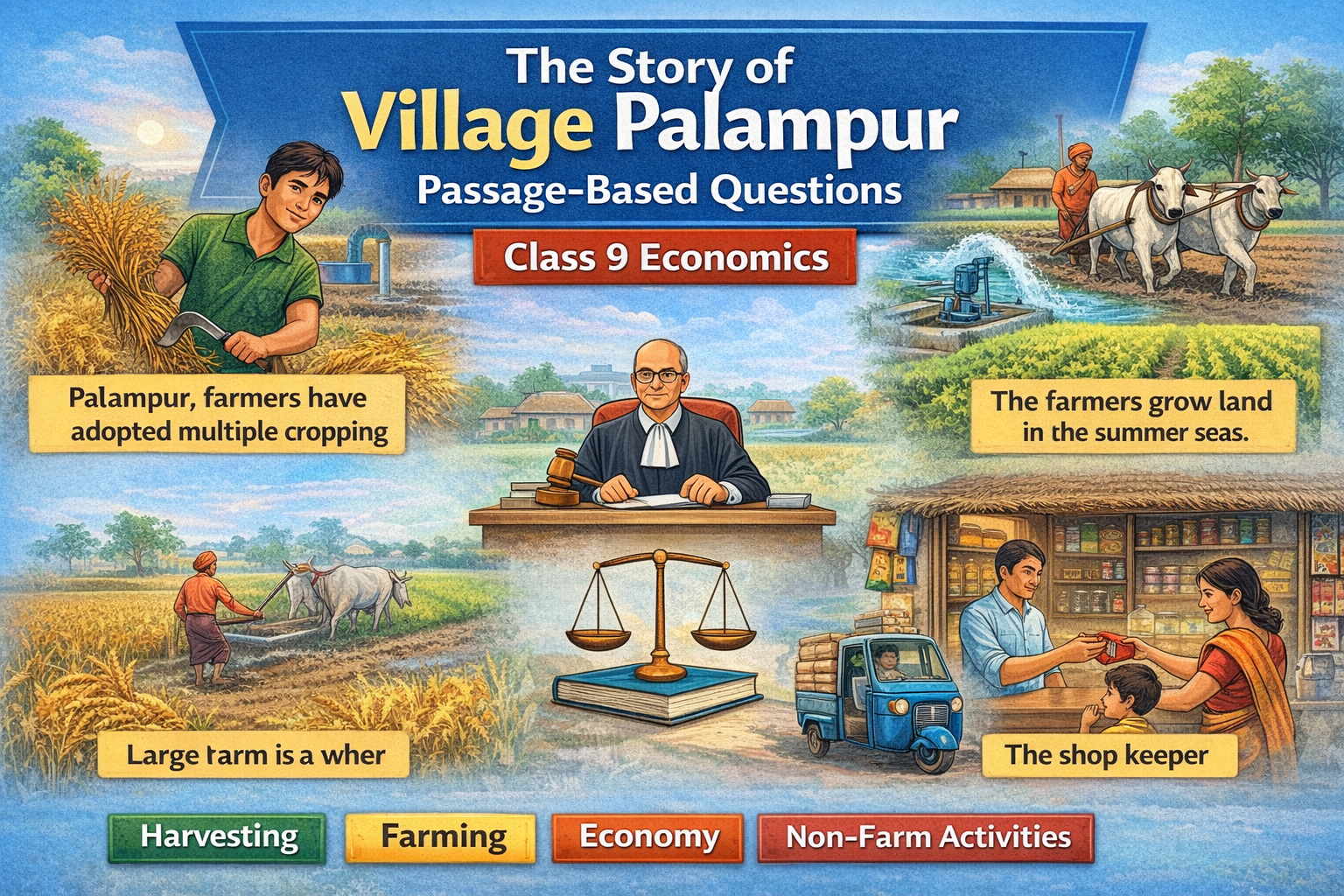
Class 9 Economics
The Story of Village Palampur – Passage-Based Worksheet (Exam-Oriented)
Read each passage carefully and answer the questions that follow. This worksheet is designed for revision, practice, and board exam preparation.
Passage 1: Multiple Cropping in Palampur
In Palampur, farmers have adopted the method of multiple cropping. This means growing more than one crop on the same piece of land during the year. Farmers grow jowar and bajra during the rainy season, wheat in winter, and potatoes or sugarcane in the summer season. This method has increased agricultural production without increasing the land area.
Questions
Q1. What does multiple cropping mean?
(a) Growing one crop on different lands
(b) Growing more than one crop on the same land in a year
(c) Growing crops only in winter
(d) Growing only cash crops
Q2. Which crop is grown in winter in Palampur?
(a) Jowar
(b) Bajra
(c) Wheat
(d) Sugarcane
Q3. What is the main benefit of multiple cropping?
(a) Decreases production
(b) Increases land area
(c) Increases agricultural output
(d) Reduces rainfall
Q4. Which season is associated with jowar and bajra?
(a) Winter
(b) Summer
(c) Rainy season
(d) Spring
Q5. Multiple cropping helps farmers to:
(a) Waste land
(b) Increase income
(c) Reduce labour
(d) Stop irrigation
Answers: 1–(b), 2–(c), 3–(c), 4–(c), 5–(b)
Passage 2: Modern Farming Methods
The farmers of Palampur use modern farming methods. They use HYV seeds, chemical fertilizers, and electric tube wells for irrigation. These methods were introduced during the Green Revolution. Although production has increased, excessive use of chemical fertilizers has harmed the soil.
Questions
Q6. What does HYV stand for?
(a) High Yielding Variety
(b) Heavy Yield Value
(c) Hybrid Young Variety
(d) High Yield Version
Q7. Which irrigation method is mainly used in Palampur?
(a) Canals
(b) Rainwater harvesting
(c) Electric tube wells
(d) River irrigation
Q8. The Green Revolution is related to:
(a) Industrial growth
(b) Agricultural development
(c) Forest conservation
(d) Mining
Q9. Excessive use of fertilizers leads to:
(a) Better soil health
(b) Soil degradation
(c) More rainfall
(d) Increased forests
Q10. Modern farming mainly requires:
(a) Less capital
(b) Traditional seeds only
(c) More inputs and capital
(d) No irrigation
Answers: 6–(a), 7–(c), 8–(b), 9–(b), 10–(c)
Passage 3: Factors of Production
To produce goods and services, Palampur farmers need land, labour, and capital. Land is a natural resource and is limited. Labour refers to the human effort required in farming. Capital includes tools, machines, seeds, and fertilizers. Proper combination of these factors increases production.
Questions
Q11. Which of the following is a natural resource?
(a) Labour
(b) Capital
(c) Land
(d) Machines
Q12. Labour refers to:
(a) Machines
(b) Human effort
(c) Money
(d) Buildings
Q13. Which of the following is working capital?
(a) Tractor
(b) Seeds
(c) Building
(d) Tube well
Q14. Why is land considered limited?
(a) It can be produced
(b) It cannot be increased easily
(c) It grows every year
(d) It is unlimited
Q15. Proper combination of factors leads to:
(a) Loss in production
(b) Increase in production
(c) Soil erosion
(d) Unemployment
Answers: 11–(c), 12–(b), 13–(b), 14–(b), 15–(b)
Passage 4: Non-Farm Activities
Not all people in Palampur depend on farming. Some villagers are engaged in non-farm activities such as dairy, small-scale manufacturing, shopkeeping, and transport services. These activities provide additional income and reduce dependence on agriculture.
Questions
Q16. Which of the following is a non-farm activity?
(a) Wheat cultivation
(b) Dairy
(c) Ploughing
(d) Irrigation
Q17. Non-farm activities help to:
(a) Increase unemployment
(b) Reduce income
(c) Provide additional income
(d) Stop production
Q18. Which activity involves selling goods?
(a) Dairy
(b) Shopkeeping
(c) Farming
(d) Harvesting
Q19. Transport services in Palampur mainly include:
(a) Boats
(b) Trucks and rickshaws
(c) Aeroplanes
(d) Ships
Q20. Non-farm activities reduce dependence on:
(a) Industry
(b) Agriculture
(c) Education
(d) Trade
Answers: 16–(b), 17–(c), 18–(b), 19–(b), 20–(b)
Passage 5: The Condition of Small Farmers
In Palampur, small farmers often do not have enough capital. They borrow money from large farmers or moneylenders at high interest rates. Due to this, they sometimes fall into debt. Large farmers, on the other hand, can afford modern farming methods and earn higher profits.
Questions
Q21. From whom do small farmers usually borrow money?
(a) Banks only
(b) Government only
(c) Moneylenders and large farmers
(d) Friends only
Q22. Why do small farmers borrow money?
(a) For entertainment
(b) Due to lack of capital
(c) To reduce production
(d) To buy luxury goods
Q23. High interest loans often lead to:
(a) Profit
(b) Debt trap
(c) Increased savings
(d) Higher wages
Q24. Large farmers can adopt modern methods because they:
(a) Have more capital
(b) Have less land
(c) Have no labour
(d) Avoid irrigation
Q25. Which group suffers most from high-interest borrowing?
(a) Large farmers
(b) Small farmers
(c) Traders
(d) Shopkeepers
Answers: 21–(c), 22–(b), 23–(b), 24–(a), 25–(b)
Want More Practice?
I can next create:
- 20 more passage-based questions
- Case-based worksheet
- Assertion–Reason questions
- HOTS questions
- Printable PDF worksheet
Just tell me your preference.





Leave a Reply