


Tissue Notes, Summary, MCQs, Important Questions & Keywords
Meta Description (120–140 characters)
Class 9 Biology Tissue notes with summary, flowchart, MCQs, important questions, keywords, and exam tips for quick revision.
Introduction of the Chapter
The chapter Tissue in Class 9 Biology explains how groups of similar cells work together to perform specific functions in living organisms. In unicellular organisms, a single cell performs all life processes. However, multicellular organisms like plants and animals need specialized groups of cells to perform different tasks efficiently. These specialized groups of cells are called tissues.
The study of tissues helps us understand how plants grow, how animals move, and how different organs function together. In plants, tissues support growth, transport water and nutrients, and provide strength. In animals, tissues enable movement, coordination, protection, and transport.
Understanding Tissue is essential for exams and builds the foundation for advanced biology topics.
Short Notes (Quick Revision Points)
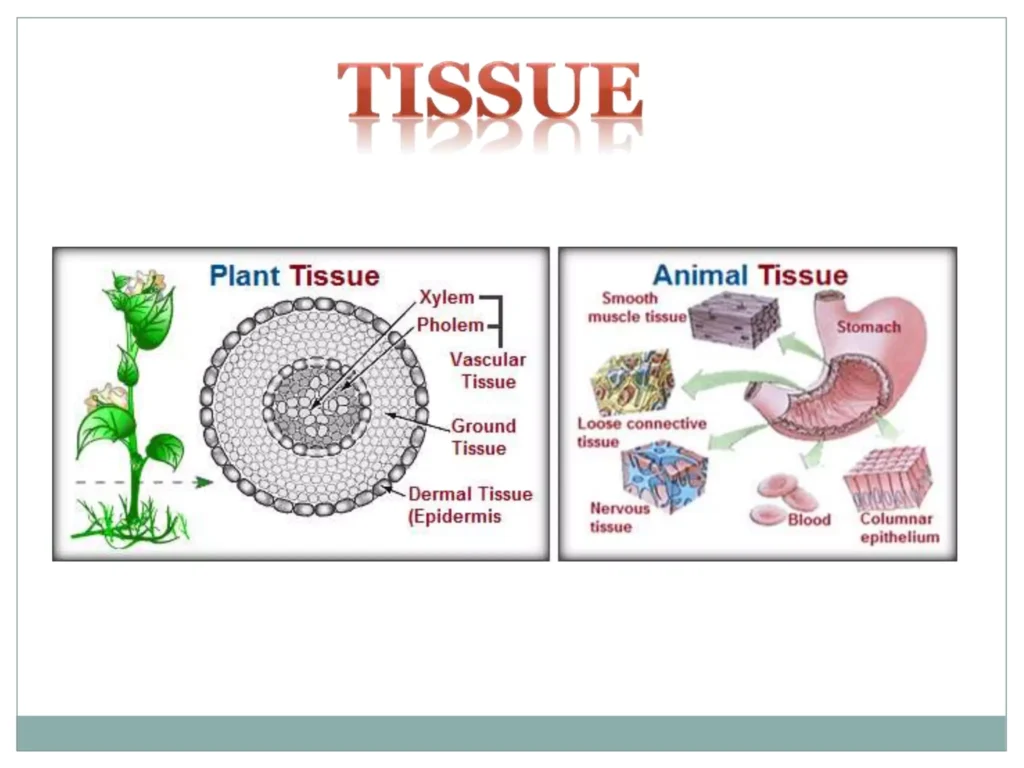
- A tissue is a group of similar cells performing a specific function.
- Plant tissues are of two main types:
- Meristematic tissue
- Permanent tissue
- Meristematic tissues help in plant growth.
- Permanent tissues provide support, storage, and transport.
- Animal tissues are four types:
- Epithelial tissue
- Connective tissue
- Muscular tissue
- Nervous tissue
- Epithelial tissue protects body surfaces.
- Connective tissue connects and supports organs.
- Muscluar tissue helps in movement.
- Nervous tissue controls body functions.
Detailed Summary of Tissue (Class 9 Biology)
The chapter Tissue describes how cells group together to form tissues that perform specialized functions. This division of labour increases efficiency and survival in multicellular organisms.
What is a Tissue?
A tissue is a group of cells with similar structure and function working together to perform a specific task.
Example:
- Muscle cells → movement
- Xylem cells → water transport
Plant Tissues
Plant tissues are divided into Meristematic and Permanent tissues.
1. Meristematic Tissue
Meristematic tissue consists of actively dividing cells responsible for plant growth.
Characteristics:
- Cells divide continuously
- Thin cell walls
- Dense cytoplasm
- No vacuole
- Large nucleus
Types:
Apical meristem
- Located at root and shoot tips
- Responsible for length growth
Intercalary meristem
- Found at nodes
- Helps in regrowth (grass)
Lateral meristem
- Found in stems and roots
- Responsible for thickness growth
2. Permanent Tissue
Permanent tissues are formed from meristematic tissues and have lost the ability to divide.
They are of two types:
Simple Permanent Tissue
Made of one type of cells.
Parenchyma
- Living cells
- Storage of food and water
- Photosynthesis (chlorenchyma)
- Air storage (aerenchyma)
Collenchyma
- Provides flexibility and support
- Found in leaf stalks
Sclerenchyma
- Dead cells
- Thick cell walls
- Provides strength (coconut husk)
Complex Permanent Tissue
Made of different types of cells working together.
Xylem
- Transports water and minerals
- Components: tracheids, vessels, fibres, parenchyma
Phloem
- Transports food
- Components: sieve tubes, companion cells, fibres, parenchyma
Protective Tissues
Epidermis
- Protects plant surface
- Prevents water loss
Cork
- Dead protective tissue
- Protects older stems
Animal Tissues
Animal tissues are specialized for movement, coordination, protection, and transport.
1. Epithelial Tissue
Forms protective covering.
Types:
- Squamous → flat cells (alveoli)
- Cuboidal → cube-shaped (kidney tubules)
- Columnar → tall cells (intestine)
- Ciliated → movement of substances (respiratory tract)
Functions:
- Protection
- Absorption
- Secretion
2. Connective Tissue
Connects, supports, and transports materials.
Types:
- Blood → transport
- Bone → support
- Cartilage → flexibility
- Tendons → muscle to bone
- Ligaments → bone to bone
- Areolar tissue → fills spaces
- Adipose tissue → fat storage
3. Muscular Tissue
Responsible for movement.
Types:
- Striated muscle → voluntary movement
- Smooth muscle → involuntary movement
- Cardiac muscle → heart muscles
4. Nervous Tissue
Controls and coordinates body functions.
- Made of neurons
- Transmits impulses
- Found in brain, spinal cord, nerves
Flowchart / Mind Map (Text-Based)
Tissue
│
├── Plant Tissues
│ ├── Meristematic
│ │ ├── Apical
│ │ ├── Intercalary
│ │ └── Lateral
│ └── Permanent
│ ├── Simple
│ │ ├── Parenchyma
│ │ ├── Collenchyma
│ │ └── Sclerenchyma
│ ├── Complex
│ │ ├── Xylem
│ │ └── Phloem
│ └── Protective
│ ├── Epidermis
│ └── Cork
│
└── Animal Tissues
├── Epithelial
├── Connective
├── Muscular
└── Nervous
Important Keywords with Meanings
- Tissue – group of similar cells performing a function
- Meristematic – actively dividing tissue
- Permanent tissue – non-dividing tissue
- Parenchyma – storage tissue
- Collenchyma – flexible support tissue
- Sclerenchyma – strength-providing tissue
- Xylem – water transport tissue
- Phloem – food transport tissue
- Epithelial tissue – protective covering tissue
- Connective tissue – supporting tissue
- Neuron – nerve cell
- Adipose tissue – fat storing tissue
Important Questions & Answers
Very Short Answer Questions
- Define tissue.
Answer: A group of similar cells performing a specific function. - Name the two types of plant tissues.
Answer: Meristematic and permanent tissue. - Which tissue helps in plant growth?
Answer: Meristematic tissue. - What is the function of xylem?
Answer: Transport of water and minerals. - Name the tissue that stores fat.
Answer: Adipose tissue. - Which tissue connects bones?
Answer: Ligament. - Where is epithelial tissue found?
Answer: Body surfaces and lining of organs. - Which muscle works involuntarily?
Answer: Smooth muscle. - What is the function of neurons?
Answer: Transmit nerve impulses. - Which tissue provides strength to plants?
Answer: Sclerenchyma.
Short Answer Questions
(Providing concise exam-ready answers)
- Explain meristematic tissue and its types.
Answer: Meristematic tissue contains dividing cells responsible for plant growth. Types include apical (length), lateral (thickness), and intercalary (internode growth). - Describe simple permanent tissues.
Answer: Parenchyma stores food, collenchyma provides flexibility, and sclerenchyma gives strength. - Explain complex permanent tissues.
Answer: Xylem transports water; phloem transports food. - Describe epithelial tissue with functions.
Answer: Forms protective covering; functions include protection, absorption, and secretion. - Explain connective tissue and its types.
Answer: Connects and supports organs; examples include bone, blood, cartilage. - Differentiate between tendon and ligament.
Answer: Tendon connects muscle to bone; ligament connects bone to bone. - Explain muscular tissue types.
Answer: Striated (voluntary), smooth (involuntary), cardiac (heart). - Describe nervous tissue structure and function.
Answer: Made of neurons; transmits impulses and controls body. - Compare plant and animal tissues.
Answer: Plant tissues support and transport; animal tissues enable movement and coordination. - Write functions of parenchyma.
Answer: Storage, photosynthesis, buoyancy, healing.
MCQs with Answers
- Tissue is a group of:
A. Cells
B. Organs
C. Systems
D. Molecules
Answer: A - Growth in plants occurs due to:
A. Parenchyma
B. Meristematic tissue
C. Xylem
D. Phloem
Answer: B - Which tissue transports food?
A. Xylem
B. Phloem
C. Collenchyma
D. Sclerenchyma
Answer: B - Dead cells with thick walls are:
A. Parenchyma
B. Collenchyma
C. Sclerenchyma
D. Phloem
Answer: C - Which tissue stores fat?
A. Blood
B. Bone
C. Adipose
D. Cartilage
Answer: C - Muscle attached to bones is:
A. Smooth
B. Cardiac
C. Striated
D. Nervous
Answer: C - Basic unit of nervous tissue:
A. Neuron
B. Axon
C. Dendrite
D. Cell body
Answer: A - Tissue that protects body:
A. Muscular
B. Epithelial
C. Nervous
D. Blood
Answer: B - Which provides flexibility in plants?
A. Parenchyma
B. Collenchyma
C. Sclerenchyma
D. Xylem
Answer: B - Water transport tissue:
A. Phloem
B. Xylem
C. Collenchyma
D. Epidermis
Answer: B
Exam Tips
- Draw neat diagrams of plant and animal tissues.
- Learn differences between similar tissues.
- Understand functions rather than memorizing.
- Practice labeling diagrams.
- Revise keywords and examples.
5 Value-Based Questions
- Why is blood donation important?
Answer: It helps save lives and supports healthcare. - Why should we maintain bone health?
Answer: Strong bones support movement and prevent injuries. - How does skin protect the body?
Answer: It prevents infection and water loss. - Why is proper nutrition important for tissue repair?
Answer: Nutrients help growth and healing. - How does plant tissue help in environmental balance?
Answer: They support oxygen production and food chains.
Conclusion (SEO Friendly)
The chapter Tissue is a fundamental topic in Class 9 Biology that explains how multicellular organisms achieve efficiency through division of labour. Understanding Tissue helps students grasp how similar cells combine to perform specialized functions essential for survival. This concept forms the foundation for studying organs, organ systems, and overall biological organization.
In plants, tissues play vital roles in growth, support, storage, and transportation. Meristematic tissues are responsible for continuous growth, enabling plants to increase in length and girth. Permanent tissues, including simple and complex tissues, provide strength, flexibility, and transport systems necessary for survival. Parenchyma stores food and performs photosynthesis, collenchyma offers flexibility, and sclerenchyma provides mechanical strength. Complex tissues such as xylem and phloem ensure efficient transport of water, minerals, and nutrients throughout the plant body. Protective tissues like epidermis and cork safeguard plants from water loss, injury, and infections.
Animal tissues are highly specialized and adapted for diverse functions. Epithelial tissue forms protective coverings and facilitates absorption and secretion. Connective tissue supports and connects different body parts while transporting substances; examples include blood, bone, cartilage, ligaments, and tendons. Muscular tissue enables movement and locomotion, while nervous tissue ensures coordination and communication by transmitting electrical impulses across the body.
The study of Tissue also highlights the structural and functional differences between plant and animal tissues. Plant tissues mainly focus on growth, support, and transport, whereas animal tissues are specialized for movement, coordination, and protection. This comparison enhances understanding of adaptation and specialization in living organisms.
Learning this chapter helps students develop scientific thinking and observation skills. It also prepares them for higher-level topics such as histology, physiology, and anatomy. From an exam perspective, diagrams, definitions, differences, and functions are frequently asked questions. Understanding the concepts rather than memorizing them ensures better retention and application.
The importance of Tissue extends beyond examinations. It explains how wounds heal, how muscles contract, how plants transport water, and how nerves transmit signals. Knowledge of tissues is applied in medicine, agriculture, biotechnology, and environmental science. For instance, understanding blood tissue is essential in transfusion medicine, while knowledge of plant tissues aids crop improvement and forestry.
To master this chapter, students should focus on keywords, functions, examples, and diagrams. Regular revision of notes, solving MCQs, and practicing short and long answers will strengthen conceptual clarity. Flowcharts and mind maps can further enhance memory and quick revision before exams.
In summary, Tissue is a crucial chapter that explains the organization and functioning of living organisms. It demonstrates how specialized cells work together to sustain life processes efficiently. A clear understanding of this chapter builds a strong biological foundation and supports future learning in science and medicine.
By thoroughly studying Tissue, students gain insight into the complexity and beauty of life, making this topic not only exam-important but also essential for understanding the living world around us.
10 Long Answer Questions from Class 9 Biology Chapter: Tissue (Detailed Answers)
1. What is a tissue? Explain the importance of tissues in multicellular organisms.
A tissue is a group of similar cells that work together to perform a specific function. In multicellular organisms, cells are specialized and organized into tissues to increase efficiency.
Importance of tissues:
- Provide division of labour.
- Improve efficiency of body functions.
- Enable specialization of functions.
- Help in growth, repair, and maintenance.
- Allow complex life processes like movement and coordination.
For example, muscle tissue helps in movement, while nervous tissue controls body activities.
2. Explain meristematic tissue and describe its types with functions.
Meristematic tissue consists of actively dividing cells responsible for plant growth.
Characteristics:
- Thin cell walls
- Dense cytoplasm
- Large nucleus
- No vacuole
- Continuous division
Types:
Apical Meristem
- Located at root and shoot tips.
- Helps in increase in length.
Intercalary Meristem
- Found at nodes and leaf bases.
- Helps in regrowth (e.g., grass).
Lateral Meristem
- Found in stems and roots.
- Increases thickness (girth).
Meristematic tissue ensures continuous plant growth.
3. Describe simple permanent tissues and their functions.
Simple permanent tissues are made up of one type of cells.
Parenchyma
- Living cells with thin walls.
- Stores food and water.
- Performs photosynthesis (chlorenchyma).
- Stores air (aerenchyma).
Collenchyma
- Elongated living cells.
- Provides flexibility and mechanical support.
- Found in leaf stalks and young stems.
Sclerenchyma
- Dead cells with thick lignified walls.
- Provides strength and rigidity.
- Found in coconut husk and seed coats.
These tissues support and strengthen plants.
4. Explain complex permanent tissues and their components.
Complex tissues consist of different types of cells working together.
Xylem Transports water and minerals from roots to leaves.
Components:
- Tracheids
- Vessels
- Xylem fibres
- Xylem parenchyma
Phloem Transports food from leaves to other parts.
Components:
- Sieve tubes
- Companion cells
- Phloem fibres
- Phloem parenchyma
These tissues ensure transport throughout the plant.
5. Describe protective tissues in plants and their functions.
Protective tissues protect plants from injury, infection, and water loss.
Epidermis
- Outermost layer of cells.
- Prevents water loss.
- Protects against pathogens.
- Contains stomata for gas exchange.
Cork (Bark)
- Made of dead cells.
- Contains suberin that prevents water loss.
- Protects older stems and roots.
Protective tissues ensure plant survival.
6. Explain epithelial tissue and its types with functions.
Epithelial tissue covers body surfaces and lines internal organs.
Functions:
- Protection
- Absorption
- Secretion
- Filtration
Types:
Squamous Epithelium
- Flat cells.
- Found in alveoli.
- Allows diffusion.
Cuboidal Epithelium
- Cube-shaped.
- Found in kidney tubules.
- Secretion and absorption.
Columnar Epithelium
- Tall cells.
- Found in intestine.
- Absorption and secretion.
Ciliated Epithelium
- Has hair-like cilia.
- Moves mucus and particles in respiratory tract.
7. Describe connective tissue and explain its types and functions.
Connective tissue supports, connects, and protects organs.
Functions:
- Support and binding
- Transport of substances
- Protection
- Storage
Types:
Areolar Tissue
- Fills spaces between organs.
Adipose Tissue
- Stores fat and provides insulation.
Bone
- Provides support and protection.
Cartilage
- Provides flexibility (ear, nose).
Blood
- Transmits oxygen, nutrients, and wastes.
Tendon
- Connects muscle to bone.
Ligament
- Connects bone to bone.
8. Explain muscular tissue and its types.
Muscular tissue is responsible for movement.
Types:
Striated Muscle
- Voluntary movement.
- Found in limbs.
- Multinucleated and striped.
Smooth Muscle
- Involuntary movement.
- Found in digestive tract.
- No stripes.
Cardiac Muscle
- Found in heart.
- Involuntary and rhythmic.
- Striated but branched.
Muscles enable movement and vital functions.
9. Describe nervous tissue and explain the structure and function of a neuron.
Nervous tissue controls and coordinates body functions.
It is made of neurons, specialized cells that transmit nerve impulses.
Structure of Neuron:
- Cell body (cyton)
- Dendrites (receive signals)
- Axon (transmits signals)
Functions:
- Transmit impulses
- Control body responses
- Coordinate actions
Nervous tissue forms brain, spinal cord, and nerves.
10. Differentiate between plant tissues and animal tissues.
| Feature | Plant Tissues | Animal Tissues |
|---|---|---|
| Growth | Continues throughout life | Stops after maturity |
| Function | Support & transport | Movement & coordination |
| Types | Meristematic & permanent | Epithelial, connective, muscular, nervous |
| Cell walls | Present | Absent |
| Living cells | Many dead tissues | Mostly living tissues |
Plant tissues mainly provide support and transport, while animal tissues enable movement and control.
Assertion-Reason 💫
Instructions:
- Read both Assertion (A) and Reason (R).
- Choose the correct option:
- A and R are true, and R is the correct explanation of A
- A and R are true, but R is not the correct explanation of A
- A is true, R is false
- A is false, R is true
1.
Assertion (A): Xylem is a complex permanent tissue.
Reason (R): It consists of tracheids, vessels, xylem parenchyma, and xylem fibres.
Answer: 1 – Both are true, and R explains A.
2.
Assertion (A): Collenchyma provides mechanical support to plants.
Reason (R): It is made of dead cells with lignified walls.
Answer: 3 – Assertion is true, Reason is false (collenchyma is living and has unevenly thickened walls).
3.
Assertion (A): Phloem transports food in plants.
Reason (R): It contains sieve tubes and companion cells.
Answer: 1 – Both true, R explains A.
4.
Assertion (A): Parenchyma cells help in photosynthesis.
Reason (R): Parenchyma cells contain chloroplasts in chlorenchyma.
Answer: 1 – Both true, R explains A.
5.
Assertion (A): Sclerenchyma provides flexibility to plants.
Reason (R): It is made of dead cells with thick walls.
Answer: 3 – Assertion false (flexibility is from collenchyma), Reason true.
6.
Assertion (A): Neurons transmit impulses in the body.
Reason (R): Neurons have axons that carry impulses away from the cell body.
Answer: 1 – Both true, R explains A.
7.
Assertion (A): Areolar tissue is a connective tissue.
Reason (R): It binds organs and fills spaces between them.
Answer: 1 – Both true, R explains A.
8.
Assertion (A): Smooth muscles are voluntary in action.
Reason (R): They are found in digestive organs.
Answer: 4 – Assertion false, Reason true.
9.
Assertion (A): Epidermis prevents water loss in plants.
Reason (R): It contains a waxy layer called cuticle.
Answer: 1 – Both true, R explains A.
10.
Assertion (A): Cardiac muscles are involuntary in action.
Reason (R): They are striated but branched cells found only in heart.
Answer: 1 – Both true, R explains A.
11.
Assertion (A): Ligaments connect muscle to bone.
Reason (R): They are made of elastic connective tissue.
Answer: 3 – Assertion false (ligaments connect bone to bone), Reason true.
12.
Assertion (A): Intercalary meristem is found at the base of leaves.
Reason (R): It helps in the regrowth of plants like grass.
Answer: 1 – Both true, R explains A.
Here’s a comprehensive set of 40 MCQs with answers for Class 9 Biology Chapter Tissue, covering plant and animal tissues, designed for exams and quick revision:
MCQs – Tissue
Plant Tissues (1–20)
- Which of the following is a meristematic tissue?
A. Parenchyma
B. Collenchyma
C. Apical meristem
D. Sclerenchyma
Answer: C - Apical meristem is found at:
A. Leaf base
B. Root and shoot tips
C. Stem lateral sides
D. Stem bark
Answer: B - Intercalary meristem is seen in:
A. Coconut
B. Grass
C. Sunflower
D. Mango
Answer: B - Lateral meristem is also called:
A. Apical meristem
B. Cambium
C. Collenchyma
D. Sclerenchyma
Answer: B - Which plant tissue stores food and water?
A. Collenchyma
B. Parenchyma
C. Sclerenchyma
D. Phloem
Answer: B - Which tissue provides flexibility to plants?
A. Parenchyma
B. Collenchyma
C. Sclerenchyma
D. Xylem
Answer: B - Sclerenchyma is:
A. Living with thin walls
B. Dead with thick lignified walls
C. Living with cellulose walls
D. Dead without cell walls
Answer: B - Xylem transports:
A. Food
B. Water and minerals
C. Hormones
D. Gases
Answer: B - Phloem consists of:
A. Tracheids and vessels
B. Sieve tubes and companion cells
C. Collenchyma and parenchyma
D. Xylem parenchyma and fibres
Answer: B - Which protective tissue prevents water loss in plants?
A. Parenchyma
B. Collenchyma
C. Epidermis
D. Sclerenchyma
Answer: C - Cork cells are:
A. Living and thin-walled
B. Dead with suberin
C. Living with lignin
D. Dead without walls
Answer: B - Aerenchyma is a type of:
A. Parenchyma
B. Collenchyma
C. Sclerenchyma
D. Xylem
Answer: A - Collenchyma is mainly found in:
A. Stem cortex
B. Leaf stalk
C. Fruit wall
D. Both A and B
Answer: D - Which tissue forms veins of leaves?
A. Collenchyma
B. Xylem and Phloem
C. Parenchyma
D. Epidermis
Answer: B - Tracheids and vessels are components of:
A. Phloem
B. Xylem
C. Collenchyma
D. Sclerenchyma
Answer: B - Sieve tubes in phloem are assisted by:
A. Tracheids
B. Companion cells
C. Parenchyma
D. Collenchyma
Answer: B - Which of the following is living at maturity?
A. Xylem vessels
B. Sieve tube
C. Tracheids
D. Sclerenchyma fibres
Answer: B - Cork is formed by:
A. Apical meristem
B. Lateral meristem (cork cambium)
C. Intercalary meristem
D. Collenchyma
Answer: B - Parenchyma with chloroplasts is called:
A. Chlorenchyma
B. Aerenchyma
C. Collenchyma
D. Sclerenchyma
Answer: A - Which tissue provides mechanical strength to mature plant organs?
A. Collenchyma
B. Sclerenchyma
C. Parenchyma
D. Epidermis
Answer: B
Animal Tissues (21–40)
- Epithelial tissue:
A. Provides support
B. Covers body surfaces
C. Transports blood
D. Contracts muscles
Answer: B - Which epithelial tissue has flat cells?
A. Cuboidal
B. Columnar
C. Squamous
D. Ciliated
Answer: C - Columnar epithelium is found in:
A. Kidney tubules
B. Small intestine
C. Alveoli
D. Skin
Answer: B - Ciliated epithelium helps in:
A. Absorption
B. Secretion
C. Movement of mucus
D. Protection
Answer: C - Connective tissue:
A. Protects body surfaces
B. Connects and supports organs
C. Helps in contraction
D. Transmits impulses
Answer: B - Blood is an example of:
A. Connective tissue
B. Muscular tissue
C. Nervous tissue
D. Epithelial tissue
Answer: A - Adipose tissue stores:
A. Minerals
B. Fat
C. Water
D. Sugar
Answer: B - Cartilage provides:
A. Rigidity only
B. Flexibility only
C. Both support and flexibility
D. Transport
Answer: C - Bone is:
A. Living tissue only
B. Non-living
C. Connective tissue providing support
D. Epithelial tissue
Answer: C - Ligaments connect:
A. Muscle to bone
B. Bone to bone
C. Muscle to muscle
D. Bone to cartilage
Answer: B - Tendons connect:
A. Muscle to muscle
B. Bone to bone
C. Muscle to bone
D. Bone to cartilage
Answer: C - Striated muscles are:
A. Involuntary
B. Voluntary
C. Found in heart
D. Smooth
Answer: B - Smooth muscles are:
A. Voluntary
B. Involuntary
C. Found in limbs
D. Striated
Answer: B - Cardiac muscles are:
A. Voluntary
B. Involuntary and striated
C. Voluntary and striated
D. Smooth
Answer: B - Nervous tissue is made of:
A. Neurons
B. Fibres
C. Muscles
D. Bones
Answer: A - Function of neurons is to:
A. Transport blood
B. Transmit impulses
C. Store fat
D. Protect body
Answer: B - Areolar tissue:
A. Stores fat
B. Fills spaces between organs
C. Connects muscle to bone
D. Covers surfaces
Answer: B - Epithelial tissue lacks:
A. Blood vessels
B. Cell junctions
C. Cells
D. Nucleus
Answer: A - Which connective tissue provides insulation?
A. Bone
B. Adipose
C. Cartilage
D. Blood
Answer: B - Muscular tissue enables:
A. Movement
B. Protection
C. Storage
D. Transport
Answer: A
Case Based question 💫
1. Case:
A gardener noticed that some plants in her garden were bending easily in the wind, while others remained rigid. On examining the stems, she found that flexible stems had cells with unevenly thickened walls.
Questions:
a) Which tissue provides flexibility to the plants?
b) Name the rigid tissue.
Answer:
a) Collenchyma – provides flexibility due to unevenly thickened walls.
b) Sclerenchyma – dead cells with thick lignified walls provide rigidity.
2. Case:
A botanist cuts a young stem and observes actively dividing cells at the tip of the root.
Questions:
a) Identify the type of tissue observed.
b) What is the function of this tissue?
Answer:
a) Apical meristem (meristematic tissue).
b) Responsible for primary growth (increase in length) of roots and shoots.
3. Case:
During a laboratory experiment, a student observed long, hollow tubes in a plant stem under a microscope that transported water from roots to leaves.
Questions:
a) Name this tissue.
b) List its components.
Answer:
a) Xylem (complex permanent tissue).
b) Components: tracheids, vessels, xylem fibres, xylem parenchyma.
4. Case:
A doctor is explaining the importance of blood to a patient. He says that it transports oxygen, nutrients, and wastes.
Questions:
a) To which type of tissue does blood belong?
b) Name the cell types present in blood.
Answer:
a) Connective tissue.
b) Red blood cells (RBCs), white blood cells (WBCs), platelets.
5. Case:
A physiologist noticed that the walls of a patient’s heart were made of striated, branched, involuntary muscles.
Questions:
a) Identify the type of muscle tissue.
b) Mention its function.
Answer:
a) Cardiac muscle.
b) Responsible for involuntary rhythmic contraction of the heart to pump blood.
6. Case:
A student noticed that the inner lining of the small intestine had tall cells with finger-like projections and a large number of microvilli.
Questions:
a) Name the type of epithelial tissue observed.
b) State its function.
Answer:
a) Columnar epithelium.
b) Absorption of nutrients and secretion of enzymes.
7. Case:
A farmer noticed that some parts of a plant stem were damaged by animals, but these areas healed over time. On examining the tissue, he found parenchyma cells near the injured site were actively dividing.
Questions:
a) Which type of plant tissue helped in healing?
b) State the general function of this tissue.
Answer:
a) Parenchyma (a type of permanent tissue that can also help in regeneration).
b) Storage of food, photosynthesis, and wound healing.
8. Case:
A physiologist observed that voluntary movements like walking are controlled by a specific type of muscle tissue with multiple nuclei and striations.
Questions:
a) Name this muscle tissue.
b) Mention two examples of its location.
Answer:
a) Striated (skeletal) muscle.
b) Found in biceps (arms) and quadriceps (thighs).
9. Case:
In a plant, some tissues transport food from leaves to other parts. On microscopic observation, cells were elongated, living, and accompanied by companion cells.
Questions:
a) Identify the tissue.
b) State its main function.
Answer:
a) Phloem.
b) Transports food (organic nutrients) from leaves to other parts.
10. Case:
A doctor explains to students that a connective tissue forms ligaments and tendons, with tendons connecting muscles to bones and ligaments connecting bones to bones.
Questions:
a) Identify the connective tissues involved.
b) Explain the functional difference.
Answer:
a) Tendons (muscle to bone), Ligaments (bone to bone).
b) Tendons transmit muscular force to move bones, while ligaments stabilize joints by connecting bones.
Class 9 Biology – Tissue Test paper 📜
Section A – Multiple Choice Questions (1 × 20 = 20 Marks)
Instructions: Choose the correct option. Each question carries 1 mark.
- A group of similar cells performing a specific function is called:
A. Organ
B. Tissue
C. System
D. Organism - Which meristematic tissue is responsible for increase in thickness of stem?
A. Apical
B. Intercalary
C. Lateral
D. Parenchyma - Collenchyma is:
A. Dead tissue providing rigidity
B. Living tissue providing flexibility
C. Complex tissue for transport
D. Protective tissue - Xylem consists of:
A. Sieve tubes and companion cells
B. Tracheids and vessels
C. Collenchyma and parenchyma
D. Fibres only - Phloem transports:
A. Water
B. Minerals
C. Food
D. Hormones - Epidermis contains:
A. Cuticle
B. Vessels
C. Sieve tubes
D. Xylem fibres - Parenchyma with chloroplasts is called:
A. Collenchyma
B. Chlorenchyma
C. Aerenchyma
D. Sclerenchyma - Tendons connect:
A. Muscle to bone
B. Bone to bone
C. Muscle to muscle
D. Bone to cartilage - Cardiac muscle is:
A. Voluntary and striated
B. Involuntary and striated
C. Voluntary and smooth
D. Involuntary and smooth - Neurons consist of:
A. Axon, dendrites, cell body
B. Xylem, phloem
C. Tracheids and vessels
D. Collenchyma and parenchyma - Which tissue fills spaces between organs?
A. Areolar connective tissue
B. Adipose tissue
C. Cartilage
D. Bone - Sclerenchyma cells are:
A. Living and flexible
B. Dead and rigid
C. Photosynthetic
D. Conductive - Intercalary meristem is commonly found in:
A. Grass
B. Mango
C. Coconut
D. Sunflower - Which epithelial tissue moves mucus?
A. Squamous
B. Cuboidal
C. Columnar
D. Ciliated - Cork cells are:
A. Living with thin walls
B. Dead with suberin
C. Conductive
D. Photosynthetic - Which connective tissue stores fat?
A. Cartilage
B. Adipose
C. Bone
D. Ligament - Bone provides:
A. Movement only
B. Support and protection
C. Transport
D. Insulation - Areolar tissue is:
A. Muscle tissue
B. Connective tissue
C. Epithelial tissue
D. Nervous tissue - Which tissue helps in photosynthesis?
A. Parenchyma
B. Collenchyma
C. Sclerenchyma
D. Epidermis - Which complex permanent tissue transports food?
A. Xylem
B. Phloem
C. Collenchyma
D. Parenchyma
Section B – Short Answer Questions (2 × 10 = 20 Marks)
Instructions: Answer in 2–3 lines each. Each question carries 2 marks.
- Define tissue with an example.
- Name two types of plant tissues.
- What is the function of collenchyma?
- Name the components of xylem.
- State the function of phloem.
- What are neurons?
- Give two functions of connective tissue.
- Name three types of muscle tissue.
- What is the function of epidermis?
- Differentiate between tendon and ligament.
Section C – Long Answer Questions (5 × 4 = 20 Marks)
Instructions: Answer in 6–8 lines each. Each question carries 4 marks.
- Explain meristematic tissue and its types.
- Describe simple permanent tissues with examples and functions.
- Explain complex permanent tissues – xylem and phloem.
- Describe the types and functions of epithelial tissue.
- Explain muscular tissue types with examples.
Section D – Diagram-Based Questions (5 × 2 = 10 Marks)
Instructions: Draw labeled diagrams. Each diagram carries 2 marks.
Solution 💫
Section A – MCQs (1 × 20 = 20 Marks)
Answer Key:
- B – Tissue
- C – Lateral
- B – Living tissue providing flexibility
- B – Tracheids and vessels
- C – Food
- A – Cuticle
- B – Chlorenchyma
- A – Muscle to bone
- B – Involuntary and striated
- A – Axon, dendrites, cell body
- A – Areolar connective tissue
- B – Dead and rigid
- A – Grass
- D – Ciliated
- B – Dead with suberin
- B – Adipose
- B – Support and protection
- B – Connective tissue
- A – Parenchyma
- B – Phloem
Section B – Short Answer Questions (2 × 10 = 20 Marks)
- Define tissue with an example.
Answer: A tissue is a group of similar cells performing a specific function.
Example: Muscle tissue in animals helps in movement. - Name two types of plant tissues.
Answer: Meristematic tissue and Permanent tissue. - What is the function of collenchyma?
Answer: Collenchyma provides mechanical support and flexibility to growing parts of plants like leaf stalks and young stems. - Name the components of xylem.
Answer: Tracheids, vessels, xylem parenchyma, xylem fibres. - State the function of phloem.
Answer: Phloem transports food (organic nutrients) from leaves to other parts of the plant. - What are neurons?
Answer: Neurons are nerve cells that transmit electrical impulses in the body. - Give two functions of connective tissue.
Answer:
- Connects and supports different organs.
- Transports substances like blood.
- Name three types of muscle tissue.
Answer: Striated (skeletal) muscle, smooth muscle, cardiac muscle. - What is the function of epidermis?
Answer: Epidermis protects the plant surface, prevents water loss, and allows gas exchange through stomata. - Differentiate between tendon and ligament.
Answer:
- Tendon: Connects muscle to bone.
- Ligament: Connects bone to bone.
Section C – Long Answer Questions (5 × 4 = 20 Marks)
- Explain meristematic tissue and its types.
Answer:
Meristematic tissue consists of actively dividing cells responsible for plant growth.
Types:
- Apical meristem: Found at root and shoot tips; helps in length growth.
- Intercalary meristem: Found at nodes or leaf base; helps in regrowth (e.g., grass).
- Lateral meristem (cambium): Found in stems and roots; increases thickness (girth).
- Describe simple permanent tissues with examples and functions.
Answer:
Simple permanent tissues are made of one type of cells.
- Parenchyma: Living cells with thin walls; storage, photosynthesis, wound healing.
- Collenchyma: Living elongated cells with uneven thickened walls; provides flexibility and support.
- Sclerenchyma: Dead cells with thick lignified walls; provides mechanical strength.
- Explain complex permanent tissues – xylem and phloem.
Answer:
Xylem: Transports water and minerals from roots to leaves.
- Components: Tracheids, vessels, xylem parenchyma, xylem fibres.
- Function: Support and conduction.
Phloem: Transports food from leaves to other parts.
- Components: Sieve tubes, companion cells, phloem fibres, phloem parenchyma.
- Function: Food conduction and mechanical support.
- Describe the types and functions of epithelial tissue.
Answer:
Epithelial tissue covers body surfaces and lines organs.
Types:
- Squamous: Flat cells; diffusion (alveoli).
- Cuboidal: Cube-shaped; secretion and absorption (kidney tubules).
- Columnar: Tall cells; absorption and secretion (intestine).
- Ciliated: Cells with cilia; movement of mucus (respiratory tract).
Functions: Protection, secretion, absorption, filtration.
- Explain muscular tissue types with examples.
Answer:
Muscular tissue enables movement in animals.
Types:
- Striated (skeletal) muscle: Voluntary; found in limbs.
- Smooth muscle: Involuntary; found in digestive organs.
- Cardiac muscle: Involuntary, striated; found in heart; pumps blood rhythmically.
Section D – Diagram-Based Questions (5 × 2 = 10 Marks)
1. Xylem – Labeled parts: Tracheids, vessels, xylem fibres, xylem parenchyma.
2. Phloem – Labeled parts: Sieve tubes, companion cells, phloem fibres, phloem parenchyma.
3. Neuron – Labeled parts: Cell body (cyton), dendrites, axon, axon terminals.
4. Collenchyma cell – Labeled parts: Cell wall (unevenly thickened), cytoplasm, nucleus.
5. Squamous epithelial tissue – Labeled parts: Flat cells, tightly packed, nucleus.





Leave a Reply