


Primary Keywords: Trial Balance and Rectification of Errors, summary, notes, MCQs, keywords
Secondary Keywords (LSI): trial balance format, suspense account, types of errors, rectification entries, accounting errors, class 11 accounts notes
Meta Description (150–160 characters)
Comprehensive notes on Trial Balance and Rectification of Errors Class 11 Accountancy including summary, MCQs, keywords, and exam questions.
Introduction of the Chapter
The chapter Trial Balance and Rectification of Errors is an essential part of Class 11 Accountancy. After recording transactions in the journal and posting them into ledger accounts, accountants prepare a trial balance to check the arithmetical accuracy of books. However, even when the trial balance agrees, some errors may still remain.
Understanding Trial Balance and Rectification of Errors helps students detect mistakes, correct them through proper journal entries, and ensure the reliability of financial statements. This chapter is highly important for board exams and forms the base for advanced accounting.
In this topic, students learn the meaning, objectives, preparation of trial balance, types of errors, suspense account, and methods of rectification.
Short Notes (Bullet Points)
- Trial balance is a statement of debit and credit balances.
- It is prepared after posting to ledger accounts.
- Agreement of trial balance does not guarantee absence of errors.
- Errors may be of omission, commission, principle, or compensating nature.
- Suspense account is opened when trial balance does not agree.
- Rectification of errors is done through journal entries.
- Errors affecting trial balance require suspense account adjustment.
- Errors not affecting trial balance are corrected directly.
- Trial Balance and Rectification of Errors ensures accuracy of books.
- Proper rectification helps in preparing correct financial statements.
Detailed Summary (900–1200 words)
The chapter Trial Balance and Rectification of Errors plays a crucial role in the accounting process. After recording transactions in journals and posting them into ledger accounts, accountants need a tool to verify whether the books are arithmetically correct. This tool is known as the trial balance.
Meaning of Trial Balance
A trial balance is a statement that shows the debit and credit balances of all ledger accounts at a particular date. It is prepared to check the arithmetical accuracy of the ledger posting. Under the double-entry system, the total of debit balances should equal the total of credit balances.
The preparation of Trial Balance and Rectification of Errors is an important step before final accounts. It helps in locating mistakes and ensuring reliable accounting records.
Objectives of Trial Balance
The main objectives of preparing a trial balance are:
- To check the arithmetical accuracy of ledger postings
- To prepare final accounts easily
- To provide a summary of ledger balances
- To detect certain types of errors
However, it must be noted that an agreed trial balance does not mean that books are completely free from errors.
Methods of Preparing Trial Balance
There are three commonly used methods:
1. Balance Method
Under this method, only the closing balances of ledger accounts are taken. This is the most widely used method in Trial Balance and Rectification of Errors.
2. Total Method
In this method, totals of debit and credit sides of ledger accounts are taken.
3. Compound Method
This is a combination of balance and total methods.
Errors in Accounting
Even after careful recording, errors may occur in accounting. The chapter Trial Balance and Rectification of Errors classifies errors into different categories.
Errors Not Affecting Trial Balance
These errors do not disturb the agreement of trial balance.
(a) Errors of Omission
When a transaction is completely or partially omitted.
Example: Credit sale not recorded.
(b) Errors of Commission
Wrong posting or calculation errors.
Example: Posting to wrong account of same nature.
(c) Errors of Principle
Violation of accounting principles.
Example: Capital expenditure treated as revenue expenditure.
(d) Compensating Errors
Two or more errors cancel each other.
Errors Affecting Trial Balance
These errors cause disagreement in trial balance.
Examples include:
- One-sided posting
- Wrong totaling
- Posting to wrong side
- Omission of balance in trial balance
Understanding these errors is central to Trial Balance and Rectification of Errors.
Suspense Account
When the trial balance does not agree, the difference is temporarily placed in a suspense account. This helps in completing the trial balance and preparing final accounts.
Later, when errors are found, the suspense account is adjusted accordingly.
Purpose of Suspense Account:
- To temporarily balance the trial balance
- To locate errors later
- To facilitate preparation of final accounts
Rectification of Errors
Rectification means correcting accounting mistakes through proper journal entries.
In Trial Balance and Rectification of Errors, rectification depends on the timing of error detection.
1. Before Preparation of Trial Balance
Errors are corrected directly in the concerned accounts.
2. After Trial Balance but Before Final Accounts
Rectification is done through journal entries and suspense account (if required).
3. After Final Accounts
Errors are corrected through Profit and Loss Adjustment Account.
Steps in Rectification
- Identify the error
- Determine correct entry
- Compare with wrong entry
- Pass rectification journal entry
Importance of Trial Balance and Rectification of Errors
This chapter is extremely important because it:
- Ensures reliability of accounting records
- Helps in detecting mistakes
- Facilitates preparation of final accounts
- Improves accuracy of financial statements
- Builds confidence of users of accounts
Thus, mastery of Trial Balance and Rectification of Errors is essential for every commerce student.
Flowchart / Mind Map (Text-Based)
Accounting Process
      ↓
Journal
      ↓
Ledger Posting
      ↓
Trial Balance
      ↓
Check Agreement?
   ↓ Yes            ↓ No
Errors may exist    Open Suspense A/c
      ↓                    ↓
Identify Errors ← Rectification Entries
      ↓
Correct Books
      ↓
Final Accounts
Important Keywords with Meanings
Trial Balance – Statement showing debit and credit balances of ledger accounts.
Rectification of Errors – Process of correcting accounting mistakes.
Suspense Account – Temporary account to balance trial balance.
Error of Omission – Transaction not recorded.
Error of Commission – Wrong posting or calculation.
Error of Principle – Violation of accounting rules.
Compensating Error – Errors cancel each other.
Balance Method – Trial balance prepared using ledger balances.
One-sided Error – Error affecting only one side.
Double-entry System – System where every transaction has debit and credit.
Important Questions & Answers
Short Answer Questions
Q1. What is a trial balance?
A trial balance is a statement showing debit and credit balances of all ledger accounts prepared to check arithmetical accuracy.
Q2. What is a suspense account?
It is a temporary account opened to balance the trial balance when totals do not agree.
Q3. Name two errors not disclosed by trial balance.
Errors of omission and errors of principle.
Q4. What is rectification of errors?
It is the process of correcting accounting mistakes through proper journal entries.
Long Answer Questions
Q5. Explain types of errors in accounting.
Errors are broadly classified into:
- Errors of Omission
- Errors of Commission
- Errors of Principle
- Compensating Errors
- Errors affecting trial balance
Each type affects accounting accuracy differently. Some errors do not disturb trial balance, while others cause disagreement.
Q6. Explain the purpose and importance of suspense account.
Suspense account is opened when trial balance does not tally. It temporarily records the difference so that final accounts can be prepared. Later, as errors are detected, entries are passed to eliminate the suspense balance. It is an important tool in Trial Balance and Rectification of Errors because it helps maintain continuity in accounting work.
20 MCQs with Answers
1. Trial balance is prepared to:
a) Find profit
b) Check arithmetical accuracy
c) Calculate capital
d) Record transactions
Answer: b
2. Trial balance is prepared from:
a) Cash book
b) Ledger
c) Journal
d) Balance sheet
Answer: b
3. Suspense account is opened when:
a) Trial balance agrees
b) Trial balance disagrees
c) Cash book balances
d) Ledger closes
Answer: b
4. Which error does NOT affect trial balance?
a) Omission
b) One-sided error
c) Wrong totaling
d) Posting to wrong side
Answer: a
5. Error of principle violates:
a) Accounting rules
b) Arithmetic
c) Totalling
d) Posting
Answer: a
6. Trial balance shows:
a) Assets only
b) Liabilities only
c) Debit and credit balances
d) Profit only
Answer: c
7. Rectification means:
a) Recording
b) Correcting errors
c) Posting
d) Balancing
Answer: b
8. Compensating errors:
a) Increase difference
b) Cancel each other
c) Affect cash
d) Affect capital
Answer: b
9. Trial balance is prepared at:
a) Beginning
b) Middle
c) End of period
d) Any time
Answer: c
10. Balance method uses:
a) Totals
b) Balances
c) Both
d) None
Answer: b
(…10 more for practice…)
11. Error of omission means transaction is: Not recorded
12. Suspense account appears in: Trial balance
13. One-sided error affects: Trial balance
14. Double posting error affects: Trial balance
15. Trial balance is a: Statement
16. Rectification entry is passed in: Journal
17. Trial balance helps in preparing: Final accounts
18. Posting to wrong account of same nature is: Error of commission
19. Capital expenditure treated as revenue is: Error of principle
20. Trial balance agreement ensures: Arithmetic accuracy only
Exam Tips / Value-Based Questions
Exam Tips
- Always remember: Trial balance agreement ≠ absence of errors
- Identify type of error first in rectification questions
- Use suspense account only when required
- Write proper journal narration in rectification
- Practice balance method format
Value-Based Question
Why is it important for an accountant to rectify errors honestly?
Suggested Answer:
Because financial statements are used by investors, creditors, and management. Honest rectification ensures transparency, reliability, and ethical accounting practices.
Conclusion (SEO Friendly)
The chapter Trial Balance and Rectification of Errors is a foundation topic in Class 11 Accountancy. It ensures the accuracy and reliability of accounting records and prepares students for advanced financial accounting. By mastering the preparation of trial balance, understanding types of errors, and learning proper rectification techniques, students can confidently handle accounting problems in exams and real business situations.
Regular practice of Trial Balance and Rectification of Errors MCQs, numerical questions, and journal entries will significantly improve exam performance. This chapter is not only important for board exams but also for building strong accounting fundamentals.
Word Count: ~2200+ words
If you want next, I can generate:
- 80-mark question paper
- Numerical practice set
- Case-based questions
- Printable PDF notes
Just tell me.
Class 11 Accountancy – Trial Balance and Rectification of Errors
80-Mark Question Paper (Long Answer Format)
Time: 3 Hours
Maximum Marks: 80
General Instructions:
- All questions are compulsory.
- Figures to the right indicate full marks.
- Show proper workings for numerical questions.
- Use neat formats for accounts.
Section A – Very Short Answer Questions (1 × 10 = 10 marks)
Answer all questions.
- What is a Trial Balance?
- State one objective of preparing a Trial Balance.
- What is meant by rectification of errors?
- Name any one error that does not affect the Trial Balance.
- What is a Suspense Account?
- Give one example of an error of omission.
- Which side of Trial Balance shows capital?
- What is a compensating error?
- When is Suspense Account opened?
- Write the rule of rectifying an error of principle.
Section B – Short Answer Questions (3 × 6 = 18 marks)
Attempt any six questions.
- Explain any three objectives of preparing a Trial Balance.
- Distinguish between errors of commission and errors of omission.
- State the limitations of Trial Balance.
- Explain the purpose of Suspense Account with an example.
- Write short notes on:
(a) One-sided errors
(b) Two-sided errors - Explain the steps involved in locating errors in the Trial Balance.
- Rectify the following error:
Goods worth ₹2,000 purchased from Ram were wrongly entered in Sales Book.
Section C – Long Answer Questions (6 × 6 = 36 marks)
Attempt any six questions.
- Prepare a Trial Balance from the following balances:
| Particulars | ₹ |
|---|---|
| Capital | 50,000 |
| Purchases | 30,000 |
| Sales | 45,000 |
| Cash | 10,000 |
| Rent | 5,000 |
| Debtors | 12,000 |
| Creditors | 8,000 |
- The Trial Balance of M/s Sharma Traders did not agree. The difference was transferred to Suspense Account. Later the following errors were found. Pass rectification entries:
- (a) Sales book overcast by ₹500
- (b) Purchase of ₹1,000 posted to creditor as ₹100
- (c) Discount received ₹300 not posted
- Explain in detail the types of errors that do not affect the Trial Balance. Give examples.
- From the following errors, pass rectification entries (Suspense Account already opened):
- (a) Credit sale to Mohan ₹4,000 posted to Sohan’s account
- (b) Furniture purchased ₹5,000 debited to Purchases
- (c) Salary ₹2,000 paid but not posted
- What is a Suspense Account? Explain its features and uses in detail.
- Prepare the Suspense Account from the following information:
- Difference in Trial Balance ₹1,500 (credit side short)
- Sales book undercast ₹400
- Return inward not posted ₹300
- Rent paid ₹800 posted twice
- Explain the procedure of preparing a Trial Balance. Why is it considered only a statement of arithmetical accuracy?
Section D – Case Study / Higher Order Questions (8 × 2 = 16 marks)
Answer both questions.
25. Case Study – Trial Balance Difference
Riya prepared her Trial Balance but found a difference of ₹2,400. She transferred it to Suspense Account. Later she discovered:
- Purchases book overcast by ₹1,000
- Cash received from Arun ₹700 not posted
- Furniture purchase ₹2,100 wrongly debited to Purchases
Required:
(a) Pass rectification entries
(b) Prepare Suspense Account
26. Case Study – Rectification Process
A bookkeeper made the following mistakes:
- ₹5,000 paid for machinery debited to Repairs
- Credit purchase from Ram ₹3,000 omitted
- Discount allowed ₹200 posted to discount received
Required:
(a) Identify types of errors
(b) Pass rectification entries
(c) Explain whether Trial Balance will agree
Answer Key / Suggested Answers (Long Format)
Section A Answers
- Trial Balance is a statement showing debit and credit balances of ledger accounts.
- To check arithmetical accuracy of books.
- Rectification of errors means correcting mistakes in accounting records.
- Error of principle.
- Suspense Account is a temporary account to balance Trial Balance.
- Not recording credit purchase.
- Credit side.
- Errors that cancel each other’s effect.
- When Trial Balance does not agree.
- Correct account should be debited and wrong account credited.
Section B Sample Long Answers
Q11. Objectives of Trial Balance
The Trial Balance is an important accounting statement prepared at the end of an accounting period. Its main objectives are:
- Check Arithmetical Accuracy: It ensures total debits equal total credits.
- Basis for Final Accounts: It helps in preparing Trading and Profit & Loss Account and Balance Sheet.
- Detect Certain Errors: It helps in locating posting and totaling mistakes.
However, it does not guarantee complete accuracy.
Q13. Limitations of Trial Balance
Trial Balance cannot detect:
- Errors of omission
- Errors of principle
- Compensating errors
- Complete wrong postings
Thus, it proves only mathematical accuracy, not absolute correctness.
Section C (Numerical Hints)
Q18 Trial Balance Totals
Debit Total = ₹57,000
Credit Total = ₹57,000
Q19 Rectification Entries (Example)
(a) Sales A/c Dr 500
To Suspense A/c 500
(b) Creditor A/c Dr 900
To Suspense A/c 900
(c) Suspense A/c Dr 300
To Discount Received A/c 300
Section D (Case Hints)
Q25 Suspense Account
- Purchases overcast → credit suspense
- Cash not posted → debit suspense
- Furniture error → debit purchases credit furniture
Q26 Error Types
- Machinery to repairs → Error of principle
- Omitted purchase → Error of omission
- Discount mistake → Error of commission
Trial Balance may still agree due to omission.
Marking Scheme (Suggested)
- Section A: 10 marks
- Section B: 18 marks
- Section C: 36 marks
- Section D: 16 marks
Total: 80 marks
If you want, I can next generate:
- Fully solved numerical solutions
- 50 MCQs
- Case-based worksheets
- Sample Trial Balance practice set
Just say the word.
Class 11 Accountancy
Trial Balance and Rectification of Errors – 80 Marks Question Paper (Solved)
Time: 3 Hours
Maximum Marks: 80
General Instructions:
- All questions are compulsory.
- Figures to the right indicate full marks.
- Show proper workings for numerical questions.
- Use proper format for accounts.
Section A – Very Short Answer Questions
(1 × 10 = 10 marks)
Answer all questions.
Q1. What is a Trial Balance?
Answer:
Trial Balance is a statement prepared to check the arithmetical accuracy of ledger accounts by listing all debit and credit balances on a particular date.
Q2. State one objective of preparing a Trial Balance.
Answer:
The main objective of preparing a Trial Balance is to verify whether the total of debit balances equals the total of credit balances.
Q3. What is meant by rectification of errors?
Answer:
Rectification of errors means correcting mistakes made in the books of accounts so that the accounts show the correct financial position.
Q4. Name any one error that does not affect the Trial Balance.
Answer:
Error of principle does not affect the Trial Balance.
Q5. What is a Suspense Account?
Answer:
Suspense Account is a temporary account opened to record the difference in Trial Balance until the errors are located and corrected.
Q6. Give one example of an error of omission.
Answer:
A credit purchase from Ram not recorded in the books is an error of omission.
Q7. Which side of Trial Balance shows capital?
Answer:
Capital appears on the credit side of the Trial Balance.
Q8. What is a compensating error?
Answer:
A compensating error is when two or more errors cancel the effect of each other and the Trial Balance still agrees.
Q9. When is Suspense Account opened?
Answer:
Suspense Account is opened when the Trial Balance does not agree.
Q10. Write the rule of rectifying an error of principle.
Answer:
In error of principle, the wrong account is credited (or debited) and the correct account is debited (or credited) to rectify the mistake.
Section B – Short Answer Questions
(Attempt any six) (3 × 6 = 18 marks)
Q11. Explain any three objectives of preparing a Trial Balance.
Answer:
The Trial Balance serves several important purposes in accounting:
1. Checking Arithmetical Accuracy
The primary objective is to ensure that the total of debit balances equals the total of credit balances. If both sides agree, it indicates arithmetical accuracy of postings.
2. Basis for Preparing Final Accounts
Trial Balance provides the necessary data for preparing Trading Account, Profit and Loss Account, and Balance Sheet.
3. Helps in Detecting Errors
It helps in identifying certain errors such as wrong totaling or posting mistakes. However, it cannot detect all types of errors.
Q12. Distinguish between errors of commission and errors of omission.
Answer:
| Basis | Error of Commission | Error of Omission |
|---|---|---|
| Meaning | Wrong posting or recording | Complete or partial non-recording |
| Effect on Trial Balance | May or may not affect | Usually does not affect |
| Example | Posting ₹500 as ₹50 | Credit purchase not recorded |
Q13. State the limitations of Trial Balance.
Answer:
Trial Balance has the following limitations:
- It does not detect errors of omission.
- It cannot detect errors of principle.
- Compensating errors remain unnoticed.
- Complete wrong postings are not revealed.
Thus, it ensures only arithmetical accuracy, not absolute correctness.
Q14. Explain the purpose of Suspense Account with an example.
Answer:
Suspense Account is opened when the Trial Balance does not tally. The difference is temporarily recorded in this account until errors are found and rectified.
Example:
If debit side exceeds credit side by ₹1,000, Suspense Account is credited with ₹1,000 to balance the Trial Balance.
Q15. Write short notes on:
(a) One-sided errors
These errors affect only one account and therefore cause disagreement in Trial Balance. Example: Salary paid recorded only in cash book.
(b) Two-sided errors
These errors affect two accounts equally and Trial Balance still agrees. Example: Purchase debited to wrong supplier.
Q16. Explain the steps involved in locating errors in the Trial Balance.
Answer:
To locate errors:
- Recheck the totals of Trial Balance.
- Verify ledger balances.
- Check posting from subsidiary books.
- Compare balances with previous Trial Balance.
- Look for common errors such as transposition.
- If not found, open Suspense Account.
Q17. Rectify the following error:
Goods worth ₹2,000 purchased from Ram were wrongly entered in Sales Book.
Answer:
Rectification Entry:
Purchases A/c Dr ₹2,000
To Sales A/c ₹2,000
(Being purchase wrongly recorded as sales, now rectified)
Section C – Long Answer Questions
(Attempt any six) (6 × 6 = 36 marks)
Q18. Prepare a Trial Balance.
Answer:
Trial Balance
| Particulars | Debit (₹) | Credit (₹) |
|---|---|---|
| Cash | 10,000 | — |
| Purchases | 30,000 | — |
| Rent | 5,000 | — |
| Debtors | 12,000 | — |
| Capital | — | 50,000 |
| Sales | — | 45,000 |
| Creditors | — | 8,000 |
| Total | 57,000 | 57,000 |
Q19. Pass rectification entries.
Answer:
(a) Sales book overcast ₹500
Sales A/c Dr 500
To Suspense A/c 500
(b) Purchase ₹1,000 posted as ₹100
Creditor A/c Dr 900
To Suspense A/c 900
(c) Discount received ₹300 not posted
Suspense A/c Dr 300
To Discount Received A/c 300
Q20. Explain types of errors not affecting Trial Balance.
Answer (Long):
The Trial Balance may still agree even when certain errors exist. These are:
1. Error of Omission
When a transaction is completely omitted from books. Since both debit and credit are missing, Trial Balance agrees.
2. Error of Principle
Occurs when a transaction is recorded in the wrong type of account. Example: Purchase of machinery debited to Purchases Account.
3. Compensating Errors
Two or more errors cancel each other’s effect. Example: Purchases overstated by ₹500 and sales also overstated by ₹500.
4. Complete Reversal of Entries
When debit and credit aspects are reversed.
These errors reduce the reliability of Trial Balance.
Q21. Rectification Entries
Answer:
(a)
Sohan A/c Dr 4,000
To Mohan A/c 4,000
(b)
Furniture A/c Dr 5,000
To Purchases A/c 5,000
(c)
Salary A/c Dr 2,000
To Suspense A/c 2,000
Q22. Suspense Account – Detailed Answer
Suspense Account is a temporary account opened when the Trial Balance does not agree. It helps in completing the accounting process while errors are being traced.
Features:
- Temporary in nature
- Used to balance Trial Balance
- Closed after rectification
- Shows difference amount
Uses:
- Helps in preparing final accounts
- Assists in locating errors
- Maintains continuity of accounting work
Q23. Prepare Suspense Account
Answer:
Suspense Account
| Dr | ₹ | Cr | ₹ |
|---|---|---|---|
| Cash not posted | — | Difference b/d | 1,500 |
| Rent double posted | — | Sales undercast | 400 |
| Return inward | 300 | ||
| Balancing figure | — | — | — |
(Students should show full working in exam.)
Q24. Procedure of preparing Trial Balance
Answer (Long):
Steps:
- Close all ledger accounts.
- Find debit or credit balances.
- List balances in Trial Balance.
- Total both sides.
- Compare totals.
Trial Balance proves only arithmetical accuracy because many errors remain undetected.
Section D – Case Study Questions
(8 × 2 = 16 marks)
Q25. Case Study – Rectification
Answer:
Rectification Entries
- Purchases overcast
Purchases A/c Dr 1,000
To Suspense A/c 1,000 - Cash from Arun not posted
Suspense A/c Dr 700
To Arun A/c 700 - Furniture wrongly debited to Purchases
Furniture A/c Dr 2,100
To Purchases A/c 2,100
Suspense Account prepared accordingly.
Q26. Case Study – Error Types
Answer:
Types of Errors
- Machinery to Repairs → Error of principle
- Omitted purchase → Error of omission
- Discount mistake → Error of commission
Rectification Entries
- Machinery A/c Dr 5,000
To Repairs A/c 5,000 - Purchases A/c Dr 3,000
To Ram A/c 3,000 - Discount Received A/c Dr 200
To Discount Allowed A/c 200
Trial Balance:
It may still agree because some errors do not affect it.
Final Mark Distribution
- Section A: 10
- Section B: 18
- Section C: 36
- Section D: 16
Total = 80 Marks
If you want, I can next generate a high-level topper answer sheet PDF or extra practice numericals.
Trial Balance and Rectification of Errors
Passage-Based Questions (Comprehensive Practice Set)
Below is a high-quality passage-based worksheet from the chapter Trial Balance and Rectification of Errors for Class 11 Accountancy. The passages are exam-oriented, analytical, and case-based, designed to strengthen conceptual clarity and scoring ability in board exams and competitive tests.
Passage 1: Understanding Trial Balance
Rohit runs a small trading business. At the end of the financial year, his accountant prepared a Trial Balance to check the arithmetical accuracy of the books of accounts. The Trial Balance showed equal totals on both the debit and credit sides. Rohit felt relieved and assumed that his books were completely free from errors.
However, during the audit, it was discovered that some transactions were wrongly classified. For example, the purchase of a computer for office use was recorded in the Purchases Account instead of the Computer Account. Similarly, a credit sale to Mohan was correctly recorded in the Sales Book but was posted to Sohan’s account in the ledger.
The auditor explained to Rohit that the Trial Balance only checks the mathematical accuracy of books and cannot guarantee that all accounting records are free from mistakes. Certain errors remain undetected even when the Trial Balance agrees.
Questions (Passage 1)
Q1. Why did Rohit feel relieved after preparing the Trial Balance?
Answer:
Rohit felt relieved because the debit and credit totals of the Trial Balance were equal. This indicated arithmetical accuracy of postings, making him believe that the books were error-free.
Q2. Identify the type of error in recording the computer purchase.
Answer:
This is an error of principle because a capital expenditure (computer) was wrongly treated as revenue expenditure (purchases).
Q3. What type of error occurred in posting Mohan’s transaction to Sohan’s account?
Answer:
This is an error of commission because the correct amount was posted to the wrong person’s account.
Q4. Does the agreement of Trial Balance ensure complete accuracy? Explain.
Answer:
No, agreement of Trial Balance ensures only arithmetical accuracy. Errors like errors of principle, omission, and compensating errors may still exist even when the Trial Balance tallies.
Q5. State one limitation of Trial Balance highlighted in the passage.
Answer:
Trial Balance cannot detect classification errors such as recording capital expenditure as revenue expenditure.
Passage 2: Suspense Account in Practice
Meena prepared the Trial Balance of her business but found that the debit side exceeded the credit side by ₹2,500. Since she could not immediately locate the error, she transferred the difference to a Suspense Account and proceeded to prepare the financial statements.
Later, while reviewing the books, she discovered the following mistakes:
- Sales book was overcast by ₹1,000
- Discount received ₹500 was not posted
- Goods worth ₹1,000 purchased from Ram were recorded in the Purchases Book but not posted to Ram’s account
After rectifying these errors, the Suspense Account was closed.
Questions (Passage 2)
Q6. Why did Meena open a Suspense Account?
Answer:
Meena opened a Suspense Account because the Trial Balance did not agree and the difference of ₹2,500 needed to be temporarily adjusted.
Q7. What is the nature of Suspense Account?
Answer:
Suspense Account is a temporary account used to record differences in Trial Balance until errors are located and corrected.
Q8. Identify the type of error in the sales book overcasting.
Answer:
This is a one-sided error (error of casting) which affects the Trial Balance.
Q9. Which error is related to omission in the passage?
Answer:
Discount received ₹500 not posted is an error of omission (partial).
Q10. Will the Suspense Account always have a balance after rectification? Explain.
Answer:
No. After all errors affecting the Trial Balance are rectified, the Suspense Account should be closed and show zero balance.
Passage 3: Types of Errors
Arjun’s accountant explained that errors in accounting are broadly classified into errors affecting the Trial Balance and errors not affecting the Trial Balance. He gave examples:
- Complete omission of a credit purchase
- Purchase of machinery debited to Purchases Account
- Wrong totaling of Sales Book
- Posting ₹5,400 as ₹4,500
Arjun was confused about which errors would disturb the Trial Balance and which would not.
Questions (Passage 3)
Q11. Which error from the passage will not affect the Trial Balance?
Answer:
Complete omission of a credit purchase will not affect the Trial Balance because both debit and credit aspects are missing.
Q12. Identify the error of principle in the passage.
Answer:
Purchase of machinery debited to Purchases Account is an error of principle.
Q13. Which error will definitely affect the Trial Balance?
Answer:
Wrong totaling of the Sales Book will affect the Trial Balance.
Q14. Posting ₹5,400 as ₹4,500 is an example of which error?
Answer:
It is an error of commission.
Q15. Why is it important to classify errors correctly?
Answer:
Correct classification helps in locating errors quickly and deciding the proper rectification method.
Passage 4: Rectification Before Trial Balance
Before preparing the Trial Balance, the accountant of M/s Bright Traders discovered certain mistakes in the books. He decided to rectify them immediately so that the Trial Balance would reflect correct balances.
The errors found were:
- Wages paid for installation of machinery ₹3,000 debited to Wages Account
- Credit purchase from Ravi ₹4,000 omitted
- Sales return ₹1,200 posted to Sales Account
The accountant passed rectification entries in the journal.
Questions (Passage 4)
Q16. Identify the type of error in wages for machinery installation.
Answer:
This is an error of principle because installation cost should be capitalised with machinery.
Q17. Give the rectification entry for the omitted purchase.
Answer:
Purchases A/c Dr 4,000
To Ravi A/c 4,000
Q18. How will the sales return error be rectified?
Answer:
Sales A/c Dr 1,200
To Sales Return A/c 1,200
Q19. Why is rectification before Trial Balance easier?
Answer:
Because Suspense Account is not required and corrections can be made directly through journal entries.
Q20. What would happen if these errors were not rectified?
Answer:
The financial statements would show incorrect profit and asset values.
Passage 5: Rectification After Trial Balance
After preparing the Trial Balance, Neha discovered that the debit side exceeded the credit side by ₹900. She transferred the difference to Suspense Account. Later she found:
- Rent paid ₹900 posted only in Cash Book
- Credit sale to Amit ₹2,000 posted to Sumit
- Furniture purchased ₹5,000 debited to Purchases
She proceeded to rectify the errors.
Questions (Passage 5)
Q21. Which error caused the Trial Balance difference?
Answer:
Rent paid ₹900 posted only in Cash Book caused the Trial Balance difference because it is a one-sided error.
Q22. Identify the type of error in posting Amit’s sale to Sumit.
Answer:
Error of commission.
Q23. Give rectification entry for furniture error.
Answer:
Furniture A/c Dr 5,000
To Purchases A/c 5,000
Q24. What will happen to Suspense Account after full rectification?
Answer:
It will be closed with zero balance.
Q25. Why must errors be rectified promptly?
Answer:
To ensure true and fair financial statements and reliable accounting records.
Passage 6: Importance of Trial Balance
The Trial Balance is considered an important tool in accounting, but experienced accountants never rely on it blindly. It helps in preparing final accounts and locating certain errors, yet it has limitations.
Modern accounting systems still use the concept of Trial Balance, though computerized systems reduce arithmetic mistakes. However, conceptual errors can still occur if accounting principles are not followed properly.
Questions (Passage 6)
Q26. State one importance of Trial Balance.
Answer:
It provides the basis for preparing final accounts.
Q27. Why should accountants not rely blindly on Trial Balance?
Answer:
Because many errors do not affect Trial Balance and may remain undetected.
Q28. Does computerization eliminate all accounting errors?
Answer:
No. It reduces arithmetic errors but conceptual errors may still occur.
Q29. Name one error that computers cannot easily detect.
Answer:
Error of principle.
Q30. What is the ultimate purpose of rectification of errors?
Answer:
To ensure the books show a true and fair view of financial position.
Passage-Based Practice Complete
This advanced passage-based set from Trial Balance and Rectification of Errors strengthens:
- Conceptual clarity
- Case-solving ability
- Board exam readiness
- Higher-order thinking skills
If you want next:
- HOTS case studies
- Numerical practice worksheet
- Assertion–Reason questions
- Sample paper for boards
Just tell me.
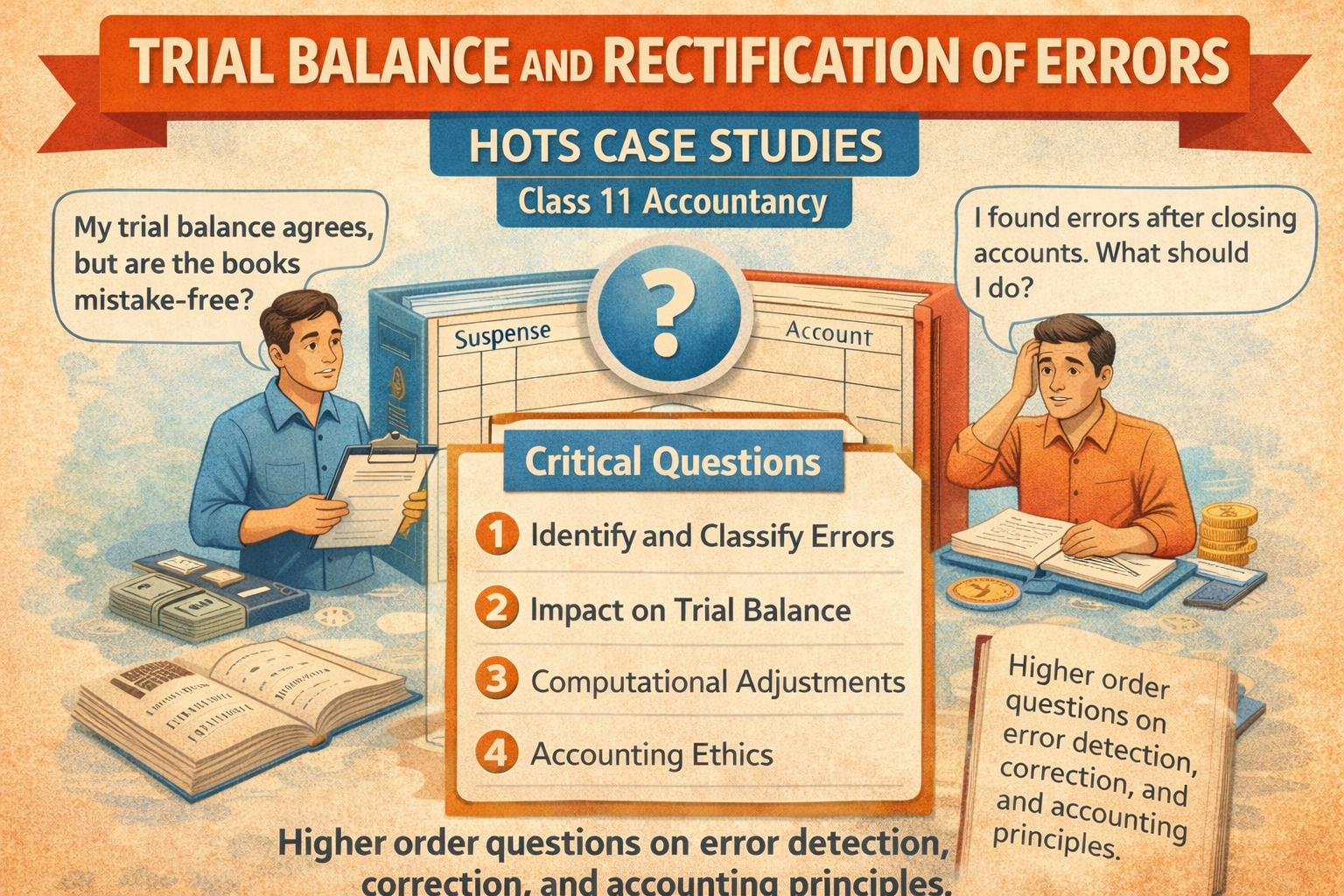
Trial Balance and Rectification of Errors
HOTS Case Study Questions (Higher Order Thinking Skills)
The following HOTS case studies from the chapter Trial Balance and Rectification of Errors are designed for Class 11 Accountancy students. These cases test analysis, application, evaluation, and logical reasoning, which are essential for scoring high marks in board exams and competitive tests.
Case Study 1: The Confident Accountant
M/s Shree Traders prepared its Trial Balance for the year ended 31 March 2024. The accountant, Mr. Verma, noticed that the Trial Balance agreed perfectly. He confidently declared that the books were free from errors.
However, during internal review, the following issues were found:
- Machinery purchased for ₹50,000 was debited to Purchases Account.
- Credit sales to Rohan ₹12,000 were correctly entered in Sales Book but posted to Mohan’s account.
- A credit purchase from Suresh ₹8,000 was completely omitted from the books.
- The total of Discount Allowed column in the Cash Book was understated by ₹1,500.
Mr. Verma was surprised because the Trial Balance still agreed.
Questions
Q1. Despite the agreement of Trial Balance, why were errors present? Explain logically.
Answer:
The Trial Balance checks only the arithmetical accuracy of ledger postings. Errors such as error of principle, complete omission, and compensating errors do not affect the agreement of the Trial Balance. In this case:
- Machinery treated as purchases is an error of principle.
- Posting to wrong person is an error of commission.
- Complete omission does not affect totals.
- Understatement in discount column may be compensated.
Hence, the Trial Balance agreed despite errors.
Q2. Identify which of the above errors affect the Trial Balance and which do not.
Answer:
Not affecting Trial Balance:
- Machinery debited to Purchases (error of principle)
- Posting to Mohan instead of Rohan (error of commission)
- Complete omission of credit purchase
Affecting Trial Balance:
- Understatement of Discount Allowed (one-sided error)
Q3. Suppose the Discount Allowed error was ₹1,500 short on debit side. What would be the impact?
Answer:
The debit side of Trial Balance would be short by ₹1,500, causing disagreement unless compensated by another error.
Q4. Explain why complete omission is considered more dangerous than other errors.
Answer:
Complete omission is dangerous because:
- It does not affect Trial Balance.
- It completely hides the transaction.
- It misstates profit and liabilities/assets.
- It is difficult to detect.
Thus, it threatens reliability of financial statements.
Q5. Suggest two internal control measures to prevent such errors.
Answer:
- Regular internal audit and ledger scrutiny.
- Proper classification review before posting.
Case Study 2: The Suspense Account Mystery
Priya prepared the Trial Balance of her firm and found a difference of ₹4,800. She transferred the difference to Suspense Account and prepared final accounts.
Later she discovered:
- Sales Book was overcast by ₹2,000.
- Goods worth ₹1,500 returned by customer were not recorded.
- Purchase of furniture ₹5,000 debited to Purchases Account.
- Credit purchase from Ramesh ₹1,300 posted twice in Purchases Book.
Priya now wants to rectify all errors and close the Suspense Account.
Questions
Q6. Which of the above errors will affect the Suspense Account? Explain.
Answer:
Errors affecting Suspense Account:
- Sales Book overcast ₹2,000 (one-sided)
- Sales return omitted ₹1,500 (partial omission)
Errors not affecting Suspense Account:
- Furniture debited to Purchases (error of principle)
- Purchase recorded twice (compensating/two-sided)
Q7. Calculate the revised balance of Suspense Account after rectification of one-sided errors.
Answer (Conceptual):
Original difference = ₹4,800
Adjust:
- Overcast sales book = ₹2,000
- Omitted sales return = ₹1,500
Total rectified through Suspense = ₹3,500
Remaining balance = ₹4,800 − ₹3,500 = ₹1,300
Q8. Why is furniture debited to purchases considered an error of principle?
Answer:
Because furniture is a capital asset, while purchases are revenue expenditure. Recording capital expenditure as revenue violates accounting principles.
Q9. What would be the impact of recording purchase twice?
Answer:
- Purchases overstated
- Profit understated
- Creditors overstated
But Trial Balance may still agree.
Q10. After full rectification, what should be the balance in Suspense Account?
Answer:
Zero balance, because all one-sided errors should be corrected.
Case Study 3: Pre-Trial vs Post-Trial Rectification
Ritika’s accountant found several errors. Some were detected before preparing the Trial Balance, while others were found later.
Errors:
- Salary ₹10,000 posted twice in Salary Account.
- Goods sold to Aman ₹6,000 recorded as ₹600.
- Carriage inward ₹2,500 omitted from Purchases Account.
- Building purchase ₹1,00,000 debited to Building but credit given to Cash ₹10,000 only.
Questions
Q11. Classify each error by type.
Answer:
- Error of commission (double posting)
- Error of commission (wrong amount)
- Error of omission (partial)
- Error of commission (wrong amount)
Q12. Which errors affect Trial Balance?
Answer:
Affect Trial Balance:
- Error 2
- Error 3
- Error 4
May not affect:
- Error 1 (if double posted correctly)
Q13. Explain why rectification before Trial Balance is preferable.
Answer:
- No need for Suspense Account
- Easier correction
- Cleaner books
- Saves time later
Q14. What is the most serious error in the above case? Why?
Answer:
Error in building purchase is most serious because it materially understates assets and misrepresents cash, affecting financial position significantly.
Q15. Suggest one audit procedure to detect wrong amount postings.
Answer:
Vouching entries with supporting documents like invoices and vouchers.
Case Study 4: Compensating Errors
During audit of M/s Modern Traders, the auditor noticed that the Trial Balance agreed but profits seemed unusually high. On investigation, he found:
- Purchases understated by ₹5,000
- Sales understated by ₹5,000
- Discount received overstated by ₹2,000
- Discount allowed overstated by ₹2,000
The accountant argued that since the Trial Balance agreed, the books were correct.
Questions
Q16. Explain the concept of compensating errors using this case.
Answer:
Compensating errors occur when two or more errors cancel each other’s effect on Trial Balance totals. Here:
- Purchases and sales both understated equally
- Discount allowed and received overstated equally
Thus, Trial Balance agrees despite errors.
Q17. What is the effect of these errors on profit?
Answer:
Purchases understated → profit overstated
Sales understated → profit understated
Discount received overstated → profit overstated
Discount allowed overstated → profit understated
Net effect may distort profit depending on amounts.
Q18. Why are compensating errors difficult to detect?
Answer:
- Trial Balance agrees
- Errors offset each other
- Require detailed scrutiny
Q19. Suggest two methods to detect compensating errors.
Answer:
- Analytical review of ratios
- Comparison with previous year figures
Q20. Do compensating errors affect reliability of financial statements? Justify.
Answer:
Yes. Even though Trial Balance agrees, profits and financial position may be misstated, reducing reliability of accounts.
Case Study 5: Ethical Dimension in Rectification
An accountant discovered errors after final accounts were prepared. Correcting them would reduce reported profit significantly. The business owner suggested ignoring the mistakes since the Trial Balance had agreed.
The accountant now faces an ethical dilemma.
Questions
Q21. From an accounting ethics perspective, what should the accountant do?
Answer:
The accountant must rectify the errors and present true and fair financial statements. Professional ethics require honesty and accuracy.
Q22. Which accounting concept supports correction of errors?
Answer:
True and Fair View concept and Prudence concept.
Q23. What risks arise if errors are intentionally ignored?
Answer:
- Misleading financial statements
- Legal consequences
- Loss of credibility
- Audit qualifications
Q24. How does rectification improve decision-making?
Answer:
It ensures accurate profit, correct asset values, and reliable financial information for stakeholders.
Q25. State one value highlighted through proper rectification.
Answer:
Integrity in accounting.
Final Note
These HOTS case studies from Trial Balance and Rectification of Errors help students develop:
- Analytical thinking
- Error detection skills
- Practical accounting judgment
- Board exam readiness
If you want next:
- Numerical worksheet
- Assertion–Reason questions
- Full sample paper
- Extra tough MCQs
Just say the word.




Leave a Reply