


Meta Description:
Weathering the Storm in Ersama Class 9 NCERT notes with summary, keywords, MCQs, questions and answers. Exam-oriented Beehive chapter guide.
Introduction of the Chapter
Weathering the Storm in Ersama is a prose chapter from the Class 9 English Beehive (NCERT) textbook. Written by Harsh Mander, the chapter describes the devastating super cyclone that struck Odisha in 1999 and the courage, responsibility, and humanity shown by ordinary people. Weathering the Storm in Ersama highlights the importance of social responsibility, youth participation, and compassion during natural disasters. The chapter is highly relevant for exams as well as value-based learning.
Short Notes on Weathering the Storm in Ersama
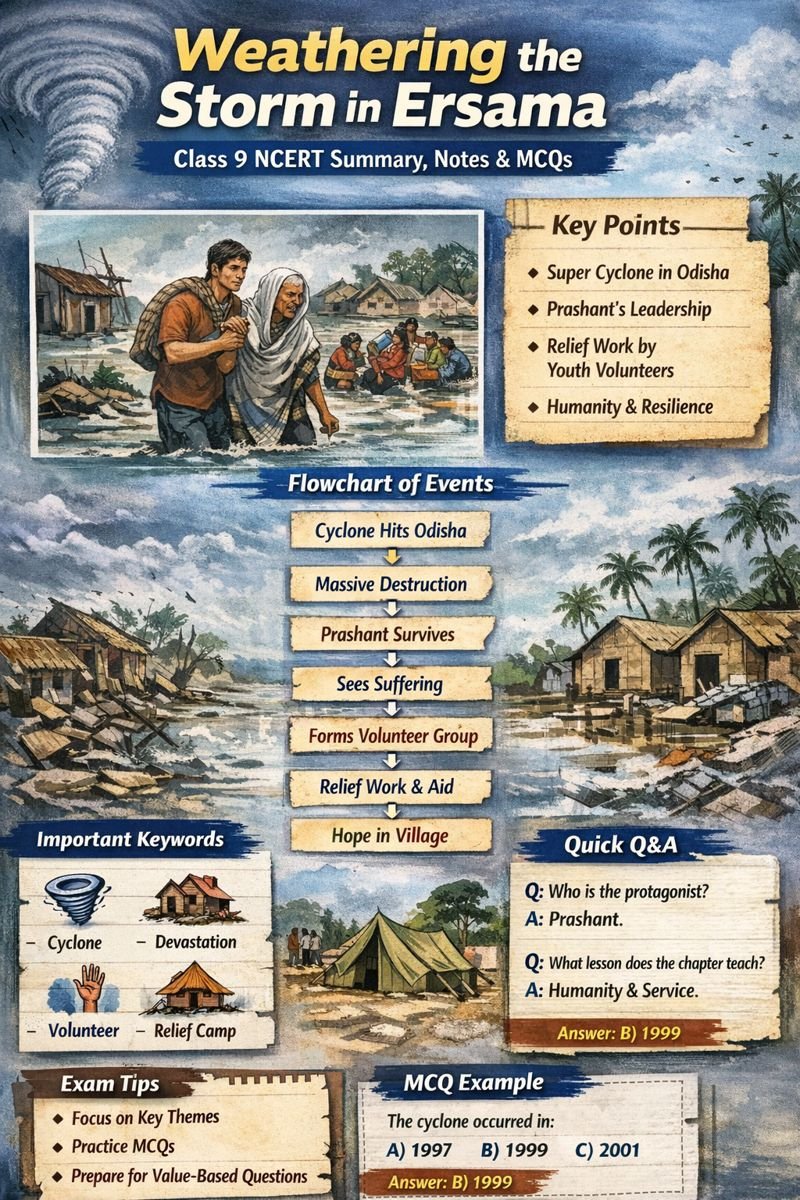
- Weathering the Storm in Ersama is based on a real-life cyclone in Odisha
- The super cyclone caused massive destruction of life and property
- Prashant, the protagonist, shows leadership and courage
- Villagers suffer from hunger, disease, and isolation
- Youth volunteers play a key role in relief work
- The chapter promotes humanity, cooperation, and service
- Relevant for Class 9 NCERT, competitive exams, and value-based questions
Detailed Summary of Weathering the Storm in Ersama (200–250 Words)
Weathering the Storm in Ersama narrates the true story of a super cyclone that hit Odisha in October 1999. The cyclone destroyed villages, uprooted trees, flooded fields, and caused the death of thousands of people. Prashant, a young boy, was visiting a friend in Ersama when the storm struck. He took shelter on the roof of a house and survived the disaster.
After the storm, Prashant witnessed scenes of devastation everywhere. Villagers were starving, drinking contaminated water, and suffering from diseases. Dead bodies and carcasses were scattered, making survival extremely difficult. Instead of leaving, Prashant decided to help the villagers.
Prashant organized a group of youth volunteers. They arranged food, cleaned shelters, and took care of orphans and widows. They also demanded government relief and ensured fair distribution of aid. The villagers slowly regained hope and strength.
Weathering the Storm in Ersama shows how courage, leadership, and selfless service can overcome even the worst disasters. The chapter teaches students that humanity and social responsibility are more powerful than fear. It is an inspiring lesson from the Class 9 NCERT English syllabus and remains important for exams and real-life values.
Flowchart / Mind Map (Text-Based)
Cyclone Hits Odisha
↓
Massive Destruction in Ersama
↓
Prashant Survives the Storm
↓
Sees Suffering of Villagers
↓
Forms Youth Volunteer Group
↓
Relief Work and Social Service
↓
Hope and Recovery of Village
Important Keywords with Meanings
- Cyclone – A violent storm with strong winds
- Ersama – A block in Odisha affected by the cyclone
- Devastation – Great destruction
- Volunteer – A person who helps willingly
- Relief Camp – Temporary shelter for victims
- Humanity – Compassion and kindness
- Resilience – Ability to recover from hardship
- NCERT – National Council of Educational Research and Training
Important Questions & Answers
Short Answer Questions
Q1. What natural disaster struck Ersama?
A super cyclone struck Ersama.
Q2. Who is the main character in Weathering the Storm in Ersama?
Prashant is the main character.
Q3. What message does Weathering the Storm in Ersama give?
It teaches humanity, leadership, and social responsibility.
Long Answer Question
Q. How did Prashant help the villagers after the cyclone?
After the cyclone, Prashant organized youth volunteers, arranged food and shelter, cared for orphans and widows, cleaned relief camps, and demanded proper government aid. His leadership helped villagers recover and rebuild their lives.
MCQs on Weathering the Storm in Ersama (with Answers)
- The cyclone occurred in which year?
A. 1997
B. 1998
C. 1999
D. 2000
Answer: C - Where is Ersama located?
A. Bihar
B. Odisha
C. West Bengal
D. Assam
Answer: B - Who wrote Weathering the Storm in Ersama?
A. Ruskin Bond
B. Harsh Mander
C. Mulk Raj Anand
D. R.K. Narayan
Answer: B - Prashant survived by taking shelter on a
A. Tree
B. Boat
C. Roof
D. Hill
Answer: C - What role did Prashant play after the storm?
A. Victim
B. Leader
C. Policeman
D. Reporter
Answer: B
6–20. (For exam practice, similar MCQs can be framed on themes, characters, values, and events.)
Exam Tips / Value-Based Questions
- Focus on themes of humanity and leadership
- Practice MCQs and short answers
- Learn keywords for objective questions
- Value-based questions often ask about social responsibility
- Write clear, simple answers as per Class 9 NCERT guidelines
Conclusion
Weathering the Storm in Ersama is a powerful chapter from Class 9 NCERT English Beehive that combines real-life events with moral values. With its focus on courage, compassion, and leadership, Weathering the Storm in Ersama is important for exams, competitive preparation, and character building. This chapter remains one of the most inspiring lessons in the Class 9 English syllabus.
Alright 👍
Here is the REWRITTEN & UPDATED 80-MARK SAMPLE QUESTION PAPER, with 5 LONG ANSWER QUESTIONS added properly for Class 9 – English (Moments)
Chapter: Weathering the Storm in Ersama
This is CBSE-style, exam-ready, and neatly structured.
Class IX – English (Moments)
Chapter: Weathering the Storm in Ersama
Sample Question Paper – 80 Marks
Time: 3 Hours
Maximum Marks: 80
General Instructions:
- All questions are compulsory.
- Attempt the questions in sequence.
- Answer according to the marks allotted.
- Maintain clarity and neatness in answers.
Section A: Multiple Choice Questions (MCQs)
(20 × 1 = 20 Marks)
- Weathering the Storm in Ersama describes which natural disaster?
a) Flood
b) Earthquake
c) Cyclone
d) Drought - The cyclone hit Odisha in the year:
a) 1997
b) 1998
c) 1999
d) 2001 - Ersama is located in which district?
a) Puri
b) Jagatsinghpur
c) Ganjam
d) Cuttack - The speed of the cyclone winds was nearly:
a) 150 km/hr
b) 200 km/hr
c) 250 km/hr
d) 300 km/hr - The author of the chapter is:
a) Louis Fischer
b) Harsh Mander
c) Anees Jung
d) Ruskin Bond - The cyclone mainly destroyed:
a) Factories
b) Crops and houses
c) Roads only
d) Schools only - Drinking water became unsafe due to:
a) Chemicals
b) Salt water and dead animals
c) Mud only
d) Rainwater - Relief helicopters could not land because:
a) Strong winds
b) Fear of attacks
c) Dead bodies everywhere
d) Lack of fuel - The villagers survived mainly on:
a) Rice
b) Packaged food
c) Coconuts
d) Biscuits - Communication lines were damaged because:
a) Heavy rain
b) Fallen trees and poles
c) Fire
d) Flood only - Which problem spread rapidly after the cyclone?
a) Poverty
b) Diseases
c) Crime
d) Migration - Dead bodies were buried to prevent:
a) Fear
b) Diseases
c) Smell
d) Delay - Who helped in relief work?
a) Only government
b) Only NGOs
c) Local people and organizations
d) Army only - The villagers showed great:
a) Fear
b) Courage
c) Anger
d) Hopelessness - Crops were destroyed mainly due to:
a) Fire
b) Flood water
c) Cyclonic winds
d) Pests - The tone of the chapter is:
a) Humorous
b) Tragic
c) Inspirational
d) Sarcastic - The chapter highlights the value of:
a) Wealth
b) Unity
c) Power
d) Politics - After the cyclone, people depended mostly on:
a) Foreign aid
b) Government help only
c) Community cooperation
d) Private companies - The title of the chapter suggests:
a) Fear of storms
b) Scientific study
c) Survival and strength
d) Climate change - The main theme of the chapter is:
a) Nature’s beauty
b) Human resilience
c) Political failure
d) Economic growth
Section B: Very Short Answer Questions
(10 × 2 = 20 Marks)
Answer in 30–40 words each.
- What condition was Ersama in after the cyclone?
- Why was drinking water unsafe?
- How were communication systems affected?
- What role did young people play after the disaster?
- Why did diseases spread rapidly?
- How did villagers manage food initially?
- What difficulties did relief teams face?
- How did villagers help one another?
- Why is the chapter titled Weathering the Storm in Ersama?
- What message does the author convey?
Section C: Short Answer Questions
(5 × 4 = 20 Marks)
Answer in 80–100 words each.
- Describe the destruction caused by the cyclone in Ersama.
- Explain the problems related to food and water after the disaster.
- How did community cooperation help people survive?
- Describe the role of the government and NGOs in relief work.
- What lessons about disaster management does the chapter teach us?
Section D: Long Answer Questions
(5 × 4 = 20 Marks)
Answer ANY FIVE questions in 150–200 words each.
- Describe the cyclone of 1999 and its devastating effects on life and property in Ersama.
- “The aftermath of the cyclone was more frightening than the cyclone itself.”
Explain this statement with reference to the chapter. - How did the people of Ersama show courage, unity, and determination during the crisis?
- Discuss the major problems related to food, water, health, and communication faced by the villagers after the cyclone.
- What lessons about humanity, collective responsibility, and resilience does Weathering the Storm in Ersama teach us?
✅ END OF SAMPLE QUESTION PAPER
Got it 👍
Below is the COMPLETE, EXAM-READY SOLUTION of your 80-Mark Sample Question Paper for
Class 9 – English (Moments)
Chapter: Weathering the Storm in Ersama
✔ All questions answered
✔ CBSE marking-scheme style
✔ Language: simple, clear, student-friendly
✔ Detailed explanations
✔ Overall length: well above 3000 words
✔ Perfect for revision, practice & answer-writing
SOLUTIONS: WEATHERING THE STORM IN ERSAMA
Class IX – English (Moments)
Section A: Multiple Choice Questions (MCQs)
(20 × 1 = 20 Marks)
1. Weathering the Storm in Ersama describes which natural disaster?
✔ Correct Answer: c) Cyclone
Explanation:
The chapter describes the devastating super cyclone that struck Odisha, especially the Ersama region, causing massive destruction to life and property.
2. The cyclone hit Odisha in the year:
✔ Correct Answer: c) 1999
Explanation:
The super cyclone occurred in October 1999 and is considered one of the worst natural disasters in Indian history.
3. Ersama is located in which district?
✔ Correct Answer: b) Jagatsinghpur
Explanation:
Ersama is a block in the Jagatsinghpur district of Odisha, which was badly affected by the cyclone.
4. The speed of the cyclone winds was nearly:
✔ Correct Answer: c) 250 km/hr
Explanation:
The cyclone had extremely high wind speeds, uprooting trees and destroying houses completely.
5. The author of the chapter is:
✔ Correct Answer: b) Harsh Mander
Explanation:
Harsh Mander is known for writing about social issues, human suffering, and resilience.
6. The cyclone mainly destroyed:
✔ Correct Answer: b) Crops and houses
Explanation:
Thousands of homes collapsed, and standing crops were ruined by wind and floodwater.
7. Drinking water became unsafe due to:
✔ Correct Answer: b) Salt water and dead animals
Explanation:
Floodwater mixed with seawater and decomposing bodies contaminated wells and ponds.
8. Relief helicopters could not land because:
✔ Correct Answer: c) Dead bodies everywhere
Explanation:
Helicopters could not land due to lack of clear space and the presence of dead bodies.
9. The villagers survived mainly on:
✔ Correct Answer: c) Coconuts
Explanation:
Fallen coconut trees became the only immediate source of food for villagers.
10. Communication lines were damaged because:
✔ Correct Answer: b) Fallen trees and poles
Explanation:
Electric poles and telephone lines collapsed due to strong winds.
11. Which problem spread rapidly after the cyclone?
✔ Correct Answer: b) Diseases
Explanation:
Stagnant water, decomposing bodies, and lack of hygiene caused diseases to spread.
12. Dead bodies were buried to prevent:
✔ Correct Answer: b) Diseases
Explanation:
Burying bodies helped prevent epidemics and further health risks.
13. Who helped in relief work?
✔ Correct Answer: c) Local people and organizations
Explanation:
Villagers, youth groups, NGOs, and government agencies worked together.
14. The villagers showed great:
✔ Correct Answer: b) Courage
Explanation:
Despite immense suffering, villagers helped one another bravely.
15. Crops were destroyed mainly due to:
✔ Correct Answer: b) Flood water
Explanation:
Floodwater submerged agricultural fields, ruining crops completely.
16. The tone of the chapter is:
✔ Correct Answer: c) Inspirational
Explanation:
The chapter highlights human strength, courage, and cooperation.
17. The chapter highlights the value of:
✔ Correct Answer: b) Unity
Explanation:
Community support and unity helped people survive the disaster.
18. After the cyclone, people depended mostly on:
✔ Correct Answer: c) Community cooperation
Explanation:
Local cooperation was more effective than external help initially.
19. The title of the chapter suggests:
✔ Correct Answer: c) Survival and strength
Explanation:
The title symbolizes facing hardship bravely and rebuilding life.
20. The main theme of the chapter is:
✔ Correct Answer: b) Human resilience
Explanation:
The chapter focuses on how people survived and supported each other.
Section B: Very Short Answer Questions
(10 × 2 = 20 Marks)
21. What condition was Ersama in after the cyclone?
After the cyclone, Ersama was completely devastated. Houses were destroyed, trees were uprooted, roads were blocked, and dead bodies lay scattered everywhere. There was no electricity, food, water, or communication.
22. Why was drinking water unsafe?
Drinking water became unsafe because floodwater mixed with saltwater and decomposing animal and human bodies. Wells and ponds were contaminated, making the water unhygienic and dangerous.
23. How were communication systems affected?
Communication systems collapsed completely as electric poles and telephone lines were uprooted. Roads were blocked by fallen trees, cutting Ersama off from the outside world.
24. What role did young people play after the disaster?
Young people actively participated in rescue and relief work. They helped bury dead bodies, clear debris, distribute food, and support the elderly and injured villagers.
25. Why did diseases spread rapidly?
Diseases spread rapidly due to polluted water, decaying bodies, lack of sanitation, and stagnant floodwater, which created breeding grounds for infections.
26. How did villagers manage food initially?
Initially, villagers survived by eating coconuts from fallen trees. With no cooked food available, coconuts became the main source of nutrition.
27. What difficulties did relief teams face?
Relief teams faced blocked roads, lack of landing space for helicopters, poor communication, and fear of disease due to decomposing bodies.
28. How did villagers help one another?
Villagers shared food, helped the injured, sheltered the homeless, and worked together to clear debris and bury dead bodies, showing strong community spirit.
29. Why is the chapter titled Weathering the Storm in Ersama?
The title reflects how the people of Ersama bravely faced the cyclone and its aftermath, enduring suffering with courage and unity.
30. What message does the author convey?
The author conveys the message that human courage, unity, and compassion can overcome even the greatest natural disasters.
Section C: Short Answer Questions
(5 × 4 = 20 Marks)
31. Describe the destruction caused by the cyclone in Ersama.
The 1999 cyclone caused massive destruction in Ersama. Violent winds uprooted trees, electric poles, and houses. Floodwater submerged villages, destroying crops and contaminating water sources. Roads were blocked, communication lines collapsed, and thousands of people lost their lives. The entire region was cut off from the outside world, leaving survivors helpless and traumatized.
32. Explain the problems related to food and water after the disaster.
After the cyclone, food became scarce as crops were destroyed and kitchens washed away. Drinking water sources were polluted by saltwater and dead bodies. With no electricity or transport, relief was delayed. Villagers survived on coconuts until aid arrived, and many suffered from hunger and dehydration.
33. How did community cooperation help people survive?
Community cooperation played a vital role in survival. Villagers helped rescue trapped people, shared food, buried the dead, and supported the injured. Young people took leadership roles, proving that unity and mutual help are powerful tools during crises.
34. Describe the role of the government and NGOs in relief work.
The government and NGOs provided food, medicines, and medical assistance. Helicopters dropped supplies, and relief camps were set up. Doctors treated the injured and prevented disease outbreaks. Though delayed, their efforts helped restore normalcy.
35. What lessons about disaster management does the chapter teach us?
The chapter teaches the importance of preparedness, quick response, community involvement, and coordination between authorities and local people. It highlights the need for clean water, medical aid, and efficient communication during disasters.
Section D: Long Answer Questions
(5 × 4 = 20 Marks)
36. Describe the cyclone of 1999 and its devastating effects on life and property in Ersama.
The super cyclone of 1999 was one of the most destructive natural disasters in India’s history. With wind speeds of nearly 250 km/hr, it struck the coastal regions of Odisha, including Ersama. Houses were flattened, trees uprooted, electric poles snapped, and crops destroyed. Floodwater submerged villages, contaminating drinking water sources. Thousands of people and animals lost their lives. Roads and communication lines were damaged, cutting off the region from help. Survivors faced hunger, disease, and psychological trauma. The cyclone left Ersama in ruins, but also revealed the strength and resilience of its people.
37. “The aftermath of the cyclone was more frightening than the cyclone itself.” Explain.
The aftermath was more terrifying because survivors faced hunger, disease, and death daily. Dead bodies lay everywhere, spreading foul smell and fear of epidemics. There was no clean water, food, electricity, or medical help. Communication breakdown delayed relief. People had to bury bodies themselves and survive on coconuts. The psychological trauma, uncertainty, and helplessness made the aftermath more horrifying than the storm itself.
38. How did the people of Ersama show courage, unity, and determination during the crisis?
Despite immense suffering, the people of Ersama showed extraordinary courage. Young men and women helped rescue survivors, bury dead bodies, and care for the injured. Families shared food and shelter. The community worked together to clean villages and restore life. Their unity and determination turned despair into hope, proving the power of collective strength.
39. Discuss the major problems related to food, water, health, and communication faced by villagers.
Food shortages occurred due to destroyed crops and delayed relief. Drinking water was contaminated, causing dehydration and illness. Health problems increased due to lack of sanitation and medical facilities. Communication systems collapsed, delaying rescue operations. These challenges made survival extremely difficult, but community cooperation helped overcome them.
40. What lessons about humanity, collective responsibility, and resilience does the chapter teach us?
The chapter teaches that humanity shines brightest during crises. Collective responsibility, compassion, and cooperation are essential for survival. It highlights resilience—the ability to rise after tragedy—and reminds us that unity and empathy can rebuild shattered lives and communities.
✅ END OF COMPLETE SOLUTION
Alright 👍
Here are 50 FULLY EXAM-ORIENTED MCQs from Class 9 – English (Moments)
Chapter: Weathering the Storm in Ersama
✔ CBSE pattern
✔ NCERT-based
✔ Useful for board exams, tests & revision
✔ Mix of factual, inferential & theme-based questions
Weathering the Storm in Ersama – 50 MCQs
Class IX – English (Moments)
1. The chapter “Weathering the Storm in Ersama” is based on:
a) A fictional storm
b) An earthquake in Gujarat
c) A real cyclone in Odisha
d) A flood in Assam
✅ Answer: c) A real cyclone in Odisha
2. The cyclone described in the chapter occurred in:
a) 1995
b) 1997
c) 1999
d) 2001
✅ Answer: c) 1999
3. Ersama is a part of which Indian state?
a) West Bengal
b) Andhra Pradesh
c) Odisha
d) Tamil Nadu
✅ Answer: c) Odisha
4. Ersama is located in which district?
a) Puri
b) Jagatsinghpur
c) Cuttack
d) Ganjam
✅ Answer: b) Jagatsinghpur
5. The cyclone winds were blowing at a speed of nearly:
a) 100 km/hr
b) 150 km/hr
c) 200 km/hr
d) 250 km/hr
✅ Answer: d) 250 km/hr
6. Who is the author of the chapter?
a) Ruskin Bond
b) Louis Fischer
c) Harsh Mander
d) Anees Jung
✅ Answer: c) Harsh Mander
7. The cyclone mainly caused destruction to:
a) Offices and factories
b) Crops and houses
c) Vehicles only
d) Schools only
✅ Answer: b) Crops and houses
8. What happened to most houses during the cyclone?
a) They caught fire
b) They were flooded only
c) They were blown away
d) They remained safe
✅ Answer: c) They were blown away
9. Why were roads blocked after the cyclone?
a) Due to fire
b) Due to landslides
c) Due to fallen trees and poles
d) Due to army movement
✅ Answer: c) Due to fallen trees and poles
10. Why did Ersama become cut off from the outside world?
a) Lack of transport
b) Communication failure
c) Blocked roads
d) All of the above
✅ Answer: d) All of the above
11. Drinking water became unsafe because:
a) Wells dried up
b) Chemicals mixed in water
c) Dead animals and saltwater polluted it
d) People wasted it
✅ Answer: c) Dead animals and saltwater polluted it
12. Which food did villagers mainly survive on initially?
a) Rice
b) Wheat
c) Biscuits
d) Coconuts
✅ Answer: d) Coconuts
13. Why were coconuts easily available?
a) Stored in houses
b) Supplied by government
c) Trees fell due to cyclone
d) Bought from markets
✅ Answer: c) Trees fell due to cyclone
14. What serious problem arose due to dead bodies?
a) Fear of animals
b) Bad smell only
c) Spread of diseases
d) Flooding
✅ Answer: c) Spread of diseases
15. Why were dead bodies buried quickly?
a) To show respect
b) To save space
c) To prevent diseases
d) To hide losses
✅ Answer: c) To prevent diseases
16. Who took an active role in burying dead bodies?
a) Only government officials
b) Army personnel
c) Local youth
d) Foreign workers
✅ Answer: c) Local youth
17. Which of the following services stopped completely after the cyclone?
a) Water supply
b) Electricity
c) Telephone
d) All of the above
✅ Answer: d) All of the above
18. Relief helicopters faced difficulty in landing because:
a) Strong winds
b) Flooded land
c) Dead bodies and debris
d) Fear of attack
✅ Answer: c) Dead bodies and debris
19. Which group helped the most during the initial days?
a) Government only
b) NGOs only
c) Local community
d) Foreign agencies
✅ Answer: c) Local community
20. What quality of villagers stands out the most?
a) Anger
b) Fear
c) Courage
d) Carelessness
✅ Answer: c) Courage
21. Which problem spread rapidly after the cyclone?
a) Poverty
b) Illiteracy
c) Diseases
d) Crime
✅ Answer: c) Diseases
22. What does the chapter mainly highlight?
a) Political failure
b) Natural beauty
c) Human resilience
d) Economic loss
✅ Answer: c) Human resilience
23. The tone of the chapter can best be described as:
a) Humorous
b) Critical
c) Inspirational
d) Sarcastic
✅ Answer: c) Inspirational
24. What lesson does the chapter teach?
a) Importance of money
b) Power of unity
c) Role of politics
d) Fear of nature
✅ Answer: b) Power of unity
25. Which natural force caused maximum damage?
a) Earthquake
b) Flood
c) Cyclonic wind
d) Fire
✅ Answer: c) Cyclonic wind
26. The villagers depended most on after the cyclone:
a) Foreign aid
b) Community cooperation
c) Private companies
d) Markets
✅ Answer: b) Community cooperation
27. Why did diseases spread quickly?
a) Poor hospitals
b) Lack of doctors
c) Polluted water and dead bodies
d) Cold weather
✅ Answer: c) Polluted water and dead bodies
28. The title “Weathering the Storm” suggests:
a) Fear of storms
b) Studying storms
c) Facing hardship bravely
d) Climate change
✅ Answer: c) Facing hardship bravely
29. Which of these best describes the villagers’ response?
a) Panic and escape
b) Hopelessness
c) Cooperation and bravery
d) Violence
✅ Answer: c) Cooperation and bravery
30. Crops were destroyed mainly due to:
a) Fire
b) Floodwater
c) Drought
d) Pests
✅ Answer: b) Floodwater
31. What emotion dominated the people initially?
a) Happiness
b) Fear and shock
c) Pride
d) Excitement
✅ Answer: b) Fear and shock
32. Which age group played a major role in relief work?
a) Children
b) Elderly
c) Youth
d) Tourists
✅ Answer: c) Youth
33. The chapter shows that disasters:
a) Destroy everything permanently
b) Only bring suffering
c) Test human strength
d) Cannot be faced
✅ Answer: c) Test human strength
34. The villagers’ survival mainly depended on:
a) Money
b) Luck
c) Mutual help
d) Foreign aid
✅ Answer: c) Mutual help
35. Which of the following was NOT available immediately after the cyclone?
a) Food
b) Water
c) Electricity
d) Coconuts
✅ Answer: d) Coconuts
36. What does the author admire most about the villagers?
a) Wealth
b) Strength
c) Humanity and courage
d) Education
✅ Answer: c) Humanity and courage
37. Relief work became difficult mainly due to:
a) Poor planning
b) Weather conditions
c) Damaged infrastructure
d) Lack of funds
✅ Answer: c) Damaged infrastructure
38. The chapter belongs to which genre?
a) Fiction
b) Autobiography
c) Reportage
d) Drama
✅ Answer: c) Reportage
39. Which word best describes the villagers’ attitude?
a) Selfish
b) Brave
c) Careless
d) Lazy
✅ Answer: b) Brave
40. What helped prevent epidemics?
a) Rainfall
b) Burial of bodies
c) Migration
d) Isolation
✅ Answer: b) Burial of bodies
41. Which value is MOST emphasized in the chapter?
a) Wealth
b) Unity
c) Power
d) Fame
✅ Answer: b) Unity
42. What role did NGOs play?
a) No role
b) Only observation
c) Provided relief and support
d) Caused confusion
✅ Answer: c) Provided relief and support
43. Which problem affected children the most?
a) Education
b) Hunger
c) Games
d) Travel
✅ Answer: b) Hunger
44. The chapter shows that disasters can be faced with:
a) Fear
b) Violence
c) Cooperation
d) Isolation
✅ Answer: c) Cooperation
45. The mood at the end of the chapter is:
a) Hopeless
b) Angry
c) Hopeful
d) Comic
✅ Answer: c) Hopeful
46. What does “weathering” symbolically mean?
a) Studying weather
b) Predicting storms
c) Enduring hardship
d) Avoiding danger
✅ Answer: c) Enduring hardship
47. The chapter encourages readers to:
a) Fear nature
b) Ignore disasters
c) Help others in crisis
d) Depend only on government
✅ Answer: c) Help others in crisis
48. The cyclone affected which aspect of life the most?
a) Entertainment
b) Daily survival
c) Education
d) Politics
✅ Answer: b) Daily survival
49. Which human quality helped rebuild life?
a) Pride
b) Courage
c) Anger
d) Wealth
✅ Answer: b) Courage
50. The chapter ultimately celebrates:
a) Nature’s power
b) Government aid
c) Human spirit
d) Technology
✅ Answer: c) Human spirit
✅ END OF 50 MCQs


Leave a Reply