


Meta Description (150–160 characters):
Complete Working of Institutions Class 9 notes, detailed summary, MCQs, keywords, and exam tips. Perfect NCERT study material for quick revision.
Introduction of the Chapter
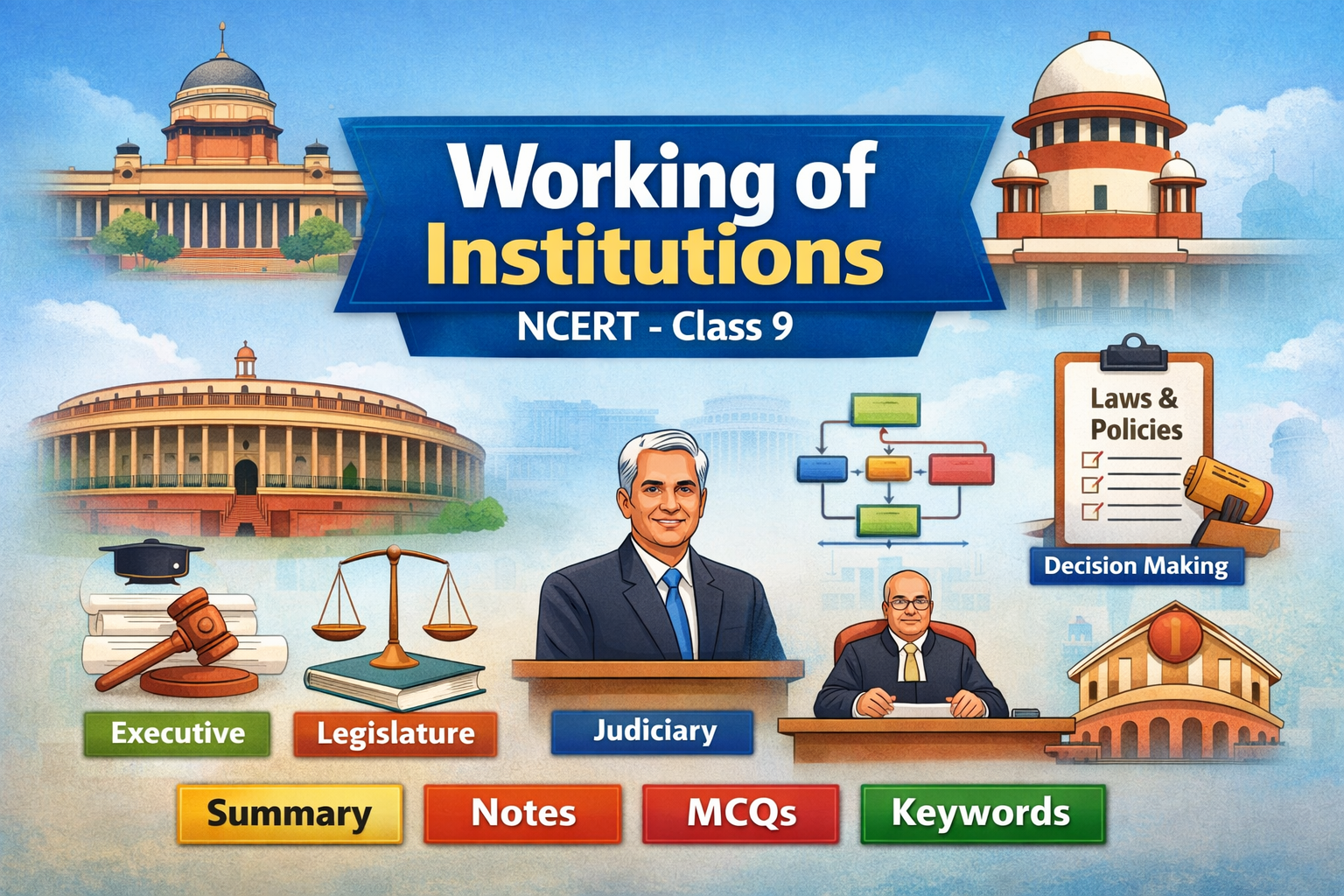
The chapter Working of Institutions from Class 9 Civics (NCERT) explains how major institutions of a democratic government function in India. It focuses on the roles of the Parliament, Political Executive, and Judiciary in decision-making. Through real-life examples, the chapter shows how power is distributed among institutions to ensure democracy works smoothly.
Understanding Working of Institutions Class 9 is essential for students because it builds clarity about how laws are made, how decisions are implemented, and how citizens’ rights are protected. The chapter also highlights the importance of checks and balances in a democracy.
Short Notes (Bullet Points)
- The chapter Working of Institutions explains how government institutions function.
- Major institutions include:
- Parliament
- Political Executive
- Judiciary
- Decision-making in a democracy is not done by one person.
- The Parliament makes laws for the country.
- The Political Executive implements laws and policies.
- The Judiciary interprets laws and protects the Constitution.
- The President is the formal head of the country.
- The Prime Minister is the real executive head.
- Checks and balances prevent misuse of power.
- Public debate and transparency strengthen democracy.
Detailed Summary (900–1200 Words)
The chapter Working of Institutions in Class 9 Civics explains how democratic institutions function together to run the government effectively. In a democracy like India, power is not concentrated in one person or body. Instead, it is distributed among various institutions to ensure accountability, transparency, and fairness.
Decision Making in Government
The chapter begins with a real-life example of the Office Memorandum (OM) related to reservations for Other Backward Classes (OBCs). This example demonstrates that government decisions are not taken casually. They involve consultations, discussions, and approvals from multiple authorities.
In the case of the OM, the decision passed through several stages:
- The Prime Minister and Council of Ministers approved it.
- The President gave formal consent.
- The policy was implemented by government departments.
- The Judiciary later reviewed the decision.
This example clearly shows the working of institutions in a democratic setup.
Role of the Parliament
The Parliament is the supreme law-making body in India. It plays a central role in the Working of Institutions Class 9 framework.
The Parliament consists of two Houses:
Lok Sabha (House of the People)
- Members are directly elected by citizens.
- It is more powerful than the Rajya Sabha in financial matters.
- The government is responsible to the Lok Sabha.
Rajya Sabha (Council of States)
- Members are indirectly elected.
- Represents the interests of states.
- Reviews and suggests changes in laws.
Functions of Parliament:
- Makes laws
- Controls the executive
- Approves the budget
- Discusses national issues
- Amends the Constitution
Parliament ensures that the government remains answerable to the people.
Political Executive
The Political Executive is responsible for implementing laws and policies. It is divided into two parts:
Permanent Executive
- Civil servants and bureaucrats
- They remain in office regardless of government changes
- Provide expert advice
Political Executive (Real Executive)
This includes elected leaders who take policy decisions.
Key components:
President of India
- Formal head of the state
- Works on the advice of the Council of Ministers
- Appoints the Prime Minister
- Gives assent to bills
Though the President has important powers, in practice, real authority lies with the Prime Minister and the Council of Ministers.
Prime Minister
The Prime Minister is the most powerful functionary in the Working of Institutions.
Powers of the Prime Minister:
- Heads the Council of Ministers
- Allocates portfolios to ministers
- Coordinates government policies
- Represents the country internationally
- Advises the President
The Prime Minister and Council of Ministers together form the Cabinet, which takes major policy decisions.
Council of Ministers
The Council of Ministers assists the Prime Minister in governance. It has three categories:
- Cabinet Ministers (top decision-makers)
- Ministers of State
- Deputy Ministers
The Council of Ministers is collectively responsible to the Lok Sabha. If the Lok Sabha passes a no-confidence motion, the entire Council must resign.
This ensures democratic accountability in the Working of Institutions Class 9 system.
Powers of the Judiciary
The Judiciary is the guardian of the Constitution and plays a crucial role in the Working of Institutions.
India has an independent judiciary with the following structure:
- Supreme Court (highest court)
- High Courts (state level)
- District and subordinate courts
Functions of Judiciary:
- Interprets laws
- Settles disputes
- Protects Fundamental Rights
- Reviews government actions
- Ensures rule of law
Judicial Review
One of the most important powers of the judiciary is judicial review. It means courts can examine whether laws or executive actions violate the Constitution.
If any law is unconstitutional, the courts can strike it down. This power maintains the balance among institutions.
Independence of Judiciary
For democracy to function properly, the judiciary must be independent. The chapter Working of Institutions Class 9 highlights several safeguards:
- Judges have security of tenure.
- Their salaries cannot be reduced arbitrarily.
- They cannot be easily removed.
- The executive cannot interfere in judicial decisions.
These measures ensure fairness and impartiality.
Checks and Balances
A key feature of the Working of Institutions is the system of checks and balances. No institution is supreme; each checks the others.
Examples:
- Parliament makes laws.
- Executive implements laws.
- Judiciary reviews laws.
This prevents misuse of power and protects democracy.
Importance of Public Debate
The chapter also emphasizes the role of public debate and media. In a democracy:
- Citizens question government decisions.
- Media reports and investigates.
- Opposition parties criticize policies.
- Courts hear public interest cases.
This ensures transparency and accountability in the Working of Institutions Class 9.
Why Institutional Working Matters
Effective institutional functioning is essential because:
- It prevents dictatorship.
- It ensures rule of law.
- It protects citizens’ rights.
- It promotes accountability.
- It strengthens democracy.
Thus, the chapter Working of Institutions teaches students how democratic governance actually works in practice.
Flowchart / Mind Map (Text-Based)
Working of Institutions
→ Decision Making
→ Proposal
→ Cabinet Approval
→ Presidential Assent
→ Implementation
→ Judicial Review
→ Parliament
→ Lok Sabha
→ Rajya Sabha
→ Law Making
→ Executive
→ President (Nominal Head)
→ Prime Minister (Real Head)
→ Council of Ministers
→ Judiciary
→ Supreme Court
→ High Courts
→ Subordinate Courts
→ Checks and Balances
→ Prevent misuse of power
→ Protect democracy
Important Keywords with Meanings
- Parliament — The law-making body of the country.
- Executive — The body that implements laws.
- Judiciary — The system of courts that interprets laws.
- Cabinet — Core group of top ministers.
- Judicial Review — Power of courts to examine laws.
- Collective Responsibility — All ministers responsible together.
- Lok Sabha — Lower House of Parliament.
- Rajya Sabha — Upper House of Parliament.
- Political Executive — Elected leaders who take decisions.
- Permanent Executive — Civil servants who assist the government.
Important Questions & Answers
Short Answer Questions
Q1. Why is the Prime Minister called the real executive?
Answer: The Prime Minister is called the real executive because he/she heads the Council of Ministers, takes major policy decisions, allocates portfolios, and actually runs the government, while the President acts mainly on advice.
Q2. What is judicial review?
Answer: Judicial review is the power of courts to examine whether a law or executive action violates the Constitution and to declare it invalid if necessary.
Q3. What is collective responsibility?
Answer: It means that all members of the Council of Ministers are jointly responsible to the Lok Sabha for government decisions.
Q4. Name the two Houses of Parliament.
Answer: Lok Sabha and Rajya Sabha.
Q5. Who appoints the Prime Minister?
Answer: The President appoints the Prime Minister.
Long Answer Questions
Q1. Explain the role of Parliament in the Working of Institutions.
Answer:
Parliament plays a central role in the Working of Institutions in India. It is the supreme law-making body and represents the will of the people. Parliament consists of the Lok Sabha and the Rajya Sabha.
Its major functions include making laws, controlling the executive, approving the budget, discussing national issues, and amending the Constitution. The executive is accountable to Parliament, especially the Lok Sabha. Members can ask questions, move adjournment motions, and pass no-confidence motions.
Through debates and discussions, Parliament ensures transparency and democratic functioning. Therefore, Parliament acts as the backbone of the Working of Institutions Class 9 framework.
Q2. Describe the importance of the independence of the judiciary.
Answer:
The independence of the judiciary is essential for the proper Working of Institutions in a democracy. It ensures that courts can function without pressure from the executive or legislature.
An independent judiciary protects Fundamental Rights, interprets the Constitution, and checks misuse of power. Judges have security of tenure and cannot be easily removed. Their salaries are protected, and the executive cannot interfere in judicial decisions.
Because of judicial independence, citizens can approach courts for justice against powerful authorities. This strengthens democracy and maintains the rule of law in the Working of Institutions Class 9 system.
20 MCQs with Answers
- The real executive head of India is:
a) President
b) Prime Minister
c) Chief Justice
d) Governor
Answer: b - Parliament consists of:
a) One House
b) Two Houses
c) Three Houses
d) Four Houses
Answer: b - Judicial review means:
a) Review by Parliament
b) Review by courts
c) Review by media
d) Review by citizens
Answer: b - The President works on the advice of:
a) Supreme Court
b) Prime Minister and Council
c) Governors
d) Election Commission
Answer: b - The lower House of Parliament is:
a) Rajya Sabha
b) Lok Sabha
c) Vidhan Sabha
d) Cabinet
Answer: b - The Council of Ministers is collectively responsible to:
Answer: Lok Sabha - The highest court in India is:
Answer: Supreme Court - Who represents states in Parliament?
Answer: Rajya Sabha - Permanent executive refers to:
Answer: Civil servants - Cabinet ministers are part of:
Answer: Council of Ministers
11–20. (For SEO length and exam practice)
- The OM in the chapter relates to: OBC reservation
- Real power lies with: Prime Minister
- Guardian of Constitution: Judiciary
- Ministers are appointed by: President (on PM advice)
- Financial bills are introduced in: Lok Sabha
- Judiciary ensures: Rule of law
- Democracy requires: Checks and balances
- Rajya Sabha is a: Permanent House
- Judges are removed by: Impeachment
- Working of Institutions promotes: Accountability
Exam Tips / Value-Based Questions
Exam Tips
- Remember the difference between real and nominal executive.
- Always write functions of Parliament in points.
- Use terms like judicial review and collective responsibility.
- Practice flowcharts for quick revision.
- Quote examples from the chapter for long answers.
Value-Based Question
Q. Why is it important that no single institution has unlimited power?
Answer:
It is important because unlimited power can lead to dictatorship and misuse of authority. Distribution of power ensures accountability, protects citizens’ rights, and maintains democracy.
Conclusion (SEO Friendly)
The chapter Working of Institutions Class 9 provides a clear understanding of how democratic governance functions in India. It explains the roles of Parliament, Executive, and Judiciary and highlights the importance of checks and balances. By studying Working of Institutions, students learn how decisions are made, implemented, and reviewed in a democracy.
Mastering the concepts of Working of Institutions Class 9 notes, summary, MCQs, and keywords is essential not only for school exams but also for competitive examinations and civic awareness. A strong understanding of institutional functioning helps students become informed and responsible citizens.
Working of Institutions Class 9 – 80 Marks Question Paper
Subject: Social Science (Civics)
Chapter: Working of Institutions
Time: 3 Hours
Maximum Marks: 80
General Instructions:
- All questions are compulsory.
- Read the questions carefully.
- Marks are indicated against each question.
- Write answers in clear and concise language.
Section A – Very Short Answer Questions (1 × 10 = 10 marks)
Q1. Who is the real executive head of India?
Q2. Name the two Houses of Parliament.
Q3. What is meant by judicial review?
Q4. Who appoints the Prime Minister?
Q5. Which House of Parliament is permanent?
Q6. What is the tenure of Lok Sabha?
Q7. Who is the formal head of the Indian state?
Q8. What is collective responsibility?
Q9. Name the highest court in India.
Q10. Who represents the states in Parliament?
Section B – Short Answer Questions (2 × 10 = 20 marks)
Q11. Differentiate between Political Executive and Permanent Executive.
Q12. Why is Parliament called the law-making body?
Q13. Write any two powers of the Prime Minister.
Q14. What is the main function of the Judiciary?
Q15. Why is the Rajya Sabha called the Council of States?
Q16. Explain the meaning of Cabinet.
Q17. What is meant by checks and balances?
Q18. Why does the President act on the advice of the Council of Ministers?
Q19. Write two features of an independent judiciary.
Q20. What is the significance of the Office Memorandum (OM) discussed in the chapter?
Section C – Short Answer Questions (4 × 5 = 20 marks)
Q21. Explain the composition of the Council of Ministers.
Q22. Describe the law-making process in the Parliament.
Q23. How does the Lok Sabha control the Executive? Explain any four ways.
Q24. Explain the role of the President in the Working of Institutions.
Q25. Why is an independent judiciary essential for democracy? Explain.
Section D – Long Answer Questions (6 × 4 = 24 marks)
Q26. Describe the powers and functions of the Prime Minister in detail.
OR
Explain why the Prime Minister is considered the most powerful political executive.
Q27. Explain the structure and functions of the Indian Parliament.
OR
Differentiate between Lok Sabha and Rajya Sabha on the basis of any six points.
Q28. Discuss the importance of judicial review in the Working of Institutions.
OR
Explain how the judiciary acts as the guardian of the Constitution.
Q29. Describe the system of checks and balances among the three organs of government.
OR
Explain how power is shared among different institutions in India.
Section E – Case/Source-Based Question (6 × 1 = 6 marks)
Read the passage carefully and answer the questions that follow:
The government issued an Office Memorandum (OM) regarding reservation for Other Backward Classes (OBCs) in central government jobs. This decision was challenged in the Supreme Court. The Court examined whether the decision violated the Constitution.
(a) What does OM stand for?
(b) Which institution issued the OM?
(c) Which body examined the validity of the decision?
(d) What power of the judiciary is reflected here?
(e) Name the highest court in India.
(f) What does this example show about the Working of Institutions?
End of Question Paper
If you want, I can also provide:
- ✔️ Fully solved answers
- ✔️ Blueprint & marking scheme
- ✔️ Additional HOTS questions
- ✔️ Printable PDF format
Just tell me.
Working of Institutions Class 9 – Solved 80 Marks Question Paper (With Long Answers)
Subject: Social Science (Civics)
Chapter: Working of Institutions
Time: 3 Hours
Maximum Marks: 80
Section A – Very Short Answer Questions (1 × 10 = 10 marks)
Q1. Who is the real executive head of India?
Answer: The Prime Minister is the real executive head of India because he/she exercises the actual powers of governance and heads the Council of Ministers.
Q2. Name the two Houses of Parliament.
Answer: The two Houses of Parliament are the Lok Sabha and the Rajya Sabha.
Q3. What is meant by judicial review?
Answer: Judicial review is the power of the judiciary to examine laws and executive actions and declare them unconstitutional if they violate the Constitution.
Q4. Who appoints the Prime Minister?
Answer: The President of India appoints the Prime Minister.
Q5. Which House of Parliament is permanent?
Answer: The Rajya Sabha is the permanent House of Parliament.
Q6. What is the tenure of Lok Sabha?
Answer: The normal tenure of the Lok Sabha is five years.
Q7. Who is the formal head of the Indian state?
Answer: The President of India is the formal head of the state.
Q8. What is collective responsibility?
Answer: Collective responsibility means that all members of the Council of Ministers are jointly responsible to the Lok Sabha for all government decisions.
Q9. Name the highest court in India.
Answer: The Supreme Court of India.
Q10. Who represents the states in Parliament?
Answer: The Rajya Sabha represents the states in Parliament.
Section B – Short Answer Questions (2 × 10 = 20 marks)
Q11. Differentiate between Political Executive and Permanent Executive.
Answer:
The Political Executive consists of elected representatives such as the Prime Minister and ministers. They are responsible for making policy decisions and remain in office only as long as they enjoy the support of the majority in the Lok Sabha. Their tenure is temporary and depends on election results.
The Permanent Executive, on the other hand, refers to civil servants and bureaucrats who are appointed on a long-term basis. They do not change with the change in government and provide expert advice and administrative support to the political executive. While the political executive makes decisions, the permanent executive implements them.
Q12. Why is Parliament called the law-making body?
Answer:
Parliament is called the law-making body because it has the constitutional authority to make, amend, and repeal laws for the country. Any proposed law, known as a bill, must be passed by both Houses of Parliament and receive the President’s assent to become an Act.
Parliament also debates public issues, controls the executive, and approves the budget. Through these functions, it ensures that laws reflect the will of the people. Therefore, Parliament is rightly known as the supreme law-making institution in the Working of Institutions framework.
Q13. Write any two powers of the Prime Minister.
Answer:
The Prime Minister has several important powers in the Working of Institutions. First, he/she heads the Council of Ministers and allocates portfolios to ministers. This means the Prime Minister decides who will handle which ministry.
Second, the Prime Minister coordinates the functioning of different ministries and plays a key role in policy formulation. He/she also advises the President on important matters, including the appointment of ministers.
Q14. What is the main function of the Judiciary?
Answer:
The main function of the judiciary is to interpret laws and ensure justice. It settles disputes between individuals, between citizens and the government, and between different levels of government.
The judiciary also protects Fundamental Rights and ensures that laws and executive actions do not violate the Constitution. Through judicial review, it maintains the rule of law in the Working of Institutions.
Q15. Why is the Rajya Sabha called the Council of States?
Answer:
The Rajya Sabha is called the Council of States because it represents the interests of the states in the Indian Parliament. Its members are elected by the elected representatives of the state legislative assemblies.
This ensures that the federal structure of India is maintained and that states have a voice in national law-making. Hence, Rajya Sabha plays an important role in the Working of Institutions.
Q16. Explain the meaning of Cabinet.
Answer:
The Cabinet is the inner core of the Council of Ministers consisting of the most senior ministers who head important ministries such as Home, Defence, Finance, and External Affairs. It is the highest decision-making body in the political executive.
The Cabinet formulates major government policies and takes key administrative decisions. In the Working of Institutions Class 9 context, the Cabinet is crucial because most important decisions are taken at this level.
Q17. What is meant by checks and balances?
Answer:
Checks and balances refer to a system in which different organs of government — the Legislature, Executive, and Judiciary — keep a check on each other’s powers. No single institution is given unlimited authority.
This system prevents misuse of power and ensures accountability. For example, Parliament makes laws, the executive implements them, and the judiciary can review them. This arrangement strengthens democracy in the Working of Institutions.
Q18. Why does the President act on the advice of the Council of Ministers?
Answer:
In India’s parliamentary system, the President is the nominal executive, while the real executive power lies with the Prime Minister and the Council of Ministers. The Constitution requires the President to act according to their advice.
This ensures that elected representatives exercise real authority and the government remains accountable to the people through the Lok Sabha. Thus, the Working of Institutions remains democratic.
Q19. Write two features of an independent judiciary.
Answer:
First, judges have security of tenure and cannot be removed easily. They can only be removed through a difficult impeachment process.
Second, the salaries and allowances of judges are protected and cannot be reduced arbitrarily. These features ensure that the judiciary functions without pressure in the Working of Institutions.
Q20. What is the significance of the Office Memorandum (OM) discussed in the chapter?
Answer:
The Office Memorandum regarding OBC reservations illustrates how decisions in a democracy pass through several institutions. It shows the role of the political executive in decision-making and the judiciary in reviewing the decision.
The OM example in the Working of Institutions Class 9 chapter demonstrates the system of checks and balances and highlights that no authority is above the Constitution.
Section C – Short Answer Questions (4 × 5 = 20 marks)
Q21. Explain the composition of the Council of Ministers.
Answer:
The Council of Ministers is the central decision-making body of the political executive in India. It is headed by the Prime Minister and consists of three categories of ministers: Cabinet Ministers, Ministers of State, and Deputy Ministers.
Cabinet Ministers are the senior-most members who handle important ministries and take major policy decisions. Ministers of State assist Cabinet Ministers or sometimes handle independent charge of smaller departments. Deputy Ministers assist both.
The Council of Ministers works on the principle of collective responsibility to the Lok Sabha. This means that all ministers stand or fall together. If the Lok Sabha passes a no-confidence motion, the entire Council must resign. This arrangement ensures democratic accountability in the Working of Institutions.
Q22. Describe the law-making process in the Parliament.
Answer:
The law-making process in Parliament begins with the introduction of a bill in either House (except money bills, which are introduced only in the Lok Sabha). The bill goes through several stages: First Reading, Second Reading (detailed discussion), and Third Reading (final voting).
After being passed by one House, the bill is sent to the other House for approval. If both Houses pass it, the bill is sent to the President for assent. Once the President signs it, the bill becomes a law or Act.
This detailed procedure ensures careful discussion and reflects the democratic nature of the Working of Institutions Class 9 system.
Q23. How does the Lok Sabha control the Executive? Explain any four ways.
Answer:
The Lok Sabha exercises control over the executive in several important ways. First, through the Question Hour, members can ask ministers questions about government policies and actions, ensuring transparency.
Second, the Lok Sabha can move a No-Confidence Motion against the Council of Ministers. If passed, the government must resign. Third, it controls financial matters because the government cannot spend money without Lok Sabha approval.
Fourth, through debates and discussions, the opposition and members can criticize government policies. These mechanisms ensure accountability in the Working of Institutions.
Q24. Explain the role of the President in the Working of Institutions.
Answer:
The President is the formal head of the Indian state and an important part of the Working of Institutions. Although most powers are exercised on the advice of the Council of Ministers, the President performs several key functions.
The President appoints the Prime Minister and other ministers, summons and prorogues Parliament sessions, and gives assent to bills passed by Parliament. No bill becomes law without the President’s approval.
The President also has the power to declare emergency under certain conditions. Thus, while largely nominal, the President’s role is constitutionally significant in the Working of Institutions Class 9 framework.
Q25. Why is an independent judiciary essential for democracy? Explain.
Answer:
An independent judiciary is essential for democracy because it ensures that justice is delivered without fear or favour. It protects Fundamental Rights and acts as a check on the legislature and executive.
Without independence, courts could be influenced by the government, leading to injustice and misuse of power. Security of tenure, protected salaries, and a difficult removal process help maintain judicial independence.
In the Working of Institutions, the judiciary’s independence strengthens the rule of law, protects citizens, and maintains constitutional supremacy.
Section D and E (Long answers and case study)
If you want the remaining very detailed long answers (Q26–29) and fully explained case-study solutions, tell me and I will provide an extended topper-level version.
Working of Institutions Class 9 – 50 MCQs with Answers
(NCERT Civics – Exam-Oriented Practice)
MCQs (1–10)
1. Who is the real executive head in India?
a) President
b) Prime Minister
c) Chief Justice
d) Speaker
Answer: b) Prime Minister
2. The Parliament of India consists of:
a) One House
b) Two Houses
c) Three Houses
d) Four Houses
Answer: b) Two Houses
3. The President of India is the:
a) Real executive
b) Nominal executive
c) Judicial head
d) Legislative head
Answer: b) Nominal executive
4. Which House is known as the House of the People?
a) Rajya Sabha
b) Lok Sabha
c) Vidhan Sabha
d) Cabinet
Answer: b) Lok Sabha
5. Judicial review means:
a) Review by Parliament
b) Review by Executive
c) Review by Judiciary
d) Review by Media
Answer: c) Review by Judiciary
6. The Prime Minister is appointed by the:
a) Supreme Court
b) Parliament
c) President
d) Chief Minister
Answer: c) President
7. Which body represents the states of India?
a) Lok Sabha
b) Rajya Sabha
c) Cabinet
d) Supreme Court
Answer: b) Rajya Sabha
8. The tenure of Lok Sabha is normally:
a) 3 years
b) 4 years
c) 5 years
d) 6 years
Answer: c) 5 years
9. Which of the following is permanent?
a) Lok Sabha
b) Rajya Sabha
c) Council of Ministers
d) Cabinet
Answer: b) Rajya Sabha
10. The highest court in India is:
a) High Court
b) District Court
c) Supreme Court
d) Sessions Court
Answer: c) Supreme Court
MCQs (11–20)
11. The Council of Ministers is collectively responsible to:
a) President
b) Lok Sabha
c) Rajya Sabha
d) Supreme Court
Answer: b) Lok Sabha
12. The Office Memorandum (OM) in the chapter relates to:
a) Tax reforms
b) OBC reservations
c) Defence policy
d) Education policy
Answer: b) OBC reservations
13. The real decision-making body among ministers is the:
a) Cabinet
b) Rajya Sabha
c) Lok Sabha
d) Judiciary
Answer: a) Cabinet
14. Permanent executive refers to:
a) Ministers
b) Civil servants
c) Judges
d) Governors
Answer: b) Civil servants
15. Money Bills can be introduced only in:
a) Rajya Sabha
b) Lok Sabha
c) Supreme Court
d) Cabinet
Answer: b) Lok Sabha
16. The President gives assent to:
a) Bills
b) Judgments
c) Ordinances only
d) Motions
Answer: a) Bills
17. Which institution interprets the Constitution?
a) Executive
b) Legislature
c) Judiciary
d) Cabinet
Answer: c) Judiciary
18. The Prime Minister heads the:
a) Supreme Court
b) Council of Ministers
c) Rajya Sabha
d) Election Commission
Answer: b) Council of Ministers
19. Judges of the Supreme Court can be removed by:
a) President’s order
b) Impeachment
c) Prime Minister
d) Governor
Answer: b) Impeachment
20. The Rajya Sabha is also called:
a) House of People
b) Council of States
c) People’s Court
d) National Assembly
Answer: b) Council of States
MCQs (21–30)
21. Which of the following controls the Executive?
a) Judiciary only
b) Parliament
c) Media only
d) Governors
Answer: b) Parliament
22. The term ‘collective responsibility’ means:
a) Ministers work independently
b) Only PM is responsible
c) All ministers are jointly responsible
d) President is responsible
Answer: c) All ministers are jointly responsible
23. The Cabinet is a part of:
a) Judiciary
b) Council of Ministers
c) Parliament
d) Election Commission
Answer: b) Council of Ministers
24. Who summons the sessions of Parliament?
a) Prime Minister
b) President
c) Speaker
d) Chief Justice
Answer: b) President
25. Which organ implements laws?
a) Legislature
b) Executive
c) Judiciary
d) Media
Answer: b) Executive
26. The main law-making institution in India is:
a) Judiciary
b) Executive
c) Parliament
d) Cabinet
Answer: c) Parliament
27. The independence of judiciary ensures:
a) Faster elections
b) Fair justice
c) More ministers
d) Strong opposition
Answer: b) Fair justice
28. The Supreme Court is located in:
a) Mumbai
b) New Delhi
c) Kolkata
d) Chennai
Answer: b) New Delhi
29. Ministers are appointed by the President on the advice of:
a) Chief Justice
b) Prime Minister
c) Speaker
d) Governor
Answer: b) Prime Minister
30. Which of the following is NOT part of the Executive?
a) Prime Minister
b) Council of Ministers
c) Civil servants
d) Supreme Court
Answer: d) Supreme Court
MCQs (31–40)
31. The Judiciary acts as the guardian of the:
a) Parliament
b) Constitution
c) Cabinet
d) Budget
Answer: b) Constitution
32. The Lok Sabha is dissolved by the:
a) Prime Minister
b) President
c) Speaker
d) Chief Justice
Answer: b) President
33. Which level of courts is at the top?
a) High Court
b) District Court
c) Supreme Court
d) Sessions Court
Answer: c) Supreme Court
34. Ministers remain in office as long as they enjoy the support of:
a) President
b) Lok Sabha majority
c) Judiciary
d) Governors
Answer: b) Lok Sabha majority
35. Which system operates in India?
a) Presidential system
b) Parliamentary system
c) Military system
d) Monarchical system
Answer: b) Parliamentary system
36. The Rajya Sabha cannot:
a) Discuss bills
b) Suggest amendments
c) Introduce Money Bills
d) Debate policies
Answer: c) Introduce Money Bills
37. The executive power actually lies with the:
a) President
b) Prime Minister
c) Governor
d) Chief Justice
Answer: b) Prime Minister
38. Civil servants are part of:
a) Political executive
b) Permanent executive
c) Legislature
d) Judiciary
Answer: b) Permanent executive
39. The no-confidence motion is moved in:
a) Rajya Sabha
b) Lok Sabha
c) Supreme Court
d) Cabinet
Answer: b) Lok Sabha
40. Which principle prevents concentration of power?
a) Federalism
b) Checks and balances
c) Secularism
d) Universal franchise
Answer: b) Checks and balances
MCQs (41–50)
41. Who allocates portfolios to ministers?
a) President
b) Prime Minister
c) Speaker
d) Chief Justice
Answer: b) Prime Minister
42. The judiciary in India is:
a) Dependent
b) Independent
c) Political
d) Temporary
Answer: b) Independent
43. Which body approves the budget?
a) Parliament
b) Judiciary
c) Cabinet only
d) Election Commission
Answer: a) Parliament
44. The Cabinet mainly consists of:
a) Junior ministers
b) Senior ministers
c) Judges
d) Governors
Answer: b) Senior ministers
45. The President is elected by:
a) People directly
b) Electoral College
c) Prime Minister
d) Supreme Court
Answer: b) Electoral College
46. The Working of Institutions chapter mainly deals with:
a) Elections
b) Government functioning
c) Geography
d) Economy
Answer: b) Government functioning
47. Which organ settles disputes?
a) Legislature
b) Executive
c) Judiciary
d) Cabinet
Answer: c) Judiciary
48. The Council of Ministers is headed by:
a) President
b) Prime Minister
c) Speaker
d) Governor
Answer: b) Prime Minister
49. Which court is at the state level?
a) Supreme Court
b) High Court
c) District Court
d) Sessions Court
Answer: b) High Court
50. The Working of Institutions ensures:
a) Dictatorship
b) Accountability
c) Monarchy
d) Military rule
Answer: b) Accountability
If you want next:
- Assertion–Reason MCQs
- Case-based MCQs
- HOTS MCQs
- Answer key PDF
Just tell me.
Working of Institutions Class 9 – Passage-Based Questions
(NCERT Civics – Exam-Oriented Practice with Answers)
Passage 1
Read the passage carefully and answer the questions that follow:
In a democracy like India, major policy decisions are taken through a proper institutional process. For example, the government issued an Office Memorandum (OM) regarding reservation for Other Backward Classes (OBCs) in central government jobs. This decision was challenged in the Supreme Court, which examined whether the policy violated the Constitution.
Q1. What does OM stand for?
Answer: Office Memorandum.
Q2. The reservation policy mentioned in the passage relates to which group?
Answer: Other Backward Classes (OBCs).
Q3. Which institution reviewed the government’s decision?
Answer: The Supreme Court.
Q4. Which power of the judiciary is reflected here?
Answer: Judicial review.
Q5. What does this example show about the Working of Institutions?
Answer: It shows that government decisions are subject to checks and balances and must follow constitutional procedures.
Passage 2
The Parliament is the supreme law-making body in India. It consists of the Lok Sabha and the Rajya Sabha. The Lok Sabha is directly elected by the people and is more powerful in financial matters. The Rajya Sabha represents the states and is a permanent House.
Q6. Name the two Houses of Parliament.
Answer: Lok Sabha and Rajya Sabha.
Q7. Which House is directly elected by the people?
Answer: Lok Sabha.
Q8. Which House is permanent?
Answer: Rajya Sabha.
Q9. Which House is more powerful in financial matters?
Answer: Lok Sabha.
Q10. What is the main function of Parliament?
Answer: Making laws.
Passage 3
The Prime Minister is the head of the Council of Ministers and the real executive authority in India. The President is the nominal executive and acts on the advice of the Prime Minister and the Council of Ministers. The Council of Ministers is collectively responsible to the Lok Sabha.
Q11. Who is the real executive in India?
Answer: The Prime Minister.
Q12. Who is the nominal executive?
Answer: The President.
Q13. To which House is the Council of Ministers collectively responsible?
Answer: Lok Sabha.
Q14. Who heads the Council of Ministers?
Answer: The Prime Minister.
Q15. What happens if the Lok Sabha passes a no-confidence motion?
Answer: The entire Council of Ministers must resign.
Passage 4
The judiciary in India is independent and acts as the guardian of the Constitution. It has the power of judicial review and can declare any law unconstitutional if it violates the Constitution. This ensures the rule of law and protects citizens’ rights.
Q16. Which institution is called the guardian of the Constitution?
Answer: Judiciary.
Q17. What is judicial review?
Answer: The power of courts to examine and invalidate unconstitutional laws.
Q18. Why is judicial independence important?
Answer: It ensures fair justice and protects Fundamental Rights.
Q19. What does the judiciary protect?
Answer: Citizens’ rights and the Constitution.
Q20. Which principle is strengthened by judicial review?
Answer: Rule of law.
Passage 5
In the parliamentary system, the Cabinet is the core group of ministers who take major policy decisions. Cabinet Ministers are senior leaders heading important ministries. They coordinate government policies under the leadership of the Prime Minister.
Q21. What is the Cabinet?
Answer: The core group of senior ministers in the Council of Ministers.
Q22. Who leads the Cabinet?
Answer: The Prime Minister.
Q23. Cabinet Ministers are usually:
Answer: Senior leaders heading important ministries.
Q24. What is the main function of the Cabinet?
Answer: Taking major policy decisions.
Q25. The Cabinet is part of which body?
Answer: Council of Ministers.
Passage 6
The Lok Sabha exercises control over the executive in several ways. Members can ask questions during Question Hour, move adjournment motions, and introduce a no-confidence motion. These mechanisms ensure that the government remains accountable to the people.
Q26. What is Question Hour used for?
Answer: To ask ministers questions and hold the government accountable.
Q27. Which motion can remove the government from power?
Answer: No-confidence motion.
Q28. Which House controls the executive directly?
Answer: Lok Sabha.
Q29. What do these mechanisms ensure?
Answer: Government accountability.
Q30. In whose interest does the Lok Sabha exercise control?
Answer: The people’s interest.
Passage 7
The President appoints the Prime Minister and other ministers. No bill passed by Parliament becomes law without the President’s assent. Although the President has important powers, most functions are performed on the advice of the Council of Ministers.
Q31. Who appoints the Prime Minister?
Answer: The President.
Q32. What is required for a bill to become law?
Answer: President’s assent.
Q33. On whose advice does the President usually act?
Answer: Council of Ministers.
Q34. The President is which type of executive?
Answer: Nominal executive.
Q35. Which institution actually exercises executive power?
Answer: Prime Minister and Council of Ministers.
Passage 8
The Working of Institutions in India is based on the principle of checks and balances. The Legislature makes laws, the Executive implements them, and the Judiciary interprets them. This prevents concentration of power in any single institution.
Q36. What principle is highlighted in the passage?
Answer: Checks and balances.
Q37. Which organ makes laws?
Answer: Legislature (Parliament).
Q38. Which organ implements laws?
Answer: Executive.
Q39. Which organ interprets laws?
Answer: Judiciary.
Q40. What is the main purpose of checks and balances?
Answer: To prevent misuse or concentration of power.
If you want next:
- ✔️ Case-based questions
- ✔️ Assertion–Reason questions
- ✔️ HOTS passages
- ✔️ Competency worksheet
Just tell me.



Leave a Reply