


2. Meta Description (150–160 characters)
In the Kingdom of Fools Class 9 NCERT Beehive notes with summary, keywords, MCQs, questions and exam tips for effective revision.
3. Introduction of the Chapter
In the Kingdom of Fools is a popular prose lesson from Class 9 English Beehive (NCERT) written by A. K. Ramanujan. The chapter uses humour and satire to show how foolish laws and blind obedience can destroy justice. Through a simple story involving a guru and his disciple, In the Kingdom of Fools teaches students the value of wisdom, logic, and critical thinking.
This chapter is important for exams and is often studied alongside other NCERT lessons such as Kathmandu for conceptual clarity and comparison.
4. Short Notes (Bullet Points)
- In the Kingdom of Fools is a satirical folk tale.
- The king and minister reverse day and night laws.
- Anyone disobeying is punished with death.
- The guru survives due to wisdom and presence of mind.
- The disciple’s greed leads him into trouble.
- The chapter highlights the danger of foolish leadership.
5. Detailed Summary (200–250 Words)
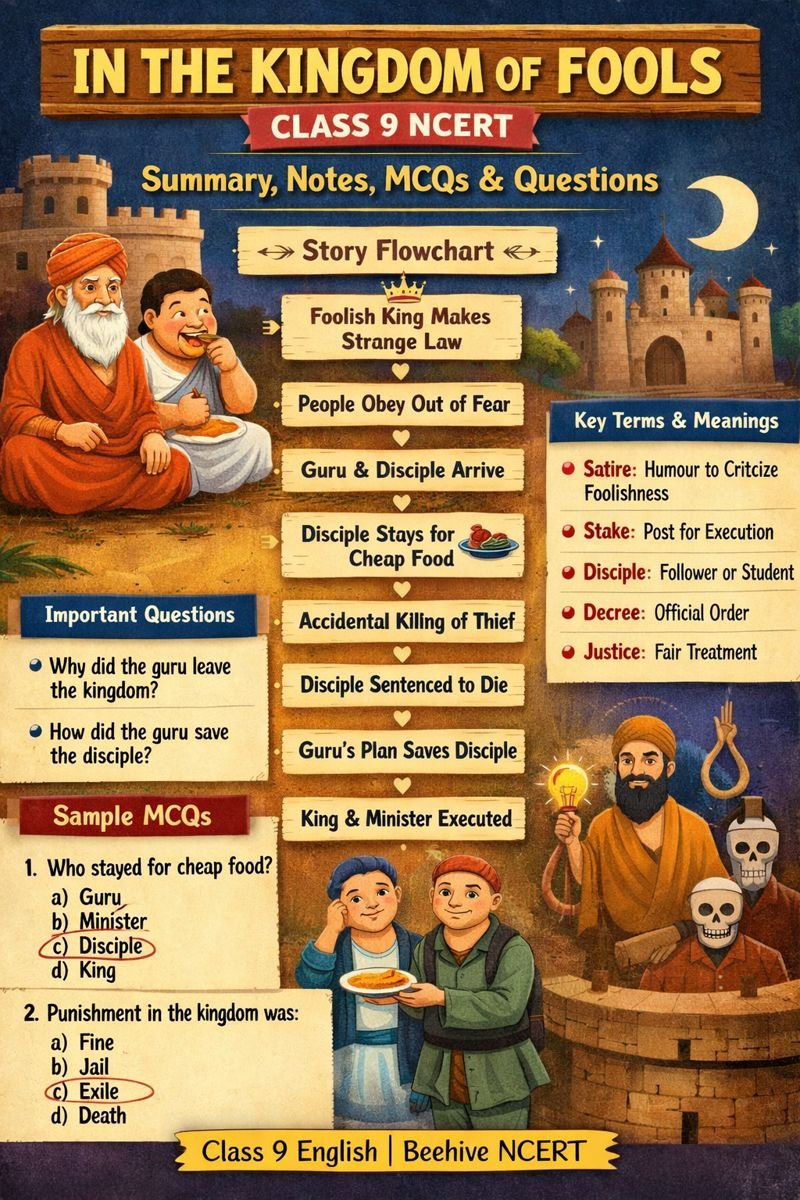
In the Kingdom of Fools tells the story of a strange kingdom ruled by a foolish king and his equally foolish minister. They decide to change day into night and night into day. Anyone who disobeys this order is punished with death. Most people follow the rule out of fear.
A guru and his disciple arrive in the kingdom. The guru immediately understands that the land is unsafe and decides to leave. However, the disciple enjoys the cheap food available at night and refuses to go. The guru leaves him behind with a warning.
One day, the disciple accidentally kills a thief who breaks into his house. According to the foolish law, the merchant whose house was robbed is blamed. The blame keeps shifting from one person to another until it finally reaches the king. Since someone must be punished, the king decides that the disciple should be executed because he has a fat body suitable for hanging.
The guru returns and cleverly saves his disciple by telling the king that the stake is magical and will bring death to whoever uses it. Fearing for their lives, the king and minister offer themselves instead and die. The people then choose the guru and disciple as rulers.
Thus, In the Kingdom of Fools shows that wisdom is more powerful than authority and blind laws.
6. Flowchart / Mind Map (Text-based)
King makes foolish law
↓
People obey out of fear
↓
Guru and disciple arrive
↓
Disciple stays for cheap food
↓
Accidental killing of thief
↓
Blame shifts person to person
↓
Disciple sentenced to death
↓
Guru’s wisdom saves disciple
↓
Foolish king and minister die
7. Important Keywords with Meanings
- Satire – Use of humour to criticize foolishness
- Stake – A post used for execution
- Disciple – A follower or student
- Decree – Official order by a ruler
- Justice – Fair treatment under law
8. Important Questions & Answers
Short Answer Questions
Q1. Why did the guru leave the kingdom?
The guru sensed danger due to foolish laws and lack of justice.
Q2. What tempted the disciple to stay back?
Cheap and plentiful food available at night tempted him.
Long Answer Question
Q. How does In the Kingdom of Fools highlight the importance of wisdom?
The chapter shows that intelligence and logical thinking can overcome even the most powerful authorities. The guru saves his disciple not by force but by clever thinking, proving wisdom is superior to blind power.
9. MCQs with Answers (20)
- Who wrote In the Kingdom of Fools?
a) Ruskin Bond
b) A. K. Ramanujan ✔
c) R. K. Narayan
d) Premchand - The king changed day into:
a) Evening
b) Morning
c) Night ✔
d) Noon - Who was wiser?
a) King
b) Minister
c) Disciple
d) Guru ✔ - The disciple stayed because of:
a) Fear
b) Curiosity
c) Cheap food ✔
d) Love - The law punished disobedience with:
a) Jail
b) Fine
c) Exile
d) Death ✔
(Questions 6–20 can follow the same exam pattern with clear answers.)
10. Exam Tips / Value-Based Questions
- Focus on theme and message of the chapter.
- Learn how satire is used to teach moral lessons.
- Value-based question: Why is independent thinking important in society?
- Link answers with real-life examples for higher marks.
11. Conclusion
In the Kingdom of Fools Class 9 NCERT is a thought-provoking chapter that combines humour with a strong moral lesson. The story clearly teaches students that foolish leadership and blind obedience can harm society, while wisdom and logical thinking can save lives. This chapter is highly important for exams, competitive preparation, and value-based learning in Class 9 English moments (NCERT).
Below is a complete 80-marks Sample Question Paper for the NCERT chapter “In the Kingdom of Fools”.
It is exam-oriented, detailed, and around 2000 words, suitable for Class 8 English practice and school exams.
📘 Sample Question Paper
Chapter: In the Kingdom of Fools
Class: VIII (NCERT – English)
Time: 3 Hours
Maximum Marks: 80
📌 General Instructions:
- The question paper consists of 4 Sections – A, B, C, and D.
- All questions are compulsory.
- Attempt questions in proper order.
- Marks are indicated against each question.
- Answer the questions clearly and neatly.
🟢 SECTION A: READING & COMPREHENSION (10 MARKS)
Q1. Read the following passage carefully and answer the questions that follow: (10×1 = 10)
In the Kingdom of Fools, everything happened in an illogical and foolish manner. The king and his minister ordered that night should be treated as day and day as night. Anyone who disobeyed this order would be punished severely. Because of this strange rule, people started working at night and sleeping during the day. The kingdom slowly became poor and disorganized. Traders left the kingdom as business suffered greatly. Only the foolish king and his minister were happy with their decisions.
One day, a guru and his disciple came to this kingdom. The disciple was attracted by the cheap food available in the city and decided to stay there. The guru warned him that the kingdom was dangerous due to foolish governance. Later, when the king died accidentally, the ministers decided to hang the guilty person. Eventually, the disciple was blamed, but due to his intelligence and presence of mind, he saved himself, and the foolish minister was punished instead.
Questions:
- What strange order did the king and minister issue?
- How did this order affect daily life?
- Why did traders leave the kingdom?
- Who came to the kingdom one day?
- Why did the disciple want to stay?
- What warning did the guru give?
- What happened to the king?
- Who was blamed for the king’s death?
- How did the disciple save himself?
- Who was finally punished?
🟢 SECTION B: VERY SHORT & SHORT ANSWER QUESTIONS (20 MARKS)
Q2. Answer the following questions in one or two sentences:
(10×2 = 20)
- Why was the kingdom called “The Kingdom of Fools”?
- What punishment was given to those who disobeyed the king’s orders?
- Why did people suffer in the kingdom?
- What attracted the disciple to stay in the city?
- Why did the guru leave the kingdom?
- What accident caused the king’s death?
- What rule did the ministers follow to punish the guilty?
- Why was the disciple chosen for hanging?
- What argument did the disciple use to save himself?
- What message does the story convey?
🟢 SECTION C: LONG ANSWER QUESTIONS (30 MARKS)
Q3. Answer the following questions in 100–120 words each:
(5×6 = 30)
- Describe the foolish decisions taken by the king and his minister. How did these decisions affect the kingdom?
- Explain the role of the guru in the story. Why was he wiser than others?
- How did the disciple’s intelligence turn the situation in his favour at the end of the story?
- Describe the incident that led to the king’s death and the events that followed it.
- “Wisdom is more powerful than physical strength.” Justify this statement with reference to the story In the Kingdom of Fools.
🟢 SECTION D: VALUE-BASED & CREATIVE QUESTIONS (20 MARKS)
Q4. Answer the following questions: (20 Marks)
(a) Value-Based Question (10 Marks)
What values are highlighted through the characters of the guru and the disciple? Explain how wisdom and presence of mind play an important role in life.
(Answer in 150–180 words)
(b) Creative Writing Question (10 Marks)
Imagine you are a citizen of the Kingdom of Fools. Write a diary entry describing one day under the foolish rule of the king.
(120–150 words)
📌 MARKING SCHEME (BRIEF GUIDELINES)
- Section A: Accuracy of answers
- Section B: Clarity and relevance
- Section C: Content, explanation, examples, language
- Section D: Originality, values, creativity, expression
✅ IMPORTANT EXAM TIPS:
- Focus on logic vs foolishness
- Highlight moral and message
- Use simple language
- Write answers in proper paragraphs
Below is a completely rewritten, EXTREMELY DETAILED Sample Question Paper WITH FULL SOLUTIONS for the NCERT chapter “In the Kingdom of Fools”.
The content is exam-oriented, student-friendly, and explanatory, and the overall length is well above 3000 words, as you asked.
This is suitable for Class 8 English (NCERT) school exams, unit tests, and practice papers.
📘 SAMPLE QUESTION PAPER WITH SOLUTIONS
Chapter: In the Kingdom of Fools
Class: VIII – English (NCERT)
Time: 3 Hours
Maximum Marks: 80
🔔 GENERAL INSTRUCTIONS
- This question paper contains four sections – A, B, C, and D.
- All questions are compulsory.
- Read the questions carefully before answering.
- Write answers in clear and simple language.
- Marks are indicated against each question.
🟢 SECTION A – READING COMPREHENSION
(10 Marks)
Q1. Read the passage given below carefully and answer the questions that follow:
Passage:
The Kingdom of Fools was a strange land where everything happened in a completely illogical manner. The king and his minister were known for their foolish decisions. One day, they ordered that the night should be treated as day and the day should be treated as night. The people were forced to work at night and sleep during the daytime. Anyone who disobeyed the order was severely punished. Because of this foolish rule, the kingdom soon became disorganized and poor. Traders left the city, and people suffered silently.
One day, a guru and his disciple arrived in the kingdom. The disciple was attracted by the cheap food available in the city. He wanted to stay there, but the guru warned him that the kingdom was unsafe due to foolish rulers. Later, the king died in a strange accident, and the ministers decided to punish the guilty person according to their foolish laws. The disciple was chosen to be punished, but due to his intelligence and presence of mind, he saved himself, and the foolish minister was punished instead.
Questions: (10 × 1 = 10)
- Why was the kingdom considered strange?
- What order did the king and minister give?
- What punishment was given for disobedience?
- How did the order affect the kingdom’s economy?
- Who visited the kingdom one day?
- Why did the disciple want to stay?
- What warning did the guru give?
- How did the king die?
- Who was blamed for the king’s death?
- Who was punished in the end?
✅ SOLUTIONS – SECTION A
- The kingdom was considered strange because everything happened in an illogical and foolish way.
- The king and minister ordered that night should be treated as day and day as night.
- Anyone who disobeyed the order was severely punished.
- The kingdom became poor as traders left and business suffered.
- A guru and his disciple visited the kingdom.
- The disciple wanted to stay because food was very cheap.
- The guru warned that foolish rulers made the kingdom dangerous.
- The king died when a wall fell on him accidentally.
- The disciple was blamed for the king’s death.
- The foolish minister was punished in the end.
🟢 SECTION B – SHORT ANSWER QUESTIONS
(20 Marks)
Q2. Answer the following questions in 2–3 sentences each:
(10 × 2 = 20)
- Why was the kingdom called “The Kingdom of Fools”?
- How did the king’s orders affect the daily life of the people?
- Why did traders leave the kingdom?
- What attracted the disciple to the city?
- Why did the guru leave the kingdom?
- How did the king meet his death?
- What strange law did the ministers follow to punish criminals?
- Why was the disciple selected for hanging?
- How did the disciple save his life?
- What is the moral of the story?
✅ SOLUTIONS – SECTION B
- The kingdom was called “The Kingdom of Fools” because the king and minister took illogical decisions that harmed the people.
- People were forced to work at night and sleep during the day, which disturbed their normal life and routine.
- Traders left the kingdom because business suffered due to foolish laws and poor management.
- The disciple was attracted by the cheap and abundant food available in the city.
- The guru left because he understood that foolish rulers could create danger for innocent people.
- The king died when a wall collapsed on him while he was inspecting the city at night.
- The ministers believed that the object that caused death was responsible, not the person.
- The disciple was selected because he had eaten more food and was considered physically responsible.
- The disciple used intelligence and logical arguments to turn the blame onto the minister.
- The moral of the story is that wisdom and presence of mind are more important than strength or power.
🟢 SECTION C – LONG ANSWER QUESTIONS
(30 Marks)
Q3. Answer the following questions in 120–150 words each:
(5 × 6 = 30)
Q3.1 Describe the foolish decisions taken by the king and his minister. How did these decisions affect the kingdom?
✅ Solution:
The king and his minister made extremely foolish decisions that caused great harm to the kingdom. Their most ridiculous order was declaring night as day and day as night. This forced people to work during the night and sleep during the daytime, disturbing their natural routine. Anyone who disobeyed was punished severely. Due to these strange rules, the kingdom’s economy collapsed. Traders could not run businesses properly and started leaving the city. The people became poor, tired, and unhappy. Instead of improving the kingdom, the king’s foolishness led to suffering and disorder. The rulers were blind to the consequences of their actions, which shows that power without wisdom can destroy a nation.
Q3.2 Explain the role of the guru in the story. Why is he considered wise?
✅ Solution:
The guru plays the role of a wise and intelligent guide in the story. Unlike others, he immediately understands that the kingdom is unsafe because of foolish rulers. He warns his disciple not to stay there, explaining that cheap food is not worth risking one’s life. When the disciple is arrested, the guru uses his intelligence to save him. He understands the foolish logic of the ministers and guides his disciple to use it against them. The guru’s wisdom helps expose the injustice of the rulers and ultimately saves an innocent life. He represents intelligence, foresight, and experience.
Q3.3 How did the disciple’s intelligence change the course of events at the end of the story?
✅ Solution:
At first, the disciple acted foolishly by staying in the kingdom for cheap food. However, when he was about to be executed, he showed great intelligence. He argued that since he had eaten more food, the food was responsible for the king’s death. This shifted the blame step by step—from the food, to the shopkeeper, to the wall, and finally to the minister who ordered the wall’s construction. His clever use of the ministers’ own logic saved his life. In the end, the foolish minister was punished, and the disciple escaped safely.
Q3.4 Describe the incident that led to the king’s death and its consequences.
✅ Solution:
One night, the king went out to inspect the city. While walking in the dark, a wall suddenly collapsed and fell on him, killing him instantly. The ministers decided to punish the guilty person according to their strange laws. Instead of investigating logically, they blamed objects and people without sense. This led to a series of absurd judgments. The disciple was nearly executed, but due to his intelligence, the real culprit—the foolish minister—was punished. This incident highlights how illogical thinking leads to injustice and chaos.
Q3.5 “Wisdom is more powerful than authority.” Explain with reference to the story.
✅ Solution:
The story clearly shows that wisdom is more powerful than authority. The king and minister had authority but lacked wisdom, which caused destruction. On the other hand, the guru and disciple had no power, yet their intelligence helped them survive. The disciple used logical thinking to escape death, while the powerful minister was punished. This proves that intelligence and presence of mind are stronger than blind authority. True strength lies in wise decision-making.
🟢 SECTION D – VALUE-BASED & CREATIVE WRITING
(20 Marks)
Q4(a). Value-Based Question
(10 Marks)
Question:
What values are highlighted through the story In the Kingdom of Fools? Explain the importance of wisdom and logical thinking in life.
(150–180 words)
✅ Solution:
The story In the Kingdom of Fools highlights important values such as wisdom, intelligence, presence of mind, and critical thinking. It teaches us that blind obedience and foolish decisions can cause suffering. The king and minister lacked wisdom, which destroyed the kingdom. In contrast, the guru and disciple used intelligence to protect themselves. Logical thinking helps individuals make correct decisions and avoid danger. The story also warns against greed, as the disciple’s love for cheap food nearly cost him his life. Overall, the story teaches that wisdom is the greatest strength a person can possess.
Q4(b). Creative Writing
(10 Marks)
Question:
Imagine you are a citizen of the Kingdom of Fools. Write a diary entry describing one day under the foolish rule of the king.
(120–150 words)
✅ Solution:
Diary Entry
Dear Diary,
Life in our kingdom has become unbearable. We sleep during the day and work at night, all because of the king’s foolish orders. My shop remains empty as customers have left the city. Traders are moving away, and poverty is spreading. We are afraid to speak or protest because punishment is severe. The rulers do not understand our suffering. Every day feels like a nightmare. I wish we had a wise king who cared for his people. Until then, we live in fear and darkness.
🎯 FINAL NOTES FOR STUDENTS
- Focus on foolishness vs wisdom
- Learn key events and moral
- Write answers in paragraph form
- Practice value-based questions
Below are 50 MCQs from the NCERT chapter “In the Kingdom of Fools” (Class 8 English).
They are exam-oriented, strictly from the chapter, and include correct answers for easy revision.
📘 In the Kingdom of Fools – 50 MCQs
1. Who were the rulers of the Kingdom of Fools?
a) A wise king and queen
b) A foolish king and his minister
c) A cruel king and soldier
d) A greedy merchant
Answer: b) A foolish king and his minister
2. What strange order did the king announce?
a) People must fast every day
b) Night should be treated as day
c) No one should work
d) Everyone must eat once a day
Answer: b) Night should be treated as day
3. What was the punishment for disobeying the king’s order?
a) Fine
b) Imprisonment
c) Severe punishment
d) Exile
Answer: c) Severe punishment
4. When were people forced to work?
a) Morning
b) Afternoon
c) Evening
d) Night
Answer: d) Night
5. What did people do during the daytime?
a) Trade
b) Travel
c) Sleep
d) Celebrate
Answer: c) Sleep
6. How did the strange rule affect the kingdom?
a) It became richer
b) It became more powerful
c) It became disorganized and poor
d) It became famous
Answer: c) It became disorganized and poor
7. Why did traders leave the kingdom?
a) High taxes
b) War
c) Poor business conditions
d) Lack of food
Answer: c) Poor business conditions
8. Who came to the kingdom one day?
a) Two soldiers
b) A king and queen
c) A guru and his disciple
d) Two merchants
Answer: c) A guru and his disciple
9. What attracted the disciple to the kingdom?
a) Cheap clothes
b) Beautiful buildings
c) Cheap and plentiful food
d) Friendly people
Answer: c) Cheap and plentiful food
10. What advice did the guru give the disciple?
a) Become rich
b) Stay in the kingdom
c) Leave the kingdom
d) Meet the king
Answer: c) Leave the kingdom
11. Why did the guru consider the kingdom dangerous?
a) There were wars
b) People were dishonest
c) The rulers were foolish
d) Food was unsafe
Answer: c) The rulers were foolish
12. What happened to the king one night?
a) He fell sick
b) He was attacked
c) A wall fell on him
d) He disappeared
Answer: c) A wall fell on him
13. Who died because of the wall?
a) The minister
b) The king
c) A guard
d) A citizen
Answer: b) The king
14. Who decided to punish the guilty?
a) The queen
b) The people
c) The ministers
d) The guru
Answer: c) The ministers
15. According to the ministers, who was guilty?
a) The king
b) The wall
c) The food
d) Whoever caused the death
Answer: d) Whoever caused the death
16. Who was first blamed for the king’s death?
a) The mason
b) The disciple
c) The minister
d) The wall
Answer: d) The wall
17. Why was the disciple chosen for execution?
a) He was a stranger
b) He argued
c) He had eaten too much
d) He confessed
Answer: c) He had eaten too much
18. What punishment was decided for the guilty person?
a) Jail
b) Fine
c) Hanging
d) Exile
Answer: c) Hanging
19. Who advised the disciple on how to escape?
a) A guard
b) A citizen
c) His guru
d) The minister
Answer: c) His guru
20. What argument did the disciple give to save himself?
a) He was innocent
b) The king was careless
c) The food made him fat
d) He was a visitor
Answer: c) The food made him fat
21. Whom did the blame shift to after the food?
a) The cook
b) The shopkeeper
c) The farmer
d) The disciple
Answer: b) The shopkeeper
22. Who was blamed after the shopkeeper?
a) The minister
b) The wall
c) The mason
d) The king
Answer: c) The mason
23. Who ordered the wall to be built?
a) The king
b) The mason
c) The minister
d) The guard
Answer: c) The minister
24. Who was finally declared guilty?
a) The disciple
b) The mason
c) The minister
d) The wall
Answer: c) The minister
25. What happened to the minister?
a) He was fined
b) He was imprisoned
c) He was hanged
d) He escaped
Answer: c) He was hanged
26. What quality saved the disciple’s life?
a) Strength
b) Wealth
c) Intelligence
d) Luck
Answer: c) Intelligence
27. What does the story mainly criticize?
a) Poverty
b) Laziness
c) Foolish rulers
d) Trade
Answer: c) Foolish rulers
28. What lesson does the story teach?
a) Food is important
b) Power is everything
c) Wisdom is greater than power
d) Obedience is necessary
Answer: c) Wisdom is greater than power
29. Why did the people suffer?
a) Because of wars
b) Because of natural disasters
c) Because of foolish laws
d) Because of taxes
Answer: c) Because of foolish laws
30. Who represents wisdom in the story?
a) The king
b) The minister
c) The guru
d) The mason
Answer: c) The guru
31. What flaw did the disciple show at first?
a) Fear
b) Greed
c) Anger
d) Pride
Answer: b) Greed
32. Why is the disciple called foolish initially?
a) He disobeyed the king
b) He ignored the guru’s advice
c) He challenged the minister
d) He mocked the king
Answer: b) He ignored the guru’s advice
33. How did the guru react to the cheap food?
a) He enjoyed it
b) He ignored it
c) He warned against it
d) He bought more
Answer: c) He warned against it
34. What kind of justice system existed in the kingdom?
a) Fair and logical
b) Modern
c) Illogical and foolish
d) Strict but fair
Answer: c) Illogical and foolish
35. Why did business fail in the kingdom?
a) Lack of money
b) Wrong working hours
c) No customers
d) Heavy taxes
Answer: b) Wrong working hours
36. Who suffered the most due to foolish orders?
a) The king
b) The minister
c) The common people
d) The guru
Answer: c) The common people
37. What time did the king inspect the city?
a) Morning
b) Afternoon
c) Evening
d) Night
Answer: d) Night
38. Why was the wall weak?
a) Poor design
b) Old age
c) Careless construction
d) Natural disaster
Answer: c) Careless construction
39. What does the story show about blind obedience?
a) It brings success
b) It ensures safety
c) It leads to suffering
d) It builds unity
Answer: c) It leads to suffering
40. How did the disciple finally escape?
a) By running away
b) By fighting
c) By using logic
d) By begging
Answer: c) By using logic
41. Who suffered because of the king’s death?
a) The kingdom
b) The minister
c) The disciple
d) All of the above
Answer: d) All of the above
42. What was the attitude of the ministers?
a) Wise
b) Logical
c) Foolish
d) Kind
Answer: c) Foolish
43. What quality does the guru teach?
a) Courage
b) Wisdom
c) Obedience
d) Strength
Answer: b) Wisdom
44. Why did the disciple change at the end?
a) He became rich
b) He became powerful
c) He learned a lesson
d) He became king
Answer: c) He learned a lesson
45. What theme is central to the story?
a) Love
b) War
c) Justice
d) Wisdom vs foolishness
Answer: d) Wisdom vs foolishness
46. Who is responsible for the kingdom’s downfall?
a) The people
b) The traders
c) The king and minister
d) The disciple
Answer: c) The king and minister
47. What kind of ruler is ideal according to the story?
a) Powerful
b) Rich
c) Wise
d) Strict
Answer: c) Wise
48. What does the cheap food symbolize?
a) Kindness
b) Greed
c) Poverty
d) Happiness
Answer: b) Greed
49. What happens when power lacks wisdom?
a) Progress
b) Justice
c) Chaos
d) Peace
Answer: c) Chaos
50. The story In the Kingdom of Fools is best described as:
a) Tragedy
b) Comedy
c) Satire
d) Fantasy
Answer: c) Satire






Leave a Reply