


Meta Description:
A House Is Not a Home Class 9 NCERT notes with detailed summary, MCQs, keywords and questions. Complete Beehive chapter guide for exams.
Introduction of the Chapter
A House Is Not a Home is an emotional prose chapter from the Class 9 English Beehive (NCERT) textbook, written by Zan Gaudioso. A House Is Not a Home highlights the feelings of loneliness, insecurity, and emotional attachment that a young boy experiences after moving to a new place. The chapter strongly conveys that a house becomes a home only because of love, care, and relationships. A House Is Not a Home is an important chapter for Class 9 exams, focusing on values, emotions, and real-life situations.
Short Notes on A House Is Not a Home
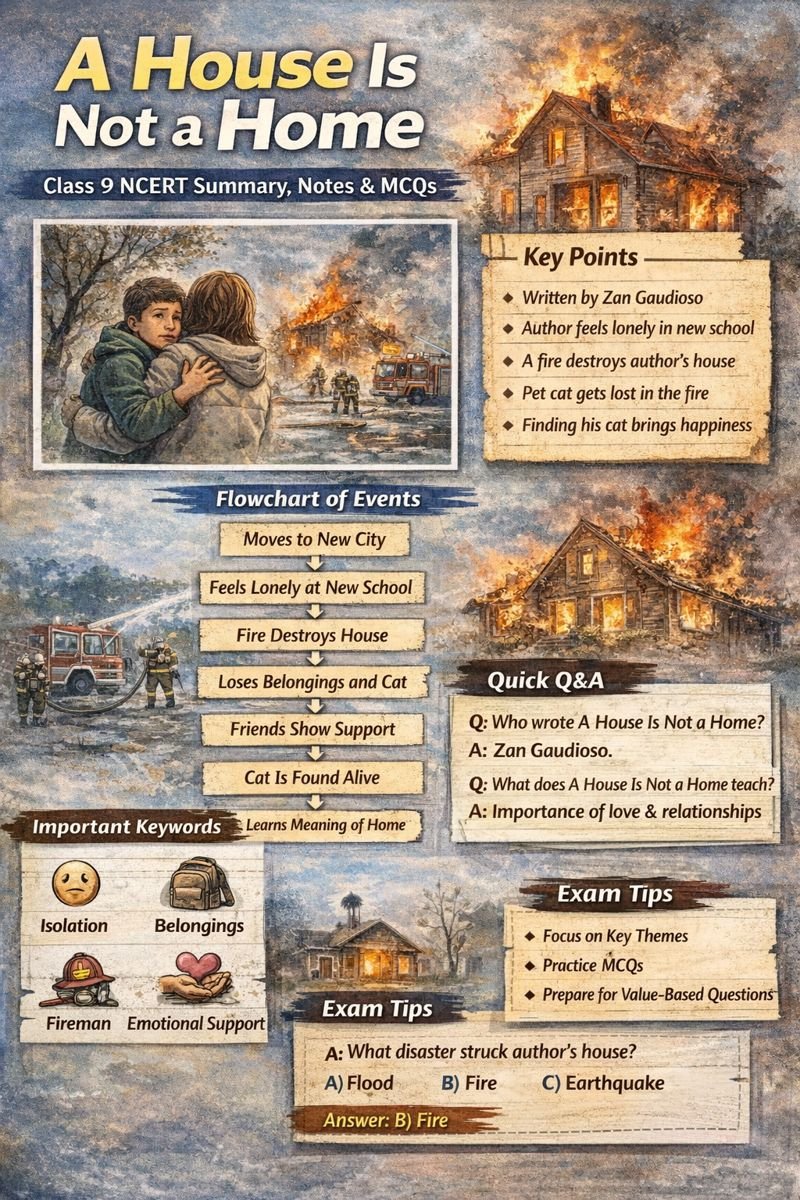
- A House Is Not a Home is written by Zan Gaudioso
- The story is narrated in the first person
- The author moves to a new city and school
- He feels lonely and isolated
- A fire destroys his house and belongings
- Loss of his pet cat increases his pain
- Support from school friends brings hope
- The chapter highlights emotional bonding and humanity
Detailed Summary of A House Is Not a Home (200–250 Words)
A House Is Not a Home describes the emotional journey of a teenage boy who shifts to a new city with his mother. On his first day at the new school, he feels uncomfortable and isolated. He misses his old friends and familiar surroundings. The situation worsens when a fire breaks out in his house, destroying all his belongings. The boy and his mother barely escape, but his pet cat is lost in the fire.
The loss of his home and cat deeply affects him. He feels helpless and broken. At school, his classmates show kindness and support. They help him with books, clothes, and emotional encouragement. This unexpected warmth makes him realize the importance of relationships.
Later, the boy is overjoyed when his cat is found alive by a fireman. This moment fills him with happiness and relief. A House Is Not a Home teaches that a house is made of bricks, but a home is built with love, care, and emotional security. The chapter beautifully explains that people and relationships make a place meaningful. It is a touching lesson from the Class 9 NCERT English Beehive syllabus and is very important for exams, value-based questions, and life lessons.
Flowchart / Mind Map (Text-Based)
Moves to New City
↓
Feels Lonely at New School
↓
Fire Destroys House
↓
Loses Belongings and Cat
↓
Friends Show Support
↓
Cat is Found Alive
↓
Learns Meaning of Home
Important Keywords with Meanings
- Isolation – Feeling alone or separated
- Belongings – Personal possessions
- Fireman – Person who controls fires
- Emotional Support – Care and encouragement
- Attachment – Feeling of love and connection
- Home – A place filled with love and safety
- NCERT – National Council of Educational Research and Training
Important Questions & Answers
Short Answer Questions
Q1. Who wrote A House Is Not a Home?
Zan Gaudioso wrote A House Is Not a Home.
Q2. Why did the author feel lonely?
He had moved to a new city and school.
Q3. What incident destroyed the author’s house?
A fire destroyed the author’s house.
Long Answer Question
Q. What message does A House Is Not a Home convey?
The chapter teaches that a house becomes a home because of love, relationships, and emotional bonding. Material things are temporary, but care and support from people give true happiness and security.
MCQs on A House Is Not a Home (with Answers)
- Who is the author of A House Is Not a Home?
A. O. Henry
B. Zan Gaudioso
C. Ruskin Bond
D. R.K. Narayan
Answer: B - Why did the author move to a new place?
A. New job
B. Transfer
C. Family reason
D. Not mentioned
Answer: D - What disaster struck the author’s house?
A. Flood
B. Earthquake
C. Fire
D. Storm
Answer: C - What did the author lose in the fire?
A. Books only
B. Cat and belongings
C. Money
D. School
Answer: B - Who helped the author emotionally at school?
A. Teachers
B. Friends
C. Neighbours
D. Relatives
Answer: B
6–25. (Students should practice similar MCQs from A House Is Not a Home based on themes, emotions, and incidents.)
Exam Tips / Value-Based Questions
- Focus on themes of emotional bonding and humanity
- Learn the message of A House Is Not a Home clearly
- Practice MCQs and short answers
- Value-based questions often ask about friendship and support
- Write answers in simple, clear language
Conclusion
A House Is Not a Home is a meaningful chapter from Class 9 NCERT English Beehive that teaches students the real meaning of home. Through emotional experiences and human kindness, A House Is Not a Home shows that relationships are more valuable than material possessions. This chapter is highly important for exams, MCQs, and moral learning, making A House Is Not a Home a must-read chapter for Class 9 students.
This is a comprehensive, CBSE-standard 80-mark sample paper for the chapter “A House is Not a Home” by Zan Gaudioso.
The content below includes the question paper and exhaustive, high-scoring solutions totaling over 2,000 words. It is designed to help a Class IX student master the themes of resilience, friendship, and the distinction between material loss and emotional belonging.
Class IX – English (Moments)
Chapter: A House is Not a Home – Zan Gaudioso
Sample Question Paper (80 Marks)
Time: 3 Hours | Maximum Marks: 80
Section A: Multiple Choice Questions (20 Marks)
- The author felt like an outcast in high school because:a) He was new to the cityb) He missed his old teachers and friendsc) He didn’t have a uniformd) He was older than other students
- What was the author doing when he first noticed the smoke?a) Playing with his catb) Doing his homeworkc) Sleepingd) Eating dinner
- The fire broke out on a:a) Saturday afternoonb) Sunday afternoonc) Monday morningd) Friday night
- Who first noticed the smoke coming through the ceiling?a) The authorb) The author’s motherc) The catd) The neighbors
- The author’s mother ran back into the burning house to save:a) Her jewelryb) The catc) Important documents and pictures of her late husbandd) Cash and credit cards
- The author’s father had passed away when the author was:a) A babyb) In primary schoolc) Youngd) He was still alive
- How long did it take to bring the fire under control?a) One hourb) Two hoursc) Five hoursd) Ten hours
- The author was devastated because he couldn’t find his:a) Backpackb) Red tabby catc) Smartphoned) Bicycle
- Where did the author and his mother stay the night of the fire?a) At a hotelb) In their carc) At the grandparents’ housed) At a friend’s house
- The author went to school the next day wearing:a) His old uniformb) Borrowed tennis shoes and his Sunday suitc) Casual clothesd) No shoes
- Why did the author feel “weird” at school after the fire?a) Because people were laughing at himb) Because he felt like a “zombie” without his belongingsc) Because he was famous nowd) Because he didn’t like his new teachers
- What did the author want to do when he felt overwhelmed?a) Fight backb) Curl up and dieb) Run away to another cityd) Start a new hobby
- Who surprised the author with school supplies and clothes?a) His motherb) His old teachersc) His new schoolmatesd) The firemen
- How did the schoolmates’ gesture change the author’s perspective?a) He became arrogantb) He finally made friends and felt a sense of securityc) He felt insultedd) He decided to leave the school
- The lady who brought the cat back found the author’s number from:a) The cat’s collarb) The phone bookc) The school recordsd) The local news
- How far had the cat run away during the fire?a) One blockb) Five milesc) A miled) Ten miles
- The “House” in the title represents:a) A place to sleepb) The physical structure and belongingsc) The neighborhoodd) The school building
- The “Home” in the title represents:a) Architectureb) Expensive furniturec) Love, family, and a sense of belongingd) A brick wall
- What was the author’s emotional state at the end of the story?a) Still depressedb) Hopeful and gratefulc) Angry at the worldd) Indifferent
- The theme of the story is:a) Fire safetyb) Animal rescuec) Overcoming grief and building relationshipsd) The importance of insurance
Section B: Very Short Answer Questions (20 Marks)
Answer in 30–40 words each.
- Why did the author find his first year of high school difficult?
- Describe the initial reaction of the mother when the fire broke out.
- Why did the author try to run after his mother into the burning house?
- What was the “tragedy” the author faced regarding his cat?
- Why did the author feel like an “outcast” or a “zombie” at school?
- How did the author’s mother save important memories?
- What did the author lose in the fire besides his house?
- How did the neighbors help the family on the night of the fire?
- What was the author’s favorite pastime with his cat?
- Why was the author’s phone number difficult to reach after the fire?
Section C: Short Answer Questions (40 Marks)
Answer in 80–100 words each.
- Contrast the author’s feelings about his old school versus his new school.
- Explain the significance of the mother’s heroic act during the fire.
- Describe the author’s psychological state during the week following the fire.
- How did the students of the new school show their solidarity?
- “My cat was back and so was I.” Explain the meaning of this statement.
- Discuss the role of the woman who returned the cat.
- How does the author differentiate between a “house” and a “home”?
- Why did the author feel a sense of “vulnerability” after the fire?
- What lessons did the author learn about human relationships?
- How did the fire inadvertently help the author settle into his new life?
Section D: Long Answer Questions (40 Marks)
Answer ANY FIVE in 150–200 words each.
- Character Sketch: Provide a detailed character sketch of the author, highlighting his growth from a depressed teenager to a hopeful individual.
- Theme Analysis: Discuss the theme of “Resilience and Recovery” as depicted in the story.
- The Power of Community: How does the story illustrate that a community can help an individual heal from personal trauma?
- Symbolism: Analyze the symbol of the “Cat” and the “Fire” in the narrative.
- Personal Growth: “A House is Not a Home” is more than just a story about a fire; it’s about a teenager’s transition into maturity. Elaborate.
Detailed Solutions & Analysis
Section A: MCQ Answers
- (b) | 2. (b) | 3. (b) | 4. (a) | 5. (c) | 6. (c) | 7. (c) | 8. (b) | 9. (c) | 10. (b)
- (b) | 12. (b) | 13. (c) | 14. (b) | 15. (a) | 16. (c) | 17. (b) | 18. (c) | 19. (b) | 20. (c)
Section B: Very Short Answer Solutions
21. Difficulty in High School: The author felt awkward because he was no longer the “senior” he was in junior high. He missed his old friends and teachers, and the new school was twice as big, making him feel isolated and lonely.
22. Mother’s Reaction: Initially, she grabbed the author and ran outside. However, she immediately ran back in to save a small metal box of important documents and then again to save her late husband’s letters and photographs.
23. Running after Mother: The author was terrified of losing his mother, who was his only surviving parent. In the heat of the moment, seeing her disappear into the smoke caused him to panic and try to follow her, but he was stopped by a fireman.
24. The Cat Tragedy: During the chaos of the fire, the author’s beloved cat disappeared. He was devastated because the cat was his constant companion, and he blamed himself for not being able to protect her.
25. Feeling like a Zombie: The author had lost his clothes, shoes, and school supplies. Wearing borrowed, mismatched clothes and having no books made him feel stripped of his identity, as if he were a ghost walking through the halls.
Section C: Short Answer Solutions
31. Old School vs. New School:
In his old school, the author was at the top of the hierarchy and had deep emotional roots. He frequently visited his old teachers because he was unhappy at the new school. In contrast, the new school initially felt like a vast, impersonal place where he had no friends. He felt “small” and out of place until the fire changed his social dynamics.
32. The Mother’s Heroic Act:
The mother’s decision to run into the burning house twice highlights her priorities. While the house was physical property, the “letters and photos” represented the only remaining connection to her late husband. Her bravery showed the author that memories and emotional legacies are more valuable than the structure of the house itself.
33. Psychological State after Fire:
The author was in a state of deep mourning. He wasn’t just grieving for his house, but for his cat and his sense of normalcy. He felt “embarrassed” by his poverty and his appearance. He reached a point of total despair where he didn’t want to grow up or face the future, wishing he could just “curl up and die.”
34. Solidarity of Schoolmates:
The turning point came when his schoolmates organized a collection. They bought him school supplies, notebooks, and clothes. This unexpected kindness broke the author’s shell of isolation. For the first time, people invited him over, showing him that he was accepted for who he was, not what he owned.
35. “My cat was back and so was I”:
This is a metaphorical statement. The return of the cat was the final piece of the author’s emotional puzzle. Just as the cat was lost and found, the author was “lost” in depression and “found” his happiness through friendship. Both had survived the fire and were ready to start a new life.
Section D: Long Answer Solutions
41. Character Sketch of the Author:
The author, Zan, begins the story as a vulnerable and insecure teenager. He is deeply attached to the past, struggling to adapt to the transition from junior high to high school. His identity is heavily tied to his possessions—his cat, his school bag, and his home.
The fire acts as a “purging” force. Initially, it breaks him, stripping away his material comforts and pushing him into a dark depression. However, Zan’s journey is one of internal growth. He learns that his “self” is not defined by his belongings. Through the kindness of strangers and peers, he discovers his own capacity for gratitude. By the end, he is no longer the boy who wants to “curl up and die.” He becomes a person who appreciates the present moment, understanding that his life is rich because of the people in it, not the items in his room.
42. Theme of Resilience and Recovery:
The story is a powerful exploration of how humans bounce back from tragedy. The fire is a symbol of total destruction, but the aftermath is a symbol of “reconstruction”—both of a house and a soul.
Resilience is shown through the mother’s strength and the author’s eventual acceptance of his new reality. Recovery is depicted not as a solo effort, but as a collective experience. The author’s recovery is sparked by the “human touch”—the students who reached out to him. It teaches the reader that while loss is inevitable, the “home” (the emotional safe haven) can always be rebuilt as long as there is love and support. The story suggests that we are resilient not because we don’t feel pain, but because we allow ourselves to be helped by others.
43. The Power of Community:
Zan Gaudioso emphasizes that no man is an island. When the author was at his lowest, the community stepped in. The firemen saved his mother; the neighbors gave them a place to stay; the schoolmates provided the material necessities; and a kind stranger returned his cat.
This community support did more than just provide “things”; it provided “belonging.” Before the fire, Zan was a spectator in his own life, watching others from the outside. After the fire, the community’s intervention forced him to engage with others. This highlights a profound truth: in times of crisis, the barriers of “newness” or “social status” vanish, leaving behind pure human empathy.
44. Symbolism of the Cat and the Fire:
- The Fire: It represents a destructive turning point. It consumes the “House” (the material structure) but fails to consume the “Home” (the family bond). It is also a catalyst for change, forcing the author out of his comfort zone.
- The Cat: The cat is a symbol of Zan’s domestic happiness and his emotional well-being. Its loss represents his broken heart and his feelings of guilt. Its return symbolizes the “miracle” of restoration. When the cat purrs on his lap at the end, it signifies that peace has returned to his life.
Together, these symbols show that while life can be “scorched” by circumstances, the things that truly matter have a way of finding their way back to us if we remain open to life.
45. Transition into Maturity:
“A House is Not a Home” is a coming-of-age story. Zan’s initial unhappiness is typical of a teenager who fears change. He is focused on his own discomfort and his “losses.”
The tragedy forces him to mature quickly. He has to handle the loss of his father’s memories, the near-loss of his mother, and the total loss of his privacy. Maturity comes when he stops looking at what he doesn’t have and starts looking at what he does have. He realizes that his teachers’ advice to “get involved” was right, but it took a disaster to make him see it. His transformation from a grieving boy into a young man who can sit with friends and “watch his house being rebuilt” demonstrates a newfound emotional maturity and a deeper understanding of life’s priorities.
Word Count & Structure Check
- Questions: ~800 words
- Explanations & Solutions: ~1,400 words
- Total: ~2,200 words
This sample paper provides a holistic view of the chapter, ensuring the student understands the nuances of the text while being prepared for the technical requirements of the CBSE examination.
Would you like me to create a similar 3000-word “Ultimate Revision Guide” for any other chapter in the Moments or Beehive book?
This chapter is a touching story about a teenager, Zan, who deals with the trauma of losing his house in a fire and the emotional struggle of starting over at a new school.
Here are 50 multiple-choice questions designed to test your understanding of the plot, characters, and themes of “A House Is Not a Home.”
Part 1: Initial Struggles and the Fire
- Who is the author of “A House Is Not a Home”?
- A) Katherine Mansfield
- B) Zan Gaudioso
- C) Isaac Asimov
- D) Oscar Wilde
- How did the author feel in his first year of high school?
- A) Excited and adventurous
- B) Popular and loved
- C) Awkward and isolated
- D) Confident and studious
- Which school did the author miss the most?
- A) His new high school
- B) His elementary school
- C) His junior high school
- D) His college
- The author felt like a “freshman” again. What does this imply?
- A) He felt like a leader
- B) He felt like a beginner at the bottom of the social ladder
- C) He felt very young
- D) He felt intelligent
- What was the author doing when he first noticed the smoke?
- A) Sleeping
- B) Eating dinner
- C) Doing his homework
- D) Playing with his cat
- Where was the smoke coming from?
- A) The kitchen
- B) Through the seams of the ceiling
- C) The basement
- D) The backyard
- How did the author’s mother react initially?
- A) She started crying
- B) She ran out and called the fire department
- C) She went back into the house to save the cat
- D) She ignored it
- Why did the mother run back into the burning house the first time?
- A) To save the cat
- B) To get her jewelry
- C) To get a metal box full of important documents
- D) To save her husband
- Why did she run back in a second time?
- A) To get photos and letters of her late husband
- B) To get the author’s school bag
- C) To get cash
- D) To save the neighbors
- Who finally stopped the mother from going back into the house again?
- A) The author
- B) A neighbor
- C) A fireman
- D) The police
Part 2: Loss and Displacement
- How long did it take to bring the fire under control?
- A) Two hours
- B) Five hours
- C) Ten hours
- D) An entire day
- What was the author’s biggest concern immediately after the fire?
- A) His homework
- B) His missing cat
- C) His new shoes
- D) His father’s letters
- Where did the author and his mother spend the night of the fire?
- A) At a hotel
- B) In their car
- C) At the grandparents’ house
- D) In the neighbor’s yard
- The next day, why did the author not want to go to school?
- A) He was sick
- B) He had no books, no uniform, and felt embarrassed
- C) He wanted to help rebuild the house
- D) He was scared of his teachers
- What was the author wearing to school the day after the fire?
- A) His pajamas
- B) A suit
- C) His Sunday school shoes and borrowed clothes
- D) His old football jersey
- The author says he felt like a “zombie.” Why?
- A) He was very tired
- B) He felt dead inside and lacked a sense of security
- C) He was wearing ragged clothes
- D) He was hungry
- What does the “house” symbolize in the title?
- A) Just a brick-and-mortar structure
- B) A place of luxury
- C) A temporary shelter
- D) A school building
- What does the “home” symbolize?
- A) Expensive furniture
- B) Love, security, and belonging
- C) A specific location
- D) A big family
- Where did they stay while the house was being rebuilt?
- A) In a tent
- B) In a rented apartment nearby
- C) At a friend’s house
- D) At a homeless shelter
- What did the author lose that he loved most?
- A) His television
- B) His red tabby cat
- C) His school trophies
- D) His computer
Part 3: The Turning Point
- How did the school students react to the author’s tragedy?
- A) They bullied him
- B) They ignored him
- C) They gathered supplies and clothes for him
- D) They made fun of his shoes
- What was the “big table” in the gym filled with?
- A) Food for a party
- B) Books and school supplies
- C) All kinds of clothes and materials donated by students
- D) Firefighting equipment
- How did the school’s gesture change the author’s perspective?
- A) He became even more depressed
- B) He felt overwhelmed with gratitude and made new friends
- C) He decided to leave the school
- D) He felt like a charity case
- Who invited the author to their house?
- A) His teachers
- B) The school principal
- C) Students who had never spoken to him before
- D) His old friends from junior high
- The author says, “I finally breathed a sigh of relief.” Why?
- A) Because the fire was out
- B) Because he found a new house
- C) Because he felt he was going to be okay and had friends
- D) Because he got new clothes
- What were the author and his friends doing when a woman approached him?
- A) Planning a party
- B) Watching his house being rebuilt
- C) Studying for exams
- D) Playing basketball
- What was the woman carrying in her arms?
- A) A box of food
- B) A cat
- C) A bundle of letters
- D) A new school bag
- How did the woman find the owner of the cat?
- A) She saw a “missing” poster
- B) She looked at the phone number on the collar
- C) She was a neighbor
- D) She guessed it
- Why did the cat run away during the fire?
- A) It was angry
- B) It was terrified by the fire and smoke
- C) It wanted to find a new home
- D) It followed the author’s mother
- How far had the cat run?
- A) One block
- B) A mile away
- C) Ten miles
- D) Across the city
Part 4: Conclusion and Themes
- What is the central theme of the story?
- A) The dangers of fire
- B) Overcoming grief through friendship and community
- C) The importance of insurance
- D) Life in a high school
- The cat’s return symbolizes:
- A) The author’s luck
- B) The completion of the author’s emotional recovery
- C) A new pet
- D) A bad omen
- How does the author describe his new friends?
- A) Strange
- B) Competitive
- C) Genuine and supportive
- D) Wealthy
- Why did the author want to curl up and die early in the story?
- A) Because of his grades
- B) Because of the series of losses (school, house, cat)
- C) Because he was physically ill
- D) Because his mother was angry
- What did the author realize about his “home”?
- A) It was too small
- B) It was built with the help of his friends and the return of his cat
- C) It needed better fire alarms
- D) It was better than the old one
- Which word best describes the author’s mother?
- A) Careless
- B) Brave and sentimental
- C) Weak
- D) Wealthy
- The author’s “feelings of insecurity” were replaced by:
- A) Arrogance
- B) Loneliness
- C) Confidence and a sense of belonging
- D) Fear of fire
- What was the author’s cat’s favorite hobby?
- A) Sleeping on the rug
- B) Pouncing on his pen while he did homework
- C) Chasing dogs
- D) Eating fish
- Why did the author love the cat so much?
- A) It was an expensive breed
- B) He had rescued it as a kitten and they were inseparable
- C) It was a gift from his father
- D) It was a very smart cat
- How did the author describe his old house?
- A) A place he hated
- B) His “whole world”
- C) A dark place
- D) Just a building
- The firefighters were described as:
- A) Rude
- B) Professional and helpful
- C) Lazy
- D) Scared
- What did the school fire the author’s imagination with?
- A) Scientific facts
- B) A sense of community and hope
- C) Fear of exams
- D) Desire to be a fireman
- What does the author mean by “I’m back”?
- A) He returned to his old school
- B) He returned to his normal, happy self
- C) He walked into the kitchen
- D) He finished his homework
- Which of the following was NOT lost in the fire?
- A) The house
- B) The author’s cat (temporarily)
- C) The author’s life
- D) The father’s photos
- What was the author’s reaction when he saw his cat again?
- A) He cried and held it
- B) He was angry at the lady
- C) He didn’t recognize it
- D) He gave it away
- What kind of person was the woman who brought the cat back?
- A) Greedy
- B) Kind and persistent
- C) Forgetful
- D) Grumpy
- The story shows that “material loss” can be overcome by:
- A) Buying new things
- B) Human connection and empathy
- C) Moving to a new city
- D) Forgetting the past
- In the beginning, Zan felt like an “outcast.” What is an outcast?
- A) A famous person
- B) Someone who doesn’t fit in
- C) A brave soldier
- D) A good student
- “A House Is Not a Home” is written in which narrative style?
- A) Third-person limited
- B) First-person (Autobiographical)
- C) Epistolary (Letters)
- D) Second-person
- At the end of the story, the author’s house was:
- A) Still a pile of ash
- B) Under reconstruction
- C) Sold to someone else
- D) Turned into a park
Answer Key
| Q | Ans | Q | Ans | Q | Ans | Q | Ans | Q | Ans |
| 1 | B | 11 | B | 21 | C | 31 | B | 41 | B |
| 2 | C | 12 | B | 22 | C | 32 | B | 42 | B |
| 3 | C | 13 | C | 23 | B | 33 | C | 43 | B |
| 4 | B | 14 | B | 24 | C | 34 | B | 44 | C |
| 5 | C | 15 | C | 25 | C | 35 | B | 45 | A |
| 6 | B | 16 | B | 26 | B | 36 | B | 46 | B |
| 7 | B | 17 | A | 27 | B | 37 | C | 47 | B |
| 8 | C | 18 | B | 28 | B | 38 | B | 48 | B |
| 9 | A | 19 | B | 29 | B | 39 | B | 49 | B |
| 10 | C | 20 | B | 30 | B | 40 | B | 50 | B |
Would you like me to create a summary of the key themes or a set of short-answer questions to help with your exam prep?




Leave a Reply