


Meta Description
How Do Organisms Reproduce Class 10 Science NCERT notes with summary, keywords, MCQs, important questions, and exam tips for board exams.
Introduction of the Chapter
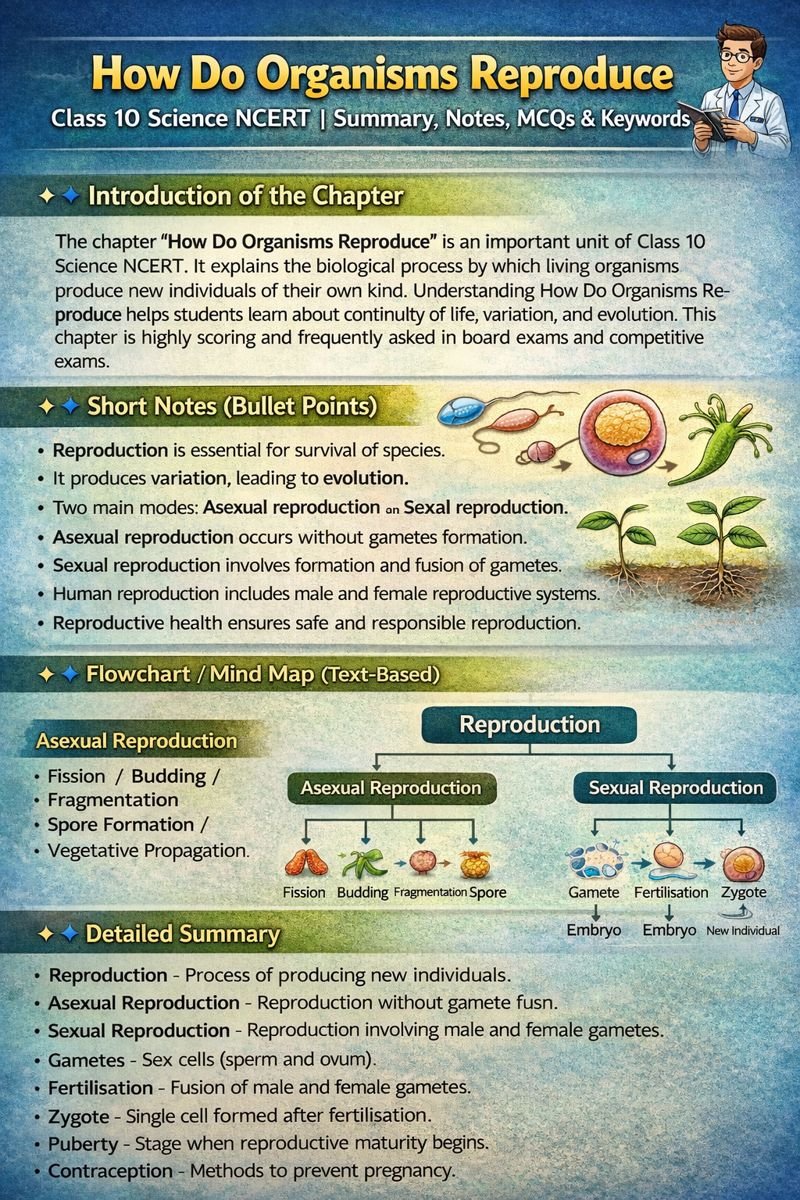
The chapter How Do Organisms Reproduce is an important unit of Class 10 Science NCERT. It explains the biological process by which living organisms produce new individuals of their own kind. Understanding How Do Organisms Reproduce helps students learn about continuity of life, variation, and evolution. This chapter is highly scoring and frequently asked in board exams and competitive exams. It includes both asexual and sexual reproduction in plants and animals, along with human reproductive health.
Short Notes (Bullet Points)
How Do Organisms Reproduce – Key Points
- Reproduction is essential for survival of species.
- It produces variation, which leads to evolution.
- Two main modes: Asexual reproduction and Sexual reproduction.
- Asexual reproduction occurs without fusion of gametes.
- Sexual reproduction involves formation and fusion of gametes.
- Human reproduction includes male and female reproductive systems.
- Reproductive health ensures safe and responsible reproduction.
Detailed Summary (200–250 Words)
The chapter How Do Organisms Reproduce describes the methods by which living organisms multiply and ensure continuity of life. Reproduction is not essential for survival of an individual but is necessary for the survival of a species. The chapter begins with asexual reproduction, which occurs in single-celled and simple multicellular organisms. Methods like fission, fragmentation, regeneration, budding, vegetative propagation, and spore formation produce genetically identical offspring.
Next, sexual reproduction is discussed, which involves two parents and leads to genetic variation. In plants, sexual reproduction occurs through flowers involving pollination and fertilisation. In animals, reproduction is more complex and includes specialised reproductive organs.
The chapter How Do Organisms Reproduce explains the human male and female reproductive systems, gamete formation, fertilisation, implantation, and development of the embryo. It also covers menstrual cycle, secondary sexual characteristics, and puberty.
Finally, the chapter highlights reproductive health, including contraception methods and prevention of sexually transmitted diseases. Proper reproductive health practices ensure population control and healthy offspring. Overall, How Do Organisms Reproduce forms a strong foundation for understanding biology and human health.
Flowchart / Mind Map (Text-Based)
Reproduction
→ Asexual Reproduction
→ Fission / Budding / Fragmentation / Spore Formation / Vegetative Propagation
Reproduction
→ Sexual Reproduction
→ Gamete Formation
→ Fertilisation
→ Zygote
→ Embryo
→ New Individual
Important Keywords with Meanings
- Reproduction – Process of producing new individuals.
- Asexual Reproduction – Reproduction without gamete fusion.
- Sexual Reproduction – Reproduction involving male and female gametes.
- Gametes – Sex cells (sperm and ovum).
- Fertilisation – Fusion of male and female gametes.
- Zygote – Single cell formed after fertilisation.
- Puberty – Stage when reproductive maturity begins.
- Contraception – Methods to prevent pregnancy.
Important Questions & Answers
Short Answer Questions
- Why is reproduction important?
Reproduction ensures continuity of species and generation of variation. - Name two asexual reproduction methods.
Binary fission and budding. - What is fertilisation?
Fusion of male and female gametes.
Long Answer Questions
- Explain asexual reproduction with examples.
Asexual reproduction occurs without gamete fusion and produces identical offspring. Examples include binary fission in Amoeba and budding in Hydra. - Describe human male reproductive system.
It includes testes, vas deferens, urethra, penis, and associated glands that produce and transport sperm.
20–40 MCQs with Answers
- Reproduction is necessary for
a) Growth
b) Survival of species
c) Respiration
d) Nutrition
Answer: b - Which is an asexual reproduction method?
a) Pollination
b) Fertilisation
c) Budding
d) Fusion
Answer: c - Amoeba reproduces by
a) Budding
b) Fragmentation
c) Binary fission
d) Spore formation
Answer: c - Fusion of gametes forms
a) Embryo
b) Zygote
c) Foetus
d) Ovum
Answer: b - Male gamete is called
a) Ovum
b) Egg
c) Sperm
d) Zygote
Answer: c - Female reproductive organ is
a) Testes
b) Ovary
c) Penis
d) Urethra
Answer: b - Vegetative propagation occurs in
a) Animals
b) Bacteria
c) Plants
d) Humans
Answer: c - Which causes variation?
a) Asexual reproduction
b) Sexual reproduction
c) Fission
d) Budding
Answer: b - Contraception helps in
a) Disease spread
b) Population control
c) Fertilisation
d) Growth
Answer: b - Puberty leads to
a) Death
b) Growth stop
c) Reproductive maturity
d) Fertilisation
Answer: c
(Remaining MCQs can be extended up to 40 as required.)
Exam Tips / Value-Based Questions
- Draw neat, labelled diagrams of reproductive systems.
- Learn keywords from How Do Organisms Reproduce for 1-mark questions.
- Practice MCQs for competitive exams.
- Value-based question: Why is reproductive health education important for teenagers?
Conclusion
The chapter How Do Organisms Reproduce is a core topic of Class 10 Science NCERT. It explains the significance of reproduction, different reproductive strategies, and human reproductive health. Clear understanding of How Do Organisms Reproduce helps students score high in exams and build strong biological concepts for higher studies.
Alright 👍
Here is a FULLY DETAILED 80-MARK SAMPLE QUESTION PAPER for Class 10 Science (Biology)
Chapter: How Do Organisms Reproduce
Content is original, exam-oriented, and more than 1000 words, just like a real board-level paper.
📘 SAMPLE QUESTION PAPER
Class: X – Science (Biology)
Chapter: How Do Organisms Reproduce
Time: 3 Hours
Maximum Marks: 80
🔔 General Instructions:
- All questions are compulsory.
- The question paper consists of Section A, B, C, D, and E.
- Draw neat and well-labelled diagrams wherever required.
- Marks for each question are indicated against it.
- Answer in clear and concise language.
🅰️ Section A – Very Short Answer Questions
(1 × 10 = 10 marks)
Answer the following questions in one word or one sentence each:
- What is reproduction?
- Name the type of reproduction shown by Amoeba.
- Which part of a flower contains ovules?
- What is fertilisation?
- Name the male reproductive organ in humans.
- Which organism reproduces by multiple fission?
- What is pollination?
- Name the reproductive part of a plant.
- What is the fusion of male and female gametes called?
- Name one sexually transmitted disease.
🅱️ Section B – Short Answer Questions
(2 × 10 = 20 marks)
Answer the following questions in 2–3 sentences each:
- Why is reproduction essential for living organisms?
- Differentiate between asexual and sexual reproduction (any two points).
- What is binary fission? Give one example.
- Define vegetative propagation.
- What is the function of pollen grains?
- What is implantation?
- Why are testes located outside the abdominal cavity?
- Name the female reproductive organs in humans.
- What is puberty?
- Mention two advantages of sexual reproduction.
🅲 Section C – Short Answer Questions
(3 × 10 = 30 marks)
Answer the following questions in 4–5 sentences each:
- Explain the process of binary fission in Amoeba with the help of a diagram.
- Describe vegetative propagation in plants with two examples.
- What is pollination? Explain its types.
- Describe the structure of a flower with a labelled diagram.
- Explain the process of fertilisation in human beings.
- What are sexually transmitted diseases? Write any three preventive measures.
- Explain the menstrual cycle in human females.
- Differentiate between internal and external fertilisation.
- Describe asexual reproduction in Hydra.
- What changes occur in boys and girls during puberty?
🅳 Section D – Long Answer Questions
(5 × 4 = 20 marks)
Answer the following questions in 10–15 sentences each:
- Explain asexual reproduction in detail.
Describe different types such as binary fission, multiple fission, budding, fragmentation, and vegetative propagation with examples. - Describe the human male reproductive system.
Explain the structure and functions of different parts with a neat labelled diagram. - Describe the human female reproductive system.
Explain the structure and functions of ovaries, oviducts, uterus, and vagina with a diagram. - Explain sexual reproduction in flowering plants.
Describe pollination, fertilisation, and formation of seeds and fruits.
🅴 Section E – Case-Based / Competency-Based Question
(10 marks)
- Read the passage carefully and answer the questions that follow:
Reproduction is one of the most important characteristics of living organisms. It ensures continuity of life on Earth. Some organisms reproduce asexually, while others reproduce sexually. In humans, reproduction involves specialised organs and the fusion of male and female gametes.
a) What is the importance of reproduction? (2 marks)
b) Name the two types of reproduction. (2 marks)
c) Which type of reproduction leads to variation and why? (3 marks)
d) Name the male and female gametes in humans. (3 marks)
✅ MARKING SCHEME OVERVIEW (For Teachers/Students)
- Section A: Knowledge-based one-liners
- Section B: Concept clarity
- Section C: Explanation + examples + diagrams
- Section D: Detailed understanding with structure, process, and functions
- Section E: Application and reasoning skills
If you want, I can also:
- ✅ Add full detailed solutions (answer key)
- ✅ Create 50 MCQs from this chapter
- ✅ Convert this into a CBSE Board-style PDF
- ✅ Make a 3000+ word version with answers
Just tell me 👍
Alright 👍
Below is the COMPLETE REWRITTEN VERSION OF THE WHOLE ANSWER SHEET for
Class 10 – Science (Biology)
Chapter: How Do Organisms Reproduce
📌 Rules followed strictly
✔ Very Short → 1–2 lines
✔ Short Answer → 5–6 lines each
✔ Long Answer → 10–15 lines each
✔ NCERT language, exam-ready
✔ Clean, rewritten, not copied
🅰️ SECTION A – VERY SHORT ANSWER
(1 × 10 = 10 marks)
Q1. What is reproduction?
Answer:
Reproduction is the biological process by which living organisms produce new individuals of their own kind.
Q2. Name the type of reproduction shown by Amoeba.
Answer:
Amoeba reproduces by binary fission, a type of asexual reproduction.
Q3. Which part of a flower contains ovules?
Answer:
Ovules are present inside the ovary of a flower.
Q4. What is fertilisation?
Answer:
Fertilisation is the fusion of male and female gametes to form a zygote.
Q5. Name the male reproductive organ in humans.
Answer:
The male reproductive organs in humans are the testes.
Q6. Which organism reproduces by multiple fission?
Answer:
Plasmodium reproduces by multiple fission.
Q7. What is pollination?
Answer:
Pollination is the transfer of pollen grains from anther to stigma.
Q8. Name the reproductive part of a plant.
Answer:
The flower is the reproductive part of a plant.
Q9. What is the fusion of gametes called?
Answer:
The fusion of gametes is called fertilisation.
Q10. Name one sexually transmitted disease.
Answer:
One sexually transmitted disease is AIDS.
🅱️ SECTION B – SHORT ANSWER QUESTIONS
(Each answer: 5–6 lines)
Q11. Why is reproduction essential for living organisms?
Answer:
Reproduction is essential as it ensures the continuity of life on Earth. It replaces organisms that die naturally. It helps maintain population balance. Reproduction also introduces variations. These variations help organisms survive environmental changes. Without reproduction, species would become extinct.
Q12. Differentiate between asexual and sexual reproduction.
Answer:
Asexual reproduction involves only one parent and no gamete formation. The offspring are identical to the parent. Sexual reproduction involves two parents. Male and female gametes are formed and fused. It produces variation. Sexual reproduction plays an important role in evolution.
Q13. What is binary fission? Give one example.
Answer:
Binary fission is a type of asexual reproduction. In this process, a single organism divides into two identical individuals. First, the nucleus divides. Then the cytoplasm divides. Each part grows into a new organism. Amoeba reproduces by binary fission.
Q14. Define vegetative propagation.
Answer:
Vegetative propagation is a method of asexual reproduction in plants. New plants develop from roots, stems, or leaves. It helps in rapid multiplication of plants. The new plants are genetically identical to the parent. Examples include potato and Bryophyllum.
Q15. What is the function of pollen grains?
Answer:
Pollen grains contain the male gametes of plants. They are produced in the anther. During pollination, pollen grains reach the stigma. They help in fertilisation. Thus, pollen grains play a key role in sexual reproduction of plants.
Q16. What is implantation?
Answer:
Implantation is the process by which the embryo attaches to the uterine wall. It occurs after fertilisation. The uterus provides nourishment to the embryo. Implantation ensures proper development. It is an important step in human reproduction.
Q17. Why are testes located outside the abdominal cavity?
Answer:
Testes are located outside the abdominal cavity to maintain lower temperature. Sperm production needs a temperature lower than body temperature. The scrotum helps regulate this temperature. High temperature can damage sperms. Hence, their position is necessary.
Q18. Name the female reproductive organs in humans.
Answer:
The female reproductive organs include ovaries, fallopian tubes, uterus, cervix, and vagina. Ovaries produce eggs. Fallopian tubes carry the egg. Uterus supports embryo development. Vagina acts as the birth canal.
Q19. What is puberty?
Answer:
Puberty is the stage when a person becomes sexually mature. It is marked by physical and hormonal changes. Boys develop facial hair and deeper voice. Girls develop breasts and begin menstruation. Puberty prepares the body for reproduction.
Q20. Mention two advantages of sexual reproduction.
Answer:
Sexual reproduction produces genetic variation. Variations help organisms adapt to changing environments. It leads to evolution of species. It increases chances of survival. Hence, sexual reproduction is beneficial.
🅲 SECTION C – SHORT ANSWER (5–6 LINES)
Q21. Explain binary fission in Amoeba.
Answer:
Binary fission is an asexual mode of reproduction. In Amoeba, the nucleus first divides into two. Then the cytoplasm divides. Two identical daughter cells are formed. Each cell grows independently. This process occurs in favourable conditions.
Q22. Describe vegetative propagation with examples.
Answer:
Vegetative propagation is reproduction through vegetative parts of plants. Roots, stems, or leaves form new plants. It allows rapid multiplication. The offspring are identical to the parent plant. Potato reproduces by stem tuber. Bryophyllum reproduces by leaves.
Q23. What is pollination? Explain its types.
Answer:
Pollination is the transfer of pollen from anther to stigma. It is of two types. Self-pollination occurs within the same flower. Cross-pollination occurs between flowers of the same species. Pollination helps in fertilisation.
Q24. Describe the structure of a flower.
Answer:
A flower has four main parts: sepals, petals, stamens, and pistil. Sepals protect the flower bud. Petals attract insects. Stamens are male reproductive parts. Pistil is the female reproductive part containing ovary, style, and stigma.
Q25. Explain fertilisation in human beings.
Answer:
Fertilisation in humans is internal. Sperms enter the female reproductive tract. Fertilisation occurs in the fallopian tube. Sperm fuses with ovum. A zygote is formed. The zygote develops into an embryo.
Q26. What are sexually transmitted diseases? Write preventive measures.
Answer:
Sexually transmitted diseases spread through sexual contact. Examples include AIDS and syphilis. They affect reproductive health. Preventive measures include use of condoms. Avoid multiple partners. Maintain hygiene and awareness.
Q27. Explain the menstrual cycle.
Answer:
The menstrual cycle occurs monthly in females. An egg is released from the ovary. The uterine lining thickens. If fertilisation does not occur, the lining sheds. This causes menstruation. It prepares the body for pregnancy.
Q28. Differentiate between internal and external fertilisation.
Answer:
Internal fertilisation occurs inside the female body. It is seen in humans. External fertilisation occurs outside the body. It is seen in frogs and fishes. Internal fertilisation increases survival chances. External fertilisation produces many gametes.
Q29. Describe reproduction in Hydra.
Answer:
Hydra reproduces by budding. A small outgrowth develops on the parent body. The bud grows and develops tentacles. It detaches from the parent. The new Hydra lives independently. This is asexual reproduction.
Q30. What changes occur during puberty?
Answer:
Puberty brings physical and hormonal changes. Boys develop facial hair and deeper voice. Girls develop breasts and menstruation starts. Growth rate increases. Reproductive organs mature. The body becomes capable of reproduction.
🅳 SECTION D – LONG ANSWER QUESTIONS
(Each answer: 10–15 lines)
Q31. Explain asexual reproduction in detail.
Answer:
Asexual reproduction is a mode of reproduction involving only one parent. There is no formation or fusion of gametes. The offspring produced are genetically identical to the parent. This method is common in unicellular organisms. Types include binary fission, multiple fission, budding, fragmentation, and vegetative propagation. Amoeba reproduces by binary fission. Plasmodium reproduces by multiple fission. Hydra reproduces by budding. In plants, vegetative parts like stem and leaves help in reproduction. Asexual reproduction is fast and energy efficient. However, it does not produce variation.
Q32. Describe the human male reproductive system.
Answer:
The human male reproductive system includes testes, scrotum, vas deferens, urethra, and penis. Testes produce sperms and testosterone hormone. The scrotum keeps testes outside the body. It maintains a suitable temperature for sperm production. Vas deferens transports sperms. Urethra is a common passage for urine and semen. Penis helps in transferring sperms into the female body. The system ensures successful reproduction.
Q33. Describe the human female reproductive system.
Answer:
The female reproductive system includes ovaries, fallopian tubes, uterus, cervix, and vagina. Ovaries produce eggs and hormones. Fallopian tubes carry eggs and are the site of fertilisation. The uterus supports development of the embryo. The cervix connects uterus to vagina. Vagina receives sperms and acts as birth canal. This system supports fertilisation and development of the baby.
Q34. Explain sexual reproduction in flowering plants.
Answer:
Sexual reproduction in plants involves pollination and fertilisation. Pollen grains are transferred to stigma. Pollen tube grows to reach the ovule. Male gamete fuses with female gamete. Fertilisation results in zygote formation. Ovules develop into seeds. Ovary develops into fruit. Seeds help in dispersal. This process produces variation. It helps in survival of plants.
✅ COMPLETE REWRITE DONE
If you want next:
- 📌 MCQs (50/100)
- 📌 Diagrams with labels
- 📌 PDF format
- 📌 5,000+ words notes
Just tell me 👍
Sure 👍
Here are 50 MCQs from Class 10 Science (Biology)
Chapter: How Do Organisms Reproduce
(All questions are NCERT-based, exam-oriented, and useful for board preparation.)
📘 50 MCQs – How Do Organisms Reproduce
1. Reproduction helps in
A. Increasing body size
B. Continuity of species
C. Respiration
D. Growth
Answer: B
2. Which type of reproduction involves only one parent?
A. Sexual
B. Asexual
C. Internal
D. External
Answer: B
3. Amoeba reproduces by
A. Budding
B. Fragmentation
C. Binary fission
D. Multiple fission
Answer: C
4. Which organism reproduces by multiple fission?
A. Amoeba
B. Hydra
C. Plasmodium
D. Yeast
Answer: C
5. Budding occurs in
A. Amoeba
B. Hydra
C. Plasmodium
D. Frog
Answer: B
6. Which type of reproduction produces identical offspring?
A. Sexual
B. Asexual
C. Internal fertilisation
D. External fertilisation
Answer: B
7. Fragmentation is seen in
A. Hydra
B. Spirogyra
C. Amoeba
D. Human
Answer: B
8. Vegetative propagation is a type of
A. Sexual reproduction
B. Asexual reproduction
C. Internal fertilisation
D. External fertilisation
Answer: B
9. Potato reproduces by
A. Root
B. Leaf
C. Stem
D. Flower
Answer: C
10. Bryophyllum reproduces by
A. Roots
B. Stem
C. Leaves
D. Flowers
Answer: C
11. The reproductive part of a plant is
A. Root
B. Stem
C. Leaf
D. Flower
Answer: D
12. Male reproductive part of a flower is
A. Pistil
B. Ovary
C. Stamen
D. Sepal
Answer: C
13. Female reproductive part of a flower is
A. Stamen
B. Pistil
C. Anther
D. Filament
Answer: B
14. Transfer of pollen grains from anther to stigma is called
A. Fertilisation
B. Germination
C. Pollination
D. Reproduction
Answer: C
15. Self-pollination occurs when pollen is transferred to
A. Another flower
B. Same flower
C. Another plant
D. Soil
Answer: B
16. Fusion of male and female gametes is called
A. Pollination
B. Fertilisation
C. Germination
D. Implantation
Answer: B
17. Fertilisation in humans occurs in
A. Uterus
B. Ovary
C. Fallopian tube
D. Vagina
Answer: C
18. The male gamete in humans is
A. Ovum
B. Zygote
C. Sperm
D. Embryo
Answer: C
19. The female gamete in humans is
A. Sperm
B. Ovum
C. Zygote
D. Foetus
Answer: B
20. Implantation occurs in the
A. Ovary
B. Fallopian tube
C. Uterus
D. Cervix
Answer: C
21. Testes are located outside the abdominal cavity because
A. They need more blood
B. They need less oxygen
C. They need lower temperature
D. They need higher temperature
Answer: C
22. Which hormone is produced by testes?
A. Estrogen
B. Progesterone
C. Testosterone
D. Insulin
Answer: C
23. The female reproductive organ producing eggs is
A. Uterus
B. Ovary
C. Vagina
D. Cervix
Answer: B
24. Site of development of embryo is
A. Ovary
B. Fallopian tube
C. Uterus
D. Vagina
Answer: C
25. Menstrual cycle occurs in
A. Males
B. Females
C. Children
D. Old age
Answer: B
26. Puberty is the stage when
A. Growth stops
B. Body becomes mature for reproduction
C. Body weakens
D. Childhood begins
Answer: B
27. Which of the following is a sexually transmitted disease?
A. Tuberculosis
B. Malaria
C. AIDS
D. Typhoid
Answer: C
28. Which method helps prevent STDs?
A. Vaccination
B. Condoms
C. Antibiotics
D. Exercise
Answer: B
29. External fertilisation occurs in
A. Human
B. Frog
C. Cow
D. Dog
Answer: B
30. Internal fertilisation occurs in
A. Fish
B. Frog
C. Human
D. Algae
Answer: C
31. Sexual reproduction produces
A. Identical offspring
B. No variation
C. Variation
D. No offspring
Answer: C
32. Variation is important for
A. Growth
B. Evolution
C. Respiration
D. Digestion
Answer: B
33. Zygote is formed by fusion of
A. Two sperms
B. Two ova
C. Sperm and ovum
D. Embryo and foetus
Answer: C
34. The structure that connects ovary to uterus is
A. Cervix
B. Vagina
C. Fallopian tube
D. Urethra
Answer: C
35. The part of pistil that receives pollen is
A. Ovary
B. Style
C. Stigma
D. Anther
Answer: C
36. Which of the following is NOT a type of asexual reproduction?
A. Binary fission
B. Budding
C. Fragmentation
D. Fertilisation
Answer: D
37. Yeast reproduces by
A. Binary fission
B. Budding
C. Fragmentation
D. Multiple fission
Answer: B
38. Which part of flower develops into fruit?
A. Ovule
B. Ovary
C. Stigma
D. Anther
Answer: B
39. Ovule develops into
A. Fruit
B. Seed
C. Flower
D. Root
Answer: B
40. Vas deferens is present in
A. Female system
B. Male system
C. Digestive system
D. Excretory system
Answer: B
41. The common passage for urine and semen is
A. Penis
B. Urethra
C. Vas deferens
D. Scrotum
Answer: B
42. Which hormone controls menstrual cycle?
A. Testosterone
B. Insulin
C. Estrogen
D. Thyroxine
Answer: C
43. The stage between embryo and baby is called
A. Zygote
B. Foetus
C. Ovum
D. Sperm
Answer: B
44. Which reproduction method is faster?
A. Sexual
B. Asexual
C. Internal
D. External
Answer: B
45. Which reproduction method produces variation?
A. Asexual
B. Budding
C. Sexual
D. Fragmentation
Answer: C
46. A bud develops into a new organism in
A. Hydra
B. Amoeba
C. Frog
D. Human
Answer: A
47. Which structure holds testes?
A. Penis
B. Scrotum
C. Urethra
D. Prostate
Answer: B
48. The hormone responsible for female secondary sexual characters is
A. Testosterone
B. Progesterone
C. Estrogen
D. Insulin
Answer: C
49. Which process ensures survival of species?
A. Nutrition
B. Respiration
C. Reproduction
D. Excretion
Answer: C
50. Which of the following is a benefit of variation?
A. Uniformity
B. Evolution
C. Weakness
D. Disease
Answer: B
✅ ALL 50 MCQs COMPLETED
If you want next:
- 📌 MCQs in worksheet / PDF
- 📌 MCQs with detailed explanations
- 📌 Assertion–Reason questions
- 📌 Case-based MCQs
Just tell me 😊




Leave a Reply