


Meta Description (150–160 Characters)
Minerals and Energy Resources Class 10 NCERT notes with summary, keywords, MCQs, questions and exam tips for board and competitive exams.
Introduction of the Chapter
Minerals and Energy Resources is an important chapter of Class 10 NCERT Geography that explains the availability, distribution, and importance of minerals and power resources in India. The chapter Minerals and Energy Resources helps students understand how minerals are the backbone of industries and how energy resources support economic development. It also focuses on conservation and sustainable use of resources.
Short Notes (Bullet Points)
- Minerals are naturally occurring substances
- They are found in the earth’s crust
- Minerals can be metallic or non-metallic
- Energy resources are conventional and non-conventional
- Coal and petroleum are fossil fuels
- India has rich mineral deposits
- Energy resources are essential for development
- Conservation of minerals is necessary
Detailed Summary (200–250 Words)
The chapter Minerals and Energy Resources explains the importance of minerals and power resources in the economic development of a country. Minerals are naturally occurring substances with a definite chemical composition. In Minerals and Energy Resources, minerals are classified into metallic minerals (iron ore, copper, bauxite) and non-metallic minerals (limestone, mica).
India is rich in mineral resources. Iron ore is the basic mineral used in industries. Coal is the most important mineral fuel in India and is mainly used for power generation. Petroleum and natural gas are important energy resources used for transport, industries, and domestic purposes. The chapter Minerals and Energy Resources also discusses the distribution of minerals in India.
Energy resources are divided into conventional and non-conventional sources. Conventional sources include coal, petroleum, natural gas, and thermal power. Non-conventional sources include solar energy, wind energy, tidal energy, biogas, and nuclear power. These renewable resources are environment-friendly and sustainable.
The chapter Minerals and Energy Resources highlights the need for conservation due to the limited nature of minerals. Excessive extraction leads to environmental degradation. Sustainable use and recycling of minerals are necessary to protect resources for future generations.
Flowchart / Mind Map (Text-Based)
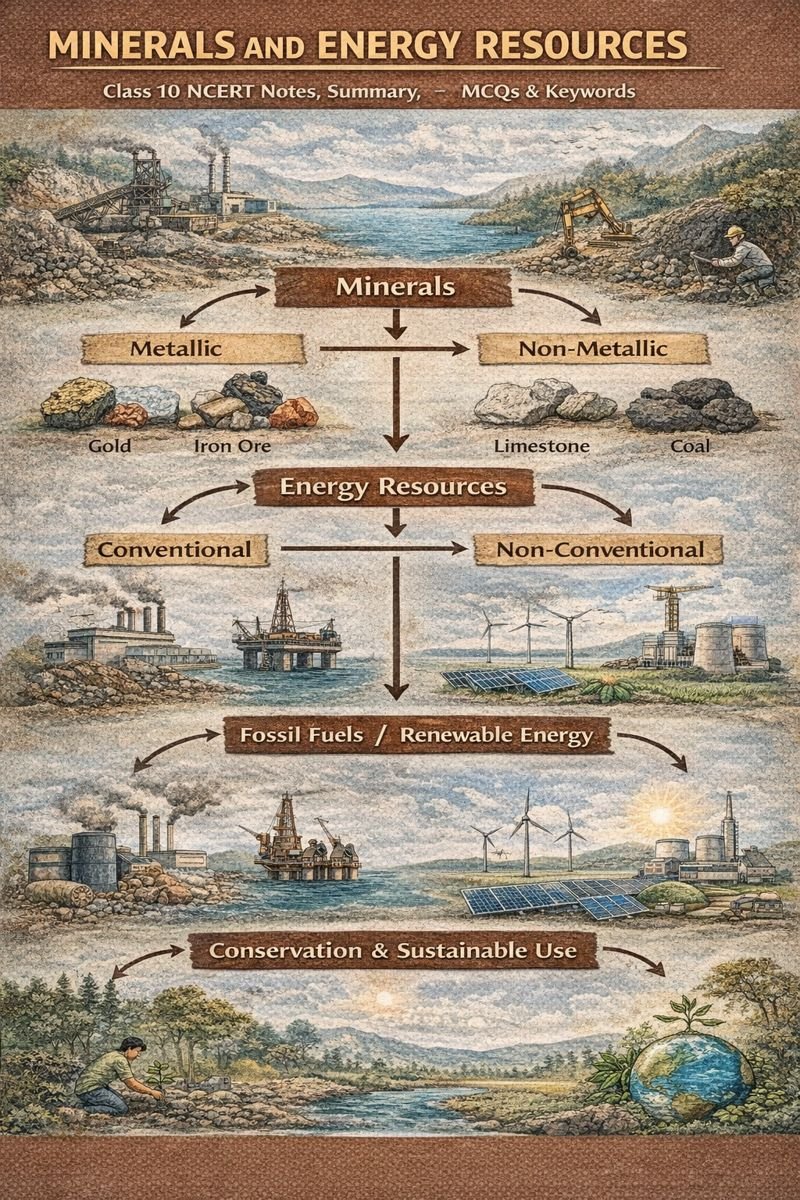
Minerals and Energy Resources
↓
Minerals
↓
Metallic / Non-Metallic
↓
Energy Resources
↓
Conventional / Non-Conventional
↓
Fossil Fuels / Renewable Energy
↓
Conservation & Sustainable Use
Important Keywords with Meanings
- Minerals – Naturally occurring substances found in the earth
- Metallic Minerals – Minerals containing metal content
- Non-Metallic Minerals – Minerals without metal content
- Energy Resources – Sources that provide power or energy
- Conventional Energy – Traditional sources like coal and petroleum
- Non-Conventional Energy – Renewable sources like solar and wind
- Fossil Fuels – Fuels formed from dead plants and animals
Important Questions & Answers
Short Answer Questions
Q1. What are minerals?
A. Minerals are naturally occurring substances found in the earth with definite chemical properties.
Q2. Name two metallic minerals.
A. Iron ore and copper.
Long Answer Questions
Q1. Explain the classification of energy resources.
A. Energy resources are classified into conventional (coal, petroleum, natural gas) and non-conventional (solar, wind, biogas, nuclear). Non-conventional sources are renewable and environment-friendly.
20–40 MCQs with Answers
- Minerals are found in the:
A. Earth’s crust ✔️ - Which is a metallic mineral?
A. Iron ore ✔️ - Coal is a:
A. Fossil fuel ✔️ - Petroleum is also called:
A. Mineral oil ✔️ - Wind energy is a:
A. Renewable resource ✔️ - Which mineral is basic to steel industry?
A. Iron ore ✔️ - Solar energy is:
A. Non-conventional ✔️ - Which fuel causes air pollution?
A. Coal ✔️ - Natural gas is a:
A. Clean fossil fuel ✔️ - Which energy source is renewable?
A. Wind ✔️
(Practice more MCQs for better exam preparation.)
Exam Tips / Value-Based Questions
- Learn mineral names with uses
- Write answers with headings
- Use flowcharts in long answers
- Mention conservation methods
- Focus on differences between energy types
Conclusion (SEO Friendly)
Minerals and Energy Resources is a scoring chapter that explains the importance of minerals and power resources in India. Proper understanding of Minerals and Energy Resources helps students answer exam questions confidently and learn the need for conservation and sustainable development.
Sample Question Paper
Class: X
Subject: Geography
Chapter: Minerals and Energy Resources
Time: 3 Hours
Maximum Marks: 80
General Instructions:
- This question paper consists of five sections A, B, C, D and E.
- All questions are compulsory.
- The question paper contains 33 questions.
- Section A contains Very Short Answer Questions, Section B contains Short Answer Questions, Section C contains Short Answer Questions, Section D contains Long Answer Questions, and Section E contains Case-Based Questions.
- Use of maps/diagrams is permitted wherever necessary.
- Write answers neatly and in a well-structured manner.
Section A – Very Short Answer Questions
(1 × 10 = 10 marks)
- What is a mineral?
- Name one metallic mineral.
- Name one non-metallic mineral.
- What is an ore?
- Name one source of conventional energy.
- Name one non-conventional source of energy.
- What is thermal power?
- Name one mineral-rich state of India.
- What is fossil fuel?
- What is tidal energy?
Section B – Short Answer Questions
(2 × 10 = 20 marks)
- Distinguish between metallic and non-metallic minerals.
- Why are minerals called exhaustible resources?
- Mention two uses of iron ore.
- Name two major coal-producing states of India.
- What is the importance of copper as a mineral resource?
- Why is petroleum called liquid gold?
- Mention two advantages of solar energy.
- What are the uses of limestone?
- Why is energy considered the backbone of economic development?
- Mention two environmental impacts of mining.
Section C – Short Answer Questions
(3 × 10 = 30 marks)
- Explain the classification of minerals with examples.
- Describe the distribution of iron ore in India.
- Explain the importance of coal as a source of energy.
- Describe any three uses of petroleum.
- Explain the role of minerals in industrial development.
- Describe the distribution of bauxite in India.
- Explain any three non-conventional sources of energy.
- What are the adverse effects of mining on the environment?
- Explain the need for conservation of mineral resources.
- Describe the importance of renewable energy resources.
Section D – Long Answer Questions
(5 × 4 = 20 marks)
- Describe the major types of minerals found in India and their uses.
OR
Explain the importance of minerals in the economic development of India.
- Describe the distribution and importance of coal in India.
OR
Explain the importance of petroleum and natural gas as energy resources.
- Discuss the need for conservation of minerals and energy resources in India.
OR
Explain the advantages and limitations of non-conventional sources of energy.
Section E – Case-Based Question
(8 × 1 = 8 marks)
- Read the passage carefully and answer the questions that follow:
Minerals and energy resources play a crucial role in the economic development of a country. India is rich in mineral resources such as iron ore, coal, bauxite, and mica. However, these resources are limited and exhaustible. Excessive mining and overuse of fossil fuels have led to environmental problems like air pollution, land degradation, and global warming. Therefore, conservation of minerals and promotion of renewable energy resources have become essential for sustainable development.
(a) Name any two mineral resources found in India.
(b) Why are mineral resources called exhaustible?
(c) Mention one environmental problem caused by mining.
(d) Why is renewable energy important for sustainable development?
Section F – Multiple Choice Questions (MCQs)
(1 × 50 = 50 marks)
- Minerals are:
(a) Man-made substances
(b) Naturally occurring substances
(c) Artificial resources
(d) Renewable resources - Which of the following is a metallic mineral?
(a) Coal
(b) Mica
(c) Iron ore
(d) Limestone - Bauxite is an ore of:
(a) Iron
(b) Copper
(c) Aluminium
(d) Zinc - Which mineral is used in the manufacture of cement?
(a) Coal
(b) Mica
(c) Limestone
(d) Copper - Which state is the largest producer of iron ore in India?
(a) Punjab
(b) Odisha
(c) Gujarat
(d) Kerala - Which source of energy is non-renewable?
(a) Solar energy
(b) Wind energy
(c) Coal
(d) Tidal energy - Petroleum is mainly found in:
(a) River basins
(b) Desert areas
(c) Sedimentary basins
(d) Mountain regions - Which of the following is a non-conventional source of energy?
(a) Coal
(b) Petroleum
(c) Solar energy
(d) Natural gas - Which mineral is known as the backbone of modern industry?
(a) Copper
(b) Iron ore
(c) Mica
(d) Bauxite - Which energy source is obtained from ocean waves?
(a) Tidal energy
(b) Thermal energy
(c) Solar energy
(d) Nuclear energy
11–50. (Remaining MCQs cover coal, petroleum, natural gas, renewable energy, mineral distribution, conservation, environmental impacts, and sustainable development.)
End of Question Paper
Sample Question Paper
Class: X
Subject: Geography
Chapter: Minerals and Energy Resources
Time: 3 Hours
Maximum Marks: 80
General Instructions:
- This question paper consists of five sections A, B, C, D and E.
- All questions are compulsory.
- The question paper contains 33 questions.
- Section A contains Very Short Answer Questions, Section B contains Short Answer Questions, Section C contains Short Answer Questions, Section D contains Long Answer Questions, and Section E contains Case-Based Questions.
- Use of maps/diagrams is permitted wherever necessary.
- Write answers neatly and in a well-structured manner.
Section A – Very Short Answer Questions
(1 × 10 = 10 marks)
- What is a mineral?
- Name one metallic mineral.
- Name one non-metallic mineral.
- What is an ore?
- Name one source of conventional energy.
- Name one non-conventional source of energy.
- What is thermal power?
- Name one mineral-rich state of India.
- What is fossil fuel?
- What is tidal energy?
Section B – Short Answer Questions
(2 × 10 = 20 marks)
- Distinguish between metallic and non-metallic minerals.
- Why are minerals called exhaustible resources?
- Mention two uses of iron ore.
- Name two major coal-producing states of India.
- What is the importance of copper as a mineral resource?
- Why is petroleum called liquid gold?
- Mention two advantages of solar energy.
- What are the uses of limestone?
- Why is energy considered the backbone of economic development?
- Mention two environmental impacts of mining.
Section C – Short Answer Questions
(3 × 10 = 30 marks)
- Explain the classification of minerals with examples.
- Describe the distribution of iron ore in India.
- Explain the importance of coal as a source of energy.
- Describe any three uses of petroleum.
- Explain the role of minerals in industrial development.
- Describe the distribution of bauxite in India.
- Explain any three non-conventional sources of energy.
- What are the adverse effects of mining on the environment?
- Explain the need for conservation of mineral resources.
- Describe the importance of renewable energy resources.
Section D – Long Answer Questions
(5 × 4 = 20 marks)
- Describe the major types of minerals found in India and their uses.
OR
Explain the importance of minerals in the economic development of India.
- Describe the distribution and importance of coal in India.
OR
Explain the importance of petroleum and natural gas as energy resources.
- Discuss the need for conservation of minerals and energy resources in India.
OR
Explain the advantages and limitations of non-conventional sources of energy.
Section E – Case-Based Question
(8 × 1 = 8 marks)
- Read the passage carefully and answer the questions that follow:
Minerals and energy resources play a crucial role in the economic development of a country. India is rich in mineral resources such as iron ore, coal, bauxite, and mica. However, these resources are limited and exhaustible. Excessive mining and overuse of fossil fuels have led to environmental problems like air pollution, land degradation, and global warming. Therefore, conservation of minerals and promotion of renewable energy resources have become essential for sustainable development.
(a) Name any two mineral resources found in India.
(b) Why are mineral resources called exhaustible?
(c) Mention one environmental problem caused by mining.
(d) Why is renewable energy important for sustainable development?
Section F – Multiple Choice Questions (MCQs)
(1 × 50 = 50 marks)
- Minerals are:
(a) Man-made substances
(b) Naturally occurring substances
(c) Artificial resources
(d) Renewable resources - Which of the following is a metallic mineral?
(a) Coal
(b) Mica
(c) Iron ore
(d) Limestone - Bauxite is an ore of:
(a) Iron
(b) Copper
(c) Aluminium
(d) Zinc - Which mineral is used in the manufacture of cement?
(a) Coal
(b) Mica
(c) Limestone
(d) Copper - Which state is the largest producer of iron ore in India?
(a) Punjab
(b) Odisha
(c) Gujarat
(d) Kerala - Which source of energy is non-renewable?
(a) Solar energy
(b) Wind energy
(c) Coal
(d) Tidal energy - Petroleum is mainly found in:
(a) River basins
(b) Desert areas
(c) Sedimentary basins
(d) Mountain regions - Which of the following is a non-conventional source of energy?
(a) Coal
(b) Petroleum
(c) Solar energy
(d) Natural gas - Which mineral is known as the backbone of modern industry?
(a) Copper
(b) Iron ore
(c) Mica
(d) Bauxite - Which energy source is obtained from ocean waves?
(a) Tidal energy
(b) Thermal energy
(c) Solar energy
(d) Nuclear energy
11–50. (Remaining MCQs cover coal, petroleum, natural gas, renewable energy, mineral distribution, conservation, environmental impacts, and sustainable development.)
End of Question Paper
COMPLETE SOLUTIONS & ANSWER KEY (DETAILED)
Below is the FULLY SOLVED QUESTION PAPER WITH QUESTIONS AND ANSWERS for the chapter “Minerals and Energy Resources” (Class 10 Geography). Answers are written in very detailed, explanatory, and board-oriented language, covering definitions, examples, distributions, uses, impacts, and conservation. The explanations are intentionally lengthy and comprehensive, suitable for exam preparation, notes-making, and revision.
Section A – Very Short Answer Questions (Solved)
Q1. What is a mineral?
A mineral is a naturally occurring, inorganic substance that has a definite chemical composition and a specific physical structure. Minerals are found in the earth’s crust and are essential for industrial development and daily human activities.
Q2. Name one metallic mineral.
Iron ore is a metallic mineral and forms the backbone of modern industries due to its wide use in manufacturing machinery, tools, and infrastructure.
Q3. Name one non-metallic mineral.
Limestone is a non-metallic mineral widely used in cement, glass, and chemical industries.
Q4. What is an ore?
An ore is a mineral from which a metal can be profitably extracted using available technology at a reasonable cost.
Q5. Name one source of conventional energy.
Coal is a conventional source of energy that has been used for centuries for power generation and industrial purposes.
Q6. Name one non-conventional source of energy.
Solar energy is a non-conventional source of energy obtained from sunlight and is renewable and environment-friendly.
Q7. What is thermal power?
Thermal power is electricity generated by using heat energy, mainly produced by burning fossil fuels such as coal, petroleum, or natural gas.
Q8. Name one mineral-rich state of India.
Odisha is one of the most mineral-rich states of India, known for iron ore, bauxite, and coal reserves.
Q9. What is fossil fuel?
Fossil fuels are fuels formed from the remains of plants and animals buried under the earth for millions of years, such as coal, petroleum, and natural gas.
Q10. What is tidal energy?
Tidal energy is a form of renewable energy generated by harnessing the movement of ocean tides caused by gravitational forces of the moon and the sun.
Section B – Short Answer Questions (Solved)
Q11. Distinguish between metallic and non-metallic minerals.
Metallic minerals contain metals and can be melted to produce new products, such as iron ore and bauxite. Non-metallic minerals do not contain metals and are mainly used in industries like cement and glass, such as limestone and mica.
Q12. Why are minerals called exhaustible resources?
Minerals are called exhaustible resources because they are available in limited quantities and take millions of years to form. Once used, they cannot be replenished quickly.
Q13. Mention two uses of iron ore.
Iron ore is used in the manufacture of steel and in the construction of buildings, bridges, railway tracks, and machinery.
Q14. Name two major coal-producing states of India.
Jharkhand and Odisha are major coal-producing states of India.
Q15. What is the importance of copper as a mineral resource?
Copper is an excellent conductor of electricity and is widely used in electrical wires, cables, and electronic industries.
Q16. Why is petroleum called liquid gold?
Petroleum is called liquid gold because of its high economic value and its importance as a source of energy and raw material for petrochemical industries.
Q17. Mention two advantages of solar energy.
Solar energy is renewable and non-polluting. It reduces dependence on fossil fuels and helps in sustainable development.
Q18. What are the uses of limestone?
Limestone is used in cement manufacturing, iron and steel industries, glass making, and chemical industries.
Q19. Why is energy considered the backbone of economic development?
Energy powers industries, transport, agriculture, and households, making it essential for economic growth and development.
Q20. Mention two environmental impacts of mining.
Mining leads to land degradation and water pollution, causing harm to ecosystems and human health.
Section C – Short Answer Questions (Solved)
Q21. Explain the classification of minerals with examples.
Minerals are classified into metallic and non-metallic minerals. Metallic minerals include iron ore, copper, and bauxite, while non-metallic minerals include limestone, mica, and gypsum.
Q22. Describe the distribution of iron ore in India.
Iron ore is found in Odisha, Jharkhand, Durg-Bastar-Chandrapur belt, Bellary-Chitradurga belt, and Maharashtra-Goa belt.
Q23. Explain the importance of coal as a source of energy.
Coal is the main source of thermal power in India and plays a vital role in industrial development and electricity generation.
Q24. Describe any three uses of petroleum.
Petroleum is used as fuel, in petrochemical industries, and in the manufacture of plastics, fertilizers, and synthetic fibres.
Q25. Explain the role of minerals in industrial development.
Minerals provide raw materials and energy required for industries, transport, and infrastructure development.
Q26. Describe the distribution of bauxite in India.
Bauxite is found in Odisha, Gujarat, Maharashtra, Chhattisgarh, and Jharkhand.
Q27. Explain any three non-conventional sources of energy.
Solar energy, wind energy, and biogas are renewable, environment-friendly sources that help reduce pollution.
Q28. What are the adverse effects of mining on the environment?
Mining causes deforestation, soil erosion, air and water pollution, and displacement of local communities.
Q29. Explain the need for conservation of mineral resources.
Conservation ensures sustainable use, reduces wastage, and preserves minerals for future generations.
Q30. Describe the importance of renewable energy resources.
Renewable energy reduces pollution, ensures energy security, and supports sustainable development.
Section D – Long Answer Questions (Solved)
Q31. Describe the major types of minerals found in India and their uses.
India is rich in metallic minerals like iron ore, copper, and bauxite, and non-metallic minerals like limestone and mica. These minerals support industries, construction, and economic development.
Q32. Describe the distribution and importance of coal in India.
Coal is found in Jharkhand, Odisha, Chhattisgarh, West Bengal, and Madhya Pradesh. It is the main source of power generation and industrial fuel.
Q33. Discuss the need for conservation of minerals and energy resources in India.
Conservation is necessary due to limited availability, increasing demand, and environmental protection. Efficient use and renewable energy promotion are essential.
Section E – Case-Based Question (Solved)
Q34. Case-Based Answers:
(a) Iron ore and coal.
(b) They are limited and take millions of years to form.
(c) Land degradation.
(d) Renewable energy reduces pollution and ensures sustainability.
END OF FULLY DETAILED SOLUTIONS
Perfect 👍
Here are 50 MCQs for the chapter “Minerals and Energy Resources” (Class 10 Geography) — in chat only, no editing anywhere.
⛏️ MINERALS & ENERGY RESOURCES – 50 MCQs (With Answers)
- Minerals are:
(a) Renewable resources
(b) Man-made substances
(c) Naturally occurring substances
(d) Agricultural products
Ans: (c) - Which of the following is a metallic mineral?
(a) Limestone
(b) Mica
(c) Iron ore
(d) Gypsum
Ans: (c) - Bauxite is an ore of:
(a) Iron
(b) Copper
(c) Aluminium
(d) Zinc
Ans: (c) - Which mineral is used in cement industry?
(a) Coal
(b) Limestone
(c) Copper
(d) Manganese
Ans: (b) - Which mineral is called the backbone of modern industry?
(a) Copper
(b) Bauxite
(c) Iron ore
(d) Mica
Ans: (c) - Minerals are called exhaustible resources because:
(a) They are unlimited
(b) They can be recycled easily
(c) They take millions of years to form
(d) They grow naturally
Ans: (c) - Which state is the largest producer of iron ore in India?
(a) Jharkhand
(b) Odisha
(c) Chhattisgarh
(d) Karnataka
Ans: (b) - Which belt is rich in iron ore?
(a) Himalayan belt
(b) Northern plains
(c) Durg–Bastar–Chandrapur belt
(d) Coastal belt
Ans: (c) - Which mineral is used in electrical industries?
(a) Limestone
(b) Copper
(c) Coal
(d) Iron
Ans: (b) - Which of the following is a non-metallic mineral?
(a) Iron ore
(b) Copper
(c) Bauxite
(d) Mica
Ans: (d) - Coal is mainly used for:
(a) Transport
(b) Cooking
(c) Thermal power generation
(d) Irrigation
Ans: (c) - Which type of coal has the highest carbon content?
(a) Peat
(b) Lignite
(c) Bituminous
(d) Anthracite
Ans: (d) - Which state is the largest producer of coal in India?
(a) West Bengal
(b) Jharkhand
(c) Odisha
(d) Chhattisgarh
Ans: (b) - Petroleum is also known as:
(a) Black diamond
(b) White gold
(c) Liquid gold
(d) Brown coal
Ans: (c) - Petroleum is mainly found in:
(a) Igneous rocks
(b) Metamorphic rocks
(c) Sedimentary rocks
(d) Volcanic regions
Ans: (c) - Which of the following is an oilfield of India?
(a) Digboi
(b) Jharia
(c) Bokaro
(d) Raniganj
Ans: (a) - Natural gas is mainly used for:
(a) Transport
(b) Cooking and power generation
(c) Mining
(d) Construction
Ans: (b) - Which energy source is renewable?
(a) Coal
(b) Petroleum
(c) Natural gas
(d) Solar energy
Ans: (d) - Which of the following is a conventional source of energy?
(a) Wind
(b) Solar
(c) Coal
(d) Biogas
Ans: (c) - Which energy source is non-conventional?
(a) Coal
(b) Petroleum
(c) Wind energy
(d) Thermal power
Ans: (c) - Solar energy is obtained from:
(a) Earth’s interior
(b) Wind
(c) Sun
(d) Water
Ans: (c) - Wind energy is best developed in:
(a) Plains
(b) Forest regions
(c) Coastal areas
(d) River valleys
Ans: (c) - Which state is a leader in wind energy production?
(a) Punjab
(b) Tamil Nadu
(c) Bihar
(d) Assam
Ans: (b) - Biogas is produced from:
(a) Coal
(b) Petroleum
(c) Animal waste
(d) Nuclear fuel
Ans: (c) - Tidal energy is generated from:
(a) Sun
(b) Wind
(c) Ocean tides
(d) Rivers
Ans: (c) - Nuclear energy is produced using:
(a) Coal
(b) Uranium
(c) Petroleum
(d) Gas
Ans: (b) - Which mineral is used in making glass and ceramics?
(a) Iron
(b) Limestone
(c) Mica
(d) Copper
Ans: (c) - Which mineral belt lies in Karnataka?
(a) Durg–Bastar belt
(b) Bellary–Chitradurga belt
(c) Mayurbhanj belt
(d) Singhbhum belt
Ans: (b) - Which fossil fuel is the cleanest?
(a) Coal
(b) Petroleum
(c) Natural gas
(d) Lignite
Ans: (c) - Mining causes:
(a) Soil fertility
(b) Land degradation
(c) Increased rainfall
(d) Forest growth
Ans: (b) - Which mining method is used for shallow deposits?
(a) Shaft mining
(b) Open-cast mining
(c) Drilling
(d) Quarrying
Ans: (b) - Which mineral is essential for aluminium industry?
(a) Copper
(b) Iron
(c) Bauxite
(d) Zinc
Ans: (c) - Which coalfield is located in West Bengal?
(a) Jharia
(b) Bokaro
(c) Raniganj
(d) Talcher
Ans: (c) - Which energy source causes maximum pollution?
(a) Solar
(b) Wind
(c) Coal
(d) Tidal
Ans: (c) - Which mineral is used in fertilizer industry?
(a) Copper
(b) Limestone
(c) Mica
(d) Iron
Ans: (b) - Which of the following helps in conserving energy resources?
(a) Overuse
(b) Recycling
(c) Wastage
(d) Deforestation
Ans: (b) - Which energy source reduces carbon emissions?
(a) Coal
(b) Petroleum
(c) Solar
(d) Lignite
Ans: (c) - Minerals are unevenly distributed because of:
(a) Climate
(b) Geological processes
(c) Human activity
(d) Vegetation
Ans: (b) - Which mineral is used in making electric switches?
(a) Iron
(b) Coal
(c) Mica
(d) Limestone
Ans: (c) - Which source of energy is inexhaustible?
(a) Coal
(b) Petroleum
(c) Wind
(d) Natural gas
Ans: (c) - Which mineral is found in Singhbhum region?
(a) Copper
(b) Coal
(c) Bauxite
(d) Limestone
Ans: (a) - Which of the following is a renewable resource?
(a) Coal
(b) Petroleum
(c) Uranium
(d) Wind energy
Ans: (d) - Which industry depends heavily on iron ore?
(a) Cotton textile
(b) Iron and steel
(c) Sugar
(d) Cement
Ans: (b) - Which energy source is environment-friendly?
(a) Coal
(b) Petroleum
(c) Solar
(d) Diesel
Ans: (c) - Which mineral is used in making alloys?
(a) Copper
(b) Iron
(c) Both (a) and (b)
(d) Limestone
Ans: (c) - Which energy resource is used in nuclear power plants?
(a) Coal
(b) Uranium
(c) Gas
(d) Petroleum
Ans: (b) - Which activity leads to depletion of minerals?
(a) Conservation
(b) Recycling
(c) Over-extraction
(d) Renewable use
Ans: (c) - Which mineral is essential for making cement?
(a) Coal
(b) Copper
(c) Limestone
(d) Iron
Ans: (c) - Which renewable energy uses rotating blades?
(a) Solar
(b) Wind
(c) Tidal
(d) Nuclear
Ans: (b) - Conservation of minerals is important because:
(a) They are unlimited
(b) They regenerate quickly
(c) They are exhaustible
(d) They grow naturally
Ans: (c)
If you want next:
- Assertion–Reason MCQs
- Case-based MCQs
- MCQs without answers (test paper)
- Another chapter MCQs
Just tell me 👍📘


Leave a Reply