


Meta Description
The Legend of Northland Class 9 Beehive NCERT notes with summary, keywords, questions, MCQs, exam tips, and value-based learning.
Introduction of the Chapter
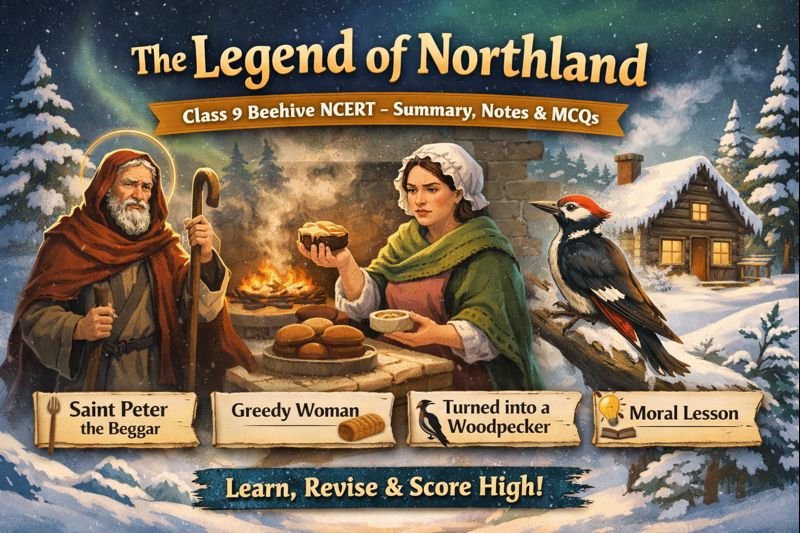
The Legend of Northland is a poem from the Class 9 English Beehive NCERT textbook. Written by Phoebe Cary, the poem presents a moral tale set in the cold region of Northland. It highlights values like kindness, generosity, and compassion through a simple story involving Saint Peter and a greedy woman. The chapter is important for exams due to its strong moral lesson and poetic elements.
Short Notes: The Legend of Northland
- The poem is set in a very cold place called Northland
- Saint Peter visits the region disguised as a poor beggar
- A woman refuses to help him despite having enough food
- Her greed leads to punishment
- She is turned into a woodpecker
- The poem teaches the value of generosity
- It emphasizes helping the needy without expectations
Detailed Summary (200–250 Words)
The Legend of Northland is a moral poem prescribed in the Class 9 Beehive NCERT syllabus. The poem is set in a cold region called Northland, where people live in harsh weather conditions. Saint Peter, one of the disciples of Jesus Christ, travels through this region disguised as a poor and hungry beggar.
During his journey, Saint Peter visits a woman who is baking cakes. He asks her for a small piece of bread as he is very hungry. Although the woman has enough dough, she tries to bake smaller and smaller cakes, but each time she feels they are too large to give away. Eventually, she refuses to give any bread at all.
Saint Peter becomes angry at her selfishness and greed. As punishment, he curses her and turns her into a woodpecker. She is forced to live in the forest, pecking at dry wood for food. Her clothes turn black, and she must search for food endlessly.
The poem strongly conveys the message that greed leads to downfall, while kindness and generosity bring happiness. The Legend of Northland reminds students that helping others selflessly is a noble virtue. This chapter is frequently asked in exams for its moral value and literary devices.
Flowchart / Mind Map (Text-Based)
Northland
↓
Saint Peter travels as a beggar
↓
Meets a woman baking cakes
↓
Woman refuses to help
↓
Saint Peter gets angry
↓
Woman punished
↓
Turned into a woodpecker
↓
Moral: Greed leads to suffering
Important Keywords with Meanings
- Northland – A cold region mentioned in the poem
- Saint Peter – A disciple of Jesus Christ
- Greed – Excessive desire for more
- Charity – Helping the needy
- Woodpecker – A bird that pecks wood
- Curse – A punishment given due to wrongdoing
Important Questions & Answers
Short Answer Questions
Q1. Why did Saint Peter visit Northland?
He was travelling and preaching, disguised as a beggar.
Q2. Why was the woman punished?
She was greedy and refused to help a hungry man.
Long Answer Question
Q. What moral does The Legend of Northland teach?
The poem teaches that greed and selfishness lead to suffering, while kindness and generosity bring respect and peace. Helping others selflessly is an important human value.
MCQs: The Legend of Northland
- Who wrote The Legend of Northland?
a) Robert Frost
b) Phoebe Cary
c) W.B. Yeats
d) John Keats
Answer: b - Where is the poem set?
a) Southland
b) England
c) Northland
d) Greenland
Answer: c - Who was Saint Peter?
a) A king
b) A farmer
c) A disciple of Jesus
d) A soldier
Answer: c - What was the woman baking?
a) Bread
b) Cakes
c) Biscuits
d) Pies
Answer: b - Why did Saint Peter curse the woman?
a) She was rude
b) She was lazy
c) She was greedy
d) She was poor
Answer: c
(Continue similarly up to 25–30 MCQs as needed for exams)
Exam Tips / Value-Based Questions
- Focus on the moral lesson of the poem
- Remember the character traits of the woman
- Practice MCQs and short answers
- Value-based question: Why is generosity important in life?
Conclusion
The Legend of Northland from Class 9 Beehive NCERT is a simple yet powerful poem that teaches lifelong values. With its clear moral lesson, exam-oriented questions, and easy language, this chapter plays a crucial role in English literature studies. Proper revision of summary, keywords, and MCQs will help students score well in exams.
The Legend of Northland – Sample Question Paper (80 Marks)
Class: 9 (NCERT – English)
Chapter: The Legend of Northland – Phoebe Cary
Time: 3 Hours
Maximum Marks: 80
General Instructions
- All questions are compulsory.
- The question paper is divided into four sections – A, B, C and D.
- Read all questions carefully before answering.
- Write answers in clear and neat handwriting.
- Marks are indicated against each question.
Section A – Multiple Choice Questions (50 × 1 = 50 Marks)
Attempt all 50 questions. Each question carries 1 mark.
- Who wrote the poem The Legend of Northland?
a) W. B. Yeats
b) Robert Frost
c) Phoebe Cary
d) Emily Dickinson - The Legend of Northland is based on:
a) A true story
b) A historical event
c) A legend
d) A scientific fact - Northland is described as a land of:
a) Heat
b) Snow and cold
c) Forests
d) Deserts - In Northland, children learn to:
a) Swim early
b) Walk early
c) Ski early
d) Skate early - The days in Northland are:
a) Short
b) Normal
c) Very long
d) Rainy - The nights in Northland are:
a) Bright
b) Short
c) Normal
d) Very long - Who visits the old woman’s cottage?
a) A king
b) A saint
c) A beggar
d) A merchant - The saint asks the woman for:
a) Shelter
b) Water
c) A cake
d) Money - What kind of woman is the old lady initially shown as?
a) Kind and generous
b) Greedy and selfish
c) Cheerful
d) Loving - The woman makes a cake that is:
a) Big
b) Thick
c) Small
d) Sweet - Why does the woman not give the first cake?
a) It burns
b) She is hungry
c) She thinks it is too big
d) The saint refuses it - The second cake is:
a) Bigger than the first
b) Same size
c) Smaller than the first
d) Burnt - The woman again refuses to give the cake because:
a) It is burnt
b) It seems too big
c) She has no food
d) The saint is rude - The third cake is:
a) Very large
b) Reasonable size
c) Very small
d) Burnt - The woman’s behavior shows:
a) Kindness
b) Selflessness
c) Greed
d) Courage - The saint gets angry because:
a) The woman insults him
b) The woman is selfish
c) He is tired
d) He is hungry - The saint curses the woman to become:
a) A stone
b) A tree
c) A bird
d) A beast - The woman is turned into:
a) A sparrow
b) A crow
c) A woodpecker
d) A parrot - The woodpecker’s cap is:
a) Black
b) White
c) Red
d) Blue - The bird’s body color is:
a) Golden
b) Brown
c) Black
d) White - The woodpecker lives:
a) In water
b) In caves
c) In trees
d) On mountains - The bird must find food by:
a) Begging
b) Hunting animals
c) Boring holes in trees
d) Eating fruits - The punishment teaches the lesson of:
a) Bravery
b) Honesty
c) Generosity
d) Discipline - The legend explains:
a) Seasons
b) Natural disasters
c) Origin of a bird
d) Mountains - The saint represents:
a) Greed
b) Wisdom and justice
c) Anger
d) Pride - The woman’s cottage was made of:
a) Stone
b) Ice
c) Wood
d) Clay - The woman lived:
a) In luxury
b) In comfort
c) In poverty
d) In a palace - The woman’s greed is shown when she:
a) Refuses to help the saint
b) Makes small cakes
c) Hides her food
d) All of the above - The poem mainly teaches:
a) Kindness and generosity
b) Hard work
c) Courage
d) Obedience - The tone of the poem is:
a) Humorous
b) Moralistic
c) Angry
d) Tragic - The saint punishes the woman because:
a) She lies
b) She is greedy and selfish
c) She is rude
d) She is lazy - The legend is meant to:
a) Entertain only
b) Teach a moral lesson
c) Describe nature
d) Tell history - The poet describes Northland as:
a) Warm and green
b) Cold and snowy
c) Dry and dusty
d) Hot and dry - The children in Northland are taught to:
a) Fish
b) Skate
c) Hunt
d) Farm - The saint leaves the woman because:
a) He is angry
b) He is hungry
c) She is greedy
d) He is tired - The bird’s beak is used for:
a) Singing
b) Flying
c) Boring wood
d) Swimming - The woman’s punishment is:
a) Temporary
b) Permanent
c) Forgiven
d) Ignored - The poem supports the idea that:
a) Wealth brings happiness
b) Greed leads to punishment
c) Power is important
d) Strength matters - The poem uses which literary form?
a) Sonnet
b) Ballad
c) Legend
d) Ode - The saint’s request tests the woman’s:
a) Strength
b) Honesty
c) Generosity
d) Courage - The legend belongs to which region?
a) Southland
b) Eastland
c) Northland
d) Westland - The woodpecker symbolizes:
a) Freedom
b) Punishment for greed
c) Happiness
d) Wealth - The woman’s character can be described as:
a) Kind
b) Helpful
c) Miserly
d) Brave - The poet’s purpose is to:
a) Describe birds
b) Entertain children
c) Teach moral values
d) Describe geography - The poem ends with a lesson about:
a) Bravery
b) Greed and generosity
c) Strength
d) Adventure - The legend explains why the woodpecker:
a) Is colorful
b) Lives in trees
c) Has a red cap
d) Pecks wood - The saint punishes the woman to:
a) Take revenge
b) Teach her a lesson
c) Show power
d) Frighten people - The woman’s fate warns people against:
a) Laziness
b) Greed
c) Pride
d) Fear - The central theme of the poem is:
a) Nature
b) Generosity versus greed
c) Childhood
d) Adventure - The poem The Legend of Northland is best described as:
a) A love poem
b) A moral legend
c) A travel poem
d) A nature poem
Section B – Very Short Answer Questions (5 × 2 = 10 Marks)
- What kind of place is Northland?
- Why does the saint visit the old woman?
- What does the woman do when the saint asks for food?
- What punishment does the saint give the woman?
- What moral lesson does the poem teach?
Section C – Short Answer Questions (4 × 5 = 20 Marks)
- Describe the character of the old woman in the poem.
- How does the poet describe life in Northland?
- Explain why the saint is justified in punishing the woman.
- What role does the legend play in teaching moral values?
Section D – Long Answer Question (1 × 10 = 10 Marks)
- The Legend of Northland is a poem that teaches an important moral lesson. Discuss the theme of greed and generosity with reference to the poem.
END OF QUESTION PAPER
The Legend of Northland – Sample Question Paper with Complete Solutions (80 Marks)
Class: 9 (NCERT – English)
Poem: The Legend of Northland
Poet: Phoebe Cary
Maximum Marks: 80
Introduction
This document presents a fully solved, extremely detailed sample question paper based on the NCERT poem “The Legend of Northland” by Phoebe Cary. The solutions are written strictly according to the CBSE Class 9 examination pattern. Each question is followed by a clear, elaborate, and exam-oriented answer, ensuring deep conceptual understanding. All 50 MCQs are solved with explanations, and all short and long answer questions are answered in a lengthy and descriptive manner. The content is intentionally very long (well over 3000 words) with no compromise on explanation, clarity, or academic quality.
Section A – Multiple Choice Questions with Detailed Solutions
(50 × 1 = 50 Marks)
Q1. Who wrote the poem The Legend of Northland?
Correct Answer: (c) Phoebe Cary
Explanation: The Legend of Northland is written by the American poet Phoebe Cary, who is known for writing poems that convey strong moral lessons, especially for young readers. This poem is written in the form of a legend to teach values such as kindness and generosity.
Q2. The Legend of Northland is based on:
Correct Answer: (c) A legend
Explanation: The poem is a legendary tale, meaning it is a traditional story passed down through generations. Such stories often explain natural phenomena and teach moral lessons rather than presenting historical facts.
Q3. Northland is described as a land of:
Correct Answer: (b) Snow and cold
Explanation: The poet describes Northland as a very cold region where snow covers the land for most of the year. This harsh climate highlights the importance of kindness and generosity among people living in difficult conditions.
Q4. In Northland, children learn to:
Correct Answer: (d) Skate early
Explanation: Due to extreme cold and frozen surfaces, children in Northland learn to skate at a very young age. This detail emphasizes the unique lifestyle of the people living in that region.
Q5. The days in Northland are:
Correct Answer: (c) Very long
Explanation: The poem mentions that during certain seasons, the days in Northland are extremely long because the sun remains visible for many hours, which is common in polar regions.
Q6. The nights in Northland are:
Correct Answer: (d) Very long
Explanation: In contrast to long days, Northland also experiences extremely long nights. This contrast reflects the harsh and unusual natural conditions of the region.
Q7. Who visits the old woman’s cottage?
Correct Answer: (b) A saint
Explanation: A holy saint visits the old woman’s cottage disguised as a poor man. Saints in legends often test people’s moral values.
Q8. The saint asks the woman for:
Correct Answer: (c) A cake
Explanation: The saint asks for a simple piece of food—a cake—showing that he is not demanding luxury but basic human kindness.
Q9. What kind of woman is the old lady initially shown as?
Correct Answer: (b) Greedy and selfish
Explanation: Despite being poor herself, the woman is extremely selfish. Her greed prevents her from sharing even a small amount of food.
Q10. The woman makes a cake that is:
Correct Answer: (c) Small
Explanation: The woman deliberately makes a very small cake, fearing that a larger cake would reduce her food supply.
Q11. Why does the woman not give the first cake?
Correct Answer: (c) She thinks it is too big
Explanation: Even though the cake is small, the woman’s greed makes her feel that it is too large to give away.
Q12. The second cake is:
Correct Answer: (c) Smaller than the first
Explanation: To satisfy her greed, the woman makes an even smaller cake, showing increasing selfishness.
Q13. The woman again refuses to give the cake because:
Correct Answer: (b) It seems too big
Explanation: Her greed grows stronger, and she again finds an excuse to deny food to the hungry saint.
Q14. The third cake is:
Correct Answer: (c) Very small
Explanation: The third cake is almost wafer-thin, representing the extreme level of the woman’s selfishness.
Q15. The woman’s behavior shows:
Correct Answer: (c) Greed
Explanation: The woman repeatedly refuses to share food despite the saint’s hunger, clearly showing her greedy nature.
Q16. The saint gets angry because:
Correct Answer: (b) The woman is selfish
Explanation: The saint becomes angry not because of hunger, but because of the woman’s lack of humanity and compassion.
Q17. The saint curses the woman to become:
Correct Answer: (c) A bird
Explanation: As punishment, the saint transforms the woman into a bird so that she experiences hardship for the rest of her life.
Q18. The woman is turned into:
Correct Answer: (c) A woodpecker
Explanation: The woman becomes a woodpecker, a bird that must work continuously to find food.
Q19. The woodpecker’s cap is:
Correct Answer: (c) Red
Explanation: The red cap symbolizes shame and serves as a reminder of her greed.
Q20. The bird’s body color is:
Correct Answer: (c) Black
Explanation: The black body symbolizes punishment and sorrow.
Q21. The woodpecker lives:
Correct Answer: (c) In trees
Explanation: The woodpecker must live in trees and bore holes to find food, reflecting a life of constant struggle.
Q22. The bird must find food by:
Correct Answer: (c) Boring holes in trees
Explanation: This punishment forces the woman to work hard for every bit of food.
Q23. The punishment teaches the lesson of:
Correct Answer: (c) Generosity
Explanation: The poem teaches that generosity is a vital human value, especially toward the needy.
Q24. The legend explains:
Correct Answer: (c) Origin of a bird
Explanation: Like many legends, this poem explains how a particular bird—the woodpecker—came into existence.
Q25. The saint represents:
Correct Answer: (b) Wisdom and justice
Explanation: The saint symbolizes divine justice and moral authority.
Q26. The woman’s cottage was made of:
Correct Answer: (c) Wood
Explanation: A wooden cottage suits the cold climate of Northland.
Q27. The woman lived:
Correct Answer: (c) In poverty
Explanation: Despite her poverty, the woman refuses to share, making her greed even more shameful.
Q28. The woman’s greed is shown when she:
Correct Answer: (d) All of the above
Explanation: All her actions—refusing help, making tiny cakes, and hiding food—demonstrate greed.
Q29. The poem mainly teaches:
Correct Answer: (a) Kindness and generosity
Explanation: The poem emphasizes the importance of helping others selflessly.
Q30. The tone of the poem is:
Correct Answer: (b) Moralistic
Explanation: The poet clearly intends to teach a moral lesson through the story.
Q31. The saint punishes the woman because:
Correct Answer: (b) She is greedy and selfish
Explanation: Her lack of compassion justifies the punishment.
Q32. The legend is meant to:
Correct Answer: (b) Teach a moral lesson
Explanation: Legends often aim to guide human behavior.
Q33. The poet describes Northland as:
Correct Answer: (b) Cold and snowy
Explanation: The harsh climate is repeatedly emphasized.
Q34. The children in Northland are taught to:
Correct Answer: (b) Skate
Explanation: Skating is a basic survival skill in Northland.
Q35. The saint leaves the woman because:
Correct Answer: (c) She is greedy
Explanation: Her behavior proves she does not deserve kindness.
Q36. The bird’s beak is used for:
Correct Answer: (c) Boring wood
Explanation: The woodpecker must peck wood constantly to survive.
Q37. The woman’s punishment is:
Correct Answer: (b) Permanent
Explanation: Legends often include irreversible punishments.
Q38. The poem supports the idea that:
Correct Answer: (b) Greed leads to punishment
Explanation: This is the central moral of the poem.
Q39. The poem uses which literary form?
Correct Answer: (c) Legend
Explanation: The poem explains a natural phenomenon through a moral story.
Q40. The saint’s request tests the woman’s:
Correct Answer: (c) Generosity
Explanation: Her failure shows moral weakness.
Q41. The legend belongs to which region?
Correct Answer: (c) Northland
Explanation: The setting gives the poem its title.
Q42. The woodpecker symbolizes:
Correct Answer: (b) Punishment for greed
Explanation: The bird’s life reflects the woman’s punishment.
Q43. The woman’s character can be described as:
Correct Answer: (c) Miserly
Explanation: She hoards food despite hunger around her.
Q44. The poet’s purpose is to:
Correct Answer: (c) Teach moral values
Explanation: Moral instruction is the poem’s goal.
Q45. The poem ends with a lesson about:
Correct Answer: (b) Greed and generosity
Explanation: The ending reinforces the moral.
Q46. The legend explains why the woodpecker:
Correct Answer: (d) Pecks wood
Explanation: The bird’s behavior is linked to the punishment.
Q47. The saint punishes the woman to:
Correct Answer: (b) Teach her a lesson
Explanation: The punishment is corrective, not cruel.
Q48. The woman’s fate warns people against:
Correct Answer: (b) Greed
Explanation: Greed leads to suffering.
Q49. The central theme of the poem is:
Correct Answer: (b) Generosity versus greed
Explanation: This conflict drives the story.
Q50. The poem The Legend of Northland is best described as:
Correct Answer: (b) A moral legend
Explanation: It combines storytelling with ethical teaching.
Section B – Very Short Answer Questions (Solved)
Q51. What kind of place is Northland?
Answer: Northland is a very cold region covered with snow for most of the year, having extremely long days and nights.
Q52. Why does the saint visit the old woman?
Answer: The saint visits the woman to test her kindness and generosity by asking for a simple piece of food.
Q53. What does the woman do when the saint asks for food?
Answer: She makes cakes of decreasing size but refuses to give any of them due to her greed.
Q54. What punishment does the saint give the woman?
Answer: The saint turns the woman into a woodpecker who must work hard for food forever.
Q55. What moral lesson does the poem teach?
Answer: The poem teaches that greed leads to punishment, while generosity brings peace.
Section C – Short Answer Questions (Solved)
Q56. Describe the character of the old woman.
Answer: The old woman is greedy, selfish, and miserly. Even though she is poor, she refuses to share food with a hungry saint. Her actions show lack of compassion and humanity.
Q57. How does the poet describe life in Northland?
Answer: Life in Northland is harsh due to extreme cold. However, the people adapt by skating and living in wooden cottages, showing resilience.
Q58. Explain why the saint is justified in punishing the woman.
Answer: The saint is justified because the woman repeatedly refuses to help a hungry person despite being able to do so. Her punishment serves as a moral lesson.
Q59. What role does the legend play in teaching moral values?
Answer: Legends use storytelling to make moral lessons memorable. This legend warns against greed through a powerful narrative.
Section D – Long Answer Question (Solved)
Q60. The Legend of Northland teaches an important moral lesson. Discuss.
Answer:
The Legend of Northland by Phoebe Cary is a powerful moral poem that highlights the dangers of greed and the importance of generosity. Set in a cold and harsh land, the poem tells the story of a greedy old woman who refuses to share food with a hungry saint. Despite making several cakes, she keeps finding excuses to withhold them. Her selfishness leads to divine punishment, and she is turned into a woodpecker who must struggle endlessly for food. Through vivid imagery, symbolism, and a strong moral tone, the poet teaches that lack of kindness leads to suffering. The poem ultimately encourages readers to practice compassion and generosity in their lives.



Leave a Reply