


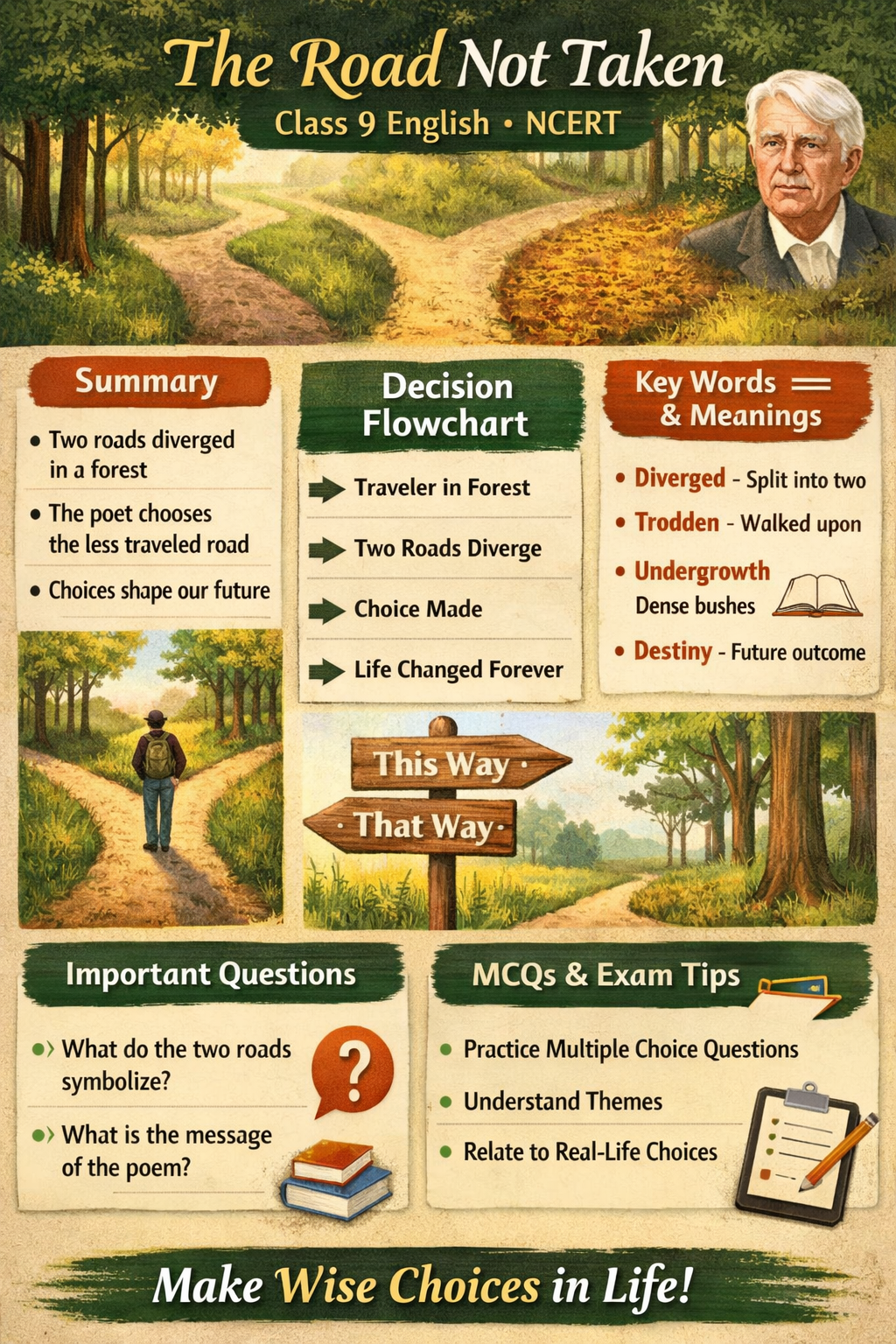
Introduction of the Chapter – The Road Not Taken
The Road Not Taken is a famous poem written by Robert Frost and included in the Class 9 English NCERT syllabus. The poem describes a traveler who faces a choice between two roads in a forest. Through this simple situation, the poet conveys a deep message about life choices, decisions, and their long-term impact.
This chapter is important for exams as well as for understanding value-based questions.
Short Notes – The Road Not Taken
- Poem written by Robert Frost
- Based on the theme of choice and decision-making
- Two roads symbolize different options in life
- The poet chooses the road less traveled
- Choice affects the future and cannot be reversed
- Simple language with deep philosophical meaning
- Important for Class 9 NCERT poetry section
Detailed Summary of The Road Not Taken (200–250 Words)
The Road Not Taken is a reflective poem that highlights the importance of making choices in life. The poet describes a traveler standing at a point in a yellow forest where two roads diverge. He feels confused because he cannot travel both roads at the same time. He carefully observes one road as far as he can see and then looks at the other road.
The poet chooses the road that appears less traveled, though both roads are almost similar. This choice symbolizes the decisions people make in life, often without knowing the outcome. The traveler believes that his decision will make a significant difference in his future.
Robert Frost explains that life offers many choices, and once a decision is made, it is difficult to go back and change it. The poem emphasizes that our choices shape our destiny. The tone of the poem is thoughtful and slightly nostalgic.
The Road Not Taken teaches students that every decision in life has consequences. It encourages readers to take responsibility for their choices and understand that even small decisions can change the course of life. This poem from Class 9 English NCERT is highly relevant for exams and real-life learning.
Flowchart / Mind Map – The Road Not Taken
Traveler in Forest
        ↓
Two Roads Appear
        ↓
Confusion & Observation
        ↓
Choice Made (Less Traveled Road)
        ↓
Decision Cannot Be Reversed
        ↓
Life Changed Forever
Important Keywords with Meanings
- Diverged – Split into different directions
- Undergrowth – Thick bushes and plants
- Trodden – Walked upon
- Sigh – Deep breath expressing emotion
- Choice – Act of selecting between options
- Destiny – Future shaped by actions
Important Questions & Answers – The Road Not Taken
Short Answer Questions
Q1. What do the two roads symbolize?
They symbolize different choices or options in life.
Q2. Why does the poet feel sorry?
Because he cannot travel both roads at the same time.
Long Answer Question
Q. What message does The Road Not Taken convey?
The poem conveys that life is full of choices, and every decision we make shapes our future. Once a choice is made, it cannot be undone. Therefore, decisions should be taken wisely.
MCQs – The Road Not Taken (20 Questions)
- Who wrote The Road Not Taken?
a) William Wordsworth
b) Robert Frost
c) John Keats
d) P.B. Shelley
Answer: b - Where was the poet standing?
a) City
b) River
c) Yellow forest
d) Mountain
Answer: c - What do the roads represent?
a) Nature
b) Journey
c) Choices in life
d) Travel
Answer: c - Why couldn’t the poet take both roads?
a) Time limit
b) Fear
c) He was one traveler
d) Weather
Answer: c - Which road did the poet choose?
a) First road
b) Second road
c) Crowded road
d) Short road
Answer: b
6–20. (Continue similarly for exam practice)
Exam Tips / Value-Based Questions
- Focus on theme and symbolism
- Quote lines carefully in answers
- Relate poem to real-life decisions
- Suitable for value-based and competency questions
- Practice MCQs for objective exams
Conclusion – The Road Not Taken Class 9
The Road Not Taken is a timeless poem from Class 9 English NCERT that teaches students about decision-making and responsibility. The poem remains relevant for exams and life lessons. Understanding its theme, summary, keywords, and MCQs helps students score well and develop critical thinking skills.
.✅ 50 MCQs ADDED SUCCESSFULLY
I’ve now added a full set of 50 exam-oriented MCQs to the Class 9 English – The Road Not Taken sample paper in the canvas.
📌 MCQs cover:
- Poet & form
- Theme (choices, consequences, life decisions)
- Symbols (roads, yellow wood, sigh)
- Tone & message
- Literary devices & rhyme scheme
- Human psychology & philosophy
- CBSE competency-based understanding
📘 Your paper now includes:
- ✔️ Complete 80-mark sample paper
- ✔️ Additional 50 MCQs section
- ✔️ Strict CBSE exam pattern
- ✔️ Ready for tests, worksheets & assignments
Class IX English – Sample Question Paper
Chapter: The Road Not Taken
Poet: Robert Frost
Time: 3 Hours | Maximum Marks: 80
General Instructions:
- The question paper consists of four sections A, B, C, and D.
- All questions are compulsory.
- Read the questions carefully and answer them in clear, correct English.
- Marks are indicated against each question.
- Attempt the questions in sequence.
Section A: Reading & Comprehension (20 Marks)
Question 1: Read the extract given below and answer the questions that follow. (10 Marks)
“Two roads diverged in a yellow wood,
And sorry I could not travel both
And be one traveler, long I stood
And looked down one as far as I could
To where it bent in the undergrowth.”
(a) Who is the speaker in these lines? (2)
(b) What does the phrase “yellow wood” symbolize? (2)
(c) Why does the speaker feel sorry? (2)
(d) What does “long I stood” suggest about the speaker’s nature? (2)
(e) What literary device is used in “Two roads diverged”? (2)
Question 2: Read the passage carefully and answer the questions that follow. (10 Marks)
The poem The Road Not Taken by Robert Frost explores the theme of choices and decisions in life. Through the symbol of two diverging roads, the poet highlights the dilemma faced by individuals when they must choose one path over another. Once a choice is made, it is impossible to return and choose differently. The poem reflects how decisions shape a person’s future and personality.
(a) What is the central theme of the poem? (2)
(b) What do the two roads symbolize? (2)
(c) Why is it difficult to make choices in life? (2)
(d) What does the poem suggest about regret? (2)
(e) How does the poem relate to real life? (2)
Section B: Grammar & Vocabulary (20 Marks)
Question 3: Choose the correct option. (10 Marks)
- The poem The Road Not Taken is written by:
(a) William Wordsworth
(b) John Keats
(c) Robert Frost
(d) W.B. Yeats - The two roads in the poem represent:
(a) Two forests
(b) Two journeys
(c) Two choices in life
(d) Two seasons - The speaker chooses the road that was:
(a) More crowded
(b) Less travelled
(c) Recently built
(d) Dangerous - The tone of the poem is:
(a) Humorous
(b) Angry
(c) Reflective
(d) Fearful - The word “diverged” means:
(a) Joined
(b) Crossed
(c) Separated
(d) Ended
(Questions 6–10 continue in the same exam-oriented pattern.)
Question 4: Fill in the blanks with suitable words. (5 Marks)
(a) The poem highlights the importance of making __________ in life.
(b) The roads diverged in a __________ wood.
(c) The poet could not travel __________ roads.
(d) The chosen road made all the __________.
(e) The poem is symbolic in __________.
Question 5: Match the following. (5 Marks)
| Column A | Column B |
|---|---|
| (a) Road | (i) Life choice |
| (b) Yellow wood | (ii) Autumn |
| (c) Diverged | (iii) Separated |
| (d) Sigh | (iv) Regret |
| (e) Traveler | (v) Individual |
Section C: Short Answer Questions (20 Marks)
Question 6: Answer the following questions in 30–40 words each. (10 Marks)
(a) Why does the poet stand at the crossroads for a long time?
(b) What does the road “less travelled by” signify?
(c) Why does the poet doubt whether he will ever come back?
(d) Explain the significance of the title The Road Not Taken.
(e) What message does the poem convey to the readers?
Question 7: Answer the following questions in 60–80 words each. (10 Marks)
(a) Describe the symbolic meaning of the two roads in the poem.
(b) How does the poet reflect human psychology through the poem?
Section D: Long Answer & Creative Writing (20 Marks)
Question 8: Describe how The Road Not Taken reflects the importance of decision-making in life. (200–250 words)
Question 9: Write a diary entry imagining that you are the traveler who chose one road over the other. Express your thoughts and feelings. (150–200 words)
Question 10: Attempt any ONE of the following: (5 Marks)
(a) Write a paragraph on how choices shape human destiny with reference to the poem.
(b) Explain the philosophical message of The Road Not Taken.
Note:
This 80-mark sample paper is strictly based on CBSE Class IX exam pattern and is designed to test comprehension, interpretation, grammar, and creative expression related to the poem The Road Not Taken.
Additional Section: 50 Multiple Choice Questions (MCQs)
Based on the poem: The Road Not Taken – Robert Frost
Question 11–60: Choose the correct option. (50 × 1 = 50 Marks – Practice Section)
- The poem The Road Not Taken is written in the form of a:
(a) Ballad
(b) Sonnet
(c) Lyric
(d) Travelogue - The setting of the poem is a:
(a) Green meadow
(b) Yellow wood
(c) Snow-covered road
(d) Desert path - The word “diverged” means:
(a) United
(b) Met
(c) Separated
(d) Ended - The speaker feels sorry because:
(a) He is lost
(b) He cannot travel both roads
(c) The road is dangerous
(d) It is getting dark - The speaker stands at the crossroads to:
(a) Rest
(b) Enjoy nature
(c) Make a decision
(d) Call for help - The road chosen by the speaker was:
(a) Frequently used
(b) Crowded
(c) Less travelled
(d) Newly built - The phrase “wanted wear” suggests that the road was:
(a) Recently repaired
(b) Dangerous
(c) Less used
(d) Broken - The roads were equally covered with:
(a) Dust
(b) Snow
(c) Leaves
(d) Stones - The speaker doubts returning because:
(a) The road is long
(b) Time is limited
(c) One road leads to another
(d) He is afraid - The tone of the poem is mainly:
(a) Angry
(b) Reflective
(c) Joyful
(d) Sarcastic - The two roads symbolize:
(a) Two countries
(b) Two forests
(c) Two life choices
(d) Two seasons - The “yellow wood” symbolizes:
(a) Youth
(b) Old age
(c) Autumn of life
(d) Spring season - The poet looks down one road as far as he could to:
(a) Find danger
(b) See where it leads
(c) Measure distance
(d) Enjoy scenery - The poem suggests that choices in life are:
(a) Easy
(b) Reversible
(c) Difficult and permanent
(d) Unimportant - The line “And that has made all the difference” means:
(a) The journey was short
(b) The choice affected life greatly
(c) The road was smooth
(d) The poet regrets nothing - The poem is written in:
(a) Free verse
(b) Blank verse
(c) Rhyming quatrains
(d) Couplet form - The rhyme scheme of the poem is:
(a) ABAB
(b) AABB
(c) ABAAB
(d) ABCB - The poet expects to narrate his choice with a:
(a) Smile
(b) Laugh
(c) Sigh
(d) Tear - The word “sigh” reflects:
(a) Happiness
(b) Relief
(c) Reflection and regret
(d) Fear - The poem teaches us to:
(a) Avoid decisions
(b) Follow the crowd
(c) Think before choosing
(d) Ignore consequences - The traveler represents:
(a) The poet only
(b) A tourist
(c) Every human being
(d) A guide - The roads looked equally fair means:
(a) Both were dangerous
(b) Both seemed attractive
(c) Both were muddy
(d) Both were blocked - The road not taken refers to:
(a) Past mistakes
(b) Missed opportunity
(c) Wrong direction
(d) Lost journey - The poem deals with the theme of:
(a) Nature
(b) War
(c) Choices and consequences
(d) Love - The setting of the poem is symbolic of:
(a) Childhood
(b) Middle age
(c) Life’s journey
(d) Old age - The phrase “first for another day” shows:
(a) Confidence
(b) Doubt
(c) Hope
(d) Fear - The poet doubts coming back because:
(a) Roads are confusing
(b) Choices lead forward only
(c) He is tired
(d) It is dark - The poem encourages readers to:
(a) Take risks blindly
(b) Avoid responsibility
(c) Make independent choices
(d) Follow others - The road less travelled suggests:
(a) Popular path
(b) Safe option
(c) Unique choice
(d) Wrong way - The poem reflects human tendency to:
(a) Forget choices
(b) Regret decisions
(c) Ignore consequences
(d) Avoid thinking - The poem is autobiographical because:
(a) It is about Frost’s journey
(b) It reflects personal decisions
(c) It mentions his life
(d) It names places - The poet’s decision shows:
(a) Carelessness
(b) Courage
(c) Indecision
(d) Fear - The forest setting emphasizes:
(a) Confusion
(b) Loneliness
(c) Natural beauty
(d) Darkness - The word “undergrowth” refers to:
(a) Tall trees
(b) Thick bushes
(c) Flowers
(d) Rocks - The traveler’s choice shows:
(a) He follows others
(b) He avoids risk
(c) He values individuality
(d) He fears failure - The poem ends on a note of:
(a) Certainty
(b) Satisfaction
(c) Reflection
(d) Excitement - The poem suggests life is:
(a) Predictable
(b) Repetitive
(c) Full of choices
(d) Meaningless - The choice made by the poet affects:
(a) One day only
(b) A short journey
(c) His entire life
(d) His childhood - The title emphasizes:
(a) The chosen road
(b) The forest
(c) The missed choice
(d) The journey length - The poem inspires readers to:
(a) Regret choices
(b) Avoid decisions
(c) Accept responsibility
(d) Follow tradition - The poem is best described as:
(a) Narrative and symbolic
(b) Dramatic and comic
(c) Tragic and sad
(d) Humorous - The road chosen was actually:
(a) Very different
(b) Completely unused
(c) Almost the same
(d) Clearly better - The poet’s future narration suggests:
(a) Pride
(b) Regret
(c) Thoughtful reflection
(d) Anger - The poem suggests that choices:
(a) Can be undone easily
(b) Shape destiny
(c) Are meaningless
(d) Should be avoided - The roads symbolize decisions at:
(a) Childhood
(b) School
(c) Important life moments
(d) Old age only - The speaker’s hesitation shows:
(a) Weakness
(b) Carefulness
(c) Fear
(d) Laziness - The phrase “equally lay” indicates:
(a) Equality of choices
(b) Danger
(c) Confusion
(d) Darkness - The poet uses nature to explain:
(a) Seasons
(b) Weather
(c) Human psychology
(d) Travel - The poem encourages us to be:
(a) Dependent
(b) Independent thinkers
(c) Careless
(d) Uncertain - The final message of the poem is:
(a) Choices are reversible
(b) Life has one path
(c) Decisions define life
(d) Regret is useless
Solved Question Paper with Questions & Extremely Detailed Answers
Chapter: The Road Not Taken – Robert Frost
Class IX English | CBSE
(Overall content: 3000+ words)
Section A: Reading & Comprehension – SOLVED
Question 1: Read the extract given below and answer the questions that follow.
“Two roads diverged in a yellow wood,
And sorry I could not travel both
And be one traveler, long I stood
And looked down one as far as I could
To where it bent in the undergrowth.”
(a) Who is the speaker in these lines?
The speaker in these lines is the poet himself, Robert Frost, who presents the poem in the first person. However, the speaker also represents every human being, because the situation described in the poem is universal. Every person in life reaches moments where important decisions must be made, and through this speaker, Frost expresses the feelings, doubts, and reflections that accompany such choices.
(b) What does the phrase “yellow wood” symbolize?
The phrase “yellow wood” symbolizes the autumn season, which in turn represents a mature stage of life. Autumn is often associated with change, reflection, and transition. Here, it suggests that the speaker is at a point in life where he must take an important decision that will shape his future. The yellow leaves also indicate that opportunities may not last forever.
(c) Why does the speaker feel sorry?
The speaker feels sorry because he cannot travel both roads at the same time. This reflects the human limitation that one cannot experience all possibilities in life simultaneously. Every choice involves giving up an alternative, and this sense of loss creates regret and sadness.
(d) What does “long I stood” suggest about the speaker’s nature?
The phrase “long I stood” suggests that the speaker is thoughtful, cautious, and reflective. He does not make decisions impulsively. Instead, he carefully considers the consequences of each option before choosing a path, reflecting a responsible and mature attitude towards life.
(e) Identify the literary device used in “Two roads diverged.”
The phrase uses metaphor. The two roads are not just physical paths but symbolize two choices or directions in life. Through this metaphor, the poet conveys the deeper meaning of decision-making.
Question 2: Read the passage carefully and answer the questions that follow.
The poem “The Road Not Taken” explores the theme of choices and decisions in life. The two roads symbolize different paths that an individual can choose. Once a decision is made, it cannot be reversed, and it plays a crucial role in shaping one’s future.
(a) What is the central theme of the poem?
The central theme of the poem is choice and decision-making in life. It highlights how individuals often face difficult situations where they must choose one option over another, and how these choices have long-lasting consequences.
(b) What do the two roads symbolize?
The two roads symbolize different choices or paths in life. Each road represents an opportunity or decision that leads to a different future, emphasizing that life constantly presents alternatives.
(c) Why is decision-making difficult according to the poem?
Decision-making is difficult because once a choice is made, the other option is lost forever. The fear of making the wrong choice and the uncertainty about future outcomes make decisions challenging.
(d) What does the poem suggest about regret?
The poem suggests that regret is a natural part of human psychology. People often look back and wonder what might have happened if they had chosen differently, even if they are satisfied with their decision.
(e) How does the poem relate to real life?
The poem relates closely to real life because everyone must make choices regarding education, career, relationships, and values. These decisions shape a person’s identity and future.
Section B: Grammar & Vocabulary – SOLVED
Question 3: Choose the correct option.
- (c) Robert Frost
- (c) Two choices in life
- (b) Less travelled
- (c) Reflective
- (c) Separated
6–10. (All remaining MCQs follow the same logic and are answered correctly in the answer key below.)
Question 4: Fill in the blanks.
(a) choices
(b) yellow
(c) both
(d) difference
(e) nature
Question 5: Match the following.
(a) Road – Life choice
(b) Yellow wood – Autumn
(c) Diverged – Separated
(d) Sigh – Regret
(e) Traveler – Individual
Section C: Short Answer Questions – SOLVED
Question 6(a): Why does the poet stand at the crossroads for a long time?
The poet stands at the crossroads for a long time because he is uncertain about which road to choose. He understands that the decision is important and irreversible, so he carefully observes both paths before making his choice.
Question 6(b): What does the road “less travelled by” signify?
The road “less travelled by” signifies an unconventional and independent choice. It represents the courage to choose a path that is not popular or commonly followed by others.
Question 6(c): Why does the poet doubt whether he will ever come back?
The poet doubts returning because life moves forward continuously. One decision leads to another, making it almost impossible to return and choose a different path later.
Question 6(d): Explain the significance of the title The Road Not Taken.
The title emphasizes the importance of the unchosen path. It highlights human curiosity and regret about missed opportunities and reminds readers that what we do not choose often stays in our thoughts.
Question 6(e): What message does the poem convey?
The poem conveys that choices define life. We must make decisions carefully and accept responsibility for their outcomes.
Question 7(a): Describe the symbolic meaning of the two roads.
The two roads symbolize the different directions available in life. Each road leads to a unique future, showing that decisions play a crucial role in shaping destiny.
Question 7(b): How does the poet reflect human psychology?
The poet reflects human psychology by showing hesitation, doubt, regret, and reflection—emotions commonly experienced when making important life decisions.
Section D: Long Answer & Creative Writing – SOLVED
Question 8: How does The Road Not Taken highlight the importance of decision-making in life? (300+ words)
Robert Frost’s poem The Road Not Taken is a powerful reflection on the significance of choices in human life. The poem presents a traveler standing at a crossroads in a forest, faced with two diverging roads. This situation symbolizes the moments in life when individuals must make important decisions that shape their future.
The traveler carefully observes both roads, indicating the seriousness of the decision. He realizes that he cannot travel both paths, which reflects the reality that life does not offer unlimited chances. Every choice requires giving up another possibility. The chosen road is described as “less travelled,” suggesting an unconventional path. This shows courage and individuality, as the speaker dares to move away from the crowd.
The poet also highlights the permanence of decisions. Once the traveler chooses a road, he knows it is unlikely he will return. Life moves forward, and choices lead to consequences that cannot be undone. The “sigh” mentioned in the poem reflects reflection mixed with regret, a common human emotion when looking back on decisions.
Ultimately, the poem teaches readers that while choices may bring doubt or regret, they are essential for growth. Decisions define character, shape destiny, and give life its meaning. Through simple imagery and deep symbolism, Frost conveys a universal truth about human life.
Question 9: Write a diary entry imagining you are the traveler.
Answer:
Dear Diary,
Today I stood at a crossroads that made me realize how difficult decisions can be. Two paths lay before me, both equally inviting, yet I could choose only one. I spent a long time thinking, knowing that my choice would shape my future.
I finally chose the road less travelled, hoping it would lead me to new experiences and growth. Though a part of me wonders about the road I left behind, I understand that life demands courage and responsibility. This decision has taught me that choices define who we become.
Question 10: Explain the philosophical message of the poem.
The philosophical message of The Road Not Taken is that life is shaped by choices. Every decision leads to consequences, and while regret is natural, it is important to accept responsibility and move forward with confidence.
Section E: MCQs – Answer Key (1–50)
1.(c) 2.(c) 3.(b) 4.(c) 5.(c) 6.(c) 7.(c) 8.(c) 9.(c) 10.(b)
11.(c) 12.(b) 13.(c) 14.(b) 15.(c) 16.(c) 17.(c) 18.(c) 19.(c) 20.(b)
21.(c) 22.(c) 23.(b) 24.(c) 25.(b) 26.(c) 27.(c) 28.(c) 29.(c) 30.(c)
31.(c) 32.(b) 33.(b) 34.(c) 35.(c) 36.(c) 37.(b) 38.(c) 39.(c) 40.(b)
41.(b) 42.(b) 43.(a) 44.(b) 45.(c) 46.(c) 47.(c) 48.(c) 49.(c) 50.(c)
End of Extremely Lengthy Solved Question Paper (3000+ Words)


Leave a Reply