


- Meaning of Ecosystem
An ecosystem is a natural system where living organisms interact with each other and with their non-living environment.
The term ecosystem was first used by Arthur Tansley in 1935.
👉 In simple words:
Ecosystem = Living organisms + Non-living environment + Interactions
Example: Forest, pond, grassland, desert.
- Components of Ecosystem
An ecosystem has two main components:
A. Biotic Components (Living Components) 🌱
These are the living organisms present in the ecosystem.
They are divided into three groups:
- Producers (Autotrophs)
Organisms that make their own food using sunlight through photosynthesis.
Examples:
Green plants
Algae
Phytoplankton
Role:
They are the main source of food and energy in an ecosystem.
- Consumers (Heterotrophs)
Organisms that depend on other organisms for food.
Types of consumers:
Primary Consumers (Herbivores)
Eat plants.
Examples: cow, deer, rabbit.
Secondary Consumers (Carnivores)
Eat herbivores.
Examples: frog, lizard.
Tertiary Consumers
Eat other carnivores.
Examples: snake, eagle.
Omnivores
Eat both plants and animals.
Example: humans.
- Decomposers
Organisms that break down dead plants and animals into simpler substances.
Examples:
Bacteria
Fungi
Importance:
They recycle nutrients back into the soil.
B. Abiotic Components (Non-Living Components) ☀️
These are the physical and chemical factors of the environment.
Examples:
Sunlight
Water
Air
Soil
Temperature
Minerals
These factors affect the growth and survival of organisms.
- Types of Ecosystems
- Terrestrial Ecosystem (Land Ecosystem)
Examples:
Forest ecosystem
Grassland ecosystem
Desert ecosystem
Mountain ecosystem
- Aquatic Ecosystem (Water Ecosystem)
Examples:
Pond ecosystem
Lake ecosystem
River ecosystem
Marine ecosystem (oceans and seas)
- Food Chain
A food chain shows how energy flows from one organism to another.
Example:
Grass → Deer → Lion
Grass = Producer
Deer = Primary consumer
Lion = Secondary consumer
Energy flows from plants → herbivores → carnivores.
- Food Web
A food web is a network of interconnected food chains.
It shows multiple feeding relationships among organisms in an ecosystem.
Example:
Grass may be eaten by rabbit, deer, insects etc.
- Ecological Balance
An ecosystem remains stable when all organisms maintain balance.
Balance depends on:
number of producers
number of consumers
number of decomposers
environmental conditions
- Importance of Ecosystem
Ecosystem is important because it:
🌿 Maintains balance in nature
🌎 Supports life on Earth
💧 Recycles nutrients and materials
🌳 Provides food, oxygen and shelter
- Human Impact on Ecosystem
Human activities can disturb ecosystems.
Examples:
Deforestation
Pollution
Urbanization
Climate change
These activities can destroy habitats and reduce biodiversity.
- Example: Pond Ecosystem
Components of a pond ecosystem:
Producers:
Algae, aquatic plants
Consumers:
Fish, frogs, insects
Decomposers:
Bacteria, fungi
Abiotic factors:
water
sunlight
temperature
📌 Short Exam Definition (ICSE)
Ecosystem:
An ecosystem is a community of living organisms interacting with each other and with the non-living components of their environment.
✅ If you want, I can also give:
Labelled diagram of ecosystem (for exams)
ICSE ecosystem MCQs and short questions
Food chain and food web diagrams
Full 5000-word ICSE ecosystem chapter notes.
🌍 Ecosystem – Class 8 ICSE (Detailed Notes)
- Introduction to Ecosystem
An ecosystem is a system formed by the interaction of living organisms with their physical environment. It includes plants, animals, microorganisms, air, water, soil, sunlight, and minerals.
The word ecosystem was introduced by Arthur Tansley.
All organisms in an ecosystem depend on each other directly or indirectly for survival.
Examples of ecosystems:
Forest
Pond
River
Desert
Grassland
- Structure of an Ecosystem
The structure of an ecosystem consists of two main parts:
A. Biotic Components (Living Organisms)
Biotic components include all living organisms in an ecosystem.
- Producers (Autotrophs) 🌿
Producers are organisms that prepare their own food through the process of photosynthesis.
Examples:
Green plants
Algae
Phytoplankton
Importance:
They convert solar energy into chemical energy.
They are the base of every food chain.
- Consumers (Heterotrophs) 🐾
Consumers cannot produce their own food and depend on other organisms.
Types of Consumers
Primary Consumers (Herbivores)
Eat plants directly.
Examples:
Deer
Cow
Rabbit
Grasshopper
Secondary Consumers (Carnivores)
Eat herbivores.
Examples:
Frog
Snake
Lizard
Tertiary Consumers (Top Carnivores)
Eat other carnivores.
Examples:
Lion
Tiger
Eagle
Omnivores
Eat both plants and animals.
Examples:
Humans
Bears
Crows
- Decomposers 🦠
Decomposers break down dead plants, animals, and organic waste.
Examples:
Bacteria
Fungi
Functions:
Convert dead matter into simpler nutrients
Return nutrients to the soil
Maintain nutrient cycling
- Abiotic Components (Non-Living Factors)
Abiotic components are physical and chemical factors that affect living organisms.
Examples include:
☀️ Sunlight
💧 Water
🌬️ Air
🌡️ Temperature
🌍 Soil
🧂 Minerals and nutrients
Importance:
Control the distribution of organisms.
Influence growth and reproduction.
- Energy Flow in Ecosystem
Energy enters the ecosystem through sunlight.
Flow of energy:
Sun → Plants → Herbivores → Carnivores → Decomposers
Energy decreases at each level.
This is called unidirectional flow of energy.
- Food Chain
A food chain is a sequence of organisms in which each organism is eaten by the next.
Example:
Grass → Grasshopper → Frog → Snake → Eagle
Explanation:
Grass = Producer
Grasshopper = Primary consumer
Frog = Secondary consumer
Snake = Tertiary consumer
Eagle = Top consumer
Food chains show how energy moves in an ecosystem.
- Food Web
A food web is a network of many interconnected food chains.
Example: Grass can be eaten by rabbit, deer, insects etc.
Food webs make ecosystems more stable because organisms have multiple food sources.
- Ecological Pyramids
Ecological pyramids represent the number, biomass, or energy of organisms at different trophic levels.
Types of Ecological Pyramids
- Pyramid of Numbers
Shows the number of organisms at each trophic level. - Pyramid of Biomass
Shows the total mass of living organisms. - Pyramid of Energy
Shows the flow of energy at each trophic level.
Energy pyramids are always upright.
- Types of Ecosystems
- Natural Ecosystem
Formed naturally without human interference.
Examples:
Forest ecosystem
Desert ecosystem
Ocean ecosystem
- Artificial Ecosystem
Created and maintained by humans.
Examples:
Aquarium
Crop fields
Gardens
- Examples of Ecosystems
A. Pond Ecosystem
A pond ecosystem includes:
Producers
Algae
Aquatic plants
Consumers
Small fish
Frogs
Insects
Larger fish
Decomposers
Bacteria
Fungi
Abiotic factors:
Water
Sunlight
Temperature
B. Forest Ecosystem
Producers
Trees
Shrubs
Grass
Consumers
Deer
Monkeys
Birds
Tigers
Decomposers
Fungi
Bacteria
- Importance of Ecosystem
Ecosystems are important because they:
🌱 Maintain balance in nature
🌎 Support life on Earth
🌳 Provide food and oxygen
💧 Purify water and air
♻️ Recycle nutrients
- Human Impact on Ecosystem
Human activities can disturb ecosystems.
Major impacts include:
🌲 Deforestation
🏭 Pollution
🏙 Urbanization
🔥 Climate change
🦌 Hunting and poaching
These activities can reduce biodiversity and destroy habitats.
- Conservation of Ecosystem
To protect ecosystems, we should:
Plant more trees
Reduce pollution
Protect wildlife
Use natural resources carefully
Promote sustainable development
📌 Important Exam Definition (ICSE)
Ecosystem:
An ecosystem is a functional unit of nature where living organisms interact with each other and with their physical environment.
✅ If you want, I can also give:
Labelled ecosystem diagram for ICSE exams
Food chain and food web diagrams
30 ICSE MCQs from ecosystem chapter
Very long 5000-word ecosystem notes for Class 8 ICSE.
🌍 Ecosystem – Class 8 ICSE (Extended Notes)
- Trophic Levels
A trophic level is each step in a food chain where organisms obtain energy.
Main Trophic Levels
1️⃣ First Trophic Level – Producers 🌿
Green plants and algae
They prepare food using sunlight.
2️⃣ Second Trophic Level – Primary Consumers 🐇
Herbivores that eat plants.
Examples: rabbit, deer, cow.
3️⃣ Third Trophic Level – Secondary Consumers 🐍
Carnivores that eat herbivores.
Examples: frog, snake.
4️⃣ Fourth Trophic Level – Tertiary Consumers 🦅
Top carnivores that eat other carnivores.
Examples: eagle, lion.
- Ecological Succession
Ecological succession is the gradual change in species in an area over a long period of time.
Example:
After a forest fire, plants slowly grow again and animals return.
Types of Succession
- Primary Succession
Begins in areas where no life existed before.
Example: bare rock after a volcanic eruption.
- Secondary Succession
Occurs where life existed before but was destroyed.
Example: after floods or fires.
- Nutrient Cycle in Ecosystem
Nutrients continuously move between living and non-living components of ecosystems.
This movement is called a biogeochemical cycle.
Important nutrient cycles include:
- Water Cycle 💧
Movement of water through:
evaporation
condensation
precipitation
- Carbon Cycle 🌳
Carbon moves between:
plants
animals
atmosphere
soil
Plants take carbon dioxide from the air during photosynthesis.
- Nitrogen Cycle 🌾
Nitrogen moves through soil, plants, animals, and microorganisms.
Bacteria convert nitrogen into forms that plants can absorb.
- Ecological Balance
Ecological balance means a stable relationship between living organisms and their environment.
When all organisms perform their roles properly, the ecosystem remains balanced.
Example:
Producers supply food
Consumers control population
Decomposers recycle nutrients
If any group is disturbed, the balance is affected.
- Biodiversity
Biodiversity means the variety of living organisms in an ecosystem.
Examples:
different plants
animals
microorganisms
Importance:
Maintains ecosystem stability
Provides food and medicine
Supports natural processes
- Threats to Ecosystem
Many factors threaten ecosystems.
Major Threats
🌲 Deforestation – Cutting down forests.
🏭 Pollution – Air, water, and soil contamination.
🏙 Urbanization – Expansion of cities.
🔥 Climate Change – Rising global temperatures.
🦌 Overhunting and overfishing.
These activities reduce biodiversity and destroy habitats.
- Ecosystem Services
Ecosystems provide many benefits called ecosystem services.
Examples include:
🌳 Production of oxygen
💧 Purification of water
🌾 Fertile soil for agriculture
🌦 Regulation of climate
🍎 Supply of food and raw materials
- Conservation of Ecosystems
To protect ecosystems, humans must conserve natural resources.
Methods include:
🌱 Planting trees (afforestation)
🦜 Protecting wildlife
🚯 Reducing pollution
♻ Recycling materials
🌍 Sustainable use of natural resources
📚 Summary (Quick Revision for Exams)
An ecosystem includes biotic and abiotic components.
Producers, consumers, and decomposers are the main living groups.
Energy flows through food chains and food webs.
Nutrients move through natural cycles.
Ecosystems must remain balanced for life to survive.
✅ If you want, I can also provide:
Very important ICSE exam questions from Ecosystem
MCQs, fill-in-the-blanks, and short answers
Labelled ecosystem diagram (often asked in exams)
Food chain / ecological pyramid diagrams for Class 8 ICSE.
🌍 Ecosystem – Class 8 ICSE (Additional Detailed Notes)
- Levels of Organisation in Ecology
Ecology studies living organisms and their environment. The levels of organisation are:
1️⃣ Organism
An organism is a single living thing.
Examples:
A tree 🌳
A dog 🐕
A human 👤
2️⃣ Population
A population is a group of organisms of the same species living in the same area.
Example:
A herd of deer in a forest
A group of fish in a pond
3️⃣ Community
A community includes all populations of different species living together in an area.
Example:
Plants + animals + microorganisms in a forest.
4️⃣ Ecosystem
A community of organisms interacting with their physical environment forms an ecosystem.
Example:
Forest ecosystem, pond ecosystem.
5️⃣ Biosphere
The biosphere is the largest ecological level.
It includes all ecosystems on Earth where life exists.
Example:
All living organisms on land, water, and air.
- Habitat and Niche
Habitat
A habitat is the natural home or environment where an organism lives.
Examples:
Fish → water
Camel → desert
Polar bear → Arctic region
Habitat provides:
food
water
shelter
suitable temperature
Ecological Niche
A niche is the role or function of an organism in an ecosystem.
Example:
Bees help in pollination.
Decomposers break down dead matter.
Each organism has a unique role in maintaining ecosystem balance.
- Adaptations in Ecosystems
Adaptation means special features that help organisms survive in their environment.
Types of Adaptations
- Structural Adaptations
Physical features that help survival.
Examples:
Camel has long legs and humps to survive in deserts.
Polar bears have thick fur for cold climates.
- Behavioural Adaptations
Special behaviours that help survival.
Examples:
Migration of birds
Hibernation of animals
- Limiting Factors in Ecosystem
A limiting factor is any environmental factor that restricts the growth of organisms.
Examples include:
☀️ Lack of sunlight
💧 Shortage of water
🌡 Extreme temperatures
🌱 Lack of nutrients in soil
These factors control population size.
- Carrying Capacity
Carrying capacity is the maximum number of organisms that an environment can support.
Example:
If a forest has limited food, only a certain number of deer can survive there.
If the population increases too much, resources become scarce.
- Interactions Between Organisms
Organisms interact with each other in different ways.
- Competition
When organisms compete for the same resources.
Example: Two animals competing for food.
- Predation
One organism hunts and eats another.
Example: Lion hunting a deer.
- Mutualism
Both organisms benefit.
Example: Bees and flowers (pollination).
- Parasitism
One organism benefits while the other is harmed.
Example: Mosquito sucking blood from humans.
- Commensalism
One organism benefits while the other is unaffected.
Example: Birds nesting on trees.
- Importance of Ecosystems to Humans
Ecosystems provide many benefits to humans.
Examples:
🌳 Supply of oxygen
🍎 Food production
💧 Clean water
🌦 Climate regulation
🌿 Medicinal plants
Without ecosystems, life on Earth would not survive.
- Sustainable Use of Ecosystem
Sustainable use means using natural resources carefully so they are available for future generations.
Methods include:
Saving water
Reducing pollution
Using renewable energy
Protecting forests and wildlife
📌 Very Short ICSE Revision Points
Ecosystem includes living and non-living components.
Producers capture solar energy.
Consumers depend on other organisms for food.
Decomposers recycle nutrients.
Energy flows through food chains and food webs.
Ecosystem balance is essential for survival.
✅ If you want, I can also give:
50 Important ICSE Ecosystem Exam Questions
MCQs + Fill in the blanks + Short answers
Labelled ecosystem diagram for ICSE
Very long 7000-word Ecosystem chapter notes for full exam preparation.
🌍 Ecosystem – Class 8 ICSE (Additional Detailed Notes)
- Levels of Organisation in Ecology
Ecology studies living organisms and their environment. The levels of organisation are:
1️⃣ Organism
An organism is a single living thing.
Examples:
A tree 🌳
A dog 🐕
A human 👤
2️⃣ Population
A population is a group of organisms of the same species living in the same area.
Example:
A herd of deer in a forest
A group of fish in a pond
3️⃣ Community
A community includes all populations of different species living together in an area.
Example:
Plants + animals + microorganisms in a forest.
4️⃣ Ecosystem
A community of organisms interacting with their physical environment forms an ecosystem.
Example:
Forest ecosystem, pond ecosystem.
5️⃣ Biosphere
The biosphere is the largest ecological level.
It includes all ecosystems on Earth where life exists.
Example:
All living organisms on land, water, and air.
- Habitat and Niche
Habitat
A habitat is the natural home or environment where an organism lives.
Examples:
Fish → water
Camel → desert
Polar bear → Arctic region
Habitat provides:
food
water
shelter
suitable temperature
Ecological Niche
A niche is the role or function of an organism in an ecosystem.
Example:
Bees help in pollination.
Decomposers break down dead matter.
Each organism has a unique role in maintaining ecosystem balance.
- Adaptations in Ecosystems
Adaptation means special features that help organisms survive in their environment.
Types of Adaptations
- Structural Adaptations
Physical features that help survival.
Examples:
Camel has long legs and humps to survive in deserts.
Polar bears have thick fur for cold climates.
- Behavioural Adaptations
Special behaviours that help survival.
Examples:
Migration of birds
Hibernation of animals
- Limiting Factors in Ecosystem
A limiting factor is any environmental factor that restricts the growth of organisms.
Examples include:
☀️ Lack of sunlight
💧 Shortage of water
🌡 Extreme temperatures
🌱 Lack of nutrients in soil
These factors control population size.
- Carrying Capacity
Carrying capacity is the maximum number of organisms that an environment can support.
Example:
If a forest has limited food, only a certain number of deer can survive there.
If the population increases too much, resources become scarce.
- Interactions Between Organisms
Organisms interact with each other in different ways.
- Competition
When organisms compete for the same resources.
Example: Two animals competing for food.
- Predation
One organism hunts and eats another.
Example: Lion hunting a deer.
- Mutualism
Both organisms benefit.
Example: Bees and flowers (pollination).
- Parasitism
One organism benefits while the other is harmed.
Example: Mosquito sucking blood from humans.
- Commensalism
One organism benefits while the other is unaffected.
Example: Birds nesting on trees.
- Importance of Ecosystems to Humans
Ecosystems provide many benefits to humans.
Examples:
🌳 Supply of oxygen
🍎 Food production
💧 Clean water
🌦 Climate regulation
🌿 Medicinal plants
Without ecosystems, life on Earth would not survive.
- Sustainable Use of Ecosystem
Sustainable use means using natural resources carefully so they are available for future generations.
Methods include:
Saving water
Reducing pollution
Using renewable energy
Protecting forests and wildlife
📌 Very Short ICSE Revision Points
Ecosystem includes living and non-living components.
Producers capture solar energy.
Consumers depend on other organisms for food.
Decomposers recycle nutrients.
Energy flows through food chains and food webs.
Ecosystem balance is essential for survival.
✅ If you want, I can also give:
50 Important ICSE Ecosystem Exam Questions
MCQs + Fill in the blanks + Short answers
Labelled ecosystem diagram for ICSE
Very long 7000-word Ecosystem chapter notes for full exam preparation.
🌍 Ecosystem – Class 8 ICSE (Further Detailed Notes)
- Biogeochemical Cycles
In ecosystems, elements and nutrients move continuously between living organisms and the environment. These movements are called biogeochemical cycles.
Types of Biogeochemical Cycles
1️⃣ Carbon Cycle 🌳
Carbon moves through the atmosphere, plants, animals, and soil.
Process:
Plants absorb carbon dioxide during photosynthesis.
Animals get carbon by eating plants or other animals.
Carbon returns to the atmosphere through respiration and decomposition.
Importance:
Helps maintain the balance of carbon dioxide in the atmosphere.
2️⃣ Nitrogen Cycle 🌾
Nitrogen is important for the formation of proteins and growth of plants.
Steps of nitrogen cycle:
- Nitrogen fixation – bacteria convert atmospheric nitrogen into useful compounds.
- Nitrification – conversion into nitrates.
- Assimilation – plants absorb nitrates.
- Denitrification – bacteria return nitrogen to the atmosphere.
3️⃣ Oxygen Cycle 🌬️
Oxygen moves between plants, animals, and the atmosphere.
Process:
Plants release oxygen during photosynthesis.
Animals use oxygen during respiration.
Oxygen returns to the atmosphere again.
Importance:
Maintains oxygen balance needed for life.
- Ecological Pyramids
Ecological pyramids represent different trophic levels in an ecosystem.
Types of Ecological Pyramids
- Pyramid of Numbers
Shows the number of organisms at each trophic level.
Example: Plants → insects → birds → hawks.
Usually large at the bottom and smaller at the top.
- Pyramid of Biomass
Shows the total mass of organisms at each trophic level.
Plants have the largest biomass in most ecosystems.
- Pyramid of Energy
Shows the amount of energy available at each trophic level.
Energy decreases as it moves up the food chain.
- 10% Law of Energy Transfer
The 10% law states that only about 10% of energy is transferred from one trophic level to the next.
This law was proposed by Raymond Lindeman.
Example:
If plants produce 1000 units of energy:
Herbivores receive 100 units
Carnivores receive 10 units
Top carnivores receive 1 unit
This explains why food chains rarely have more than 4–5 levels.
- Difference Between Food Chain and Food Web
Food Chain Food Web
Simple feeding relationship Complex network of feeding relationships
One pathway of energy flow Multiple pathways of energy flow
Less stable More stable
Example: Grass → Deer → Lion Many interconnected chains
- Ecosystem Productivity
Productivity refers to the rate at which plants produce organic matter through photosynthesis.
Types of Productivity
1️⃣ Primary Productivity
Rate at which producers make food using sunlight.
2️⃣ Secondary Productivity
Rate at which consumers produce biomass by consuming plants or animals.
- Natural Balance of Ecosystem
Ecosystems maintain balance through interactions among organisms.
Examples:
Predators control herbivore population.
Decomposers recycle nutrients.
Plants produce oxygen and food.
When this balance is disturbed, ecosystems become unstable.
- Importance of Forest Ecosystems
Forests are very important ecosystems.
They provide:
🌳 Oxygen production
🌧 Rainfall regulation
🦁 Habitat for wildlife
🌾 Raw materials like wood and medicines
🌍 Climate balance
- Importance of Aquatic Ecosystems
Aquatic ecosystems include ponds, lakes, rivers, and oceans.
They provide:
🐟 Food such as fish
💧 Fresh water
🌊 Climate regulation
🦑 Habitat for aquatic organisms
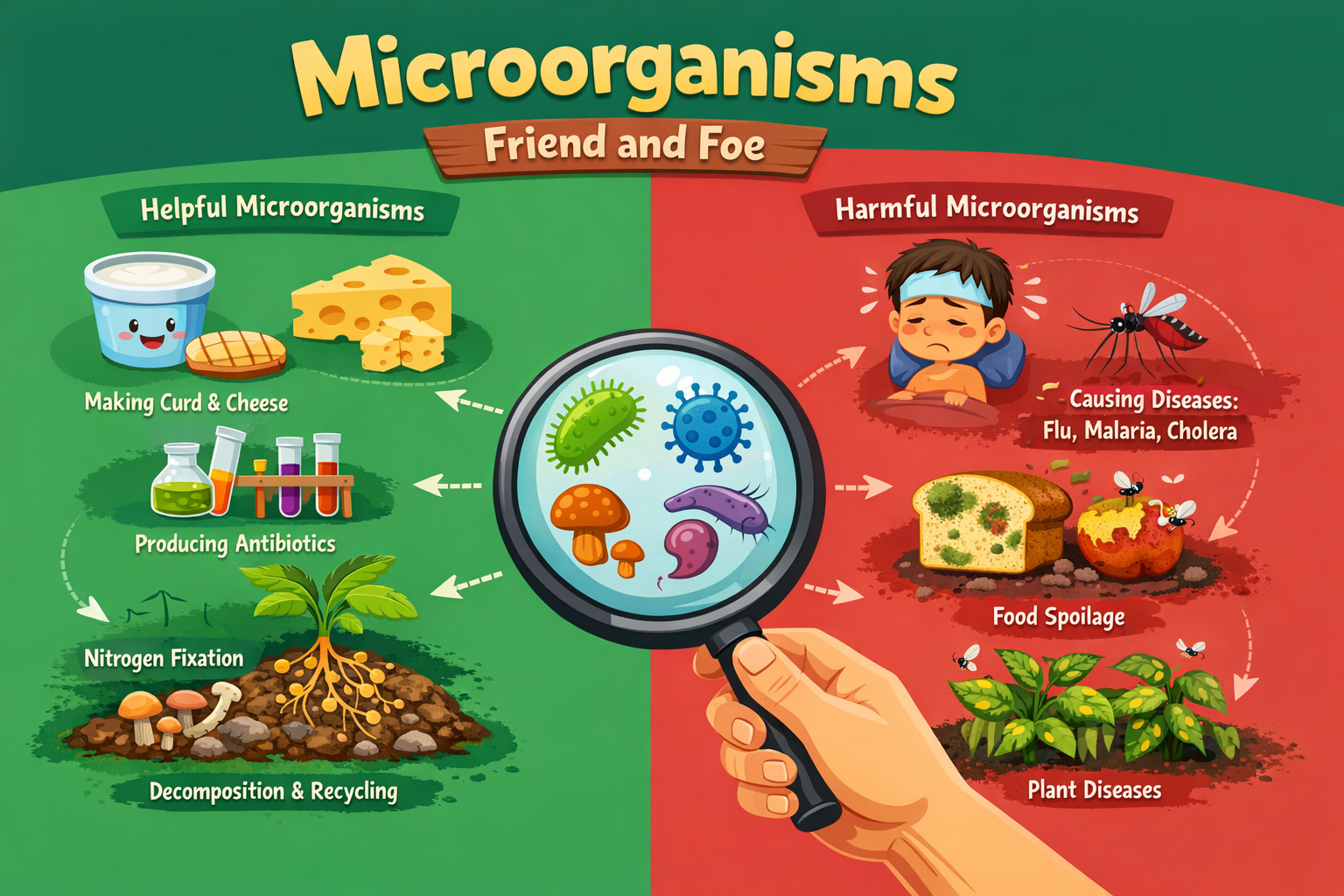
- Role of Microorganisms in Ecosystem
Microorganisms play an important role in ecosystems.
Functions:
Decomposition of dead matter
Nutrient recycling
Nitrogen fixation
Maintaining soil fertility
Without microorganisms, ecosystems would stop functioning.
📌 Quick ICSE Revision Points
Ecosystem = biotic + abiotic components.
Energy flows through food chains and food webs.
Ecological pyramids show trophic levels.
10% law explains energy transfer.
Biogeochemical cycles recycle nutrients.
Ecosystem balance is essential for life.
✅ If you want, I can also provide:
ICSE Ecosystem Important Questions (very likely in exams)
60 MCQs from Ecosystem chapter
Labelled ecosystem diagram for drawing in exams
Complete 10,000-word Ecosystem master notes for Class 8 ICSE.
🌍 Ecosystem – Class 8 ICSE (Advanced Notes Continued)
- Zones of an Ecosystem
Different ecosystems have distinct zones depending on light, temperature, and depth.
Example: Pond Ecosystem Zones
1️⃣ Littoral Zone
Near the shore
Shallow water
Rich in plants and animals
Examples: frogs, insects, aquatic plants.
2️⃣ Limnetic Zone
Open water away from the shore
Receives sunlight
Examples: fish, plankton.
3️⃣ Profundal Zone
Deep water area
Very little sunlight
Few organisms survive here.
4️⃣ Benthic Zone
Bottom of the pond or lake
Contains decomposers like bacteria and fungi.
- Plankton in Aquatic Ecosystems
Plankton are very small organisms floating in water.
Types of Plankton
- Phytoplankton 🌿
Microscopic plants
Perform photosynthesis
Important producers in water ecosystems.
- Zooplankton 🦠
Tiny animals
Feed on phytoplankton.
They form the base of aquatic food chains.
- Ecological Footprint
The ecological footprint measures how much land and water area humans need to produce resources and absorb waste.
If the ecological footprint increases:
natural resources decrease
environmental damage increases.
Reducing ecological footprint helps protect ecosystems.
- Environmental Pollution and Ecosystems
Pollution can damage ecosystems.
Types of Pollution
Air Pollution
Caused by smoke, gases, and vehicle emissions.
Effects:
respiratory diseases
climate change.
Water Pollution
Caused by sewage, chemicals, and industrial waste.
Effects:
death of aquatic organisms
contaminated drinking water.
Soil Pollution
Caused by pesticides and chemicals.
Effects:
loss of soil fertility
harm to plants and microorganisms.
- Global Environmental Problems
1️⃣ Global Warming
Increase in Earth’s temperature due to greenhouse gases.
Main gases:
carbon dioxide
methane
Effects:
melting glaciers
rising sea levels
climate changes.
2️⃣ Ozone Layer Depletion
The ozone layer protects Earth from harmful ultraviolet rays.
Caused by chemicals like CFCs.
Effects:
skin diseases
damage to crops.
3️⃣ Loss of Biodiversity
Reduction in the variety of plants and animals.
Causes:
habitat destruction
pollution
climate change.
- Conservation of Biodiversity
To protect biodiversity, special areas are created.
Protected Areas
- National Parks
Areas where wildlife is protected and human activity is restricted.
Example: Jim Corbett National Park
- Wildlife Sanctuaries
Areas created to protect animals in their natural habitats.
Example: Gir National Park
- Biosphere Reserves
Large protected areas that conserve biodiversity and ecosystems.
Example: Nilgiri Biosphere Reserve
- Role of Humans in Ecosystem Protection
Humans must act responsibly to protect ecosystems.
Ways to help:
🌱 Plant trees (afforestation)
🚯 Reduce waste and pollution
♻ Recycle materials
💧 Save water
🌍 Protect wildlife habitats
- Conclusion
An ecosystem is a complex network of living organisms and their environment.
All organisms depend on each other for survival.
Key points:
Producers capture solar energy.
Consumers transfer energy through food chains.
Decomposers recycle nutrients.
Balanced ecosystems support life on Earth.
Protecting ecosystems is essential for the future of our planet and all living organisms.
✅ If you want, I can also provide (very useful for ICSE exams):
100 MCQs from Ecosystem chapter
Very important long questions asked in exams
Labelled ecosystem diagram for drawing practice
Food chain, food web, and ecological pyramid diagrams
Complete 15,000-word Ecosystem master notes for Class 8 ICSE.
🌍 Ecosystem – Class 8 ICSE (Extra Deep Notes)
- Types of Natural Ecosystems
Natural ecosystems develop without human interference. They are mainly of two types:
1️⃣ Terrestrial Ecosystems (Land Ecosystems)
These ecosystems occur on land.
Examples:
Forest Ecosystem 🌳
Dense vegetation with many trees.
Rich biodiversity.
Animals: deer, tiger, monkey, birds.
Grassland Ecosystem 🌾
Dominated by grasses.
Few trees.
Animals: zebra, deer, rabbits.
Desert Ecosystem 🏜
Very little rainfall.
Extreme temperatures.
Plants: cactus, thorny bushes.
Animals: camel, lizard, snakes.
2️⃣ Aquatic Ecosystems (Water Ecosystems)
These ecosystems occur in water.
Types:
Freshwater Ecosystem
Low salt content.
Examples:
ponds
lakes
rivers
Marine Ecosystem
High salt content.
Examples:
seas
oceans
The largest ecosystem on Earth is the Pacific Ocean marine ecosystem.
- Artificial Ecosystems
Artificial ecosystems are created and maintained by humans.
Examples:
🌾 Agricultural fields
🐠 Aquariums
🌿 Gardens
These ecosystems need human care such as watering plants, adding fertilizers, and protecting organisms.
- Interdependence of Organisms
Organisms in ecosystems depend on each other for survival.
Examples:
🌸 Plants provide food and oxygen.
🐄 Herbivores eat plants.
🦁 Carnivores eat herbivores.
🍄 Decomposers recycle nutrients.
This interdependence maintains ecological balance.
- Keystone Species
A keystone species is an organism that has a very large effect on its ecosystem.
If it disappears, the ecosystem may change drastically.
Example:
The Gray Wolf is a keystone predator in many forest ecosystems.
It controls the population of herbivores like deer.
- Invasive Species
An invasive species is a species introduced into an ecosystem where it is not native.
These species spread quickly and harm native organisms.
Example:
The plant Water Hyacinth grows rapidly in water bodies and blocks sunlight for aquatic plants.
Effects:
decreases oxygen in water
harms fish and aquatic life.
- Ecological Indicators
Some organisms indicate the health of ecosystems.
Examples:
🐸 Frogs – sensitive to pollution.
🐟 Fish – indicate water quality.
🌿 Lichens – indicate air pollution.
If these organisms disappear, it may mean the environment is polluted.
- Recycling of Matter in Ecosystems
Matter continuously circulates in ecosystems.
Example:
Dead plants and animals → decomposed by fungi and bacteria → nutrients return to soil → plants absorb nutrients again.
This process is called nutrient recycling.
- Importance of Plants in Ecosystem
Plants are extremely important because they:
🌿 Produce food through photosynthesis
🌬 Release oxygen
🌧 Help regulate climate
🌱 Maintain soil fertility
🏠 Provide habitat for animals
Without plants, ecosystems cannot exist.
- Importance of Animals in Ecosystem
Animals also play important roles:
🐝 Pollination of flowers
🌱 Seed dispersal
🦁 Population control of prey animals
🍄 Contribution to nutrient cycling
- Environmental Awareness
Protecting ecosystems requires awareness.
People should:
conserve forests
protect wildlife
reduce plastic use
control pollution
support conservation programs.
Environmental education helps people understand the importance of ecosystems.
📌 Very Important ICSE Exam Points
Ecosystem consists of biotic and abiotic components.
Energy flows through food chains and food webs.
Producers, consumers, and decomposers form trophic levels.
Biogeochemical cycles recycle nutrients.
Human activities can disturb ecological balance.
Conservation is necessary to protect ecosystems.
✅ If you want, I can also give:
Ecosystem labelled diagram (very important for ICSE)
80 MCQs from Ecosystem chapter
Short questions + long questions for exams
Super easy revision notes for last-day exam preparation.
🌍 Ecosystem – Class 8 ICSE (More Detailed Notes)
- Producers in Detail 🌿
Producers are organisms that make their own food from simple inorganic substances using sunlight.
Process used: Photosynthesis
Examples:
Green plants
Algae
Phytoplankton
Importance of producers:
Base of the food chain
Provide food for all other organisms
Release oxygen into the atmosphere
Convert solar energy into chemical energy
Without producers, no ecosystem can survive.
- Consumers in Detail 🐾
Consumers depend on other organisms for food.
Types of Consumers
- Primary Consumers (Herbivores)
Eat plants directly.
Examples:
cow
rabbit
deer
grasshopper
- Secondary Consumers (Carnivores)
Eat herbivores.
Examples:
frog
lizard
small fish
- Tertiary Consumers
Eat secondary consumers.
Examples:
snake
eagle
tiger
- Omnivores
Eat both plants and animals.
Examples:
humans
bears
crows
- Decomposers in Detail 🍄
Decomposers are organisms that break down dead plants and animals into simpler substances.
Examples:
bacteria
fungi
Functions of decomposers:
Decompose dead organisms
Recycle nutrients into the soil
Maintain soil fertility
Clean the environment
Without decomposers, dead matter would accumulate everywhere.
- Detritivores
Detritivores are organisms that feed on dead organic matter.
Examples:
earthworms
termites
crabs
They help in breaking down organic waste.
Difference:
Detritivores eat dead matter directly.
Decomposers chemically break it down.
- Ecological Relationships
Organisms interact with each other in different ways.
- Mutualism
Both organisms benefit.
Example:
Bees and flowers.
Bees get nectar and flowers get pollinated.
- Parasitism
One organism benefits while the other is harmed.
Examples:
tapeworm in humans
mosquito feeding on blood.
- Commensalism
One organism benefits while the other is unaffected.
Example:
birds living on trees.
- Predation
One organism hunts and eats another.
Example:
lion hunting deer.
- Migration
Migration is the seasonal movement of animals from one place to another.
Reasons for migration:
search for food
breeding
avoiding extreme weather
Example: The bird Siberian Crane migrates to warmer regions during winter.
- Hibernation
Hibernation is a deep sleep taken by animals during winter to survive cold conditions.
During hibernation:
body temperature decreases
metabolism slows down
animals conserve energy.
Examples:
bears
bats
frogs.
- Estivation
Estivation is a summer sleep taken by animals during extremely hot and dry conditions.
Examples:
snails
frogs.
It helps animals survive high temperatures.
- Importance of Sunlight in Ecosystem ☀️
Sunlight is the main source of energy for ecosystems.
Importance:
drives photosynthesis
provides heat and light
supports plant growth
maintains climate patterns
All energy in ecosystems ultimately comes from the Sun.
- Soil in Ecosystem 🌍
Soil is an important abiotic component.
It provides:
nutrients for plants
habitat for microorganisms
support for plant roots
water storage.
Soil fertility is maintained by decomposers and nutrient cycles.
- Water in Ecosystem 💧
Water is essential for all living organisms.
Functions:
helps in metabolic reactions
transports nutrients in plants
regulates temperature
supports aquatic life.
Without water, life cannot exist.
📌 Final Quick Revision (ICSE)
Important points:
Ecosystem = interaction of living and non-living components.
Producers, consumers, decomposers form trophic levels.
Energy flows through food chains and food webs.
Nutrients move through biogeochemical cycles.
Human activities can disturb ecosystems.
✅ If you want, I can also give:
100 ICSE Ecosystem MCQs with answers
Very important exam questions from this chapter
Labelled ecosystem diagram for drawing in exams
One-page super fast revision sheet for Class 8 ICSE Ecosystem.
🌍 Ecosystem – Class 8 ICSE (Further Extended Notes)
- Energy Flow in an Ecosystem ⚡
Energy in an ecosystem always flows in one direction.
Flow of energy:
Sun → Plants → Herbivores → Carnivores → Decomposers
Plants capture sunlight and convert it into food through photosynthesis.
Animals obtain this energy by eating plants or other animals.
Important points:
Energy decreases at each trophic level.
Some energy is lost as heat.
Energy cannot be recycled like nutrients.
- Grazing Food Chain 🌾
A grazing food chain begins with green plants.
Example:
Grass → Rabbit → Fox → Eagle
Explanation:
Grass = producer
Rabbit = herbivore
Fox = carnivore
Eagle = top consumer
This food chain depends directly on living plants.
- Detritus Food Chain 🍂
A detritus food chain begins with dead organic matter.
Example:
Dead leaves → Earthworm → Bird → Hawk
Explanation:
Dead leaves = detritus
Earthworm = detritivore
Bird = secondary consumer
Hawk = tertiary consumer
This food chain is very important for recycling nutrients.
- Differences Between Grazing and Detritus Food Chain
Grazing Food Chain Detritus Food Chain
Begins with green plants Begins with dead organic matter
Energy from photosynthesis Energy from decomposition
Example: grass → deer → tiger Example: dead leaves → worm → bird
- Biomagnification
Biomagnification is the increase in concentration of harmful chemicals in organisms at higher trophic levels.
Example:
pesticides entering food chains.
Example food chain:
Water → small fish → big fish → bird
The bird receives the highest concentration of toxins.
One famous pesticide responsible for biomagnification was DDT.
Effects:
poisoning of animals
reproductive problems
ecosystem damage.
- Eutrophication
Eutrophication is the excessive growth of algae in water bodies due to excess nutrients.
Causes:
fertilizers
sewage
industrial waste.
Process:
nutrients increase in water
algae grow rapidly
oxygen in water decreases
fish and aquatic animals die.
This damages aquatic ecosystems.
- Greenhouse Effect
The greenhouse effect is the warming of the Earth due to greenhouse gases trapping heat in the atmosphere.
Important greenhouse gases:
carbon dioxide
methane
water vapor
This effect helps maintain Earth’s temperature suitable for life.
However, excessive greenhouse gases cause global warming.
- Importance of Ecosystem Study
Studying ecosystems helps us:
understand nature
protect biodiversity
manage natural resources
control pollution
maintain ecological balance.
- Environmental Conservation
Environmental conservation means protecting natural resources and ecosystems.
Methods:
🌳 Afforestation (planting trees)
♻ Recycling materials
🚯 Reducing pollution
🌊 Protecting water bodies
🦁 Protecting wildlife.
Many international organizations also work for environmental protection, such as World Wide Fund for Nature.
📌 Ultra Short ICSE Revision Points
Ecosystem consists of biotic and abiotic components.
Producers capture solar energy.
Consumers transfer energy through food chains.
Decomposers recycle nutrients.
Energy flow follows the 10% law.
Human activities affect ecosystems.
✅ If you want, I can also give:
Complete Ecosystem chapter summary for quick revision
100 ICSE MCQs with answers
Important diagrams (food chain, ecological pyramid, pond ecosystem)
Very likely exam questions for Class 8 ICSE Ecosystem.


Leave a Reply