


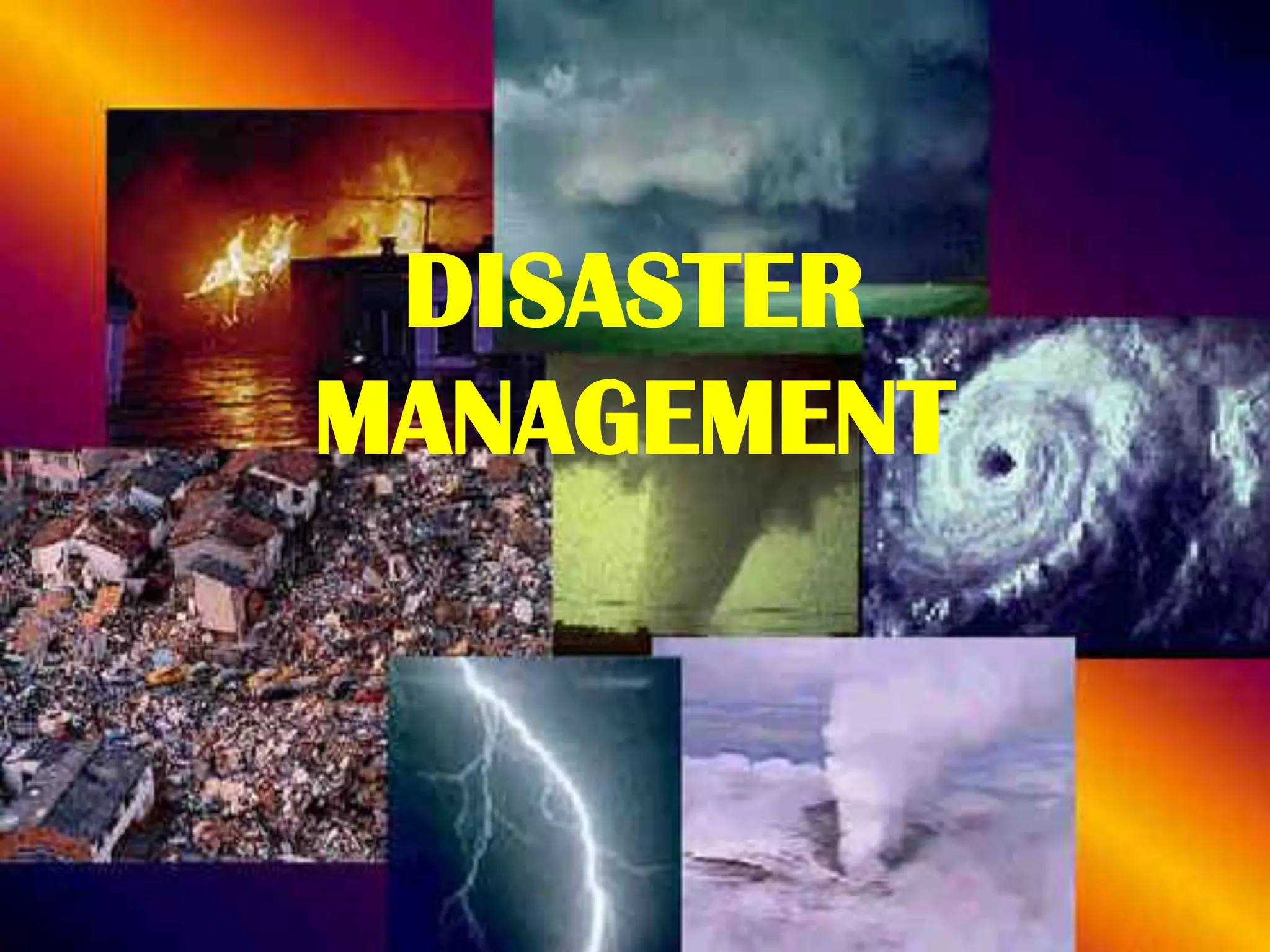
Disaster and Disaster Management
Introduction
A disaster is a sudden or gradual event that causes serious disruption to the functioning of a community or society. It results in significant loss of life, property, environment, economy, and infrastructure beyond the ability of the affected community to cope using its own resources. Disasters can be natural or human-made, and their impact can be short-term or long-term depending on preparedness and response.
Disaster management refers to the organized efforts to prevent, prepare for, respond to, and recover from disasters. It aims to reduce the harmful effects of disasters and ensure quick recovery. In today’s world, with increasing population, urbanization, and climate change, disaster management has become more important than ever.
Types of Disasters
Disasters are broadly classified into Natural Disasters and Man-made (Human-induced) Disasters.
1. Natural Disasters
Natural disasters occur due to natural processes of the Earth. Some major types are:
1.1 Earthquakes
An earthquake is the sudden shaking of the Earth’s surface due to movement of tectonic plates. Countries like Japan and Nepal frequently experience earthquakes due to their geographical location. Major earthquakes can cause building collapse, landslides, and tsunamis.
1.2 Floods
Floods occur when water overflows onto land that is usually dry. Heavy rainfall, river overflow, dam failure, and poor drainage systems are common causes. Floods destroy crops, homes, roads, and can lead to water-borne diseases.
1.3 Cyclones
Cyclones are powerful storms with strong winds and heavy rainfall. In India, cyclones often affect coastal areas such as Odisha and West Bengal. They cause destruction of houses, trees, electricity lines, and crops.
1.4 Drought
Drought is a prolonged period of low rainfall leading to water shortage. It affects agriculture, livestock, and drinking water supply.
1.5 Landslides
Landslides occur when masses of rock or soil move down a slope due to heavy rainfall, earthquakes, or human activities.
1.6 Tsunami
A tsunami is a series of huge sea waves caused by underwater earthquakes or volcanic eruptions. The 2004 Indian Ocean tsunami caused massive destruction in many countries.
1.7 Pandemics
A pandemic is a global outbreak of disease. The COVID-19 pandemic severely affected economies, healthcare systems, and daily life worldwide.
2. Man-Made Disasters
These disasters are caused by human activities.
2.1 Industrial Accidents
Gas leaks, chemical spills, and factory explosions are examples. The Bhopal Gas Tragedy in 1984 is one of the worst industrial disasters in history.
2.2 Nuclear Disasters
Nuclear accidents occur due to malfunctioning reactors or human error. The Chernobyl disaster is a major example.
2.3 Terrorism
Terrorist attacks cause loss of life, property damage, and psychological trauma.
2.4 War
Wars destroy infrastructure, cause displacement, and lead to humanitarian crises.
2.5 Environmental Pollution
Excessive pollution can lead to environmental disasters like oil spills.
Causes of Disasters
Disasters occur due to various reasons:
- Natural geological activities
- Climate change
- Deforestation
- Rapid urbanization
- Poor planning and construction
- Industrial negligence
- Population growth
- Lack of awareness
Human activities often increase the severity of natural disasters. For example, cutting forests increases the risk of floods and landslides.
Impact of Disasters
Disasters affect society in multiple ways:
1. Human Impact
- Loss of life
- Injuries
- Spread of diseases
- Psychological stress
- Displacement of people
2. Economic Impact
- Destruction of property
- Loss of crops and livestock
- Damage to industries
- Unemployment
3. Environmental Impact
- Soil erosion
- Water contamination
- Loss of biodiversity
- Habitat destruction
4. Social Impact
- Breakdown of communication
- Disruption of education
- Migration
- Increase in poverty
Disaster Management
Disaster management is a continuous process. It involves planning, organizing, coordinating, and implementing measures to deal with disasters effectively.
It consists of four main phases:
1. Mitigation
Mitigation means reducing the severity or impact of disasters before they happen.
Measures:
- Construction of earthquake-resistant buildings
- Building dams and embankments
- Afforestation
- Proper urban planning
- Early warning systems
- Public awareness campaigns
Mitigation aims to reduce risks and vulnerabilities.
2. Preparedness
Preparedness involves planning and training before a disaster occurs.
Examples:
- Conducting mock drills
- Emergency response training
- Stockpiling food and medical supplies
- Developing evacuation plans
- Installing warning alarms
Preparedness ensures that people know what to do during emergencies.
3. Response
Response actions are taken immediately after a disaster to save lives and reduce suffering.
Activities:
- Search and rescue operations
- Providing medical aid
- Distributing food and water
- Setting up temporary shelters
- Restoring communication systems
Quick response reduces further damage.
4. Recovery
Recovery includes rebuilding and restoring normal life.
Includes:
- Reconstructing buildings and roads
- Providing financial assistance
- Rehabilitation of affected people
- Psychological counseling
- Restoring livelihoods
Recovery can take months or even years depending on the disaster’s scale.
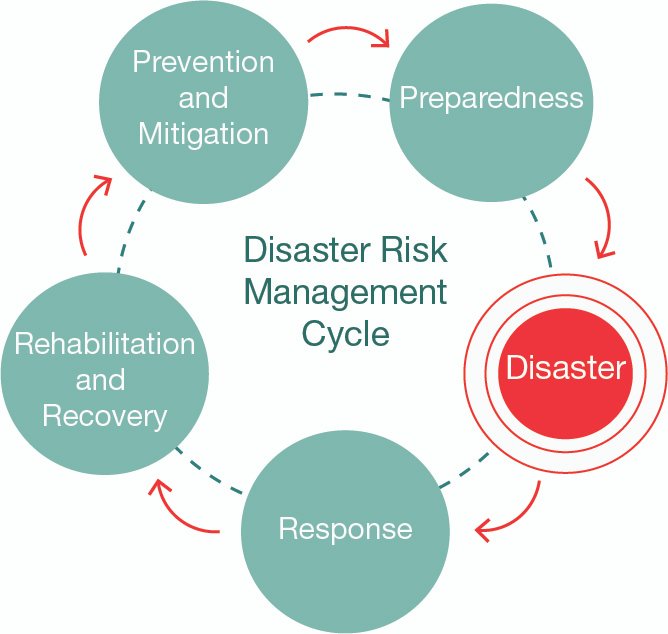
Disaster Management Cycle
The disaster management cycle includes:
- Prevention
- Mitigation
- Preparedness
- Response
- Recovery
It is a continuous cycle because after recovery, planning begins again for future disasters.
Role of Government in Disaster Management
Governments play a vital role in disaster management.
Key Responsibilities:
- Creating disaster management policies
- Setting up disaster management authorities
- Providing funds
- Coordinating rescue teams
- Implementing early warning systems
- Conducting awareness programs
For example, in India, the National Disaster Management Authority (NDMA) coordinates disaster management activities.
Role of Technology in Disaster Management
Modern technology helps reduce disaster impact.
Examples:
- Satellite monitoring
- Weather forecasting systems
- Geographic Information Systems (GIS)
- Drones for rescue operations
- Mobile alert systems
Technology improves prediction, communication, and rescue efficiency.
Community Participation
Community involvement is essential for effective disaster management.
Community Roles:
- Participating in drills
- Following safety guidelines
- Helping vulnerable groups
- Volunteering in rescue operations
- Spreading awareness
Local communities are often the first responders during disasters.
Disaster Risk Reduction (DRR)
Disaster Risk Reduction focuses on minimizing vulnerabilities and disaster risks to prevent or limit adverse impacts.
It includes:
- Risk assessment
- Strengthening infrastructure
- Sustainable development
- Climate adaptation strategies
DRR is a long-term strategy for safer communities.
Importance of Disaster Management
- Saves lives
- Reduces economic losses
- Protects environment
- Ensures quick recovery
- Promotes sustainable development
- Enhances community resilience
Without proper disaster management, even small disasters can cause huge destruction.
Challenges in Disaster Management
Despite improvements, several challenges remain:
- Lack of awareness
- Insufficient funding
- Poor coordination
- Rapid urbanization
- Climate change
- Population density
- Weak infrastructure
Developing countries face greater difficulties due to limited resources.
Measures to Improve Disaster Management
- Strengthening early warning systems
- Enforcing building codes
- Promoting environmental conservation
- Increasing public awareness
- Training volunteers
- Improving emergency healthcare
- Encouraging international cooperation
Global cooperation is necessary because disasters do not recognize borders.
Conclusion
Disasters are unavoidable, but their impact can be reduced through effective disaster management. Natural and man-made disasters cause immense suffering and economic loss. However, with proper planning, awareness, technology, and cooperation, societies can become more resilient.
Disaster management is not only the responsibility of governments but also of communities and individuals. Every citizen must be aware of safety measures and participate in preparedness programs. Sustainable development, environmental protection, and climate change mitigation are also essential to reduce disaster risks.
In the modern world, disaster management has become a crucial part of governance and development planning. A well-prepared nation can face disasters with courage and recover quickly. Therefore, investing in disaster management is investing in a safer and more secure future.
Here are 100 Multiple Choice Questions (MCQs) on Disaster and Disaster Management with answers:
Disaster and Disaster Management – 100 MCQs
1. A disaster is defined as:
A) A minor accident
B) A sudden event causing serious disruption
C) A daily inconvenience
D) A festival gathering
Answer: B
2. Which of the following is a natural disaster?
A) War
B) Industrial fire
C) Earthquake
D) Terrorism
Answer: C
3. Floods are mainly caused by:
A) Deforestation only
B) Heavy rainfall
C) Earth’s rotation
D) Air pollution
Answer: B
4. A prolonged period of low rainfall is called:
A) Flood
B) Cyclone
C) Drought
D) Tsunami
Answer: C
5. Cyclones generally form over:
A) Mountains
B) Oceans
C) Forests
D) Deserts
Answer: B
6. Tsunami waves are usually caused by:
A) Forest fires
B) Heavy traffic
C) Underwater earthquakes
D) Pollution
Answer: C
7. Landslides commonly occur in:
A) Plains
B) Deserts
C) Hilly areas
D) Oceans
Answer: C
8. The shaking of Earth’s surface is called:
A) Volcano
B) Earthquake
C) Storm
D) Flood
Answer: B
9. Which is a man-made disaster?
A) Earthquake
B) Flood
C) Industrial accident
D) Drought
Answer: C
10. Disaster management mainly aims to:
A) Increase damage
B) Reduce impact of disasters
C) Stop rainfall
D) Create fear
Answer: B
11. The first phase of disaster management is:
A) Recovery
B) Response
C) Mitigation
D) Celebration
Answer: C
12. Preparedness includes:
A) Mock drills
B) Ignoring warnings
C) Cutting trees
D) Spreading rumors
Answer: A
13. Search and rescue comes under:
A) Recovery
B) Mitigation
C) Response
D) Prevention
Answer: C
14. Rebuilding houses after disaster is part of:
A) Preparedness
B) Recovery
C) Mitigation
D) Response
Answer: B
15. Early warning systems help in:
A) Increasing risk
B) Disaster prediction
C) Pollution
D) Panic
Answer: B
16. Deforestation increases risk of:
A) Earthquakes
B) Landslides and floods
C) Cyclones
D) Tsunami
Answer: B
17. Disaster Risk Reduction focuses on:
A) Increasing population
B) Reducing vulnerability
C) Ignoring safety
D) Damaging environment
Answer: B
18. Earthquakes occur due to movement of:
A) Rivers
B) Clouds
C) Tectonic plates
D) Trees
Answer: C
19. Which disaster spreads water-borne diseases?
A) Drought
B) Flood
C) Earthquake
D) Landslide
Answer: B
20. Which is not a phase of disaster management?
A) Mitigation
B) Preparedness
C) Celebration
D) Recovery
Answer: C
(Continuing in same format)
21. Strong rotating winds with heavy rain are: Cyclones – Answer: A
A) Cyclones
B) Earthquakes
C) Drought
D) Landslides
22. Pandemic refers to: Global disease outbreak – Answer: B
A) Local storm
B) Global disease outbreak
C) Volcano
D) Drought
23. Main aim of mitigation is: Reduce impact – Answer: A
A) Reduce impact
B) Increase damage
C) Delay rescue
D) Avoid planning
24. Emergency kits are part of: Preparedness – Answer: C
A) Recovery
B) Response
C) Preparedness
D) Damage
25. Temporary shelters are set up during: Response – Answer: B
A) Mitigation
B) Response
C) Prevention
D) Planning
26–100 (Concise Format for Coverage)
- Gas leak disaster is — Man-made (A)
- Building earthquake-resistant houses is — Mitigation (B)
- Loss of biodiversity is — Environmental impact (C)
- Psychological stress is — Human impact (A)
- Climate change increases — Disaster risk (B)
- Mock drills improve — Preparedness (A)
- Tsunami affects — Coastal areas (C)
- Drought affects — Agriculture (B)
- War causes — Human displacement (A)
- Oil spill is — Environmental disaster (D)
- Disaster cycle is — Continuous (B)
- Volunteers help in — Response (A)
- GIS helps in — Mapping risk (C)
- Rapid urbanization increases — Vulnerability (B)
- Poor drainage causes — Floods (A)
- Dam failure leads to — Flood (C)
- Emergency numbers are for — Quick response (B)
- Search operation aims to — Save lives (A)
- Recovery may take — Years (D)
- Disaster planning reduces — Losses (B)
- Safe construction reduces — Earthquake damage (A)
- First aid is part of — Response (C)
- Stockpiling food is — Preparedness (B)
- Afforestation reduces — Flood risk (D)
- Disaster management promotes — Safety (A)
- Overpopulation increases — Risk (B)
- Heatwaves are — Natural disaster (A)
- Chemical explosion is — Industrial disaster (C)
- Evacuation means — Moving to safe place (D)
- Relief camps provide — Shelter (B)
- Sustainable development supports — DRR (A)
- Infrastructure damage causes — Economic loss (C)
- Community awareness improves — Safety (D)
- Risk assessment identifies — Vulnerability (A)
- Emergency training builds — Confidence (B)
- Communication systems help in — Coordination (C)
- Hazard means — Potential danger (D)
- Vulnerability means — Weakness (A)
- Capacity means — Ability to cope (B)
- Tsunami warning uses — Technology (C)
- Emergency exit plan is — Preparedness (D)
- Relief materials include — Food & water (A)
- Landslides follow — Heavy rain (B)
- Recovery restores — Normal life (C)
- Prevention reduces — Future risk (D)
- Disaster education is — Awareness tool (A)
- Fire is — Man-made disaster (B)
- Emergency response teams save — Lives (C)
- Climate adaptation reduces — Risk (D)
- Rescue operations start in — Response phase (A)
- Long-term rebuilding is — Recovery (B)
- Flood barriers are — Mitigation (C)
- Public cooperation ensures — Effective management (D)
- Hazard mapping helps — Planning (A)
- Aftershock follows — Earthquake (B)
- Relief fund helps — Victims (C)
- Emergency siren gives — Warning (D)
- Disaster affects — Economy (A)
- Earthquake scale measures — Magnitude (B)
- Sandbags prevent — Flooding (C)
- Rescue dogs help in — Search (D)
- Emergency lighting is for — Safety (A)
- Disaster management reduces — Suffering (B)
- Volunteers are part of — Community response (C)
- Health camps prevent — Disease spread (D)
- Infrastructure includes — Roads (A)
- Rapid action reduces — Damage (B)
- Shelter management is — Response (C)
- Disaster planning is — Continuous (D)
- Environmental protection reduces — Risk (A)
- Safety drills are — Practice (B)
- International aid supports — Recovery (C)
- Media spreads — Awareness (D)
- Strong governance improves — Disaster control (A)
- Disaster management builds — Resilience (B)
Assertion Reason 💫
Directions:
A) Both Assertion (A) and Reason (R) are true and R is the correct explanation of A.
B) Both A and R are true but R is NOT the correct explanation of A.
C) A is true but R is false.
D) A is false but R is true.
1.
Assertion (A): Earthquakes cannot be prevented.
Reason (R): They occur due to movement of tectonic plates.
Answer: A
2.
A: Floods can cause water-borne diseases.
R: Floodwater often contaminates drinking water sources.
Answer: A
3.
A: Deforestation increases the risk of landslides.
R: Trees help bind the soil with their roots.
Answer: A
4.
A: Preparedness reduces disaster losses.
R: People know how to respond during emergencies.
Answer: A
5.
A: Cyclones mainly affect coastal areas.
R: Cyclones form over warm ocean waters.
Answer: A
6.
A: Mitigation is done after a disaster occurs.
R: Mitigation focuses on reducing future risks.
Answer: D
7.
A: Recovery includes rebuilding infrastructure.
R: Recovery aims to restore normal life.
Answer: A
8.
A: Drought affects agricultural production.
R: Drought results from excessive rainfall.
Answer: C
9.
A: Early warning systems save lives.
R: They provide advance information about disasters.
Answer: A
10.
A: Industrial accidents are natural disasters.
R: They are caused by human activities.
Answer: D
11.
A: Disaster management is a continuous process.
R: The disaster management cycle repeats after recovery.
Answer: A
12.
A: Urbanization increases disaster vulnerability.
R: Rapid urban growth may ignore safety standards.
Answer: A
13.
A: Tsunamis are caused by underwater disturbances.
R: They are caused by strong winds over land.
Answer: C
14.
A: Community participation strengthens disaster management.
R: Local people are often first responders.
Answer: A
15.
A: Climate change increases disaster frequency.
R: It causes extreme weather events.
Answer: A
16.
A: Response phase includes search and rescue.
R: It focuses on immediate action after disaster.
Answer: A
17.
A: Mock drills are part of recovery.
R: Mock drills prepare people before disaster.
Answer: D
18.
A: Hazard means potential danger.
R: Vulnerability means ability to cope.
Answer: C
19.
A: Building codes reduce earthquake damage.
R: Strong structures resist seismic forces.
Answer: A
20.
A: Oil spills are environmental disasters.
R: They pollute water bodies.
Answer: A
21.
A: Flood barriers are mitigation measures.
R: They reduce flood impact.
Answer: A
22.
A: Emergency kits are useful in disasters.
R: They contain essential supplies.
Answer: A
23.
A: War is a man-made disaster.
R: It causes destruction due to human conflict.
Answer: A
24.
A: Landslides are common in plains.
R: Landslides occur mostly in hilly areas.
Answer: D
25.
A: Relief camps are part of response.
R: They provide shelter and food.
Answer: A
26.
A: Disaster Risk Reduction focuses on minimizing vulnerability.
R: It includes long-term planning.
Answer: A
27.
A: Pandemics affect only one country.
R: Pandemics spread globally.
Answer: D
28.
A: First aid is important during disasters.
R: It helps treat injuries immediately.
Answer: A
29.
A: Afforestation can reduce flood risk.
R: Trees increase soil absorption of water.
Answer: A
30.
A: Evacuation means staying at home.
R: Evacuation means moving to a safer place.
Answer: D
31.
A: Infrastructure damage causes economic loss.
R: Roads and industries support the economy.
Answer: A
32.
A: Aftershocks follow earthquakes.
R: Aftershocks are smaller tremors after the main shock.
Answer: A
33.
A: Disaster management promotes sustainable development.
R: It reduces long-term risks.
Answer: A
34.
A: Emergency sirens are used for warning.
R: They alert people about danger.
Answer: A
35.
A: Preparedness includes stockpiling food.
R: Supplies may not be available during disasters.
Answer: A
36.
A: Heatwaves are natural disasters.
R: They result from extreme temperature rise.
Answer: A
37.
A: Poor drainage systems can cause floods.
R: Water cannot flow out quickly.
Answer: A
38.
A: Psychological stress is a social impact of disaster.
R: Disasters create fear and trauma.
Answer: A
39.
A: Emergency training increases panic.
R: Training builds confidence and awareness.
Answer: D
40.
A: Tsunami warning systems use technology.
R: Satellites and sensors detect sea disturbances.
Answer: A
41.
A: Search dogs help during disasters.
R: They can locate trapped victims.
Answer: A
42.
A: Population growth increases disaster risk.
R: More people may live in vulnerable areas.
Answer: A
43.
A: Recovery phase ends all disaster risks.
R: Future disasters can still occur.
Answer: D
44.
A: Community awareness reduces vulnerability.
R: Informed people take safety measures.
Answer: A
45.
A: Hazard mapping helps disaster planning.
R: It identifies risk-prone areas.
Answer: A
46.
A: Nuclear accidents are natural disasters.
R: They are caused by reactor failures.
Answer: D
47.
A: Relief funds support victims.
R: Financial aid helps rebuild lives.
Answer: A
48.
A: Climate adaptation reduces disaster impact.
R: It prepares communities for extreme events.
Answer: A
49.
A: Rescue operations are part of mitigation.
R: Mitigation occurs before disaster.
Answer: D
50.
A: Disaster management builds community resilience.
R: It strengthens the ability to cope with disasters.
Answer: A
Here are 100 True/False Questions on Disaster and Disaster Management with answers:
Disaster and Disaster Management – 100 True/False
- A disaster causes serious disruption to society. — True
- Earthquakes are man-made disasters. — False
- Floods can destroy crops and homes. — True
- Drought is caused by excessive rainfall. — False
- Cyclones usually form over oceans. — True
- Tsunami waves are caused by underwater disturbances. — True
- Landslides commonly occur in hilly areas. — True
- Industrial accidents are natural disasters. — False
- Disaster management aims to reduce losses. — True
- Preparedness is done after a disaster. — False
- Search and rescue operations are part of response. — True
- Recovery includes rebuilding damaged infrastructure. — True
- Mitigation focuses on reducing future risks. — True
- Early warning systems increase disaster damage. — False
- Deforestation can increase flood risk. — True
- Disaster Risk Reduction aims to minimize vulnerability. — True
- Earthquakes can be completely prevented. — False
- Floodwater may contaminate drinking water. — True
- War is a man-made disaster. — True
- Oil spills are environmental disasters. — True
- Mock drills are part of preparedness. — True
- Climate change can increase extreme weather events. — True
- Relief camps provide food and shelter. — True
- Hazard means the ability to cope. — False
- Vulnerability means weakness or exposure to risk. — True
- Capacity refers to ability to manage disasters. — True
- Landslides never occur after heavy rainfall. — False
- Tsunami mainly affects coastal regions. — True
- Emergency kits are useless during disasters. — False
- Evacuation means moving to a safer place. — True
- Infrastructure damage leads to economic loss. — True
- Population growth may increase disaster risk. — True
- Aftershocks follow major earthquakes. — True
- Disaster management cycle is continuous. — True
- Recovery phase eliminates all future risks. — False
- Heatwaves are natural disasters. — True
- Strong building codes reduce earthquake damage. — True
- Flood barriers are mitigation measures. — True
- Emergency sirens are used for warnings. — True
- Preparedness includes stockpiling supplies. — True
- Urbanization never affects disaster vulnerability. — False
- Community awareness reduces disaster impact. — True
- Rescue operations happen during mitigation phase. — False
- First aid is important in disaster response. — True
- Poor drainage systems can cause flooding. — True
- Tsunami warning systems use technology. — True
- Disaster only affects the environment. — False
- Psychological stress can result from disasters. — True
- Relief funds help victims recover. — True
- Drought affects agriculture and livestock. — True
- Emergency response teams save lives. — True
- Sustainable development reduces disaster risks. — True
- Landslides are common in deserts. — False
- Communication systems are important during disasters. — True
- Risk assessment identifies hazard-prone areas. — True
- Disaster preparedness increases panic. — False
- Cyclones bring strong winds and heavy rain. — True
- Emergency exits are unnecessary in buildings. — False
- Hazard mapping helps disaster planning. — True
- Climate adaptation prepares communities for disasters. — True
- Pandemics spread globally. — True
- Industrial safety rules prevent accidents. — True
- Volunteers can help during disasters. — True
- Deforestation improves environmental stability. — False
- Tsunami can be predicted with early warning systems. — True
- Disaster management promotes safety and resilience. — True
- Earthquakes occur due to tectonic plate movement. — True
- Floods never spread diseases. — False
- Recovery may take months or years. — True
- Emergency lighting improves safety. — True
- Mitigation is done before disaster strikes. — True
- Relief materials include food and water. — True
- Disaster only affects poor countries. — False
- Rapid response reduces damage and loss. — True
- Heatwaves can cause health problems. — True
- Landslides can block roads and rivers. — True
- Oil spills damage marine life. — True
- Disaster planning is unnecessary. — False
- Training builds confidence in emergencies. — True
- Shelter management is part of response. — True
- War causes displacement of people. — True
- Floods may result from dam failure. — True
- Community participation strengthens disaster management. — True
- Hazard and disaster mean the same thing. — False
- Earthquake magnitude is measured on a scale. — True
- Environmental protection reduces disaster risks. — True
- Emergency numbers are useful during disasters. — True
- Strong governance improves disaster control. — True
- Tsunami affects only mountains. — False
- Disaster response includes medical aid. — True
- Rapid urban growth can increase vulnerability. — True
- Recovery restores normal life gradually. — True
- Risk cannot be reduced by planning. — False
- Prepared communities cope better with disasters. — True
- First responders are often local people. — True
- Climate change has no effect on disasters. — False
- Disaster management requires coordination. — True
- Floodwater may damage electrical systems. — True
- Relief camps are permanent housing solutions. — False
- Disaster management builds community resilience. — True
Case Based question 💫
Case 1: Flood in a River Basin
After continuous heavy rainfall, a river overflowed and flooded nearby villages. Many houses were submerged, and drinking water sources were contaminated.
Q1. What type of disaster is this?
Answer: Natural disaster (Flood)
Q2. Name one major health risk after floods.
Answer: Water-borne diseases
Q3. Which phase involves distributing food and clean water?
Answer: Response phase
Case 2: Earthquake in a City
A 6.8 magnitude earthquake struck a densely populated city. Many poorly constructed buildings collapsed.
Q1. Which disaster management measure could have reduced building damage?
Answer: Earthquake-resistant construction (Mitigation)
Q2. What is the immediate action after such a disaster?
Answer: Search and rescue operations
Case 3: Cyclone Warning
Meteorological departments issued early warnings about a strong cyclone approaching the coast.
Q1. Which phase does issuing warnings belong to?
Answer: Preparedness
Q2. What should people in coastal areas do?
Answer: Evacuate to safer places
Case 4: Industrial Gas Leak
A chemical factory released toxic gas due to negligence, affecting thousands of people.
Q1. Is this a natural or man-made disaster?
Answer: Man-made disaster
Q2. Name one long-term recovery measure.
Answer: Medical treatment and compensation
Case 5: Drought Situation
A region experienced very low rainfall for two years, affecting crops and livestock.
Q1. What disaster is described?
Answer: Drought
Q2. Suggest one mitigation measure.
Answer: Water conservation and rainwater harvesting
Case 6: Landslide in Hills
After heavy rain, a landslide blocked roads and damaged houses in a hill station.
Q1. What natural factor triggered the landslide?
Answer: Heavy rainfall
Q2. Name one preventive measure.
Answer: Afforestation
Case 7: Pandemic Spread
A contagious disease spread rapidly across countries, affecting global health systems.
Q1. What type of disaster is this?
Answer: Pandemic
Q2. Which measure helps control spread?
Answer: Vaccination and public awareness
Case 8: Dam Failure
A dam broke due to structural weakness, flooding nearby towns.
Q1. What disaster occurred?
Answer: Flood
Q2. Which phase involves rebuilding infrastructure?
Answer: Recovery
Case 9: Heatwave
Extreme high temperatures caused health issues and deaths in a city.
Q1. What type of disaster is this?
Answer: Natural disaster (Heatwave)
Q2. Suggest one preparedness step.
Answer: Issuing heat alerts and setting up cooling centers
Case 10: Oil Spill
An oil tanker accident caused oil to spill into the sea, harming marine life.
Q1. What kind of disaster is this?
Answer: Environmental disaster
Q2. Mention one environmental impact.
Answer: Damage to marine ecosystem
Case 11: Urban Flooding
Poor drainage systems caused severe flooding in a metropolitan city after rainfall.
Q1. What human factor increased flood impact?
Answer: Poor urban planning
Q2. Name one mitigation strategy.
Answer: Improving drainage systems
Case 12: Earthquake Drill
A school conducted regular earthquake drills for students.
Q1. Which phase does this represent?
Answer: Preparedness
Q2. Why are drills important?
Answer: They reduce panic and improve response
Case 13: Terrorist Attack
A bomb blast in a public place caused heavy casualties.
Q1. What type of disaster is this?
Answer: Man-made disaster
Q2. Which phase focuses on providing medical aid immediately?
Answer: Response
Case 14: Forest Fire
A wildfire spread rapidly during summer due to dry conditions.
Q1. Name the disaster.
Answer: Forest fire
Q2. Suggest one preventive measure.
Answer: Creating fire lines and monitoring forests
Case 15: Relief Camp Setup
After a cyclone, government authorities set up relief camps with food and shelter.
Q1. Which phase does this belong to?
Answer: Response
Q2. What is the purpose of relief camps?
Answer: Provide temporary shelter and supplies
Case 16: Risk Mapping
Authorities prepared hazard maps showing flood-prone areas.
Q1. What is this process called?
Answer: Risk assessment / Hazard mapping
Q2. Which phase does it support?
Answer: Mitigation and Preparedness
Case 17: Community Volunteers
Local volunteers helped distribute food and rescue trapped victims.
Q1. In which phase are volunteers most active?
Answer: Response
Q2. Why is community participation important?
Answer: They are first responders
Case 18: Climate Change Impact
Increasing global temperatures are causing more frequent extreme weather events.
Q1. What global factor is increasing disaster frequency?
Answer: Climate change
Q2. Name one adaptation strategy.
Answer: Sustainable development planning
Case 19: Building Collapse
A poorly constructed building collapsed during a mild earthquake.
Q1. What increased the damage?
Answer: Weak construction
Q2. Suggest one mitigation measure.
Answer: Enforcing building codes
Case 20: Long-Term Rehabilitation
After a major flood, the government provided loans and rebuilt roads and schools.
Q1. Which phase is this?
Answer: Recovery
Q2. What is the main goal of rehabilitation?
Answer: Restore normal life and livelihoods
Important questions answer
1. What is a disaster? Explain its types.
Answer:
A disaster is a sudden or slow-onset event causing serious disruption in society, resulting in human, economic, and environmental losses beyond the community’s capacity to cope.
Types:
- Natural disasters: Earthquakes, floods, cyclones, droughts, landslides, tsunami, heatwaves.
- Man-made disasters: Industrial accidents, nuclear disasters, terrorism, war, pollution.
2. Explain the phases of disaster management.
Answer:
Disaster management involves four main phases:
- Mitigation: Reducing risk before disasters (e.g., building flood barriers, earthquake-resistant buildings).
- Preparedness: Planning and training for disasters (e.g., mock drills, emergency kits, evacuation plans).
- Response: Immediate action during disaster (e.g., search and rescue, medical aid, food and water distribution).
- Recovery: Rebuilding and restoring normal life (e.g., reconstructing infrastructure, psychological counseling, livelihood support).
3. What are the major causes of disasters?
Answer:
Natural causes: Earthquakes, cyclones, floods, droughts, tsunamis.
Human-induced causes: Deforestation, industrial accidents, pollution, urbanization, war, nuclear accidents.
Additional factors: Population growth, climate change, poor planning, lack of awareness.
4. How do floods affect society?
Answer:
Floods impact society in many ways:
- Human impact: Loss of life, injuries, displacement, water-borne diseases.
- Economic impact: Damage to crops, homes, roads, industries.
- Environmental impact: Soil erosion, water contamination, habitat loss.
- Social impact: Disruption of education, communication, and livelihood.
5. What is Disaster Risk Reduction (DRR)?
Answer:
DRR is a systematic approach to reduce vulnerabilities and disaster risks. It includes:
- Hazard and risk assessment
- Community awareness
- Infrastructure strengthening
- Environmental conservation
- Sustainable development and climate adaptation
Goal: Minimize loss of life, property, and environmental damage.
6. Explain the role of technology in disaster management.
Answer:
Technology plays a crucial role in prediction, prevention, and response:
- Satellite monitoring for weather forecasting
- Early warning systems for cyclones, floods, tsunamis
- GIS and hazard mapping for risk assessment
- Drones and robots for rescue operations
- Mobile alerts for public communication
7. What are the human impacts of disasters?
Answer:
- Loss of life and injuries
- Psychological trauma and stress
- Displacement of populations
- Spread of diseases (e.g., cholera after floods)
- Disruption of education and social life
8. Describe some preventive measures to reduce disaster impact.
Answer:
- Mitigation: Earthquake-resistant buildings, flood barriers, afforestation.
- Preparedness: Mock drills, stockpiling food and medicine, evacuation plans.
- Environmental protection: Sustainable land use, avoiding deforestation.
- Early warning systems: Weather forecasts, tsunami alerts.
- Community awareness: Educating people on disaster safety measures.
9. Explain the importance of community participation in disaster management.
Answer:
- Local communities are often first responders.
- They help rescue, distribute relief, and assist vulnerable groups.
- Participation enhances preparedness and resilience.
- Awareness campaigns reduce panic and improve recovery.
10. What are the challenges in disaster management?
Answer:
- Lack of awareness among people
- Insufficient funding and resources
- Poor coordination between agencies
- Rapid urbanization and high population density
- Weak infrastructure
- Climate change increasing disaster frequency
- Slow rehabilitation and recovery in developing countries
Solution: Better planning, technology use, government and community cooperation, and international support.
Advantages and Disadvantages of Disaster and Disaster Management
Disasters, whether natural or man-made, cause massive destruction and disruption in society. While disasters themselves are harmful, effective disaster management can reduce their adverse effects and even provide certain benefits. At the same time, disaster management has its own challenges. Understanding both the advantages and disadvantages helps in planning better strategies for future preparedness and risk reduction.
Advantages of Disaster Management
1. Saving Lives
The primary advantage of disaster management is the protection of human life. Early warning systems, emergency response teams, and preparedness measures ensure that fewer people are injured or killed during disasters. For example, cyclone warning systems in India have helped evacuate coastal populations, significantly reducing casualties.
2. Reducing Economic Losses
Disasters can destroy homes, crops, infrastructure, and industries, causing huge economic losses. Disaster management strategies such as flood barriers, earthquake-resistant buildings, and insurance policies help minimize economic damage. Preparedness and mitigation measures reduce the financial burden on governments, communities, and individuals.
3. Protection of Property and Infrastructure
Mitigation measures like safe construction practices, embankments, and hazard-resistant structures protect critical infrastructure and property. Well-planned urban areas with disaster management in mind are less likely to experience total devastation during natural events like earthquakes or floods.
4. Environmental Protection
Certain disaster management practices contribute to environmental conservation. Afforestation reduces the risk of floods and landslides, while sustainable land use planning preserves soil stability and biodiversity. Disaster management thus not only mitigates disasters but also encourages eco-friendly development.
5. Community Awareness and Participation
Disaster management promotes community involvement. Awareness programs, mock drills, and training workshops educate people about risks and safety measures. Communities become more resilient and better equipped to respond effectively in emergencies. This participation strengthens social cohesion and public responsibility.
6. Quick Recovery and Rehabilitation
Efficient disaster management ensures faster recovery after a disaster. Relief operations, temporary shelters, medical aid, and financial support help affected people return to normal life. Long-term recovery programs also provide livelihood restoration, education continuity, and infrastructure rebuilding.
7. Risk Reduction and Preparedness
Disaster management helps identify hazards and vulnerabilities through risk mapping, hazard assessment, and planning. By understanding potential risks, governments and communities can implement strategies to prevent disasters or reduce their impact, ensuring safer living conditions.
8. Promotes Technological Advancement
Disaster management encourages the use of modern technology. Early warning systems, Geographic Information Systems (GIS), satellites, drones, and mobile alerts enhance disaster preparedness and response. Technological innovations improve monitoring, prediction, and rescue operations, benefiting society as a whole.
9. Psychological Safety and Confidence
Prepared communities feel more secure and confident. Knowledge of disaster response procedures, emergency kits, and safety measures reduces fear and panic during emergencies, contributing to better mental health outcomes.
10. International Cooperation
Large-scale disasters often lead to international support and cooperation. Countries exchange knowledge, resources, and expertise in disaster management. Global collaboration strengthens the ability to handle crises and fosters goodwill among nations.
Disadvantages of Disaster Management
1. High Cost
Implementing disaster management programs can be expensive. Building flood barriers, earthquake-resistant structures, early warning systems, and emergency preparedness plans require significant investment. Developing countries often struggle to allocate sufficient funds for comprehensive disaster management.
2. Infrastructure and Resource Limitations
In many areas, particularly rural and underdeveloped regions, inadequate infrastructure limits the effectiveness of disaster management. Poor roads, weak communication networks, and lack of equipment make rescue and relief operations slower and less efficient.
3. Human Negligence
Even with disaster management systems, human negligence can increase disaster impacts. Ignoring warnings, violating safety norms, or unsafe construction practices may nullify mitigation efforts. For example, poorly constructed buildings collapse during earthquakes despite established building codes.
4. Dependence on Technology
Disaster management relies heavily on technology such as satellites, early warning systems, and communication networks. Failures in technology during critical moments—such as power outages or system malfunctions—can hinder response operations.
5. Environmental Impact of Certain Measures
While disaster management aims to reduce damage, some mitigation measures may have unintended environmental consequences. For example, constructing large dams for flood control can disrupt ecosystems, displace communities, and alter natural river flow.
6. Psychological Stress
Despite disaster management efforts, disasters still cause trauma and stress. Constant awareness campaigns, drills, and warnings may create anxiety in communities, particularly children and vulnerable populations.
7. Unequal Benefit Distribution
Disaster management programs sometimes benefit urban areas more than rural regions. Poor and marginalized communities often have limited access to relief, training, and mitigation facilities, increasing their vulnerability.
8. Difficulty in Prediction
Some natural disasters like earthquakes and landslides are difficult to predict accurately. Even with preparedness plans, sudden onset events can overwhelm disaster management systems, causing damage despite precautions.
9. Time and Effort Intensive
Disaster management requires continuous planning, coordination, and effort. Regular drills, risk assessments, and community programs demand significant time and commitment from authorities and citizens alike.
10. Potential for Mismanagement
Disaster management involves multiple agencies and resources. Poor coordination, corruption, or bureaucratic delays may lead to inefficient response and relief distribution, reducing the effectiveness of programs and harming public trust.
Conclusion
Disaster management is a critical tool for reducing the devastating effects of natural and man-made disasters. Its advantages include saving lives, protecting property, promoting environmental conservation, and enhancing community resilience. It also fosters technological innovation, international cooperation, and psychological preparedness.
However, it has limitations and challenges such as high costs, resource constraints, dependency on technology, and unequal distribution of benefits. Despite these disadvantages, disaster management remains essential for sustainable development and safe living, as proactive planning and preparedness significantly reduce risks and losses.
Ultimately, the success of disaster management depends on government planning, community participation, and global collaboration, ensuring that societies are better prepared to face disasters with minimal damage.
Here’s a Quick Revision Sheet on Disaster and Disaster Management in about 500 words, designed for fast exam preparation:
Disaster and Disaster Management – Quick Revision Sheet
1. Definition of Disaster
A disaster is a sudden or slow-onset event causing serious disruption to society, resulting in human, economic, and environmental losses that exceed the affected community’s capacity to cope.
2. Types of Disasters
A. Natural Disasters
- Earthquake: Shaking of the Earth’s surface due to tectonic plate movements.
- Flood: Overflow of water submerging land.
- Drought: Prolonged period of low rainfall.
- Cyclone: Strong rotating winds with heavy rain forming over oceans.
- Tsunami: Large sea waves caused by underwater disturbances.
- Landslide: Downhill movement of soil and rocks, usually after heavy rain.
- Heatwave/Cold wave: Extreme temperature conditions.
B. Man-Made Disasters
- Industrial accidents (chemical leaks, explosions)
- Nuclear accidents
- Terrorism and wars
- Pollution disasters
3. Phases of Disaster Management
- Mitigation: Reducing risk before disaster. Examples: flood barriers, earthquake-resistant buildings, afforestation.
- Preparedness: Planning and training for disasters. Examples: mock drills, emergency kits, evacuation plans.
- Response: Immediate actions during disaster. Examples: search & rescue, medical aid, food/water distribution.
- Recovery: Restoring normal life. Examples: rebuilding infrastructure, livelihood restoration, psychological support.
4. Causes of Disasters
- Natural: Tectonic activity, extreme weather, floods, droughts.
- Human-induced: Deforestation, industrial negligence, urbanization, war, nuclear accidents.
- Additional factors: Population growth, climate change, poor planning.
5. Impacts of Disasters
A. Human Impact:
- Loss of life, injuries, displacement, stress and trauma
B. Economic Impact:
- Damage to crops, homes, industries, infrastructure
C. Environmental Impact:
- Soil erosion, deforestation, water contamination, biodiversity loss
D. Social Impact:
- Disruption of education, communication, and livelihoods
6. Disaster Risk Reduction (DRR)
- Systematic approach to minimize vulnerability and risk.
- Includes hazard mapping, community awareness, environmental conservation, and sustainable development.
7. Importance of Technology
- Early warning systems (cyclones, floods, tsunamis)
- GIS and hazard mapping for risk assessment
- Drones and satellites for rescue and monitoring
- Mobile alerts for public communication
8. Key Measures
Mitigation Measures:
- Strong buildings, flood barriers, afforestation, safe land use
Preparedness Measures:
- Mock drills, emergency kits, evacuation plans
Response Measures:
- Rescue operations, relief camps, medical aid
Recovery Measures:
- Rebuilding infrastructure, restoring livelihoods, psychological counseling
9. Advantages of Disaster Management
- Saves lives and reduces human suffering
- Minimizes economic and environmental losses
- Promotes community awareness and participation
- Encourages technology use and international cooperation
- Builds resilience and confidence
10. Disadvantages / Challenges
- High cost of implementation
- Infrastructure and resource limitations
- Human negligence and improper planning
- Dependence on technology
- Unequal benefit distribution
- Difficulty in predicting certain disasters
11. Important Terms to Remember
- Hazard: Potential threat (e.g., flood, earthquake)
- Vulnerability: Exposure to risk or weakness
- Capacity: Ability to cope with disasters
- Resilience: Ability to recover quickly
12. Tips for Quick Recall
- Memorize disaster types and examples
- Remember 4 phases: Mitigation, Preparedness, Response, Recovery
- Link disaster impacts with types (e.g., flood → water-borne diseases)
- Focus on key mitigation strategies like afforestation and strong infrastructure
- Understand technology applications: GIS, satellites, early warning








Leave a Reply