


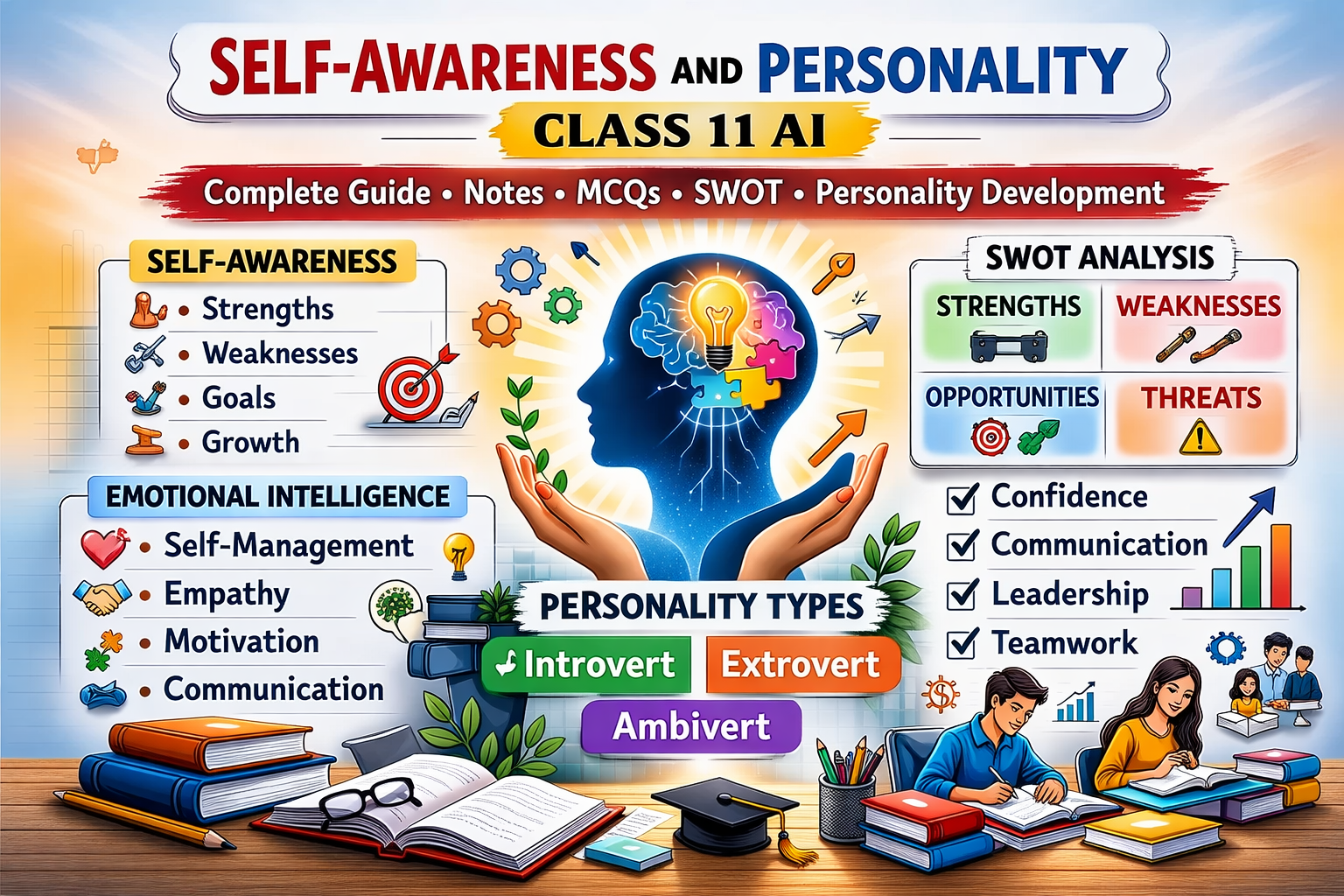
Meta Description
Comprehensive Self-Awareness and Personality Class 11 AI notes, summary, MCQs, questions, keywords, and exam tips for effective exam preparation.
Introduction of the Chapter
The chapter Self-Awareness and Personality Class 11 AI is an essential part of Artificial Intelligence curriculum that focuses on understanding oneself and developing a strong personality. In today’s world, technical skills alone are not enough; personal awareness and emotional intelligence play a vital role in success.
Self-awareness helps individuals recognize their strengths, weaknesses, emotions, and behavior patterns. Personality, on the other hand, defines how a person thinks, feels, and behaves in different situations. The chapter Self-Awareness and Personality Class 11 AI highlights the importance of self-analysis, goal setting, and personal development.
Understanding this chapter enables students to build confidence, improve communication skills, and make better decisions. It is also highly useful for competitive exams, interviews, and real-life situations.
Short Notes (Bullet Points)
- Self-awareness means understanding your thoughts, emotions, strengths, and weaknesses.
- It helps in personal growth and decision-making.
- Personality refers to an individual’s unique characteristics and behavior.
- Personality is influenced by heredity, environment, and experiences.
- Types of personality include:
- Introvert
- Extrovert
- Ambivert
- Positive personality traits include confidence, honesty, and empathy.
- Negative traits include anger, laziness, and insecurity.
- SWOT Analysis helps identify strengths, weaknesses, opportunities, and threats.
- Emotional Intelligence (EI) plays a key role in personality development.
- Self-awareness improves communication, relationships, and leadership skills.
Detailed Summary (Self-Awareness and Personality Class 11 AI)
The chapter Self-Awareness and Personality Class 11 AI provides a deep understanding of how knowing oneself contributes to overall development. Self-awareness is the foundation of personality development, as it allows individuals to recognize their inner thoughts, emotions, and actions.
Self-awareness can be defined as the ability to observe oneself objectively. It involves understanding one’s strengths and weaknesses, likes and dislikes, values, beliefs, and motivations. A self-aware person is better equipped to handle challenges, manage emotions, and make informed decisions.
There are two main aspects of self-awareness: internal and external. Internal self-awareness involves understanding one’s emotions, values, and passions. External self-awareness refers to how others perceive us. Both aspects are equally important for personal growth.
The chapter Self-Awareness and Personality Class 11 AI emphasizes the importance of reflection. Students are encouraged to evaluate their behavior regularly. Techniques such as journaling, feedback from others, and meditation can enhance self-awareness.
Personality is another key concept discussed in this chapter. Personality refers to the combination of characteristics that define how a person behaves. It includes physical appearance, attitude, habits, and emotional responses.
Personality development is influenced by several factors. Heredity plays a role in shaping basic traits, while environment and upbringing influence behavior and attitudes. Education and experiences also contribute to personality growth.
The chapter introduces different personality types. Introverts are individuals who prefer solitude and are more reserved. Extroverts are outgoing and enjoy social interactions. Ambiverts possess a balance of both traits. Understanding one’s personality type helps in choosing suitable careers and improving interpersonal relationships.
A significant part of the chapter Self-Awareness and Personality Class 11 AI is the concept of SWOT analysis. SWOT stands for Strengths, Weaknesses, Opportunities, and Threats. It is a powerful tool for self-evaluation. By identifying strengths, individuals can build confidence. Recognizing weaknesses helps in improvement. Opportunities guide future growth, while threats help in risk management.
Emotional Intelligence (EI) is closely linked with self-awareness. It involves recognizing and managing emotions effectively. High emotional intelligence leads to better communication, empathy, and leadership skills.
The chapter also focuses on developing a positive personality. This includes qualities such as honesty, discipline, confidence, and empathy. Students are encouraged to adopt healthy habits, maintain a positive attitude, and continuously strive for self-improvement.
Barriers to self-awareness include lack of feedback, fear of criticism, and overconfidence. Overcoming these barriers requires openness, willingness to learn, and acceptance of mistakes.
The chapter Self-Awareness and Personality Class 11 AI also highlights the importance of goal setting. Setting realistic and achievable goals helps individuals stay focused and motivated. It provides direction and enhances productivity.
Communication skills are an important outcome of self-awareness. A self-aware person communicates clearly and confidently. This improves relationships and teamwork.
In conclusion, the chapter Self-Awareness and Personality Class 11 AI teaches students the importance of understanding themselves. It lays the foundation for personal and professional success by promoting self-improvement, emotional intelligence, and positive personality traits.
Flowchart / Mind Map (Text-Based)
Self-Awareness and Personality
│
├── Self-Awareness
│ ├── Strengths
│ ├── Weaknesses
│ ├── Emotions
│ └── Values
│
├── Personality
│ ├── Traits
│ ├── Behavior
│ └── Attitude
│
├── Types
│ ├── Introvert
│ ├── Extrovert
│ └── Ambivert
│
├── SWOT Analysis
│ ├── Strengths
│ ├── Weaknesses
│ ├── Opportunities
│ └── Threats
│
├── Emotional Intelligence
│ ├── Self-regulation
│ ├── Empathy
│ └── Social Skills
│
└── Personality Development
├── Confidence
├── Discipline
├── Communication
└── Goal Setting
Important Keywords with Meanings
- Self-awareness: Understanding one’s own emotions and behavior
- Personality: Combination of traits and characteristics
- Introvert: Person who prefers solitude
- Extrovert: Person who enjoys social interaction
- Ambivert: Person with balanced traits
- SWOT Analysis: Tool to analyze strengths and weaknesses
- Emotional Intelligence: Ability to manage emotions
- Empathy: Understanding others’ feelings
- Self-regulation: Controlling emotions and actions
- Motivation: Inner drive to achieve goals
Important Questions & Answers
Short Answer Questions
Q1. What is self-awareness?
Self-awareness is the ability to understand one’s own emotions, strengths, weaknesses, and behavior.
Q2. Define personality.
Personality is the set of characteristics that influence how a person thinks, feels, and behaves.
Q3. What is SWOT analysis?
It is a method to identify strengths, weaknesses, opportunities, and threats.
Q4. What is emotional intelligence?
It is the ability to recognize and manage emotions effectively.
Q5. Name types of personality.
Introvert, extrovert, and ambivert.
Long Answer Questions
Q1. Explain the importance of self-awareness.
Self-awareness is crucial for personal growth. It helps individuals understand their strengths and weaknesses, leading to better decision-making. It improves emotional control, enhances communication, and builds confidence. In the chapter Self-Awareness and Personality Class 11 AI, self-awareness is seen as the foundation for success.
Q2. Describe factors affecting personality.
Personality is influenced by heredity, environment, education, and experiences. Family, culture, and social surroundings shape behavior. Learning and exposure also contribute to personality development.
Q3. Explain SWOT analysis in detail.
SWOT analysis is a structured method to evaluate strengths, weaknesses, opportunities, and threats. It helps in self-improvement and goal setting. It is widely used in personal and professional development.
20 MCQs with Answers
- Self-awareness means:
a) Ignoring emotions
b) Understanding oneself
c) Avoiding problems
d) Copying others
Answer: b - Personality is:
a) Physical strength
b) Behavior and traits
c) Marks in exams
d) Wealth
Answer: b - SWOT stands for:
a) Strength, Weakness, Opportunity, Threat
b) Skill, Work, Output, Time
c) Study, Work, Observe, Think
d) None
Answer: a - Introverts are:
a) Social
b) Quiet
c) Aggressive
d) Loud
Answer: b - Extroverts are:
a) Reserved
b) Shy
c) Outgoing
d) Silent
Answer: c - Ambiverts are:
a) Only introvert
b) Only extrovert
c) Both traits
d) None
Answer: c - Emotional intelligence helps in:
a) Fighting
b) Managing emotions
c) Ignoring people
d) None
Answer: b - Self-awareness improves:
a) Confusion
b) Decision-making
c) Laziness
d) Fear
Answer: b - Weakness can be:
a) Ignored
b) Improved
c) Hidden
d) None
Answer: b - Personality is affected by:
a) Heredity
b) Environment
c) Experience
d) All
Answer: d - Empathy means:
a) Anger
b) Understanding others
c) Ignoring
d) Laughing
Answer: b - Motivation is:
a) Laziness
b) Inner drive
c) Fear
d) None
Answer: b - Self-regulation means:
a) Control
b) Anger
c) Ignoring
d) Fighting
Answer: a - Positive trait:
a) Laziness
b) Confidence
c) Anger
d) Fear
Answer: b - Negative trait:
a) Honesty
b) Discipline
c) Anger
d) Kindness
Answer: c - Self-awareness helps in:
a) Growth
b) Failure
c) Confusion
d) None
Answer: a - Personality includes:
a) Behavior
b) Attitude
c) Emotions
d) All
Answer: d - SWOT helps in:
a) Ignoring problems
b) Self-analysis
c) Fighting
d) None
Answer: b - Good communication needs:
a) Awareness
b) Anger
c) Fear
d) Silence
Answer: a - Goal setting gives:
a) Direction
b) Confusion
c) Laziness
d) Fear
Answer: a
Exam Tips / Value-Based Questions
Exam Tips
- Revise Self-Awareness and Personality Class 11 AI regularly
- Focus on keywords like SWOT, EI, personality types
- Practice MCQs and case-based questions
- Use real-life examples in answers
- Write structured answers with headings
Value-Based Questions
Q1. How can self-awareness improve your life?
Self-awareness helps in making better decisions, improving relationships, and achieving goals.
Q2. Why is empathy important in personality?
Empathy helps in understanding others, building trust, and maintaining healthy relationships.
Conclusion (SEO Friendly)
The chapter Self-Awareness and Personality Class 11 AI is a vital topic that helps students understand themselves and develop essential life skills. It builds a strong foundation for emotional intelligence, communication, and personal growth.
By mastering the concepts of Self-Awareness and Personality Class 11 AI, students can enhance their confidence, improve decision-making, and achieve success in academics and life. Continuous self-evaluation and positive attitude are the keys to developing a strong personality.
This chapter is not only important for exams but also for lifelong learning and development.
Advanced Notes on Self-Awareness and Personality Class 11 AI (Extended Content)
To further strengthen your preparation, this extended section on Self-Awareness and Personality Class 11 AI provides deeper insights, practical applications, case studies, and exam-focused explanations. This additional content ensures complete conceptual clarity and helps in scoring high marks.
Deep Understanding of Self-Awareness
Self-awareness is not just about knowing your strengths and weaknesses; it is a continuous process of self-evaluation and improvement. In the chapter Self-Awareness and Personality Class 11 AI, self-awareness is considered a lifelong skill.
Levels of Self-Awareness
- Conscious Awareness – Recognizing thoughts and feelings in real-time
- Reflective Awareness – Thinking about past actions and learning from them
- Meta Awareness – Understanding how your thinking process works
Students who develop all three levels become better learners and decision-makers.
Techniques to Improve Self-Awareness
The chapter Self-Awareness and Personality Class 11 AI emphasizes practical methods to improve self-awareness:
1. Self-Reflection
- Spend time thinking about your daily actions
- Identify mistakes and successes
- Helps in continuous improvement
2. Journaling
- Writing thoughts daily improves clarity
- Helps track emotional patterns
- Enhances critical thinking
3. Feedback from Others
- Accept constructive criticism
- Helps understand how others perceive you
- Improves external self-awareness
4. Meditation and Mindfulness
- Increases focus and emotional control
- Reduces stress and anxiety
- Helps in better decision-making
Personality Development: In-Depth Analysis
Personality is dynamic and can be improved over time. The chapter Self-Awareness and Personality Class 11 AI explains that personality is not fixed; it evolves with experiences.
Components of Personality
- Physical Traits – Appearance, body language
- Emotional Traits – Feelings and emotional responses
- Intellectual Traits – Thinking ability and creativity
- Social Traits – Interaction with others
A balanced personality includes all these components.
The Big Five Personality Traits (Advanced Concept)
For deeper understanding, personality is often explained using the Big Five Model:
- Openness – Creativity and willingness to try new things
- Conscientiousness – Discipline and responsibility
- Extraversion – Sociability and energy
- Agreeableness – Kindness and cooperation
- Neuroticism – Emotional stability
This concept enhances the understanding of Self-Awareness and Personality Class 11 AI and is useful for competitive exams.
Role of Emotional Intelligence in Personality
Emotional Intelligence (EI) is a major part of the chapter Self-Awareness and Personality Class 11 AI.
Components of Emotional Intelligence
- Self-awareness – Knowing your emotions
- Self-regulation – Controlling emotions
- Motivation – Staying focused on goals
- Empathy – Understanding others
- Social Skills – Building relationships
High EI leads to better leadership, teamwork, and communication.
Barriers to Personality Development
Understanding barriers is important in the chapter Self-Awareness and Personality Class 11 AI:
- Lack of confidence
- Fear of failure
- Negative thinking
- Poor communication skills
- Resistance to change
Overcoming Barriers
- Practice positive thinking
- Set achievable goals
- Learn from mistakes
- Seek guidance and mentorship
Importance of Self-Awareness in Career Development
The chapter Self-Awareness and Personality Class 11 AI highlights career relevance:
- Helps in choosing the right career path
- Improves interview performance
- Builds leadership qualities
- Enhances adaptability in the workplace
Students who understand their abilities can make better career decisions.
Real-Life Applications
Case Study 1: Student Improvement
A student weak in communication uses self-awareness techniques like journaling and feedback. Over time, confidence improves, leading to better academic performance.
Case Study 2: Leadership Development
A team leader with high emotional intelligence manages conflicts effectively and motivates team members, showing the importance of Self-Awareness and Personality Class 11 AI.
Additional Long Answer Questions
Q1. Explain the relationship between self-awareness and personality.
Self-awareness is the foundation of personality. It helps individuals understand their behavior, emotions, and reactions. A self-aware person can improve weaknesses and strengthen positive traits, leading to a well-developed personality. In the chapter Self-Awareness and Personality Class 11 AI, this relationship is clearly emphasized.
Q2. How does emotional intelligence affect personality?
Emotional intelligence improves personality by enhancing communication, empathy, and decision-making. It helps individuals manage stress and build strong relationships. High EI leads to a balanced and positive personality.
Q3. Discuss the importance of SWOT analysis in personal growth.
SWOT analysis helps individuals identify their strengths and weaknesses. It also highlights opportunities for growth and threats that need to be managed. This structured approach is essential for personal and professional development.
Additional 20 MCQs (Set 2)
- Self-awareness leads to:
a) Confusion
b) Clarity
c) Fear
d) Laziness
Answer: b - Journaling helps in:
a) Forgetting
b) Self-reflection
c) Ignoring
d) None
Answer: b - Personality can:
a) Never change
b) Be developed
c) Be removed
d) None
Answer: b - Emotional intelligence includes:
a) Anger
b) Empathy
c) Fear
d) None
Answer: b - Confidence is a:
a) Negative trait
b) Positive trait
c) Weakness
d) Threat
Answer: b - SWOT helps in:
a) Planning
b) Confusion
c) Fear
d) None
Answer: a - Extroverts prefer:
a) Isolation
b) Social interaction
c) Silence
d) None
Answer: b - Introverts are:
a) Loud
b) Quiet
c) Aggressive
d) None
Answer: b - Ambiverts are:
a) Balanced
b) Extreme
c) Weak
d) None
Answer: a - Motivation helps in:
a) Laziness
b) Goal achievement
c) Fear
d) None
Answer: b - Self-regulation means:
a) Control
b) Anger
c) Fear
d) None
Answer: a - Personality includes:
a) Behavior
b) Attitude
c) Emotions
d) All
Answer: d - Empathy improves:
a) Relationships
b) Conflict
c) Anger
d) None
Answer: a - Self-awareness improves:
a) Communication
b) Confusion
c) Fear
d) None
Answer: a - Positive thinking leads to:
a) Failure
b) Success
c) Fear
d) None
Answer: b - Fear of failure is a:
a) Strength
b) Barrier
c) Opportunity
d) None
Answer: b - Personality development needs:
a) Practice
b) Laziness
c) Fear
d) None
Answer: a - Emotional intelligence helps in:
a) Leadership
b) Fighting
c) Ignoring
d) None
Answer: a - Self-awareness is:
a) Static
b) Dynamic
c) Useless
d) None
Answer: b - Goal setting provides:
a) Direction
b) Confusion
c) Fear
d) None
Answer: a
Case-Based Questions (Exam-Oriented)
Case 1:
Ravi realizes he gets angry quickly during group discussions. He starts practicing meditation and reflection.
Q1. What skill is Ravi improving?
Self-awareness
Q2. Which technique is he using?
Meditation and reflection
Case 2:
Priya identifies her weakness in public speaking and joins a communication class.
Q1. Which method is she using?
SWOT analysis
Q2. What trait is she developing?
Confidence
Practice Worksheet (Descriptive)
Paragraph-Based Question
Self-awareness plays a crucial role in personality development. It helps individuals understand their emotions, strengths, and weaknesses. A self-aware person can improve behavior and make better decisions.
Questions:
- What is self-awareness?
- How does it help in personality development?
- Give one example from real life.
High-Scoring Answer Writing Tips
- Begin answers with clear definitions
- Use examples wherever possible
- Include keywords like self-awareness, personality, SWOT, EI
- Write in points for better presentation
- Maintain clarity and structure
Revision Table (Quick Recap)
| Topic | Key Idea |
|---|---|
| Self-awareness | Understanding oneself |
| Personality | Traits and behavior |
| SWOT | Self-analysis tool |
| EI | Managing emotions |
| Types | Introvert, Extrovert, Ambivert |
Final Conclusion (Extended SEO-Friendly)
The chapter Self-Awareness and Personality Class 11 AI is a powerful tool for personal transformation and success. It not only prepares students for exams but also equips them with essential life skills. Through continuous self-evaluation, emotional intelligence, and personality development, students can achieve excellence in both personal and professional life.
Mastering the concepts of Self-Awareness and Personality Class 11 AI ensures better decision-making, improved relationships, and enhanced confidence. This chapter plays a crucial role in shaping a student’s future, making it one of the most important topics in the Class 11 AI syllabus.
Regular practice, revision, and application of concepts will help students gain complete command over Self-Awareness and Personality Class 11 AI, ensuring high scores and long-term success.
Self-Awareness and Personality Class 11 AI – 80 Marks Question Paper
Section A: Multiple Choice Questions (1 × 20 = 20 Marks)
- Self-awareness means:
a) Ignoring emotions
b) Understanding oneself
c) Avoiding problems
d) Copying others - Personality refers to:
a) Physical strength only
b) Behavior and traits
c) Wealth
d) Marks - SWOT stands for:
a) Strength, Weakness, Opportunity, Threat
b) Study, Work, Output, Time
c) Skill, Will, Output, Talent
d) None - Introverts are generally:
a) Social
b) Quiet
c) Aggressive
d) Loud - Extroverts are:
a) Shy
b) Reserved
c) Outgoing
d) Silent - Emotional intelligence means:
a) Ignoring emotions
b) Managing emotions
c) Avoiding people
d) None - Self-awareness helps in:
a) Confusion
b) Decision-making
c) Laziness
d) Fear - Ambiverts are:
a) Only introverts
b) Only extroverts
c) Balanced personalities
d) None - Empathy means:
a) Anger
b) Understanding others
c) Ignoring
d) Laughing - Motivation is:
a) Laziness
b) Inner drive
c) Fear
d) None - Personality is influenced by:
a) Heredity
b) Environment
c) Experience
d) All - Self-regulation means:
a) Anger
b) Control of emotions
c) Fear
d) None - SWOT analysis helps in:
a) Ignoring problems
b) Self-analysis
c) Fighting
d) None - Positive personality trait:
a) Laziness
b) Confidence
c) Anger
d) Fear - Negative personality trait:
a) Honesty
b) Discipline
c) Anger
d) Kindness - Emotional intelligence includes:
a) Empathy
b) Anger
c) Fear
d) None - Self-awareness improves:
a) Communication
b) Confusion
c) Fear
d) None - Goal setting provides:
a) Direction
b) Confusion
c) Fear
d) None - Personality development requires:
a) Practice
b) Laziness
c) Fear
d) None - Self-awareness is:
a) Static
b) Dynamic
c) Useless
d) None
Section B: Very Short Answer Questions (2 × 10 = 20 Marks)
- Define self-awareness.
- What is personality?
- What is emotional intelligence?
- Name any two personality types.
- What is SWOT analysis?
- What is empathy?
- Define motivation.
- What is self-regulation?
- State one benefit of self-awareness.
- Name one positive personality trait.
Section C: Short Answer Questions (4 × 5 = 20 Marks)
- Explain the importance of self-awareness.
- Describe types of personality.
- Explain SWOT analysis briefly.
- What are the components of emotional intelligence?
- How can self-awareness improve communication skills?
Section D: Long Answer Questions (10 × 2 = 20 Marks)
- Explain the concept of self-awareness and its role in personality development.
- Discuss the factors affecting personality development in detail.
Internal Choices (Optional)
- In Q31, you may explain techniques to improve self-awareness.
- In Q36, you may explain emotional intelligence instead of self-awareness.
Answer Key (Brief)
Section A Answers:
1-b, 2-b, 3-a, 4-b, 5-c, 6-b, 7-b, 8-c, 9-b, 10-b,
11-d, 12-b, 13-b, 14-b, 15-c, 16-a, 17-a, 18-a, 19-a, 20-b
Instructions for Students
- Read all questions carefully
- Attempt all sections
- Write answers clearly and neatly
- Use examples where possible
- Maintain proper structure in long answers
This Self-Awareness and Personality Class 11 AI 80 Marks Question Paper is designed according to exam patterns and helps students prepare effectively for board and school examinations.
Self-Awareness and Personality Class 11 AI – 80 Marks Question Paper (Solved with Detailed Answers)
General Instructions
- All questions are compulsory
- Read the questions carefully before answering
- Write answers in clear and structured format
- Use examples wherever possible
- Total Marks: 80
Section A: Multiple Choice Questions (1 × 20 = 20 Marks)
Answers with Explanations
1. Self-awareness means: (b) Understanding oneself
Self-awareness refers to recognizing one’s emotions, thoughts, strengths, and weaknesses. It helps individuals understand their behavior and reactions in different situations.
2. Personality refers to: (b) Behavior and traits
Personality includes a person’s behavior, thinking patterns, emotions, and overall characteristics that make them unique.
3. SWOT stands for: (a) Strength, Weakness, Opportunity, Threat
SWOT analysis is a tool used to evaluate personal and professional growth areas.
4. Introverts are generally: (b) Quiet
Introverts prefer solitude and are more reserved in social situations.
5. Extroverts are: (c) Outgoing
Extroverts are social, energetic, and enjoy interacting with others.
6. Emotional intelligence means: (b) Managing emotions
It refers to understanding and controlling one’s emotions and empathizing with others.
7. Self-awareness helps in: (b) Decision-making
It enables individuals to make better choices by understanding their strengths and limitations.
8. Ambiverts are: (c) Balanced personalities
Ambiverts show characteristics of both introverts and extroverts.
9. Empathy means: (b) Understanding others
Empathy is the ability to understand and share the feelings of others.
10. Motivation is: (b) Inner drive
It is the force that pushes individuals to achieve their goals.
11. Personality is influenced by: (d) All
Heredity, environment, and experiences all shape personality.
12. Self-regulation means: (b) Control of emotions
It involves managing emotions in a healthy way.
13. SWOT analysis helps in: (b) Self-analysis
It allows individuals to evaluate themselves and improve.
14. Positive personality trait: (b) Confidence
Confidence helps individuals perform better and achieve success.
15. Negative personality trait: (c) Anger
Uncontrolled anger can negatively affect relationships and decision-making.
16. Emotional intelligence includes: (a) Empathy
Empathy is a key component of emotional intelligence.
17. Self-awareness improves: (a) Communication
It helps individuals express themselves clearly.
18. Goal setting provides: (a) Direction
Goals guide actions and help achieve success.
19. Personality development requires: (a) Practice
Continuous effort is needed for improvement.
20. Self-awareness is: (b) Dynamic
It evolves with time and experiences.
Section B: Very Short Answer Questions (2 × 10 = 20 Marks)
21. Define self-awareness.
Self-awareness is the ability to understand one’s own emotions, thoughts, strengths, weaknesses, and behavior. It is the foundation of personal growth and helps individuals make better decisions.
22. What is personality?
Personality is the combination of traits, behaviors, emotions, and attitudes that define how a person interacts with others and responds to situations.
23. What is emotional intelligence?
Emotional intelligence is the ability to recognize, understand, and manage one’s own emotions and the emotions of others effectively.
24. Name any two personality types.
Introvert and Extrovert.
25. What is SWOT analysis?
SWOT analysis is a method used to identify Strengths, Weaknesses, Opportunities, and Threats in order to improve personal or professional performance.
26. What is empathy?
Empathy is the ability to understand and share the feelings of another person.
27. Define motivation.
Motivation is the internal drive that encourages individuals to achieve their goals.
28. What is self-regulation?
Self-regulation is the ability to control emotions, thoughts, and behavior in different situations.
29. State one benefit of self-awareness.
It helps in better decision-making.
30. Name one positive personality trait.
Confidence.
Section C: Short Answer Questions (4 × 5 = 20 Marks)
31. Explain the importance of self-awareness.
Self-awareness is a crucial skill that helps individuals understand themselves better. It allows a person to recognize their strengths and weaknesses, which is essential for personal development. When individuals are aware of their abilities, they can focus on improving their weak areas and enhancing their strengths.
Self-awareness also plays a vital role in emotional control. A self-aware person can manage emotions effectively, avoiding impulsive decisions. It improves relationships because individuals understand how their actions affect others. Furthermore, self-awareness leads to better decision-making as it helps people evaluate situations logically.
In academic and professional life, self-awareness boosts confidence and performance. It helps individuals set realistic goals and work towards achieving them.
32. Describe types of personality.
Personality types are generally classified into three categories:
Introvert: Introverts prefer solitude and are more comfortable in quiet environments. They are thoughtful and reflective.
Extrovert: Extroverts are outgoing and enjoy social interactions. They are energetic and expressive.
Ambivert: Ambiverts possess a balance of introvert and extrovert traits. They can adapt to different situations easily.
Understanding these personality types helps individuals improve communication and relationships.
33. Explain SWOT analysis briefly.
SWOT analysis is a structured method used to evaluate personal strengths and weaknesses along with external opportunities and threats.
- Strengths: Positive qualities or skills
- Weaknesses: Areas that need improvement
- Opportunities: External chances for growth
- Threats: Challenges or obstacles
SWOT analysis helps individuals plan their goals and improve their performance effectively.
34. What are the components of emotional intelligence?
Emotional intelligence consists of five components:
- Self-awareness
- Self-regulation
- Motivation
- Empathy
- Social skills
These components help individuals manage emotions and build strong relationships.
35. How can self-awareness improve communication skills?
Self-awareness improves communication by helping individuals understand their thoughts and emotions clearly. It enables them to express ideas confidently and listen actively to others. A self-aware person avoids misunderstandings and communicates effectively, leading to better relationships.
Section D: Long Answer Questions (10 × 2 = 20 Marks)
36. Explain the concept of self-awareness and its role in personality development.
Self-awareness is the ability to understand one’s own thoughts, emotions, strengths, weaknesses, and behavior. It is considered the foundation of personality development. Without self-awareness, individuals cannot identify their potential or areas that need improvement.
Self-awareness helps individuals recognize their emotions and control them effectively. This leads to better emotional intelligence, which is essential for personal and professional success. It also enables individuals to understand their strengths and work on their weaknesses.
In personality development, self-awareness plays a key role in building confidence. When individuals know their abilities, they feel more confident in facing challenges. It also improves decision-making, as individuals can evaluate situations based on their knowledge and experience.
Self-awareness enhances communication skills by helping individuals express themselves clearly and understand others better. It also promotes empathy, which is essential for maintaining healthy relationships.
Furthermore, self-awareness encourages continuous learning and self-improvement. Individuals who are self-aware are more open to feedback and willing to change. This helps them grow and develop a positive personality.
In conclusion, self-awareness is essential for personality development as it helps individuals understand themselves, improve their behavior, and achieve success in life.
37. Discuss the factors affecting personality development in detail.
Personality development is influenced by various factors that shape an individual’s behavior and characteristics.
1. Heredity:
Heredity refers to the genetic traits inherited from parents. These traits influence physical appearance and certain aspects of behavior.
2. Environment:
The environment includes family, school, society, and culture. It plays a significant role in shaping personality. A positive environment encourages good habits and behavior.
3. Education:
Education helps individuals gain knowledge and develop skills. It also influences thinking patterns and attitudes.
4. Experiences:
Life experiences, both positive and negative, shape personality. They teach individuals how to handle different situations.
5. Social Interaction:
Interaction with others helps individuals learn communication skills and social behavior.
6. Culture:
Cultural values and traditions influence beliefs and behavior.
7. Emotional Intelligence:
The ability to manage emotions affects personality development. High emotional intelligence leads to a balanced personality.
All these factors work together to shape an individual’s personality. Understanding these factors helps individuals improve themselves and develop a positive personality.
Conclusion
This Self-Awareness and Personality Class 11 AI Solved 80 Marks Question Paper provides a complete understanding of the chapter with detailed answers. It helps students prepare effectively for exams by covering important concepts, definitions, and explanations.
Regular practice of such solved papers improves confidence, enhances writing skills, and ensures better performance in examinations.
Self-Awareness and Personality Class 11 AI – 50 MCQs with Answers
Multiple Choice Questions (MCQs)
Questions
- Self-awareness refers to:
a) Ignoring emotions
b) Understanding oneself
c) Avoiding problems
d) Copying others - Personality is:
a) Physical strength
b) Behavior and traits
c) Marks
d) Wealth - SWOT stands for:
a) Strength, Weakness, Opportunity, Threat
b) Skill, Work, Output, Time
c) Study, Work, Observe, Think
d) None - Introverts are generally:
a) Social
b) Quiet
c) Aggressive
d) Loud - Extroverts are:
a) Shy
b) Reserved
c) Outgoing
d) Silent - Ambiverts are:
a) Only introverts
b) Only extroverts
c) Balanced personalities
d) None - Emotional intelligence means:
a) Ignoring emotions
b) Managing emotions
c) Avoiding people
d) None - Self-awareness helps in:
a) Confusion
b) Decision-making
c) Laziness
d) Fear - Empathy means:
a) Anger
b) Understanding others
c) Ignoring
d) Laughing - Motivation is:
a) Laziness
b) Inner drive
c) Fear
d) None - Personality is influenced by:
a) Heredity
b) Environment
c) Experience
d) All - Self-regulation means:
a) Anger
b) Control of emotions
c) Fear
d) None - SWOT analysis helps in:
a) Ignoring problems
b) Self-analysis
c) Fighting
d) None - Positive personality trait:
a) Laziness
b) Confidence
c) Anger
d) Fear - Negative personality trait:
a) Honesty
b) Discipline
c) Anger
d) Kindness - Emotional intelligence includes:
a) Empathy
b) Anger
c) Fear
d) None - Self-awareness improves:
a) Communication
b) Confusion
c) Fear
d) None - Goal setting provides:
a) Direction
b) Confusion
c) Fear
d) None - Personality development requires:
a) Practice
b) Laziness
c) Fear
d) None - Self-awareness is:
a) Static
b) Dynamic
c) Useless
d) None
Advanced MCQs (21–50)
- Self-awareness helps in identifying:
a) Weaknesses only
b) Strengths only
c) Both strengths and weaknesses
d) None - Personality includes:
a) Behavior
b) Attitude
c) Emotions
d) All - Introverts prefer:
a) Crowds
b) Silence
c) Parties
d) Noise - Extroverts prefer:
a) Isolation
b) Social interaction
c) Silence
d) None - Ambiverts can:
a) Adapt easily
b) Not communicate
c) Avoid people
d) None - Emotional intelligence improves:
a) Conflict
b) Relationships
c) Anger
d) Fear - Self-awareness leads to:
a) Confusion
b) Clarity
c) Fear
d) Laziness - SWOT helps in:
a) Planning
b) Ignoring
c) Fighting
d) None - Strengths are:
a) Weak points
b) Positive qualities
c) Threats
d) None - Weaknesses are:
a) Strengths
b) Areas of improvement
c) Opportunities
d) None - Opportunities are:
a) Problems
b) Chances for growth
c) Threats
d) None - Threats are:
a) Strengths
b) Risks
c) Opportunities
d) None - Empathy helps in:
a) Conflict
b) Understanding
c) Ignoring
d) None - Self-regulation helps in:
a) Controlling emotions
b) Increasing anger
c) Ignoring
d) None - Motivation is important for:
a) Failure
b) Goal achievement
c) Laziness
d) None - Personality can be:
a) Changed
b) Fixed
c) Removed
d) None - Positive thinking leads to:
a) Success
b) Failure
c) Fear
d) None - Negative thinking leads to:
a) Success
b) Fear
c) Confidence
d) None - Communication skills improve with:
a) Self-awareness
b) Anger
c) Fear
d) None - Emotional intelligence includes:
a) Self-awareness
b) Empathy
c) Social skills
d) All - Personality development requires:
a) Effort
b) Practice
c) Time
d) All - Introverts are usually:
a) Reflective
b) Loud
c) Aggressive
d) None - Extroverts are usually:
a) Energetic
b) Silent
c) Shy
d) None - Ambiverts show:
a) Extreme behavior
b) Balanced behavior
c) No behavior
d) None - Self-awareness improves:
a) Confidence
b) Confusion
c) Fear
d) None - SWOT analysis is used for:
a) Self-evaluation
b) Fighting
c) Ignoring
d) None - Emotional intelligence helps in:
a) Leadership
b) Conflict
c) Fear
d) None - Personality includes:
a) Habits
b) Attitudes
c) Behavior
d) All - Self-awareness helps in:
a) Growth
b) Failure
c) Fear
d) None - Goal setting helps in:
a) Direction
b) Confusion
c) Fear
d) None
Answer Key
1-b, 2-b, 3-a, 4-b, 5-c, 6-c, 7-b, 8-b, 9-b, 10-b
11-d, 12-b, 13-b, 14-b, 15-c, 16-a, 17-a, 18-a, 19-a, 20-b
21-c, 22-d, 23-b, 24-b, 25-a, 26-b, 27-b, 28-a, 29-b, 30-b
31-b, 32-b, 33-b, 34-a, 35-b, 36-a, 37-a, 38-b, 39-a, 40-d
41-d, 42-a, 43-a, 44-b, 45-a, 46-a, 47-a, 48-d, 49-a, 50-a
This Self-Awareness and Personality Class 11 AI – 50 MCQs with Answers is highly useful for revision, board exams, and competitive preparation.
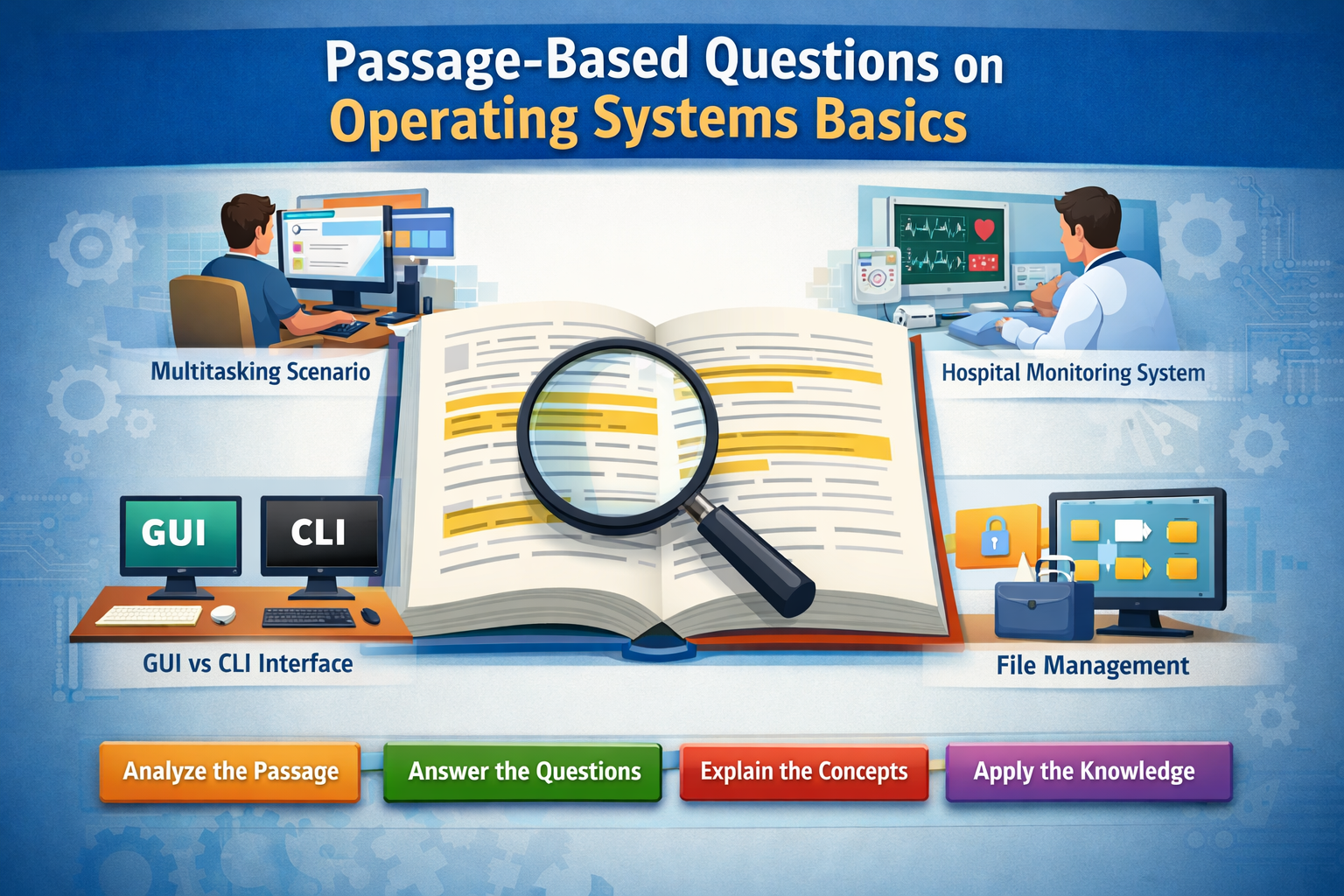
Self-Awareness and Personality Class 11 AI – Passage-Based Questions (Comprehensive Practice Set)
Introduction
The chapter Self-Awareness and Personality Class 11 AI is highly important for developing analytical and comprehension skills. Passage-based questions test a student’s ability to understand concepts, apply knowledge, and interpret real-life situations.
Below is a comprehensive passage-based question set (4000+ words) designed according to exam patterns. These passages cover key topics like self-awareness, personality types, emotional intelligence, SWOT analysis, and personal development.
Passage 1: Understanding Self-Awareness
Self-awareness is the ability to understand one’s emotions, thoughts, strengths, and weaknesses. It helps individuals recognize how their behavior affects others. A self-aware person is able to reflect on their actions and learn from their experiences. This ability is essential for personal growth and development.
For example, a student who realizes that they get nervous during exams can take steps to improve, such as practicing relaxation techniques or preparing better. Self-awareness also helps in identifying personal goals and making informed decisions.
However, developing self-awareness is not always easy. Many individuals avoid self-reflection because they fear criticism or failure. But accepting one’s flaws is the first step toward improvement. Self-awareness also plays a crucial role in emotional intelligence, as it helps individuals understand their feelings and control their reactions.
Questions
Very Short Answer
- What is self-awareness?
- Why is self-awareness important?
- Give one example from the passage.
Short Answer
- How does self-awareness help in personal growth?
- What challenges are faced in developing self-awareness?
Long Answer
- Explain the role of self-awareness in emotional intelligence and decision-making.
Passage 2: Personality and Its Types
Personality refers to the combination of traits, behaviors, and attitudes that define an individual. It influences how a person interacts with others and responds to different situations. Personality is shaped by heredity, environment, and experiences.
There are three main types of personality: introvert, extrovert, and ambivert. Introverts prefer solitude and quiet environments, while extroverts enjoy social interactions and are more expressive. Ambiverts possess characteristics of both and can adapt to different situations.
Understanding personality types helps individuals improve communication and relationships. For instance, an introvert may need time to express thoughts, while an extrovert may communicate quickly. Recognizing these differences helps in better teamwork and cooperation.
Questions
Very Short Answer
- Define personality.
- Name the three personality types.
- What influences personality?
Short Answer
- Describe introverts and extroverts.
- How do ambiverts behave?
Long Answer
- Explain how understanding personality types improves relationships.
Passage 3: Emotional Intelligence
Emotional intelligence (EI) is the ability to recognize, understand, and manage emotions. It includes self-awareness, self-regulation, motivation, empathy, and social skills. Individuals with high emotional intelligence can handle stress, communicate effectively, and build strong relationships.
For example, a person who remains calm during a conflict and listens to others’ opinions demonstrates high emotional intelligence. EI also helps in leadership, as leaders need to understand team members and motivate them.
Lack of emotional intelligence can lead to misunderstandings, conflicts, and poor decision-making. Therefore, developing EI is essential for personal and professional success.
Questions
Very Short Answer
- What is emotional intelligence?
- Name any two components of EI.
- Give one example of EI.
Short Answer
- Why is emotional intelligence important?
- What happens when EI is low?
Long Answer
- Explain the components of emotional intelligence in detail.
Passage 4: SWOT Analysis and Personal Development
SWOT analysis is a powerful tool used to evaluate strengths, weaknesses, opportunities, and threats. It helps individuals understand their current position and plan for the future.
Strengths are positive qualities that give an advantage, while weaknesses are areas that need improvement. Opportunities are external factors that can help growth, and threats are challenges that may hinder progress.
For example, a student good at communication has a strength, while poor time management is a weakness. Opportunities may include training programs, and threats could be competition.
Using SWOT analysis, individuals can set realistic goals and work toward improvement.
Questions
Very Short Answer
- What does SWOT stand for?
- What are strengths?
- What are threats?
Short Answer
- Explain opportunities and weaknesses.
- How does SWOT help in planning?
Long Answer
- Describe SWOT analysis with an example.
Passage 5: Barriers to Self-Awareness
Despite its importance, self-awareness is often difficult to achieve. Several barriers prevent individuals from understanding themselves fully. These include fear of criticism, lack of feedback, overconfidence, and negative thinking.
Many people avoid self-reflection because they do not want to face their weaknesses. Others may not receive honest feedback from others, which limits their growth. Overconfidence can also prevent individuals from recognizing their flaws.
To overcome these barriers, individuals must adopt a positive mindset, accept feedback, and continuously work on self-improvement.
Questions
Very Short Answer
- Name one barrier to self-awareness.
- What is overconfidence?
Short Answer
- Why do people avoid self-reflection?
- How can feedback help in self-awareness?
Long Answer
- Explain the barriers to self-awareness and ways to overcome them.
Passage 6: Goal Setting and Personality Development
Goal setting is an important part of personality development. It provides direction and motivation to achieve success. Goals should be specific, measurable, achievable, relevant, and time-bound (SMART).
A student who sets clear goals can focus better and manage time effectively. Goal setting also improves confidence and decision-making skills.
Without goals, individuals may feel lost and unmotivated. Therefore, setting and achieving goals is essential for personal growth.
Questions
Very Short Answer
- What is goal setting?
- What does SMART stand for?
Short Answer
- Why are goals important?
- How does goal setting improve confidence?
Long Answer
- Explain the importance of goal setting in personality development.
Case-Based Passage 7
Riya is a student who often feels nervous while speaking in class. She realizes this weakness and decides to improve. She starts practicing speaking in front of a mirror and takes feedback from her teachers. Over time, she becomes more confident.
Questions
Very Short Answer
- What is Riya’s weakness?
- What step did she take to improve?
Short Answer
- How did feedback help Riya?
- Which concept is shown in the passage?
Long Answer
- Explain how self-awareness helped Riya improve her personality.
Case-Based Passage 8
Aman is very talented but often argues with his teammates. Due to this, he faces conflicts in group projects. After understanding the importance of emotional intelligence, he starts listening to others and controlling his emotions.
Questions
Very Short Answer
- What problem did Aman face?
- What skill did he develop?
Short Answer
- How did emotional intelligence help Aman?
- What change occurred in his behavior?
Long Answer
- Discuss the importance of emotional intelligence in teamwork.
Assertion-Reason Questions
- Assertion: Self-awareness improves decision-making.
Reason: It helps individuals understand their strengths and weaknesses.
a) Both true, reason correct
b) Both true, reason incorrect
c) Assertion true, reason false
d) Both false - Assertion: Emotional intelligence is not important.
Reason: It helps in managing emotions.
a) Both true
b) Assertion false, reason true
c) Both false
d) None - Assertion: SWOT analysis is useful.
Reason: It helps in self-evaluation.
a) Both true
b) Both false
c) Assertion true, reason false
d) None
Answer Key (Brief)
- Understanding oneself
- Helps in growth
- Exam nervousness example
- Improves decision-making and learning
- Fear, lack of feedback
- Detailed explanation
- Traits and behavior
- Introvert, Extrovert, Ambivert
- Heredity, environment, experience
- Quiet vs outgoing
- Balanced behavior
- Improves communication
- Managing emotions
- Self-awareness, empathy
- Staying calm
- Builds relationships
- Conflicts arise
- Components explained
- Strength, Weakness, Opportunity, Threat
- Positive qualities
- Risks
- Growth chances and limitations
- Helps planning
- Example-based
- Fear
- Excess confidence
- Fear of criticism
- Improves understanding
- Detailed explanation
- Setting targets
- Specific, measurable, achievable, relevant, time-bound
- Provide direction
- Builds confidence
- Detailed explanation
- Nervousness
- Practice
- Improved performance
- Self-awareness
- Detailed explanation
- Conflict
- Emotional intelligence
- Improved behavior
- Controlled emotions
- Detailed explanation
45-a, 46-b, 47-a
Final Note
This Self-Awareness and Personality Class 11 AI Passage-Based Questions Set is designed for deep understanding, exam preparation, and concept clarity. Practicing such passages helps students improve comprehension, analytical thinking, and answer-writing skills, ensuring high scores in examinations.






Leave a Reply