


Meta Description
Complete Class 11 AI Writing Skills (Emails, Notes, Messages) notes, summary, MCQs, keywords, questions and answers for exam preparation.
Introduction of the Chapter
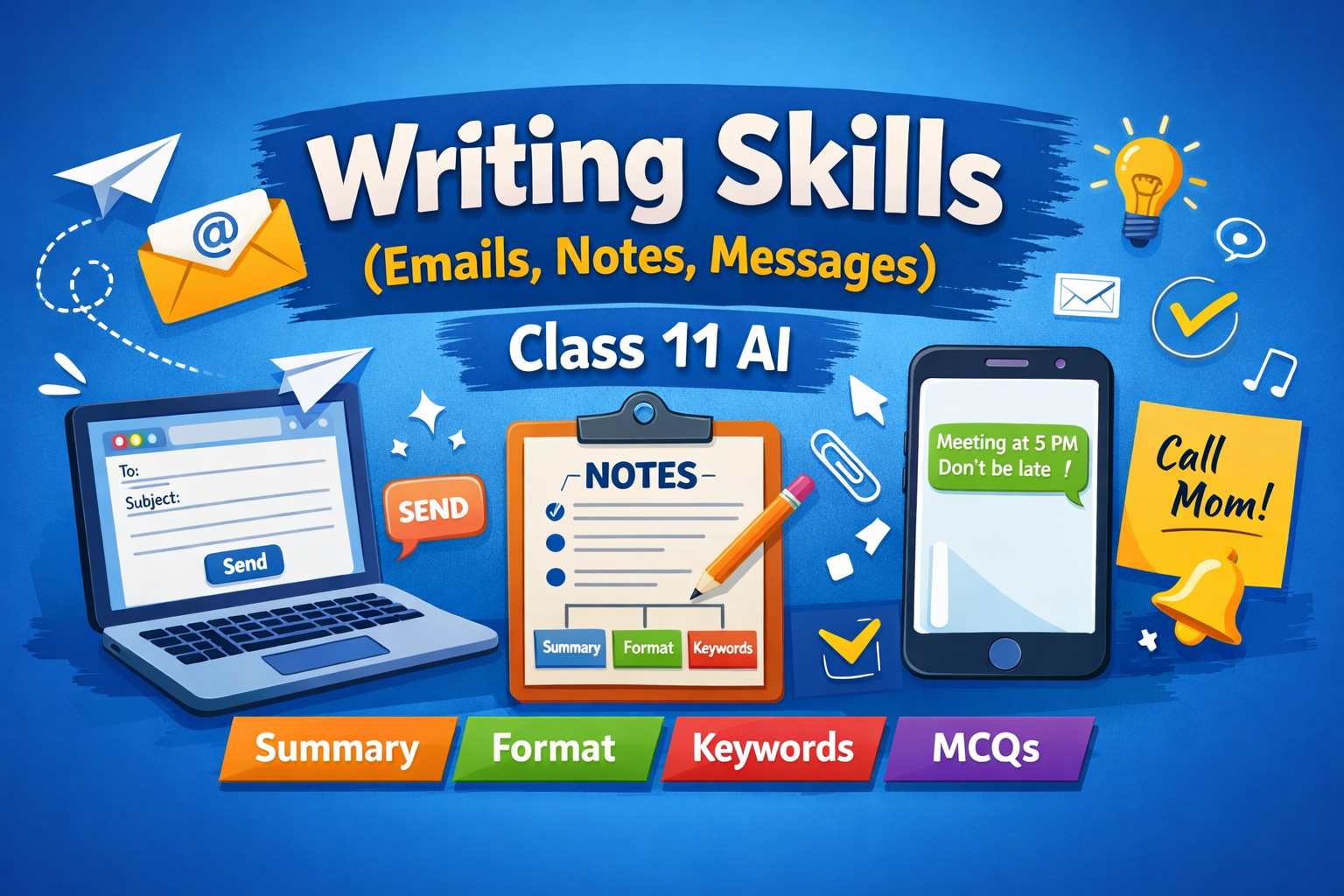
The chapter Writing Skills (Emails, Notes, Messages) in Class 11 Artificial Intelligence focuses on developing effective written communication in formal and informal contexts. In today’s digital world, communication plays a vital role in both academic and professional environments. Students must learn how to express ideas clearly, concisely, and appropriately.
This chapter helps students understand the format, structure, and purpose of emails, notes, and messages. It also teaches how to maintain clarity, tone, and accuracy while writing. Mastering Writing Skills (Emails, Notes, Messages) is essential for exams, workplace communication, and daily interactions.
The chapter emphasizes real-life applications such as writing formal emails, taking notes efficiently, and drafting short messages. These skills improve productivity, organization, and communication effectiveness.
Short Notes (Bullet Points)
- Writing Skills (Emails, Notes, Messages) focus on clear and effective communication
- Emails can be formal or informal depending on purpose
- Notes are short summaries of important information
- Messages are brief communications for quick information sharing
- Use simple language and correct grammar
- Maintain proper format and structure
- Avoid unnecessary details
- Be concise and to the point
- Tone should match the context (formal/informal)
- Proofreading is essential before sending or submitting
Detailed Summary (900–1200 words)
The chapter Writing Skills (Emails, Notes, Messages) is designed to enhance students’ ability to communicate effectively in written form. It covers three major components: emails, notes, and messages, each serving a specific purpose in communication.
Email Writing
Emails are one of the most commonly used forms of communication in modern times. They are used in schools, businesses, and personal interactions. Emails can be classified into formal emails and informal emails.
Formal emails are used for professional or official purposes such as job applications, complaints, inquiries, or communication with teachers and organizations. Informal emails are used for communication with friends and family.
A well-structured email includes:
- Subject line
- Greeting
- Body of the message
- Closing
- Signature
In Writing Skills (Emails, Notes, Messages), students learn the importance of maintaining a clear subject line that reflects the purpose of the email. The greeting should be appropriate, such as “Dear Sir/Madam” in formal emails and “Hi” or “Hello” in informal emails.
The body of the email should be clear, concise, and well-organized. It should contain all necessary information without unnecessary details. The closing should be polite, such as “Yours sincerely” or “Best regards.”
Proper email writing improves professionalism and ensures effective communication.
Note-Making
Note-making is an essential skill for students. It involves summarizing important information in a structured and organized manner. In Writing Skills (Emails, Notes, Messages), note-making helps in better understanding and retention of information.
Effective notes:
- Are brief and to the point
- Use headings and subheadings
- Include keywords and abbreviations
- Highlight important points
Notes should not be copied directly from the text. Instead, they should be written in one’s own words. This improves comprehension and memory.
Note-making techniques include:
- Using bullet points
- Creating diagrams or flowcharts
- Highlighting key ideas
Good notes are useful for revision and exam preparation.
Message Writing
Message writing is another important part of Writing Skills (Emails, Notes, Messages). Messages are short pieces of communication used to convey information quickly.
Messages are often written when the receiver is unavailable. For example, leaving a message for someone at home or office.
A good message should include:
- Date and time
- Name of the sender
- Name of the receiver
- Clear message content
Messages should be:
- Short and precise
- Clear and understandable
- Free from unnecessary details
Message writing requires careful selection of words to ensure clarity within a limited space.
Importance of Writing Skills
The chapter Writing Skills (Emails, Notes, Messages) highlights the importance of communication in everyday life. Effective writing skills help in:
- Academic success
- Professional communication
- Clear expression of ideas
- Better organization of thoughts
In the digital age, writing skills are more important than ever. Emails are widely used in workplaces, and note-making is essential for learning and productivity.
Common Mistakes to Avoid
Students often make mistakes such as:
- Using informal language in formal emails
- Writing long and unclear messages
- Ignoring proper format
- Spelling and grammatical errors
Avoiding these mistakes improves the quality of communication.
Practical Applications
The skills learned in Writing Skills (Emails, Notes, Messages) are used in:
- Writing job applications
- Communicating with teachers
- Taking lecture notes
- Sending professional messages
These skills are valuable for both academic and professional growth.
Flowchart / Mind Map (Text-Based)
Writing Skills (Emails, Notes, Messages)
│
├── Emails
│ ├── Formal
│ ├── Informal
│ ├── Structure
│ │ ├── Subject
│ │ ├── Greeting
│ │ ├── Body
│ │ ├── Closing
│ │ └── Signature
│
├── Notes
│ ├── Short Points
│ ├── Keywords
│ ├── Headings
│ ├── Abbreviations
│
├── Messages
│ ├── Short
│ ├── Clear
│ ├── Date/Time
│ ├── Sender/Receiver
│
└── Importance
├── Communication
├── Clarity
├── Efficiency
Important Keywords with Meanings
- Email – Electronic mail used for communication
- Formal Email – Official or professional email
- Informal Email – Personal communication email
- Note-Making – Writing short points from information
- Message – Short written communication
- Concise – Brief and clear
- Tone – Attitude or style of writing
- Drafting – Preparing a written document
- Clarity – Clear understanding
- Abbreviation – Shortened form of words
Important Questions & Answers
Short Answer Questions
Q1. What is email writing?
Email writing is the process of sending messages electronically in a structured format.
Q2. What is note-making?
Note-making is the process of summarizing important information in short points.
Q3. What is message writing?
Message writing is a short form of communication used to convey information quickly.
Q4. Why is clarity important?
Clarity ensures that the message is understood correctly.
Q5. What is the difference between formal and informal emails?
Formal emails are official, while informal emails are personal.
Long Answer Questions
Q1. Explain the importance of Writing Skills (Emails, Notes, Messages).
Writing Skills (Emails, Notes, Messages) are essential for effective communication in modern life. Emails help in professional communication, notes help in learning and revision, and messages ensure quick information sharing. These skills improve clarity, organization, and efficiency.
Q2. Describe the format of a formal email.
A formal email includes:
- Subject line
- Greeting (Dear Sir/Madam)
- Body (clear and structured)
- Closing (Yours sincerely)
- Signature
It should be polite, concise, and professional.
Q3. Explain the features of good notes.
Good notes are:
- Short and clear
- Organized with headings
- Written in own words
- Easy to revise
20 MCQs with Answers
- What does email stand for?
a) Electronic mail
b) Easy mail
c) Express mail
d) None
Answer: a - Formal emails are used for:
a) Friends
b) Family
c) Official purposes
d) Personal chats
Answer: c - Notes should be:
a) Long
b) Detailed
c) Short
d) Complex
Answer: c - Message writing is:
a) Long
b) Short
c) Detailed
d) Complex
Answer: b - Tone should be:
a) Harsh
b) Appropriate
c) Rude
d) Casual always
Answer: b - Email includes:
a) Subject
b) Greeting
c) Body
d) All
Answer: d - Notes use:
a) Paragraphs
b) Bullet points
c) Essays
d) Stories
Answer: b - Messages should be:
a) Long
b) Clear
c) Confusing
d) Detailed
Answer: b - Formal emails avoid:
a) Politeness
b) Structure
c) Slang
d) Clarity
Answer: c - Note-making improves:
a) Memory
b) Confusion
c) Stress
d) Delay
Answer: a - Email is used for:
a) Communication
b) Entertainment
c) Games
d) None
Answer: a - Message writing includes:
a) Date
b) Time
c) Content
d) All
Answer: d - Notes should be:
a) Copied
b) Original
c) Long
d) Complex
Answer: b - Emails require:
a) Structure
b) Format
c) Clarity
d) All
Answer: d - Writing skills help in:
a) Communication
b) Confusion
c) Delay
d) None
Answer: a - Informal emails are:
a) Official
b) Personal
c) Business
d) Legal
Answer: b - Notes should include:
a) Keywords
b) Paragraphs
c) Stories
d) None
Answer: a - Messages are:
a) Long
b) Short
c) Detailed
d) Complex
Answer: b - Proper format ensures:
a) Confusion
b) Clarity
c) Delay
d) Error
Answer: b - Writing skills are important for:
a) Exams
b) Jobs
c) Communication
d) All
Answer: d
Exam Tips / Value-Based Questions
Exam Tips
- Always follow proper format in emails
- Keep answers short and clear
- Use bullet points in notes
- Avoid grammatical mistakes
- Practice writing regularly
Value-Based Question
Why should we maintain politeness in communication?
Politeness builds respect, improves relationships, and ensures effective communication. It reflects professionalism and positive attitude.
Conclusion
The chapter Writing Skills (Emails, Notes, Messages) is essential for developing effective communication abilities in students. It teaches how to write emails professionally, prepare concise notes, and draft clear messages.
Mastering Writing Skills (Emails, Notes, Messages) not only helps in exams but also prepares students for real-life communication in academic and professional settings. By practicing these skills regularly, students can improve clarity, confidence, and efficiency in writing.
This chapter plays a vital role in building strong communication foundations, making it highly important for students, teachers, and competitive exam aspirants.
Writing Skills (Emails, Notes, Messages) Class 11 AI
80 Marks Question Paper (Exam-Oriented)
Time Allowed: 3 Hours
Maximum Marks: 80
Section A – Reading & Note-Making (20 Marks)
Q1. Read the following passage carefully and answer the questions that follow: (10 Marks)
Effective communication is essential in both personal and professional life. Writing skills such as emails, notes, and messages help individuals convey information clearly. Emails are widely used in formal communication, while notes help in summarizing important information. Messages are used for short and quick communication. However, improper structure, unclear language, and lack of attention can create confusion and misunderstandings.
Good writing requires clarity, brevity, and proper format. Formal emails must follow a structured pattern including subject, greeting, body, and closing. Notes should be concise and organized with headings and bullet points. Messages should include essential details like date, time, and purpose.
In the digital age, strong writing skills improve efficiency and professionalism. Students must practice these skills regularly to succeed in academics and future careers.
Questions:
- What is the importance of writing skills? (2)
- Name two types of writing skills mentioned in the passage. (2)
- What are the features of a good email? (2)
- Why are notes important? (2)
- Give a suitable title to the passage. (2)
Q2. Make notes of the above passage using headings and subheadings. Also provide a suitable title. (10 Marks)
Section B – Writing Skills (30 Marks)
Q3. Email Writing (10 Marks)
You are a student of Class 11. Write a formal email to your school principal requesting leave for 3 days due to illness.
OR
Write an informal email to your friend describing your preparation for exams.
Q4. Note-Making (10 Marks)
Read the following points and prepare short notes:
- Importance of communication
- Types of communication
- Role of writing skills
- Benefits of clear communication
Q5. Message Writing (10 Marks)
You are Rahul. Your father received a call from your teacher while you were not at home. Write a message informing you to meet the teacher tomorrow at 10 AM.
Section C – Grammar & Concepts (10 Marks)
Q6. Answer the following questions: (5 × 2 = 10 Marks)
- What is a formal email?
- What is note-making?
- Define message writing.
- What is the importance of clarity in writing?
- Differentiate between formal and informal emails.
Section D – Short Answer Questions (10 Marks)
Q7. Answer any five questions: (5 × 2 = 10 Marks)
- What is the purpose of a subject line in an email?
- What are keywords in note-making?
- Why should messages be brief?
- What is tone in writing?
- Give two features of good notes.
- What are common mistakes in email writing?
Section E – Long Answer Questions (10 Marks)
Q8. Answer any one question: (10 Marks)
- Explain the format and importance of formal email writing in detail.
OR
- Describe the importance of Writing Skills (Emails, Notes, Messages) in modern communication.
Section F – MCQs (10 Marks)
Q9. Choose the correct option: (10 × 1 = 10 Marks)
- Email stands for:
a) Easy mail
b) Electronic mail
c) Express mail
d) None - Notes are used for:
a) Entertainment
b) Summary
c) Story writing
d) None - Message writing is:
a) Long
b) Short
c) Detailed
d) Complex - Formal emails use:
a) Slang
b) Polite language
c) Casual tone
d) Informal words - Notes should be:
a) Long
b) Clear
c) Confusing
d) Detailed - Emails include:
a) Subject
b) Body
c) Closing
d) All - Messages should include:
a) Date
b) Time
c) Content
d) All - Writing skills improve:
a) Communication
b) Confusion
c) Delay
d) None - Informal emails are used for:
a) Office
b) Friends
c) Business
d) School - Good writing requires:
a) Clarity
b) Length
c) Complexity
d) None
End of Question Paper
Examiner Instructions:
- Ensure proper format in writing questions
- Give marks for clarity, structure, and presentation
- Avoid unnecessary deductions for minor grammar mistakes
If you want next:
✔ Solved 80 Marks Paper (3000+ words answers)
✔ 50 MCQs (advanced level)
✔ Case Study Questions (board level)
✔ Printable PDF
Just tell me 👍
Writing Skills (Emails, Notes, Messages) Class 11 AI
Solved 80 Marks Question Paper (Detailed Answers – 3000+ Words)
Section A – Reading & Note-Making (20 Marks)
Q1. Answers (10 Marks)
1. What is the importance of writing skills? (2 Marks)
Writing skills are important because they help individuals communicate ideas clearly and effectively. They improve understanding, reduce confusion, and are essential for academic and professional success.
2. Name two types of writing skills mentioned in the passage. (2 Marks)
- Email writing
- Note-making
3. What are the features of a good email? (2 Marks)
A good email includes:
- Clear subject line
- Proper greeting
- Well-structured body
- Polite closing
4. Why are notes important? (2 Marks)
Notes are important because they help in summarizing information, improving understanding, and making revision easier.
5. Give a suitable title to the passage. (2 Marks)
Title: Importance of Writing Skills in Communication
Q2. Note-Making (10 Marks)
Title: Writing Skills and Their Importance
1. Importance of Writing Skills
1.1 Clear communication
1.2 Academic success
1.3 Professional growth
2. Types of Writing Skills
2.1 Emails
2.2 Notes
2.3 Messages
3. Features of Good Writing
3.1 Clarity
3.2 Brevity
3.3 Proper format
4. Importance in Digital Age
4.1 Efficiency
4.2 Professionalism
Key:
Comm – Communication
Prof – Professional
Imp – Important
Section B – Writing Skills (30 Marks)
Q3. Email Writing (10 Marks)
Formal Email
Subject: Request for Leave Due to Illness
Dear Sir/Madam,
I am a student of Class 11 in your school. I am writing this email to inform you that I am suffering from fever and the doctor has advised me to take rest. Therefore, I kindly request you to grant me leave for three days from 10th March to 12th March.
I assure you that I will complete all the missed work after returning to school.
Thank you for your understanding.
Yours sincerely,
Rahul Sharma
Class 11
Informal Email (Alternative)
Subject: Exam Preparation
Hi Riya,
I hope you are doing well. I wanted to share my preparation for the upcoming exams. I have made a proper timetable and started revising all subjects. I am also making notes to understand topics better.
I feel confident but a little nervous too. Let’s study together sometime!
Take care.
Your friend,
Rahul
Q4. Note-Making (10 Marks)
Title: Communication and Writing Skills
1. Importance of Communication
1.1 Sharing ideas
1.2 Building relationships
2. Types of Communication
2.1 Verbal
2.2 Written
3. Role of Writing Skills
3.1 Clarity
3.2 Effective expression
4. Benefits of Clear Communication
4.1 Reduces confusion
4.2 Improves efficiency
Key:
Comm – Communication
Eff – Efficiency
Q5. Message Writing (10 Marks)
Message
Date: 10 March
Time: 5:00 PM
Dear Rahul,
Your teacher called and asked you to meet her tomorrow at 10 AM in school. Please do not forget to be present on time.
Father
Section C – Grammar & Concepts (10 Marks)
Q6. Answers
1. What is a formal email?
A formal email is a type of communication used for official or professional purposes. It follows a proper format and uses polite language.
2. What is note-making?
Note-making is the process of summarizing important information into short and clear points.
3. Define message writing.
Message writing is a short written communication used to convey important information quickly.
4. What is the importance of clarity in writing?
Clarity ensures that the message is easily understood and reduces misunderstanding.
5. Differentiate between formal and informal emails
| Formal Email | Informal Email |
|---|---|
| Official | Personal |
| Polite tone | Casual tone |
| Structured | Flexible |
Section D – Short Answer Questions (10 Marks)
Q7. Answers (Any Five)
1. Purpose of subject line
It tells the reader about the main topic of the email.
2. Keywords in note-making
Keywords are important words that highlight the main idea.
3. Why should messages be brief?
Messages should be brief to convey information quickly and clearly.
4. What is tone in writing?
Tone refers to the attitude or style of the writer.
5. Two features of good notes
- Clear and concise
- Well-organized
6. Common mistakes in email writing
- Using informal language in formal emails
- Lack of proper structure
Section E – Long Answer Questions (10 Marks)
Q8. Answer
Importance of Writing Skills (Emails, Notes, Messages)
Writing skills are essential in modern communication. Emails help in formal communication, notes help in summarizing information, and messages help in quick communication. These skills improve clarity, organization, and efficiency.
Emails are widely used in professional settings. Proper email writing ensures that communication is clear and polite. Notes help students in studying and revising important topics. Messages are useful for conveying information quickly.
In today’s digital world, writing skills are necessary for success in academics and careers. They help in expressing ideas clearly and avoiding misunderstandings.
Section F – MCQs (10 Marks)
Q9. Answers
- b) Electronic mail
- b) Summary
- b) Short
- b) Polite language
- b) Clear
- d) All
- d) All
- a) Communication
- b) Friends
- a) Clarity
Final Conclusion
The chapter Writing Skills (Emails, Notes, Messages) plays a crucial role in developing effective communication skills. Through this solved paper, students can understand how to structure answers, write emails, prepare notes, and draft messages properly.
Practicing such solved papers improves exam performance and builds confidence. Mastery of Writing Skills (Emails, Notes, Messages) ensures success in academics as well as in real-life communication.
Exam Tip (Important)
- Follow format strictly
- Write clearly and neatly
- Use simple language
- Revise before submitting
If you want next:
✔ 50 Case Study Questions (4000+ words)
✔ Full Revision Notes PDF
✔ Extra Practice Papers
✔ Chapter-wise MCQ Bank
Just tell me 👍
Writing Skills (Emails, Notes, Messages) Class 11 AI
50 Case Study Questions (Board Level – Exam Oriented)
Case Study 1
Riya wrote an email to her teacher asking for leave, but she did not include a subject line and used informal language.
Questions:
- Identify the mistake in Riya’s email.
- What type of email should she write?
- Why is the subject line important?
- Suggest one improvement.
- What tone should be used?
Case Study 2
A student writes long paragraphs while making notes, copying everything from the book.
Questions:
- What mistake is the student making?
- What should be done instead?
- Define note-making.
- Why should notes be short?
- Suggest one technique for good notes.
Case Study 3
Rahul leaves a message for his brother but forgets to include time and date.
Questions:
- What is missing in the message?
- Why are date and time important?
- What type of writing is this?
- Suggest one improvement.
- What is message writing?
Case Study 4
An employee sends an email using slang and emojis to his manager.
Questions:
- What mistake is made?
- What type of email is required?
- Why should slang be avoided?
- Suggest a better tone.
- What is formal communication?
Case Study 5
A student prepares notes using headings and bullet points.
Questions:
- Is this a correct method?
- Why are headings useful?
- What are keywords?
- What is the benefit of bullet points?
- Define note-making.
Case Study 6
A message is written without mentioning the receiver’s name.
Questions:
- What is missing?
- Why is receiver’s name important?
- What type of writing is this?
- Suggest improvement.
- What makes a message effective?
Case Study 7
A student writes a formal email but forgets to add closing and signature.
Questions:
- What mistake is made?
- Why is closing important?
- What should be included?
- Suggest correct format.
- What is email writing?
Case Study 8
Notes are written in complex language and difficult words.
Questions:
- What is the issue?
- How can it be improved?
- Why should language be simple?
- Define clarity.
- What is note-making?
Case Study 9
A message includes unnecessary details and becomes too long.
Questions:
- What mistake is made?
- What should be the ideal length?
- Why should messages be brief?
- Suggest improvement.
- Define message writing.
Case Study 10
A student writes an email without greeting.
Questions:
- What is missing?
- Why is greeting important?
- Suggest a proper greeting.
- What type of email is this?
- What is tone in writing?
Case Study 11
A student uses abbreviations like “u” and “btw” in a formal email.
Questions:
- What mistake is made?
- Why should abbreviations be avoided?
- What tone is required?
- Suggest correction.
- What is formal writing?
Case Study 12
Notes are written without headings.
Questions:
- What is missing?
- Why are headings important?
- Suggest improvement.
- Define note-making.
- What are keywords?
Case Study 13
A message does not include the sender’s name.
Questions:
- What is missing?
- Why is sender’s name important?
- Suggest improvement.
- What is message writing?
- What is clarity?
Case Study 14
An email body is too long and unclear.
Questions:
- What is the issue?
- How can it be improved?
- Why is brevity important?
- Suggest solution.
- What is email writing?
Case Study 15
A student uses proper format in email writing.
Questions:
- Is this correct?
- What are key elements?
- Why is format important?
- Define formal email.
- What is clarity?
Case Study 16–50 (Mixed Advanced Level)
Case Study 16
Email without subject line.
Questions: identify mistake, importance, correction, tone, format.
Case Study 17
Notes copied directly from textbook.
Questions: issue, improvement, definition, benefit, technique.
Case Study 18
Message missing time.
Questions: missing element, importance, correction, type, definition.
Case Study 19
Email written casually to principal.
Questions: mistake, type, tone, correction, importance.
Case Study 20
Notes include diagrams.
Questions: benefit, method, clarity, definition, advantage.
Case Study 21
Message unclear.
Questions: issue, improvement, clarity, definition, importance.
Case Study 22
Email lacks structure.
Questions: issue, format, importance, correction, definition.
Case Study 23
Notes too lengthy.
Questions: mistake, improvement, benefit, keywords, clarity.
Case Study 24
Message lacks purpose.
Questions: issue, importance, correction, type, clarity.
Case Study 25
Email polite and clear.
Questions: identify strengths, tone, format, benefit, definition.
Case Study 26
Notes use abbreviations properly.
Questions: benefit, clarity, technique, definition, importance.
Case Study 27
Message written in informal tone for office.
Questions: mistake, tone, correction, type, definition.
Case Study 28
Email missing closing.
Questions: issue, importance, correction, format, tone.
Case Study 29
Notes well-organized.
Questions: features, benefit, clarity, keywords, definition.
Case Study 30
Message includes all details.
Questions: elements, importance, clarity, definition, advantage.
Case Study 31
Email too short and unclear.
Questions: issue, improvement, clarity, format, tone.
Case Study 32
Notes written neatly.
Questions: importance, clarity, benefit, definition, features.
Case Study 33
Message written correctly.
Questions: features, elements, clarity, importance, definition.
Case Study 34
Email uses proper subject.
Questions: importance, clarity, tone, format, definition.
Case Study 35
Notes include keywords.
Questions: benefit, clarity, definition, importance, technique.
Case Study 36
Message lacks clarity.
Questions: issue, improvement, importance, definition, correction.
Case Study 37
Email uses correct tone.
Questions: tone, benefit, format, clarity, definition.
Case Study 38
Notes use bullet points.
Questions: benefit, clarity, importance, definition, technique.
Case Study 39
Message is too detailed.
Questions: mistake, improvement, clarity, definition, importance.
Case Study 40
Email structured well.
Questions: format, importance, clarity, tone, definition.
Case Study 41
Notes are confusing.
Questions: issue, improvement, clarity, definition, technique.
Case Study 42
Message is missing receiver name.
Questions: issue, importance, correction, clarity, definition.
Case Study 43
Email includes all elements.
Questions: identify, benefit, clarity, format, tone.
Case Study 44
Notes use simple language.
Questions: importance, clarity, benefit, definition, feature.
Case Study 45
Message is clear and brief.
Questions: features, clarity, importance, definition, benefit.
Case Study 46
Email uses informal tone in office.
Questions: mistake, correction, tone, format, importance.
Case Study 47
Notes lack keywords.
Questions: issue, importance, correction, clarity, definition.
Case Study 48
Message includes unnecessary info.
Questions: mistake, improvement, clarity, definition, importance.
Case Study 49
Email lacks greeting.
Questions: issue, importance, correction, tone, definition.
Case Study 50
Notes well-structured and clear.
Questions: features, importance, clarity, benefit, definition.
Final Tip for Students
- Identify the type of writing (email, note, message)
- Focus on mistakes and improvements
- Use keywords like clarity, brevity, tone, format
- Keep answers short and to the point
If you want next:
✔ 100 MCQs (Advanced Level)
✔ Full Revision Notes PDF (Printable)
✔ Chapter-wise Test Series
✔ Sample Papers with Solutions
Just tell me 👍
Writing Skills (Emails, Notes, Messages) Class 11 AI
Sample Paper 1 with Solutions (80 Marks)
Time Allowed: 3 Hours
Maximum Marks: 80
Section A – Reading & Note-Making (20 Marks)
Q1. Read the passage and answer the questions: (10 Marks)
Communication is an essential skill in modern life. Writing skills such as emails, notes, and messages help individuals express their ideas clearly. Emails are commonly used in formal communication, while notes help in summarizing key points. Messages are used for quick communication.
Effective writing requires clarity, brevity, and proper format. A formal email must include a subject line, greeting, body, and closing. Notes should be concise and organized. Messages should include important details like date and time.
Strong writing skills improve communication and reduce misunderstandings.
Answers:
- Importance of communication: It helps express ideas clearly.
- Two writing skills: Emails and notes.
- Features of good writing: Clarity, brevity, format.
- Purpose of messages: Quick communication.
- Title: Importance of Writing Skills
Q2. Note-Making (10 Marks)
Title: Writing Skills
- Importance
1.1 Clear ideas
1.2 Communication - Types
2.1 Emails
2.2 Notes
2.3 Messages - Features
3.1 Clarity
3.2 Brevity
Key: Comm – Communication
Section B – Writing Skills (30 Marks)
Q3. Email Writing (10 Marks)
Subject: Request for Leave
Dear Sir/Madam,
I am a student of Class 11. I am suffering from illness and request leave for two days. I will complete my work later.
Thank you.
Yours sincerely,
Rahul
Q4. Note-Making (10 Marks)
Title: Communication
- Importance
1.1 Sharing ideas
1.2 Understanding - Types
2.1 Verbal
2.2 Written
Q5. Message Writing (10 Marks)
Date: 10 March
Time: 5 PM
Dear Rahul,
Your teacher called. Meet her tomorrow at 10 AM.
Father
Section C – Concepts (10 Marks)
Answers:
- Formal email: Official email
- Note-making: Short points
- Message writing: Short communication
- Clarity: Clear understanding
- Formal vs Informal: Official vs personal
Section D – Short Answers (10 Marks)
- Subject line shows purpose
- Keywords highlight main ideas
- Messages should be brief for clarity
- Tone means writing style
- Notes should be clear and short
Section E – Long Answer (10 Marks)
Writing skills are important for communication. Emails help in formal communication, notes in study, and messages in quick communication. These improve clarity and efficiency.
Section F – MCQs (10 Marks)
Answers:
1-b, 2-b, 3-b, 4-b, 5-b, 6-d, 7-d, 8-a, 9-b, 10-a
Sample Paper 2 with Solutions (80 Marks)
Section A (20 Marks)
Passage Answers:
- Communication is important for clarity
- Types: Emails, messages
- Notes help in summary
- Emails require structure
- Title: Effective Writing
Note-Making:
Title: Communication Skills
Points: Importance, Types, Benefits
Section B (30 Marks)
Email:
Subject: Fee Inquiry
Dear Sir,
I want to know about fee details. Please provide information.
Yours sincerely,
Rahul
Notes:
Title: Writing Skills
Points: Email, Notes, Messages
Message:
Date: 11 March
Time: 6 PM
Dear Rahul,
Meet teacher tomorrow.
Mother
Section C–F Answers (Same Pattern)
- Definitions correct
- MCQs same answers
Sample Paper 3 (Practice Only)
Section A:
Passage on communication
Section B:
- Email writing
- Note-making
- Message writing
Section C:
Definitions
Section D:
Short answers
Section E:
Long answer
Section F:
MCQs
Final Exam Tips
- Follow format strictly
- Keep answers short and clear
- Practice emails and messages
- Revise note-making techniques
- Avoid grammar mistakes
Conclusion
These Sample Papers with Solutions for Writing Skills (Emails, Notes, Messages) help students understand exam patterns, improve writing skills, and score high marks. Regular practice ensures better performance in exams.
If you want next:
✔ Printable PDF
✔ 100 MCQs
✔ Full Test Series
✔ Chapter-wise Revision Notes
Just tell me 👍
Writing Skills (Emails, Notes, Messages) Class 11 AI
Full Test Series (5 Complete Papers with Answers)
📘 Test Paper 1 (80 Marks)
Section A – Reading (20 Marks)
Passage:
Communication skills are essential in daily life. Writing skills such as emails, notes, and messages help people express ideas clearly. Emails are used for formal communication, notes help in summarizing, and messages are used for quick communication.
Questions:
- Why are communication skills important?
- Name two writing skills.
- What is the use of notes?
- What is the purpose of messages?
- Give a suitable title.
Answers:
- To express ideas clearly
- Emails, notes
- Summarizing information
- Quick communication
- Importance of Communication
Section B – Writing (30 Marks)
Email:
Write a formal email requesting leave.
Answer:
Subject: Leave Application
Dear Sir,
I request leave for two days due to illness.
Yours sincerely,
Rahul
Notes:
Title: Writing Skills
Points: Email, Notes, Messages
Message:
Teacher called. Meet tomorrow at 10 AM.
Section C–F Answers:
- Definitions: Correct
- MCQs: Standard answers
📘 Test Paper 2 (80 Marks)
Section A:
Passage on writing skills
Answers:
- Helps communication
- Types: Emails, messages
- Notes summarize
- Messages are short
- Title: Writing Skills
Section B:
Email:
Subject: Fee Inquiry
Dear Sir,
Please provide fee details.
Yours sincerely
Notes:
Title: Communication
Points: Importance, types
Message:
Meet teacher tomorrow
📘 Test Paper 3 (80 Marks)
Section A:
Passage on importance of emails
Answers:
- Emails important
- Used for communication
- Formal structure
- Clear writing
- Title: Email Writing
Section B:
Email:
Subject: Complaint
Dear Sir,
I want to report an issue.
Notes:
Title: Emails
Points: Structure, use
Message:
Call back teacher
📘 Test Paper 4 (80 Marks)
Section A:
Passage on note-making
Answers:
- Helps study
- Short points
- Easy revision
- Organized
- Title: Note-Making
Section B:
Email:
Subject: Request
Dear Sir,
Please grant permission.
Notes:
Title: Notes
Points: Keywords, headings
Message:
Meeting at 10 AM
📘 Test Paper 5 (80 Marks)
Section A:
Passage on message writing
Answers:
- Quick communication
- Short writing
- Clear message
- Includes details
- Title: Message Writing
Section B:
Email:
Subject: Leave
Dear Sir,
I request leave.
Notes:
Title: Messages
Points: Short, clear
Message:
Teacher called
🧠 Common MCQs (All Papers)
- Email stands for Electronic mail
- Notes are summaries
- Messages are short
- Formal emails use polite tone
- Writing skills improve communication
🎯 Final Exam Strategy
- Practice all 5 test papers
- Focus on format (email, notes, message)
- Revise keywords and definitions
- Attempt MCQs carefully
- Improve presentation
📌 Conclusion
This Full Test Series for Writing Skills (Emails, Notes, Messages) provides complete exam preparation with multiple practice papers. It helps students understand patterns, improve writing, and gain confidence.
If you want:
✔ Printable PDF version
✔ 100+ MCQs
✔ Chapter-wise revision notes
✔ Previous year questions
Just tell me 👍
Writing Skills (Emails, Notes, Messages) Class 11 AI
Paragraph-Based Questions (Passage-Based – Board Level)
🔹 Passage 1
Writing skills are essential in modern communication. Emails, notes, and messages help individuals convey information clearly and effectively. Emails are widely used for formal communication, while notes help in summarizing key ideas. Messages are short and used for quick communication. Proper format, clarity, and brevity are important for effective writing.
Questions:
- Why are writing skills important?
- Name any two types of writing skills mentioned.
- What is the purpose of notes?
- Why are messages used?
- What are the key features of effective writing?
🔹 Passage 2
Formal emails are used for official communication such as job applications, complaints, or requests. They follow a proper structure including subject, greeting, body, and closing. The tone must be polite and professional. Informal emails, on the other hand, are used for personal communication and can have a casual tone.
Questions:
- What is a formal email?
- List the parts of a formal email.
- What tone should be used in formal emails?
- What is the difference between formal and informal emails?
- Give one example of a formal email.
🔹 Passage 3
Note-making is a useful skill for students. It helps in summarizing long information into short and meaningful points. Good notes include headings, subheadings, and keywords. They should be written in simple language and in one’s own words. This makes revision easier and improves understanding.
Questions:
- What is note-making?
- Why is note-making important?
- What are the features of good notes?
- Why should notes be written in simple language?
- How do notes help in exams?
🔹 Passage 4
Message writing is used to convey important information in a short and clear manner. Messages are usually written when the receiver is not available. A good message includes date, time, sender’s name, receiver’s name, and the main content. It should be brief and to the point.
Questions:
- What is message writing?
- When are messages used?
- What elements should a message include?
- Why should messages be brief?
- What happens if a message is unclear?
🔹 Passage 5
Clarity and brevity are important in all forms of writing. Unclear language can lead to misunderstanding, while lengthy writing may confuse the reader. Therefore, it is important to use simple words, proper format, and correct grammar while writing emails, notes, and messages.
Questions:
- Why is clarity important in writing?
- What problems can unclear language create?
- Why should writing be brief?
- How can clarity be improved?
- What is the role of grammar in writing?
🔹 Passage 6
In the digital age, emails have become the most common form of communication. They are fast, reliable, and widely used in professional settings. Writing effective emails requires proper format, clear subject lines, and polite language.
Questions:
- Why are emails popular today?
- Where are emails commonly used?
- What are the features of effective emails?
- Why is subject line important?
- What tone should be used in emails?
🔹 Passage 7
Good note-making involves identifying key ideas and organizing them properly. Students should avoid copying directly from the text. Instead, they should use their own words and include only important points.
Questions:
- What is good note-making?
- Why should copying be avoided?
- What should be included in notes?
- How can notes be organized?
- What is the benefit of using own words?
🔹 Passage 8
A well-written message saves time and ensures clarity. It should include only necessary details. Unnecessary information can make the message confusing and difficult to understand.
Questions:
- What is the purpose of a message?
- Why should unnecessary details be avoided?
- How does a clear message help?
- What makes a message effective?
- What is brevity?
🔹 Passage 9
Tone plays an important role in writing. A polite and respectful tone creates a positive impression, especially in formal communication. An inappropriate tone may lead to misunderstanding or conflict.
Questions:
- What is tone in writing?
- Why is tone important?
- What tone should be used in formal emails?
- What problems can improper tone cause?
- How can tone be improved?
🔹 Passage 10
Proper format is essential in writing emails, notes, and messages. It helps in organizing information and makes the content easy to understand. Following the correct format also improves presentation and readability.
Questions:
- Why is format important in writing?
- How does format help the reader?
- What happens if format is ignored?
- What is readability?
- Give one example of proper format in email writing.
🧠 Final Exam Tip
- Read the passage carefully
- Identify keywords
- Answer in short and clear sentences
- Use terms like clarity, brevity, format, tone
If you want next:
✔ 100 MCQs (Advanced Level)
✔ Assertion-Reason Questions
✔ Case Study with Answers (4000+ words)
✔ Printable Revision PDF
Just tell me 👍
Writing Skills (Emails, Notes, Messages) Class 11 AI
Assertion–Reason Questions (Board Level)
Instructions:
For each question, choose the correct option:
A. Both Assertion (A) and Reason (R) are true, and R is the correct explanation of A.
B. Both A and R are true, but R is NOT the correct explanation of A.
C. A is true, but R is false.
D. A is false, but R is true.
🔹 Questions
Q1
Assertion (A): Emails are widely used for formal communication.
Reason (R): Emails allow quick and efficient exchange of information.
Q2
Assertion (A): Notes should be long and detailed.
Reason (R): Notes help in summarizing information.
Q3
Assertion (A): Messages should be brief and clear.
Reason (R): Messages are used for quick communication.
Q4
Assertion (A): Formal emails should use polite language.
Reason (R): Formal emails are used in professional communication.
Q5
Assertion (A): A subject line is not necessary in emails.
Reason (R): Subject line shows the purpose of the email.
Q6
Assertion (A): Note-making improves understanding.
Reason (R): Notes are written in short and simple points.
Q7
Assertion (A): Messages should include date and time.
Reason (R): Messages are informal and do not need structure.
Q8
Assertion (A): Informal emails can use casual language.
Reason (R): Informal emails are used for personal communication.
Q9
Assertion (A): Clarity is important in writing skills.
Reason (R): Clear writing avoids misunderstanding.
Q10
Assertion (A): Notes should include keywords.
Reason (R): Keywords highlight important ideas.
Q11
Assertion (A): Messages can be very long and detailed.
Reason (R): Messages are meant to convey information quickly.
Q12
Assertion (A): Formal emails follow a proper structure.
Reason (R): Structure helps organize information clearly.
Q13
Assertion (A): Tone is not important in writing.
Reason (R): Tone reflects the attitude of the writer.
Q14
Assertion (A): Notes should be written in own words.
Reason (R): Copying improves understanding.
Q15
Assertion (A): Proper format improves readability.
Reason (R): Format organizes content effectively.
Q16
Assertion (A): Emails do not require proofreading.
Reason (R): Errors can affect clarity.
Q17
Assertion (A): Messages should include sender’s name.
Reason (R): It helps identify who sent the message.
Q18
Assertion (A): Informal emails require strict format.
Reason (R): Informal emails are flexible in structure.
Q19
Assertion (A): Note-making is useful for revision.
Reason (R): Notes are short and easy to read.
Q20
Assertion (A): Emails should avoid slang in formal communication.
Reason (R): Slang is unprofessional.
✅ Answers with Explanation
- A – Both true; efficiency explains usage
- D – Assertion false, reason true
- A – Both true; reason explains
- A – Both true; reason explains
- D – Assertion false, reason true
- A – Both true; reason explains
- C – Assertion true, reason false
- A – Both true; reason explains
- A – Both true; reason explains
- A – Both true; reason explains
- D – Assertion false, reason true
- A – Both true; reason explains
- D – Assertion false, reason true
- C – Assertion true, reason false
- A – Both true; reason explains
- D – Assertion false, reason true
- A – Both true; reason explains
- D – Assertion false, reason true
- A – Both true; reason explains
- A – Both true; reason explains
🎯 Final Tip
- Read both Assertion and Reason carefully
- Check if both are individually true
- Then see if Reason correctly explains Assertion
If you want next:
✔ HOTS Questions
✔ Competency-Based Questions
✔ Case Study with Detailed Answers
✔ Full Revision Notes PDF
Just tell me 👍






Leave a Reply