


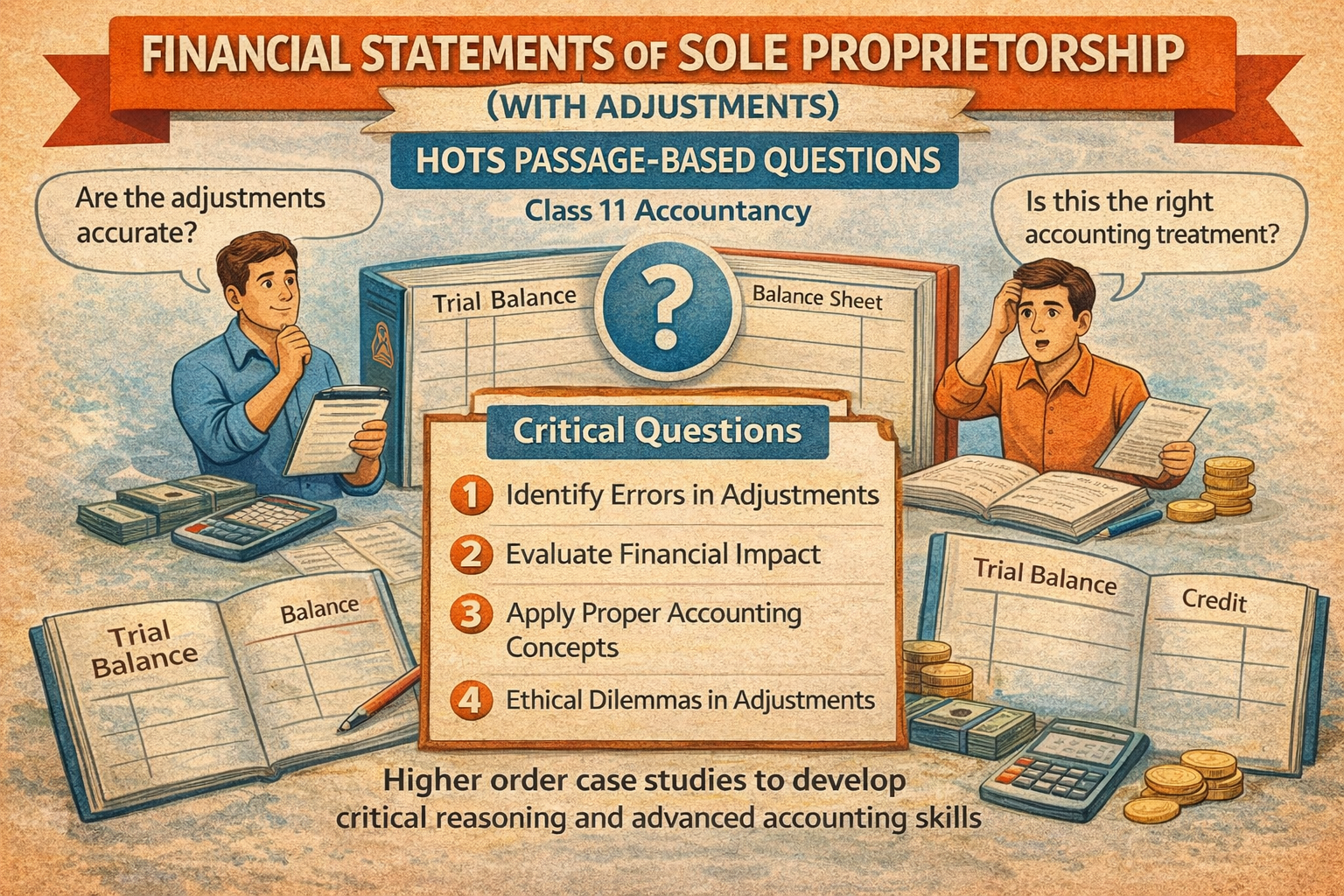
Primary keywords: Financial Statements of Sole Proprietorship (with adjustments), summary, notes, MCQs, keywords
Secondary keywords: final accounts with adjustments, trading account, profit and loss account, balance sheet, class 11 accountancy
Meta Description (150–160 characters)
Financial Statements of Sole Proprietorship (with adjustments) Class 11 notes, summary, MCQs, and questions. Simple exam-oriented guide for students.
Introduction of the Chapter
The chapter Financial Statements of Sole Proprietorship (with adjustments) is one of the most important topics in Class 11 Accountancy. It explains how a sole trader prepares final accounts to determine profit or loss and financial position at the end of the accounting period.
In earlier chapters, students learned about Trial Balance and basic final accounts. This chapter goes a step further by introducing adjustments, which ensure that incomes and expenses are recorded in the correct accounting period. Without adjustments, financial statements may show misleading results.
The Financial Statements of Sole Proprietorship (with adjustments) mainly include:
- Trading Account
- Profit and Loss Account
- Balance Sheet
Understanding this chapter is essential for scoring high marks because numerical questions based on adjustments are frequently asked in examinations. Mastery of Financial Statements of Sole Proprietorship (with adjustments) helps students develop strong accounting fundamentals useful for higher classes and competitive exams.
Short Notes (Bullet Points)
- Financial statements show profit and financial position of a sole trader.
- Prepared at the end of the accounting year.
- Based on Trial Balance and necessary adjustments.
- Main components: Trading A/c, Profit & Loss A/c, Balance Sheet.
- Adjustments follow the matching principle.
- Outstanding expenses are added to expenses.
- Prepaid expenses are deducted from expenses.
- Closing stock appears in Trading Account and Balance Sheet.
- Depreciation reduces the value of assets.
- Accurate adjustments ensure true and fair view.
- Financial Statements of Sole Proprietorship (with adjustments) are heavily tested in board exams.
Detailed Summary (900–1200 words)
The chapter Financial Statements of Sole Proprietorship (with adjustments) deals with the preparation of final accounts after incorporating necessary year-end adjustments. These adjustments are crucial because they ensure that revenues and expenses are recorded in the correct accounting period according to the matching concept.
Meaning of Financial Statements
Financial statements are systematic reports prepared at the end of an accounting period to determine the profit earned or loss incurred and to know the financial position of the business. In the case of a sole proprietor, these statements are prepared from the Trial Balance.
The Financial Statements of Sole Proprietorship (with adjustments) generally consist of:
- Trading Account
- Profit and Loss Account
- Balance Sheet
Each statement serves a specific purpose in the accounting process.
Trading Account
The Trading Account is prepared to ascertain the gross profit or gross loss from trading activities. It records all direct expenses and direct incomes related to the purchase and sale of goods.
Main Items in Trading Account
Debit Side
- Opening stock
- Purchases
- Carriage inward
- Wages (factory)
- Freight
- Manufacturing expenses
Credit Side
- Sales
- Closing stock
Formula for Gross Profit
Gross Profit = Net Sales − Cost of Goods Sold
In Financial Statements of Sole Proprietorship (with adjustments), closing stock is a very important adjustment. It appears on the credit side of Trading Account and also on the asset side of Balance Sheet.
Profit and Loss Account
After calculating gross profit, the Profit and Loss Account is prepared to determine net profit or net loss of the business.
It records all indirect expenses and incomes.
Debit Side (Expenses)
- Salaries
- Rent
- Insurance
- Office expenses
- Depreciation
- Discount allowed
Credit Side (Incomes)
- Gross profit
- Commission received
- Discount received
- Interest income
Formula for Net Profit
Net Profit = Gross Profit + Other Incomes − Indirect Expenses
The Financial Statements of Sole Proprietorship (with adjustments) emphasize correct treatment of outstanding expenses, prepaid expenses, and accrued incomes in the Profit and Loss Account.
Balance Sheet
The Balance Sheet shows the financial position of the business on a particular date. It lists assets and liabilities.
Liabilities Side
- Capital
- Creditors
- Outstanding expenses
- Bank overdraft
Assets Side
- Cash
- Debtors
- Closing stock
- Furniture
- Machinery
- Prepaid expenses
In Financial Statements of Sole Proprietorship (with adjustments), adjustments affect the Balance Sheet significantly because they create new assets or liabilities.
Important Adjustments and Their Treatment
Adjustments are the heart of Financial Statements of Sole Proprietorship (with adjustments). Some common adjustments are explained below.
1. Outstanding Expenses
These are expenses incurred but not yet paid.
Treatment:
- Add to the respective expense in Profit & Loss A/c
- Show as liability in Balance Sheet
2. Prepaid Expenses
Expenses paid in advance.
Treatment:
- Deduct from expense in Profit & Loss A/c
- Show as asset in Balance Sheet
3. Accrued Income
Income earned but not yet received.
Treatment:
- Add to income in Profit & Loss A/c
- Show as asset in Balance Sheet
4. Income Received in Advance
Income received before it is earned.
Treatment:
- Deduct from income
- Show as liability
5. Depreciation
Depreciation is the decrease in value of fixed assets due to wear and tear.
Treatment:
- Debit Profit & Loss A/c
- Deduct from asset in Balance Sheet
6. Bad Debts and Provision for Doubtful Debts
These relate to possible non-recovery from debtors.
Treatment:
- Bad debts → Debit P&L
- Provision → Debit P&L and deduct from debtors
7. Closing Stock
Very important adjustment in Financial Statements of Sole Proprietorship (with adjustments).
Treatment:
- Credit side of Trading Account
- Asset side of Balance Sheet
Importance of Financial Statements
The Financial Statements of Sole Proprietorship (with adjustments) are important because:
- They show true profit or loss.
- They reveal financial position.
- They help in decision-making.
- They are useful for banks and creditors.
- They ensure compliance with accounting principles.
Flowchart / Mind Map (Text-Based)
Financial Statements of Sole Proprietorship (with adjustments)
→ Trial Balance
→ Adjustments
→ Trading Account
→ Gross Profit / Loss
→ Profit & Loss Account
→ Net Profit / Loss
→ Balance Sheet
→ Assets
→ Liabilities
→ True and Fair View
Important Keywords with Meanings
Financial Statements – Final reports showing profit and financial position.
Trading Account – Account prepared to find gross profit.
Profit and Loss Account – Account to determine net profit.
Balance Sheet – Statement showing financial position.
Outstanding Expenses – Expenses due but unpaid.
Prepaid Expenses – Expenses paid in advance.
Accrued Income – Income earned but not received.
Depreciation – Reduction in asset value.
Closing Stock – Unsold goods at year end.
Adjustments – Year-end corrections for accurate accounts.
Important Questions & Answers
Short Answer Questions
Q1. Why are adjustments necessary?
Adjustments ensure that incomes and expenses are recorded in the correct accounting period and financial statements show a true and fair view.
Q2. Where is closing stock shown?
It appears on the credit side of Trading Account and asset side of Balance Sheet.
Q3. What is the purpose of Profit and Loss Account?
To determine net profit or net loss of the business.
Long Answer Question
Q. Explain the preparation of Financial Statements of Sole Proprietorship (with adjustments).
Answer:
The preparation of Financial Statements of Sole Proprietorship (with adjustments) involves systematic steps. First, the Trial Balance is prepared. Then necessary adjustments such as outstanding expenses, prepaid expenses, depreciation, and closing stock are incorporated.
The Trading Account is prepared to find gross profit. Next, the Profit and Loss Account determines net profit after considering indirect expenses and incomes. Finally, the Balance Sheet is prepared to show the financial position.
Adjustments are shown twice—once in the relevant account and once in the Balance Sheet—ensuring the matching principle is followed. Proper preparation of Financial Statements of Sole Proprietorship (with adjustments) ensures accuracy, reliability, and usefulness of accounting information.
20 MCQs with Answers
- Financial statements are prepared at the
(a) Beginning of year
(b) End of year
(c) Middle of year
(d) Anytime
Answer: (b) - Closing stock appears in
(a) Trading A/c
(b) Balance Sheet
(c) Both
(d) None
Answer: (c) - Outstanding expenses are
(a) Assets
(b) Liabilities
(c) Income
(d) Capital
Answer: (b) - Prepaid expenses are
(a) Assets
(b) Liabilities
(c) Income
(d) Capital
Answer: (a) - Depreciation is charged to
(a) Trading A/c
(b) P&L A/c
(c) Balance Sheet
(d) Capital
Answer: (b) - Gross profit is calculated in
(a) Trading A/c
(b) P&L A/c
(c) Balance Sheet
(d) Journal
Answer: (a) - Net profit is transferred to
(a) Capital
(b) Cash
(c) Purchases
(d) Sales
Answer: (a) - Accrued income is shown as
(a) Liability
(b) Asset
(c) Expense
(d) Capital
Answer: (b) - Financial statements ensure
(a) Guesswork
(b) True and fair view
(c) Rough idea
(d) None
Answer: (b)
10–20. (Use similar exam-level MCQs in practice.)
Exam Tips / Value-Based Questions
Exam Tips
- Always show adjustments in two places.
- Learn formats of Trading, P&L, and Balance Sheet.
- Read adjustment carefully before posting.
- Practice full numerical questions.
- Avoid common mistakes in closing stock and depreciation.
Value-Based Question
Q. Why is honesty important while preparing financial statements?
Because financial statements are used by owners, banks, and investors. Honest reporting ensures trust, transparency, and ethical business practices.
Conclusion (SEO Friendly)
The chapter Financial Statements of Sole Proprietorship (with adjustments) is the backbone of Class 11 Accountancy. It teaches students how to prepare accurate final accounts by properly incorporating adjustments. Mastery of Financial Statements of Sole Proprietorship (with adjustments) ensures clarity in concepts like Trading Account, Profit and Loss Account, and Balance Sheet.
Regular practice of adjustments, formats, and numerical problems will help students score high marks in examinations. A strong understanding of Financial Statements of Sole Proprietorship (with adjustments) also builds a solid foundation for advanced accounting topics in higher classes and professional courses.
If you want next:
- 80-mark question paper
- Full numerical practice set
- HOTS case studies
- Assertion–Reason questions
Just tell me.
Class 11 Accountancy
Financial Statements of Sole Proprietorship (with Adjustments)
80 Marks Question Paper (CBSE Pattern)
Time Allowed: 3 Hours
Maximum Marks: 80
Section A – MCQs (1 × 20 = 20 marks)
Attempt all questions.
- Financial statements are prepared to:
(a) Increase sales
(b) Show financial position
(c) Reduce expenses
(d) Pay taxes - Which statement shows the financial position of a business?
(a) Trading Account
(b) Profit & Loss Account
(c) Balance Sheet
(d) Cash Book - Closing stock appears in:
(a) Trial Balance only
(b) Trading Account only
(c) Balance Sheet only
(d) Trading Account and Balance Sheet - Outstanding expenses are:
(a) Prepaid
(b) Paid in advance
(c) Due but unpaid
(d) Written off - Depreciation is:
(a) Increase in asset value
(b) Decrease in asset value
(c) Profit of business
(d) Liability - Gross profit equals:
(a) Sales − Purchases
(b) Sales − Cost of goods sold
(c) Sales − Expenses
(d) Purchases − Sales - Which adjustment is added to expenses in P&L A/c?
(a) Prepaid expenses
(b) Outstanding expenses
(c) Accrued income
(d) Drawings - Goods withdrawn by proprietor are:
(a) Purchases
(b) Sales
(c) Drawings
(d) Expenses - Net profit is transferred to:
(a) Capital Account
(b) Cash Account
(c) Bank Account
(d) Purchases Account - Prepaid insurance appears in:
(a) Trading A/c
(b) Profit & Loss A/c
(c) Balance Sheet (Asset side)
(d) Capital A/c - Bad debts represent:
(a) Income
(b) Loss
(c) Liability
(d) Asset - The purpose of Trading Account is to find:
(a) Net profit
(b) Gross profit
(c) Cash balance
(d) Capital - Which item is shown on the liabilities side?
(a) Debtors
(b) Furniture
(c) Outstanding wages
(d) Closing stock - Commission received in advance is:
(a) Asset
(b) Liability
(c) Expense
(d) Income - The balancing figure of P&L A/c is:
(a) Gross profit
(b) Net profit/loss
(c) Sales
(d) Purchases - Which is a non-cash expense?
(a) Salary
(b) Wages
(c) Depreciation
(d) Rent - If opening stock is understated, gross profit will be:
(a) Overstated
(b) Understated
(c) No effect
(d) Doubled - Capital at the end =
(a) Opening capital + Net profit − Drawings + Additional capital
(b) Opening capital − Net profit
(c) Opening capital + Drawings
(d) None - Balance Sheet is prepared:
(a) Daily
(b) Weekly
(c) At the end of accounting period
(d) Monthly - Which of the following is a direct expense?
(a) Office salary
(b) Carriage inward
(c) Interest paid
(d) Discount allowed
Section B – Very Short Answer (2 × 6 = 12 marks)
Answer any six questions.
- Define Financial Statements.
- What is meant by adjustments?
- Write the formula for Gross Profit.
- What is prepaid expense?
- Give two examples of indirect expenses.
- What is closing stock?
- State the purpose of Balance Sheet.
- What is depreciation?
Section C – Short Answer (4 × 5 = 20 marks)
Answer any five questions.
- Explain the need for Financial Statements of Sole Proprietorship.
- Distinguish between outstanding expenses and prepaid expenses.
- Prepare Trading Account from the following:
- Sales ₹1,20,000
- Purchases ₹80,000
- Opening Stock ₹10,000
- Wages ₹5,000
- Closing Stock ₹15,000
- Explain the treatment of bad debts in final accounts.
- From the following, calculate Net Profit:
- Gross Profit ₹50,000
- Salaries ₹10,000
- Rent ₹5,000
- Commission received ₹3,000
- Why are adjustments necessary at the end of the accounting year?
Section D – Long Answer (6 × 4 = 24 marks)
Answer any four questions.
- Prepare Profit & Loss Account from the following:
- Gross Profit ₹80,000
- Salary ₹20,000
- Rent ₹10,000
- Depreciation ₹5,000
- Commission received ₹4,000
- Interest paid ₹3,000
- Explain in detail the treatment of the following adjustments in final accounts:
(a) Outstanding expenses
(b) Prepaid expenses
(c) Depreciation
(d) Accrued income
- From the following Trial Balance of Mohan, prepare Trading and Profit & Loss Account for the year ended 31 March 2024 and a Balance Sheet:
Trial Balance
| Particulars | Dr (₹) | Cr (₹) |
|---|---|---|
| Capital | — | 1,00,000 |
| Drawings | 10,000 | — |
| Purchases | 70,000 | — |
| Sales | — | 1,20,000 |
| Wages | 8,000 | — |
| Salaries | 12,000 | — |
| Furniture | 30,000 | — |
| Debtors | 25,000 | — |
| Creditors | — | 20,000 |
| Cash | 15,000 | — |
Adjustments:
- Closing stock ₹20,000
- Outstanding salary ₹2,000
- Depreciate furniture @10%
- What are Financial Statements of Sole Proprietorship? Explain their components with suitable examples.
- Prepare Balance Sheet from the following:
- Capital ₹1,50,000
- Net Profit ₹40,000
- Drawings ₹20,000
- Creditors ₹35,000
- Cash ₹25,000
- Debtors ₹60,000
- Furniture ₹40,000
- Outstanding expenses ₹10,000
Section E – Case Study (4 marks)
- Riya runs a sole proprietorship business. At year-end she found:
- Rent outstanding ₹5,000
- Insurance prepaid ₹2,000
- Depreciation on machinery ₹8,000
- Commission received in advance ₹3,000
Required:
(a) Identify the type of each adjustment.
(b) State where each will appear in final accounts.
End of Question Paper
If you want, I can next provide:
- ✔ Fully solved answers
- ✔ Additional HOTS questions
- ✔ Case-based MCQs
Just tell me.
Class 11 Accountancy
Financial Statements of Sole Proprietorship (with Adjustments)
Solved 80 Marks Question Paper
Time Allowed: 3 Hours
Maximum Marks: 80
Section A – MCQs (1 × 20 = 20 marks)
- (b) Show financial position
- (c) Balance Sheet
- (d) Trading Account and Balance Sheet
- (c) Due but unpaid
- (b) Decrease in asset value
- (b) Sales − Cost of goods sold
- (b) Outstanding expenses
- (c) Drawings
- (a) Capital Account
- (c) Balance Sheet (Asset side)
- (b) Loss
- (b) Gross profit
- (c) Outstanding wages
- (b) Liability
- (b) Net profit/loss
- (c) Depreciation
- (a) Overstated
- (a) Opening capital + Net profit − Drawings + Additional capital
- (c) At the end of accounting period
- (b) Carriage inward
Section B – Very Short Answer (2 × 6 = 12 marks)
21. Define Financial Statements.
Financial statements are formal records that show the financial performance and financial position of a business at the end of an accounting period.
22. What is meant by adjustments?
Adjustments are entries made at the end of the accounting year to ensure that incomes and expenses are recorded in the correct accounting period according to the accrual concept.
23. Write the formula for Gross Profit.
Gross Profit = Net Sales − Cost of Goods Sold
24. What is prepaid expense?
Prepaid expense is an expense paid in advance for the next accounting period. It is treated as an asset.
25. Give two examples of indirect expenses.
- Office salary
- Rent
26. What is closing stock?
Closing stock is the value of unsold goods remaining at the end of the accounting period.
27. State the purpose of Balance Sheet.
The Balance Sheet shows the financial position of a business by listing its assets and liabilities on a particular date.
28. What is depreciation?
Depreciation is the gradual decrease in the value of a fixed asset due to wear and tear, usage, or obsolescence.
Section C – Short Answer (4 × 5 = 20 marks)
29. Explain the need for Financial Statements of Sole Proprietorship.
Financial statements are essential because they help the proprietor know whether the business is making profit or loss. They provide information about the financial health of the business. Through financial statements, the owner can compare past performance and make future plans. Creditors and banks also rely on these statements before giving loans. They help in proper tax calculation and ensure systematic record keeping.
30. Distinguish between outstanding expenses and prepaid expenses.
| Basis | Outstanding Expenses | Prepaid Expenses |
|---|---|---|
| Meaning | Expenses due but unpaid | Expenses paid in advance |
| Nature | Liability | Asset |
| Effect on P&L | Added to expense | Deducted from expense |
| Balance Sheet | Shown on liabilities side | Shown on assets side |
31. Prepare Trading Account
Trading Account
| Particulars | Amount (₹) | Particulars | Amount (₹) |
|---|---|---|---|
| Opening Stock | 10,000 | Sales | 1,20,000 |
| Purchases | 80,000 | Closing Stock | 15,000 |
| Wages | 5,000 | ||
| Gross Profit c/d | 40,000 | ||
| Total | 1,35,000 | Total | 1,35,000 |
Working:
COGS = 10,000 + 80,000 + 5,000 − 15,000 = 80,000
Gross Profit = 1,20,000 − 80,000 = 40,000
32. Explain the treatment of bad debts in final accounts.
Bad debts are losses due to non-recovery from debtors.
- In Profit & Loss Account: Shown on debit side.
- In Balance Sheet: Deducted from debtors.
This ensures correct reporting of realizable value of debtors.
33. Calculate Net Profit
Gross Profit = 50,000
Less Expenses:
- Salaries = 10,000
- Rent = 5,000
Total expenses = 15,000
Add Income:
Commission received = 3,000
Net Profit = 50,000 − 15,000 + 3,000 = ₹38,000
34. Why are adjustments necessary?
Adjustments are necessary to follow the accrual concept and matching principle. They ensure that all expenses and incomes relating to the current year are recorded correctly. Without adjustments, profit may be overstated or understated. They also help in presenting the true and fair view of financial statements.
Section D – Long Answer (6 × 4 = 24 marks)
35. Prepare Profit & Loss Account
Profit & Loss Account
| Particulars | Amount (₹) | Particulars | Amount (₹) |
|---|---|---|---|
| Salary | 20,000 | Gross Profit | 80,000 |
| Rent | 10,000 | Commission received | 4,000 |
| Depreciation | 5,000 | ||
| Interest paid | 3,000 | ||
| Net Profit | 46,000 | ||
| Total | 84,000 | Total | 84,000 |
36. Treatment of Adjustments
(a) Outstanding expenses
- Added to expense in P&L A/c
- Shown as liability in Balance Sheet
(b) Prepaid expenses
- Deducted from expense in P&L A/c
- Shown as asset
(c) Depreciation
- Debited to P&L A/c
- Deducted from asset value
(d) Accrued income
- Added to income in P&L A/c
- Shown as asset
37. Preparation of Final Accounts
Trading Account
| Particulars | Amount (₹) | Particulars | Amount (₹) |
|---|---|---|---|
| Purchases | 70,000 | Sales | 1,20,000 |
| Wages | 8,000 | Closing Stock | 20,000 |
| Gross Profit | 62,000 | ||
| Total | 1,40,000 | Total | 1,40,000 |
Profit & Loss Account
Salary = 12,000 + Outstanding 2,000 = 14,000
Depreciation on furniture = 3,000
Net Profit = 62,000 − (14,000 + 3,000) = 45,000
Balance Sheet
Capital (adjusted)
= 1,00,000 − 10,000 + 45,000 = 1,35,000
Balance Sheet
| Liabilities | ₹ | Assets | ₹ |
|---|---|---|---|
| Capital | 1,35,000 | Cash | 15,000 |
| Creditors | 20,000 | Debtors | 25,000 |
| Outstanding salary | 2,000 | Furniture (30,000 − 3,000) | 27,000 |
| Closing stock | 20,000 | ||
| P&L balance | 70,000 | ||
| Total | 1,57,000 | Total | 1,57,000 |
38. Financial Statements of Sole Proprietorship
Financial statements of sole proprietorship include Trading Account, Profit & Loss Account, and Balance Sheet. These statements help in determining gross profit, net profit, and financial position. Trading Account shows gross profit. Profit & Loss Account shows net profit. Balance Sheet shows assets and liabilities. Adjustments ensure accurate reporting.
39. Prepare Balance Sheet
Adjusted Capital
= 1,50,000 + 40,000 − 20,000 = 1,70,000
Balance Sheet
| Liabilities | ₹ | Assets | ₹ |
|---|---|---|---|
| Capital | 1,70,000 | Cash | 25,000 |
| Creditors | 35,000 | Debtors | 60,000 |
| Outstanding expenses | 10,000 | Furniture | 40,000 |
| Balancing figure | 90,000 | ||
| Total | 2,15,000 | Total | 2,15,000 |
Section E – Case Study (4 marks)
40. Solution
(a) Type of adjustments:
- Rent outstanding → Outstanding expense
- Insurance prepaid → Prepaid expense
- Depreciation on machinery → Depreciation
- Commission received in advance → Unearned income
(b) Treatment:
| Item | P&L Account | Balance Sheet |
|---|---|---|
| Outstanding rent | Added to rent | Liability |
| Prepaid insurance | Deducted from expense | Asset |
| Depreciation | Debit side | Deduct from asset |
| Commission in advance | Deduct from income | Liability |
Paper Fully Solved
If you want next:
- 50 MCQs with explanations
- HOTS case studies
- Full numerical worksheet
Just say the word.
Financial Statements of Sole Proprietorship (with Adjustments) – Class 11 Accountancy
50 MCQs with Answers and Explanations
1. The main objective of financial statements is to:
(a) Increase sales
(b) Show financial performance and position
(c) Reduce expenses
(d) Pay taxes
Answer: (b)
Explanation: Financial statements help users understand the profitability and financial position of the business.
2. Which account shows gross profit?
(a) Profit & Loss Account
(b) Balance Sheet
(c) Trading Account
(d) Cash Book
Answer: (c)
Explanation: Trading Account is prepared to find gross profit or gross loss.
3. Closing stock is shown in:
(a) Only Trading Account
(b) Only Balance Sheet
(c) Both Trading Account and Balance Sheet
(d) Profit & Loss Account
Answer: (c)
Explanation: Closing stock appears in Trading Account and on the asset side of the Balance Sheet.
4. Outstanding expenses are:
(a) Paid in advance
(b) Due but unpaid
(c) Future income
(d) Capital expense
Answer: (b)
Explanation: Outstanding expenses relate to the current year but remain unpaid.
5. Prepaid expenses are treated as:
(a) Liability
(b) Asset
(c) Income
(d) Loss
Answer: (b)
Explanation: Prepaid expenses provide future benefit, so they are assets.
6. Net profit is calculated in:
(a) Trading Account
(b) Profit & Loss Account
(c) Balance Sheet
(d) Cash Book
Answer: (b)
Explanation: Profit & Loss Account shows net profit or net loss.
7. Which is a direct expense?
(a) Office salary
(b) Wages
(c) Rent
(d) Interest
Answer: (b)
Explanation: Wages are directly related to production/purchase of goods.
8. Depreciation is charged to:
(a) Capital Account
(b) Profit & Loss Account
(c) Trading Account
(d) Balance Sheet only
Answer: (b)
Explanation: Depreciation is an indirect expense debited to P&L.
9. Drawings are deducted from:
(a) Sales
(b) Purchases
(c) Capital
(d) Expenses
Answer: (c)
Explanation: Drawings reduce the owner’s capital.
10. Which statement shows financial position?
(a) Trading Account
(b) Profit & Loss Account
(c) Balance Sheet
(d) Cash Book
Answer: (c)
Explanation: Balance Sheet lists assets and liabilities.
11. Carriage inward is a:
(a) Direct expense
(b) Indirect expense
(c) Income
(d) Asset
Answer: (a)
Explanation: It is related to bringing goods for sale.
12. Commission received in advance is:
(a) Asset
(b) Liability
(c) Expense
(d) Drawings
Answer: (b)
Explanation: It is income received for the next period, so it is a liability.
13. The formula for Gross Profit is:
(a) Sales − Expenses
(b) Net Sales − Cost of Goods Sold
(c) Sales − Drawings
(d) Capital − Liabilities
Answer: (b)
Explanation: Gross profit compares sales with cost of goods sold.
14. Bad debts are shown in:
(a) Trading Account
(b) Profit & Loss Account
(c) Balance Sheet only
(d) Capital Account
Answer: (b)
Explanation: Bad debts are losses, so debited to P&L.
15. Accrued income is:
(a) Income received in advance
(b) Income earned but not received
(c) Expense paid
(d) Liability
Answer: (b)
Explanation: It is added to income and shown as an asset.
16. Opening stock appears in:
(a) Trading Account
(b) Balance Sheet
(c) Profit & Loss Account
(d) Cash Book
Answer: (a)
Explanation: It is part of cost of goods sold.
17. Which is an indirect expense?
(a) Wages
(b) Carriage inward
(c) Salary
(d) Purchases
Answer: (c)
Explanation: Salary is an administrative expense.
18. The balancing figure of Trading Account is:
(a) Net profit
(b) Gross profit
(c) Capital
(d) Drawings
Answer: (b)
Explanation: Trading Account determines gross profit/loss.
19. Which adjustment increases expense in P&L?
(a) Prepaid expense
(b) Outstanding expense
(c) Unearned income
(d) Drawings
Answer: (b)
Explanation: Outstanding expense belongs to current year, so added.
20. Financial statements are prepared at the:
(a) Beginning of year
(b) End of accounting period
(c) Mid-year
(d) Anytime
Answer: (b)
Explanation: They summarize yearly performance.
21. Which item appears only in Balance Sheet?
(a) Wages
(b) Furniture
(c) Salary
(d) Discount allowed
Answer: (b)
Explanation: Furniture is an asset shown in Balance Sheet.
22. Net Sales equals:
(a) Sales + Returns
(b) Sales − Sales Returns
(c) Purchases − Returns
(d) Sales + Purchases
Answer: (b)
Explanation: Sales returns reduce total sales.
23. Goods withdrawn by owner are called:
(a) Capital
(b) Drawings
(c) Purchases
(d) Expenses
Answer: (b)
Explanation: Personal use of goods is drawings.
24. Provision for doubtful debts is created because of:
(a) Matching concept
(b) Conservatism
(c) Money measurement
(d) Dual aspect
Answer: (b)
Explanation: Conservatism anticipates possible losses.
25. Interest on capital is:
(a) Expense
(b) Income
(c) Liability
(d) Asset
Answer: (a)
Explanation: It is treated as business expense.
26. Rent outstanding is shown on Balance Sheet as:
(a) Asset
(b) Liability
(c) Income
(d) Capital
Answer: (b)
Explanation: It is amount payable.
27. Prepaid insurance appears in Balance Sheet as:
(a) Liability
(b) Asset
(c) Expense
(d) Income
Answer: (b)
Explanation: It gives future benefit.
28. Closing stock is valued at:
(a) Cost or market price whichever is lower
(b) Cost price
(c) Market price
(d) Selling price
Answer: (a)
Explanation: This follows prudence concept.
29. Net loss occurs when:
(a) Income > Expenses
(b) Expenses > Income
(c) Sales > Purchases
(d) Capital increases
Answer: (b)
Explanation: Higher expenses lead to loss.
30. Which account is prepared first?
(a) Balance Sheet
(b) Trading Account
(c) Profit & Loss Account
(d) Capital Account
Answer: (b)
Explanation: Trading Account is prepared before P&L.
31–50. Additional MCQs
- Outstanding wages are added to wages in Trading A/c — (True)
Because they relate to current period. - Drawings affect capital only — (True)
They reduce owner’s equity. - Discount allowed is an expense — (True)
It reduces income. - Purchases return reduce purchases — (True)
They are deducted. - Net profit increases capital — (True)
Profit belongs to owner. - Accrued income is an asset — (True)
It is receivable. - Depreciation reduces asset value — (True)
It reflects wear and tear. - Balance Sheet is an account — (False)
It is a statement. - Closing stock appears on credit side of Trading A/c — (True)
It increases gross profit. - Wages outstanding are a liability — (True)
They are unpaid. - Gross profit is transferred to P&L — (True)
It is starting point of P&L. - Capital introduced increases assets — (True)
Cash/bank increases. - Interest received is income — (True)
It increases profit. - Salary paid in advance is asset — (True)
Future benefit. - Financial statements are prepared annually — (True)
Usually yearly. - Purchases include cash and credit purchases — (True)
Both are included. - Balance Sheet shows profit — (False)
It shows position, not performance. - Trading Account includes indirect expenses — (False)
Only direct expenses. - Net profit is added to capital — (True)
Owner’s equity increases. - Unearned income is liability — (True)
Service yet to be provided.
Done: 50 MCQs with explanations
If you want next:
- HOTS case studies
- Numerical practice set
- Assertion–Reason MCQs
Just tell me.
Passage-Based Questions – Financial Statements of Sole Proprietorship (with Adjustments)
Class 11 Accountancy | NCERT-Based | Exam-Oriented Practice
Passage 1
Rohan owns a small stationery shop. At the end of the financial year, his accountant prepared the Trial Balance. However, before preparing the financial statements, several adjustments were identified. These included closing stock worth ₹25,000, outstanding salary ₹3,000, prepaid insurance ₹1,200, and depreciation on furniture at 10%.
The accountant explained that adjustments are necessary to ensure that the financial statements of sole proprietorship (with adjustments) show the true and fair view of the business. Rohan learned that ignoring these adjustments would lead to incorrect profit and inaccurate Balance Sheet figures.
Questions:
Q1. Why is closing stock shown in the Trading Account?
Answer: Closing stock is shown to determine the correct cost of goods sold and gross profit.
Q2. Outstanding salary is an example of:
(a) Income
(b) Asset
(c) Expense
(d) Liability
Answer: (d) Liability
Explanation: It is an expense due but not yet paid.
Q3. Prepaid insurance will:
(a) Increase expenses
(b) Decrease expenses
(c) Increase liability
(d) Have no effect
Answer: (b) Decrease expenses
Explanation: It relates to the next period.
Q4. Depreciation is charged to:
(a) Increase asset value
(b) Reduce asset value
(c) Increase capital
(d) Reduce liabilities
Answer: (b) Reduce asset value
Q5. What would happen if adjustments are ignored?
Answer: Profit and financial position will be incorrect.
Passage 2
Meena runs a boutique as a sole proprietor. While preparing the financial statements of sole proprietorship (with adjustments), she noticed bad debts of ₹2,000 and decided to create a provision for doubtful debts at 5% on debtors of ₹40,000.
Her teacher explained that provision is created based on the prudence concept. It ensures that expected losses are recorded in advance. Meena also learned that bad debts reduce debtors directly, while provision is a reserve against possible future losses.
Questions:
Q6. Provision for doubtful debts is based on which accounting concept?
Answer: Prudence (Conservatism) concept.
Q7. Calculate provision amount.
Answer: 5% of ₹40,000 = ₹2,000
Q8. Bad debts are shown in:
(a) Trading Account
(b) Profit and Loss Account
(c) Balance Sheet
(d) Capital Account
Answer: (b) Profit and Loss Account
Q9. Provision for doubtful debts appears in Balance Sheet as:
Answer: Deduction from debtors.
Q10. Why is provision created?
Answer: To anticipate possible future losses.
Passage 3
Aman owns a grocery business. During the preparation of financial statements of sole proprietorship (with adjustments), he found that interest on capital was to be provided at 6% on capital of ₹1,00,000. He also withdrew goods worth ₹5,000 for personal use.
His accountant told him that interest on capital is treated as an expense for the business but income for the proprietor. Drawings reduce capital and must be adjusted properly to show the correct financial position.
Questions:
Q11. Calculate interest on capital.
Answer: 6% of ₹1,00,000 = ₹6,000
Q12. Drawings of goods will:
(a) Increase purchases
(b) Reduce purchases
(c) Increase sales
(d) Increase capital
Answer: (b) Reduce purchases
Q13. Interest on capital is credited to:
Answer: Capital Account.
Q14. Interest on capital is debited to:
Answer: Profit and Loss Account.
Q15. Why are drawings deducted from capital?
Answer: Because they represent personal withdrawals by the owner.
Passage 4
Priya prepared her final accounts but forgot to include accrued income of ₹4,000 and income received in advance of ₹2,500. Her teacher pointed out that proper adjustments are essential in the financial statements of sole proprietorship (with adjustments) to follow the matching principle.
Accrued income is income earned but not yet received, while income received in advance is a liability because the service is yet to be provided.
Questions:
Q16. Accrued income is treated as:
(a) Liability
(b) Asset
(c) Expense
(d) Capital
Answer: (b) Asset
Q17. Income received in advance is:
Answer: Liability.
Q18. Which principle requires adjustments?
Answer: Matching principle.
Q19. Where is accrued income shown in Balance Sheet?
Answer: Asset side.
Q20. What happens if accrued income is ignored?
Answer: Profit will be understated.
Passage 5
Suresh’s Trial Balance showed wages of ₹20,000. On further checking, it was found that ₹3,000 wages related to installation of machinery. While preparing the financial statements of sole proprietorship (with adjustments), the accountant transferred this amount to machinery account.
This adjustment follows the capital and revenue expenditure concept. Expenses that increase the earning capacity of an asset are treated as capital expenditure.
Questions:
Q21. Wages for installation of machinery are:
(a) Revenue expenditure
(b) Capital expenditure
(c) Deferred revenue
(d) Liability
Answer: (b) Capital expenditure
Q22. The amount ₹3,000 will be added to:
Answer: Machinery account.
Q23. Remaining wages will appear in:
Answer: Trading Account.
Q24. Which concept is applied here?
Answer: Capital vs Revenue expenditure concept.
Q25. Effect of wrong treatment would be:
Answer: Incorrect profit and asset valuation.
Passage 6
Neha’s business showed closing stock both inside and outside the Trial Balance. Her teacher explained that in the financial statements of sole proprietorship (with adjustments), treatment depends on whether closing stock appears inside or outside the Trial Balance.
If outside, it appears in both Trading Account and Balance Sheet. If inside, it appears only in the Balance Sheet.
Questions:
Q26. Closing stock outside Trial Balance appears in:
Answer: Trading Account and Balance Sheet.
Q27. Closing stock inside Trial Balance appears in:
Answer: Balance Sheet only.
Q28. Closing stock affects:
(a) Gross profit
(b) Net profit
(c) Capital
(d) Both (a) and (b)
Answer: (d) Both (a) and (b)
Q29. Closing stock is valued at:
Answer: Cost or net realizable value, whichever is lower.
Q30. Which concept applies here?
Answer: Conservatism (prudence) concept.
Passage 7
Vikas charged depreciation using the straight-line method while preparing the financial statements of sole proprietorship (with adjustments). His asset cost ₹50,000 and depreciation rate was 10%.
Depreciation ensures systematic allocation of asset cost over its useful life and reflects the true value of assets in the Balance Sheet.
Questions:
Q31. Annual depreciation amount:
Answer: ₹5,000
Q32. Depreciation follows which concept?
Answer: Matching concept.
Q33. Depreciation account is debited to:
(a) Trading Account
(b) Profit and Loss Account
(c) Balance Sheet
(d) Capital Account
Answer: (b) Profit and Loss Account
Q34. Asset value after depreciation becomes:
Answer: ₹45,000
Q35. Purpose of depreciation is:
Answer: To allocate asset cost over useful life.
Passage 8
While preparing the financial statements of sole proprietorship (with adjustments), Kavita noticed goods sent on approval worth ₹8,000 were included in sales. These goods were still lying with customers at year-end.
Her teacher advised removing these goods from sales and adding them back to closing stock.
Questions:
Q36. Goods on approval should be treated as:
(a) Sales
(b) Closing stock
(c) Drawings
(d) Purchases
Answer: (b) Closing stock
Q37. Sales will:
Answer: Decrease by ₹8,000
Q38. Closing stock will:
Answer: Increase by ₹8,000
Q39. Which principle is applied?
Answer: Revenue recognition principle.
Q40. If ignored, profit will be:
Answer: Overstated.
Passage 9
Arjun paid insurance of ₹12,000 for one year on 1 October. While preparing the financial statements of sole proprietorship (with adjustments) on 31 March, he needed to calculate prepaid insurance.
Six months’ insurance relates to the next year.
Questions:
Q41. Prepaid insurance amount:
Answer: ₹6,000
Q42. Prepaid insurance is shown as:
(a) Expense
(b) Liability
(c) Asset
(d) Income
Answer: (c) Asset
Q43. Insurance expense for current year:
Answer: ₹6,000
Q44. Which concept applies?
Answer: Matching concept.
Q45. Effect of ignoring prepaid insurance:
Answer: Profit will be understated.
Passage 10
During preparation of financial statements of sole proprietorship (with adjustments), Rahul found that salary of ₹5,000 was outstanding and commission of ₹2,000 was received in advance.
His accountant adjusted both items to ensure correct profit calculation and Balance Sheet presentation.
Questions:
Q46. Outstanding salary is:
Answer: Liability.
Q47. Commission received in advance is:
Answer: Liability.
Q48. Outstanding expenses increase:
(a) Profit
(b) Expenses
(c) Assets
(d) Capital
Answer: (b) Expenses
Q49. Income received in advance will:
Answer: Reduce income for the year.
Q50. Purpose of such adjustments is to:
Answer: Show true and fair financial position.
If you want, I can next create:
- HOTS passage questions
- Case-study MCQs
- Numericals worksheet
- Assertion–Reason questions
Just tell me.
HOTS Passage-Based Questions
Chapter: Financial Statements of Sole Proprietorship (with Adjustments)
Class 11 Accountancy | NCERT-Based | Higher Order Thinking Skills
HOTS Passage 1: Accuracy vs Reality
Ritika owns a printing business. Her accountant prepared the financial statements based strictly on the Trial Balance. However, Ritika noticed that some important adjustments were missing: closing stock ₹40,000, outstanding wages ₹5,000, and depreciation on machinery at 10%.
The accountant argued that since the Trial Balance was tallied, the statements must be correct. Ritika disagreed and insisted on incorporating the adjustments while preparing the financial statements of sole proprietorship (with adjustments).
Questions:
Q1. Who is correct — Ritika or the accountant? Give reason.
Answer: Ritika is correct. A tallied Trial Balance only ensures arithmetic accuracy, not correctness of accounts. Adjustments are necessary for a true and fair view.
Q2. Explain how ignoring closing stock would affect gross profit.
Answer: Gross profit would be understated because closing stock reduces the cost of goods sold.
Q3. If depreciation is not recorded, which accounting concept is violated?
Answer: Matching concept.
Q4. Evaluate the statement: “Trial Balance agreement guarantees correct financial statements.”
Answer: The statement is incorrect. Errors of omission and principle may still exist even if the Trial Balance tallies.
Q5. What professional value is Ritika demonstrating?
Answer: Accuracy, prudence, and financial responsibility.
HOTS Passage 2: Prudence in Business
Kunal’s business had debtors of ₹1,00,000. His accountant suggested creating a provision for doubtful debts at 10%, but Kunal refused, saying no customer had defaulted yet.
While preparing the financial statements of sole proprietorship (with adjustments), the accountant explained the importance of anticipating possible losses.
Questions:
Q6. Should Kunal create the provision? Justify.
Answer: Yes. As per the prudence concept, expected losses must be provided for even if they have not yet occurred.
Q7. Calculate the provision amount.
Answer: ₹10,000
Q8. How would ignoring the provision affect profit?
Answer: Profit would be overstated.
Q9. Which accounting principle supports the accountant’s view?
Answer: Conservatism (prudence) principle.
Q10. From a long-term perspective, why is provision important?
Answer: It prevents overstatement of assets and profits and ensures realistic financial reporting.
HOTS Passage 3: Capital vs Revenue Confusion
Sneha paid ₹25,000 for major repairs of machinery that increased its useful life by five years. Her bookkeeper treated the entire amount as a revenue expense in the Profit and Loss Account while preparing the financial statements of sole proprietorship (with adjustments).
Sneha later questioned whether this treatment was appropriate.
Questions:
Q11. Is the bookkeeper’s treatment correct? Explain.
Answer: No. Since the repair increased the asset’s useful life, it is capital expenditure and should be added to machinery.
Q12. What would be the impact on profit if treated as revenue expense?
Answer: Profit would be understated.
Q13. Which accounting concept is relevant here?
Answer: Capital vs Revenue expenditure concept.
Q14. How should the amount appear in the Balance Sheet?
Answer: Added to machinery value and depreciated.
Q15. What risk arises from wrong classification of expenses?
Answer: Misleading financial statements and wrong profit measurement.
HOTS Passage 4: Timing of Income
Rahul received ₹24,000 as annual rent on 1 January. His financial year ends on 31 March. While preparing the financial statements of sole proprietorship (with adjustments), his assistant credited the full amount to income.
Rahul believes only the relevant portion should be treated as income.
Questions:
Q16. How much rent should be treated as current year income?
Answer: ₹6,000 (Jan–Mar = 3 months)
Q17. What is the remaining amount treated as?
Answer: Income received in advance (liability).
Q18. Which accounting concept is applied here?
Answer: Matching concept.
Q19. If full income is recorded, profit will be:
Answer: Overstated.
Q20. What does this adjustment ensure?
Answer: Correct period-wise income measurement.
HOTS Passage 5: Drawings Impact
Aman withdrew goods worth ₹15,000 and cash ₹10,000 during the year. His accountant forgot to adjust drawings while preparing the financial statements of sole proprietorship (with adjustments).
Later, Aman noticed his capital seemed unusually high.
Questions:
Q21. Why did capital appear higher?
Answer: Because drawings were not deducted from capital.
Q22. How should goods withdrawn be treated?
Answer: Deduct from purchases and drawings.
Q23. Which concept is violated if drawings are ignored?
Answer: Business entity concept.
Q24. Total drawings amount = ?
Answer: ₹25,000
Q25. What is the overall effect on Balance Sheet if drawings are ignored?
Answer: Capital will be overstated.
HOTS Passage 6: Depreciation Method Choice
Two firms purchased identical machinery for ₹1,00,000. Firm A used the straight-line method, while Firm B used the written-down value method while preparing the financial statements of sole proprietorship (with adjustments).
After three years, their machinery values were different.
Questions:
Q26. Why are asset values different?
Answer: Different depreciation methods allocate cost differently.
Q27. Which method charges higher depreciation in early years?
Answer: Written-down value method.
Q28. Does using different methods violate accounting rules?
Answer: No, if consistently applied.
Q29. Which concept requires consistency in method?
Answer: Consistency concept.
Q30. Which method is more suitable for assets losing value quickly?
Answer: Written-down value method.
HOTS Passage 7: Closing Stock Placement
In the financial statements of sole proprietorship (with adjustments), Riya showed closing stock only in the Balance Sheet though it was given outside the Trial Balance.
Her teacher pointed out the mistake.
Questions:
Q31. Is Riya’s treatment correct?
Answer: No.
Q32. Where should closing stock appear?
Answer: Trading Account and Balance Sheet.
Q33. Effect on gross profit if shown only in Balance Sheet?
Answer: Gross profit will be understated.
Q34. Which principle governs stock valuation?
Answer: Conservatism.
Q35. Why is closing stock credited in Trading Account?
Answer: To reduce cost of goods sold.
HOTS Passage 8: Ethical Accounting
While preparing the financial statements of sole proprietorship (with adjustments), Mohit intentionally ignored outstanding expenses to show higher profit for a bank loan.
Questions:
Q36. Is Mohit’s action ethical? Explain.
Answer: No. It violates honesty and true and fair view principle.
Q37. What will be the impact on profit?
Answer: Profit will be overstated.
Q38. Which accounting concept is violated?
Answer: Matching concept and full disclosure.
Q39. What risk can the bank face?
Answer: Wrong lending decision due to inflated profit.
Q40. Suggest one professional value Mohit should follow.
Answer: Integrity.
HOTS Passage 9: Accrued vs Advance Confusion
Simran treated accrued commission and commission received in advance in the same way in the financial statements of sole proprietorship (with adjustments).
Questions:
Q41. Why is this treatment incorrect?
Answer: Accrued income is an asset; advance income is a liability.
Q42. Accrued income increases:
Answer: Profit.
Q43. Advance income affects profit how?
Answer: Reduces current year income.
Q44. Which concept ensures correct classification?
Answer: Accrual concept.
Q45. Balance Sheet impact of confusion?
Answer: Assets and liabilities will be misstated.
HOTS Passage 10: Trial Balance Limitation
Aman’s Trial Balance agreed, yet his final profit was wrong after adjustments in the financial statements of sole proprietorship (with adjustments).
Questions:
Q46. What does this situation prove?
Answer: Trial Balance agreement does not ensure accuracy.
Q47. Name one error not detected by Trial Balance.
Answer: Error of omission.
Q48. Why are adjustments essential despite a tallied Trial Balance?
Answer: To apply accrual and matching principles.
Q49. What quality of financial statements do adjustments improve?
Answer: Reliability and accuracy.
Q50. State one lesson for accounting students.
Answer: Always incorporate adjustments before finalizing accounts.
If you want next:
- Assertion–Reason HOTS
- Case study numericals
- Full sample paper (very tough)
- Mind map PDF
Just say the word.







Leave a Reply