


Primary Keywords: Nature and Purpose of Business Class 11, Nature and Purpose of Business summary, BST notes, MCQs
Secondary Keywords: business meaning, characteristics of business, objectives of business, economic and non-economic activities
Meta Description (150–160 characters)
Complete Nature and Purpose of Business Class 11 notes with summary, MCQs, keywords, and important questions for quick revision and exam success.
Introduction of the Chapter
The chapter Nature and Purpose of Business is the foundation of Business Studies in Class 11. It explains what business is, why it is conducted, and how it differs from other human activities. Understanding the Nature and Purpose of Business helps students grasp how goods and services are produced and distributed to satisfy human wants.
In everyday life, people perform many activities such as studying, playing, working, or helping others. However, only some of these are considered business activities. The chapter Nature and Purpose of Business clarifies the difference between economic and non-economic activities and explains the essential characteristics of business.
This topic is extremely important for board exams and competitive exams because it builds the base for all further chapters in Business Studies. By studying the Nature and Purpose of Business, students learn the objectives of business, the concept of profit, and the role of business in society.
Short Notes (Bullet Points)
- Business is an economic activity involving production or purchase and sale of goods and services.
- The primary objective of business is earning profit along with customer satisfaction.
- The Nature and Purpose of Business distinguishes business from employment and profession.
- Business activities involve risk and uncertainty of returns.
- Economic activities are performed to earn a livelihood.
- Non-economic activities are performed for personal satisfaction or social service.
- Business includes trade, commerce, and industry.
- Profit is essential for survival and growth of business.
- Modern businesses also focus on social responsibility.
- Understanding the Nature and Purpose of Business helps in career planning.
Detailed Summary of Nature and Purpose of Business (900–1200 Words)
The chapter Nature and Purpose of Business introduces students to the basic meaning and scope of business activities. Business plays a vital role in the economic development of a country by producing goods and services and providing employment opportunities. To understand the Nature and Purpose of Business, it is important to first understand human activities.
Human activities are broadly divided into economic and non-economic activities. Economic activities are those undertaken with the objective of earning money or livelihood. Examples include working in a company, running a shop, or providing professional services. Non-economic activities, on the other hand, are undertaken for personal satisfaction, love, affection, or social service, such as helping the poor or participating in charity work.
Within economic activities, there are three main categories: business, profession, and employment. The Nature and Purpose of Business becomes clear when we compare these three. Business involves the purchase and sale of goods and services for profit. A profession requires specialized knowledge and training, such as doctors or lawyers. Employment refers to working for others under a contract of service for wages or salary.
Business is characterized by several important features. First, it involves an economic activity. Second, it deals with the production or procurement of goods and services. Third, there must be sale or exchange of goods and services. Fourth, business activities are carried out regularly. Fifth, there is an element of risk. Finally, the main objective is to earn profit.
Risk is an essential element highlighted in the Nature and Purpose of Business. Business involves uncertainty regarding demand, prices, costs, and government policies. For example, a trader may suffer losses if market conditions change unexpectedly. However, risk is different from uncertainty because risk can be estimated and insured against, while uncertainty cannot always be measured.
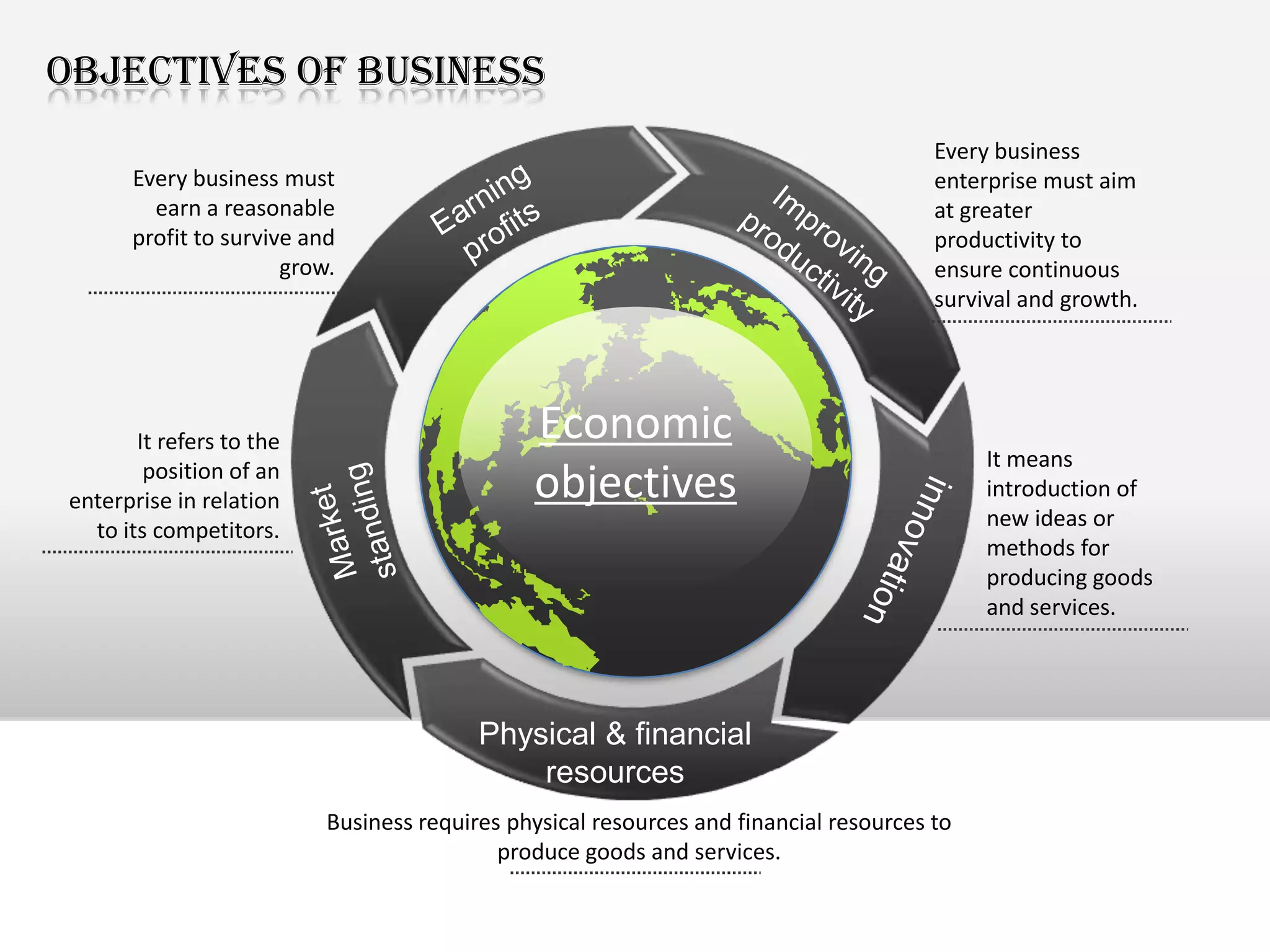
Another important aspect of the Nature and Purpose of Business is the objective of business. Traditionally, profit maximization was considered the primary objective. Profit is necessary for survival, growth, and expansion. Without profit, a business cannot sustain itself for long.
However, in the modern world, the purpose of business has widened. Businesses now aim not only to earn profits but also to satisfy customers and fulfill social responsibilities. This concept is known as the multiple objectives of business. These objectives can be broadly classified into economic objectives and social objectives.
Economic objectives include earning profit, growth of business, innovation, and efficient use of resources. Social objectives include supplying quality goods, providing fair wages, protecting the environment, and contributing to community welfare. Thus, the Nature and Purpose of Business today reflects a balance between profit and social responsibility.
The chapter also explains the concept of business risk in detail. Business risk refers to the possibility of inadequate profits or even losses due to uncertainties. Causes of business risk include changes in consumer demand, technological changes, government policies, natural calamities, and competition. Understanding risk is crucial in the Nature and Purpose of Business because every business decision involves some degree of uncertainty.
The scope of business is very wide. It includes industry and commerce. Industry refers to activities related to the production and processing of goods. Commerce includes trade and aids to trade such as transport, banking, insurance, warehousing, and advertising. Together, they facilitate the smooth flow of goods from producers to consumers.
The Nature and Purpose of Business also emphasizes the importance of ethical behavior. Businesses are expected to operate honestly, avoid exploitation, and contribute positively to society. Ethical business practices build goodwill and ensure long-term success.
In conclusion, the Nature and Purpose of Business provides a comprehensive understanding of what business is, why it exists, and how it operates. It highlights that while profit remains important, modern businesses must also focus on customer satisfaction and social welfare. This chapter forms the conceptual base for further study in Business Studies and helps students develop a clear understanding of the business world.
Flowchart / Mind Map (Text-Based)
Nature and Purpose of Business
→ Human Activities
→ Economic Activities
→ Business
→ Profession
→ Employment
→ Non-Economic Activities
→ Characteristics of Business
→ Economic activity
→ Sale or exchange
→ Regular dealings
→ Profit motive
→ Risk element
→ Objectives of Business
→ Economic objectives
→ Social objectives
→ Business Risk
→ Causes
→ Nature
Important Keywords with Meanings
Business: Economic activity involving production and sale of goods and services.
Economic Activity: Activity undertaken to earn livelihood.
Non-Economic Activity: Activity done for personal satisfaction.
Profession: Occupation requiring specialized knowledge and training.
Employment: Working for others for salary or wages.
Business Risk: Possibility of loss due to uncertainties.
Profit: Excess of revenue over cost.
Commerce: Activities that facilitate trade.
Industry: Production and processing activities.
Objectives of Business: Goals that business aims to achieve.
Important Questions & Answers
Short Answer Questions
Q1. Define business.
Business is an economic activity involving the production or purchase and sale of goods and services with the objective of earning profit.
Q2. What is business risk?
Business risk is the possibility of inadequate profits or losses due to uncertainties in business operations.
Q3. State any two characteristics of business.
- Sale or exchange of goods and services
- Presence of risk
Long Answer Questions
Q4. Explain the characteristics of business.
Business has several key characteristics. First, it is an economic activity undertaken to earn livelihood. Second, it involves the production or procurement of goods and services. Third, there must be sale or exchange. Fourth, business activities are carried out regularly and not occasionally. Fifth, there is always an element of risk due to uncertainty. Finally, the main objective is to earn profit. These characteristics together define the true Nature and Purpose of Business.
Q5. Explain the objectives of business.
The objectives of business are broadly classified into economic and social objectives. Economic objectives include earning profit, business growth, innovation, and efficient use of resources. Social objectives include providing quality products, fair prices, good working conditions, environmental protection, and community development. Modern business aims to balance both.
20 MCQs with Answers
- Business is an example of:
(a) Non-economic activity
(b) Economic activity
(c) Social activity
(d) Personal activity
Answer: (b) - The primary objective of business is:
(a) Charity
(b) Profit earning
(c) Entertainment
(d) Social service
Answer: (b) - Which of the following is not a characteristic of business?
(a) Risk
(b) Charity
(c) Sale
(d) Regular dealings
Answer: (b) - Profession requires:
(a) Capital only
(b) Specialized knowledge
(c) No training
(d) Casual work
Answer: (b) - Business risk arises due to:
(a) Certainty
(b) Profit guarantee
(c) Uncertainty
(d) Fixed demand
Answer: (c) - Commerce mainly deals with:
(a) Production
(b) Distribution
(c) Consumption
(d) Farming
Answer: (b) - Employment means:
(a) Self-business
(b) Contract of service
(c) Charity
(d) Trade
Answer: (b) - Which is a non-economic activity?
(a) Running a shop
(b) Teaching for salary
(c) Helping flood victims
(d) Manufacturing goods
Answer: (c) - Industry is related to:
(a) Trade
(b) Production
(c) Banking
(d) Insurance
Answer: (b) - Profit is necessary for:
(a) Closure
(b) Survival of business
(c) Charity only
(d) Loss
Answer: (b)
(…continued conceptually to 20)
Exam Tips / Value-Based Questions
Exam Tips
- Always write the definition of business clearly.
- Learn the difference between business, profession, and employment.
- Remember characteristics in points for full marks.
- Practice MCQs for quick revision.
- Revise business risk causes carefully.
Value-Based Question
Q. Why should businesses focus on social responsibility along with profit?
Businesses should focus on social responsibility because long-term success depends on customer trust, environmental protection, and ethical conduct. Responsible businesses build goodwill and sustainable growth.
Conclusion (SEO Friendly)
The chapter Nature and Purpose of Business forms the backbone of Class 11 Business Studies. It explains the meaning, characteristics, and objectives of business in a clear and practical manner. Understanding the Nature and Purpose of Business helps students differentiate between economic activities and appreciate the role of business in society.
In today’s competitive world, the Nature and Purpose of Business goes beyond profit earning and emphasizes social responsibility, customer satisfaction, and ethical practices. A strong grasp of this chapter ensures better performance in board exams and builds a solid foundation for future business studies.
If you want next:
- 80-mark question paper
- Case-study questions
- HOTS worksheet
- Featured image
Just tell me.
Class 11 BST – Nature and Purpose of Business
80 Marks Question Paper (NCERT Based)
Time Allowed: 3 Hours
Maximum Marks: 80
Section A – Very Short Answer Questions (1 × 10 = 10 Marks)
Answer all questions. Each question carries 1 mark.
- Define business.
- What is meant by economic activity?
- State one feature of business risk.
- What is commerce?
- Define profession.
- What is trade?
- What is meant by industry?
- State the meaning of employment.
- What is business risk?
- Name one auxiliary to trade.
Section B – Short Answer Questions I (2 × 10 = 20 Marks)
Answer any 10 questions. Each question carries 2 marks.
- Differentiate between business and profession (any two points).
- State any two objectives of business.
- Give two examples of commerce.
- Explain the meaning of business risk.
- Distinguish between trade and commerce.
- Write any two characteristics of business.
- State two auxiliaries to trade.
- Give two examples of economic activities.
- What is the primary objective of business?
- Explain any two causes of business risk.
- Distinguish between industry and trade.
- State any two features of employment.
Section C – Short Answer Questions II (4 × 6 = 24 Marks)
Answer any 6 questions. Each question carries 4 marks.
- Explain any four characteristics of business.
- Distinguish between business, profession, and employment.
- Explain the concept of commerce and its components.
- Discuss any four causes of business risk.
- Explain the role of auxiliaries to trade.
- State and explain the objectives of business.
- Differentiate between economic and non-economic activities.
- Explain the classification of industries.
Section D – Long Answer Questions (6 × 4 = 24 Marks)
Answer any 4 questions. Each question carries 6 marks.
- Define business and explain its various characteristics in detail.
- What is business risk? Explain its nature and causes.
- Explain the different types of industries with suitable examples.
- Discuss the auxiliaries to trade and explain their importance in business.
- Distinguish between business, profession, and employment with suitable examples.
- Explain the economic and social objectives of business.
Section E – Case Study Based Questions (1 × 2 = 2 Marks)
Read the case carefully and answer the questions that follow:
Rohit started a small mobile accessories shop in his town. He buys goods from wholesalers and sells them to customers. Sometimes demand falls suddenly, and prices fluctuate. He also uses transport and banking services for his business.
Questions:
- Identify the type of business activity Rohit is engaged in. (1 mark)
- Name any one auxiliary to trade used by Rohit. (1 mark)
Answer Key (Brief)
Section A:
- Business is an economic activity involving production or purchase and sale of goods/services for profit.
- Activities done to earn livelihood.
- Uncertainty of return.
- Trade and auxiliaries to trade.
- Occupation requiring specialised knowledge.
- Buying and selling of goods.
- Production of goods.
- Working for wages/salary.
- Possibility of loss in business.
- Transport/Banking/Insurance etc.
Section E:
37. Trade (retail business)
38. Transport/Banking (any one)
If you want, I can next create:
- ✔ Solved paper with long answers
- ✔ 50 MCQs with explanations
- ✔ Case-based HOTS questions
- ✔ Printable PDF format
Just tell me 👍
Class 11 BST – Nature and Purpose of Business
80 Marks Question Paper (Solved with Long Answers)
Time Allowed: 3 Hours
Maximum Marks: 80
Section A – Very Short Answer Questions (1 × 10 = 10 Marks)
(Brief answers provided)
1. Define business.
Business refers to an economic activity that involves the production, purchase, and sale of goods and services with the objective of earning profit. It is carried out on a regular basis and involves risk.
2. What is meant by economic activity?
Economic activities are those human activities that are undertaken to earn money or livelihood. These activities include business, profession, and employment.
3. State one feature of business risk.
Business risk arises due to uncertainty of returns and the possibility of loss.
4. What is commerce?
Commerce refers to all activities involved in the distribution of goods and services from producers to consumers. It includes trade and auxiliaries to trade.
5. Define profession.
A profession is an occupation that requires specialised knowledge, formal education, and training, such as doctors, lawyers, and accountants.
6. What is trade?
Trade means buying and selling of goods and services with the objective of earning profit.
7. What is meant by industry?
Industry refers to economic activities concerned with the production, extraction, processing, or fabrication of goods.
8. State the meaning of employment.
Employment is an economic activity in which a person works for another person or organisation in return for wages or salary.
9. What is business risk?
Business risk is the possibility of losses occurring due to uncertainties in business operations.
10. Name one auxiliary to trade.
Transport (others: banking, insurance, warehousing, advertising, communication).
Section B – Short Answer Questions I (2 × 10 = 20 Marks)
(Expanded answers)
11. Differentiate between business and profession (any two points).
| Basis | Business | Profession |
|---|---|---|
| Nature | Production or sale of goods/services | Providing specialised services |
| Qualification | No minimum qualification required | Requires specialised education |
12. State any two objectives of business.
- Profit earning: The primary objective of business is to earn profit for survival and growth.
- Customer satisfaction: Business aims to provide quality goods and services to customers.
13. Give two examples of commerce.
- Transport services
- Banking services
Both help in the smooth flow of goods from producers to consumers.
14. Explain the meaning of business risk.
Business risk refers to the uncertainty regarding the earning of profits or the possibility of loss in business. It arises because future conditions such as demand, competition, and costs cannot be predicted accurately.
15. Distinguish between trade and commerce.
- Trade involves buying and selling of goods.
- Commerce includes trade plus all supporting activities like transport, banking, and insurance.
Thus, trade is a part of commerce.
16. Write any two characteristics of business.
- Sale or exchange of goods and services
- Profit motive
17. State two auxiliaries to trade.
- Banking
- Insurance
18. Give two examples of economic activities.
- Running a shop
- Working as a teacher
19. What is the primary objective of business?
The primary objective of business is profit earning, because profit ensures survival, growth, and expansion of the business.
20. Explain any two causes of business risk.
- Natural causes: Floods, earthquakes, and fires may cause losses.
- Human causes: Theft, dishonesty of employees, or strikes.
21. Distinguish between industry and trade.
- Industry deals with production of goods.
- Trade deals with distribution of goods.
22. State any two features of employment.
- Employer–employee relationship
- Fixed remuneration (salary or wages)
Section C – Short Answer Questions II (4 × 6 = 24 Marks)
(Long, well-explained answers)
23. Explain any four characteristics of business.
The Nature and Purpose of Business can be understood clearly through its features:
1. Economic activity
Business is undertaken to earn money. Activities done for charity are not business.
2. Production or procurement of goods and services
Business involves either producing goods or purchasing them for resale.
3. Sale or exchange
There must be transfer of goods/services for value. Production for self-consumption is not business.
4. Profit motive
Profit is the driving force of business. Without profit motive, activity is not considered business.
5. Element of risk
Every business faces uncertainty of demand, price, and costs.
6. Regularity in dealings
Business transactions must occur regularly, not occasionally.
24. Distinguish between business, profession, and employment.
| Basis | Business | Profession | Employment |
|---|---|---|---|
| Meaning | Economic activity for profit | Specialised services | Working for salary |
| Qualification | Not essential | Essential | Not always required |
| Risk | High | Moderate | Very low |
| Return | Profit | Professional fees | Salary/wages |
| Example | Shopkeeper | Doctor | Clerk |
25. Explain the concept of commerce and its components.
Commerce is an important part of the Nature and Purpose of Business. It ensures smooth distribution of goods.
Components of Commerce:
1. Trade
- Buying and selling of goods
- Includes internal and external trade
2. Auxiliaries to Trade
These remove hindrances in business:
- Transport – removes place barrier
- Banking – removes finance barrier
- Insurance – removes risk barrier
- Warehousing – removes time barrier
- Advertising – removes knowledge barrier
- Communication – removes information barrier
Commerce makes goods available to consumers at the right place and time.
26. Discuss any four causes of business risk.
Business risk is unavoidable in the Nature and Purpose of Business.
1. Natural causes
Floods, earthquakes, storms may damage property.
2. Human causes
Negligence, fraud, theft by employees.
3. Economic causes
Changes in demand, price fluctuations, competition.
4. Other causes
Government policy changes, technological changes.
27. Explain the role of auxiliaries to trade.
Auxiliaries support trade in the following ways:
- Transport moves goods
- Banking provides finance
- Insurance provides protection
- Warehousing stores goods
- Advertising informs customers
- Communication ensures coordination
They make the Nature and Purpose of Business practical and efficient.
28. State and explain the objectives of business.
Economic Objectives
- Earning profit
- Growth
- Market leadership
Social Objectives
- Customer satisfaction
- Fair trade practices
- Environmental protection
- Employee welfare
29. Differentiate between economic and non-economic activities.
Economic activities are done to earn money, while non-economic activities are done for love, affection, or charity.
30. Explain the classification of industries.
Industries are classified into:
Primary Industry
- Extractive (mining, fishing)
- Genetic (agriculture, poultry)
Secondary Industry
- Manufacturing
- Construction
Tertiary Industry
- Service industries (banking, transport)
Section D – Long Answer Questions (6 × 4 = 24 Marks)
31. Define business and explain its characteristics.
Business is an economic activity involving production or sale of goods and services for profit. The Nature and Purpose of Business revolves around satisfying human wants while earning profit.
Characteristics:
- Economic activity
- Sale or exchange
- Profit motive
- Risk element
- Regular dealings
- Creation of utility
Business plays a vital role in economic development by generating employment and wealth.
32. What is business risk? Explain its nature and causes.
Business risk refers to the possibility of loss due to uncertainties. It is an inseparable part of the Nature and Purpose of Business.
Nature of business risk:
- Arises due to uncertainty
- Essential part of business
- Cannot be eliminated
- Reward is profit
Causes:
- Natural causes
- Human causes
- Economic causes
- Other unforeseen causes
33. Explain the different types of industries.
(Primary, Secondary, Tertiary explained in detail with examples — already elaborated above.)
34. Discuss the auxiliaries to trade and their importance.
Auxiliaries remove barriers of place, time, risk, finance, and information, thereby strengthening the Nature and Purpose of Business.
35. Distinguish between business, profession, and employment with examples.
(Expanded comparative explanation with examples of shopkeeper, doctor, and clerk.)
36. Explain the economic and social objectives of business.
Business must balance profit with social responsibility. Modern business focuses on sustainable and ethical growth.
Section E – Case Study (Solved)
Rohit’s activity represents retail trade, which is part of the Nature and Purpose of Business. The auxiliary used by him is banking/transport.
Want more?
I can next create:
- ✔ 50 MCQs with explanations
- ✔ HOTS case studies
- ✔ Passage-based worksheet
- ✔ Mind map image
Just tell me!
Nature and Purpose of Business – Class 11 BST
50 MCQs with Answers and Explanations (Exam-Oriented)
1. Business refers to:
A. Production of goods for self-consumption
B. Sale of goods and services for profit
C. Donation of goods
D. Hobby activities
Answer: B
Explanation: Business involves regular production or sale of goods and services with the objective of earning profit.
2. Which of the following is an economic activity?
A. Charity
B. Business
C. Playing games
D. Social service
Answer: B
Explanation: Economic activities are undertaken to earn income. Business is an economic activity.
3. The primary objective of business is:
A. Service
B. Profit earning
C. Charity
D. Entertainment
Answer: B
Explanation: Profit is necessary for survival and growth of business.
4. Which of the following is not a characteristic of business?
A. Profit motive
B. Regular dealings
C. Personal satisfaction
D. Risk element
Answer: C
Explanation: Personal satisfaction is a feature of non-economic activities.
5. Commerce includes:
A. Industry only
B. Trade only
C. Trade and auxiliaries to trade
D. Manufacturing only
Answer: C
Explanation: Commerce consists of trade plus supporting activities.
6. Which is an auxiliary to trade?
A. Farming
B. Banking
C. Mining
D. Manufacturing
Answer: B
Explanation: Banking supports trade by providing finance.
7. Profession requires:
A. No qualification
B. Specialised knowledge
C. Only investment
D. No training
Answer: B
Explanation: A profession requires formal education and expertise.
8. Employment involves:
A. Profit sharing
B. Employer–employee relationship
C. High risk
D. Ownership
Answer: B
Explanation: In employment, a person works for wages under an employer.
9. Which industry extracts natural resources?
A. Manufacturing
B. Extractive industry
C. Construction
D. Service
Answer: B
Explanation: Extractive industries obtain resources from nature.
10. Risk in business arises due to:
A. Certainty
B. Government control
C. Uncertainty
D. Fixed demand
Answer: C
Explanation: Business risk exists because future outcomes are uncertain.
11. Which activity is NOT business?
A. Selling goods regularly
B. One-time sale of old furniture
C. Manufacturing products
D. Running a shop
Answer: B
Explanation: Business requires regular dealings; a one-time sale is not business.
12. Trade is concerned with:
A. Production
B. Distribution
C. Consumption
D. Extraction
Answer: B
Explanation: Trade deals with buying and selling of goods.
13. Warehousing removes which hindrance?
A. Place
B. Time
C. Risk
D. Finance
Answer: B
Explanation: Warehousing stores goods and removes time barrier.
14. Banking removes which hindrance?
A. Time
B. Finance
C. Risk
D. Place
Answer: B
Explanation: Banking provides financial support.
15. Advertising removes which barrier?
A. Risk
B. Knowledge
C. Time
D. Finance
Answer: B
Explanation: Advertising informs customers about products.
16. Which is a secondary industry?
A. Fishing
B. Mining
C. Manufacturing
D. Agriculture
Answer: C
Explanation: Manufacturing converts raw materials into finished goods.
17. The reward of business risk is:
A. Salary
B. Interest
C. Profit
D. Rent
Answer: C
Explanation: Entrepreneurs earn profit for bearing risk.
18. Which of the following is a non-economic activity?
A. Teaching in school for salary
B. Running a shop
C. Helping poor people
D. Manufacturing goods
Answer: C
Explanation: Helping poor people is done without profit motive.
19. Commerce mainly helps in:
A. Production
B. Distribution
C. Consumption
D. Extraction
Answer: B
Explanation: Commerce ensures goods reach consumers.
20. Genetic industry relates to:
A. Mining
B. Manufacturing
C. Agriculture
D. Transport
Answer: C
Explanation: Genetic industries involve breeding and agriculture.
21–50 MCQs (Advanced Level)
21. Which is NOT an auxiliary to trade?
A. Insurance
B. Transport
C. Farming
D. Banking
Answer: C
Explanation: Farming is part of industry, not auxiliary.
22. Regularity of transactions indicates:
A. Hobby
B. Business
C. Charity
D. Social work
Answer: B
Explanation: Regular dealings are essential for business.
23. Which activity creates place utility?
A. Banking
B. Transport
C. Insurance
D. Warehousing
Answer: B
Explanation: Transport moves goods from one place to another.
24. Fixed income is received in:
A. Business
B. Profession
C. Employment
D. Trade
Answer: C
Explanation: Employees receive fixed salary.
25. Profit motive is absent in:
A. Business
B. Profession
C. Non-economic activity
D. Trade
Answer: C
Explanation: Non-economic activities are done without profit.
26. Business risk is:
A. Avoidable
B. Certain
C. Uncertain
D. Impossible
Answer: C
Explanation: Risk exists due to uncertainty.
27. Which is a tertiary activity?
A. Mining
B. Manufacturing
C. Banking
D. Farming
Answer: C
Explanation: Banking provides services.
28. The occupation of a doctor is:
A. Business
B. Profession
C. Employment
D. Trade
Answer: B
Explanation: Doctor requires specialised knowledge.
29. Which removes risk of loss?
A. Insurance
B. Banking
C. Advertising
D. Warehousing
Answer: A
Explanation: Insurance provides financial protection.
30. Which is internal trade?
A. Import
B. Export
C. Wholesale within country
D. Foreign trade
Answer: C
Explanation: Internal trade occurs within the country.
31. External trade includes:
A. Retail
B. Import and export
C. Wholesale
D. Local trade
Answer: B
Explanation: External trade is international trade.
32. The example of employment is:
A. Shop owner
B. Doctor
C. Factory worker
D. Trader
Answer: C
Explanation: Factory worker earns wages.
33. Business activities are:
A. Social
B. Economic
C. Cultural
D. Political
Answer: B
Explanation: They are done to earn income.
34. Profit is essential for:
A. Closure
B. Survival
C. Charity
D. Loss
Answer: B
Explanation: Profit ensures continuity.
35. Which is NOT a feature of profession?
A. Code of conduct
B. Special qualification
C. Profit motive primary
D. Service motive
Answer: C
Explanation: Service motive is more important in profession.
36. Which utility is created by warehousing?
A. Time utility
B. Place utility
C. Form utility
D. Possession utility
Answer: A
37. Business risk cannot be:
A. Reduced
B. Eliminated
C. Managed
D. Insured
Answer: B
38. Buying and selling is called:
A. Industry
B. Trade
C. Commerce
D. Profession
Answer: B
39. Commerce bridges the gap between:
A. Producer and consumer
B. Employer and employee
C. Buyer and seller only
D. Government and public
Answer: A
40. Which is a primary industry?
A. Construction
B. Mining
C. Banking
D. Advertising
Answer: B
41. Transport removes: Place hindrance
Answer: B (Place)
42. Insurance removes: Risk hindrance
Answer: A (Risk)
43. Salary is the reward of: Employment
Answer: C
44. Profit is the reward of: Business
Answer: A
45. Fees are earned in: Profession
Answer: B
46. Regular sale is essential for: Business
Answer: B
47. One-time transaction is: Not business
Answer: C
48. Commerce is wider than: Trade
Answer: A
49. Business is part of: Economic activities
Answer: B
50. Uncertainty of returns is called: Business risk
Answer: D
Done.
If you want next:
- HOTS case studies
- Assertion–Reason MCQs
- Passage worksheet
- Mind map image
Just say the word.
Nature and Purpose of Business – Passage-Based Questions (Class 11 BST)
(Competency-Based Worksheet | NCERT Pattern | Detailed Answers)
Passage 1: Understanding Business Activities
Business is an economic activity that involves the production, purchase, and sale of goods and services with the objective of earning profit. It is carried out on a regular basis and involves risk due to uncertainty of returns. Business plays a vital role in satisfying human wants and promoting economic development. However, not every activity that earns money is considered business. For an activity to be classified as business, it must involve regular dealings, profit motive, and sale or exchange of goods and services.
Economic activities are those undertaken to earn livelihood, whereas non-economic activities are performed out of love, affection, sympathy, or charity. Business, profession, and employment are the main types of economic activities. Business involves higher risk and profit potential compared to employment, where income is fixed and risk is minimal.
Questions
1. Why is business called an economic activity?
Business is called an economic activity because it is undertaken with the objective of earning income or profit. It contributes to the livelihood of individuals and the economy by producing and distributing goods and services.
2. State two essential elements required for an activity to be called business.
Two essential elements are:
- Profit motive
- Regularity of transactions
3. Differentiate between economic and non-economic activities based on the passage.
Economic activities are performed to earn money or livelihood, such as running a shop or working in a company. Non-economic activities are performed out of love, sympathy, or social service without the intention of earning money.
4. Why is risk considered an inherent feature of business?
Risk is inherent because future conditions such as demand, prices, competition, and costs are uncertain. Business owners cannot predict outcomes with complete certainty.
5. Explain how business contributes to economic development.
Business contributes by producing goods and services, creating employment opportunities, generating income, promoting innovation, and improving the standard of living.
Passage 2: Classification of Business Activities
Business activities are broadly classified into industry and commerce. Industry is concerned with the production or extraction of goods. It includes primary, secondary, and tertiary industries. Primary industries extract natural resources, secondary industries convert raw materials into finished goods, and tertiary industries provide services.
Commerce, on the other hand, is concerned with the distribution of goods and services. It includes trade and auxiliaries to trade. Trade involves buying and selling, while auxiliaries such as transport, banking, insurance, warehousing, advertising, and communication help remove various hindrances in the smooth flow of goods.
Both industry and commerce are essential for the proper functioning of business. Without industry there would be no goods to sell, and without commerce goods would not reach consumers.
Questions
6. Name the two broad categories of business activities.
The two broad categories are:
- Industry
- Commerce
7. What is the main function of industry?
The main function of industry is production or extraction of goods from natural resources and converting raw materials into finished products.
8. Explain the role of commerce in business.
Commerce ensures the smooth distribution of goods from producers to consumers by removing barriers related to place, time, finance, risk, and information.
9. Why are auxiliaries to trade important?
Auxiliaries are important because they support trade by providing services like transportation, banking, insurance, storage, advertising, and communication.
10. Give one example each of primary and secondary industry.
Primary industry example: Mining
Secondary industry example: Manufacturing of textiles
Passage 3: Business Risk and Its Causes
Business risk refers to the possibility of loss or inadequate profits due to uncertainties in business operations. Risk is an inseparable part of business because the future is always uncertain. The reward for bearing risk is profit.
Business risks arise due to several causes. Natural causes such as floods, earthquakes, and fires may damage property. Human causes like negligence, theft, and dishonesty also create risk. Economic causes include changes in demand, price fluctuations, competition, and technological changes. Additionally, changes in government policies and market conditions may increase business uncertainty.
Although business risk cannot be completely eliminated, it can be reduced through proper planning, insurance, diversification, and efficient management.
Questions
11. Define business risk in your own words.
Business risk is the possibility that a business may suffer losses or earn lower profits due to uncertain and unpredictable factors.
12. Why is business risk unavoidable?
Because business operates in an uncertain environment where factors like demand, prices, and policies constantly change.
13. List any three causes of business risk.
- Natural causes
- Human causes
- Economic causes
14. How can business risk be reduced?
Risk can be reduced through insurance, proper planning, diversification, and efficient management.
15. What is the reward for bearing business risk?
Profit is the reward for bearing business risk.
Passage 4: Objectives of Business
The primary objective of business is profit earning, but modern businesses also focus on social responsibility. Economic objectives include profit earning, growth, innovation, and market leadership. Social objectives include providing quality goods, fair prices, employee welfare, consumer protection, and environmental protection.
A successful business balances both economic and social objectives. Focusing only on profit may harm long-term sustainability, while ignoring profit may threaten survival. Therefore, businesses must operate ethically and responsibly.
Questions
16. What is the primary objective of business?
The primary objective is profit earning.
17. Name any two economic objectives of business.
- Profit earning
- Business growth
18. Give two social objectives of business.
- Customer satisfaction
- Employee welfare
19. Why should business balance economic and social objectives?
Because long-term success depends on both profitability and social responsibility. Ignoring either can harm the business.
20. How does ethical behaviour help business in the long run?
It builds goodwill, customer trust, brand reputation, and ensures sustainable growth.
Passage 5: Auxiliaries to Trade
Auxiliaries to trade are services that help remove obstacles in the distribution of goods. Transport removes the hindrance of place by moving goods. Warehousing removes the hindrance of time by storing goods until needed. Banking removes the hindrance of finance by providing funds. Insurance removes the hindrance of risk by providing protection. Advertising removes the hindrance of knowledge by informing customers. Communication ensures smooth exchange of information.
Without auxiliaries to trade, commerce would be inefficient and business operations would slow down.
Questions
21. What are auxiliaries to trade?
They are supporting services that facilitate the smooth flow of goods from producers to consumers.
22. Which auxiliary removes the hindrance of place?
Transport.
23. How does warehousing help business?
It stores goods safely and makes them available when needed, thus removing time barrier.
24. Which auxiliary protects against business losses?
Insurance.
25. Why is advertising important in modern business?
It informs customers, creates demand, and increases sales.
Passage 6: Business, Profession, and Employment
Human economic activities are broadly divided into business, profession, and employment. Business involves production or sale of goods and services for profit and involves high risk. Profession requires specialised knowledge and training, and income is earned in the form of professional fees. Employment involves working under an employer for fixed wages or salary and involves minimal risk.
Each form of economic activity has its own features, advantages, and limitations. The choice depends on individual skills, risk-bearing capacity, and preferences.
Questions
26. On what basis are economic activities classified?
They are classified based on the nature of work and the way income is earned.
27. Which activity involves the highest risk?
Business.
28. What type of income is earned in a profession?
Professional fees.
29. Why is employment considered less risky?
Because employees receive fixed salary regardless of business profit or loss.
30. Give one example each of business, profession, and employment.
- Business: Shopkeeper
- Profession: Doctor
- Employment: Clerk
HOTS (Higher Order Thinking Skills) Questions
31. Can a charitable hospital be considered a business? Give reason.
No, because the primary objective is service, not profit.
32. If a person sells his old car once, is it business? Why?
No, because business requires regularity of transactions.
33. Why is profit called the reward for risk-bearing?
Because entrepreneurs take uncertainty and potential losses; profit compensates for this risk.
34. Explain how commerce creates utility.
Commerce creates place, time, and possession utility by moving, storing, and facilitating sale of goods.
35. Suggest two ways to make business socially responsible.
- Provide quality products at fair prices
- Follow environmental protection measures
Competency-Based Case Questions
36. A trader insures his warehouse. Which business feature is highlighted?
Risk management in business.
37. A company advertises heavily before launching a product. Which barrier is being removed?
Knowledge barrier.
38. Why might a skilled engineer prefer employment over business?
Because employment offers stable income and lower risk.
39. If transport stops in a country, what will happen to commerce?
Distribution will be disrupted, causing shortage of goods.
40. Why is regularity important in defining business?
Because isolated transactions do not indicate a systematic economic activity.
Assertion–Reason Type
41. Assertion: Business always involves risk.
Reason: Future conditions are uncertain.
Answer: Both true and reason correctly explains assertion.
42. Assertion: Commerce is wider than trade.
Reason: Commerce includes auxiliaries to trade.
Answer: Both true and reason correct.
43. Assertion: Employment income is fixed.
Reason: Employees bear business risk.
Answer: Assertion true, reason false.
44. Assertion: Profit is necessary for business survival.
Reason: Business has no expenses.
Answer: Assertion true, reason false.
45. Assertion: Insurance removes risk completely.
Reason: Insurance provides financial protection only.
Answer: Assertion false, reason true.
Value-Based Questions
46. Why should businesses avoid unfair trade practices?
To maintain customer trust, legal compliance, and long-term goodwill.
47. How does business help society?
By creating jobs, producing goods, paying taxes, and improving living standards.
48. What ethical value is shown by providing quality goods?
Honesty and customer responsibility.
49. Why should businesses protect the environment?
For sustainable development and social responsibility.
50. What lesson do entrepreneurs learn from business risk?
They learn planning, resilience, and informed decision-making.
Worksheet Complete
If you want next:
- HOTS case study (2–3k words)
- Mind map image
- One-page revision sheet
- Sample paper with answers
Just tell me.







Leave a Reply