


Meta Description
Learn Consumer’s Equilibrium and Demand Class 11 with easy summary, notes, keywords, important questions, and MCQs based on NCERT for effective exam preparation.
Consumer’s Equilibrium and Demand Class 11
Introduction of the Chapter
The chapter Consumer’s Equilibrium and Demand Class 11 is one of the most important topics in microeconomics. It explains how consumers make decisions about purchasing goods and services with limited income. Since human wants are unlimited but income is limited, consumers must decide how to allocate their income in order to obtain maximum satisfaction.
The concept of consumer’s equilibrium refers to a situation in which a consumer gets maximum satisfaction from spending a given income on different goods at given prices. In this state, the consumer has no desire to change the combination of goods he or she is consuming.
The chapter Consumer’s Equilibrium and Demand Class 11 also introduces the concept of demand. Demand refers to the quantity of a commodity that consumers are willing and able to buy at different prices during a specific period of time.
This chapter explains important economic principles such as utility, marginal utility, law of diminishing marginal utility, law of demand, demand schedule, demand curve, and factors affecting demand. Understanding Consumer’s Equilibrium and Demand Class 11 helps students analyze consumer behavior and market demand.
Short Notes – Consumer’s Equilibrium and Demand Class 11
- Consumer’s equilibrium refers to the point where a consumer achieves maximum satisfaction.
- Utility means satisfaction derived from consuming goods or services.
- Total utility (TU) is the total satisfaction obtained from consuming goods.
- Marginal utility (MU) is the additional satisfaction from consuming one more unit of a commodity.
- The Law of Diminishing Marginal Utility states that marginal utility decreases as consumption increases.
- The Law of Demand states that demand decreases when price increases and vice versa.
- A demand schedule shows the relationship between price and quantity demanded.
- A demand curve is a graphical representation of demand.
- Factors affecting demand include income, tastes, prices of related goods, and expectations.
- The study of Consumer’s Equilibrium and Demand Class 11 helps explain consumer behavior in the market.
Detailed Summary – Consumer’s Equilibrium and Demand Class 11
The chapter Consumer’s Equilibrium and Demand Class 11 explains how consumers allocate their limited income among various goods to maximize satisfaction. Consumers make purchasing decisions based on their preferences, income, and prices of goods.
Economists study consumer behavior to understand how demand for goods and services is determined in a market. The concepts of utility, marginal utility, and demand are essential in understanding consumer choices.
Utility
Utility refers to the satisfaction or benefit a consumer receives from consuming goods or services. For example, when a person eats food, drinks water, or buys clothes, they gain satisfaction from these goods. This satisfaction is called utility.
Utility is subjective and varies from person to person. For instance, a book may provide high utility to a student but low utility to someone who is not interested in reading.
Total Utility and Marginal Utility
Total Utility (TU) refers to the total satisfaction obtained from consuming a certain quantity of a commodity.
Marginal Utility (MU) refers to the additional satisfaction gained from consuming one extra unit of a commodity.
For example, if a person eats slices of pizza, the first slice may give high satisfaction. However, as the person continues eating more slices, the additional satisfaction from each extra slice decreases.
This concept leads to the Law of Diminishing Marginal Utility.
Law of Diminishing Marginal Utility
The Law of Diminishing Marginal Utility states that as a consumer consumes more units of a commodity, the marginal utility derived from each additional unit decreases.
This law explains why consumers stop consuming additional units of a good after a certain point. For example, the first glass of water provides great satisfaction to a thirsty person, but the fifth or sixth glass provides much less satisfaction.
The law of diminishing marginal utility is an important concept in Consumer’s Equilibrium and Demand Class 11 because it explains how consumers allocate their income among different goods.
Consumer’s Equilibrium
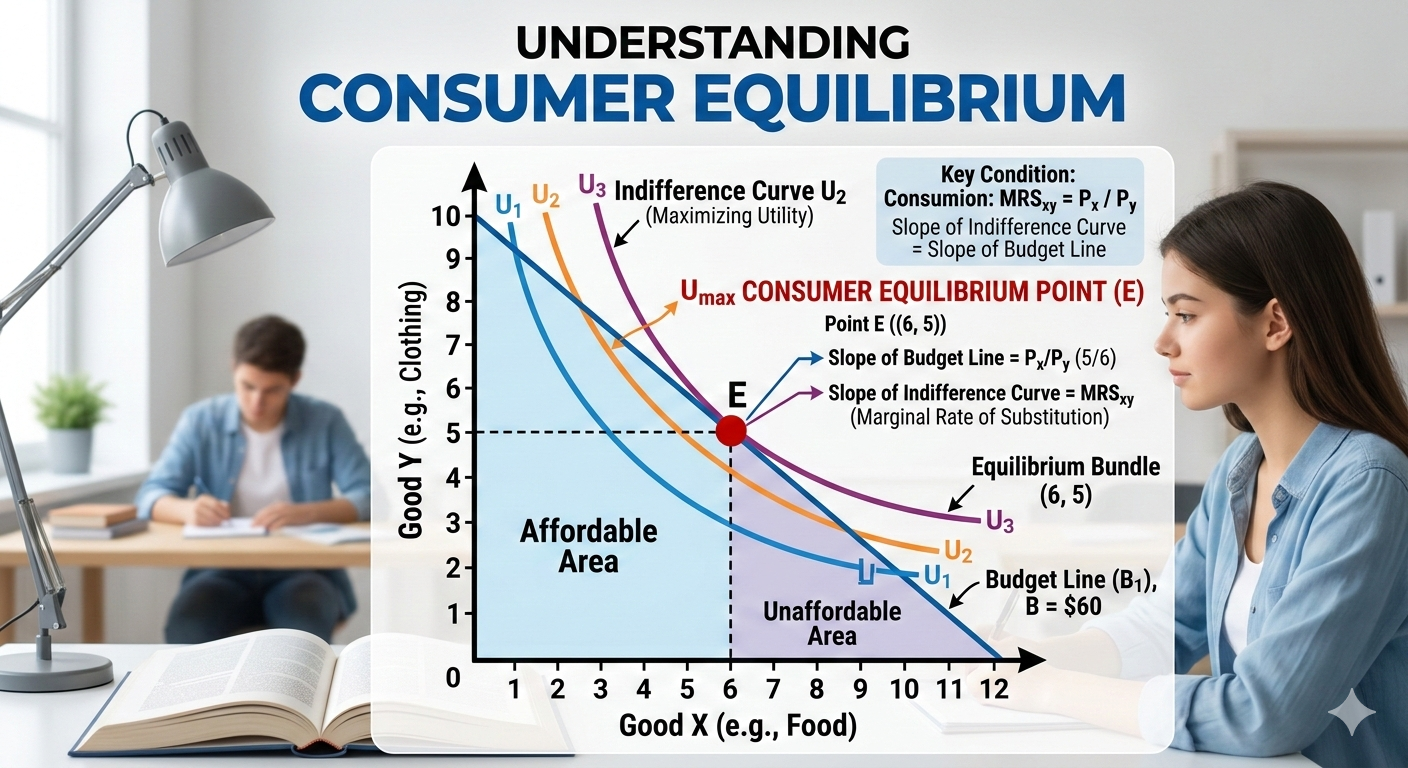
Consumer’s equilibrium refers to a situation where the consumer achieves maximum satisfaction from a given income and prices of goods. At this point, the consumer does not want to change the combination of goods purchased.
Consumer’s equilibrium can be explained using two approaches:
- Marginal Utility Analysis
- Indifference Curve Analysis
Marginal Utility Analysis
According to this approach, a consumer reaches equilibrium when the ratio of marginal utility to price is equal for all goods.
MUx / Px = MUy / Py
Where:
MUx = Marginal utility of good X
Px = Price of good X
MUy = Marginal utility of good Y
Py = Price of good Y
This condition ensures that the consumer gets maximum satisfaction from the available income.
Demand
Demand refers to the quantity of a commodity that consumers are willing and able to purchase at different prices during a specific period.
Demand depends on several factors such as income, tastes, preferences, prices of related goods, and expectations about future prices.
The concept of demand is an important part of Consumer’s Equilibrium and Demand Class 11 because it explains how consumer decisions influence market prices and production.
Law of Demand
The Law of Demand states that, other things remaining constant, the quantity demanded of a commodity decreases when its price increases and increases when its price decreases.
In simple terms, price and demand have an inverse relationship.
For example, when the price of a mobile phone decreases, more people are willing to buy it. When the price increases, fewer people buy it.
Demand Schedule and Demand Curve
A demand schedule is a table showing the relationship between price and quantity demanded.
A demand curve is a graphical representation of the demand schedule. It slopes downward from left to right, indicating the inverse relationship between price and quantity demanded.
The demand curve is an important concept in Consumer’s Equilibrium and Demand Class 11 because it visually represents consumer behavior in the market.
Factors Affecting Demand
Several factors influence demand for goods and services.
- Income of consumers
- Tastes and preferences
- Prices of related goods
- Population
- Expectations about future prices
Changes in these factors can increase or decrease demand.
Understanding these factors helps explain how markets operate and why demand for certain products changes over time.
The study of Consumer’s Equilibrium and Demand Class 11 provides important insights into consumer decision-making and market demand. It forms the foundation for understanding many other economic concepts in microeconomics.
Flowchart / Mind Map – Consumer’s Equilibrium and Demand
Consumer’s Equilibrium and Demand
│
├── Utility
│ ├ Total Utility
│ └ Marginal Utility
│
├── Law of Diminishing Marginal Utility
│
├── Consumer’s Equilibrium
│ ├ Marginal Utility Approach
│ └ Maximum Satisfaction
│
├── Demand
│ ├ Demand Schedule
│ └ Demand Curve
│
└── Law of Demand
└ Inverse relationship between price and demand
Important Keywords with Meanings
Utility
Satisfaction derived from consuming goods and services.
Total Utility
Total satisfaction obtained from consumption.
Marginal Utility
Additional satisfaction from consuming one more unit of a commodity.
Law of Diminishing Marginal Utility
Marginal utility decreases as consumption increases.
Consumer’s Equilibrium
A state where a consumer achieves maximum satisfaction.
Demand
Quantity of a commodity consumers are willing and able to buy.
Demand Schedule
Table showing relationship between price and quantity demanded.
Demand Curve
Graph showing the relationship between price and demand.
Law of Demand
States that demand decreases when price increases.
Important Questions and Answers
Short Answer Questions
1. What is consumer’s equilibrium?
Consumer’s equilibrium is the point at which a consumer obtains maximum satisfaction from a given income and prices of goods.
2. Define utility.
Utility is the satisfaction or benefit derived from consuming goods and services.
3. What is marginal utility?
Marginal utility is the additional satisfaction gained from consuming one more unit of a commodity.
4. State the law of demand.
The law of demand states that when the price of a commodity increases, its quantity demanded decreases, and when the price decreases, demand increases.
5. What is a demand schedule?
A demand schedule is a table showing the relationship between price and quantity demanded.
Long Answer Questions
1. Explain the law of diminishing marginal utility.
The law of diminishing marginal utility states that as a consumer consumes more units of a commodity, the additional satisfaction derived from each extra unit decreases.
For example, the first slice of pizza provides high satisfaction, but the fifth slice provides much less satisfaction.
This law explains consumer behavior and helps determine consumer equilibrium.
2. Explain consumer’s equilibrium with marginal utility approach.
According to the marginal utility approach, a consumer reaches equilibrium when the ratio of marginal utility to price is equal for all goods.
MUx/Px = MUy/Py
At this point, the consumer obtains maximum satisfaction and has no incentive to change the consumption pattern.
20 MCQs – Consumer’s Equilibrium and Demand
- Utility means
A Satisfaction
B Profit
C Cost
D Income
Answer: A - Marginal utility refers to
A Total satisfaction
B Additional satisfaction
C Cost of production
D Profit
Answer: B - The law of diminishing marginal utility states that
A MU increases
B MU decreases
C MU remains constant
D MU becomes negative
Answer: B - Consumer equilibrium means
A Minimum satisfaction
B Maximum satisfaction
C No satisfaction
D Equal income
Answer: B - Demand refers to
A Desire only
B Quantity willing to buy
C Production
D Supply
Answer: B - Demand curve slopes
A Upward
B Downward
C Vertical
D Horizontal
Answer: B - Demand schedule shows
A Price and supply
B Price and quantity demanded
C Income and demand
D Cost and profit
Answer: B - Law of demand shows
A Direct relationship
B Inverse relationship
C No relationship
D Equal relationship
Answer: B - Utility is
A Objective
B Subjective
C Fixed
D Permanent
Answer: B - Consumer equilibrium occurs when
A MU = Price
Answer: A - Demand depends on
A Income
B Taste
C Price
D All of these
Answer: D - Total utility refers to
A Total satisfaction
Answer: A - Demand curve represents
A Supply
B Demand
C Cost
D Profit
Answer: B - Marginal utility decreases due to
A Law of demand
B Law of diminishing marginal utility
C Law of supply
D Law of returns
Answer: B - Consumer equilibrium aims at
A Maximum satisfaction
Answer: A - Demand increases when
A Price decreases
Answer: A - Utility comes from
A Consumption
Answer: A - Demand curve shows
A Price-demand relationship
Answer: A - Law of demand assumes
A Other factors constant
Answer: A - Consumer behavior is studied in
A Microeconomics
Answer: A
Exam Tips / Value-Based Questions
- Understand formulas like MUx/Px = MUy/Py clearly.
- Practice drawing demand curves.
- Learn definitions of utility, marginal utility, and demand.
- Revise law of demand and its assumptions.
Value-Based Question
Why should consumers spend their income wisely?
Consumers should spend wisely because income is limited and resources are scarce. Efficient spending helps achieve maximum satisfaction.
Conclusion
The chapter Consumer’s Equilibrium and Demand Class 11 explains how consumers make rational decisions to maximize satisfaction from limited income. Concepts such as utility, marginal utility, law of demand, and demand curve help explain consumer behavior in the market.
Understanding Consumer’s Equilibrium and Demand Class 11 is essential for analyzing demand patterns, market prices, and economic decision-making. This chapter provides a strong foundation for further study of microeconomics and helps students perform better in examinations and competitive tests.
Consumer’s Equilibrium and Demand Class 11 – 80 Marks Question Paper
(NCERT Economics – Chapter: Consumer’s Equilibrium and Demand)
General Instructions
- All questions are compulsory.
- The question paper consists of 5 Sections (A–E).
- Use diagrams wherever required.
- Write answers in clear and concise language.
Section A – MCQs (1 × 10 = 10 Marks)
Choose the correct answer.
- Utility refers to
a) Profit from business
b) Satisfaction from consumption
c) Income from work
d) Cost of goods - Marginal utility means
a) Total satisfaction
b) Additional satisfaction from one more unit
c) Cost of production
d) Price of a commodity - The law of diminishing marginal utility states that
a) MU increases with consumption
b) MU decreases as consumption increases
c) MU remains constant
d) MU becomes infinite - Consumer equilibrium refers to
a) Maximum profit
b) Maximum satisfaction
c) Minimum cost
d) Equal income - Demand refers to
a) Desire for a commodity
b) Quantity willing and able to buy
c) Production of goods
d) Supply of goods - Demand curve generally slopes
a) Upward
b) Downward
c) Vertical
d) Horizontal - The law of demand shows
a) Direct relationship between price and demand
b) Inverse relationship between price and demand
c) Equal relationship
d) No relationship - A demand schedule shows
a) Relationship between price and supply
b) Relationship between price and demand
c) Relationship between cost and profit
d) Relationship between income and saving - Utility is
a) Objective
b) Subjective
c) Constant
d) Fixed - Consumer behaviour is mainly studied in
a) Macroeconomics
b) Microeconomics
c) Statistics
d) Accounting
Section B – Very Short Answer Questions (2 × 5 = 10 Marks)
Answer in 30–40 words.
- Define utility.
- What is marginal utility?
- What is consumer’s equilibrium?
- Define demand.
- What is a demand curve?
Section C – Short Answer Questions (4 × 5 = 20 Marks)
Answer in 80–100 words.
- Explain the concept of total utility and marginal utility.
- State and explain the law of diminishing marginal utility.
- Explain the law of demand with an example.
- Distinguish between demand schedule and demand curve.
- Explain the factors affecting demand.
Section D – Long Answer Questions (6 × 4 = 24 Marks)
Answer in 150–200 words.
- Explain the concept of consumer’s equilibrium using the marginal utility approach.
- Explain the assumptions and limitations of the law of demand.
- Discuss the relationship between price and demand with the help of a demand curve.
- Explain the importance of studying Consumer’s Equilibrium and Demand in economics.
Section E – Case Study / Application-Based Questions (8 × 2 = 16 Marks)
Case Study 1
Ravi buys chocolates regularly. The first chocolate gives him high satisfaction. When he eats more chocolates, the satisfaction from each additional chocolate decreases.
Questions
- Which economic law is illustrated in the passage?
- What is marginal utility?
- Why does satisfaction decrease with additional units?
- Give one example of diminishing marginal utility in daily life.
Case Study 2
The price of a mobile phone decreases in the market. As a result, more consumers start purchasing the mobile phone.
Questions
- Which economic law is illustrated in the passage?
- What is meant by demand?
- Why does demand increase when price decreases?
- Draw or explain the shape of the demand curve.
Total Marks: 80
If you want, I can also generate high-traffic SEO content for this chapter, such as:
- Solved 80 Marks Question Paper (Detailed Answers)
- 50 MCQs with explanations
- 3000+ Word Passage-Based Worksheet
- Case Study Questions for CBSE Board Exams
- SEO Featured Image for Consumer’s Equilibrium and Demand
These resources are useful for ranking your education blog and helping students prepare for exams.
Consumer’s Equilibrium and Demand Class 11 – Solved 80 Marks Question Paper (Detailed Answers)
(NCERT Economics – Chapter: Consumer’s Equilibrium and Demand)
General Instructions
- All questions are compulsory.
- Attempt the questions according to the marks allotted.
- Diagrams should be drawn wherever necessary.
Section A – MCQs (1 × 10 = 10 Marks)
1. Utility refers to
Answer: (b) Satisfaction from consumption
Explanation: Utility is the satisfaction or benefit derived from consuming goods and services.
2. Marginal utility means
Answer: (b) Additional satisfaction from one more unit
Explanation: Marginal utility refers to the extra satisfaction obtained from consuming one additional unit of a commodity.
3. The law of diminishing marginal utility states that
Answer: (b) MU decreases as consumption increases
Explanation: As more units of a commodity are consumed, the additional satisfaction from each extra unit decreases.
4. Consumer equilibrium refers to
Answer: (b) Maximum satisfaction
Explanation: Consumer equilibrium is the point where a consumer gets maximum satisfaction from a given income and prices.
5. Demand refers to
Answer: (b) Quantity willing and able to buy
Explanation: Demand refers to the quantity of a commodity that consumers are willing and able to purchase at a given price.
6. Demand curve generally slopes
Answer: (b) Downward
Explanation: The demand curve slopes downward due to the inverse relationship between price and quantity demanded.
7. The law of demand shows
Answer: (b) Inverse relationship between price and demand
Explanation: When price increases, demand decreases, and when price decreases, demand increases.
8. A demand schedule shows
Answer: (b) Relationship between price and demand
Explanation: A demand schedule shows the quantity demanded at different prices.
9. Utility is
Answer: (b) Subjective
Explanation: Utility varies from person to person depending on preferences and needs.
10. Consumer behaviour is mainly studied in
Answer: (b) Microeconomics
Explanation: Microeconomics studies individual economic units such as consumers and firms.
Section B – Very Short Answer Questions (2 × 5 = 10 Marks)
11. Define Utility.
Utility refers to the satisfaction or benefit that a consumer derives from consuming a good or service. It is a subjective concept because the level of satisfaction differs from person to person.
12. What is Marginal Utility?
Marginal utility is the additional satisfaction obtained from consuming one more unit of a commodity. It helps determine how consumers allocate their income among different goods.
13. What is Consumer’s Equilibrium?
Consumer’s equilibrium refers to the state in which a consumer obtains maximum satisfaction from a given income and prices of goods. At this point, the consumer has no incentive to change the combination of goods consumed.
14. Define Demand.
Demand refers to the quantity of a commodity that consumers are willing and able to purchase at different prices during a given period of time.
15. What is a Demand Curve?
A demand curve is a graphical representation showing the relationship between price and quantity demanded of a commodity. It usually slopes downward from left to right.
Section C – Short Answer Questions (4 × 5 = 20 Marks)
16. Explain the concept of Total Utility and Marginal Utility.
Total utility refers to the total satisfaction obtained from consuming a certain quantity of a commodity. It increases as more units of the commodity are consumed.
Marginal utility refers to the additional satisfaction gained from consuming one more unit of the commodity.
For example, if a person eats slices of pizza, the total satisfaction from all slices is total utility, while the extra satisfaction from the last slice is marginal utility.
17. State and explain the Law of Diminishing Marginal Utility.
The Law of Diminishing Marginal Utility states that as a consumer consumes more units of a commodity, the marginal utility derived from each additional unit decreases.
For example, the first glass of water provides great satisfaction to a thirsty person. However, the second or third glass gives less satisfaction, and eventually additional glasses provide very little satisfaction.
This law explains why consumers do not consume unlimited quantities of a commodity.
18. Explain the Law of Demand with an example.
The Law of Demand states that, other things remaining constant, the quantity demanded of a commodity decreases when its price increases and increases when its price decreases.
For example, if the price of a mobile phone falls, more consumers will be willing to buy it. If the price rises, fewer consumers will purchase it.
Thus, there is an inverse relationship between price and demand.
19. Distinguish between Demand Schedule and Demand Curve.
| Basis | Demand Schedule | Demand Curve |
|---|---|---|
| Meaning | A table showing price and quantity demanded | Graphical representation of demand |
| Form | Tabular | Diagrammatic |
| Use | Shows numerical relationship | Shows visual relationship |
| Example | Table of prices and quantities | Downward sloping curve |
20. Explain the factors affecting demand.
Demand for a commodity can change due to several factors:
Income of consumers – Higher income usually increases demand.
Tastes and preferences – Changes in fashion and preferences affect demand.
Prices of related goods – Demand depends on substitute and complementary goods.
Population – Larger population increases demand.
Future expectations – Expected price changes influence demand.
Section D – Long Answer Questions (6 × 4 = 24 Marks)
21. Explain Consumer’s Equilibrium using the Marginal Utility Approach.
According to the marginal utility approach, a consumer reaches equilibrium when the ratio of marginal utility to price is equal for all goods.
MUx / Px = MUy / Py
Where:
MUx = Marginal utility of good X
Px = Price of good X
MUy = Marginal utility of good Y
Py = Price of good Y
At this point, the consumer gets maximum satisfaction from the available income.
If the ratio is not equal, the consumer will shift expenditure toward the good that provides higher utility per rupee until equilibrium is achieved.
Thus, consumer equilibrium ensures efficient allocation of income.
22. Explain the assumptions and limitations of the Law of Demand.
Assumptions of the Law of Demand
- Income of consumers remains constant.
- Tastes and preferences remain unchanged.
- Prices of related goods remain constant.
- No expectations of future price changes.
Limitations of the Law of Demand
- It does not apply to luxury or prestige goods.
- It may not hold during emergencies.
- Expectations of future price changes may influence demand.
Despite these limitations, the law of demand is an important principle in economics.
23. Discuss the relationship between price and demand with the help of a demand curve.
The relationship between price and demand is inverse. When the price of a commodity increases, the quantity demanded decreases. When the price decreases, the quantity demanded increases.
This relationship is represented by a downward sloping demand curve.
The demand curve slopes downward due to:
- Law of diminishing marginal utility
- Substitution effect
- Income effect
The demand curve helps explain consumer behavior and market demand.
24. Explain the importance of studying Consumer’s Equilibrium and Demand.
The study of consumer’s equilibrium and demand is important for understanding how consumers make decisions regarding spending their income.
It helps explain how prices influence consumer behavior and demand for goods. Businesses use this information to determine pricing strategies and production levels.
Governments also use demand analysis to design economic policies and regulate markets.
Thus, understanding consumer equilibrium and demand helps analyze market behavior and economic decision-making.
Section E – Case Study / Application-Based Questions (8 × 2 = 16 Marks)
Case Study 1
25. Which economic law is illustrated in the passage?
The passage illustrates the Law of Diminishing Marginal Utility, which states that marginal utility decreases as consumption increases.
26. What is Marginal Utility?
Marginal utility is the additional satisfaction obtained from consuming one more unit of a commodity.
27. Why does satisfaction decrease with additional units?
Satisfaction decreases because the consumer’s need gradually becomes satisfied, reducing the additional satisfaction from each extra unit.
28. Give one example of diminishing marginal utility.
For example, the first slice of pizza gives high satisfaction, but the fifth slice gives much less satisfaction.
Case Study 2
29. Which economic law is illustrated in the passage?
The passage illustrates the Law of Demand.
30. What is meant by Demand?
Demand refers to the quantity of a commodity that consumers are willing and able to purchase at a given price.
31. Why does demand increase when price decreases?
Demand increases when price decreases because consumers can afford to buy more goods and substitute cheaper goods for expensive ones.
32. Explain the shape of the demand curve.
The demand curve slopes downward from left to right, indicating the inverse relationship between price and quantity demanded.
Total Marks: 80
If you want, I can also create high-ranking SEO educational content for this chapter such as:
- 50 MCQs with explanations
- 3000+ Word Passage-Based Worksheet
- Case Study Questions for CBSE Board Exams
- SEO Featured Image for Consumer’s Equilibrium and Demand
These resources are very effective for education blogs, student revision, and Google ranking.
Consumer’s Equilibrium and Demand – 50 MCQs with Answers
Class 11 Economics (NCERT) | Chapter: Consumer’s Equilibrium and Demand
MCQs on Utility
- Utility means
A. Profit from selling goods
B. Satisfaction from consuming goods
C. Income earned from work
D. Cost of production
Answer: B
- Utility is
A. Objective
B. Subjective
C. Fixed
D. Constant
Answer: B
- The concept of utility is related to
A. Production
B. Consumption
C. Distribution
D. Investment
Answer: B
- Total Utility refers to
A. Satisfaction from all units consumed
B. Satisfaction from the last unit
C. Satisfaction from the first unit
D. Satisfaction from production
Answer: A
- Marginal Utility refers to
A. Total satisfaction
B. Extra satisfaction from one more unit
C. Satisfaction from first unit
D. Satisfaction from many goods
Answer: B
MCQs on Law of Diminishing Marginal Utility
- The law of diminishing marginal utility was given by
A. Alfred Marshall
B. Adam Smith
C. Karl Marx
D. John Maynard Keynes
Answer: A
- According to the law of diminishing marginal utility, marginal utility
A. Increases continuously
B. Decreases with each additional unit
C. Remains constant
D. Becomes infinite
Answer: B
- The law of diminishing marginal utility applies when
A. Consumption increases continuously
B. Consumption decreases
C. Income increases
D. Supply decreases
Answer: A
- When marginal utility becomes zero, total utility becomes
A. Minimum
B. Maximum
C. Negative
D. Zero
Answer: B
- When marginal utility becomes negative, total utility
A. Increases
B. Decreases
C. Remains constant
D. Becomes zero
Answer: B
MCQs on Consumer’s Equilibrium
- Consumer equilibrium means
A. Maximum profit
B. Maximum satisfaction
C. Minimum cost
D. Equal income
Answer: B
- Consumer equilibrium is achieved when
A. MU > Price
B. MU = Price
C. MU < Price
D. MU = Income
Answer: B
- In marginal utility approach, equilibrium condition is
A. MUx/Px = MUy/Py
B. MUx = Px
C. TU = MU
D. Px = Py
Answer: A
- Consumer behaviour is studied in
A. Macroeconomics
B. Microeconomics
C. Statistics
D. Accounting
Answer: B
- Consumer equilibrium ensures
A. Maximum satisfaction with given income
B. Maximum production
C. Maximum profit
D. Maximum saving
Answer: A
MCQs on Demand
- Demand refers to
A. Desire for a product
B. Quantity willing and able to buy
C. Production of goods
D. Supply of goods
Answer: B
- Demand is effective only when
A. Desire exists
B. Purchasing power exists
C. Willingness to buy exists
D. All of these
Answer: D
- A demand schedule shows
A. Relationship between price and supply
B. Relationship between price and demand
C. Relationship between income and saving
D. Relationship between cost and profit
Answer: B
- Demand curve shows
A. Direct relationship
B. Inverse relationship
C. No relationship
D. Equal relationship
Answer: B
- The demand curve generally slopes
A. Upward
B. Downward
C. Vertical
D. Horizontal
Answer: B
MCQs on Law of Demand
- Law of demand states that
A. Price and demand move in same direction
B. Price and demand move in opposite direction
C. Demand remains constant
D. Price remains constant
Answer: B
- When price rises, demand
A. Increases
B. Decreases
C. Remains same
D. Becomes zero
Answer: B
- When price falls, demand
A. Increases
B. Decreases
C. Remains same
D. Stops
Answer: A
- The law of demand operates under
A. Ceteris paribus
B. Perfect competition
C. Monopoly
D. Inflation
Answer: A
- Ceteris paribus means
A. Everything changes
B. Other things remain constant
C. Demand increases
D. Price increases
Answer: B
MCQs on Factors Affecting Demand
- Demand for a good increases when
A. Income rises (normal goods)
B. Price rises
C. Supply decreases
D. Production decreases
Answer: A
- Substitute goods example
A. Tea and Coffee
B. Car and Petrol
C. Pen and Ink
D. Bread and Butter
Answer: A
- Complementary goods example
A. Tea and Coffee
B. Pen and Ink
C. Rice and Wheat
D. Butter and Jam
Answer: B
- When price of substitute good rises, demand for the good
A. Increases
B. Decreases
C. Remains constant
D. Stops
Answer: A
- When price of complementary good rises, demand
A. Increases
B. Decreases
C. Remains constant
D. Becomes infinite
Answer: B
MCQs on Demand Curve
- Demand curve slopes downward because of
A. Law of demand
B. Law of supply
C. Law of production
D. Law of cost
Answer: A
- Demand curve is drawn with
A. Price on X-axis
B. Quantity on Y-axis
C. Price on Y-axis and Quantity on X-axis
D. Quantity on both axes
Answer: C
- Movement along demand curve occurs due to
A. Change in price
B. Change in income
C. Change in taste
D. Change in population
Answer: A
- Shift in demand curve occurs due to
A. Change in price
B. Change in non-price factors
C. Change in supply
D. Change in cost
Answer: B
- Increase in demand shifts the curve
A. Leftward
B. Rightward
C. Upward
D. Downward
Answer: B
Advanced Concept MCQs
- Decrease in demand shifts the demand curve
A. Rightward
B. Leftward
C. Upward
D. Downward
Answer: B
- A demand curve represents
A. Demand schedule graphically
B. Supply schedule
C. Production function
D. Cost curve
Answer: A
- Which of the following affects demand?
A. Income
B. Price of related goods
C. Taste and preferences
D. All of these
Answer: D
- Consumer equilibrium occurs when
A. Satisfaction is minimum
B. Satisfaction is maximum
C. Utility is zero
D. Income is zero
Answer: B
- In equilibrium
A. MU > Price
B. MU < Price
C. MU = Price
D. MU = Income
Answer: C
Higher-Level MCQs
- Total utility increases at a decreasing rate when
A. MU increases
B. MU decreases but remains positive
C. MU becomes negative
D. MU is zero
Answer: B
- When MU = 0, TU is
A. Maximum
B. Minimum
C. Negative
D. Zero
Answer: A
- Utility analysis is mainly concerned with
A. Consumer behaviour
B. Producer behaviour
C. Government policy
D. Banking system
Answer: A
- Consumer equilibrium is studied under
A. Consumer theory
B. Producer theory
C. Distribution theory
D. Trade theory
Answer: A
- Demand depends on
A. Income
B. Taste
C. Price of related goods
D. All of these
Answer: D
- Example of inferior good
A. Rice
B. Wheat
C. Cheap clothing
D. Milk
Answer: C
- When income increases, demand for inferior goods
A. Increases
B. Decreases
C. Remains constant
D. Doubles
Answer: B
- Demand curve assumes
A. Income changes
B. Prices change
C. Other factors remain constant
D. Demand remains fixed
Answer: C
- The law of demand is based on
A. Utility theory
B. Supply theory
C. Production theory
D. Cost theory
Answer: A
- Economics that studies individual consumer behaviour is called
A. Macroeconomics
B. Microeconomics
C. Public finance
D. Statistics
Answer: B
If you want, I can also generate very high traffic educational content for your website/blog such as:
- 3000+ Word Passage-Based Worksheet (Google traffic content)
- SEO Optimized Chapter Notes (2500+ words)
- 100 MCQs with explanations for board exams
- Case Study Questions for CBSE 2026 pattern
- SEO Featured Image for the chapter
These resources are ideal for ranking education blogs on Google and getting AdSense approval.
b











Leave a Reply