


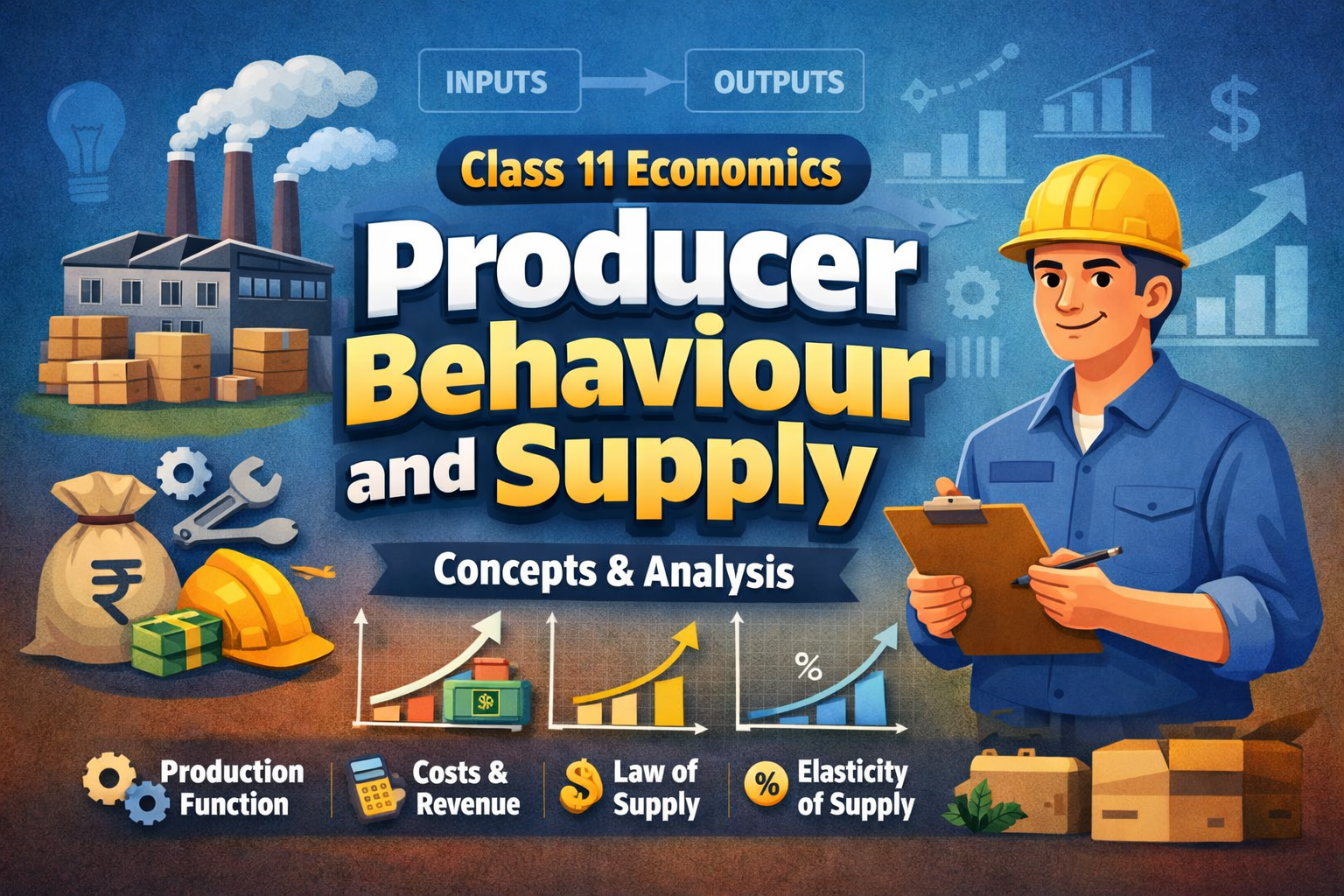
Meta Description
Complete guide to Producer Behaviour and Supply Class 11 Economics with summary, short notes, important questions, MCQs, keywords, and exam tips for quick revision.
Introduction to Producer Behaviour and Supply (Class 11 Economics)
The chapter Producer Behaviour and Supply Class 11 Economics explains how producers make decisions regarding production and supply of goods and services. While consumers try to maximize satisfaction, producers aim to maximize profits.
In economics, a producer decides how much to produce, what to produce, and how to produce by analyzing costs, technology, and market prices.
The chapter Producer Behaviour and Supply Class 11 Economics mainly focuses on:
- Meaning of production
- Production function
- Law of diminishing returns
- Cost concepts
- Revenue concepts
- Producer’s equilibrium
- Meaning and determinants of supply
- Law of supply
- Elasticity of supply
Understanding Producer Behaviour and Supply Class 11 Economics helps students learn how firms determine output and how supply responds to price changes in a market.
Short Notes – Producer Behaviour and Supply Class 11 Economics
Meaning of Production
- Production refers to the process of converting inputs into outputs.
- Inputs include land, labour, capital, and entrepreneur.
- Output refers to goods and services produced.
Production Function
- It shows the relationship between inputs and output.
- It explains how much output can be produced using given inputs.
Law of Diminishing Marginal Product
- As more units of a variable factor are used with fixed factors, marginal product eventually decreases.
Cost Concepts
Important cost concepts in Producer Behaviour and Supply Class 11 Economics include:
- Total Cost (TC)
- Total Fixed Cost (TFC)
- Total Variable Cost (TVC)
- Average Cost (AC)
- Marginal Cost (MC)
Revenue Concepts
Revenue means income earned by the producer.
Types include:
- Total Revenue (TR)
- Average Revenue (AR)
- Marginal Revenue (MR)
Producer’s Equilibrium
Producer’s equilibrium is the level of output where profit is maximum.
Two conditions:
- MR = MC
- MC curve cuts MR from below
Meaning of Supply
Supply refers to the quantity of a commodity that a producer is willing to sell at different prices during a given period.
Law of Supply
It states that price and quantity supplied are positively related, assuming other factors remain constant.
Elasticity of Supply
Elasticity of supply measures the degree of responsiveness of supply to changes in price.
Detailed Summary – Producer Behaviour and Supply Class 11 Economics
The chapter Producer Behaviour and Supply Class 11 Economics deals with the behaviour of producers in an economy. Just like consumers try to maximize satisfaction, producers aim to maximize profits.
A producer uses various factors of production such as land, labour, capital, and entrepreneurship to produce goods and services. The main objective of a firm is to produce goods efficiently and sell them at a price that provides maximum profit.
Production Function
In Producer Behaviour and Supply Class 11 Economics, the production function shows the relationship between inputs and output.
It can be expressed as:
Q = f (L, K)
Where:
- Q = Output
- L = Labour
- K = Capital
This function explains how output changes when inputs change.
There are two types of inputs:
- Fixed Factors
These factors remain constant in the short run. Example: machinery, building. - Variable Factors
These factors change with production level. Example: labour, raw material.
Short Run and Long Run
The concept of short run and long run is important in Producer Behaviour and Supply Class 11 Economics.
Short Run
- At least one factor is fixed.
- Production increases mainly by increasing variable factors.
Long Run
- All factors are variable.
- Firms can change scale of production.
Law of Diminishing Marginal Product
One of the most important concepts in Producer Behaviour and Supply Class 11 Economics is the Law of Diminishing Marginal Product.
It states that when additional units of a variable factor are employed with fixed factors, the marginal product eventually decreases.
Stages of Production
Production occurs in three stages:
Stage 1 – Increasing Returns
- Total product increases rapidly.
- Marginal product rises.
Stage 2 – Diminishing Returns
- Total product increases at decreasing rate.
- Marginal product falls but remains positive.
Stage 3 – Negative Returns
- Total product starts falling.
- Marginal product becomes negative.
A rational producer operates in Stage 2.
Cost Concepts
Cost is the expenditure incurred by producers to produce goods.
Total Cost (TC)
Total cost is the sum of total fixed cost and total variable cost.
TC = TFC + TVC
Total Fixed Cost (TFC)
These costs remain constant regardless of output.
Examples:
- Rent
- Salaries
- Insurance
Total Variable Cost (TVC)
These costs change with production level.
Examples:
- Raw material
- Wages
Average Cost (AC)
AC = TC / Q
It represents cost per unit of output.
Marginal Cost (MC)
MC is the additional cost incurred in producing one more unit of output.
MC = Change in TC / Change in Output
In Producer Behaviour and Supply Class 11 Economics, the MC curve plays a crucial role in determining producer equilibrium.
Revenue Concepts
Revenue refers to the income earned from selling goods.
Total Revenue (TR)
TR = Price × Quantity Sold
Average Revenue (AR)
AR = TR / Q
Marginal Revenue (MR)
MR = Change in TR / Change in Quantity
These revenue concepts help in determining profit maximization.
Producer’s Equilibrium
Producer’s equilibrium is the level of output where profit is maximum.
Two conditions for equilibrium in Producer Behaviour and Supply Class 11 Economics are:
- Marginal Revenue = Marginal Cost (MR = MC)
- MC curve must cut MR from below
At this point, producers neither increase nor decrease output.
Meaning of Supply
Supply refers to the quantity of goods that producers are willing to sell at different prices during a given time period.
Supply is influenced by various factors such as:
- Price of the commodity
- Cost of production
- Technology
- Government policy
- Number of firms
Law of Supply
The Law of Supply states that other things remaining constant, quantity supplied increases when price increases.
Reasons behind the law of supply:
- Profit motive
- Entry of new firms
- Expansion of production
This law is represented by an upward-sloping supply curve.
Elasticity of Supply
Elasticity of supply measures how responsive supply is to price changes.
Formula:
Es = Percentage change in quantity supplied / Percentage change in price
Types of elasticity of supply include:
- Perfectly elastic supply
- Perfectly inelastic supply
- Relatively elastic supply
- Relatively inelastic supply
- Unitary elastic supply
The concept of elasticity helps producers understand how supply reacts to price changes in markets.
Thus, the chapter Producer Behaviour and Supply Class 11 Economics explains production decisions, cost analysis, revenue generation, and supply behaviour of firms in the market.
Flowchart / Mind Map – Producer Behaviour and Supply
Producer Behaviour and Supply
↓
Production
→ Factors of Production
→ Production Function
↓
Law of Diminishing Marginal Product
↓
Cost Concepts
→ Total Cost
→ Fixed Cost
→ Variable Cost
→ Average Cost
→ Marginal Cost
↓
Revenue Concepts
→ Total Revenue
→ Average Revenue
→ Marginal Revenue
↓
Producer’s Equilibrium
→ MR = MC
↓
Supply
→ Meaning of Supply
→ Law of Supply
→ Elasticity of Supply
Important Keywords – Producer Behaviour and Supply Class 11 Economics
Production
Process of converting inputs into outputs.
Production Function
Relationship between input quantities and output.
Marginal Product
Additional output produced by one more unit of input.
Total Cost
Total expenditure incurred in production.
Marginal Cost
Additional cost of producing one more unit.
Total Revenue
Total income earned from selling goods.
Marginal Revenue
Additional revenue earned by selling one more unit.
Supply
Quantity of goods producers are willing to sell.
Law of Supply
Price and supply move in the same direction.
Elasticity of Supply
Responsiveness of supply to price changes.
Important Questions and Answers
Short Answer Questions
1. What is production?
Production is the process of transforming inputs such as labour, land, and capital into goods and services.
2. What is a production function?
A production function shows the relationship between inputs used and output produced.
3. What is marginal cost?
Marginal cost is the additional cost incurred in producing one more unit of output.
4. What is supply?
Supply refers to the quantity of a commodity that producers are willing to sell at various prices during a given period.
5. State the law of supply.
The law of supply states that quantity supplied increases when price increases, other things remaining constant.
Long Answer Questions
1. Explain the law of diminishing marginal product.
The law of diminishing marginal product states that when additional units of a variable factor are used with fixed factors, the marginal product eventually decreases.
Initially productivity increases because resources are used efficiently. However, after a certain point, overcrowding of the variable factor reduces productivity.
This law is important in Producer Behaviour and Supply Class 11 Economics because it explains why marginal cost rises after a certain level of output.
2. Explain the conditions of producer’s equilibrium.
Producer’s equilibrium refers to the level of output where profit is maximum.
Two conditions must be satisfied:
First Condition
Marginal Revenue must equal Marginal Cost (MR = MC).
Second Condition
The Marginal Cost curve must cut the Marginal Revenue curve from below.
If these conditions are not satisfied, the producer can increase profit by changing the level of output.
20 MCQs – Producer Behaviour and Supply Class 11 Economics
- Production means
A. Consumption
B. Creation of utility
C. Selling goods
D. Buying goods
Answer: B
- Production function shows relation between
A. Cost and revenue
B. Inputs and output
C. Price and demand
D. Supply and demand
Answer: B
- Law of diminishing returns operates in
A. Short run
B. Long run
C. Both
D. None
Answer: A
- Total cost equals
A. TFC + TVC
B. TC – TVC
C. TC – TFC
D. AC × MC
Answer: A
- Fixed cost does not change with
A. Output
B. Price
C. Revenue
D. Demand
Answer: A
- Marginal cost means
A. Cost per unit
B. Additional cost of one more unit
C. Total cost
D. Fixed cost
Answer: B
- Total revenue equals
A. Price × Quantity
B. Cost × Quantity
C. Price + Quantity
D. Cost + Quantity
Answer: A
- Producer equilibrium occurs when
A. MC > MR
B. MR > MC
C. MR = MC
D. AR = MR
Answer: C
- Supply refers to
A. Demand for goods
B. Quantity sold
C. Quantity producers are willing to sell
D. Stock of goods
Answer: C
- Supply curve slopes
A. Downward
B. Upward
C. Horizontal
D. Vertical
Answer: B
- Elasticity of supply measures
A. Demand change
B. Price change
C. Responsiveness of supply
D. Cost change
Answer: C
- Stage of rational production is
A. Stage 1
B. Stage 2
C. Stage 3
D. None
Answer: B
- Average cost equals
A. TC / Q
B. Q / TC
C. TC × Q
D. MC / Q
Answer: A
- Marginal revenue equals
A. Change in TR
B. Change in TR / Change in Q
C. TR / Q
D. TR × Q
Answer: B
- Supply increases when price
A. Falls
B. Rises
C. Constant
D. Zero
Answer: B
- Example of variable cost
A. Rent
B. Salaries
C. Raw material
D. Insurance
Answer: C
- Production requires
A. Labour only
B. Capital only
C. Factors of production
D. Demand
Answer: C
- Law of supply shows
A. Negative relation
B. Positive relation
C. No relation
D. Random relation
Answer: B
- Producer aims to maximize
A. Utility
B. Profit
C. Demand
D. Supply
Answer: B
- Supply depends on
A. Price
B. Technology
C. Number of firms
D. All of these
Answer: D
Exam Tips / Value-Based Questions
Exam Tips
- Always remember the MR = MC rule for producer equilibrium.
- Practice diagrams of MC, AC, and supply curves.
- Understand the difference between fixed cost and variable cost.
- Revise formulas of revenue and elasticity.
- Learn definitions clearly for short answer questions.
Value-Based Question
A factory owner increases production but ensures workers get proper wages and safe working conditions.
Question: What values are reflected here?
Answer:
- Social responsibility
- Ethical business practices
- Welfare of workers
Conclusion – Producer Behaviour and Supply Class 11 Economics
The chapter Producer Behaviour and Supply Class 11 Economics explains how producers make decisions regarding production and supply in a market economy. It covers important concepts such as production function, law of diminishing marginal product, cost and revenue analysis, producer’s equilibrium, and supply.
Understanding Producer Behaviour and Supply Class 11 Economics helps students learn how firms maximize profits and how supply responds to price changes. The concepts are essential not only for board examinations but also for competitive exams and higher studies in economics.
With proper understanding of Producer Behaviour and Supply Class 11 Economics, students can easily analyze production decisions, cost behavior, and market supply in real-world economic situations.
Class 11 Economics
Producer Behaviour and Supply – 80 Marks Question Paper
Time: 3 Hours
Maximum Marks: 80
Section A – Very Short Answer Questions
(1 × 10 = 10 Marks)
Answer the following questions in one sentence.
- Define production in economics.
- What is meant by a production function?
- Define marginal product.
- What is meant by fixed cost?
- Define marginal cost.
- What is meant by producer’s equilibrium?
- Define supply.
- What is meant by elasticity of supply?
- State the law of supply.
- What is total revenue?
Section B – Short Answer Questions
(3 × 6 = 18 Marks)
Answer the following questions in about 60–80 words.
- Explain the concept of a production function.
- Distinguish between fixed factors and variable factors of production.
- Explain the relationship between Total Product and Marginal Product.
- What are the different types of costs in the short run?
- Explain the meaning of Total Revenue, Average Revenue and Marginal Revenue.
- Explain the determinants of supply.
Section C – Medium Answer Questions
(4 × 6 = 24 Marks)
Answer the following questions in about 100–120 words.
- Explain the Law of Diminishing Marginal Product with a suitable example.
- Explain the relationship between Average Cost and Marginal Cost.
- Explain the conditions of Producer’s Equilibrium using the Marginal Cost and Marginal Revenue approach.
- Explain the Law of Supply with the help of a schedule or diagram.
- Explain the concept and types of Elasticity of Supply.
- Explain the factors affecting elasticity of supply.
Section D – Long Answer Questions
(6 × 3 = 18 Marks)
Answer the following questions in about 150–200 words.
- Explain the three stages of the Law of Variable Proportions with the help of a diagram.
- Explain different revenue concepts (TR, AR, MR) and their relationship.
- Explain the factors determining supply of a commodity in detail.
Section E – Case Study / Application-Based Questions
(5 × 2 = 10 Marks)
Case Study 1
A farmer increases the number of labourers working on his field while the size of land remains the same. Initially production increases rapidly, but after some time the increase in output becomes smaller.
Answer the following questions:
- Which law is illustrated in the above situation?
- Why does output increase initially?
- Why does marginal product start falling after some time?
- In which stage should the producer operate?
- Why is the third stage considered irrational?
Internal Choice (Optional Questions)
Students may attempt the following questions instead of the corresponding question number.
- Write short notes on Total Fixed Cost and Total Variable Cost.
- Explain Producer’s Equilibrium with the help of Total Revenue and Total Cost approach.
If you want, I can also create:
• Solved 80 Marks Paper (Detailed Answers – 2500+ words)
• CBSE Board Pattern Question Paper PDF
• Case Study Based Questions (20 Questions)
• Numerical Questions for Producer Behaviour and Supply
Just tell me.
Class 11 Economics
Producer Behaviour and Supply – Solved 80 Marks Question Paper (Detailed Answers)
Time: 3 Hours
Maximum Marks: 80
This Solved Question Paper for Producer Behaviour and Supply Class 11 Economics is designed according to the CBSE examination pattern. The answers are written in a clear, exam-oriented format to help students prepare effectively for board exams and competitive examinations.
Section A – Very Short Answer Questions
(1 × 10 = 10 Marks)
1. Define production in economics.
Production refers to the process of converting inputs into outputs in order to create goods and services that satisfy human wants. In economics, production does not simply mean manufacturing physical goods but also includes creating utility or usefulness.
For example, when a farmer grows wheat or a factory manufactures clothes, both activities are considered production because they create goods that satisfy human needs.
The main factors of production used in the production process include:
- Land
- Labour
- Capital
- Entrepreneurship
Thus, production is the economic activity of transforming resources into goods and services.
2. What is meant by a production function?
A production function shows the relationship between inputs used in production and the output produced. It explains how different quantities of factors of production result in different levels of output.
It can be expressed as:
Q = f (L, K)
Where:
Q = Quantity of output
L = Labour
K = Capital
The production function helps producers understand how efficiently resources are used in production.
3. Define marginal product.
Marginal product refers to the additional output produced by employing one more unit of a variable factor while keeping other factors constant.
Formula:
Marginal Product = Change in Total Product / Change in Quantity of Variable Factor
For example, if employing an additional worker increases output from 50 units to 60 units, the marginal product of that worker is 10 units.
4. What is meant by fixed cost?
Fixed cost refers to the costs that remain constant regardless of the level of production. These costs do not change even when output increases or decreases.
Examples include:
- Rent of factory building
- Salaries of permanent staff
- Insurance expenses
- Depreciation of machinery
Fixed costs must be paid even if the firm produces zero output.
5. Define marginal cost.
Marginal cost refers to the additional cost incurred in producing one more unit of output.
Formula:
Marginal Cost = Change in Total Cost / Change in Output
Marginal cost plays an important role in determining the optimal level of production and in achieving producer’s equilibrium.
6. What is meant by producer’s equilibrium?
Producer’s equilibrium refers to the level of output at which a producer earns maximum profit and has no incentive to increase or decrease production.
This occurs when:
Marginal Revenue (MR) = Marginal Cost (MC)
At this point, the firm achieves the best possible combination of costs and revenues.
7. Define supply.
Supply refers to the quantity of a commodity that producers are willing and able to sell at different prices during a given period of time, assuming other factors remain constant.
Supply is influenced by factors such as:
- Price of the commodity
- Cost of production
- Technology
- Government policies
8. What is meant by elasticity of supply?
Elasticity of supply measures the degree of responsiveness of quantity supplied to a change in price.
Formula:
Elasticity of Supply = Percentage Change in Quantity Supplied / Percentage Change in Price
If supply changes significantly when price changes, supply is considered elastic.
9. State the law of supply.
The law of supply states that other things remaining constant, the quantity supplied of a commodity increases when its price increases and decreases when its price decreases.
Thus, price and supply have a direct or positive relationship.
10. What is total revenue?
Total revenue refers to the total income received by a firm from selling its goods or services.
Formula:
Total Revenue = Price × Quantity Sold
For example, if a firm sells 100 units at ₹10 each, total revenue will be ₹1000.
Section B – Short Answer Questions
(3 × 6 = 18 Marks)
11. Explain the concept of a production function.
A production function represents the technical relationship between inputs used in production and the maximum output that can be produced with those inputs.
It explains how output changes when the quantity of inputs changes.
A production function can be expressed as:
Q = f (L, K)
Where:
- Q = Output
- L = Labour
- K = Capital
The production function assumes that technology remains constant.
There are two types of inputs:
Fixed Inputs
These inputs remain constant in the short run. Examples include machinery, land, and factory buildings.
Variable Inputs
These inputs can be changed in the short run, such as labour and raw materials.
The production function is important because it helps producers:
- Determine efficient use of resources
- Increase productivity
- Analyze cost behavior
- Plan production levels
Thus, the production function plays a crucial role in understanding producer behaviour.
12. Distinguish between fixed factors and variable factors of production.
| Basis | Fixed Factors | Variable Factors |
|---|---|---|
| Meaning | Factors that remain constant in the short run | Factors that can be changed easily |
| Nature | Do not change with output | Change with level of output |
| Examples | Machinery, building, land | Labour, raw materials |
| Role in production | Provide basic infrastructure | Directly influence level of output |
Fixed factors create the production capacity, while variable factors determine how much output is produced within that capacity.
13. Explain the relationship between Total Product and Marginal Product.
Total Product (TP) refers to the total quantity of output produced using a given amount of variable factors.
Marginal Product (MP) refers to the additional output produced by employing one more unit of variable factor.
The relationship between TP and MP can be explained as follows:
- When MP increases, TP increases at an increasing rate.
- When MP decreases but remains positive, TP increases at a decreasing rate.
- When MP becomes zero, TP reaches its maximum.
- When MP becomes negative, TP starts declining.
This relationship helps producers understand the optimal level of employment of variable factors.
14. What are the different types of costs in the short run?
In the short run, costs are classified into two main types:
Fixed Costs
Fixed costs remain constant regardless of output level. These costs must be paid even if production stops.
Examples include:
- Rent
- Salaries of permanent staff
- Insurance
- Interest on loans
Variable Costs
Variable costs change with the level of production.
Examples include:
- Raw materials
- Wages of temporary workers
- Fuel and electricity
Total Cost
Total cost is the sum of fixed and variable costs.
TC = TFC + TVC
Understanding cost structure helps firms control expenses and maximize profits.
15. Explain the meaning of Total Revenue, Average Revenue and Marginal Revenue.
Revenue refers to the income earned from selling goods or services.
Total Revenue (TR)
Total revenue is the total income received from selling output.
TR = Price × Quantity Sold
Average Revenue (AR)
Average revenue refers to revenue earned per unit of output.
AR = TR / Q
In most cases, average revenue equals the price of the product.
Marginal Revenue (MR)
Marginal revenue refers to additional revenue earned by selling one more unit of output.
MR = Change in TR / Change in Quantity
These revenue concepts are important for determining producer equilibrium.
16. Explain the determinants of supply.
Supply of a commodity depends on several factors:
Price of the Commodity
Higher prices encourage producers to supply more goods because profits increase.
Cost of Production
If production costs increase, supply decreases because profits decline.
Technology
Improved technology increases productivity and reduces costs, leading to higher supply.
Government Policy
Taxes reduce supply, while subsidies encourage production.
Number of Firms
If more firms enter the industry, total market supply increases.
These factors help determine how much producers are willing to supply.
Section C – Medium Answer Questions
(24 Marks)
17. Explain the Law of Diminishing Marginal Product.
The law of diminishing marginal product states that when additional units of a variable factor are employed with fixed factors, the marginal product eventually decreases.
Initially, increasing labour leads to better utilization of resources and higher productivity. However, after a certain point, overcrowding of workers reduces efficiency.
Reasons for this law include:
- Limited fixed factors
- Inefficient coordination
- Overuse of resources
Example:
If a farmer increases the number of workers on a fixed piece of land, output initially rises rapidly. But after some time, additional workers contribute less to output.
This law helps firms determine optimal input usage.
18. Explain the relationship between Average Cost and Marginal Cost.
Average cost (AC) is the cost per unit of output.
AC = TC / Q
Marginal cost (MC) is the additional cost of producing one more unit.
Relationship:
- When MC is less than AC, AC falls.
- When MC equals AC, AC is minimum.
- When MC is greater than AC, AC rises.
This relationship is important for understanding cost behavior in production.
19. Explain the conditions of Producer’s Equilibrium using the Marginal Cost and Marginal Revenue approach.
Producer equilibrium occurs when a firm maximizes profit.
Two conditions must be satisfied:
First Condition
Marginal Revenue must equal Marginal Cost.
MR = MC
Second Condition
The MC curve must cut the MR curve from below.
If MR is greater than MC, the firm should increase production.
If MC is greater than MR, the firm should reduce production.
Thus, equilibrium occurs only when both conditions are satisfied.
20. Explain the Law of Supply.
The law of supply states that quantity supplied increases when price increases and decreases when price decreases, assuming other factors remain constant.
Reasons for the law of supply:
- Higher prices lead to higher profits
- Firms increase production
- New firms enter the industry
The supply curve slopes upward from left to right, showing a positive relationship between price and supply.
21. Explain the concept and types of Elasticity of Supply.
Elasticity of supply measures how responsive supply is to changes in price.
Types include:
- Perfectly elastic supply
- Perfectly inelastic supply
- Relatively elastic supply
- Relatively inelastic supply
- Unitary elastic supply
This concept helps producers understand market responsiveness.
22. Explain the factors affecting elasticity of supply.
Important factors include:
- Nature of goods
- Availability of resources
- Time period
- Production capacity
- Mobility of factors
These factors determine how quickly supply can respond to price changes.
Section D – Long Answer Questions
(18 Marks)
23. Explain the three stages of the Law of Variable Proportions.
The law of variable proportions explains the relationship between variable input and output when other factors remain constant.
Stage 1 – Increasing Returns
In this stage:
- Total product increases rapidly
- Marginal product increases
Reasons include better use of fixed factors and specialization.
Stage 2 – Diminishing Returns
In this stage:
- Total product increases at decreasing rate
- Marginal product decreases but remains positive
This stage is considered the rational stage of production.
Stage 3 – Negative Returns
In this stage:
- Total product starts declining
- Marginal product becomes negative
This occurs because of excessive use of variable factors.
24. Explain different revenue concepts and their relationship.
Revenue refers to the income earned by a firm from selling goods.
Total Revenue
TR = Price × Quantity
Average Revenue
AR = TR / Q
Marginal Revenue
MR = Change in TR / Change in Q
Relationship:
- When MR > AR, AR increases
- When MR = AR, AR is constant
- When MR < AR, AR decreases
These concepts help firms determine profit-maximizing output.
25. Explain the factors determining supply of a commodity.
Supply depends on several factors:
Price of Commodity
Higher prices encourage producers to supply more goods.
Cost of Production
Lower production costs increase supply.
Technology
Improved technology increases production efficiency.
Government Policies
Taxes decrease supply, while subsidies increase it.
Prices of Related Goods
Producers may switch production depending on profitability.
Number of Firms
More firms increase market supply.
Understanding these factors helps analyze market behavior and price determination.
Section E – Case Study
Case Study 1
A farmer increases the number of labourers working on his field while the size of land remains the same.
26. Which law is illustrated?
The Law of Diminishing Marginal Product.
27. Why does output increase initially?
Because labour and fixed resources are used more efficiently.
28. Why does marginal product fall later?
Due to overcrowding of workers and limited fixed resources.
29. In which stage should the producer operate?
The producer should operate in Stage 2, where marginal product is positive but decreasing.
30. Why is Stage 3 irrational?
Because additional workers reduce total output, causing losses.
Conclusion
The chapter Producer Behaviour and Supply Class 11 Economics explains how producers make decisions regarding production, cost management, and supply of goods in the market.
By understanding key concepts such as production function, law of diminishing marginal product, cost analysis, revenue concepts, producer equilibrium, and supply, students can analyze how firms maximize profits and respond to market changes.
Mastering Producer Behaviour and Supply Class 11 Economics is essential for scoring high marks in board examinations and for building a strong foundation in economics.
Producer Behaviour and Supply Class 11 Economics – 50 MCQs with Answers
The following multiple choice questions on Producer Behaviour and Supply Class 11 Economics are designed according to the CBSE examination pattern. These MCQs help students revise important concepts such as production function, law of diminishing marginal product, cost concepts, revenue concepts, producer’s equilibrium, supply, law of supply, and elasticity of supply.
Section A – MCQs (1 Mark Each)
1. Production in economics means
A. Manufacturing goods only
B. Creation of utility
C. Consumption of goods
D. Distribution of goods
Answer: B
2. Production function shows the relationship between
A. Price and demand
B. Inputs and output
C. Cost and revenue
D. Supply and demand
Answer: B
3. Which of the following is a variable factor of production?
A. Land
B. Machinery
C. Labour
D. Building
Answer: C
4. Which of the following is a fixed factor in the short run?
A. Labour
B. Raw material
C. Land
D. Fuel
Answer: C
5. Marginal product refers to
A. Total output produced
B. Average output per unit
C. Additional output from one more unit of input
D. Minimum output produced
Answer: C
6. The law of diminishing marginal product operates in
A. Long run
B. Short run
C. Both short and long run
D. None of these
Answer: B
7. When marginal product increases, total product
A. Decreases
B. Increases at increasing rate
C. Remains constant
D. Decreases rapidly
Answer: B
8. When marginal product becomes zero, total product is
A. Maximum
B. Minimum
C. Constant
D. Negative
Answer: A
9. When marginal product becomes negative, total product
A. Increases
B. Decreases
C. Remains constant
D. Becomes zero
Answer: B
10. The rational stage of production is
A. Stage 1
B. Stage 2
C. Stage 3
D. Stage 4
Answer: B
11. Total cost is equal to
A. TFC + TVC
B. TC – TVC
C. TC – TFC
D. AC × MC
Answer: A
12. Fixed costs are those costs which
A. Change with output
B. Remain constant with output
C. Increase with price
D. Decrease with production
Answer: B
13. Which of the following is an example of fixed cost?
A. Raw material
B. Electricity charges
C. Rent of factory building
D. Wages of labour
Answer: C
14. Variable costs change with
A. Price
B. Output level
C. Demand
D. Supply
Answer: B
15. Marginal cost is defined as
A. Total cost per unit
B. Additional cost of producing one more unit
C. Fixed cost per unit
D. Total revenue per unit
Answer: B
16. Average cost is calculated as
A. TC × Q
B. TC / Q
C. Q / TC
D. MC / Q
Answer: B
17. Total revenue equals
A. Price × Quantity
B. Cost × Quantity
C. Price + Quantity
D. Cost + Quantity
Answer: A
18. Average revenue is equal to
A. Price of the commodity
B. Total cost
C. Marginal cost
D. Fixed cost
Answer: A
19. Marginal revenue is
A. Change in total revenue due to change in output
B. Total revenue divided by output
C. Price multiplied by quantity
D. Cost per unit
Answer: A
20. Producer equilibrium occurs when
A. MR > MC
B. MR < MC
C. MR = MC
D. AR = MR
Answer: C
21. For equilibrium, MC curve must cut MR curve
A. From above
B. From below
C. Horizontally
D. Vertically
Answer: B
22. Supply refers to
A. Quantity demanded
B. Quantity produced
C. Quantity sellers are willing to sell
D. Stock of goods
Answer: C
23. Law of supply shows
A. Negative relationship between price and supply
B. Positive relationship between price and supply
C. No relationship
D. Random relationship
Answer: B
24. Supply curve slopes
A. Downward
B. Upward
C. Horizontal
D. Vertical
Answer: B
25. Which of the following increases supply?
A. Increase in production cost
B. Improvement in technology
C. Increase in taxes
D. Decrease in number of firms
Answer: B
Section B – Concept-Based MCQs
26. Which factor affects supply?
A. Price of commodity
B. Cost of production
C. Technology
D. All of these
Answer: D
27. Elasticity of supply measures
A. Demand change
B. Responsiveness of supply to price change
C. Change in cost
D. Change in production
Answer: B
28. If supply does not change with price, supply is
A. Perfectly elastic
B. Perfectly inelastic
C. Unitary elastic
D. Relatively elastic
Answer: B
29. If small price change causes large change in supply, supply is
A. Perfectly inelastic
B. Perfectly elastic
C. Relatively elastic
D. Relatively inelastic
Answer: C
30. In the long run, elasticity of supply is generally
A. Less
B. More
C. Zero
D. Negative
Answer: B
31. Which stage of production is irrational?
A. Stage 1
B. Stage 2
C. Stage 3
D. All stages
Answer: C
32. Marginal product starts falling in
A. Stage 1
B. Stage 2
C. Stage 3
D. Stage 4
Answer: B
33. Total product is maximum when
A. MP is maximum
B. MP is zero
C. MP is negative
D. MP equals TP
Answer: B
34. Which cost curve is U-shaped?
A. Average cost
B. Marginal cost
C. Both AC and MC
D. Fixed cost
Answer: C
35. If MC is below AC, AC will
A. Rise
B. Fall
C. Remain constant
D. Become zero
Answer: B
36. If MC is above AC, AC will
A. Rise
B. Fall
C. Remain constant
D. Become negative
Answer: A
37. When MC equals AC, AC is
A. Maximum
B. Minimum
C. Zero
D. Negative
Answer: B
38. Total fixed cost curve is
A. Horizontal line
B. Upward sloping
C. Downward sloping
D. Vertical
Answer: A
39. Total variable cost curve is
A. Upward sloping
B. Horizontal
C. Downward sloping
D. Vertical
Answer: A
40. The main objective of a producer is to
A. Maximize utility
B. Maximize profit
C. Increase demand
D. Reduce supply
Answer: B
Section C – Higher Order MCQs
41. Supply increases due to
A. Increase in tax
B. Improvement in technology
C. Increase in cost
D. Decrease in productivity
Answer: B
42. When price rises from ₹10 to ₹15 and supply increases significantly, supply is
A. Inelastic
B. Elastic
C. Perfectly inelastic
D. Zero
Answer: B
43. Which curve represents law of supply?
A. Downward sloping curve
B. Upward sloping curve
C. Vertical curve
D. Horizontal curve
Answer: B
44. Which factor reduces supply?
A. Subsidy
B. Improved technology
C. Increase in taxes
D. Increase in firms
Answer: C
45. In producer equilibrium
A. Profit is minimum
B. Profit is maximum
C. Cost is maximum
D. Output is zero
Answer: B
46. If MR > MC, the firm should
A. Reduce output
B. Increase output
C. Stop production
D. Maintain same output
Answer: B
47. If MC > MR, the firm should
A. Increase production
B. Reduce production
C. Maintain production
D. Increase price
Answer: B
48. Which concept explains the positive relationship between price and supply?
A. Law of demand
B. Law of supply
C. Law of utility
D. Law of production
Answer: B
49. The responsiveness of supply depends on
A. Time period
B. Production capacity
C. Availability of resources
D. All of these
Answer: D
50. The concept of supply is related to
A. Consumers
B. Producers
C. Government
D. Households
Answer: B
If you want, I can also create very high-ranking SEO content for your blog, such as:
• 3000+ Word Passage-Based Worksheet (very powerful for SEO)
• Case Study Questions for Producer Behaviour and Supply
• Numerical Questions from Producer Behaviour and Supply
• SEO Featured Image Prompt for your blog post
• Google Discover optimized FAQ schema section
These will help your WordPress post rank faster on Google.
Producer Behaviour and Supply Class 11 Economics – Passage Based Worksheet (3000+ Words)
Introduction
The chapter Producer Behaviour and Supply Class 11 Economics is one of the most important chapters in microeconomics. It explains how producers make decisions about production, cost, and supply in order to maximize profits. Just as consumers aim to maximize satisfaction, producers aim to achieve the highest possible profit from their production activities.
In economics, production refers to the process of converting inputs into outputs. Inputs include factors of production such as land, labour, capital, and entrepreneurship. Producers combine these resources in different proportions to produce goods and services that satisfy human wants.
The study of Producer Behaviour and Supply Class 11 Economics focuses on several key concepts such as production function, law of diminishing marginal product, cost concepts, revenue concepts, producer equilibrium, supply, law of supply, and elasticity of supply.
Passage-based questions are becoming increasingly important in modern examinations because they test not only theoretical knowledge but also the ability to apply economic concepts to real-life situations. This passage-based worksheet on Producer Behaviour and Supply Class 11 Economics is designed according to the CBSE examination pattern and helps students develop analytical and application-based understanding of the chapter.
Each passage below describes a real-life situation related to production or supply. Students must carefully read the passage and answer the questions that follow.
Passage 1 – Production in a Textile Factory
A textile factory produces cotton shirts using various factors of production. The owner of the factory employs workers, machines, raw cotton, and electricity to manufacture shirts. Initially, when the factory hires a few workers, production increases rapidly because the machines and other resources are efficiently used.
However, after some time, as the number of workers continues to increase while the number of machines remains the same, the increase in output becomes smaller. Eventually, adding more workers leads to overcrowding in the factory, which reduces efficiency and slows down production.
The factory owner realizes that there is an optimal number of workers that should be employed in order to achieve maximum efficiency in production.
Questions
- What is meant by production in economics?
- Identify the factors of production used in the factory.
- Why does production increase rapidly in the beginning?
- Which economic law explains the situation described in the passage?
- Why does production eventually increase at a decreasing rate?
- What problem occurs when too many workers are employed in the factory?
- Which stage of production is considered rational for the producer?
- What lesson can producers learn from this situation?
Passage 2 – Law of Diminishing Marginal Product on a Farm
A farmer owns a small piece of land where he grows wheat. Initially, he employs two workers and production is relatively low. When he hires additional workers, production increases because more labour is available to perform farming activities such as ploughing, watering, and harvesting.
However, as the number of workers continues to increase while the size of the land remains fixed, the productivity of each additional worker begins to decline. After a certain point, adding more workers contributes very little to total output.
This situation shows that although increasing labour can increase production, it cannot continue indefinitely when other resources remain fixed.
Questions
- What is meant by marginal product?
- Why does marginal product increase initially?
- Why does marginal product begin to decline after some time?
- Which economic law is illustrated in the passage?
- What is the role of fixed factors in this situation?
- Why should the farmer avoid employing too many workers?
- What is the ideal stage of production for the farmer?
- How does this law help producers make better decisions?
Passage 3 – Cost of Production in a Furniture Industry
A furniture manufacturer produces wooden tables and chairs. In order to produce these goods, the firm incurs various costs. Some costs, such as rent for the factory building and salaries of permanent employees, remain constant regardless of how much furniture is produced.
Other costs, such as the cost of wood, wages paid to temporary workers, and electricity used in production, change depending on the level of output.
The manufacturer carefully studies these costs to determine how much furniture should be produced in order to maximize profits.
Questions
- What are fixed costs?
- Identify the fixed costs mentioned in the passage.
- What are variable costs?
- Identify the variable costs mentioned in the passage.
- Why is it important for producers to analyze production costs?
- What is the relationship between total cost, fixed cost, and variable cost?
- How does understanding costs help a firm maximize profit?
- Give two examples of fixed cost and variable cost from real life.
Passage 4 – Revenue and Profit in a Bakery
A bakery produces cakes and sells them in the market. The price of each cake is ₹200. If the bakery sells 100 cakes in a day, its total revenue will be ₹20,000.
When the bakery sells additional cakes, its total revenue increases. However, the owner must compare the revenue earned from selling extra cakes with the additional cost of producing them.
The bakery owner determines that profit is maximized when the additional revenue from selling one more cake is equal to the additional cost of producing it.
Questions
- What is total revenue?
- Calculate the total revenue if 100 cakes are sold at ₹200 each.
- What is marginal revenue?
- What is marginal cost?
- When does producer equilibrium occur?
- Why must a producer compare marginal revenue with marginal cost?
- What happens if marginal revenue is greater than marginal cost?
- What happens if marginal cost is greater than marginal revenue?
Passage 5 – Producer Equilibrium in a Mobile Phone Company
A mobile phone company manufactures smartphones and sells them in the market. The company continuously analyzes the cost of production and the revenue earned from selling phones.
Initially, as production increases, the company earns higher profits because revenue grows faster than costs. However, after producing a certain number of phones, the cost of producing additional units starts rising rapidly.
The company reaches a point where the marginal cost of producing one more phone becomes equal to the marginal revenue earned from selling it. At this point, the company achieves producer equilibrium.
Questions
- What is meant by producer equilibrium?
- What is the first condition of producer equilibrium?
- What is the second condition of producer equilibrium?
- Why does marginal cost increase after a certain level of production?
- What happens if the company produces more than the equilibrium level?
- What happens if the company produces less than the equilibrium level?
- Why is equilibrium important for profit maximization?
- How does this concept help firms plan production?
Passage 6 – Supply of Agricultural Products
A group of farmers produces vegetables such as tomatoes, potatoes, and onions. When the market price of tomatoes increases, farmers are encouraged to supply more tomatoes in the market because they can earn higher profits.
However, if the price of tomatoes falls significantly, farmers may reduce the quantity supplied and instead grow other crops that are more profitable.
This situation shows how producers respond to changes in market prices.
Questions
- What is meant by supply?
- What does the law of supply state?
- Why do farmers increase supply when prices rise?
- Why do farmers reduce supply when prices fall?
- What kind of relationship exists between price and supply?
- What does an upward sloping supply curve represent?
- Give two examples of goods where supply increases with price.
- How does supply affect market price?
Passage 7 – Determinants of Supply
A shoe manufacturing company studies various factors before deciding how many shoes to produce. The company considers the price of shoes, cost of raw materials, technology used in production, government taxes, and the number of firms in the industry.
If technology improves and production becomes more efficient, the company can produce more shoes at lower cost. Similarly, if the government provides subsidies, production becomes more profitable and supply increases.
On the other hand, if taxes increase or raw materials become expensive, the cost of production rises and supply decreases.
Questions
- What are the determinants of supply?
- How does technology affect supply?
- What impact do taxes have on supply?
- How do subsidies affect production decisions?
- Why does an increase in production cost reduce supply?
- How does the number of firms influence supply?
- What role does government policy play in determining supply?
- Give two real-life examples of determinants of supply.
Passage 8 – Elasticity of Supply in the Smartphone Market
A smartphone company produces mobile phones for the global market. When the price of smartphones increases, the company attempts to increase supply. However, it cannot immediately increase production because manufacturing smartphones requires specialized machines and skilled workers.
Over time, the company invests in new machines and hires more workers, which allows it to increase production.
This example shows that supply may respond differently to price changes depending on the time available for producers to adjust production.
Questions
- What is elasticity of supply?
- What does elasticity of supply measure?
- Why cannot the company immediately increase production?
- How does time period affect elasticity of supply?
- What happens to supply in the long run?
- What factors determine elasticity of supply?
- Give an example of a product with elastic supply.
- Give an example of a product with inelastic supply.
Passage 9 – Production Decisions in an Automobile Industry
An automobile company produces cars using advanced technology, skilled labour, and capital equipment. The company constantly evaluates the cost of production and expected demand in the market.
If demand for cars increases and prices rise, the company may expand production by investing in new machinery and hiring additional workers.
However, if production costs rise significantly due to higher prices of steel and other raw materials, the company may reduce production to avoid losses.
Questions
- What factors influence production decisions in the automobile industry?
- Why does the company increase production when demand rises?
- How do rising raw material prices affect production decisions?
- What is the role of technology in production?
- How do producers respond to changes in market conditions?
- Why is cost analysis important for producers?
- How do supply decisions affect market price?
- What economic concepts from the chapter apply to this situation?
Passage 10 – Real Life Example of Supply and Profit
A dairy company produces milk and dairy products such as butter, cheese, and yogurt. During festival seasons, the demand for these products increases significantly. As a result, the company increases production and supplies more products to the market.
However, if the cost of cattle feed and transportation rises sharply, the company may find it difficult to maintain the same level of supply.
The company therefore carefully studies market conditions, costs, and expected profits before making production decisions.
Questions
- Why does the dairy company increase production during festival seasons?
- What role does demand play in influencing supply decisions?
- How do rising costs affect supply?
- What is the relationship between profit and production decisions?
- How does the company determine the optimal level of production?
- What economic concepts from the chapter apply to this example?
- Why must producers study market conditions carefully?
- What can students learn about producer behaviour from this example?
Conclusion
The chapter Producer Behaviour and Supply Class 11 Economics provides a detailed understanding of how producers make decisions regarding production, cost management, and supply of goods in the market.
Through concepts such as production function, law of diminishing marginal product, cost analysis, revenue concepts, producer equilibrium, and supply behavior, students learn how firms maximize profits and respond to market conditions.
Passage-based worksheets are extremely useful because they help students apply theoretical concepts to real-life situations. Practicing such questions improves analytical thinking, conceptual clarity, and examination performance.
A strong understanding of Producer Behaviour and Supply Class 11 Economics not only helps students score high marks in board examinations but also builds a solid foundation for advanced studies in economics and business.
Students should regularly practice MCQs, case studies, and passage-based questions to develop a deeper understanding of the chapter and improve their problem-solving skills.










Leave a Reply