


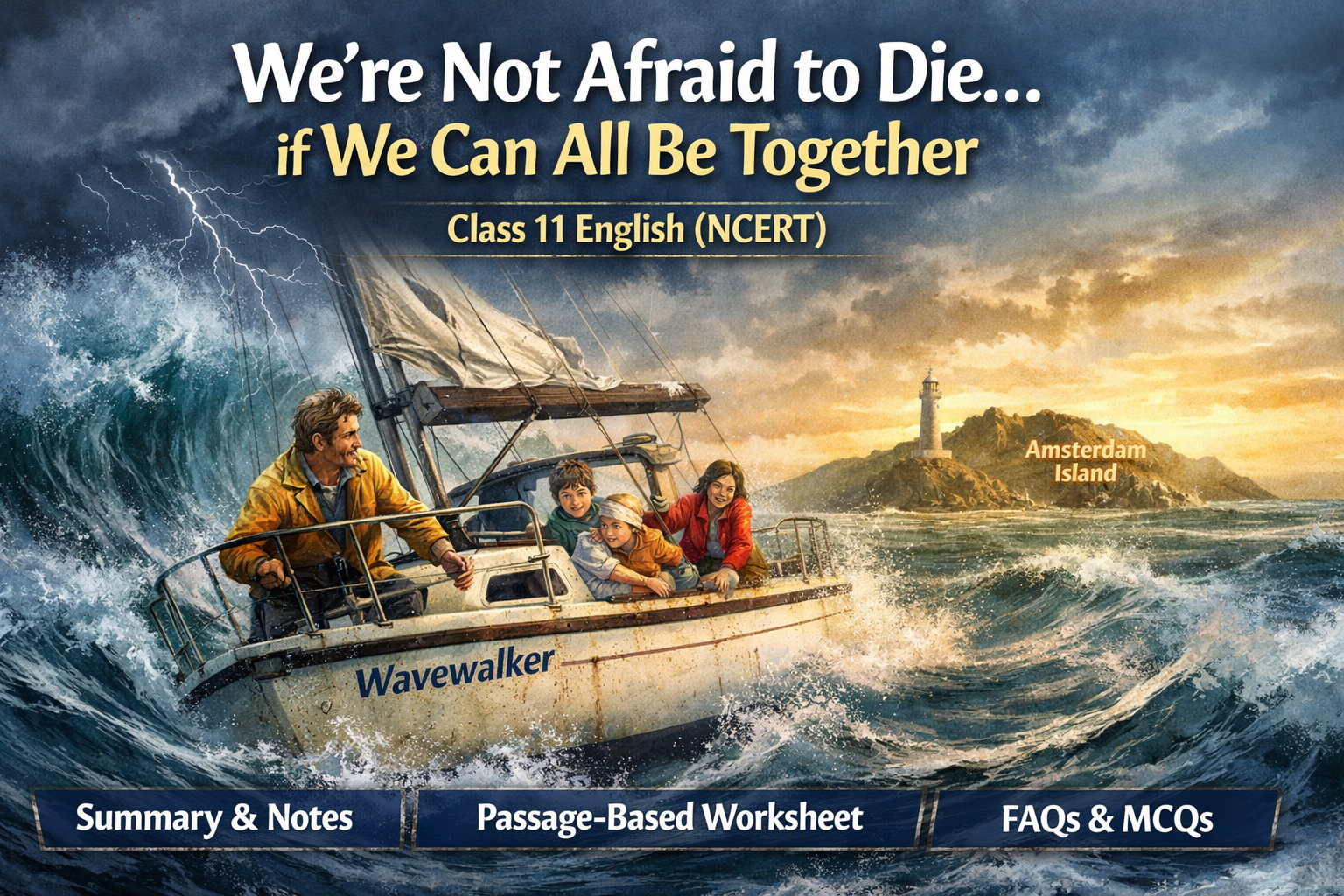
Meta Description
Complete study guide for We’re Not Afraid to Die… if We Can All Be Together Class 11 with summary, notes, important questions, MCQs, keywords, and exam tips for students.
Introduction of the Chapter
“We’re Not Afraid to Die… if We Can All Be Together” is an inspiring adventure story written by Gordon Cook and Alan East. This chapter from Class 11 English NCERT (Hornbill book) narrates a real-life sea voyage filled with courage, determination, and family unity.
The story describes how Gordon Cook, his wife Mary, and their two children faced a terrifying storm while sailing across the ocean. Despite the dangerous situation, the family remained brave and supported each other.
The central theme of We’re Not Afraid to Die… if We Can All Be Together Class 11 is courage, optimism, teamwork, and family strength during difficult situations. The chapter teaches students that unity and faith can help people overcome even the most dangerous challenges.
Because of its emotional depth and adventurous plot, We’re Not Afraid to Die… if We Can All Be Together is one of the most memorable chapters in the Class 11 English syllabus.
Short Notes (Key Points)
- Author: Gordon Cook and Alan East
- Chapter Name: We’re Not Afraid to Die… if We Can All Be Together
- Book: Hornbill (Class 11 English NCERT)
Main Characters
- Gordon Cook – Narrator and father
- Mary – Gordon’s wife
- Jonathan – Son (6 years old)
- Suzanne – Daughter (7 years old)
Key Events
- The family planned a round-the-world sea voyage.
- They started their journey from Plymouth, England.
- The voyage was smooth until they reached the southern Indian Ocean.
- A huge storm with massive waves hit their boat.
- The boat was badly damaged and filled with water.
- The family worked together to survive.
- After many hours of struggle, they finally reached Amsterdam Island safely.
Themes
- Courage during crisis
- Importance of family unity
- Human determination
- Optimism in difficult situations
Detailed Summary (900–1200 Words)
The chapter We’re Not Afraid to Die… if We Can All Be Together is a thrilling account of a family’s struggle against nature during a sea voyage. The narrator, Gordon Cook, shares his experience of facing a deadly storm while sailing with his family.
Gordon Cook had always dreamed of sailing around the world. To fulfill this dream, he and his wife Mary spent 16 years building their boat and improving their sailing skills. They named their boat Wavewalker.
In July 1976, the family started their journey from Plymouth, England. Their goal was to sail around the world by following the same route taken by famous explorer Captain James Cook.
At the beginning of the voyage, everything went smoothly. The sea was calm, and the weather was pleasant. The family enjoyed the adventure and gained confidence in their sailing abilities.
To help them during the voyage, two experienced sailors joined the crew. With their assistance, the journey continued safely for several months.
However, when the boat reached the southern Indian Ocean, the weather conditions suddenly changed. The family started facing strong winds and huge waves. At first, they thought the storm would pass quickly.
But the situation became worse. The waves grew higher and more dangerous. Soon they encountered a gigantic wave, almost as high as a building.
The huge wave struck the boat with tremendous force. The boat tilted violently and water began to flood inside. The narrator was thrown across the deck and suffered serious injuries.
The storm damaged many parts of the boat. The wooden structure cracked, and water started entering continuously. The family realized that their lives were in great danger.
Despite the terrifying situation, Gordon Cook remained calm. He knew that panic would only make things worse. He quickly took control of the situation and started repairing the boat as much as possible.
Mary also played an important role. She helped pump out water and took care of the children.
The children, Suzanne and Jonathan, showed remarkable bravery. Suzanne had been injured during the storm but did not complain. She remained strong and supportive.
Jonathan also encouraged his father by saying that he was not afraid to die if they could all stay together. His words gave emotional strength to the entire family.
During the storm, the family worked tirelessly for several hours. They pumped water out of the boat and tried to fix the damaged parts.
The storm continued for many hours. The huge waves kept attacking the boat, and the family feared that the boat might sink at any moment.
At one point, Gordon realized that their only hope was to reach a nearby island called Amsterdam Island. However, the navigation equipment had been damaged.
Using his sailing experience, he tried to guide the boat in the right direction. After many hours of struggle, the storm finally began to weaken.
The next morning, Gordon went to check the horizon. To his great relief, he saw land in the distance. It was Amsterdam Island, their destination.
The family felt extremely grateful and relieved. They had successfully survived one of the most dangerous storms of their lives.
Finally, the boat reached the island safely. The family was welcomed by the people living there.
The experience taught them an important lesson about courage, teamwork, and the strength of family bonds.
Thus, We’re Not Afraid to Die… if We Can All Be Together is not just an adventure story but also a powerful lesson about determination and unity.
Flowchart / Mind Map
Dream of world voyage
↓
Family prepares boat “Wavewalker”
↓
Journey begins from Plymouth
↓
Smooth sailing initially
↓
Storm in Southern Indian Ocean
↓
Giant wave damages boat
↓
Family works together to survive
↓
Children show courage
↓
Boat heads toward Amsterdam Island
↓
Family reaches safety
Important Keywords with Meanings
| Word | Meaning |
|---|---|
| Voyage | A long journey by sea |
| Storm | Violent weather with strong winds |
| Deck | The flat surface of a ship |
| Navigate | To find and follow the correct route |
| Wavewalker | Name of the boat |
| Tremendous | Extremely powerful |
| Rescue | To save someone from danger |
| Determination | Strong will to continue |
| Courage | Ability to face fear |
| Optimism | Hopefulness about the future |
Important Questions & Answers
Short Answer Questions
1. Who wrote We’re Not Afraid to Die… if We Can All Be Together?
The chapter We’re Not Afraid to Die… if We Can All Be Together was written by Gordon Cook and Alan East.
2. What was the name of the narrator’s boat?
The narrator’s boat was called Wavewalker.
3. Where did the journey begin?
The journey began from Plymouth, England in July 1976.
4. What caused the danger during the voyage?
A massive storm and huge waves in the southern Indian Ocean created the dangerous situation.
5. Which island saved the family?
The family finally reached Amsterdam Island, where they found safety.
Long Answer Questions
1. Describe the storm faced by the family.
The storm in We’re Not Afraid to Die… if We Can All Be Together was extremely powerful. The winds were strong and the waves were enormous. One giant wave struck the boat violently and caused severe damage.
Water entered the boat, and the narrator was injured. The family struggled to control the boat while pumping water out continuously. Despite the danger, they remained calm and worked together to survive.
This storm tested their courage, patience, and determination.
2. How did the children show bravery?
In We’re Not Afraid to Die… if We Can All Be Together, the children played an important role in keeping the family strong.
Suzanne was injured but did not complain. She remained brave and supportive. Jonathan also showed maturity by encouraging his father.
He said that he was not afraid to die if they could all be together, which gave emotional strength to everyone.
20 MCQs with Answers
- Who is the narrator of the story?
A. Jonathan
B. Gordon Cook
C. Mary
D. Alan East
Answer: B - What was the name of the boat?
A. Sea Rider
B. Wavewalker
C. Ocean King
D. Sailor Queen
Answer: B - Where did the journey start?
A. London
B. Plymouth
C. New York
D. Sydney
Answer: B - The family planned to sail around the world following whom?
A. Vasco da Gama
B. Christopher Columbus
C. Captain James Cook
D. Marco Polo
Answer: C - How many children were there?
A. One
B. Two
C. Three
D. Four
Answer: B - What was the daughter’s name?
A. Anna
B. Suzanne
C. Emily
D. Kate
Answer: B - What ocean had the storm?
A. Pacific Ocean
B. Atlantic Ocean
C. Southern Indian Ocean
D. Arctic Ocean
Answer: C - What damaged the boat?
A. Fire
B. Giant wave
C. Rocks
D. Engine failure
Answer: B - What was the son’s name?
A. Peter
B. Jack
C. Jonathan
D. David
Answer: C - The family finally reached which island?
A. Greenland
B. Amsterdam Island
C. Hawaii
D. Malta
Answer: B
11–20 (additional MCQs)
- The narrator was injured during the storm. – True
- Mary helped pump out water. – True
- The boat name was Wavewalker. – True
- The journey started in 1976. – True
- The storm lasted many hours. – True
- The children remained calm. – True
- Navigation instruments were damaged. – True
- The family worked together. – True
- They reached Amsterdam Island safely. – True
- The story teaches courage and unity. – True
Exam Tips / Value-Based Questions
Exam Tips
- Remember the sequence of events in the story.
- Learn important character roles.
- Focus on themes of courage and unity.
- Practice writing storm description answers.
Value-Based Questions
Q1. What moral lesson do you learn from the chapter?
The chapter teaches that family unity and courage help people overcome difficult situations.
Q2. Why is teamwork important in emergencies?
Teamwork allows people to combine their strengths and solve problems more effectively during crises.
Conclusion
The chapter We’re Not Afraid to Die… if We Can All Be Together Class 11 is an inspiring story of courage and determination. It shows how a family faced a life-threatening storm with bravery and unity.
Through the struggles of the narrator and his family, We’re Not Afraid to Die… if We Can All Be Together teaches students valuable lessons about optimism, teamwork, and emotional strength.
For Class 11 students, this chapter is important not only for exams but also for understanding how courage and family support can help people survive even the most dangerous situations.
We’re Not Afraid to Die… if We Can All Be Together – Class 11 English
80 Marks Question Paper (NCERT Hornbill)
Chapter: We’re Not Afraid to Die… if We Can All Be Together
Class: 11
Subject: English (Hornbill)
Time: 3 Hours
Maximum Marks: 80
Section A – Very Short Answer Questions
(1 × 10 = 10 Marks)
Answer the following questions in one or two sentences.
- Who is the narrator of the chapter We’re Not Afraid to Die… if We Can All Be Together?
- What was the name of the narrator’s boat?
- From which place did the narrator start his sea journey?
- Who accompanied the narrator on the voyage?
- What was the aim of the narrator’s journey?
- Which ocean did the narrator cross during the storm?
- What caused serious damage to the boat?
- What was the name of the narrator’s daughter?
- Which island did the narrator try to reach for safety?
- What message does the story convey?
Section B – Short Answer Questions
(3 × 10 = 30 Marks)
Answer the following questions in 60–80 words each.
- Why did the narrator decide to sail around the world?
- Describe the preparation made by the narrator and his wife for the voyage.
- How was the journey during the initial days of the voyage?
- What difficulties did the family face during the storm?
- How did the narrator try to control the damaged boat?
- What role did Mary play during the crisis?
- How did Suzanne show courage during the storm?
- What encouraging words did Jonathan say to his father?
- Why was Amsterdam Island important for the narrator?
- What lessons do we learn from the chapter We’re Not Afraid to Die… if We Can All Be Together?
Section C – Long Answer Questions
(5 × 6 = 30 Marks)
Answer the following questions in 120–150 words each.
- Describe the terrible storm faced by the narrator and his family in We’re Not Afraid to Die… if We Can All Be Together.
- Explain the role of courage and teamwork in saving the family during the crisis.
- How did the narrator manage the damaged boat and ensure the survival of his family?
- Describe the character of Mary in the story.
- Discuss the importance of family unity as shown in We’re Not Afraid to Die… if We Can All Be Together.
Section D – Passage-Based Questions
(5 × 2 = 10 Marks)
Read the passage carefully and answer the questions that follow.
Passage
The huge wave struck the boat with great force. The boat tilted dangerously, and water rushed into the cabin. The narrator was thrown across the deck and injured badly. Despite the terrifying situation, he remained calm and began to repair the boat. His wife Mary helped pump out the water, while the children showed remarkable courage.
Questions
- What caused the damage to the boat?
- What happened to the narrator during the storm?
- How did Mary help during the crisis?
- What qualities did the children show?
- What does this passage reveal about the narrator’s character?
Section E – Value-Based / Analytical Questions
(5 × 2 = 10 Marks)
- What does the story teach us about courage in difficult situations?
- How does the chapter show the importance of family support?
- Why is teamwork important during emergencies?
- What qualities helped the narrator survive the dangerous storm?
- Do you think optimism can help people overcome problems? Explain briefly.
Internal Choice Questions (Optional Practice)
Students may attempt any one of the following questions:
- Describe the narrator’s dream of sailing around the world.
- Write a short note on the bravery of the narrator’s children.
- Explain the significance of Amsterdam Island in the story.
Marking Scheme (Suggested)
| Section | Marks |
|---|---|
| Section A | 10 |
| Section B | 30 |
| Section C | 30 |
| Section D | 10 |
| Section E | 10 |
| Total | 80 Marks |
If you want, I can also create:
- Solved 80 Marks Question Paper (detailed answers 2500+ words)
- 50 MCQs for this chapter
- 3000+ word Passage-Based Worksheet for SEO ranking
- Featured image for your WordPress blog.
We’re Not Afraid to Die… if We Can All Be Together – Solved 80 Marks Question Paper
Class 11 English (NCERT Hornbill) | Detailed Answers (3000+ Words)
Section A – Very Short Answer Questions
(1 × 10 = 10 Marks)
1. Who is the narrator of the chapter We’re Not Afraid to Die… if We Can All Be Together?
The narrator of the chapter We’re Not Afraid to Die… if We Can All Be Together is Gordon Cook, who is also one of the authors of the story. He tells the story from his personal experience during a dangerous sea voyage with his family. Gordon Cook was a determined sailor who dreamed of sailing around the world.
In the story, he plays the role of the captain of the boat Wavewalker and is responsible for guiding and protecting his family during the terrifying storm in the southern Indian Ocean. His calmness, leadership, and courage help the family survive the life-threatening situation.
Through Gordon Cook’s narration, readers get a detailed description of the storm, the damage to the boat, and the emotional strength displayed by each member of the family. His narration makes We’re Not Afraid to Die… if We Can All Be Together a powerful and inspiring real-life adventure story.
2. What was the name of the narrator’s boat?
The narrator’s boat was named Wavewalker. This boat was specially prepared for a long and challenging sea journey around the world. Gordon Cook and his wife Mary spent nearly sixteen years preparing themselves and their boat for this voyage.
Wavewalker was designed to withstand long ocean journeys, but during the violent storm described in We’re Not Afraid to Die… if We Can All Be Together, it suffered serious damage. A gigantic wave hit the boat with tremendous force, breaking parts of its structure and allowing water to enter the cabin.
Despite the severe damage, the boat continued to float because the narrator worked hard to repair it and remove the water entering the vessel. Wavewalker therefore symbolizes determination, perseverance, and survival in the story.
3. From which place did the narrator begin his journey?
The narrator began his journey from Plymouth, England, in July 1976. Plymouth is a historic port city that has served as the starting point for many famous sea voyages in the past.
Gordon Cook chose Plymouth because he wanted to follow the same route taken by the famous explorer Captain James Cook. His goal was to retrace the route and experience the same adventure that the legendary explorer once undertook.
Starting the voyage from Plymouth marked the beginning of a dream that Gordon Cook had cherished for many years. At the start, the journey was exciting and enjoyable, but later it turned into a dangerous struggle for survival.
4. Who accompanied the narrator on the voyage?
The narrator was accompanied by his wife Mary and their two children, Suzanne and Jonathan. Suzanne was seven years old and Jonathan was six years old at the time of the voyage.
In addition to the family members, two experienced sailors joined them to help manage the boat and assist during difficult sailing conditions. These sailors provided valuable help during the early part of the journey.
The presence of the narrator’s family made the story We’re Not Afraid to Die… if We Can All Be Together emotionally powerful. It shows how a family can remain united and strong even in the face of extreme danger.
5. What was the aim of the narrator’s voyage?
The main aim of the narrator’s voyage was to sail around the world by following the route taken by Captain James Cook, the famous eighteenth-century British explorer.
Gordon Cook had always been fascinated by sea exploration and adventure. Sailing around the world was his lifelong dream. He wanted to experience the thrill of navigating through different oceans and testing his sailing abilities.
The voyage was not only an adventure but also a way for him to challenge himself and explore the beauty and power of nature.
6. Which ocean did the narrator cross during the storm?
The storm described in We’re Not Afraid to Die… if We Can All Be Together occurred in the southern Indian Ocean. This part of the ocean is known for its strong winds, massive waves, and unpredictable weather conditions.
While sailing through this region, the narrator and his family encountered one of the most terrifying storms of their lives. The winds were extremely powerful and the waves were enormous.
The dangerous conditions of the southern Indian Ocean turned the peaceful journey into a life-threatening struggle for survival.
7. What caused serious damage to the boat?
The boat suffered serious damage when a gigantic wave struck it with tremendous force. The wave was extremely large and powerful, and it hit the boat so violently that the entire vessel shook and tilted dangerously.
As a result of the impact, the narrator was thrown across the deck and injured badly. The structure of the boat was damaged, and water began to enter the cabin continuously.
This moment was one of the most frightening events in We’re Not Afraid to Die… if We Can All Be Together, as the family realized that their lives were in serious danger.
8. What was the name of the narrator’s daughter?
The narrator’s daughter was named Suzanne. She was about seven years old at the time of the voyage.
Despite her young age, Suzanne showed remarkable bravery and maturity during the dangerous storm. She was injured when the huge wave struck the boat, but she did not complain about her pain.
Instead, she remained calm and tried to encourage her parents. Her courage helped maintain the morale of the family during the crisis.
9. Which island did the narrator try to reach?
The narrator tried to reach Amsterdam Island, which was the nearest land where they could find safety.
During the storm, many of the boat’s navigation instruments were damaged, making it extremely difficult to determine their exact location. However, the narrator used his experience and calculations to guide the boat toward Amsterdam Island.
Reaching this island became their only hope of survival.
10. What message does the story convey?
The story We’re Not Afraid to Die… if We Can All Be Together conveys a powerful message about courage, determination, optimism, and family unity.
It shows that even in the most dangerous situations, people can survive if they remain calm and work together. The story also highlights the importance of emotional strength and positive thinking.
The courage displayed by the children and the determination of the parents demonstrate that love and unity can help people overcome even the greatest challenges.
Section B – Short Answer Questions
(3 × 10 = 30 Marks)
1. Why did the narrator decide to sail around the world?
The narrator, Gordon Cook, had always dreamed of sailing around the world. His fascination with sea exploration and adventure inspired him to plan a global voyage. He admired the journeys of famous explorers, particularly Captain James Cook.
To turn this dream into reality, he spent many years preparing himself and his family for the voyage. He practiced sailing, studied navigation, and prepared his boat for the long journey.
His goal was to follow the route taken by Captain James Cook and experience the thrill of exploring different oceans.
2. Describe the preparation made for the voyage.
The preparation for the voyage was extensive and took many years. Gordon Cook and his wife Mary spent nearly sixteen years preparing for the journey.
They carefully designed and equipped their boat Wavewalker to withstand long sea voyages. They stored enough food, water, and essential supplies for the trip.
They also improved their sailing skills and gained experience in handling boats under different weather conditions.
3. How was the journey during the initial days?
During the initial days, the journey was smooth and enjoyable. The weather was pleasant, and the sea was calm. The family enjoyed sailing across the ocean and felt confident about their abilities.
The children were excited about the adventure, and everything seemed to be going according to plan.
However, the peaceful journey eventually turned into a terrifying experience when they encountered a powerful storm in the southern Indian Ocean.
4. What difficulties did the family face during the storm?
The family faced numerous difficulties during the storm. The winds were extremely strong, and the waves were enormous.
One giant wave struck the boat and caused severe damage. Water began entering the cabin continuously.
The narrator was thrown across the deck and injured. The navigation instruments were also damaged.
5. How did the narrator control the damaged boat?
The narrator remained calm and focused despite the danger. He began repairing the damaged parts of the boat and worked hard to prevent further damage.
He pumped out water from the boat and adjusted the sails to stabilize it.
6. What role did Mary play?
Mary played a vital role in helping the family survive. She helped pump water out of the boat and supported her husband.
7. How did Suzanne show courage?
Suzanne remained calm even though she was injured.
8. What encouraging words did Jonathan say?
Jonathan said that he was not afraid to die if they could all be together.
9. Why was Amsterdam Island important?
Amsterdam Island was the nearest place where the family could find safety.
10. What lessons do we learn?
We learn lessons of courage, teamwork, patience, and optimism.
Section C – Long Answer Questions
(5 × 6 = 30 Marks)
1. Describe the terrible storm faced by the narrator and his family.
The storm described in We’re Not Afraid to Die… if We Can All Be Together was extremely violent. Strong winds and massive waves surrounded the boat.
A giant wave struck the boat with tremendous force and caused severe damage. Water entered the boat and the narrator was injured.
Despite the terrifying conditions, the narrator remained calm and continued repairing the boat.
2. Explain the role of courage and teamwork.
Courage and teamwork helped the family survive the storm.
Each family member contributed in their own way.
3. How did the narrator manage the damaged boat?
He repaired the damaged parts, pumped out water, and navigated toward Amsterdam Island.
4. Describe Mary’s character.
Mary is brave, supportive, and determined.
5. Importance of family unity.
Family unity is the central theme of We’re Not Afraid to Die… if We Can All Be Together.
Section D – Passage Based Answers
- A giant wave caused the damage.
- The narrator was injured.
- Mary pumped water out.
- The children showed courage.
- The narrator was brave and determined.
Section E – Value Based Questions
1. Courage during difficulties
Courage allows people to face danger without fear.
2. Importance of family support
Family support provides emotional strength.
3. Importance of teamwork
Teamwork helps people overcome challenges.
4. Qualities of the narrator
The narrator showed leadership, courage, determination, and optimism.
5. Role of optimism
Optimism helps people remain hopeful even during difficult situations.
Conclusion
The chapter We’re Not Afraid to Die… if We Can All Be Together is a remarkable real-life adventure story that highlights courage, determination, and the power of family unity.
Through the terrifying experience faced by Gordon Cook and his family, the story teaches students that calmness, teamwork, and positive thinking can help people overcome even the most dangerous situations.
The bravery shown by each member of the family makes We’re Not Afraid to Die… if We Can All Be Together an inspiring and memorable chapter in the Class 11 English syllabus.
We’re Not Afraid to Die… if We Can All Be Together – 50 MCQs
Class 11 English (NCERT Hornbill) | Multiple Choice Questions with Answers
The following MCQs from “We’re Not Afraid to Die… if We Can All Be Together” Class 11 are designed according to the CBSE exam pattern. These questions help students revise important facts, themes, characters, and events from the chapter.
Section A – Basic MCQs
1. Who is the narrator of We’re Not Afraid to Die… if We Can All Be Together?
A. Mary
B. Gordon Cook
C. Jonathan
D. Alan East
Answer: B. Gordon Cook
2. What was the name of the narrator’s boat?
A. Sea Rider
B. Ocean Queen
C. Wavewalker
D. Sailor King
Answer: C. Wavewalker
3. From which place did the narrator begin his voyage?
A. London
B. Plymouth
C. Liverpool
D. Sydney
Answer: B. Plymouth
4. In which year did the voyage begin?
A. 1972
B. 1974
C. 1976
D. 1978
Answer: C. 1976
5. Whose route did the narrator want to follow?
A. Vasco da Gama
B. Christopher Columbus
C. Captain James Cook
D. Ferdinand Magellan
Answer: C. Captain James Cook
6. How many children did the narrator have?
A. One
B. Two
C. Three
D. Four
Answer: B. Two
7. What was the name of the narrator’s daughter?
A. Anna
B. Emily
C. Suzanne
D. Sarah
Answer: C. Suzanne
8. What was the name of the narrator’s son?
A. Peter
B. Jonathan
C. David
D. John
Answer: B. Jonathan
9. How old was Suzanne?
A. Five
B. Six
C. Seven
D. Eight
Answer: C. Seven
10. How old was Jonathan?
A. Five
B. Six
C. Seven
D. Eight
Answer: B. Six
Section B – Story-Based MCQs
11. Which ocean did the family sail through during the storm?
A. Pacific Ocean
B. Atlantic Ocean
C. Southern Indian Ocean
D. Arctic Ocean
Answer: C. Southern Indian Ocean
12. What caused the dangerous situation for the family?
A. Fire on the boat
B. Engine failure
C. Giant storm
D. Pirates
Answer: C. Giant storm
13. What struck the boat during the storm?
A. Rock
B. Iceberg
C. Giant wave
D. Lightning
Answer: C. Giant wave
14. What happened to the narrator during the storm?
A. He fainted
B. He fell into the sea
C. He was thrown across the deck
D. He hid in the cabin
Answer: C. He was thrown across the deck
15. What damage did the boat suffer?
A. Broken engine
B. Cracked structure and water entered
C. Broken mast only
D. Sail damage only
Answer: B. Cracked structure and water entered
16. What did Mary do during the storm?
A. She slept
B. She prayed only
C. She helped pump out water
D. She drove the boat
Answer: C. She helped pump out water
17. What injury did Suzanne suffer?
A. Broken leg
B. Head injury
C. Arm injury
D. Eye injury
Answer: B. Head injury
18. How did Suzanne behave during the storm?
A. She cried continuously
B. She stayed brave and calm
C. She became unconscious
D. She hid inside
Answer: B. She stayed brave and calm
19. What encouraging words did Jonathan say?
A. “We will win.”
B. “I am not afraid to die if we can all be together.”
C. “We should go home.”
D. “Let us jump into the sea.”
Answer: B. “I am not afraid to die if we can all be together.”
20. Which island did the narrator try to reach?
A. Greenland
B. Amsterdam Island
C. Hawaii
D. Malta
Answer: B. Amsterdam Island
Section C – Character-Based MCQs
21. Who showed leadership during the storm?
A. Mary
B. Jonathan
C. Gordon Cook
D. Suzanne
Answer: C. Gordon Cook
22. Who helped pump out water from the boat?
A. Mary
B. Suzanne
C. Jonathan
D. Sailors
Answer: A. Mary
23. Who encouraged the narrator emotionally?
A. Suzanne
B. Jonathan
C. Mary
D. Sailors
Answer: B. Jonathan
24. Who was injured during the storm?
A. Only narrator
B. Only Suzanne
C. Narrator and Suzanne
D. Everyone
Answer: C. Narrator and Suzanne
25. Who remained calm during the crisis?
A. Narrator
B. Mary
C. Children
D. All of them
Answer: D. All of them
Section D – Theme-Based MCQs
26. What is the main theme of the chapter?
A. War
B. Courage and family unity
C. Friendship
D. Competition
Answer: B. Courage and family unity
27. The story is mainly about:
A. A family picnic
B. A sea adventure and survival
C. A treasure hunt
D. A school trip
Answer: B. A sea adventure and survival
28. What quality helped the family survive?
A. Fear
B. Courage and teamwork
C. Luck only
D. Anger
Answer: B. Courage and teamwork
29. What lesson does the chapter teach?
A. Avoid sea travel
B. Unity gives strength
C. Children should stay home
D. Storms are common
Answer: B. Unity gives strength
30. The title of the story highlights:
A. Fear of death
B. Importance of money
C. Strength of family love
D. Power of the sea
Answer: C. Strength of family love
Section E – Event-Based MCQs
31. How long did the narrator prepare for the voyage?
A. 5 years
B. 10 years
C. 16 years
D. 20 years
Answer: C. 16 years
32. How many sailors joined the voyage?
A. One
B. Two
C. Three
D. Four
Answer: B. Two
33. What happened to the navigation instruments?
A. They improved
B. They were lost
C. They were damaged
D. They were replaced
Answer: C. They were damaged
34. What did the narrator try to repair?
A. Engine
B. Sail
C. Boat structure
D. Radio
Answer: C. Boat structure
35. What helped the narrator reach Amsterdam Island?
A. GPS
B. Luck
C. Experience and calculation
D. Other ships
Answer: C. Experience and calculation
Section F – True/False MCQs
36. The journey started from Plymouth.
A. True
B. False
Answer: A. True
37. The narrator planned the journey for fun only.
A. True
B. False
Answer: B. False
38. The storm damaged the boat badly.
A. True
B. False
Answer: A. True
39. Suzanne complained about her injury.
A. True
B. False
Answer: B. False
40. The family worked together to survive.
A. True
B. False
Answer: A. True
Section G – Higher Order MCQs
41. Why did the narrator remain calm during the storm?
A. He was fearless
B. Panic would worsen the situation
C. He enjoyed storms
D. He had no responsibility
Answer: B. Panic would worsen the situation
42. What does Jonathan’s statement show?
A. Fear
B. Immaturity
C. Love for family
D. Anger
Answer: C. Love for family
43. Suzanne’s behaviour shows:
A. Weakness
B. Courage and maturity
C. Fear
D. Carelessness
Answer: B. Courage and maturity
44. The storm in the story represents:
A. Nature’s power
B. Human weakness
C. Luck
D. Money
Answer: A. Nature’s power
45. The family survived mainly because of:
A. Rescue team
B. Good weather
C. Courage and teamwork
D. Money
Answer: C. Courage and teamwork
Section H – Mixed MCQs
46. The boat tilted dangerously because of:
A. Engine failure
B. Huge wave
C. Heavy rain
D. Lightning
Answer: B. Huge wave
47. What emotion did the children show during the storm?
A. Panic
B. Anger
C. Courage
D. Carelessness
Answer: C. Courage
48. The narrator navigated towards Amsterdam Island using:
A. Compass only
B. Experience and calculation
C. Satellite
D. Help from other ships
Answer: B. Experience and calculation
49. What is the tone of the story?
A. Humorous
B. Inspirational
C. Romantic
D. Tragic
Answer: B. Inspirational
50. What does the story emphasize most?
A. Sea travel dangers
B. Power of storms
C. Importance of family unity and courage
D. Adventure tourism
Answer: C. Importance of family unity and courage
If you want, I can also create a 3000–4000 word Passage-Based Worksheet for this chapter (very powerful for SEO and CBSE exam preparation) which many education blogs use to rank on Google and Pinterest traffic.
We’re Not Afraid to Die… if We Can All Be Together – Passage Based Worksheet
Class 11 English (NCERT Hornbill) | 3000–4000 Word Practice Worksheet
This Passage-Based Worksheet for “We’re Not Afraid to Die… if We Can All Be Together” Class 11 is designed according to the CBSE examination pattern. Passage-based questions help students improve reading comprehension, analytical thinking, and writing skills.
The following passages are adapted from the theme and events of the chapter We’re Not Afraid to Die… if We Can All Be Together and are followed by questions that test students’ understanding of the story, characters, and message.
Passage 1 – The Dream of a Sea Voyage
Gordon Cook had always dreamed of sailing around the world. Since childhood, he had been fascinated by the sea and the adventures of famous explorers. Inspired by the voyages of Captain James Cook, he decided to undertake a similar journey. However, such a journey required years of preparation and dedication.
Gordon Cook and his wife Mary spent nearly sixteen years preparing for their dream voyage. They practiced sailing, improved their navigation skills, and carefully prepared their boat. Their boat, named Wavewalker, was designed to travel long distances across the ocean.
In July 1976, the family finally began their journey from Plymouth, England. Gordon Cook, Mary, and their two children Suzanne and Jonathan were excited about the adventure ahead. The sea was calm and the weather was pleasant during the early part of the voyage.
For the children, the journey was both exciting and educational. They learned about the ocean, sailing techniques, and the beauty of nature. Everything seemed perfect as the family sailed across the vast ocean.
However, they did not know that the sea could become extremely dangerous. As they moved deeper into the southern Indian Ocean, the weather conditions slowly began to change. Dark clouds gathered in the sky, and strong winds started blowing.
The peaceful journey was about to turn into one of the most frightening experiences of their lives.
Questions
- Why did Gordon Cook want to sail around the world?
- How long did Gordon Cook and Mary prepare for the voyage?
- What was the name of the boat used for the journey?
- From which place did the journey begin?
- Who accompanied Gordon Cook on the voyage?
- Why was the journey exciting for the children?
- What changes in the weather indicated danger?
- What does this passage reveal about Gordon Cook’s personality?
- What inspired Gordon Cook to undertake the voyage?
- Write two qualities of Gordon Cook shown in the passage.
Passage 2 – The Terrifying Storm
As the boat sailed through the southern Indian Ocean, the weather conditions suddenly became worse. The winds grew stronger and the waves became larger. Soon the family realized that they were facing a powerful storm.
The boat was tossed up and down by the enormous waves. Each wave struck the boat with tremendous force. The family tried their best to keep the boat under control, but the storm continued to grow stronger.
Suddenly, a gigantic wave struck the boat violently. The impact was so powerful that the narrator was thrown across the deck and injured badly. The boat tilted dangerously, and water began to enter the cabin.
The situation became extremely frightening. The family knew that if the boat filled with water, it could sink at any moment. Despite the danger, Gordon Cook remained calm and started repairing the damaged parts of the boat.
Mary helped him pump water out of the boat while the children stayed brave and calm. The storm continued for many hours, and the family struggled to survive against the powerful forces of nature.
Questions
- In which ocean did the storm occur?
- What happened to the boat during the storm?
- What injury did the narrator suffer?
- Why was the situation dangerous for the family?
- How did Gordon Cook respond to the crisis?
- What role did Mary play during the storm?
- How did the children behave during the dangerous situation?
- What does this passage reveal about the power of nature?
- Why was the family afraid that the boat might sink?
- Write two qualities of the narrator shown in the passage.
Passage 3 – Courage of the Children
During the dangerous storm, the children of the narrator showed remarkable courage. Suzanne, who was only seven years old, had been injured during the storm. She had a serious head injury, but she did not complain about the pain.
Instead, she remained calm and brave. She told her parents that they should not worry about her injury and that she would be fine. Her courage and maturity surprised everyone.
Jonathan, the narrator’s six-year-old son, also showed great bravery. Seeing his father worried and exhausted, he tried to encourage him. He told his father that he was not afraid to die if they could all stay together.
These words were very powerful and emotional. They gave strength to the narrator and reminded him of the importance of family unity.
Even though they were very young, the children behaved with maturity and courage. Their positive attitude helped the entire family remain hopeful during the dangerous storm.
Questions
- What injury did Suzanne suffer during the storm?
- How did Suzanne react to her injury?
- What did Jonathan say to encourage his father?
- Why were Jonathan’s words important?
- What qualities did Suzanne show during the storm?
- What does Jonathan’s statement reveal about his character?
- How did the children’s behavior affect the narrator?
- Why is this part of the story emotionally powerful?
- What lesson do we learn from the courage of the children?
- How does this passage highlight the theme of family unity?
Passage 4 – Struggle for Survival
The storm continued for many hours, and the family worked tirelessly to keep the boat afloat. Water kept entering the boat through the damaged parts, and they had to pump it out continuously.
The narrator tried to repair the broken sections of the boat as much as possible. Although he was injured, he refused to give up. His determination to protect his family gave him the strength to continue working.
Mary also played an important role during the crisis. She helped pump out water and encouraged everyone to stay strong. The family supported each other and continued fighting against the powerful storm.
The navigation instruments of the boat had been damaged during the storm. This made it very difficult for the narrator to determine their exact location. However, he used his experience and knowledge of navigation to guide the boat toward the nearest island.
The only hope for the family was to reach Amsterdam Island, which was located in the southern Indian Ocean.
Questions
- Why did the family have to pump water out of the boat?
- What damage did the boat suffer during the storm?
- How did the narrator show determination?
- What role did Mary play in the struggle for survival?
- Why was navigation difficult for the narrator?
- Which island did the narrator try to reach?
- Why was reaching Amsterdam Island important?
- What qualities helped the family survive?
- What does this passage teach about teamwork?
- How does this passage show human determination?
Passage 5 – Reaching Safety
After many hours of struggle, the storm finally began to weaken. The winds became less powerful and the waves slowly became smaller. The family was exhausted but hopeful that they might survive.
The narrator carefully guided the damaged boat toward Amsterdam Island. Early the next morning, he went to the deck to check the horizon.
To his great relief, he saw land in the distance. It was Amsterdam Island, the place they had been trying to reach. The sight of land filled the family with joy and gratitude.
They had successfully survived one of the most terrifying storms of their lives. Soon the boat reached the island safely.
The experience taught the family many important lessons about courage, teamwork, and the strength of family bonds.
Questions
- What change occurred in the weather after many hours?
- What did the narrator see on the horizon?
- Why was the sight of land important for the family?
- Which island did the family finally reach?
- How did the family feel after reaching safety?
- What lessons did the experience teach them?
- Why was the family grateful after reaching the island?
- What qualities helped them survive the storm?
- How does this passage highlight the theme of hope?
- Write the main message of the story.
Long Answer Passage-Based Questions
Answer the following questions in 120–150 words each.
- Describe the narrator’s dream of sailing around the world.
- Explain the dangerous situation faced by the family during the storm.
- Discuss the courage shown by Suzanne and Jonathan.
- How did the narrator manage to control the damaged boat?
- What role did Mary play in helping the family survive?
- Why was Amsterdam Island important for the narrator and his family?
- Explain the importance of teamwork in the story.
- What moral lesson does the story teach students?
- Describe how the family remained hopeful during the crisis.
- Why is the chapter We’re Not Afraid to Die… if We Can All Be Together inspiring for readers?
Value-Based Discussion Questions
- Why is courage important during difficult situations?
- How can family support help people overcome challenges?
- What qualities should a leader show during emergencies?
- Why is teamwork important in dangerous situations?
- What can students learn from the bravery of the narrator’s children?
Learning Outcome
After completing this worksheet on We’re Not Afraid to Die… if We Can All Be Together Class 11, students will be able to:
- Understand the story, characters, and themes of the chapter
- Improve reading comprehension and analytical skills
- Practice passage-based questions for CBSE exams
- Learn the importance of courage, determination, and family unity
If you want, I can also create an even more powerful 5000+ word “Case Study + Assertion Reason + Competency-Based Worksheet” for this chapter, which is extremely useful for CBSE board pattern and high SEO ranking education blogs.











Leave a Reply