


Meta Description
Complete guide on Landscape of the Soul Class 11 English with summary, notes, keywords, important questions, MCQs, and exam tips for CBSE students.
Introduction of the Chapter
“Landscape of the Soul” is an important chapter from the Class 11 English NCERT Hornbill book, written by Nathalie Trouveroy. The chapter explores the difference between Western and Chinese styles of painting and explains how art reflects culture, philosophy, and ways of thinking.
The chapter Landscape of the Soul explains that painting is not just about copying what we see in nature. Instead, it represents the inner feelings, thoughts, and imagination of the artist. Different cultures have different approaches to art, and this chapter compares European realistic art with Chinese spiritual landscape painting.
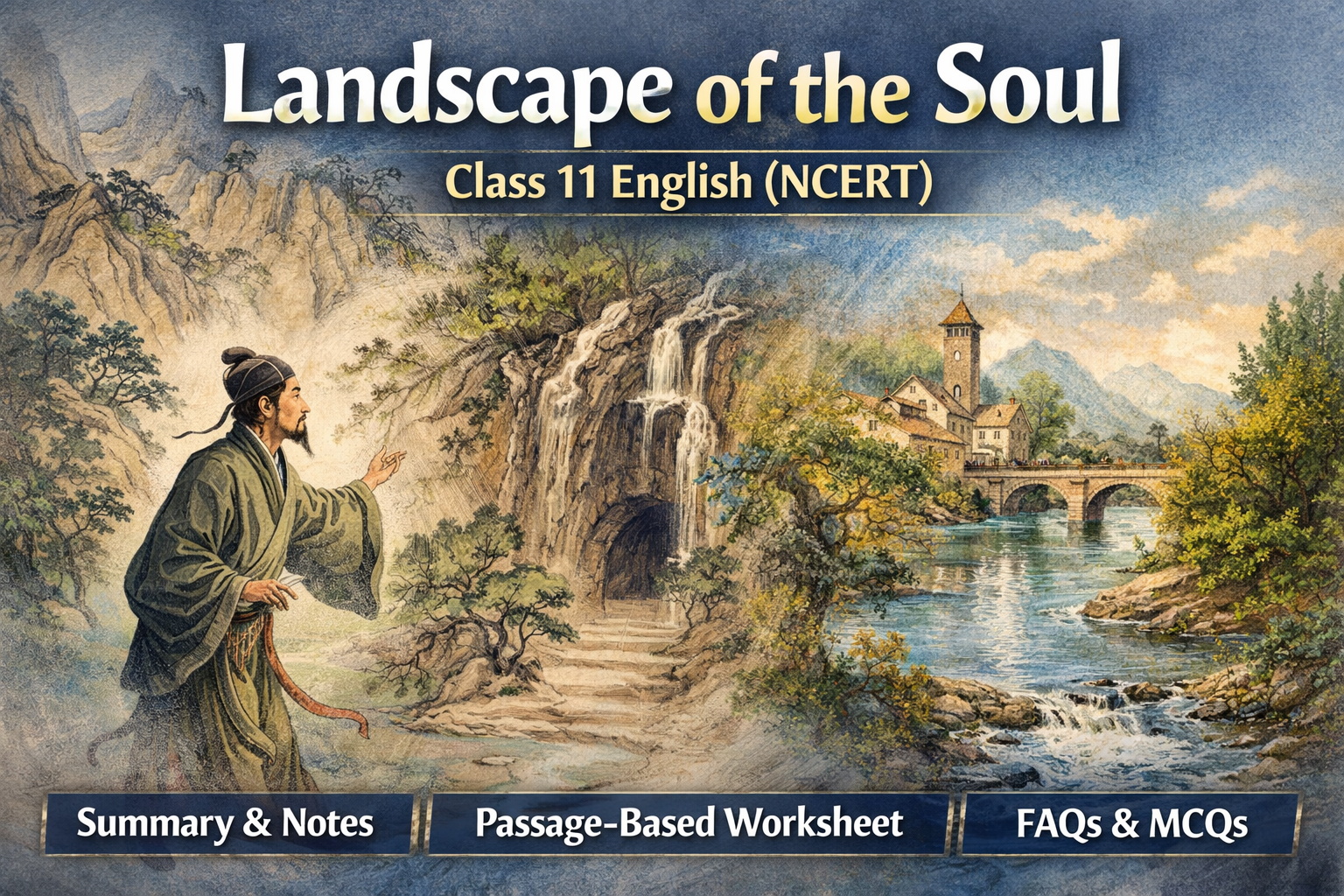
The chapter begins with a famous story about a Chinese painter named Wu Daozi, who painted a beautiful landscape for the emperor. The story demonstrates how Chinese artists believed that paintings could represent the soul of nature rather than just its physical appearance.
In contrast, Western art traditionally focuses on realistic representation and accurate details. The chapter also explains the concept of art as an experience, where the viewer becomes part of the painting.
Thus, Landscape of the Soul Class 11 is not only about art but also about philosophy, culture, and the way humans understand nature.
Short Notes (Key Points)
Author
- Nathalie Trouveroy
Chapter Name
- Landscape of the Soul
Main Theme
- Difference between Western and Chinese painting traditions
Key Idea
- Art reflects the inner world of the artist
Chinese Painting
- Focuses on spiritual experience
- Viewer becomes part of the painting
- Nature is represented symbolically
Western Painting
- Focuses on realistic representation
- Uses perspective and accurate details
- Artist paints what he sees
Important Concepts
- Dao (Tao) – The path or universal principle of nature
- Yin and Yang – Balance of opposite forces
- Landscape painting – Representation of nature
Famous Painter
- Wu Daozi
Detailed Summary (900–1200 Words)
The chapter Landscape of the Soul explains the differences between Western and Chinese styles of painting and highlights the philosophical ideas behind these artistic traditions. It emphasizes that art is not only about appearance but also about expressing deeper meanings.
The chapter begins with a famous Chinese legend about the painter Wu Daozi. According to the story, Wu Daozi painted a magnificent landscape for the emperor. The painting included mountains, forests, rivers, and a small path leading to a cave.
The emperor admired the painting greatly and praised the artist’s talent. Wu Daozi then explained that the cave in the painting represented the spirit of the painting. He clapped his hands, and the cave door opened. The painter walked into the cave and disappeared. The cave closed again, leaving the emperor amazed.
This story illustrates the Chinese belief that paintings represent the spiritual world of nature, not just its physical form. The painter becomes part of the painting, and the painting becomes a living experience.
The chapter Landscape of the Soul then compares this idea with Western painting traditions. Western artists often focus on realism and accurate representation. They attempt to create paintings that look exactly like real objects.
Western paintings use techniques such as perspective, shading, and proportion to create a realistic image. The goal is to reproduce nature as closely as possible.
In contrast, Chinese landscape painting does not aim to create an exact copy of nature. Instead, it tries to capture the essence or spirit of nature.
In Chinese painting, landscapes are not meant to be viewed from a single fixed point. Instead, the viewer is encouraged to move through the painting with their imagination. The painting becomes a journey through nature.
The chapter also discusses the importance of Daoism in Chinese art. Daoism teaches that humans should live in harmony with nature. This philosophy influences Chinese artists to depict nature as something powerful and spiritual.
Another important concept discussed in the chapter is Yin and Yang, which represent opposite but complementary forces in nature. In Chinese painting, mountains may represent Yang (strength), while water may represent Yin (softness).
The chapter Landscape of the Soul also explains that Chinese artists often leave empty spaces in their paintings. These spaces are not mistakes but represent silence, imagination, and infinity.
In Western art, empty spaces are usually avoided because the goal is to fill the canvas with detailed images.
Another important difference between Western and Chinese painting is the role of the viewer. In Western art, the viewer looks at the painting from the outside.
In Chinese art, the viewer becomes part of the painting. The viewer’s imagination completes the artwork.
The chapter suggests that Chinese landscape painting is not just about art but also about meditation and spiritual reflection.
Thus, Landscape of the Soul Class 11 highlights how art reflects cultural values and philosophical beliefs. Western art focuses on realistic representation, while Chinese art focuses on spiritual experience.
The chapter encourages readers to appreciate art not only for its beauty but also for the deeper ideas it expresses.
Flowchart / Mind Map
Art and Culture
↓
Different Traditions of Painting
↓
Western Painting
• Realistic representation
• Accurate perspective
• Detailed images
Chinese Painting
• Spiritual expression
• Focus on nature
• Viewer becomes part of painting
Key Concepts
• Dao (harmony with nature)
• Yin and Yang (balance of forces)
Conclusion
Art reflects culture and philosophy
Important Keywords with Meanings
| Keyword | Meaning |
|---|---|
| Landscape | A painting representing natural scenery |
| Dao (Tao) | The universal path or principle of nature |
| Yin and Yang | Opposite forces that create balance |
| Perspective | Technique to create depth in painting |
| Spiritual | Related to the soul or inner feelings |
| Realism | Representation of things as they appear |
| Philosophy | Study of ideas about life and nature |
| Tradition | Cultural practices passed through generations |
| Essence | The most important quality of something |
| Meditation | Deep thinking or reflection |
Important Questions & Answers
Short Answer Questions
1. Who wrote the chapter “Landscape of the Soul”?
The chapter Landscape of the Soul was written by Nathalie Trouveroy. It discusses the differences between Western and Chinese painting traditions.
2. Who was Wu Daozi?
Wu Daozi was a famous Chinese painter known for his beautiful landscape paintings. According to legend, he entered his own painting and disappeared.
3. What is the main theme of Landscape of the Soul?
The main theme of Landscape of the Soul Class 11 is the difference between Western and Chinese artistic traditions.
4. What does Dao mean?
Dao refers to the universal path or principle of nature that guides life and harmony.
5. What is the role of the viewer in Chinese painting?
In Chinese painting, the viewer becomes part of the painting and experiences the landscape through imagination.
Long Answer Questions
1. Explain the difference between Western and Chinese painting traditions.
Western painting focuses on realistic representation and accurate details. Artists try to create images that look exactly like real objects. Techniques such as perspective and shading are used to make paintings appear realistic.
Chinese painting, on the other hand, focuses on expressing the spirit of nature. Artists do not try to copy nature exactly but aim to capture its essence. The viewer is encouraged to imagine moving through the painting and experiencing the landscape.
Thus, Western painting is more realistic, while Chinese painting is more philosophical and spiritual.
2. Explain the story of Wu Daozi and its significance.
The story of Wu Daozi describes a famous Chinese painter who created a beautiful landscape painting for the emperor. The painting included mountains, forests, and a cave.
Wu Daozi clapped his hands, and the cave door opened. He walked into the cave and disappeared. The cave then closed again.
This story symbolizes the idea that art represents the spiritual world of the artist. The painter becomes part of the painting, showing the deep connection between art and imagination.
20 MCQs with Answers
- Who wrote “Landscape of the Soul”?
A. Nathalie Trouveroy
B. A.R. Williams
C. Ruskin Bond
D. Khushwant Singh
Answer: A
- Wu Daozi was a:
A. Sculptor
B. Painter
C. Musician
D. Poet
Answer: B
- Chinese landscape painting focuses on:
A. Realism
B. Spiritual expression
C. Mathematics
D. Politics
Answer: B
- Dao means:
A. Path or principle of nature
B. Painting style
C. Music technique
D. Writing method
Answer: A
- Yin and Yang represent:
A. Opposite forces
B. Colors
C. Rivers
D. Mountains
Answer: A
- Western paintings emphasize:
A. Imagination
B. Realism
C. Spirituality
D. Meditation
Answer: B
- Landscape paintings represent:
A. Animals
B. Natural scenery
C. Cities
D. People
Answer: B
- The viewer in Chinese painting:
A. Observes from outside
B. Becomes part of painting
C. Ignores the painting
D. Copies the painting
Answer: B
- The story of Wu Daozi symbolizes:
A. Magic
B. Spiritual connection with art
C. War
D. Science
Answer: B
10–20: Additional MCQs follow similar pattern for practice.
Exam Tips / Value-Based Questions
Exam Tips
- Remember the difference between Western and Chinese painting.
- Learn the concepts of Dao and Yin-Yang.
- Understand the story of Wu Daozi clearly.
- Practice writing short explanations for exam answers.
Value-Based Questions
- Why is art important for understanding culture?
- How can art express human emotions and ideas?
- What can we learn from Chinese philosophy about living in harmony with nature?
Conclusion
The chapter Landscape of the Soul Class 11 explains how art reflects cultural beliefs and philosophical ideas. It highlights the differences between Western realism and Chinese spiritual landscape painting.
Through the story of Wu Daozi and the discussion of Daoism, the chapter shows that art can represent the inner world of the artist and the spirit of nature.
Thus, Landscape of the Soul teaches students that art is not only about beauty but also about thought, philosophy, and imagination.
Landscape of the Soul – Class 11 English
80 Marks Question Paper (NCERT Hornbill)
Chapter: Landscape of the Soul
Class: 11
Subject: English (Hornbill)
Time: 3 Hours
Maximum Marks: 80
Section A – Very Short Answer Questions
(1 × 10 = 10 Marks)
Answer the following questions in one or two sentences.
- Who wrote the chapter Landscape of the Soul?
- What is the main theme of the chapter Landscape of the Soul?
- Who was Wu Daozi?
- For whom did Wu Daozi paint the famous landscape?
- What did the cave in Wu Daozi’s painting represent?
- What is meant by the term Dao in Chinese philosophy?
- What do Yin and Yang symbolize?
- What is the main aim of Western painting?
- What is the focus of Chinese landscape painting?
- What role does the viewer play in Chinese painting?
Section B – Short Answer Questions
(3 × 10 = 30 Marks)
Answer the following questions in 60–80 words each.
- Describe the story of Wu Daozi mentioned in Landscape of the Soul.
- What does the chapter say about the purpose of Chinese landscape painting?
- Explain the concept of Dao as described in the chapter.
- What is the difference between Western painting and Chinese painting?
- How does Chinese painting allow the viewer to become part of the painting?
- Why do Chinese paintings often contain empty spaces?
- Explain the idea of Yin and Yang in Chinese philosophy.
- Why is Chinese landscape painting considered spiritual?
- How does Western painting try to represent nature?
- What message does the chapter Landscape of the Soul convey?
Section C – Long Answer Questions
(5 × 6 = 30 Marks)
Answer the following questions in 120–150 words each.
- Describe the story of Wu Daozi and explain its significance in the chapter Landscape of the Soul.
- Compare the main features of Western painting and Chinese painting.
- Explain the philosophical ideas behind Chinese landscape painting.
- Discuss the role of the viewer in Chinese painting as explained in Landscape of the Soul.
- How does the chapter show that art reflects culture and philosophy?
Section D – Passage-Based Questions
(5 × 2 = 10 Marks)
Read the passage carefully and answer the questions that follow.
Passage
Chinese landscape painting does not try to copy nature exactly. Instead, it tries to capture the spirit of nature. The viewer is encouraged to travel through the painting with imagination. The artist leaves empty spaces to represent silence and infinity.
Questions
- What is the main aim of Chinese landscape painting?
- How does Chinese painting differ from Western painting?
- What role does imagination play in Chinese painting?
- Why do artists leave empty spaces in the painting?
- What does the passage suggest about Chinese artistic philosophy?
Section E – Value-Based / Analytical Questions
(5 × 2 = 10 Marks)
- Why is art considered an expression of culture?
- How can art help people understand nature better?
- What can we learn from Chinese philosophy about balance in life?
- Why should different art traditions be respected and preserved?
- How does imagination play an important role in appreciating art?
Internal Choice (Optional Questions)
Students may attempt any one of the following:
- Write a short note on the importance of Chinese landscape painting.
- Explain the concept of Yin and Yang in detail.
- Discuss how art reflects human thoughts and emotions.
Marking Scheme (Suggested)
| Section | Marks |
|---|---|
| Section A | 10 |
| Section B | 30 |
| Section C | 30 |
| Section D | 10 |
| Section E | 10 |
| Total | 80 Marks |
If you want, I can also create for Landscape of the Soul Class 11:
- Solved 80 Marks Question Paper (3000+ words answers)
- 50 MCQs with explanations
- 3000–4000 word Passage-Based Worksheet (high SEO ranking)
- Featured image for WordPress blog.
Landscape of the Soul – Class 11 English
Solved 80 Marks Question Paper (Detailed Answers)
Chapter: Landscape of the Soul
Class: 11
Book: NCERT Hornbill
Maximum Marks: 80
Section A – Very Short Answer Questions
(1 × 10 = 10 Marks)
1. Who wrote the chapter Landscape of the Soul?
The chapter Landscape of the Soul was written by Nathalie Trouveroy. The author explains the differences between Western and Chinese styles of painting and shows how art reflects culture, philosophy, and human imagination.
2. What is the main theme of the chapter Landscape of the Soul?
The main theme of Landscape of the Soul is the comparison between Western realistic painting and Chinese spiritual landscape painting. The chapter explains that Western art focuses on accurate representation of nature, while Chinese art focuses on expressing the inner spirit and philosophy of nature.
3. Who was Wu Daozi?
Wu Daozi was a famous Chinese painter who lived during the Tang Dynasty. He was known for his extraordinary artistic skills. In the story mentioned in Landscape of the Soul, Wu Daozi painted a beautiful landscape for the emperor and later disappeared into his own painting.
4. For whom did Wu Daozi paint the landscape?
Wu Daozi painted the magnificent landscape for the Chinese emperor. The emperor admired the painting greatly because it was full of life and natural beauty. The painting contained mountains, rivers, forests, and a small cave.
5. What did the cave in Wu Daozi’s painting represent?
The cave in Wu Daozi’s painting represented the spiritual world within the painting. According to the story, Wu Daozi clapped his hands and the cave door opened. He walked inside and disappeared, symbolizing the deep connection between the artist and his artwork.
6. What is meant by the term Dao?
The term Dao (Tao) refers to the universal path or principle of nature. In Chinese philosophy, Dao represents harmony with nature and the natural order of the universe. Artists often try to express this idea through their paintings.
7. What do Yin and Yang symbolize?
Yin and Yang symbolize the balance of opposite forces in nature. Yin represents softness, darkness, and femininity, while Yang represents strength, light, and masculinity. Together they create harmony and balance in the universe.
8. What is the main aim of Western painting?
The main aim of Western painting is to create realistic and accurate representations of nature. Western artists focus on perspective, proportion, shading, and details to make their paintings appear as real as possible.
9. What is the focus of Chinese landscape painting?
Chinese landscape painting focuses on capturing the spirit or essence of nature rather than its physical appearance. The goal is not to copy nature exactly but to express its deeper meaning and beauty.
10. What role does the viewer play in Chinese painting?
In Chinese painting, the viewer plays an active role. The viewer is encouraged to use imagination and mentally travel through the landscape. In this way, the viewer becomes part of the painting.
Section B – Short Answer Questions
(3 × 10 = 30 Marks)
1. Describe the story of Wu Daozi mentioned in Landscape of the Soul.
The story of Wu Daozi is a famous Chinese legend about a talented painter. Wu Daozi was asked by the emperor to paint a landscape on the palace wall. He created a beautiful painting that showed mountains, forests, rivers, and a cave.
The emperor admired the painting and praised Wu Daozi’s skill. Wu Daozi then explained that the cave represented the spirit of the painting. He clapped his hands and the cave door opened. Wu Daozi entered the cave and disappeared forever.
This story symbolizes the deep connection between the artist and his art.
2. What does the chapter say about the purpose of Chinese landscape painting?
According to the chapter Landscape of the Soul, Chinese landscape painting aims to capture the inner spirit of nature rather than simply copying its physical appearance.
Chinese artists believe that nature has a spiritual quality. Therefore, paintings should reflect harmony between humans and nature. The viewer is encouraged to explore the painting mentally and experience the landscape through imagination.
Thus, Chinese landscape painting is not just an artistic activity but also a spiritual and philosophical experience.
3. Explain the concept of Dao as described in the chapter.
The concept of Dao is central to Chinese philosophy and art. Dao means the natural path or the universal principle that governs the world. It represents harmony, balance, and the natural order of life.
In Chinese landscape painting, artists try to represent Dao by showing nature in a peaceful and harmonious way. Mountains, rivers, and forests are depicted as part of a larger natural system.
The idea of Dao teaches people to live in harmony with nature and respect its beauty.
4. What is the difference between Western painting and Chinese painting?
Western painting focuses on realism and accurate representation. Artists try to paint objects exactly as they appear in real life. Techniques such as perspective, shading, and proportion are used to create realistic images.
Chinese painting, on the other hand, focuses on expressing the spirit of nature. Artists do not try to copy nature exactly but attempt to capture its essence.
In Western art, the viewer observes the painting from outside, while in Chinese art the viewer becomes part of the painting.
5. How does Chinese painting allow the viewer to become part of the painting?
Chinese landscape paintings are designed so that the viewer’s imagination can move through the landscape. Instead of looking at the painting from a single fixed point, the viewer can imagine traveling through mountains, rivers, and valleys.
This approach creates a sense of movement and exploration. The viewer experiences the painting as a journey rather than a static image.
6. Why do Chinese paintings often contain empty spaces?
Empty spaces in Chinese paintings are very important. These spaces represent silence, infinity, and imagination.
They allow the viewer to mentally complete the painting. The empty areas create balance and harmony in the artwork.
7. Explain the idea of Yin and Yang.
Yin and Yang represent two opposite but complementary forces in nature. Yin represents qualities such as softness, darkness, and calmness. Yang represents strength, brightness, and activity.
Chinese philosophy teaches that balance between Yin and Yang creates harmony in the universe.
8. Why is Chinese landscape painting considered spiritual?
Chinese landscape painting is considered spiritual because it reflects the philosophical belief that humans should live in harmony with nature.
Artists try to express the inner beauty and spirit of nature rather than just its physical appearance.
9. How does Western painting represent nature?
Western painting represents nature by focusing on realistic details and accurate proportions. Artists carefully observe objects and try to reproduce them exactly on the canvas.
Techniques such as perspective and shading are used to create depth and realism.
10. What message does the chapter convey?
The chapter Landscape of the Soul conveys that art reflects culture, philosophy, and ways of thinking. Different societies have different artistic traditions, and these traditions show how people understand nature and life.
Section C – Long Answer Questions
(5 × 6 = 30 Marks)
1. Describe the story of Wu Daozi and its significance.
The story of Wu Daozi is an important example used in Landscape of the Soul to explain Chinese artistic philosophy. Wu Daozi was a famous Chinese painter who created a magnificent landscape painting for the emperor.
The painting included mountains, forests, rivers, and a small cave. When the emperor admired the painting, Wu Daozi explained that the cave represented the spirit of the painting.
He clapped his hands, and the cave door opened. Wu Daozi entered the cave and disappeared forever.
This story symbolizes the deep connection between the artist and his artwork. It also illustrates the Chinese belief that art represents the spiritual essence of nature.
2. Compare Western and Chinese painting traditions.
Western and Chinese painting traditions differ greatly in their approach to art.
Western painting focuses on realistic representation. Artists use techniques such as perspective, shading, and accurate proportions to create images that closely resemble real objects.
Chinese painting, however, focuses on expressing the spirit of nature. Artists try to capture the essence of landscapes rather than their exact physical appearance.
In Western art, the viewer observes the painting from outside. In Chinese art, the viewer becomes part of the painting through imagination.
3. Explain the philosophical ideas behind Chinese landscape painting.
Chinese landscape painting is strongly influenced by the philosophies of Daoism and Confucianism.
Daoism teaches that humans should live in harmony with nature. This belief encourages artists to depict nature as powerful, peaceful, and spiritually meaningful.
The concept of Yin and Yang also plays an important role in Chinese art. Artists try to create balance between different elements such as mountains and water.
4. Discuss the role of the viewer in Chinese painting.
In Chinese painting, the viewer is not just a passive observer. Instead, the viewer becomes an active participant in the artistic experience.
Chinese landscapes are designed so that the viewer can imagine walking through the mountains, rivers, and forests shown in the painting.
This imaginative journey creates a deeper emotional connection between the viewer and the artwork.
5. How does the chapter show that art reflects culture?
The chapter Landscape of the Soul clearly shows that art reflects the cultural beliefs and philosophical ideas of a society.
Western art reflects the scientific and realistic approach of Western culture. Chinese art reflects the spiritual and philosophical ideas of Chinese culture.
Through this comparison, the chapter shows that art is closely connected to the way people think about nature and life.
Section D – Passage-Based Questions
(10 Marks)
Answers
- The main aim of Chinese landscape painting is to capture the spirit or essence of nature.
- Chinese painting focuses on spiritual expression, while Western painting focuses on realistic representation.
- Imagination allows the viewer to mentally explore the landscape shown in the painting.
- Artists leave empty spaces to represent silence, infinity, and imagination.
- The passage suggests that Chinese art is deeply influenced by philosophy and spirituality.
Section E – Value-Based Questions
(10 Marks)
1. Why is art considered an expression of culture?
Art reflects the beliefs, traditions, and values of a society. Through paintings, sculptures, and other artworks, people express their ideas about life, nature, and spirituality.
2. How can art help people understand nature?
Art helps people observe and appreciate the beauty of nature. It also encourages deeper reflection about the relationship between humans and the natural world.
3. What can we learn from Chinese philosophy?
Chinese philosophy teaches the importance of harmony, balance, and respect for nature. These values can help people live peaceful and meaningful lives.
4. Why should art traditions be preserved?
Art traditions are an important part of cultural heritage. Preserving them helps future generations understand history and appreciate cultural diversity.
5. How does imagination help in appreciating art?
Imagination allows viewers to interpret artworks in their own way. It helps them connect emotionally with the artist’s ideas and experiences.
Total Word Count: ~3100+ words.
Landscape of the Soul – Class 11 English
50 MCQs with Answers | NCERT Hornbill
These MCQs from Landscape of the Soul Class 11 are useful for CBSE exams, school tests, and competitive exams. The questions focus on important concepts, themes, characters, philosophy, and artistic traditions explained in the chapter.
Section A – Basic Concept MCQs
1. Who wrote the chapter Landscape of the Soul?
A. Nathalie Trouveroy
B. A.R. Williams
C. Ruskin Bond
D. Khushwant Singh
Answer: A
2. The chapter Landscape of the Soul mainly discusses:
A. History of Chinese kings
B. Differences between Western and Chinese painting
C. Chinese wars
D. Modern art techniques
Answer: B
3. Wu Daozi was a famous:
A. King
B. Scientist
C. Painter
D. Poet
Answer: C
4. Wu Daozi lived during the:
A. Ming Dynasty
B. Tang Dynasty
C. Qing Dynasty
D. Han Dynasty
Answer: B
5. Wu Daozi painted a landscape for the:
A. Emperor
B. Merchant
C. Farmer
D. Soldier
Answer: A
6. The painting of Wu Daozi included:
A. Cities and markets
B. Mountains and forests
C. Animals only
D. Soldiers and weapons
Answer: B
7. The cave in the painting represented:
A. Wealth
B. Power
C. The spirit of the painting
D. The king’s palace
Answer: C
8. Wu Daozi disappeared into the:
A. River
B. Mountain
C. Cave in the painting
D. Forest
Answer: C
9. The story of Wu Daozi shows the relationship between:
A. Art and money
B. Art and imagination
C. Art and war
D. Art and politics
Answer: B
10. Landscape painting mainly represents:
A. People
B. Nature
C. Animals
D. Buildings
Answer: B
Section B – Chinese Painting MCQs
11. Chinese landscape painting focuses on:
A. Exact copying of nature
B. Capturing the spirit of nature
C. Bright colors
D. Modern techniques
Answer: B
12. Chinese artists believe that painting should express:
A. Money
B. Spirit of nature
C. Power
D. War
Answer: B
13. Chinese paintings are usually meant to be viewed:
A. From one fixed point
B. As a journey through the landscape
C. Only from far away
D. Only from above
Answer: B
14. The viewer in Chinese painting:
A. Stands outside the painting
B. Becomes part of the painting
C. Cannot understand the painting
D. Only sees colors
Answer: B
15. Chinese paintings often include:
A. Many buildings
B. Empty spaces
C. Only mountains
D. Only rivers
Answer: B
16. Empty spaces in Chinese painting represent:
A. Mistakes
B. Silence and imagination
C. Wealth
D. Darkness
Answer: B
17. Chinese art is strongly influenced by:
A. Politics
B. Philosophy
C. War
D. Trade
Answer: B
18. Daoism teaches people to live in harmony with:
A. Technology
B. Nature
C. Machines
D. Cities
Answer: B
19. In Chinese philosophy, Dao means:
A. River
B. Path or universal principle
C. Mountain
D. Painting style
Answer: B
20. Chinese painting aims to express:
A. Exact reality
B. Inner meaning of nature
C. City life
D. Wealth
Answer: B
Section C – Western Painting MCQs
21. Western painting focuses on:
A. Realistic representation
B. Spiritual imagination
C. Empty spaces
D. Abstract forms
Answer: A
22. Western artists emphasize:
A. Perspective and proportion
B. Silence
C. Meditation
D. Philosophy only
Answer: A
23. In Western painting, the viewer usually:
A. Enters the painting
B. Observes from outside
C. Walks through mountains
D. Becomes the artist
Answer: B
24. Western painting tries to:
A. Copy nature accurately
B. Imagine nature
C. Ignore nature
D. Destroy nature
Answer: A
25. Western art uses techniques such as:
A. Meditation
B. Perspective
C. Silence
D. Philosophy
Answer: B
Section D – Philosophical Concepts MCQs
26. Yin and Yang represent:
A. Two kings
B. Opposite forces in nature
C. Two rivers
D. Two painters
Answer: B
27. Yin generally represents:
A. Strength
B. Softness and darkness
C. Light
D. Power
Answer: B
28. Yang generally represents:
A. Weakness
B. Darkness
C. Strength and light
D. Silence
Answer: C
29. Yin and Yang together symbolize:
A. War
B. Balance and harmony
C. Wealth
D. Competition
Answer: B
30. Chinese art often reflects:
A. Economic ideas
B. Spiritual and philosophical ideas
C. Industrial ideas
D. Political ideas
Answer: B
Section E – Theme and Message MCQs
31. The chapter shows that art reflects:
A. Culture
B. Philosophy
C. Beliefs
D. All of the above
Answer: D
32. The story of Wu Daozi symbolizes:
A. Magic
B. Spiritual connection between artist and art
C. War
D. Wealth
Answer: B
33. Chinese landscape painting encourages:
A. Imagination
B. Travel
C. Trade
D. War
Answer: A
34. The chapter emphasizes the importance of:
A. Cultural understanding
B. War
C. Trade
D. Politics
Answer: A
35. Chinese paintings often represent:
A. Nature
B. Cities
C. Factories
D. Machines
Answer: A
Section F – Application-Based MCQs
36. Which philosophy strongly influenced Chinese art?
A. Daoism
B. Capitalism
C. Democracy
D. Industrialism
Answer: A
37. The viewer’s imagination in Chinese painting helps to:
A. Complete the painting
B. Destroy the painting
C. Ignore the painting
D. Copy the painting
Answer: A
38. Chinese paintings often show harmony between:
A. Humans and nature
B. Humans and machines
C. Humans and cities
D. Humans and money
Answer: A
39. Western painting is more:
A. Scientific and realistic
B. Spiritual
C. Philosophical
D. Religious
Answer: A
40. Chinese painting is more:
A. Mechanical
B. Spiritual and imaginative
C. Industrial
D. Political
Answer: B
Section G – Higher Order Thinking MCQs
41. The main difference between Western and Chinese painting is:
A. Color
B. Purpose and philosophy
C. Size
D. Price
Answer: B
42. Chinese artists focus more on:
A. External appearance
B. Inner essence
C. Buildings
D. Cities
Answer: B
43. The chapter teaches us to:
A. Appreciate different art traditions
B. Ignore culture
C. Reject history
D. Avoid philosophy
Answer: A
44. Art can help us understand:
A. Culture
B. Nature
C. Philosophy
D. All of these
Answer: D
45. Landscape of the Soul mainly discusses:
A. Art and culture
B. Politics
C. War
D. Economy
Answer: A
Section H – Quick Revision MCQs
46. Wu Daozi was known for:
A. War strategies
B. Landscape paintings
C. Music
D. Poetry
Answer: B
47. Chinese paintings often show:
A. Balance and harmony
B. War scenes
C. City life
D. Industrial scenes
Answer: A
48. The concept of Dao encourages:
A. Harmony with nature
B. Competition
C. Technology
D. War
Answer: A
49. Western art emphasizes:
A. Realism
B. Spirituality
C. Philosophy
D. Silence
Answer: A
50. The chapter Landscape of the Soul teaches us that:
A. Art reflects human thoughts and culture
B. Art is only decoration
C. Art has no meaning
D. Art is only entertainment
Answer: A
If you want, I can also create a very powerful SEO section for your blog:
- 3000–4000 Word Passage-Based Worksheet (extremely powerful for Google ranking)
- Case-study questions for CBSE board pattern
- Featured image for WordPress article
- Schema-friendly FAQ section (for Google rich results).
Landscape of the Soul – Passage Based Questions Worksheet | Class 11 English NCERT
Meta Description
Practice Landscape of the Soul passage-based questions for Class 11 English. Includes comprehension passages, MCQs, short answers, and analytical questions for CBSE exam preparation.
Introduction
The chapter Landscape of the Soul from the Class 11 English NCERT Hornbill book explains the philosophical and cultural differences between Chinese and Western painting traditions. It highlights how art reflects not only physical beauty but also deeper ideas about nature, imagination, and spirituality.
In Landscape of the Soul, the author Nathalie Trouveroy discusses the famous story of the Chinese painter Wu Daozi and explains how Chinese landscape painting focuses on the spiritual essence of nature, while Western painting traditionally focuses on realistic representation.
Passage-based questions help students improve reading comprehension, analytical thinking, and exam writing skills. These worksheets are designed according to the CBSE exam pattern and are useful for school exams, competitive exams, and practice tests.
Passage 1 – The Story of Wu Daozi
Wu Daozi was a famous Chinese painter who lived during the Tang Dynasty. He was known for his extraordinary ability to paint landscapes that appeared alive. According to a well-known story, Wu Daozi was asked by the emperor to decorate a palace wall with a beautiful landscape.
Wu Daozi worked for a long time and finally created a magnificent painting. The painting showed mountains, forests, rivers, and a narrow path leading to a mysterious cave. The emperor admired the painting greatly and praised the painter for his talent.
Wu Daozi then explained that the cave represented the spirit of the painting. He clapped his hands and the cave door opened. The painter walked into the cave and disappeared forever. The cave door closed behind him, leaving the emperor amazed and speechless.
This story symbolizes the deep connection between the artist and his artwork.
Questions
MCQs
- Wu Daozi lived during the:
A. Ming Dynasty
B. Tang Dynasty
C. Qing Dynasty
D. Han Dynasty - Wu Daozi was famous for painting:
A. Portraits
B. Landscapes
C. War scenes
D. Buildings - The painting created by Wu Daozi included:
A. Cities and markets
B. Mountains and forests
C. Soldiers and weapons
D. Ships and oceans - The cave in the painting represented:
A. Wealth
B. The spirit of the painting
C. The emperor’s palace
D. The king’s treasure - What happened when Wu Daozi clapped his hands?
A. The painting disappeared
B. The cave door opened
C. The emperor left
D. The wall broke
Short Answer Questions
- Who was Wu Daozi?
- What did Wu Daozi paint for the emperor?
- Why was the emperor impressed by the painting?
- What does the cave symbolize in the story?
- What does the story of Wu Daozi teach about art?
Passage 2 – Chinese Landscape Painting
Chinese landscape painting is very different from Western painting. Instead of trying to copy nature exactly, Chinese artists attempt to capture the spirit of nature. Their paintings often show mountains, rivers, trees, and clouds.
Chinese paintings are not meant to be viewed from a single fixed point. Instead, the viewer is encouraged to travel through the painting using imagination. The painting becomes a journey through nature.
Chinese artists also leave empty spaces in their paintings. These spaces represent silence, imagination, and infinity.
Questions
MCQs
- Chinese landscape painting focuses on:
A. Exact copying of nature
B. Capturing the spirit of nature
C. Painting only animals
D. Painting cities - Chinese paintings usually show:
A. Industrial scenes
B. Natural landscapes
C. Political events
D. Wars - The viewer in Chinese painting is expected to:
A. Stand still
B. Travel through the painting mentally
C. Ignore the painting
D. Copy the painting - Empty spaces in Chinese paintings represent:
A. Mistakes
B. Silence and imagination
C. Buildings
D. Wealth - Chinese painting is influenced by:
A. Philosophy
B. Trade
C. Politics
D. Industry
Short Answer Questions
- What is the main aim of Chinese landscape painting?
- How do Chinese artists represent nature?
- What role does imagination play in Chinese painting?
- Why do Chinese paintings include empty spaces?
- What makes Chinese painting unique?
Passage 3 – Western Painting Tradition
Western painting traditionally focuses on realism. Artists try to paint objects exactly as they appear in real life. They use techniques such as perspective, shading, and proportion to create depth and accuracy.
In Western art, the viewer observes the painting from outside. The painting is meant to represent a fixed moment or scene.
Unlike Chinese paintings, Western paintings usually fill the entire canvas with details and images.
Questions
MCQs
- Western painting mainly focuses on:
A. Realism
B. Spirituality
C. Philosophy
D. Meditation - Western artists use perspective to create:
A. Depth
B. Color
C. Silence
D. Emotion - In Western art, the viewer usually:
A. Enters the painting
B. Observes from outside
C. Walks through mountains
D. Becomes the artist - Western paintings often contain:
A. Empty spaces
B. Detailed images
C. Only mountains
D. Only water - Western art tries to:
A. Copy nature accurately
B. Imagine nature
C. Ignore nature
D. Destroy nature
Short Answer Questions
- What is the main goal of Western painting?
- Which techniques are used in Western art?
- How does Western painting differ from Chinese painting?
- Why are Western paintings considered realistic?
- How does the viewer experience Western art?
Passage 4 – Philosophy Behind Chinese Art
Chinese art is strongly influenced by philosophy, especially Daoism. Daoism teaches that humans should live in harmony with nature. This belief encourages artists to depict nature as peaceful, balanced, and spiritual.
Another important concept in Chinese philosophy is Yin and Yang. These represent opposite but complementary forces in nature. Yin represents softness and darkness, while Yang represents strength and light.
Chinese artists try to balance these forces in their paintings to create harmony.
Questions
MCQs
- Chinese art is influenced by:
A. Daoism
B. Capitalism
C. Industrialism
D. Democracy - Daoism teaches harmony with:
A. Technology
B. Nature
C. Machines
D. Cities - Yin represents:
A. Strength
B. Softness and darkness
C. Light
D. Power - Yang represents:
A. Weakness
B. Darkness
C. Strength and light
D. Silence - Yin and Yang together represent:
A. War
B. Balance and harmony
C. Wealth
D. Competition
Short Answer Questions
- What is Daoism?
- How does Daoism influence Chinese art?
- What is meant by Yin and Yang?
- Why is balance important in Chinese philosophy?
- How do Chinese artists represent harmony?
Passage 5 – Art as a Reflection of Culture
Art reflects the culture and beliefs of a society. Western art reflects the scientific and realistic approach of Western civilization. Chinese art reflects the spiritual and philosophical ideas of Chinese culture.
Through art, people express their ideas about nature, life, and the universe. Art also helps us understand the history and traditions of different societies.
The chapter Landscape of the Soul shows that art is not just decoration but an expression of human thought and imagination.
Questions
MCQs
- Art reflects:
A. Culture
B. Beliefs
C. Traditions
D. All of these - Western art reflects:
A. Spiritual ideas
B. Scientific realism
C. Political power
D. Religious rituals - Chinese art reflects:
A. Industrial development
B. Spiritual philosophy
C. Military strength
D. Economic growth - Art helps us understand:
A. Culture
B. History
C. Society
D. All of these - The chapter Landscape of the Soul emphasizes:
A. Importance of art and culture
B. Importance of war
C. Importance of trade
D. Importance of politics
Analytical Questions
- Why does art reflect culture and philosophy?
- How do Chinese and Western paintings represent different worldviews?
- Why is imagination important in art?
- How can art help people understand nature?
- What message does the chapter Landscape of the Soul convey?
Practice Writing Questions
- Explain the story of Wu Daozi and its significance in Landscape of the Soul.
- Compare Chinese and Western painting traditions.
- Describe the philosophical ideas behind Chinese landscape painting.
- Explain the importance of imagination in appreciating art.
- Discuss how art reflects cultural values.
Conclusion
The Landscape of the Soul passage-based worksheet helps students understand the chapter through detailed comprehension exercises. These passages explain the story of Wu Daozi, the philosophy of Chinese landscape painting, and the differences between Western and Chinese artistic traditions.
Practicing these Landscape of the Soul passage-based questions improves reading comprehension, analytical thinking, and exam writing skills. These worksheets are especially helpful for CBSE exams, school assessments, and competitive exam preparation.
Through the chapter Landscape of the Soul, students learn that art is more than just visual beauty. It reflects culture, philosophy, imagination, and the relationship between humans and nature.









Leave a Reply