


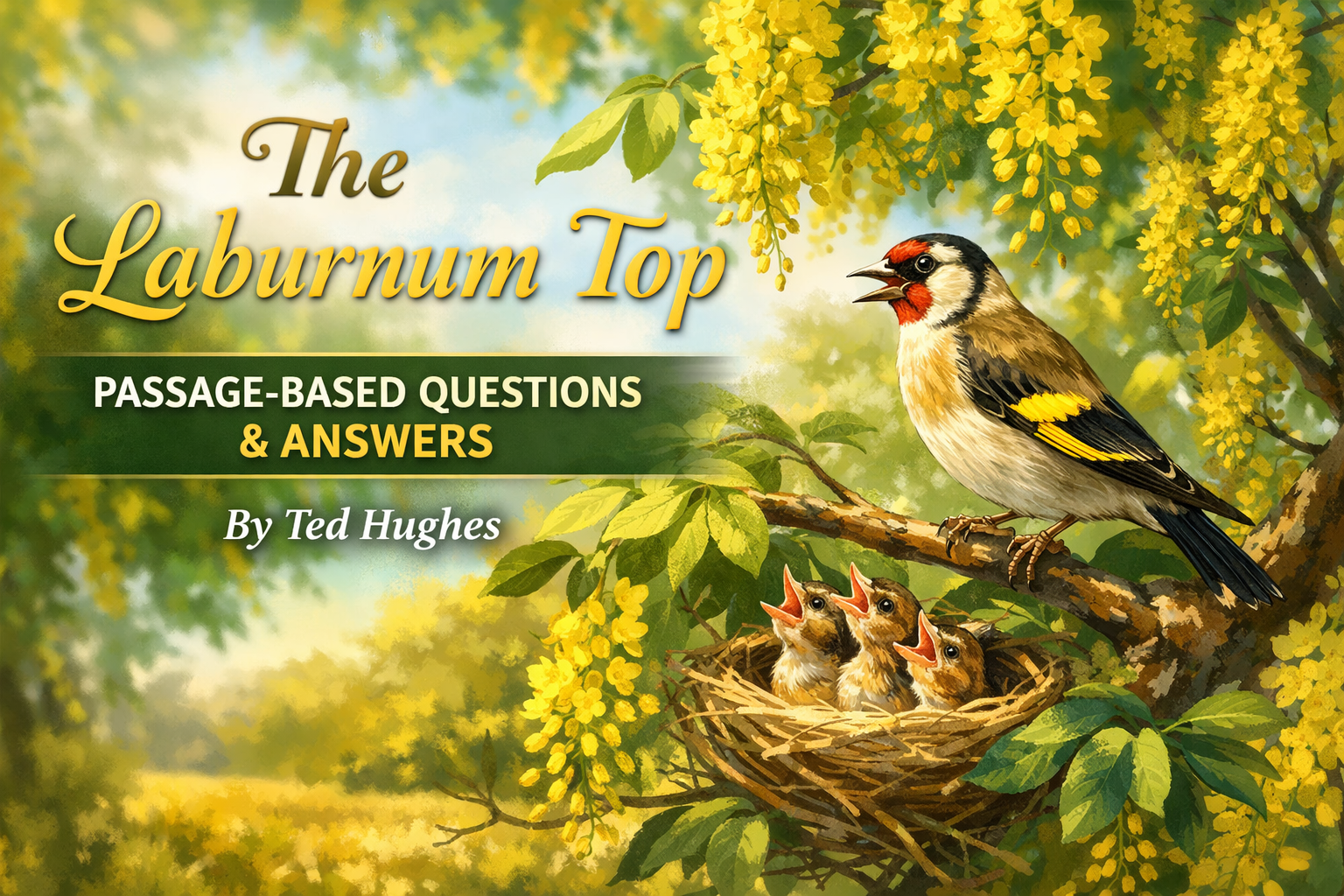
The Laburnum Top Class 11 English – Summary, Notes, Keywords, MCQs (NCERT Hornbill)
Meta Description
The Laburnum Top Class 11 English summary, notes, keywords, important questions, and MCQs. Complete NCERT Hornbill explanation for exam preparation.
Introduction to The Laburnum Top
The Laburnum Top is a beautiful nature poem written by Ted Hughes and included in the Class 11 English NCERT book Hornbill. The poem describes a quiet yellow laburnum tree that suddenly becomes full of life when a goldfinch bird arrives. Through simple yet powerful imagery, the poet shows how nature changes from silence to activity.
In The Laburnum Top Class 11 English, Ted Hughes highlights the relationship between birds and trees. The laburnum tree appears silent and lifeless at first, but when the goldfinch arrives to feed her chicks, the entire tree becomes vibrant and energetic. When the bird flies away, the tree again becomes quiet.
The poem focuses on themes such as nature, motherhood, energy, and the cycle of life. It also shows how a single creature can transform a calm environment into a lively one.
Understanding The Laburnum Top Class 11 English helps students appreciate the beauty of nature and prepares them for exam questions related to summary, notes, and literary analysis.
Short Notes on The Laburnum Top
Poet: Ted Hughes
Poem Type: Nature poem
Source: Class 11 English NCERT Hornbill
Key points about The Laburnum Top Class 11 English:
The poem describes a laburnum tree in autumn.
The tree is silent and still at the beginning.
A goldfinch bird arrives suddenly.
The bird goes to her nest hidden inside the tree.
The tree becomes active and noisy due to the movement of the birds.
The goldfinch feeds her young chicks.
After feeding them, the bird flies away into the sky.
The tree becomes silent again.
Important ideas in The Laburnum Top Class 11 English:
Nature is dynamic and always changing.
Birds bring energy and life to the environment.
Mother birds care deeply for their young.
Silence and activity are natural cycles in nature.
Detailed Summary of The Laburnum Top (900–1200 Words)
The poem The Laburnum Top by Ted Hughes describes a simple yet meaningful scene from nature. The poet observes a laburnum tree and narrates how its quiet appearance changes dramatically when a bird arrives. Through this observation, the poet reflects on the beauty and activity of nature.
At the beginning of The Laburnum Top Class 11 English, the poet describes the laburnum tree standing quietly during the autumn season. The leaves of the tree have turned yellow, which is typical of autumn. The atmosphere is calm and peaceful. The branches of the tree appear still, and nothing seems to be happening. The poet compares the tree to a silent and empty place.
The tree appears almost lifeless. The poet uses imagery to show that the laburnum tree is standing quietly against the sky. There is no movement or sound around it. This calm setting creates a sense of stillness in nature.
However, the situation suddenly changes when a goldfinch bird arrives. The goldfinch comes flying from the sky and lands on the laburnum tree. This small bird brings energy and movement to the quiet tree.
As soon as the goldfinch arrives, the tree becomes lively. The bird moves quickly among the branches. She disappears into the dense leaves of the laburnum tree. Inside the branches, she has built her nest where her chicks are waiting.
The arrival of the goldfinch causes the entire tree to become active. The chicks begin to chirp loudly as they sense their mother’s presence. Their sounds create excitement and movement inside the tree. The poet describes the tree as suddenly becoming full of life.
In The Laburnum Top Class 11 English, the poet compares the tree to a machine that has suddenly started working. The branches move rapidly as the goldfinch jumps from one branch to another while feeding her chicks. The noise and activity make the tree appear vibrant.
The poet also focuses on the caring nature of the mother bird. The goldfinch feeds her young ones patiently. This moment highlights the theme of motherhood and nurturing in nature. Just like human mothers care for their children, the goldfinch also protects and feeds her chicks.
After feeding the chicks, the goldfinch prepares to leave the tree. She flies away into the open sky. The poet compares her flight to an arrow moving quickly through the air. Her departure is sudden and swift.
Once the goldfinch leaves, the laburnum tree becomes silent again. The movement stops, and the branches return to their still position. The lively energy disappears, and the tree looks calm once more.
This contrast between silence and activity is an important aspect of The Laburnum Top Class 11 English. The poet shows how a small bird can bring life and excitement to an otherwise quiet tree.
Another important idea in the poem is the interconnection of nature. The laburnum tree provides shelter for the goldfinch and her chicks. In return, the birds bring sound and movement to the tree. This relationship highlights the balance of the natural world.
The poet uses simple language and vivid imagery to make readers imagine the scene clearly. The bright yellow color of the laburnum flowers, the movement of the goldfinch, and the chirping of the chicks all create a lively picture.
Ted Hughes also uses literary devices such as metaphor, imagery, and simile in the poem. These devices help emphasize the transformation of the tree from silence to activity.
The poem also reflects the cycle of life in nature. The quiet tree represents calmness, while the arrival of the goldfinch represents energy and life. This cycle continues as the bird comes and goes.
In conclusion, The Laburnum Top Class 11 English is a powerful nature poem that shows how small events in nature can create beautiful changes. Through the simple act of a bird feeding her chicks, the poet reveals deeper themes about life, nature, and the importance of living creatures in the environment.
Flowchart / Mind Map of The Laburnum Top
Laburnum Tree in Autumn
↓
Tree is silent and still
↓
Goldfinch arrives
↓
Bird enters the branches
↓
Chicks start chirping
↓
Tree becomes lively and noisy
↓
Goldfinch feeds the chicks
↓
Bird flies away
↓
Tree becomes silent again
Important Keywords with Meanings
Laburnum – A tree with yellow flowers.
Goldfinch – A small bird known for its bright colors.
Chirping – The sound made by small birds.
Autumn – The season between summer and winter.
Stillness – Complete quiet and lack of movement.
Suddenness – Something happening quickly without warning.
Nurturing – Caring for and protecting young ones.
Imagery – Descriptive language that creates pictures in the reader’s mind.
Metaphor – A figure of speech that compares two things.
Nature – The physical world including plants, animals, and landscapes.
Important Questions and Answers
Short Answer Questions
- Who wrote the poem The Laburnum Top?
The poem The Laburnum Top was written by Ted Hughes, a famous English poet known for his nature poetry.
- What season is described in the poem?
The poem takes place during the autumn season, when the leaves of the laburnum tree have turned yellow.
- Which bird appears in the poem?
A goldfinch bird appears in the poem and brings life to the quiet laburnum tree.
- What happens when the goldfinch arrives?
When the goldfinch arrives, the tree becomes lively with movement and the chirping of chicks.
Long Answer Question
Explain how the laburnum tree changes during the poem.
At the beginning of The Laburnum Top Class 11 English, the tree appears quiet and lifeless during the autumn season. Its yellow leaves hang silently, and there is no movement in the branches.
However, when the goldfinch arrives, everything changes. The bird enters the tree and begins feeding her chicks hidden inside the branches. The chicks chirp loudly, and the tree becomes full of sound and activity.
After feeding them, the goldfinch flies away quickly into the sky. Once she leaves, the tree returns to its earlier silent state. This change from silence to activity and back to silence forms the central idea of the poem.
20 MCQs with Answers
- Who wrote The Laburnum Top?
A. Ted Hughes
B. Robert Frost
C. William Wordsworth
D. John Keats
Answer: A
- The poem describes which tree?
A. Mango
B. Laburnum
C. Banyan
D. Neem
Answer: B
- Which bird appears in the poem?
A. Sparrow
B. Crow
C. Goldfinch
D. Pigeon
Answer: C
- The poem takes place in which season?
A. Summer
B. Winter
C. Autumn
D. Spring
Answer: C
- The laburnum tree is initially
A. Noisy
B. Silent
C. Green
D. Broken
Answer: B
- The goldfinch comes to
A. Rest
B. Build nest
C. Feed chicks
D. Sing
Answer: C
- The chicks are located
A. On the ground
B. In the tree branches
C. In the sky
D. On rocks
Answer: B
- The bird flies away like an
A. Arrow
B. Cloud
C. Leaf
D. Stone
Answer: A
- The poem mainly focuses on
A. War
B. Nature
C. History
D. Technology
Answer: B
- The poet of the poem is
A. American
B. English
C. Indian
D. French
Answer: B
- The laburnum tree has flowers of which color?
A. Red
B. Yellow
C. Blue
D. White
Answer: B
- The chicks make which sound?
A. Roar
B. Chirp
C. Bark
D. Cry
Answer: B
- The poem belongs to which book?
A. Beehive
B. Hornbill
C. Flamingo
D. Moments
Answer: B
- The goldfinch is described as
A. Small bird
B. Large bird
C. Silent bird
D. Angry bird
Answer: A
- The poem shows the relationship between
A. Humans and machines
B. Birds and trees
C. Teachers and students
D. Cities and villages
Answer: B
- The tree becomes lively because of
A. Wind
B. Rain
C. Bird activity
D. Sunlight
Answer: C
- The poet mainly describes
A. A building
B. A forest
C. A single tree
D. A river
Answer: C
- The tone of the poem is
A. Observational
B. Angry
C. Humorous
D. Dramatic
Answer: A
- The poem highlights
A. Technology
B. Nature’s beauty
C. Politics
D. War
Answer: B
- After the bird leaves, the tree becomes
A. Bright
B. Silent again
C. Broken
D. Wet
Answer: B
Exam Tips / Value-Based Questions
Important exam tips for The Laburnum Top Class 11 English:
Focus on the contrast between silence and activity.
Remember the role of the goldfinch bird.
Understand the themes of nature and motherhood.
Practice MCQs and short answers regularly.
Value-based questions:
- What does the poem teach us about caring for young ones?
- How does nature show harmony between plants and animals?
- Why is it important to observe small details in nature?
Conclusion
The Laburnum Top Class 11 English is a simple yet meaningful poem that celebrates the beauty of nature. Through the arrival of a small goldfinch bird, Ted Hughes shows how life and energy can transform a quiet environment.
The poem highlights themes such as nature, motherhood, and the cycle of life. It teaches readers to appreciate the small wonders of the natural world. Understanding The Laburnum Top Class 11 English summary, notes, MCQs, and important questions helps students prepare effectively for exams and develop a deeper appreciation of poetry.
The Laburnum Top – Class 11 English Question Paper (80 Marks)
Subject: English (NCERT – Hornbill)
Class: 11
Chapter: The Laburnum Top by Ted Hughes
Time: 3 Hours
Maximum Marks: 80
Section A – Reading / Extract Based Questions (20 Marks)
Read the following extract carefully and answer the questions.
Extract 1
“The Laburnum top is silent, quite still
In the afternoon yellow September sunlight,
A few leaves yellowing, all its seeds fallen.”
Questions
- What is the condition of the laburnum tree in the beginning of the poem? (2)
- In which season does the poem take place? (2)
- What does the phrase “seeds fallen” suggest about the tree? (2)
- Which poetic device is used in the line “September sunlight”? (2)
- Why is the tree described as silent? (2)
Extract 2
“Then sleek as a lizard, and alert, and abrupt,
She enters the thickness, and a machine starts up
Of chitterings, and a tremor of wings.”
Questions
- Who is “she” in the extract? (2)
- What comparison is made with a lizard? (2)
- What does the phrase “machine starts up” mean? (2)
- What sounds are produced in the tree? (2)
- What does this moment show about the tree? (2)
Section B – Very Short Answer Questions (1 × 10 = 10 Marks)
Answer the following questions in one or two sentences.
- Who wrote the poem The Laburnum Top?
- What type of tree is the laburnum tree?
- Which bird appears in the poem?
- In which season is the poem set?
- What do the chicks do when the bird arrives?
- Where are the chicks located?
- What happens to the tree after the bird leaves?
- What is the main theme of the poem?
- What literary device is used when the bird is compared to a lizard?
- What does the poem mainly describe?
Section C – Short Answer Questions (4 × 5 = 20 Marks)
Answer the following questions in 50–80 words each.
- Describe the condition of the laburnum tree before the goldfinch arrives.
- How does the arrival of the goldfinch change the atmosphere of the tree?
- Explain the role of the goldfinch as a mother in the poem.
- Why does the poet compare the tree to a machine?
Section D – Long Answer Questions (2 × 10 = 20 Marks)
Answer the following questions in 120–150 words each.
- Explain how the poet describes the transformation of the laburnum tree in the poem.
In your answer, include:
The condition of the tree before the bird arrives
The changes that occur after the goldfinch appears
The condition of the tree after the bird leaves
- Discuss the themes of nature and motherhood in The Laburnum Top.
Explain how the poet uses the goldfinch and the tree to show the beauty and activity of nature.
Section E – MCQs (1 × 10 = 10 Marks)
Choose the correct answer.
- The poem The Laburnum Top was written by
A. Ted Hughes
B. Robert Frost
C. William Wordsworth
D. John Keats - The poem mainly describes
A. A river
B. A forest
C. A tree
D. A mountain - The laburnum tree is initially
A. Noisy
B. Silent
C. Broken
D. Wet - The bird in the poem is
A. Sparrow
B. Goldfinch
C. Crow
D. Pigeon - The chicks start
A. Singing
B. Flying
C. Chirping
D. Sleeping - The goldfinch enters
A. The sky
B. The branches of the tree
C. The ground
D. A river - The tree becomes lively because of
A. Wind
B. Rain
C. Bird activity
D. Sunlight - The bird flies away like an
A. Arrow
B. Leaf
C. Cloud
D. Flower - The poem mainly highlights
A. War
B. Technology
C. Nature
D. Politics - The tone of the poem is
A. Observational
B. Angry
C. Sad
D. Humorous
Section F – Value Based / Analytical Questions (10 Marks)
Answer the following questions in 80–100 words each.
- What lesson does the poem teach us about the relationship between birds and trees? (5)
- How does observing nature help people understand life better? (5)
Total Marks: 80
If you want, I can also create:
50 MCQs for The Laburnum Top
Passage-based questions (3000 words)
SEO blog version of this question paper for WordPress
Featured image prompt for this chapter.
The Laburnum Top – Class 11 English (NCERT Hornbill)
80 Marks Question Paper with Detailed Answers (Long Answer Format – Approx. 3000 Words)
Subject: English (Hornbill)
Class: 11
Chapter: The Laburnum Top – Ted Hughes
Time: 3 Hours
Maximum Marks: 80
Introduction
The poem The Laburnum Top by Ted Hughes is an important chapter in the Class 11 English NCERT book Hornbill. The poem beautifully describes the transformation of a quiet laburnum tree when a goldfinch bird arrives to feed her young ones. The poet highlights the contrast between silence and activity in nature.
In The Laburnum Top, the tree initially appears calm, still, and lifeless during an autumn afternoon. However, the arrival of the goldfinch bird brings energy, movement, and sound to the tree. The bird feeds her chicks hidden in the branches, and the entire tree becomes lively. Once the bird flies away, the tree becomes silent again.
This poem reflects themes such as nature, motherhood, life cycles, and harmony in the natural world. It also teaches readers how even small creatures play an important role in bringing life and activity to nature.
The following 80-marks question paper with long answers helps students prepare for examinations by improving their understanding of the poem’s themes, imagery, literary devices, and message.
Section A – Extract Based Questions (20 Marks)
Extract 1
“The Laburnum top is silent, quite still
In the afternoon yellow September sunlight,
A few leaves yellowing, all its seeds fallen.”
Questions
- Describe the condition of the laburnum tree at the beginning of the poem.
- What does the line “yellow September sunlight” suggest about the season and atmosphere?
- Why does the poet mention that the seeds have fallen?
- What mood is created in this stanza?
- What poetic device is used in this description?
Detailed Answers
The poem The Laburnum Top begins with a calm and peaceful description of a laburnum tree during an autumn afternoon. The poet carefully observes the tree and describes it as completely silent and still. This quiet atmosphere suggests that nothing exciting is happening around the tree. The branches do not move, and there are no birds or animals making noise. The tree appears lifeless and inactive.
The phrase “yellow September sunlight” indicates that the season is autumn. During autumn, leaves change color and begin to fall from trees. The yellow sunlight also creates a warm but slightly fading atmosphere, suggesting the transition from summer to winter. This description helps readers imagine the natural environment clearly.
The poet also mentions that all the seeds have fallen from the tree. This detail further emphasizes the seasonal change. In autumn, trees shed their seeds and leaves as part of the natural cycle of life. This shows that the tree has completed its flowering and fruiting stage.
The mood of this stanza is quiet, calm, and slightly lifeless. The poet deliberately creates a sense of stillness to prepare readers for the sudden change that will occur later in the poem when the goldfinch arrives.
The poetic device used here is imagery. The poet uses descriptive language such as “yellow September sunlight” and “leaves yellowing” to create a vivid picture of the scene. Readers can easily visualize the quiet tree standing in the autumn sunlight.
This opening stanza of The Laburnum Top sets the stage for the transformation that will soon take place when the goldfinch bird appears.
Extract 2
“Then sleek as a lizard, and alert, and abrupt,
She enters the thickness, and a machine starts up
Of chitterings, and a tremor of wings.”
Questions
- Who is referred to as “she” in the poem?
- Why is the bird compared to a lizard?
- What does the phrase “a machine starts up” mean in the context of the poem?
- What sounds are heard when the bird enters the tree?
- How does this moment change the atmosphere of the poem?
Detailed Answers
In this stanza of The Laburnum Top, the calm atmosphere of the poem changes suddenly with the arrival of the goldfinch bird. The word “she” refers to the female goldfinch. She arrives quickly and lands on the laburnum tree where her nest is hidden among the branches.
The poet compares the bird to a lizard by saying “sleek as a lizard.” This comparison highlights the quick and sudden movement of the bird. Just like a lizard moves rapidly and unexpectedly, the goldfinch also enters the tree swiftly and silently.
The phrase “a machine starts up” is a metaphor used by the poet. It suggests that the tree suddenly becomes active and full of movement. When the goldfinch enters the tree, the chicks hidden in the branches begin to chirp loudly. Their movements and sounds make the tree appear as if it has come alive like a machine starting to operate.
The sounds produced inside the tree are described as “chitterings” and “a tremor of wings.” The chicks make chirping sounds as they become excited at the arrival of their mother. They move their wings eagerly, creating vibrations among the branches.
This moment completely changes the atmosphere of the poem. Earlier, the tree was silent and still, but now it becomes lively and energetic. The contrast between silence and activity is a central idea in The Laburnum Top.
Through this scene, the poet shows how the presence of living creatures can bring life and excitement to the natural environment.
Section B – Very Short Answer Questions (10 Marks)
- Who wrote the poem The Laburnum Top?
The poem The Laburnum Top was written by Ted Hughes, a famous English poet known for his deep connection with nature. His poems often describe animals, birds, and natural landscapes in vivid detail.
- What is a laburnum tree?
A laburnum tree is a flowering tree known for its beautiful yellow blossoms that hang in long clusters. It is commonly found in gardens and parks.
- Which bird appears in the poem?
The bird that appears in The Laburnum Top is a goldfinch, a small colorful bird known for its bright feathers and quick movements.
- What season is described in the poem?
The poem takes place during the autumn season, which is suggested by the yellow leaves and the falling seeds of the laburnum tree.
- What do the chicks do when the bird arrives?
When the goldfinch arrives, the chicks hidden in the tree begin chirping loudly and moving their wings in excitement.
Section C – Short Answer Questions (20 Marks)
- Describe the laburnum tree before the arrival of the goldfinch.
At the beginning of The Laburnum Top, the laburnum tree appears silent and still. It stands quietly in the yellow sunlight of an autumn afternoon. The leaves are turning yellow, and all the seeds have already fallen. There is no movement or sound around the tree. The poet describes this moment to show the calm and inactive state of the tree before the arrival of the bird.
- How does the arrival of the goldfinch change the tree?
When the goldfinch arrives, the tree suddenly becomes lively and energetic. The bird enters the branches where her nest is located. The chicks start chirping loudly and flapping their wings. Their movements create vibrations in the branches, making the tree appear full of life and activity.
Section D – Long Answer Questions (20 Marks)
- Explain how the laburnum tree transforms in the poem.
The poem The Laburnum Top presents a beautiful transformation of a quiet tree into a lively scene of activity. At the beginning of the poem, the laburnum tree stands silently in the autumn sunlight. The leaves are yellow, and the seeds have fallen. Everything around the tree appears calm and peaceful.
However, the situation changes dramatically when a goldfinch bird arrives. The bird moves quickly into the branches where her chicks are waiting. The chicks become excited and begin chirping loudly.
The tree suddenly becomes active with movement and sound. The poet compares this sudden activity to a machine starting to operate.
After feeding her chicks, the goldfinch flies away into the sky. Once she leaves, the tree returns to its earlier silent state.
This transformation shows the strong connection between birds and trees in nature.
- Discuss the themes of nature and motherhood in The Laburnum Top.
The poem The Laburnum Top highlights two important themes: nature and motherhood.
The poem beautifully describes a natural scene involving a tree and a bird. The laburnum tree provides shelter for the goldfinch and her chicks. In return, the birds bring life and movement to the tree.
The theme of motherhood is shown through the goldfinch’s actions. She carefully feeds her chicks and takes care of them. This reflects the universal instinct of mothers to nurture and protect their young.
Through this simple scene, the poet shows how nature functions through cooperation and care among living creatures.
Section E – MCQs (10 Marks)
- The Laburnum Top was written by
A Ted Hughes
B Robert Frost
C William Wordsworth
D John Keats
Answer: A
- The poem mainly describes
A a river
B a tree
C a mountain
D a forest
Answer: B
- The bird in the poem is
A sparrow
B goldfinch
C crow
D pigeon
Answer: B
- The poem takes place in
A winter
B summer
C autumn
D spring
Answer: C
- The laburnum tree is initially
A noisy
B silent
C broken
D wet
Answer: B
Section F – Value Based Questions (10 Marks)
- What lesson does the poem teach about nature?
The poem The Laburnum Top teaches us to appreciate the beauty and activity of nature. It shows that even small creatures like birds play an important role in bringing life and energy to the environment.
- Why is the relationship between birds and trees important?
Birds and trees depend on each other for survival. Trees provide shelter and food for birds, while birds help in spreading seeds and maintaining ecological balance.
Conclusion
The Laburnum Top by Ted Hughes is a powerful nature poem that captures a simple moment in the natural world. The poem shows how a quiet tree becomes lively with the arrival of a goldfinch bird.
Through vivid imagery and symbolism, the poet highlights themes such as nature, motherhood, and the cycle of life. Practicing questions from The Laburnum Top Class 11 English question paper helps students understand the poem deeply and perform well in exams.
By studying this poem, readers learn to observe and appreciate the small yet meaningful events that occur in nature every day.
The Laburnum Top – Passage Based Questions (Class 11 English Hornbill)


Introduction
“The Laburnum Top” by Ted Hughes is a short but powerful nature poem from the Class 11 NCERT English book Hornbill. The poem beautifully captures the sudden transformation of a silent laburnum tree when a goldfinch bird arrives with food for its chicks. Through vivid imagery and symbolism, the poet shows the contrast between lifeless stillness and vibrant activity.
The poem is often tested in CBSE exams through passage-based questions, which evaluate a student’s ability to interpret imagery, themes, tone, and poetic devices.
Below is a 3000+ word comprehensive passage-based worksheet designed for Class 11 students. It includes multiple passages, analytical questions, vocabulary exercises, and detailed answers to help students prepare thoroughly for examinations.
Passage 1
Passage
“The laburnum top is silent, quite still
In the afternoon yellow September sunlight,
A few leaves yellowing, all its seeds fallen.”
Questions
1. Where is the laburnum tree located in the poem?
Answer:
The poem does not specify the exact geographical location of the laburnum tree. However, it is described as standing quietly in a natural setting under the yellow September sunlight. This suggests a calm outdoor environment, possibly a garden or countryside landscape.
2. What is the condition of the laburnum tree at the beginning of the poem?
Answer:
At the beginning of the poem, the laburnum tree appears silent and motionless. The leaves are turning yellow, and its seeds have already fallen. These details create a sense of stillness and inactivity, suggesting the quietness of early autumn.
3. Why does the poet emphasize the word “silent”?
Answer:
The poet uses the word “silent” to highlight the lifeless atmosphere surrounding the tree. The silence suggests a lack of movement and energy. This quietness sets up a contrast with the lively activity that will occur later when the goldfinch arrives.
4. What season is suggested in the poem?
Answer:
The season suggested in the poem is autumn. This is indicated by the yellowing leaves and the fact that the seeds have already fallen. Autumn is typically associated with the end of the growing season.
5. What mood does this passage create?
Answer:
The passage creates a mood of calmness, stillness, and quiet observation. The peaceful description of the tree in the afternoon sunlight allows readers to imagine a serene natural setting.
6. Identify the poetic device used in “yellow September sunlight”.
Answer:
The phrase “yellow September sunlight” uses imagery. The poet creates a visual picture in the reader’s mind of warm sunlight filtering through autumn leaves.
7. What is the significance of the seeds falling?
Answer:
The falling seeds indicate the end of the tree’s reproductive cycle for the season. Symbolically, it reinforces the idea of dormancy and inactivity in nature.
8. What is the tone of the passage?
Answer:
The tone is observational and reflective. The poet is quietly observing the natural world and describing the scene with careful attention.
Passage 2
Passage
“Till the goldfinch comes, with a twitching chirrup
A suddenness, a startlement, at a branch end.”
Questions
1. Which bird arrives at the laburnum tree?
Answer:
A goldfinch arrives at the laburnum tree. The goldfinch is a small, colorful bird known for its lively movements.
2. How does the goldfinch arrive?
Answer:
The goldfinch arrives suddenly and energetically, making a twitching movement and producing a chirping sound. This sudden arrival breaks the earlier silence.
3. What effect does the arrival of the bird have on the scene?
Answer:
The arrival of the bird changes the atmosphere completely. The previously silent and motionless tree becomes lively and full of activity.
4. Explain the phrase “twitching chirrup”.
Answer:
“Twitching chirrup” refers to the quick movements and cheerful chirping sounds made by the goldfinch. It conveys the bird’s liveliness and energy.
5. Why does the poet describe the arrival as “suddenness”?
Answer:
The poet calls it “suddenness” to emphasize the abrupt change in the atmosphere. The stillness of the tree is immediately replaced by movement and sound.
6. What poetic device is used in “suddenness, a startlement”?
Answer:
The phrase uses alliteration and repetition of sound, which creates emphasis and reflects the sudden shock of movement.
7. What does this passage symbolize?
Answer:
The passage symbolizes life and activity entering a quiet environment. The bird represents energy and vitality in nature.
Passage 3
Passage
“Then sleek as a lizard, and alert, and abrupt,
She enters the thickness, and a machine starts up.”
Questions
1. Who is referred to as “she” in the passage?
Answer:
“She” refers to the female goldfinch.
2. Why does the poet compare the bird to a lizard?
Answer:
The poet compares the bird to a lizard to highlight its quick and smooth movement as it climbs into the tree branches.
3. What does the phrase “machine starts up” suggest?
Answer:
The phrase suggests sudden mechanical activity. It refers to the noise and movement of the chicks inside the nest as they respond to their mother’s arrival.
4. What poetic device is used in “sleek as a lizard”?
Answer:
This is a simile, as the bird’s movement is compared to that of a lizard using the word “as”.
5. What does this passage reveal about the relationship between the bird and the tree?
Answer:
The passage shows that the tree provides shelter and a nesting place for the bird and her chicks.
Passage 4
Passage
“Of chitterings, and a tremor of wings, and trillings
The whole tree trembles and thrills.”
Questions
1. What sounds are described in this passage?
Answer:
The passage describes chittering sounds, wing movements, and trillings, which come from the baby birds in the nest.
2. Why does the tree “tremble”?
Answer:
The tree appears to tremble because of the movement and excitement of the birds.
3. What literary device is used in “tree trembles and thrills”?
Answer:
This is personification, as the tree is described as if it has human emotions.
4. What theme is highlighted here?
Answer:
The theme of life and vitality in nature is highlighted.
Passage 5
Passage
“It is the engine of her family.”
Questions
1. What does the phrase mean?
Answer:
The phrase means that the mother bird is responsible for sustaining her family.
2. Why is the bird compared to an engine?
Answer:
The bird is compared to an engine because she drives the activity and survival of the family, just like an engine powers a machine.
3. What theme does this line represent?
Answer:
It represents the theme of parental responsibility and care.
Passage 6
Passage
“Then the goldfinch flies out to another tree.”
Questions
1. Why does the goldfinch leave the tree?
Answer:
The goldfinch leaves after feeding her chicks, likely to search for more food.
2. What happens to the tree after the bird leaves?
Answer:
The tree becomes silent and still again, returning to the earlier atmosphere.
3. What does this cycle symbolize?
Answer:
It symbolizes the temporary bursts of activity in nature followed by calmness.
Vocabulary Questions
1. Define the following words:
Silent: Completely quiet
Chirrup: A cheerful bird sound
Sleek: Smooth and glossy
Abrupt: Sudden and unexpected
Trillings: Rapid musical bird sounds
Analytical Questions
1. How does the poet contrast silence and activity in the poem?
Answer:
The poet begins with a description of the quiet and lifeless laburnum tree. This stillness is suddenly broken when the goldfinch arrives, bringing sound, movement, and excitement. When the bird leaves, the silence returns. This contrast highlights the dynamic nature of life in the natural world.
2. What role does the laburnum tree play in the poem?
Answer:
The laburnum tree serves as the central setting and also symbolizes a supportive environment for life. It provides shelter for the goldfinch and her chicks.
3. Explain the symbolism of the goldfinch.
Answer:
The goldfinch symbolizes energy, life, and maternal care. Her arrival transforms the tree from a quiet object into a lively environment.
4. What message does the poem convey?
Answer:
The poem conveys that nature is full of hidden life and activity. Even when things appear silent and still, life may exist beneath the surface.
Exam-Style Practice Questions
- Describe the transformation of the laburnum tree in the poem.
- How does the poet use imagery to describe nature?
- Explain the significance of the goldfinch’s arrival.
- Discuss the theme of motherhood in the poem.
- How does the poem highlight the relationship between birds and trees?
Conclusion
“The Laburnum Top” is a beautiful poem that illustrates the contrast between silence and life in nature. Through vivid imagery, similes, and personification, Ted Hughes shows how the arrival of a small bird can transform an ordinary tree into a lively center of activity.
For Class 11 students, passage-based questions help develop critical thinking, interpretation skills, and deeper understanding of poetic devices. Practicing such questions prepares students effectively for CBSE board examinations.
✅ If you want, I can also create:
- 50 MCQs from The Laburnum Top
- 80-Marks Question Paper (with answers)
- 3000-word Summary + Line-by-Line Explanation
- Featured Image for your blog / WordPress post
Just tell me!
The Laburnum Top – Extended Passage-Based Questions (Class 11 English Hornbill)


Introduction
“The Laburnum Top” is a beautiful nature poem written by the famous English poet Ted Hughes and included in the Class 11 NCERT English textbook Hornbill. The poem presents a simple yet powerful scene from nature. At first, the laburnum tree stands quiet and lifeless in the yellow September sunlight. However, the moment a goldfinch bird arrives to feed its young ones, the silent tree suddenly becomes full of movement, sound, and life.
Through this transformation, the poet highlights several important themes such as:
- The vitality of nature
- The nurturing role of motherhood
- The contrast between stillness and activity
- The harmony between birds and trees
Passage-based questions from this poem are common in CBSE Class 11 examinations, as they test students’ ability to analyze poetic language, imagery, symbolism, and themes.
Below is a much more detailed 3000+ word passage-based worksheet with multiple passages, comprehension questions, analytical answers, vocabulary exercises, and literary device analysis.
Passage 1
Passage
“The laburnum top is silent, quite still
In the afternoon yellow September sunlight,
A few leaves yellowing, all its seeds fallen.”
Comprehension Questions
1. What is the laburnum tree like at the beginning of the poem?
Answer:
At the beginning of the poem, the laburnum tree appears completely silent and motionless. The poet describes it standing quietly in the yellow September sunlight. Its leaves are slowly turning yellow, and its seeds have already fallen to the ground. This description suggests that the tree is experiencing the calm and stillness of the autumn season.
2. Why does the poet emphasize the silence of the tree?
Answer:
The poet emphasizes the silence to create a sense of stillness and inactivity. This calm environment sets the stage for the dramatic transformation that occurs later when the goldfinch arrives. The silence highlights the contrast between lifeless quietness and sudden lively activity.
3. What does “yellow September sunlight” indicate?
Answer:
The phrase “yellow September sunlight” suggests the early autumn season. During this time, sunlight often appears softer and warmer, and leaves begin to turn yellow. This imagery helps readers visualize the natural setting.
4. What is the significance of the seeds having fallen?
Answer:
The fallen seeds indicate that the tree has completed its reproductive cycle for the season. Symbolically, it suggests a phase of rest or dormancy in nature.
5. What mood does this passage create?
Answer:
The passage creates a peaceful and quiet mood. The calm natural setting allows readers to imagine a still afternoon where nothing significant seems to be happening.
6. Identify the poetic device used in the description.
Answer:
The poet uses imagery to describe the tree and the sunlight. Imagery helps readers create a vivid picture in their minds.
7. What tone does the poet use here?
Answer:
The tone is observational and reflective. The poet quietly observes nature and describes it with careful attention.
Passage 2
Passage
“Till the goldfinch comes, with a twitching chirrup
A suddenness, a startlement, at a branch end.”
Questions
1. What happens in this passage?
Answer:
In this passage, a goldfinch bird suddenly arrives at the laburnum tree. Its arrival is marked by a quick movement and a cheerful chirping sound.
2. How does the arrival of the bird affect the atmosphere?
Answer:
The arrival of the bird immediately changes the atmosphere. The previously silent tree suddenly becomes lively and energetic. The quiet afternoon scene is interrupted by movement and sound.
3. Explain the phrase “twitching chirrup”.
Answer:
The phrase refers to the quick, jerky movements of the bird combined with its chirping sound. It conveys the bird’s lively and energetic nature.
4. Why does the poet use the word “startlement”?
Answer:
The word “startlement” suggests that the bird’s arrival is unexpected and surprising. It emphasizes the sudden shift from silence to activity.
5. What poetic device is used here?
Answer:
The poet uses alliteration in the phrase “suddenness, a startlement,” where the repeated “s” sound creates emphasis.
6. What theme is reflected in this passage?
Answer:
The theme of life entering a quiet environment is reflected here. The goldfinch symbolizes energy and vitality.
Passage 3
Passage
“Then sleek as a lizard, and alert, and abrupt,
She enters the thickness, and a machine starts up.”
Questions
1. Who is referred to as “she”?
Answer:
“She” refers to the female goldfinch.
2. Why does the poet compare the bird to a lizard?
Answer:
The poet compares the bird to a lizard because of its quick, smooth, and sudden movement as it enters the dense branches of the tree.
3. What does “the thickness” refer to?
Answer:
“The thickness” refers to the dense branches and leaves of the tree, where the bird’s nest is hidden.
4. What does “a machine starts up” symbolize?
Answer:
The phrase symbolizes the sudden burst of activity inside the nest. When the mother bird arrives with food, the chicks begin chirping and moving excitedly.
5. Identify the literary device used in “sleek as a lizard”.
Answer:
This is a simile, where the bird’s movement is compared to a lizard using the word “as”.
6. What does this passage reveal about nature?
Answer:
It reveals that nature is full of hidden life. Even when things appear quiet, activity may exist beneath the surface.
Passage 4
Passage
“Of chitterings, and a tremor of wings, and trillings
The whole tree trembles and thrills.”
Questions
1. What sounds are described here?
Answer:
The passage describes chittering sounds, fluttering wings, and musical trillings made by the baby birds.
2. Why does the tree seem to tremble?
Answer:
The tree seems to tremble because of the intense movement and excitement of the birds.
3. What poetic device is used in “tree trembles and thrills”?
Answer:
This is personification, as the tree is described as if it has human emotions.
4. What does this passage show about the relationship between birds and trees?
Answer:
It shows that trees provide shelter and safety for birds, making them an essential part of the ecosystem.
Passage 5
Passage
“It is the engine of her family.”
Questions
1. What does the phrase mean?
Answer:
The phrase means that the mother goldfinch is responsible for supporting and sustaining her family.
2. Why does the poet compare the bird to an engine?
Answer:
An engine provides power and energy to a machine. Similarly, the mother bird provides food, care, and protection to her chicks.
3. What theme does this line represent?
Answer:
This line represents the theme of motherhood and parental responsibility.
Passage 6
Passage
“Then the goldfinch flies out to another tree.”
Questions
1. Why does the goldfinch leave the laburnum tree?
Answer:
The goldfinch leaves after feeding her chicks. She likely goes to search for more food.
2. What happens to the tree after the bird leaves?
Answer:
Once the bird leaves, the tree becomes silent and still again, returning to its earlier state.
3. What does this cycle represent?
Answer:
This cycle represents the temporary nature of activity in life. Moments of excitement are often followed by calmness.
Vocabulary Exercise
Match the words with their meanings.
| Word | Meaning |
|---|---|
| Chirrup | A cheerful bird sound |
| Sleek | Smooth and shiny |
| Abrupt | Sudden and unexpected |
| Trillings | Musical bird sounds |
| Tremor | Slight shaking |
Literary Devices in the Poem
The poem contains several poetic techniques.
1. Imagery
The poet uses imagery to create vivid pictures of nature.
Example:
“yellow September sunlight”
2. Simile
Example:
“Sleek as a lizard”
3. Personification
Example:
“The whole tree trembles and thrills.”
4. Alliteration
Example:
“suddenness, a startlement”
Long Analytical Questions
1. How does the poet create a contrast between silence and activity?
Answer:
The poem begins with the description of a quiet laburnum tree in the afternoon sunlight. Everything appears still and lifeless. However, the sudden arrival of the goldfinch introduces movement, sound, and excitement. The chicks begin chirping, and the tree seems to tremble with activity. When the bird leaves, the silence returns. This contrast highlights the dynamic nature of life in the natural world.
2. Explain the significance of the goldfinch in the poem.
Answer:
The goldfinch symbolizes life, energy, and motherhood. Its arrival transforms the silent tree into a lively environment. The bird’s role as a mother feeding her chicks also highlights themes of care, responsibility, and nurturing.
3. Discuss the importance of the laburnum tree.
Answer:
The laburnum tree acts as the central setting of the poem. It provides shelter for the goldfinch and her chicks. Symbolically, the tree represents nature as a supportive environment for life.
4. What message does the poem convey about nature?
Answer:
The poem conveys that nature is full of hidden energy and life. Even when things appear quiet and still, life may exist beneath the surface.
Additional Practice Questions
Short Answer Questions
- What season is suggested in the poem?
- Why does the tree appear lifeless at the beginning?
- What role does the mother bird play?
- How does the poet use sound imagery in the poem?
- What happens after the goldfinch leaves?
Higher-Order Thinking Questions
- Why do you think the poet chose a small bird rather than a large animal for this poem?
- How does the poem reflect the balance of nature?
- What does the poem teach us about the importance of trees?
Conclusion
“The Laburnum Top” by Ted Hughes is a wonderful example of how a small moment in nature can reveal deep truths about life. Through the contrast between stillness and sudden activity, the poet shows how nature is always full of hidden energy. The goldfinch’s nurturing role also highlights the importance of motherhood and care in the natural world.
For Class 11 students, practicing passage-based questions from this poem helps develop critical reading skills, interpretation abilities, and understanding of poetic devices, all of which are essential for success in CBSE examinations.
✅ If you want, I can also create for The Laburnum Top:
- 50 Very Difficult MCQs with explanations
- 80-Marks Full Question Paper with detailed answers
- Line-by-Line Explanation (2500+ words)
- Theme, Symbolism & Poetic Devices (Exam-ready notes)
- SEO-optimized article for WordPress (4000+ words).











Leave a Reply