


Meta Description
Father to Son Class 11 summary, notes, keywords, MCQs, and important questions. Easy explanation of the NCERT poem Father to Son for exam preparation.
Introduction of the Chapter
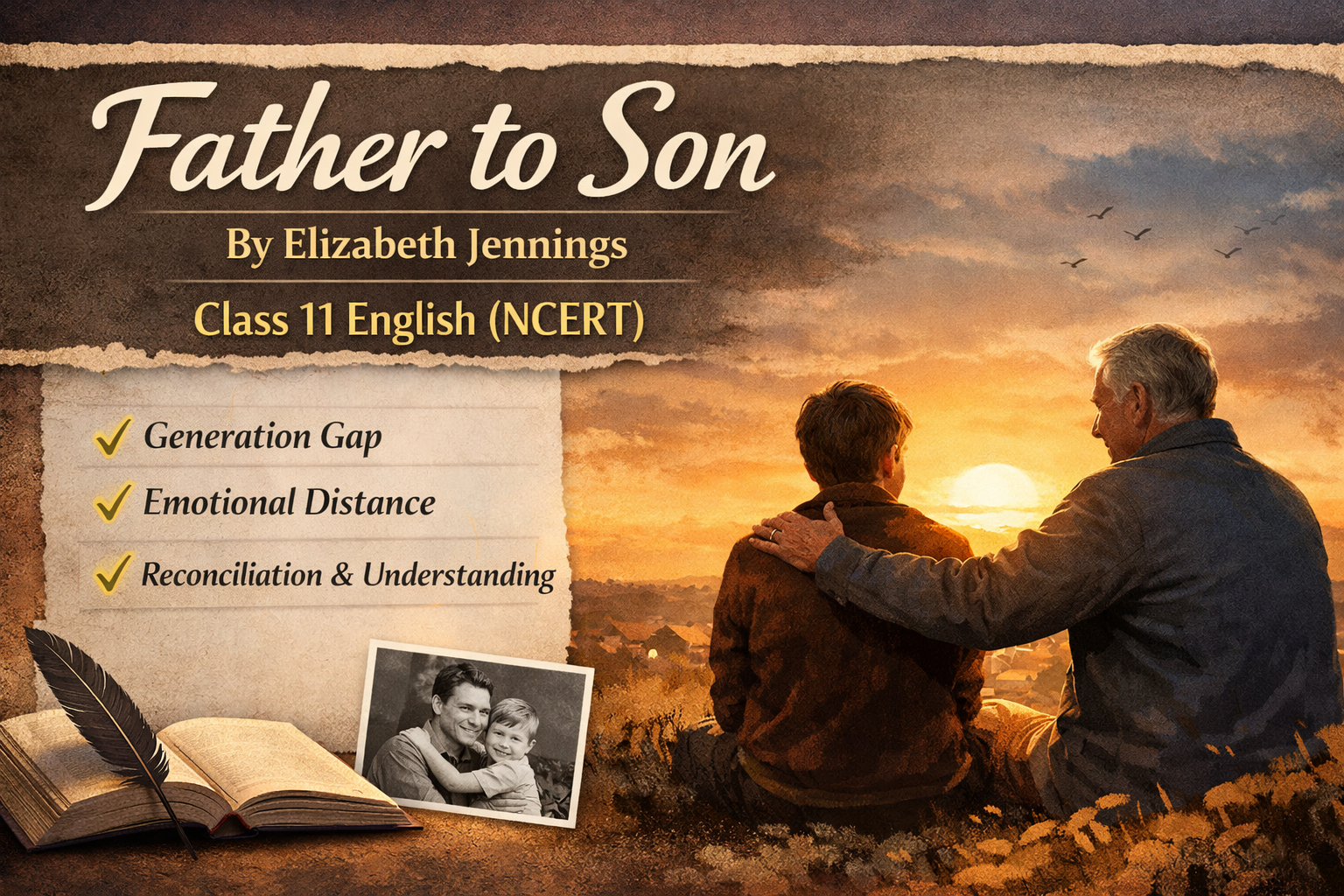
Father to Son is a powerful and emotional poem written by Elizabeth Jennings. It is included in the Class 11 English NCERT book Hornbill. The poem Father to Son Class 11 explores the complex relationship between a father and his teenage son. It focuses on the emotional distance that sometimes develops between parents and children as they grow up.
In Father to Son Class 11, the father feels confused and helpless because he no longer understands his son. Although they live in the same house, their relationship has weakened. The father tries to remember the time when his son was young and innocent, but now he feels like he is living with a stranger.
The poem Father to Son Class 11 summary highlights themes such as generation gap, communication problems, emotional distance, love, regret, and reconciliation. The father still loves his son deeply and hopes to rebuild their relationship. The poem reminds readers that communication and understanding are essential for strong family relationships.
Short Notes (Father to Son Class 11)
- Poet: Elizabeth Jennings
- Poem: Father to Son
- Book: Hornbill (Class 11 English)
- Theme: Generation gap and communication problems between parents and children
Key Points
- The poem Father to Son Class 11 describes a father’s emotional struggle with his teenage son.
- The father feels that he does not understand his son anymore.
- Both father and son live in the same house but feel emotionally distant.
- The father regrets losing connection with his son.
- He remembers the time when his son was young and easy to understand.
- The poem highlights the generation gap between parents and children.
- The father wants to rebuild the relationship with his son.
- The poem ends with a hope that both will try to understand each other.
Detailed Summary of Father to Son (900–1200 Words)
The poem Father to Son Class 11 is an emotional reflection on the strained relationship between a father and his teenage son. Written by Elizabeth Jennings, the poem presents the father’s feelings of confusion, regret, and hope for reconciliation.
At the beginning of the poem Father to Son Class 11, the father says that he and his son have lived together in the same house for many years. Despite sharing the same space, the father realizes that he does not understand his son anymore. This realization makes him feel sad and helpless.
The father remembers the early days of his son’s childhood. At that time, the father had complete influence over him. He could guide him, teach him values, and shape his personality. However, as the son grew older, he developed his own thoughts, ideas, and identity. Gradually, the emotional bond between them weakened.
In the poem Father to Son Class 11 summary, the father compares the situation to planting a tree and watching it grow in a different direction than expected. This metaphor shows how parents try to shape their children’s lives, but eventually children develop their own individuality.
The father feels that his son has become like a stranger living in the same house. He says that he does not understand the language of his son anymore. This does not mean literal language but rather differences in thinking, attitudes, and values.
The father also expresses regret about his role in the broken relationship. He wonders if he made mistakes while raising his son. Perhaps he did not give enough time, attention, or understanding when his son needed it most. This self-reflection shows that the father is willing to accept responsibility for the distance between them.
Another important idea in Father to Son Class 11 is the concept of the generation gap. Parents and children often belong to different generations with different beliefs and perspectives. As children grow up, they want independence and freedom to make their own choices. This sometimes leads to conflicts with parents.
However, the poem does not present the father as angry or controlling. Instead, he appears emotional and sincere. He still loves his son deeply and wants to rebuild the relationship. He expresses a desire to start the relationship again, just like they were strangers meeting for the first time.
The father hopes that both of them can forget past misunderstandings and begin a new chapter. He wants open communication so that they can understand each other better.
Towards the end of the poem Father to Son Class 11 summary, the father expresses a strong emotional appeal. He says that he does not want to lose his son completely. Even though they are different people with different opinions, they are still connected by blood and family.
The father believes that both he and his son must make an effort to rebuild the relationship. Understanding and forgiveness are necessary to bridge the gap between them.
The poem Father to Son Class 11 teaches an important lesson about family relationships. It reminds readers that communication, patience, and empathy are essential for maintaining strong bonds between parents and children.
Overall, Father to Son Class 11 summary presents a realistic picture of the emotional challenges faced by families during adolescence. It encourages parents and children to talk openly and understand each other’s perspectives.
Flowchart / Mind Map (Text-Based)
Father to Son Class 11
Father and Son Living Together
↓
Emotional Distance Develops
↓
Father Feels Confused and Hurt
↓
Generation Gap and Misunderstanding
↓
Father Reflects on Past Mistakes
↓
Desire for Communication
↓
Hope for Reconciliation and Understanding
Important Keywords with Meanings
1. Prodigal
A person who leaves home and later returns after wasting resources.
2. Estranged
No longer close or affectionate with someone.
3. Reconciliation
Restoring friendly relations after conflict.
4. Generation Gap
Difference in attitudes and values between parents and children.
5. Identity
A person’s sense of self and individuality.
6. Alienation
Feeling isolated or disconnected from others.
7. Communication
Exchange of thoughts and feelings.
8. Conflict
Disagreement or struggle between people.
Important Questions and Answers
Short Answer Questions
1. Who wrote the poem Father to Son?
The poem Father to Son Class 11 was written by Elizabeth Jennings.
2. What is the central theme of Father to Son?
The main theme of Father to Son Class 11 is the generation gap and emotional distance between parents and children.
3. Why does the father feel sad?
The father feels sad because he no longer understands his son, even though they live in the same house.
4. What does the father want in the poem?
The father wants to rebuild his relationship with his son through communication and understanding.
5. What lesson does Father to Son teach?
The poem teaches that communication and empathy are important in family relationships.
Long Answer Questions
1. Explain the theme of generation gap in Father to Son.
The poem Father to Son Class 11 clearly presents the theme of generation gap. As children grow older, they develop their own opinions, interests, and identities. These changes sometimes create misunderstandings between parents and children.
In the poem, the father feels that his son has become a stranger. They live in the same house but do not communicate properly. The father regrets losing connection with his son and hopes to rebuild the relationship.
The poem shows that both parents and children must try to understand each other’s perspectives. Communication, patience, and empathy can help bridge the generation gap.
2. Describe the father’s feelings in Father to Son.
In Father to Son Class 11, the father experiences several emotions. At first, he feels confused and hurt because he cannot understand his son anymore. He remembers the time when his son was young and easy to guide.
Later, the father feels regret and wonders if he made mistakes while raising his son. Despite these feelings, he still loves his son deeply and hopes for reconciliation.
The father’s emotions reflect the struggles many parents face when their children grow up and become independent.
20 MCQs with Answers
- Who is the poet of Father to Son?
A. Robert Frost
B. Elizabeth Jennings
C. William Blake
D. John Keats
Answer: B - Father to Son is included in which book?
A. Flamingo
B. Hornbill
C. Snapshots
D. First Flight
Answer: B - The poem mainly deals with:
A. Nature
B. War
C. Family relationship
D. Adventure
Answer: C - The father feels his son has become:
A. A friend
B. A stranger
C. A teacher
D. A leader
Answer: B - The poem highlights the problem of:
A. Poverty
B. Generation gap
C. Politics
D. Education
Answer: B - The father wants to:
A. Punish his son
B. Ignore his son
C. Rebuild the relationship
D. Send him away
Answer: C - The father and son live:
A. In different cities
B. In the same house
C. In different countries
D. In different schools
Answer: B - The father remembers his son’s:
A. Childhood
B. School
C. Job
D. Marriage
Answer: A - The tone of the poem is:
A. Humorous
B. Emotional
C. Angry
D. Romantic
Answer: B - The poem suggests the importance of:
A. Money
B. Communication
C. Travel
D. Fame
Answer: B
(Additional MCQs)
- What does the father want to do again?
A. Start the relationship again
B. Move away
C. Change house
D. Send his son abroad
Answer: A - The poem reflects:
A. Social conflict
B. Family conflict
C. Political conflict
D. Economic conflict
Answer: B - The father feels:
A. Proud
B. Angry
C. Helpless
D. Happy
Answer: C - The poem emphasizes:
A. Love and understanding
B. Competition
C. Adventure
D. Wealth
Answer: A - The relationship can improve through:
A. Silence
B. Distance
C. Communication
D. Punishment
Answer: C - The father compares parenting to:
A. Teaching
B. Growing a plant
C. Building a house
D. Cooking
Answer: B - The father hopes for:
A. Separation
B. Reconciliation
C. Conflict
D. Argument
Answer: B - The poem’s message is about:
A. Education
B. Family bonding
C. Nature
D. Politics
Answer: B - The son represents:
A. Childhood
B. Youth and independence
C. Old age
D. Tradition
Answer: B - The poem ends with:
A. Anger
B. Hope
C. Fear
D. Silence
Answer: B
Exam Tips / Value-Based Questions
Exam Tips
- Focus on the theme of generation gap.
- Understand the father’s emotions in the poem.
- Remember the symbolism of growing a tree.
- Practice short and long answer questions for better exam performance.
Value-Based Question
Q: What lesson can modern families learn from Father to Son?
Modern families can learn that communication and understanding are essential. Parents should listen to their children, and children should respect their parents. Mutual respect can strengthen family bonds.
Conclusion
The poem Father to Son Class 11 by Elizabeth Jennings presents a touching portrayal of the emotional distance that can develop between parents and children. Through the father’s reflections, the poem highlights the importance of communication, empathy, and forgiveness in family relationships.
The Father to Son Class 11 summary, notes, and MCQs help students understand the poem clearly and prepare effectively for examinations. The poem reminds readers that although differences may arise between generations, love and understanding can rebuild broken relationships.
Father to Son Class 11 – 80 Marks Question Paper
(NCERT English Hornbill – Poem: Father to Son by Elizabeth Jennings)
Section A – Reading Based / Extract Based Questions
(20 Marks)
Question 1 – Read the extract and answer the questions.
(10 Marks)
I do not understand this child
Though we have lived together now
In the same house for years.
Questions
- Who is the speaker in these lines? (2 marks)
- Why does the speaker say he does not understand the child? (2 marks)
- What does the phrase “lived together in the same house” suggest? (2 marks)
- Identify the theme reflected in these lines. (2 marks)
- What emotions does the father express here? (2 marks)
Question 2 – Read the extract and answer the questions.
(10 Marks)
Silence surrounds us. I would have
Him prodigal, returning to
His father’s house, the home he knew.
Questions
- What does the word “prodigal” mean in the poem? (2 marks)
- Why does the father want his son to return? (2 marks)
- What does “silence surrounds us” indicate about their relationship? (2 marks)
- What feeling does the father express in these lines? (2 marks)
- Identify the central theme of this extract. (2 marks)
Section B – Short Answer Questions
(30 Marks)
(Answer any six questions in about 60–80 words each)
6 × 5 = 30 marks
- What problem between father and son is highlighted in Father to Son?
- Why does the father feel that his son has become a stranger?
- What does the metaphor of growing a tree symbolize in the poem?
- How does the poem represent the generation gap?
- Why does the father feel regret in the poem Father to Son?
- What does the father wish for in the end of the poem?
- Explain the importance of communication in the poem Father to Son.
- What lesson about family relationships does the poem teach?
Section C – Long Answer Questions
(30 Marks)
(Answer any three questions in about 150–200 words each)
3 × 10 = 30 marks
1.
Explain the theme of generation gap in the poem Father to Son. How does the poet present the emotional distance between father and son?
2.
Describe the feelings of the father throughout the poem Father to Son. How do his emotions change from confusion to hope?
3.
Discuss the role of communication and understanding in improving family relationships as shown in Father to Son.
4.
How does the poem reflect the struggles faced by parents when children grow up and become independent?
5.
Explain how the poet uses imagery and symbolism to express the father’s feelings in the poem Father to Son.
Section D – Value-Based / Analytical Questions
(20 Marks)
(Answer any two questions in about 200–250 words each)
2 × 10 = 20 marks
1.
Modern families often face conflicts due to differences in thinking between parents and children. Discuss how the poem Father to Son reflects this issue and suggest ways to resolve such conflicts.
2.
The poem highlights the importance of understanding and empathy in family relationships. Explain this idea with reference to the poem.
3.
If you were the son in the poem Father to Son, how would you respond to the father’s feelings and attempt to rebuild the relationship?
4.
Discuss how the poem Father to Son teaches an important lesson about communication and emotional bonding in families.
Internal Choice Pattern (CBSE Style)
Total Questions: 15
Attempt Required: 11
| Section | Marks |
|---|---|
| Section A | 20 |
| Section B | 30 |
| Section C | 30 |
| Section D | 20 |
| Total | 80 Marks |
If you want, I can also create:
- Solved 80 Marks Question Paper (3000–4000 word answers)
- 50 MCQs for Father to Son
- 3000+ word Passage-Based Worksheet
- SEO Featured Image for your blog post
These will help your WordPress post rank on Google for Father to Son Class 11.
Solved 80 Marks Question Paper – Father to Son (Class 11 English Hornbill)
Introduction
The poem “Father to Son” by Elizabeth Jennings from the Class 11 English NCERT book Hornbill deals with the emotional distance between a father and his teenage son. The poem reflects the generation gap, communication problems, and the pain of misunderstanding within families. Although the father and son live together in the same house, the father feels that he no longer understands his son.
The poem presents the father’s feelings of confusion, regret, sadness, and hope. He remembers the days when his son was young and easy to guide, but now the son has grown independent and distant. The father expresses his desire to rebuild the broken relationship through understanding and communication.
The following is a fully solved 80 marks question paper for Father to Son Class 11, written in detailed, exam-oriented answers suitable for CBSE board preparation.
Section A – Extract Based Questions (20 Marks)
Extract 1
“I do not understand this child
Though we have lived together now
In the same house for years.”
1. Who is the speaker in these lines?
The speaker in these lines is the father. He is expressing his feelings about his relationship with his son. The father is confused because he feels that he no longer understands his child even though they have lived together for many years in the same house.
The father is emotionally troubled by the distance that has developed between them. This opening line sets the tone for the entire poem and highlights the central theme of generation gap and emotional separation between parents and children.
2. Why does the father say he does not understand the child?
The father says he does not understand his child because his son has grown up and developed his own identity, thoughts, and beliefs. As children grow older, they often begin to think independently and may not always share their feelings with their parents.
This change creates a gap between the father and the son. The father feels that he has lost the connection he once had with his child. He feels confused and helpless because he cannot understand what his son is thinking or feeling.
3. What does the phrase “lived together in the same house” suggest?
The phrase “lived together in the same house” suggests that the father and son share the same physical space and have been living together for many years. However, despite this physical closeness, there is emotional distance between them.
This line highlights an important idea in the poem: living together does not always mean understanding each other. The father realizes that even though they are under the same roof, their relationship has become distant and disconnected.
4. Identify the theme reflected in these lines.
The main theme reflected in these lines is the generation gap and communication breakdown between parents and children. The father feels that he cannot understand his son anymore.
The poem shows how children grow up and develop their own personalities, which sometimes creates misunderstandings with their parents. The lines also highlight emotional alienation within families.
5. What emotions does the father express here?
The father expresses several emotions in these lines:
- Confusion because he cannot understand his son
- Sadness because the relationship has become distant
- Helplessness because he does not know how to fix the problem
These emotions show the father’s deep concern for his son and his desire to reconnect with him.
Extract 2
“Silence surrounds us. I would have
Him prodigal, returning to
His father’s house, the home he knew.”
1. What does the word “prodigal” mean in the poem?
The word “prodigal” refers to someone who leaves home and later returns after realizing their mistakes. The word is taken from the Biblical story of the Prodigal Son, who leaves his father’s home, wastes his wealth, and eventually returns seeking forgiveness.
In the poem, the father wishes that his son would return to him emotionally, just like the prodigal son returned to his father.
2. Why does the father want his son to return?
The father wants his son to return because he misses the emotional bond they once shared. He feels lonely and hurt due to the silence and distance between them.
By wishing his son to return like the prodigal son, the father expresses his hope that the son will realize the importance of family and reconnect with him.
3. What does “silence surrounds us” indicate?
The phrase “silence surrounds us” indicates a lack of communication between the father and son. They do not talk openly about their feelings or problems.
This silence represents emotional distance and misunderstanding. It shows that their relationship has become strained and uncomfortable.
4. What feeling does the father express in these lines?
The father expresses feelings of loneliness, longing, and hope. He longs for the return of the loving relationship he once had with his son.
Despite the current distance, the father still hopes that their relationship can be repaired.
5. Identify the central theme of this extract.
The central theme of this extract is reconciliation and emotional reunion. The father wants to restore the bond with his son and rebuild their relationship.
Section B – Short Answer Questions (30 Marks)
1. What problem between father and son is highlighted in Father to Son?
The poem highlights the problem of generation gap and lack of communication between a father and his son. The father feels that his son has grown distant and no longer shares his thoughts and feelings with him.
Although they live together in the same house, they are emotionally separated. The father cannot understand his son’s behavior, and this makes him feel confused and helpless.
The poem shows how misunderstandings and lack of communication can create problems in family relationships.
2. Why does the father feel that his son has become a stranger?
The father feels that his son has become a stranger because he no longer understands him. As the son grows older, he develops his own identity, opinions, and interests.
These changes create distance between the father and the son. The father feels that he cannot relate to his son anymore, and this makes him feel as if he is living with a stranger.
3. What does the metaphor of growing a tree symbolize?
The metaphor of growing a tree symbolizes the process of raising a child. Just as a gardener plants and nurtures a tree, parents raise their children with love and care.
However, once the tree grows, it may grow in directions that the gardener cannot control. Similarly, children grow up and develop their own personalities and independence.
This metaphor highlights the idea that parents cannot fully control their children’s lives.
4. How does the poem represent the generation gap?
The poem represents the generation gap through the emotional distance between the father and the son. They belong to different generations with different values, beliefs, and perspectives.
The father finds it difficult to understand his son’s behavior and thinking. This difference in attitudes creates misunderstanding and conflict.
The poem shows that the generation gap can be reduced through communication and understanding.
5. Why does the father feel regret in the poem?
The father feels regret because he wonders if he made mistakes while raising his son. He thinks that perhaps he failed to understand his child’s needs or emotions.
He reflects on the past and feels that he may have lost the opportunity to build a stronger bond with his son.
6. What does the father wish for at the end of the poem?
At the end of the poem, the father wishes to rebuild his relationship with his son. He wants them to communicate openly and understand each other better.
He hopes that they can start their relationship again and remove the emotional distance between them.
Section C – Long Answer Questions (30 Marks)
1. Explain the theme of generation gap in the poem Father to Son.
The poem Father to Son explores the theme of generation gap, which refers to the difference in attitudes, beliefs, and values between parents and children.
As children grow up, they develop their own personalities and opinions. They want independence and freedom to make their own decisions. This often creates misunderstandings between parents and children.
In the poem, the father feels that he no longer understands his son. Even though they live together in the same house, their relationship has become distant. The father remembers the time when his son was young and easy to guide, but now he feels confused about his son’s behavior.
The poem shows that the generation gap can create emotional distance in families. However, it also suggests that communication and understanding can help bridge this gap.
2. Describe the feelings of the father throughout the poem.
Throughout the poem, the father experiences many emotions.
At the beginning, he feels confused and hurt because he cannot understand his son anymore. He feels sad that their relationship has changed.
Later, the father feels regret. He wonders if he made mistakes while raising his son and thinks about the past.
Finally, the father expresses hope. He wants to rebuild the relationship and reconnect with his son. His emotions show that he still loves his son deeply.
3. Discuss the importance of communication in family relationships.
Communication plays a crucial role in maintaining healthy family relationships. When family members communicate openly, they can understand each other’s feelings and perspectives.
In the poem, the lack of communication between the father and the son creates emotional distance. They live together but do not talk about their thoughts and emotions.
The poem suggests that communication is the key to resolving misunderstandings and strengthening family bonds.
Section D – Value Based Questions (20 Marks)
1. How does the poem reflect the importance of empathy in families?
The poem shows that empathy is essential for strong family relationships. Parents and children must try to understand each other’s feelings and perspectives.
The father in the poem realizes that he must understand his son rather than judge him. He shows empathy by reflecting on his own mistakes and hoping to rebuild the relationship.
Empathy helps families overcome misunderstandings and build stronger emotional connections.
2. How can families overcome the generation gap?
Families can overcome the generation gap through communication, patience, and mutual respect.
Parents should listen to their children’s opinions and give them the freedom to express themselves. At the same time, children should respect their parents’ experience and guidance.
When both sides try to understand each other, the generation gap can be reduced and family relationships can become stronger.
Conclusion
The poem Father to Son by Elizabeth Jennings presents a touching exploration of the emotional distance that can develop between parents and children. Through the father’s reflections, the poem highlights the challenges created by the generation gap and lack of communication.
However, the poem also offers hope. It suggests that understanding, empathy, and open communication can help rebuild broken relationships.
For students studying Father to Son Class 11, the poem provides important lessons about family relationships and emotional bonding. It encourages readers to value communication and mutual respect in order to maintain strong connections with their loved ones.
Father to Son Class 11 MCQs (50 Multiple Choice Questions with Answers)
(NCERT English Hornbill – Poem: Father to Son by Elizabeth Jennings)
These Father to Son Class 11 MCQs are designed according to the CBSE exam pattern. They help students revise the summary, themes, characters, keywords, and poetic ideas from the poem Father to Son.
Section 1 – Basic Concept MCQs
1. Who is the poet of Father to Son?
A. Robert Frost
B. Elizabeth Jennings
C. William Wordsworth
D. John Keats
Answer: B
2. The poem Father to Son is included in which book?
A. Flamingo
B. Hornbill
C. Snapshots
D. First Flight
Answer: B
3. The poem mainly describes the relationship between:
A. Two brothers
B. A teacher and student
C. A father and his son
D. Two friends
Answer: C
4. The father feels that his son has become:
A. A leader
B. A stranger
C. A hero
D. A teacher
Answer: B
5. What is the central theme of the poem?
A. War
B. Friendship
C. Generation gap
D. Adventure
Answer: C
6. The father and son live:
A. In different countries
B. In the same house
C. In different schools
D. In different cities
Answer: B
7. The father remembers his son’s:
A. Childhood
B. School life
C. Job
D. Marriage
Answer: A
8. The father cannot understand his son because:
A. He is busy
B. The son has grown independent
C. The son moved away
D. The son is angry
Answer: B
9. The tone of the poem is mainly:
A. Humorous
B. Sad and emotional
C. Angry
D. Romantic
Answer: B
10. The poem emphasizes the importance of:
A. Money
B. Communication
C. Power
D. Competition
Answer: B
Section 2 – Theme Based MCQs
11. The poem highlights the problem of:
A. Poverty
B. Generation gap
C. Politics
D. Education
Answer: B
12. The father feels confused because:
A. He lost his job
B. He cannot understand his son
C. He moved to a new place
D. He is ill
Answer: B
13. The father wants to:
A. Punish his son
B. Rebuild the relationship
C. Send him away
D. Ignore him
Answer: B
14. The emotional distance between father and son is caused by:
A. Money problems
B. Generation gap
C. Travel
D. School
Answer: B
15. The poem teaches the value of:
A. Discipline
B. Love and understanding
C. Competition
D. Wealth
Answer: B
Section 3 – Literary Devices and Meaning MCQs
16. The metaphor of a growing tree represents:
A. Nature
B. Education
C. Child development
D. Business
Answer: C
17. The word “prodigal” refers to:
A. A wise person
B. A person who returns home after leaving
C. A teacher
D. A traveler
Answer: B
18. The phrase “silence surrounds us” suggests:
A. Peace
B. Happiness
C. Lack of communication
D. Celebration
Answer: C
19. The father compares raising a child to:
A. Teaching a lesson
B. Growing a tree
C. Building a house
D. Running a business
Answer: B
20. The poem reflects which social issue?
A. Pollution
B. Generation gap
C. Poverty
D. Illiteracy
Answer: B
Section 4 – Character and Emotion MCQs
21. The father feels:
A. Proud
B. Helpless
C. Excited
D. Angry
Answer: B
22. The father remembers the time when his son was:
A. A baby
B. A child
C. A teacher
D. A worker
Answer: B
23. The father hopes that the son will:
A. Leave home
B. Return emotionally
C. Ignore him
D. Argue with him
Answer: B
24. The father reflects on:
A. His business
B. His mistakes
C. His job
D. His travel
Answer: B
25. The father’s feelings show:
A. Indifference
B. Deep love for his son
C. Anger
D. Fear
Answer: B
Section 5 – Interpretation MCQs
26. The father wants to start the relationship again like:
A. Old enemies
B. Strangers meeting for the first time
C. Teachers
D. Travelers
Answer: B
27. The poem suggests that conflicts can be solved through:
A. Silence
B. Communication
C. Distance
D. Anger
Answer: B
28. The father’s reflection shows:
A. Responsibility
B. Arrogance
C. Pride
D. Carelessness
Answer: A
29. The son represents:
A. Childhood
B. Youth and independence
C. Old age
D. Tradition
Answer: B
30. The father’s desire for reconciliation shows:
A. Anger
B. Love
C. Jealousy
D. Pride
Answer: B
Section 6 – Message and Values MCQs
31. The poem teaches that family relationships need:
A. Money
B. Communication
C. Competition
D. Authority
Answer: B
32. The poem encourages:
A. Fighting
B. Understanding
C. Silence
D. Punishment
Answer: B
33. The father wants:
A. Revenge
B. Peace and understanding
C. Distance
D. Separation
Answer: B
34. The poem highlights the importance of:
A. Friendship
B. Emotional bonding
C. Travel
D. Competition
Answer: B
35. The father hopes to:
A. Break the relationship
B. Rebuild the relationship
C. Forget his son
D. Punish his son
Answer: B
Section 7 – Advanced MCQs
36. The poem shows the difficulty of:
A. Teaching children
B. Understanding growing children
C. Traveling abroad
D. Working hard
Answer: B
37. The father feels that his son:
A. Understands him completely
B. Has become distant
C. Is always happy
D. Is successful
Answer: B
38. The father’s reflections show:
A. Self-realization
B. Pride
C. Anger
D. Indifference
Answer: A
39. The poem ends with:
A. Anger
B. Hope
C. Fear
D. Sadness
Answer: B
40. The poem emphasizes:
A. Authority of parents
B. Emotional understanding
C. Wealth
D. Competition
Answer: B
Section 8 – Additional Practice MCQs
41. The father wants the son to return to:
A. School
B. His father’s house
C. A new city
D. A hostel
Answer: B
42. The poem shows that relationships need:
A. Patience
B. Understanding
C. Communication
D. All of the above
Answer: D
43. The emotional conflict in the poem occurs between:
A. Friends
B. Brothers
C. Father and son
D. Teacher and student
Answer: C
44. The poem reflects:
A. Social harmony
B. Family conflict
C. Political issues
D. Economic problems
Answer: B
45. The father’s memories reflect:
A. Childhood bonding
B. Business success
C. School achievements
D. Travel experiences
Answer: A
46. The poem suggests that misunderstandings arise due to:
A. Generation gap
B. Travel
C. Work pressure
D. Education
Answer: A
47. The father hopes that his son will:
A. Forgive and understand him
B. Ignore him
C. Leave home
D. Fight with him
Answer: A
48. The poem mainly focuses on:
A. Family relationships
B. Nature
C. War
D. Adventure
Answer: A
49. The father expresses a desire for:
A. Power
B. Emotional connection
C. Wealth
D. Fame
Answer: B
50. The final message of the poem is:
A. Family relationships require love and communication
B. Children should leave home
C. Parents should control children
D. Independence is more important than family
Answer: A
If you want, I can also create a 3000+ word Passage-Based Worksheet for “Father to Son” (very powerful for Google SEO and exam preparation for your WordPress blog).
Father to Son Class 11 – Passage Based Questions (3000+ Words)
(NCERT English Hornbill – Poem: Father to Son by Elizabeth Jennings)
Introduction
The poem Father to Son by Elizabeth Jennings is included in the Class 11 English NCERT book Hornbill. It is a powerful poem that explores the emotional distance between a father and his teenage son. The poem highlights the generation gap, lack of communication, emotional conflict, and the longing for reconciliation within families.
In many families, parents and children face misunderstandings as children grow older and develop their own ideas and personalities. The poem Father to Son reflects this situation through the thoughts of a father who feels that he no longer understands his son.
Even though they live together in the same house, the father feels emotionally disconnected from his child. He remembers the time when his son was young and easy to guide, but now the relationship has changed. The father regrets the distance that has developed and hopes that one day they will reconnect.
The following passage-based questions from Father to Son Class 11 are designed according to the CBSE examination pattern. These passages help students understand the themes, emotions, and literary elements of the poem while improving their analytical and comprehension skills.
Passage 1
The poem Father to Son begins with the father expressing his confusion about his relationship with his son. Although they have lived together in the same house for many years, the father feels that he does not truly understand his child. This realization makes him feel deeply sad and helpless.
The father remembers the early days of his son’s childhood when the relationship between them was strong and simple. During that time, the father had a clear role in guiding and shaping the child’s life. However, as the son grew older, he began to develop his own personality and independent thinking. Gradually, the father started feeling that he could not control or influence his son as before.
The father now feels that the boy he once knew has changed into someone he cannot recognize. This emotional distance between them creates a sense of loneliness and confusion for the father. The poem shows that even though family members may live together physically, they may still feel emotionally distant from each other.
The father reflects on the possibility that he might have made mistakes while raising his son. He wonders if he failed to understand his son’s feelings or neglected to communicate properly with him. This self-reflection shows that the father is not blaming his son entirely but is also questioning his own role in the broken relationship.
The passage highlights the importance of communication in family relationships. When parents and children do not express their feelings openly, misunderstandings can develop over time. The father in the poem realizes that silence and lack of communication have contributed to the distance between him and his son.
Despite his sadness, the father still loves his son deeply. He hopes that their relationship can improve in the future if they both make an effort to understand each other.
Questions
- Why does the father feel confused about his relationship with his son?
- What memories from the past does the father recall?
- How did the relationship change as the son grew older?
- What does the passage suggest about emotional distance in families?
- Why does the father reflect on his own mistakes?
Answers
1. The father feels confused because he realizes that he no longer understands his son, even though they have lived together for many years. The son has grown independent and developed his own identity.
2. The father recalls the time when his son was young and easy to guide. During childhood, their relationship was simple and close.
3. As the son grew older, he developed his own personality and independence, which created emotional distance between him and his father.
4. The passage suggests that family members may live together but still feel emotionally distant if there is a lack of communication.
5. The father reflects on his own mistakes because he wonders if he contributed to the broken relationship by not understanding his son properly.
Passage 2
One of the central ideas in the poem Father to Son is the concept of the generation gap. A generation gap occurs when people from different age groups have different beliefs, attitudes, and ways of thinking. This difference often leads to misunderstandings between parents and children.
In the poem, the father belongs to an older generation with certain values and expectations about life. His son, however, belongs to a younger generation that seeks independence and freedom. These differences create a communication barrier between them.
The father compares raising a child to planting a tree and watching it grow. When parents raise their children, they try to guide them and shape their character. However, as children grow older, they develop their own ideas and choose their own path in life. Just like a tree grows in its own direction, children eventually become independent individuals.
The father realizes that he cannot control his son’s life forever. Instead, he must learn to accept the son’s individuality and respect his choices. This realization is an important step toward understanding and reconciliation.
At the same time, the father feels hurt because the son seems distant and uncommunicative. The silence between them represents the emotional gap that has developed over time. The father wishes that his son would return to him emotionally, just like the prodigal son in the Biblical story.
The father’s wish for reconciliation shows that he still cares deeply about his son. He hopes that their relationship can be repaired through understanding and communication.
Questions
- What is meant by the term “generation gap”?
- How does the poem explain the idea of independence in children?
- What metaphor does the father use to describe raising a child?
- Why does the father feel hurt in the poem?
- What does the father hope for in the future?
Answers
1. The generation gap refers to differences in attitudes, values, and beliefs between parents and children.
2. The poem explains that as children grow older, they develop their own identities and want to make independent decisions.
3. The father uses the metaphor of growing a tree to describe raising a child.
4. The father feels hurt because his son has become distant and does not communicate with him.
5. The father hopes that he and his son will rebuild their relationship and understand each other better.
Passage 3
The poem Father to Son also explores the emotional struggles faced by parents when their children grow up. Parenting is a journey filled with love, care, and responsibility. Parents often invest a great deal of time and effort in raising their children.
However, as children grow older, they begin to form their own opinions and beliefs. This natural process of development sometimes leads to conflicts between parents and children. Parents may find it difficult to accept that their children are becoming independent individuals.
In the poem, the father feels a deep sense of loss because he believes that he has lost the connection he once had with his son. The son’s silence and distance make the father feel lonely.
Despite these feelings, the father does not express anger or blame. Instead, he reflects on the situation calmly and tries to understand the reasons behind the conflict. This shows the father’s maturity and emotional sensitivity.
The poem suggests that relationships require effort from both sides. Parents and children must communicate openly and listen to each other’s perspectives. Only through mutual understanding can family relationships become stronger.
The father hopes that both he and his son will make an effort to rebuild their bond. He believes that it is never too late to repair a broken relationship.
Questions
- What emotional struggle does the father experience in the poem?
- Why do conflicts often arise between parents and children?
- How does the father react to the situation?
- What does the poem suggest about maintaining relationships?
- What message does this passage convey?
Answers
1. The father experiences sadness and loneliness because he feels disconnected from his son.
2. Conflicts arise because children grow up and develop their own ideas and independence.
3. The father reacts calmly and reflects on the situation instead of blaming his son.
4. The poem suggests that relationships require communication, understanding, and effort from both sides.
5. The passage conveys the message that broken relationships can be repaired through empathy and communication.
Passage 4
The poem Father to Son ultimately presents a message of hope and reconciliation. Even though the father feels hurt and confused, he still believes that the relationship with his son can be repaired.
The father expresses his willingness to start the relationship again. He suggests that they could begin as if they were strangers meeting for the first time. This idea shows the father’s desire to remove past misunderstandings and build a fresh bond with his son.
The poem also emphasizes that love within families remains strong even during times of conflict. Although the father and son may disagree or misunderstand each other, their bond as family members cannot be completely broken.
Another important message of the poem is the value of empathy. Parents should try to understand the challenges faced by young people, while children should appreciate the love and sacrifices made by their parents.
The poem encourages readers to reflect on their own relationships with family members. It reminds us that communication and understanding are essential for maintaining strong emotional bonds.
Ultimately, the poem teaches that while misunderstandings are a natural part of family life, they can be resolved through patience, empathy, and honest communication.
Questions
- What hope does the father express in this passage?
- Why does the father want to start the relationship again?
- What does the poem say about family love?
- How does the poem encourage empathy?
- What lesson can readers learn from this passage?
Answers
1. The father hopes that he and his son can rebuild their relationship.
2. He wants to start again to remove past misunderstandings and build a better bond.
3. The poem suggests that family love remains strong even during conflicts.
4. It encourages parents and children to understand each other’s feelings and perspectives.
5. Readers learn that communication and empathy are essential for strong family relationships.
Conclusion
The poem Father to Son by Elizabeth Jennings presents a realistic portrayal of the emotional challenges faced by families. It highlights the problems caused by the generation gap, lack of communication, and misunderstanding between parents and children.
Through the father’s reflections, the poem shows that relationships require patience, empathy, and open communication. Even when conflicts arise, love and understanding can help rebuild broken bonds.
These passage-based questions for Father to Son Class 11 help students analyze the poem more deeply and prepare effectively for examinations. The poem also offers valuable life lessons about maintaining strong and meaningful family relationships.




Leave a Reply