


Meta Description
Comprehensive Introduction to ICT Class 11 AI notes, summary, MCQs, keywords, and questions answers for exam preparation and quick revision.
Introduction of the Chapter
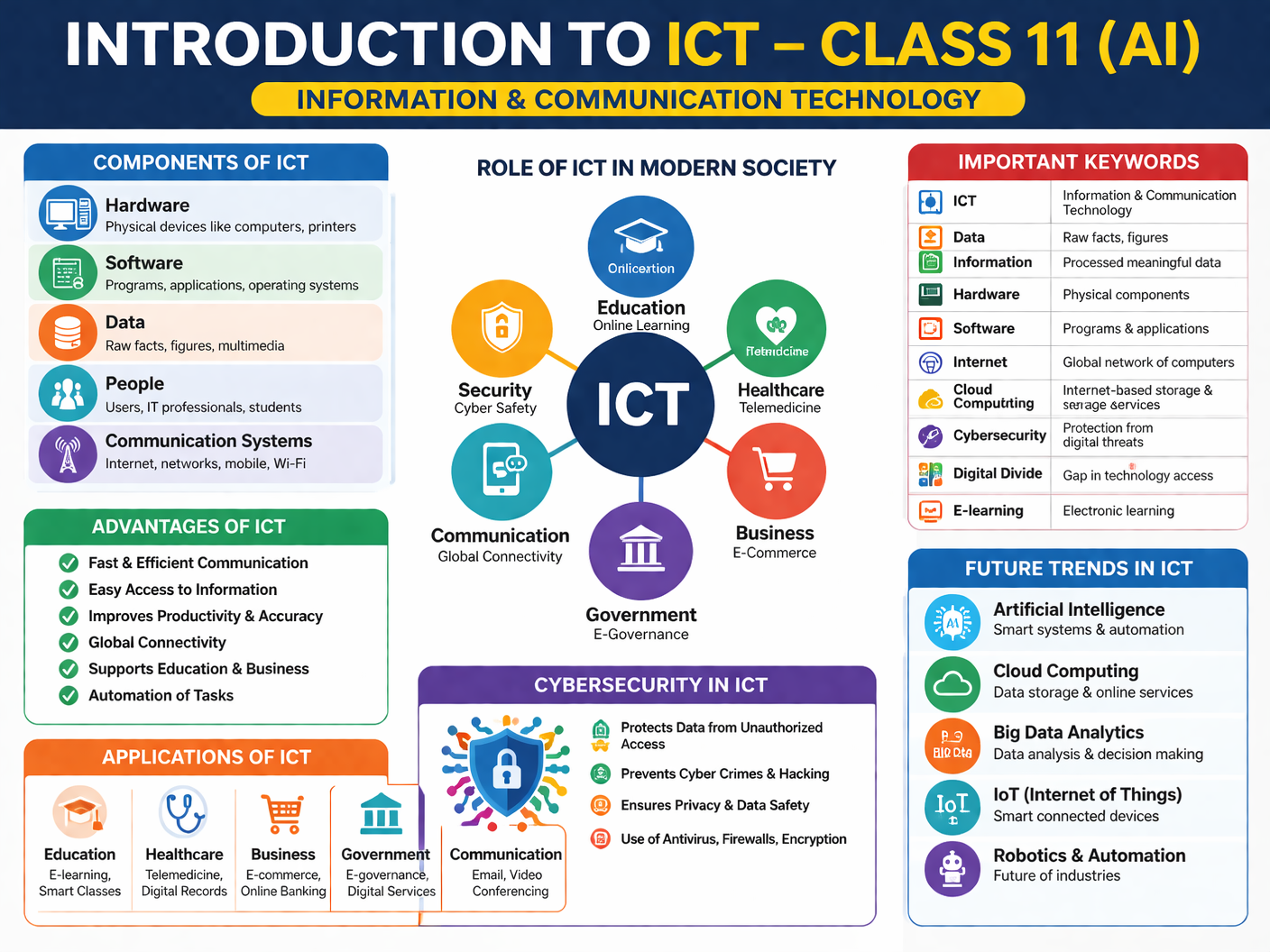
The chapter Introduction to ICT Class 11 AI is the foundation of understanding how Information and Communication Technology (ICT) impacts our daily lives. In today’s digital world, ICT plays a crucial role in education, business, healthcare, communication, and governance.
This chapter introduces students to the basic concepts of ICT, its components, types, applications, and importance in modern society. It also highlights how ICT tools improve efficiency, productivity, and connectivity. By studying Introduction to ICT Class 11 AI, students develop digital literacy, which is essential for academic success and future careers.
Short Notes (Bullet Points)
- ICT stands for Information and Communication Technology
- It includes technologies used for handling information and communication
- Main components:
- Hardware
- Software
- Data
- People
- Communication systems
- ICT tools:
- Computers
- Internet
- Mobile phones
- Types of ICT:
- Traditional ICT (radio, TV)
- Modern ICT (internet, cloud computing)
- Uses of ICT:
- Education (e-learning)
- Healthcare (telemedicine)
- Business (e-commerce)
- Advantages:
- Fast communication
- Easy data storage
- Global connectivity
- Disadvantages:
- Cybersecurity risks
- Digital divide
- Privacy issues
Detailed Summary (900–1200 words)
The chapter Introduction to ICT Class 11 AI provides a detailed understanding of how technology helps in managing and communicating information efficiently. ICT is an integration of computer and communication technologies that enable users to access, store, transmit, and manipulate information.
Meaning of ICT
ICT refers to all digital technologies that help in handling information. It includes devices like computers, smartphones, and networks such as the internet. In the Introduction to ICT Class 11 AI, students learn that ICT is not limited to computers but also includes communication tools like television, radio, and telecommunication systems.
Components of ICT
ICT is made up of several important components:
- Hardware
Physical devices like computers, keyboards, printers, and servers. - Software
Programs and applications that run on hardware, such as operating systems and applications. - Data
Raw facts and figures that are processed to generate meaningful information. - People
Users who interact with ICT systems, including students, teachers, and professionals. - Communication Systems
Networks that connect devices, such as the internet, Wi-Fi, and mobile networks.
Understanding these components is essential in Introduction to ICT Class 11 AI, as they form the backbone of all ICT operations.
Types of ICT
The chapter explains different types of ICT technologies:
- Traditional ICT
- Radio
- Television
- Landline telephones
- Modern ICT
- Internet
- Smartphones
- Cloud computing
- Artificial Intelligence
Modern ICT is more interactive and widely used in today’s digital world.
Applications of ICT
ICT is used in almost every sector:
Education
ICT has transformed education through:
- Online classes
- Digital learning platforms
- Smart classrooms
Students studying Introduction to ICT Class 11 AI benefit from e-learning tools and digital resources.
Healthcare
ICT helps in:
- Telemedicine
- Digital health records
- Online consultations
Doctors can diagnose and treat patients remotely.
Business
ICT enables:
- E-commerce
- Digital payments
- Online marketing
Businesses can operate globally using ICT tools.
Communication
ICT has revolutionized communication:
- Video conferencing
- Social media
Communication is now faster and more efficient.
Advantages of ICT
The Introduction to ICT Class 11 AI highlights several benefits:
- Speed: Information can be shared instantly
- Accuracy: Reduces human errors
- Storage: Large data can be stored digitally
- Connectivity: Connects people worldwide
- Automation: Reduces manual work
Disadvantages of ICT
Despite its benefits, ICT also has drawbacks:
- Cybersecurity threats such as hacking
- Privacy concerns
- Digital divide between rural and urban areas
- Health issues due to excessive screen time
Role of ICT in Daily Life
ICT plays a vital role in everyday activities:
- Online banking
- Digital shopping
- Social networking
- Online education
The chapter Introduction to ICT Class 11 AI emphasizes how ICT has become an essential part of modern living.
ICT and Future Opportunities
ICT is continuously evolving, creating new career opportunities:
- Data analyst
- Software developer
- Network engineer
- AI specialist
Students who understand Introduction to ICT Class 11 AI gain a strong base for future technological careers.
Flowchart / Mind Map (Text-Based)
ICT (Information and Communication Technology)
→ Components
→ Hardware
→ Software
→ Data
→ People
→ Communication
→ Types
→ Traditional ICT
→ Modern ICT
→ Applications
→ Education
→ Healthcare
→ Business
→ Communication
→ Advantages
→ Speed
→ Accuracy
→ Storage
→ Disadvantages
→ Cybersecurity
→ Privacy Issues
→ Digital Divide
Important Keywords with Meanings
- ICT: Technology used to manage and communicate information
- Hardware: Physical components of a computer
- Software: Programs that run on computers
- Data: Raw facts and figures
- Information: Processed data
- Internet: Global network of computers
- Cloud Computing: Storage and services over the internet
- E-learning: Learning using digital platforms
- Cybersecurity: Protection of digital systems
- Digital Divide: Gap between technology users and non-users
Important Questions & Answers
Short Answer Questions
Q1. What is ICT?
ICT stands for Information and Communication Technology. It includes technologies used to handle information and communication.
Q2. Name two components of ICT.
Hardware and Software.
Q3. What is e-learning?
Learning through digital platforms using ICT tools.
Q4. What is cloud computing?
Storing and accessing data over the internet instead of local storage.
Q5. Give one disadvantage of ICT.
Cybersecurity risks.
Long Answer Questions
Q1. Explain the components of ICT in detail.
ICT consists of hardware, software, data, people, and communication systems. Hardware includes physical devices like computers. Software includes programs that run these devices. Data is processed to create information. People operate ICT systems. Communication systems connect devices and enable data transfer. Together, these components ensure effective functioning of ICT.
Q2. Discuss the applications of ICT in different fields.
ICT is widely used in education for online learning, in healthcare for telemedicine, in business for e-commerce, and in communication through emails and video calls. It improves efficiency, saves time, and enhances productivity across all sectors.
Q3. What are the advantages and disadvantages of ICT?
Advantages include speed, accuracy, and connectivity. Disadvantages include cybersecurity threats, privacy issues, and the digital divide. Proper use of ICT can maximize benefits while minimizing risks.
20 MCQs with Answers
- ICT stands for:
a) Information Communication Technology
b) Information and Communication Technology
c) Internet Communication Technology
d) None
Answer: b - Which is a hardware device?
a) MS Word
b) Keyboard
c) Software
d) Data
Answer: b - Which is an example of modern ICT?
a) Radio
b) Television
c) Internet
d) Newspaper
Answer: c - ICT is used in:
a) Education
b) Healthcare
c) Business
d) All
Answer: d - Data becomes information after:
a) Storage
b) Processing
c) Input
d) Output
Answer: b - Cloud computing is:
a) Local storage
b) Internet storage
c) Hardware
d) Software
Answer: b - ICT improves:
a) Speed
b) Efficiency
c) Communication
d) All
Answer: d - Which is not ICT?
a) Internet
b) Computer
c) Book
d) Mobile
Answer: c - Digital divide means:
a) Data division
b) Technology gap
c) Software issue
d) Hardware issue
Answer: b - Email is used for:
a) Storage
b) Communication
c) Processing
d) None
Answer: b - ICT helps in:
a) Online learning
b) Telemedicine
c) E-commerce
d) All
Answer: d - Software is:
a) Physical
b) Logical
c) Data
d) None
Answer: b - Which is a communication system?
a) Internet
b) Keyboard
c) Monitor
d) CPU
Answer: a - ICT reduces:
a) Efficiency
b) Speed
c) Manual work
d) Communication
Answer: c - Which is traditional ICT?
a) Cloud
b) Radio
c) Internet
d) AI
Answer: b - ICT stands for:
Answer: Information and Communication Technology - Telemedicine is used in:
Answer: Healthcare - ICT helps in global:
Answer: Connectivity - ICT systems require:
Answer: People - Cybersecurity protects:
Answer: Data
Exam Tips / Value-Based Questions
Exam Tips
- Focus on definitions like ICT, data, information
- Learn components and applications clearly
- Practice MCQs regularly
- Use diagrams/flowcharts for revision
- Write answers in points for better scoring
Value-Based Questions
Q1. How can ICT reduce inequality in education?
ICT provides equal access to online learning resources, helping students from remote areas.
Q2. Why is cybersecurity important?
It protects personal and sensitive data from misuse and cyber threats.
Conclusion (SEO Friendly)
The chapter Introduction to ICT Class 11 AI is essential for building a strong foundation in digital technology. It helps students understand how ICT tools are used in everyday life and across various industries. With the increasing importance of technology, knowledge of ICT is crucial for academic success and future career growth.
By mastering the concepts of Introduction to ICT Class 11 AI, students can enhance their digital skills, improve problem-solving abilities, and stay prepared for a technology-driven world. This chapter not only supports exams but also builds real-life skills needed in the 21st century.
Additional Practice Section for Introduction to ICT Class 11 AI
To strengthen your preparation of Introduction to ICT Class 11 AI, here are advanced-level questions, case studies, assertion-reason questions, and extra MCQs. This section is designed for board exams, competitive exams, and deep conceptual clarity.
Case Study-Based Questions (With Answers)
Case Study 1: Digital Education
Riya lives in a remote village where schools lack proper infrastructure. She attends online classes using a smartphone and internet connection. She also uses educational apps for learning.
Questions:
Q1. Which ICT tool is helping Riya the most?
Answer: Internet and smartphone.
Q2. What is the role of ICT in Riya’s education?
Answer: ICT provides access to online learning resources, making education accessible even in remote areas.
Q3. Identify one advantage of ICT shown here.
Answer: Accessibility of education.
Q4. What problem can Riya face while using ICT?
Answer: Poor internet connectivity or digital divide.
Case Study 2: Online Business
A small shop owner started selling products online using a website and digital payment system. His business expanded across cities.
Questions:
Q1. Which ICT application is used here?
Answer: E-commerce.
Q2. How does ICT help business growth?
Answer: ICT enables global reach, faster transactions, and online marketing.
Q3. Name one ICT tool used here.
Answer: Website or digital payment system.
Q4. What risk is associated with this system?
Answer: Cybersecurity threats.
Case Study 3: Healthcare Technology
A patient consults a doctor through a video call instead of visiting a hospital.
Questions:
Q1. What is this service called?
Answer: Telemedicine.
Q2. How does ICT benefit healthcare?
Answer: It provides remote consultation and faster diagnosis.
Q3. Which ICT component is involved?
Answer: Communication system.
Q4. What is one limitation?
Answer: Lack of physical examination.
Assertion-Reason Questions
- Assertion (A): ICT improves communication speed.
Reason (R): ICT uses digital technologies like the internet.
Answer: Both A and R are true, and R is the correct explanation. - Assertion (A): ICT has no disadvantages.
Reason (R): ICT ensures fast communication.
Answer: A is false, R is true. - Assertion (A): Cloud computing stores data online.
Reason (R): It uses internet-based servers.
Answer: Both A and R are true, and R is correct. - Assertion (A): ICT reduces manual work.
Reason (R): ICT automates tasks.
Answer: Both A and R are true. - Assertion (A): Digital divide is beneficial.
Reason (R): It increases access to technology.
Answer: Both A and R are false.
Additional MCQs (30 Questions)
- ICT mainly deals with:
a) Communication only
b) Information only
c) Both information and communication
d) None
Answer: c - Which is not a component of ICT?
a) Data
b) People
c) Oxygen
d) Software
Answer: c - Internet is an example of:
a) Hardware
b) Software
c) Communication system
d) Data
Answer: c - Telemedicine is related to:
a) Business
b) Education
c) Healthcare
d) Communication
Answer: c - ICT enables:
a) Fast communication
b) Global connectivity
c) Data storage
d) All
Answer: d - Which is input device?
a) Monitor
b) Printer
c) Keyboard
d) Speaker
Answer: c - Which is output device?
a) Mouse
b) Keyboard
c) Monitor
d) Scanner
Answer: c - Data refers to:
a) Processed facts
b) Raw facts
c) Output
d) Software
Answer: b - Information is:
a) Raw data
b) Processed data
c) Hardware
d) Input
Answer: b - ICT helps in:
a) Communication
b) Education
c) Business
d) All
Answer: d - Digital divide refers to:
Answer: Gap between technology users - ICT tools include:
Answer: Computers and internet - Email is used for:
Answer: Communication - Cloud computing uses:
Answer: Internet - Hardware includes:
Answer: Physical devices - Software includes:
Answer: Programs - ICT improves:
Answer: Efficiency - Cybersecurity protects:
Answer: Data - ICT reduces:
Answer: Manual work - Online shopping is:
Answer: E-commerce - Smartphone is:
Answer: ICT tool - Data is stored in:
Answer: Storage devices - Communication system includes:
Answer: Internet - ICT helps in:
Answer: Automation - Video conferencing is:
Answer: Communication tool - ICT is important for:
Answer: Digital literacy - Cloud is:
Answer: Online storage - ICT increases:
Answer: Productivity - Internet connects:
Answer: Computers globally - ICT is used in:
Answer: All sectors
HOTS (Higher Order Thinking Questions)
Q1. How can ICT help in disaster management?
ICT helps in early warning systems, communication during emergencies, and coordination of rescue operations.
Q2. Explain how ICT can improve government services.
ICT enables e-governance, online services, digital records, and transparency in administration.
Q3. Analyze the impact of ICT on employment.
ICT creates new jobs in technology sectors but may reduce traditional jobs due to automation.
Revision Notes (Quick Recap)
- ICT = Information + Communication Technology
- Components = Hardware, Software, Data, People, Communication
- Types = Traditional & Modern
- Uses = Education, Healthcare, Business
- Benefits = Speed, Accuracy, Connectivity
- Limitations = Cyber threats, Privacy issues
Common Mistakes Students Make
- Confusing data and information
- Forgetting components of ICT
- Ignoring disadvantages in long answers
- Writing vague answers without examples
- Not practicing MCQs
Practice Long Answer Questions (Exam Level)
Q1. Explain the role of ICT in modern society.
ICT plays a vital role in education, healthcare, business, and communication. It improves efficiency, saves time, and enables global connectivity. It also supports innovation and digital transformation.
Q2. Describe the advantages and challenges of ICT.
Advantages include speed, storage, automation, and connectivity. Challenges include cybersecurity threats, privacy concerns, and digital divide. Balanced use is necessary.
Sample 5-Mark Questions
- Define ICT and explain its components.
- Differentiate between data and information.
- Explain the role of ICT in education.
- What is digital divide? Explain with example.
- Discuss advantages of ICT in business.
Sample 3-Mark Questions
- What is cloud computing?
- Give two uses of ICT.
- Define cybersecurity.
- What are ICT tools?
- What is e-learning?
Final Revision Strategy for Introduction to ICT Class 11 AI
- Revise Introduction to ICT Class 11 AI notes daily
- Practice at least 20 MCQs per day
- Learn keywords and definitions properly
- Solve case studies for better understanding
- Focus on applications and real-life examples
This extended section ensures complete mastery of Introduction to ICT Class 11 AI, making it ideal for scoring high marks in exams as well as building strong conceptual understanding.
Introduction to ICT Class 11 AI – 80 Marks Question Paper (CBSE Pattern)
Time Allowed: 3 Hours
Maximum Marks: 80
General Instructions:
- All questions are compulsory.
- Read the questions carefully before answering.
- Use clear and concise language.
- Draw diagrams/flowcharts wherever required.
- Marks are indicated against each question.
Section A – MCQs (1 × 20 = 20 Marks)
Choose the correct option:
- ICT stands for:
a) Information Communication Technology
b) Information and Communication Technology
c) Internet Communication Technology
d) Information Computer Technology - Which of the following is a hardware device?
a) MS Word
b) Operating System
c) Keyboard
d) Software - Which of the following is an example of modern ICT?
a) Radio
b) Newspaper
c) Internet
d) Magazine - Data refers to:
a) Processed information
b) Raw facts
c) Output
d) Software - Information is:
a) Raw data
b) Processed data
c) Hardware
d) Input - Which is not a component of ICT?
a) People
b) Data
c) Oxygen
d) Software - Internet is an example of:
a) Hardware
b) Communication system
c) Software
d) Data - Which of the following is used for communication?
a) Email
b) Printer
c) Keyboard
d) Monitor - Cloud computing refers to:
a) Local storage
b) Internet-based storage
c) Hardware
d) Input - Telemedicine is related to:
a) Education
b) Business
c) Healthcare
d) Entertainment - Digital divide means:
a) Data processing
b) Gap between technology users
c) Internet speed
d) Software error - Which is an output device?
a) Keyboard
b) Mouse
c) Monitor
d) Scanner - ICT helps in:
a) Education
b) Business
c) Healthcare
d) All - Software is:
a) Physical device
b) Logical program
c) Input device
d) Output device - Which is traditional ICT?
a) Cloud computing
b) Internet
c) Radio
d) AI - E-learning is:
a) Offline learning
b) Learning through ICT
c) Classroom learning
d) Manual learning - ICT improves:
a) Speed
b) Accuracy
c) Efficiency
d) All - Cybersecurity protects:
a) Hardware
b) Data
c) Monitor
d) Printer - Smartphone is an example of:
a) ICT tool
b) Software
c) Data
d) Output - Video conferencing is used for:
a) Storage
b) Communication
c) Processing
d) Input
Section B – Very Short Answer (2 × 5 = 10 Marks)
- Define ICT.
- What is data?
- What is cloud computing?
- Name any two ICT tools.
- What is digital divide?
Section C – Short Answer (3 × 5 = 15 Marks)
- Differentiate between data and information.
- Explain any three components of ICT.
- Write three advantages of ICT.
- What are ICT tools? Give examples.
- Explain the role of ICT in communication.
Section D – Case Study Based Questions (5 × 3 = 15 Marks)
Case Study 1:
A student attends online classes using a laptop and internet connection.
- Identify the ICT tools used.
- What is the role of ICT in education here?
- Mention one advantage of ICT in this case.
Case Study 2:
A businessman sells products online using a website and digital payment.
- Which ICT application is used?
- How does ICT help in business?
- Mention one risk involved.
Case Study 3:
A patient consults a doctor through video conferencing.
- What is this service called?
- Which ICT component is used?
- State one benefit.
Section E – Long Answer Questions (5 × 4 = 20 Marks)
- Explain the components of ICT in detail.
- Discuss the applications of ICT in education, healthcare, and business.
- Explain the advantages and disadvantages of ICT.
- Describe the role of ICT in modern society.
- Explain the concept of cybersecurity and its importance in ICT.
Internal Choice (Optional)
- Attempt any one:
OR
Explain the concept of cloud computing and its uses.
End of Question Paper
This Introduction to ICT Class 11 AI 80 Marks Question Paper is designed exactly as per CBSE pattern and helps in board exam preparation, revision, and practice.
Introduction to ICT Class 11 AI – Solved 80 Marks Question Paper (Detailed Answers | 3000+ Words)
Time Allowed: 3 Hours
Maximum Marks: 80
Section A – MCQs (Answers)
- b
- c
- c
- b
- b
- c
- b
- a
- b
- c
- b
- c
- d
- b
- c
- b
- d
- b
- a
- b
Section B – Very Short Answer (2 × 5 = 10 Marks)
Q21. Define ICT.
ICT (Information and Communication Technology) refers to the use of digital technologies such as computers, the internet, and communication devices to store, process, and transmit information. It combines both information handling and communication processes, enabling users to access and share data efficiently.
Q22. What is data?
Data refers to raw facts and figures that have no meaning on their own. It can be numbers, text, images, or symbols. When data is processed and organized, it becomes meaningful information.
Q23. What is cloud computing?
Cloud computing is a technology that allows users to store and access data over the internet instead of using local storage devices. It enables remote access, data sharing, and efficient data management.
Q24. Name any two ICT tools.
Two ICT tools are:
- Computer
- Smartphone
Q25. What is digital divide?
Digital divide refers to the gap between individuals or communities who have access to modern technology and those who do not. It highlights inequality in access to ICT resources.
Section C – Short Answer (3 × 5 = 15 Marks)
Q26. Differentiate between data and information.
Data and information are closely related but different concepts in ICT.
Data refers to raw, unprocessed facts and figures. It does not have any meaning by itself. For example, numbers like 50, 60, and 70 are data.
Information, on the other hand, is processed data that has meaning. When data is organized and interpreted, it becomes useful information. For example, “The average marks of students are 60” is information.
Thus, data is the input, and information is the output after processing.
Q27. Explain any three components of ICT.
ICT has several components, but three important ones are:
Hardware:
Hardware includes physical devices such as computers, keyboards, monitors, and printers. These devices help in input, processing, and output of data.
Software:
Software consists of programs and applications that run on hardware. Examples include operating systems and application software like word processors.
Communication System:
This includes networks like the internet and Wi-Fi that connect devices and allow data transfer between them.
These components work together to perform ICT functions effectively.
Q28. Write three advantages of ICT.
- Speed: ICT allows fast communication and quick data processing.
- Accuracy: It reduces human errors and ensures correct results.
- Connectivity: ICT connects people globally, enabling communication and collaboration.
Q29. What are ICT tools? Give examples.
ICT tools are devices and applications used to handle and communicate information. Examples include computers, smartphones, the internet, email, and video conferencing tools.
Q30. Explain the role of ICT in communication.
ICT has transformed communication by making it faster, cheaper, and more efficient. Tools like email, messaging apps, and video conferencing allow instant communication across the world. ICT eliminates geographical barriers and enables real-time interaction, making communication more effective.
Section D – Case Study Based Questions (15 Marks)
Case Study 1
A student attends online classes using a laptop and internet connection.
Q31. Identify the ICT tools used.
The ICT tools used are a laptop and internet connection.
Q32. What is the role of ICT in education here?
ICT enables online learning, allowing students to attend classes remotely. It provides access to digital resources, recorded lectures, and interactive learning platforms.
Q33. Mention one advantage of ICT in this case.
One major advantage is accessibility, as students can learn from anywhere.
Case Study 2
A businessman sells products online using a website and digital payment.
Q34. Which ICT application is used?
The application used is e-commerce.
Q35. How does ICT help in business?
ICT helps businesses by expanding their reach globally, enabling online marketing, and allowing digital transactions. It increases efficiency and customer convenience.
Q36. Mention one risk involved.
One risk is cybersecurity threats such as hacking or data theft.
Case Study 3
A patient consults a doctor through video conferencing.
Q37. What is this service called?
This service is called telemedicine.
Q38. Which ICT component is used?
The communication system is used.
Q39. State one benefit.
It saves time and provides remote access to healthcare services.
Section E – Long Answer Questions (20 Marks)
Q40. Explain the components of ICT in detail.
ICT (Information and Communication Technology) consists of several key components that work together to process, store, and communicate information efficiently. These components form the backbone of modern digital systems and are essential for understanding how ICT functions in different fields.
1. Hardware:
Hardware refers to the physical components of a computer system. These include devices that can be seen and touched, such as computers, keyboards, monitors, printers, scanners, and storage devices. Hardware plays a crucial role in inputting, processing, and outputting data. For example, a keyboard is used to input data, the CPU processes it, and the monitor displays the output.
2. Software:
Software is the set of instructions or programs that tell hardware how to perform tasks. It is intangible and includes operating systems (like Windows or Linux) and application software (like MS Word or Excel). Software enables users to interact with hardware and perform specific functions such as writing documents, browsing the internet, or analyzing data.
3. Data:
Data is a collection of raw facts and figures that are processed to generate meaningful information. It can be in the form of text, numbers, images, audio, or video. Data is essential because it is the input for all ICT processes. Once processed, it becomes useful information that can support decision-making.
4. People:
People are an important component of ICT as they design, operate, and manage ICT systems. This includes users, programmers, IT professionals, and system administrators. Without people, ICT systems cannot function effectively.
5. Communication Systems:
Communication systems include networks and technologies that enable data transmission between devices. Examples include the internet, Wi-Fi, mobile networks, and satellite communication. These systems allow users to share information globally in real time.
All these components work together to ensure that ICT systems function efficiently. Understanding these components is essential for mastering the chapter Introduction to ICT Class 11 AI.
Q41. Discuss the applications of ICT in education, healthcare, and business.
ICT has revolutionized various sectors, especially education, healthcare, and business. Its applications have improved efficiency, accessibility, and productivity.
1. Education:
ICT has transformed education through digital learning platforms, online classes, and smart classrooms. Students can access e-books, videos, and interactive content. Teachers use ICT tools to create engaging lessons. E-learning allows students to learn at their own pace and from any location.
2. Healthcare:
In healthcare, ICT enables telemedicine, electronic health records, and online consultations. Doctors can diagnose and treat patients remotely. ICT also helps in managing patient data, improving accuracy, and reducing paperwork.
3. Business:
ICT plays a vital role in business through e-commerce, digital marketing, and online transactions. Businesses can reach global markets and interact with customers easily. ICT tools like email, websites, and payment systems improve communication and efficiency.
Overall, ICT has made these sectors more efficient, accessible, and advanced.
Q42. Explain the advantages and disadvantages of ICT.
ICT has both positive and negative impacts on society.
Advantages:
- Speed: ICT allows fast processing and communication of information.
- Accuracy: Reduces errors and ensures reliable results.
- Connectivity: Connects people globally through the internet.
- Storage: Allows large amounts of data to be stored digitally.
- Automation: Reduces manual work and increases efficiency.
Disadvantages:
- Cybersecurity Threats: Risk of hacking, data theft, and cybercrime.
- Privacy Issues: Personal information can be misused.
- Digital Divide: Unequal access to technology.
- Health Problems: Excessive use can lead to eye strain and stress.
Thus, while ICT offers many benefits, it also requires responsible use.
Q43. Describe the role of ICT in modern society.
ICT plays a crucial role in modern society by influencing how people communicate, work, and live. It has become an integral part of daily life.
In communication, ICT enables instant messaging, emails, and video calls. People can connect globally in seconds. In education, ICT provides access to online learning and digital resources. In business, it supports e-commerce and digital transactions.
ICT also plays a role in governance through e-governance services, making government services more transparent and accessible. In entertainment, ICT provides streaming services and online gaming.
Overall, ICT improves efficiency, saves time, and enhances the quality of life. It is essential for development in the digital age.
Q44. Explain the concept of cybersecurity and its importance in ICT.
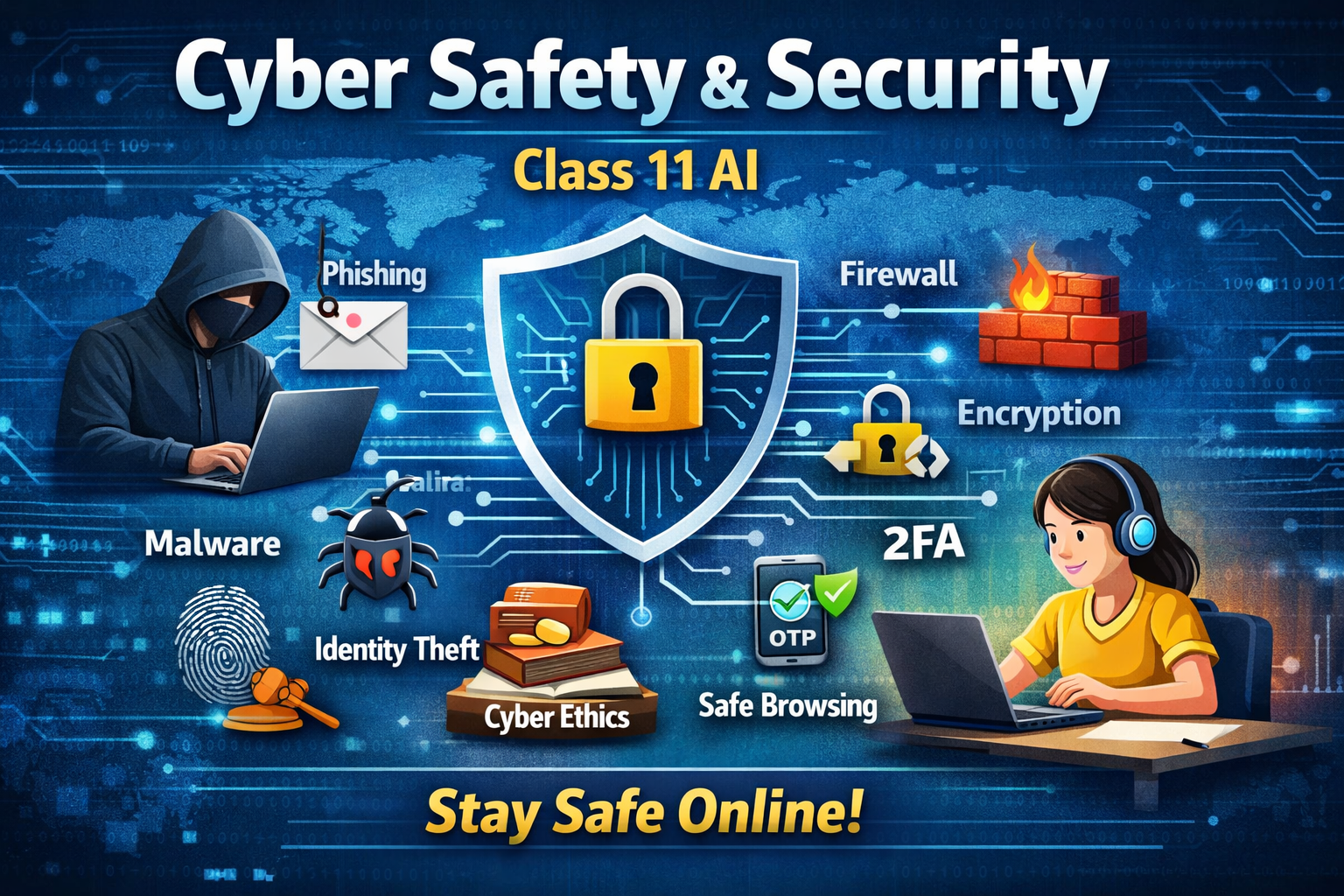
Cybersecurity refers to the protection of computer systems, networks, and data from unauthorized access, attacks, or damage. It is a crucial aspect of ICT because digital systems are vulnerable to cyber threats.
Cybersecurity involves the use of tools like firewalls, antivirus software, encryption, and secure passwords. It protects sensitive information such as personal data, financial details, and business records.
The importance of cybersecurity lies in:
- Protecting data from theft and misuse
- Ensuring privacy and confidentiality
- Preventing cyber attacks
- Maintaining trust in digital systems
Without proper cybersecurity, ICT systems can be easily exploited, leading to serious consequences.
Conclusion
This Introduction to ICT Class 11 AI solved question paper provides a complete understanding of all important concepts required for exams. It covers definitions, applications, advantages, and real-life uses of ICT in detail.
By practicing such detailed answers, students can improve their writing skills, conceptual clarity, and exam performance. Mastering the chapter Introduction to ICT Class 11 AI ensures strong digital literacy and prepares students for future technological challenges.
Introduction to ICT Class 11 AI – 50 MCQs with Answers
Practice these 50 MCQs from Introduction to ICT Class 11 AI to strengthen your concepts and score high in exams.
Multiple Choice Questions
- ICT stands for:
a) Information Communication Technology
b) Information and Communication Technology
c) Internet Communication Technology
d) Information Computer Technology
Answer: b - Which of the following is a hardware device?
a) Software
b) MS Word
c) Keyboard
d) Data
Answer: c - Which is an example of modern ICT?
a) Radio
b) Newspaper
c) Internet
d) Magazine
Answer: c - Data refers to:
a) Processed facts
b) Raw facts
c) Output
d) Software
Answer: b - Information is:
a) Raw data
b) Processed data
c) Hardware
d) Input
Answer: b - Which is not a component of ICT?
a) People
b) Data
c) Oxygen
d) Software
Answer: c - Internet is an example of:
a) Hardware
b) Communication system
c) Software
d) Input device
Answer: b - Email is used for:
a) Storage
b) Communication
c) Processing
d) Input
Answer: b - Cloud computing refers to:
a) Local storage
b) Internet-based storage
c) Hardware
d) Output
Answer: b - Telemedicine is related to:
a) Business
b) Healthcare
c) Education
d) Entertainment
Answer: b - Digital divide means:
a) Data gap
b) Technology gap
c) Software gap
d) Hardware gap
Answer: b - Which is an output device?
a) Keyboard
b) Mouse
c) Monitor
d) Scanner
Answer: c - ICT helps in:
a) Education
b) Healthcare
c) Business
d) All
Answer: d - Software is:
a) Physical
b) Logical
c) Input device
d) Output device
Answer: b - Which is traditional ICT?
a) Internet
b) Cloud computing
c) Radio
d) AI
Answer: c - E-learning means:
a) Classroom learning
b) Digital learning
c) Offline learning
d) Manual learning
Answer: b - ICT improves:
a) Speed
b) Accuracy
c) Efficiency
d) All
Answer: d - Cybersecurity protects:
a) Monitor
b) Data
c) Keyboard
d) Printer
Answer: b - Smartphone is:
a) Software
b) ICT tool
c) Data
d) Output
Answer: b - Video conferencing is used for:
a) Storage
b) Communication
c) Input
d) Processing
Answer: b
- Data becomes information after:
a) Input
b) Processing
c) Storage
d) Output
Answer: b - Which is an input device?
a) Monitor
b) Printer
c) Keyboard
d) Speaker
Answer: c - ICT is mainly used for:
a) Communication only
b) Information only
c) Both communication and information
d) None
Answer: c - Which is not ICT tool?
a) Computer
b) Internet
c) Book
d) Smartphone
Answer: c - ICT allows:
a) Fast communication
b) Data storage
c) Global connectivity
d) All
Answer: d - Cloud storage means:
a) Offline storage
b) Internet storage
c) Hardware storage
d) Manual storage
Answer: b - ICT is important for:
a) Digital literacy
b) Entertainment only
c) Communication only
d) None
Answer: a - Which is application of ICT?
a) E-commerce
b) Telemedicine
c) E-learning
d) All
Answer: d - Communication system includes:
a) Internet
b) CPU
c) Keyboard
d) Mouse
Answer: a - Hardware includes:
a) Software
b) Programs
c) Physical devices
d) Data
Answer: c
- Software includes:
a) Monitor
b) Programs
c) Printer
d) Keyboard
Answer: b - ICT reduces:
a) Efficiency
b) Speed
c) Manual work
d) Communication
Answer: c - ICT increases:
a) Workload
b) Productivity
c) Errors
d) Delay
Answer: b - Internet connects:
a) Computers globally
b) Only local devices
c) Only phones
d) None
Answer: a - Email is:
a) Hardware
b) Software
c) Communication tool
d) Data
Answer: c - Telecommunication includes:
a) Internet
b) Radio
c) Mobile networks
d) All
Answer: d - Which is disadvantage of ICT?
a) Speed
b) Connectivity
c) Cyber threats
d) Storage
Answer: c - ICT helps in education by:
a) Online learning
b) Smart classes
c) Digital content
d) All
Answer: d - Digital payment is used in:
a) Education
b) Business
c) Healthcare
d) Entertainment
Answer: b - Which is example of ICT device?
a) Computer
b) Mobile
c) Tablet
d) All
Answer: d
- Data can be in form of:
a) Text
b) Numbers
c) Images
d) All
Answer: d - ICT enables:
a) Automation
b) Communication
c) Data storage
d) All
Answer: d - ICT tools include:
a) Email
b) Internet
c) Computer
d) All
Answer: d - Which is modern ICT tool?
a) Radio
b) Newspaper
c) Cloud computing
d) Magazine
Answer: c - ICT is useful for:
a) Students
b) Teachers
c) Businesses
d) All
Answer: d - Information is useful for:
a) Decision making
b) Storage
c) Input
d) Output
Answer: a - Cybersecurity is important because:
a) Protects data
b) Increases speed
c) Reduces cost
d) None
Answer: a - ICT in healthcare helps in:
a) Diagnosis
b) Records
c) Communication
d) All
Answer: d - ICT makes communication:
a) Slow
b) Fast
c) Difficult
d) Manual
Answer: b - ICT stands for:
a) Information Communication Technology
b) Information and Communication Technology
c) Internet Computer Technology
d) None
Answer: b
Final Tip
Practice these Introduction to ICT Class 11 AI MCQs regularly to improve accuracy, speed, and confidence for board exams and competitive tests.
Introduction to ICT Class 11 AI – Paragraph Based Questions with Answers (3000+ Words)
This section provides high-quality paragraph-based questions from Introduction to ICT Class 11 AI, designed for board exams and competency-based assessment. These questions test understanding, application, and analytical skills.
Passage 1: Understanding ICT in Daily Life
Information and Communication Technology (ICT) has become an essential part of modern life. It refers to technologies that provide access to information through telecommunications. ICT includes devices such as computers, smartphones, and networks like the internet. These tools help people communicate, store, process, and share information efficiently. In daily life, ICT is used for online shopping, banking, communication, education, and entertainment. The use of ICT has made tasks faster, more accurate, and more convenient. However, it also brings challenges such as cybersecurity threats and privacy issues.
Questions:
Q1. What is ICT?
ICT refers to technologies used for accessing, storing, processing, and communicating information.
Q2. Name two ICT tools mentioned in the passage.
Computers and smartphones.
Q3. How does ICT help in daily life?
ICT helps by making communication faster, enabling online services, and improving efficiency in tasks like banking and shopping.
Q4. Mention one disadvantage of ICT.
Cybersecurity threats or privacy issues.
Q5. Why is ICT important today?
It improves efficiency, connectivity, and convenience in everyday activities.
Passage 2: ICT in Education
ICT has transformed the education system significantly. Students can now attend online classes, access digital textbooks, and use educational apps. Teachers use ICT tools such as projectors and smartboards to make lessons interactive. E-learning platforms allow students to learn at their own pace. ICT also helps in distance learning, making education accessible to students in remote areas. However, lack of internet access and digital devices can create a digital divide among students.
Questions:
Q1. How has ICT changed education?
ICT has introduced online learning, digital resources, and interactive teaching methods.
Q2. What is e-learning?
E-learning is learning through digital platforms using ICT tools.
Q3. What is one benefit of ICT in education?
It provides flexible and accessible learning opportunities.
Q4. What problem is mentioned in the passage?
Digital divide due to lack of access to internet and devices.
Q5. How does ICT help teachers?
It helps teachers make lessons more interactive and engaging.
Passage 3: ICT in Healthcare
ICT plays a crucial role in the healthcare sector. It enables telemedicine, where patients can consult doctors remotely through video calls. Hospitals use digital records to store patient information, which improves efficiency and accuracy. ICT also helps in diagnosing diseases and monitoring patients. It saves time and reduces the need for physical visits. However, challenges such as data security and lack of technical skills can affect its effectiveness.
Questions:
Q1. What is telemedicine?
Telemedicine is remote consultation between doctors and patients using ICT tools.
Q2. How does ICT improve healthcare?
It improves efficiency, accuracy, and access to medical services.
Q3. What is one advantage of digital records?
They store patient data safely and can be accessed easily.
Q4. Mention one challenge of ICT in healthcare.
Data security issues or lack of technical skills.
Q5. Why is ICT important in hospitals?
It helps in better management, diagnosis, and patient care.
Passage 4: ICT in Business
ICT has revolutionized the business world. Businesses use ICT tools such as computers, websites, and mobile applications to operate efficiently. E-commerce platforms allow companies to sell products online and reach global customers. Digital payment systems make transactions quick and secure. ICT also helps in marketing through social media and email. Despite its advantages, businesses face risks such as cyber attacks and data breaches.
Questions:
Q1. What is e-commerce?
E-commerce is buying and selling goods and services online.
Q2. How does ICT help businesses grow?
It enables global reach, faster communication, and efficient operations.
Q3. What is one ICT tool used in business?
Website or mobile application.
Q4. Mention one risk in using ICT.
Cyber attacks or data breaches.
Q5. Why are digital payments important?
They make transactions fast, easy, and secure.
Passage 5: Components of ICT
ICT consists of several components that work together. Hardware includes physical devices like computers and printers. Software includes programs that run on hardware. Data refers to raw facts that are processed into information. People are users who operate ICT systems. Communication systems connect devices and allow data transfer. All these components are essential for effective functioning of ICT systems.
Questions:
Q1. What are the components of ICT?
Hardware, software, data, people, and communication systems.
Q2. What is hardware?
Physical devices like computers and printers.
Q3. What is software?
Programs that run on hardware.
Q4. What is data?
Raw facts and figures.
Q5. Why are communication systems important?
They connect devices and enable data transfer.
Passage 6: Advantages of ICT
ICT offers many advantages in different sectors. It enables fast communication through emails and messaging apps. It improves accuracy and reduces human errors. ICT allows large amounts of data to be stored and accessed easily. It also supports automation, reducing manual work. ICT connects people globally and provides access to information anytime. These advantages make ICT an essential tool in modern society.
Questions:
Q1. Name one advantage of ICT.
Fast communication.
Q2. How does ICT improve accuracy?
It reduces human errors through automation.
Q3. What is data storage?
Saving large amounts of information digitally.
Q4. How does ICT support automation?
It performs tasks automatically without human intervention.
Q5. Why is ICT important globally?
It connects people and provides access to information worldwide.
Passage 7: Disadvantages of ICT
Despite its benefits, ICT has some disadvantages. Cybersecurity threats such as hacking and viruses can damage systems and steal data. Privacy issues arise when personal information is misused. The digital divide creates inequality between those who have access to technology and those who do not. Excessive use of ICT can also lead to health problems such as eye strain and stress.
Questions:
Q1. What are cybersecurity threats?
Threats like hacking and viruses that harm digital systems.
Q2. What is privacy issue?
Misuse of personal information.
Q3. What is digital divide?
Gap between people with and without access to technology.
Q4. Mention one health issue caused by ICT.
Eye strain or stress.
Q5. Why should ICT be used carefully?
To avoid risks and negative effects.
Passage 8: ICT and Communication
ICT has revolutionized communication. In earlier times, people used letters and telephones. Today, emails, messaging apps, and video calls allow instant communication. ICT enables people to connect globally in real time. It also supports sharing of multimedia such as images and videos. This has made communication faster, easier, and more effective.
Questions:
Q1. How has communication changed due to ICT?
It has become faster and more efficient.
Q2. Name two modern communication tools.
Email and video calls.
Q3. What is real-time communication?
Instant communication without delay.
Q4. What type of data can be shared?
Text, images, and videos.
Q5. Why is ICT important in communication?
It connects people globally and saves time.
Passage 9: ICT and Future
ICT is continuously evolving and creating new opportunities. Technologies such as artificial intelligence, cloud computing, and big data are shaping the future. ICT creates jobs like software developers, data analysts, and IT professionals. It also supports innovation and development. Students who learn ICT skills are better prepared for future careers.
Questions:
Q1. Name one future technology mentioned.
Artificial Intelligence.
Q2. How does ICT create jobs?
By generating roles in technology fields.
Q3. What is cloud computing?
Storing data on internet servers.
Q4. Why should students learn ICT?
To prepare for future careers.
Q5. What is the role of ICT in development?
It supports innovation and growth.
Passage 10: ICT in Government Services
ICT is widely used in government services through e-governance. Citizens can access services like online applications, digital payments, and information portals. ICT improves transparency, efficiency, and accountability in governance. It reduces paperwork and saves time. However, challenges such as lack of awareness and technical issues may affect its implementation.
Questions:
Q1. What is e-governance?
Use of ICT in government services.
Q2. How does ICT improve governance?
By increasing efficiency and transparency.
Q3. What services can citizens access online?
Applications, payments, and information.
Q4. Mention one challenge of e-governance.
Lack of awareness or technical issues.
Q5. Why is ICT important for government?
It improves service delivery and reduces paperwork.
Final Note
These Introduction to ICT Class 11 AI paragraph-based questions are highly important for exams. Practice them thoroughly to improve comprehension, analytical skills, and answer-writing ability. They are especially useful for case study questions, competency-based questions, and board exam preparation.



Leave a Reply