


Meta Description:
Complete guide to A Photograph Class 11 English poem including summary, notes, keywords, MCQs, important questions, and exam tips for easy revision and exam preparation.
Introduction of the Poem
The poem A Photograph Class 11 English is written by Shirley Toulson and is included in the NCERT book Hornbill. The poem is a touching reflection on memories, childhood, and the pain of losing loved ones. Through a simple photograph, the poet recalls moments from her mother’s childhood and reflects on how time changes everything.
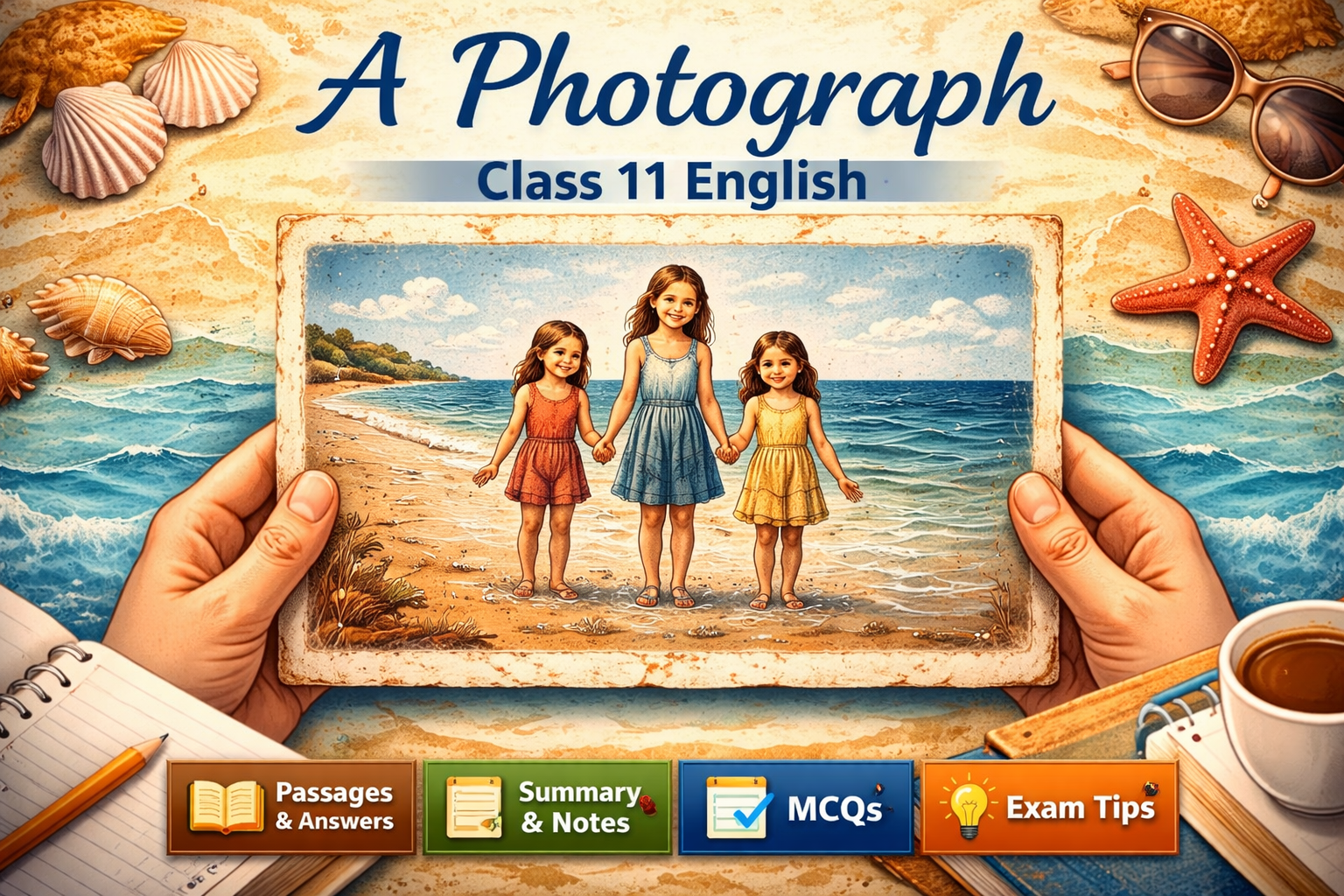
The poem A Photograph Class 11 English shows how photographs preserve memories even when people and situations change. The poet looks at an old photograph of her mother when she was a young girl enjoying a holiday at the beach with her cousins. The image captures a happy moment from the past.
As the poet reflects on the photograph, she remembers how her mother used to laugh while recalling that childhood memory. However, the poet also mentions that her mother has passed away, which creates a feeling of deep sadness. The poem beautifully explores themes such as time, memory, nostalgia, and loss.
The poem A Photograph Class 11 English summary helps students understand how the poet connects past memories with present emotions. The photograph becomes a symbol of how memories remain even when people are no longer alive.
Short Notes (A Photograph Class 11 English Notes)
Poet: Shirley Toulson
Poem Type: Reflective and emotional poem
Theme: Memories, passage of time, and loss
The poem describes an old photograph of the poet’s mother taken during childhood.
The photograph shows the poet’s mother with her cousins at the beach.
The girls are enjoying the seaside and standing beside the sea waves.
The poet remembers how her mother laughed while talking about the photograph.
The poet’s mother later passed away, leaving the poet with memories.
The photograph symbolizes how memories remain even after people are gone.
The poem highlights the contrast between the permanence of the sea and the temporary nature of human life.
These A Photograph Class 11 English notes are useful for quick revision before exams.
Detailed Summary (A Photograph Class 11 English Summary)
The poem A Photograph Class 11 English by Shirley Toulson is a deeply emotional poem that explores the relationship between memory, time, and loss. The poet uses a simple photograph as a way to recall memories of her mother’s childhood and reflect on the passing of time.
The poem begins with the poet describing an old photograph that shows her mother when she was a young girl. In the photograph, the poet’s mother is about twelve years old. She is standing at the beach with two of her cousins. The girls are holding hands and smiling at the camera. Their hair is flying in the wind, and they look happy and carefree.
The photograph was taken many years ago by the poet’s grandmother, who was standing behind the camera. The grandmother wanted to capture the happy moment of the girls enjoying their holiday at the seaside.
The poet describes how the sea waves touched the girls’ feet while they stood at the beach. The sea appears calm and peaceful in the photograph. The poet also mentions that the sea has not changed much over the years. Even after many decades, the sea remains the same, while human lives change and pass away.
This contrast between the unchanging sea and the changing human life is one of the main ideas in the poem A Photograph Class 11 English. The sea symbolizes permanence and continuity, while humans symbolize temporary existence.
In the second part of the poem, the poet remembers how her mother used to talk about the photograph. Whenever her mother looked at the photograph, she would laugh and recall the happy memories of that day at the beach. She would also comment on how her cousins looked dressed for the beach holiday.
The mother’s laughter shows that she felt joyful remembering those moments from her childhood. For her, the photograph was a reminder of a carefree time when she was young and enjoying life with her cousins.
However, as time passed, the poet’s mother grew older and eventually passed away. This creates a sense of sadness in the poem. The poet realizes that the person who once laughed while looking at the photograph is no longer alive.
In the final part of the poem, the poet reflects on her feelings after her mother’s death. She says that there is nothing left to say about the loss. The silence represents the deep pain and emptiness she feels.
The poet suggests that sometimes grief cannot be expressed through words. Instead, it remains as silent memories in the heart.
The poem A Photograph Class 11 English summary shows how time changes everything. The young girl in the photograph grew up, became a mother, and eventually passed away. However, the photograph still remains as a reminder of that happy moment.
Another important idea in the poem is the power of photographs. Photographs capture moments that can never return. They preserve memories and help people remember the past.
The poet also highlights the natural cycle of life. People are born, grow up, and eventually die, but memories remain through photographs and stories.
The poem A Photograph Class 11 English also emphasizes the emotional bond between a mother and a daughter. The poet feels deeply connected to her mother’s memories even after her death.
The sea in the poem acts as a powerful symbol. While human life is short and temporary, the sea continues to exist unchanged. This contrast reminds readers about the passage of time and the inevitability of change.
Overall, the poem A Photograph Class 11 English summary presents a touching reflection on memory, love, and loss. It shows how photographs preserve moments from the past and allow people to remember loved ones even after they are gone.
Flowchart / Mind Map (Text Based)
A Photograph Poem Structure
Photograph of Mother’s Childhood
↓
Mother with Two Cousins at Beach
↓
Sea Waves Touch Their Feet
↓
Grandmother Takes the Photograph
↓
Mother Remembers and Laughs Later
↓
Passage of Time
↓
Mother’s Death
↓
Poet’s Silence and Grief
↓
Theme – Memories and Loss
Important Keywords with Meanings
Photograph – A picture taken with a camera that captures a moment in time.
Cousins – Children of one’s uncle or aunt.
Seashore – The land area near the sea.
Nostalgia – A feeling of longing for the past.
Transient – Something that lasts for a short time.
Immortal – Something that lasts forever.
Silence – Absence of sound; used to represent deep emotions.
Memory – The ability to remember past events.
Loss – The feeling of sadness when someone dies or leaves.
Contrast – Showing the difference between two things.
Important Questions and Answers
Short Answer Questions
- Who wrote the poem A Photograph?
The poem A Photograph was written by Shirley Toulson. - What does the photograph show?
The photograph shows the poet’s mother as a young girl standing at the beach with her two cousins. - Who took the photograph?
The poet’s grandmother took the photograph. - How old was the poet’s mother in the photograph?
She was about twelve years old. - What does the sea symbolize in the poem?
The sea symbolizes permanence and continuity.
Long Answer Questions
- Describe the theme of the poem A Photograph.
The poem A Photograph Class 11 English explores the themes of time, memory, and loss. Through an old photograph, the poet recalls a moment from her mother’s childhood when she was enjoying a holiday at the beach with her cousins. The photograph captures a happy memory from the past.
The poet remembers how her mother used to laugh when she looked at the photograph and talked about her childhood experiences. However, the poet’s mother later passed away, which brings sadness to the poet.
The poem highlights the contrast between the permanence of nature and the temporary nature of human life. While the sea remains unchanged over time, human beings grow old and eventually die.
Overall, the poem shows how photographs preserve memories and remind people of the past.
- How does the poet express the passage of time in the poem?
In the poem A Photograph Class 11 English, the passage of time is shown through three stages. First, the photograph captures the poet’s mother as a young girl enjoying her childhood. Second, the poet remembers how her mother used to laugh while recalling the photograph. Third, the poet reflects on the present moment when her mother is no longer alive.
This progression clearly shows how time moves forward and changes everything. The photograph remains the same, but the people in it grow older and eventually pass away.
20 MCQs with Answers
- Who wrote the poem A Photograph?
A. Robert Frost
B. Shirley Toulson
C. William Wordsworth
D. John Keats
Answer: B - The photograph shows the poet’s
A. Sister
B. Mother
C. Friend
D. Teacher
Answer: B - The poet’s mother was about
A. 10 years old
B. 12 years old
C. 15 years old
D. 18 years old
Answer: B - The photograph was taken at
A. River
B. Beach
C. Forest
D. Mountain
Answer: B - Who took the photograph?
A. Father
B. Grandmother
C. Uncle
D. Friend
Answer: B - The girls in the photograph were
A. Playing
B. Standing
C. Running
D. Swimming
Answer: B - The sea in the poem represents
A. Change
B. Permanence
C. Danger
D. Happiness
Answer: B - The poet’s mother used to
A. Cry at the photograph
B. Laugh at the photograph
C. Ignore the photograph
D. Destroy the photograph
Answer: B - The poem expresses feelings of
A. Joy
B. Anger
C. Nostalgia
D. Excitement
Answer: C - The poem A Photograph is about
A. Adventure
B. Memories and loss
C. War
D. Friendship
Answer: B
11–20 Additional MCQs
- The photograph captures
Answer: A moment from the past - The poet feels
Answer: Sad after her mother’s death - The sea remains
Answer: Unchanged - Human life is
Answer: Temporary - The poem highlights
Answer: Passage of time - The cousins were
Answer: Younger - The mother’s memory created
Answer: Nostalgia - The poet’s feeling at the end
Answer: Silence - Photographs preserve
Answer: Memories - The poem teaches
Answer: Value of memories
Exam Tips / Value-Based Questions
Exam Tips
Focus on the A Photograph Class 11 English summary for long-answer questions.
Remember the three stages of time shown in the poem.
Understand the symbolism of the sea and photograph.
Revise keywords and themes carefully.
Value-Based Question
What lesson do we learn from the poem A Photograph?
The poem teaches us to value memories and relationships. It reminds us that life is temporary, so we should appreciate our loved ones while they are with us.
Conclusion
The poem A Photograph Class 11 English is a touching reflection on the power of memories and the passage of time. Through a simple photograph, the poet remembers her mother’s childhood and reflects on the inevitability of loss.
The A Photograph Class 11 English summary, notes, MCQs, and important questions help students understand the poem in a clear and exam-oriented way. The poem teaches an important life lesson: while people may pass away, memories remain alive through photographs and stories.
Studying the poem A Photograph Class 11 English not only helps students prepare for exams but also encourages them to appreciate the beauty of memories and relationships.
Class 11 English (Hornbill) – A Photograph Question Paper (80 Marks)
Chapter/Poem: A Photograph
Class: 11
Subject: English (NCERT – Hornbill)
Time: 3 Hours
Maximum Marks: 80
Instructions
Attempt all questions.
Read each question carefully before answering.
Write answers in clear and simple language.
Follow the word limit where mentioned.
Section A – Very Short Answer Questions
(1 × 10 = 10 Marks)
Answer the following questions in one or two sentences.
- Who is the poet of the poem A Photograph?
- What does the photograph described in the poem show?
- How old was the poet’s mother in the photograph?
- Who took the photograph of the girls at the beach?
- Who were standing with the poet’s mother in the photograph?
- What were the girls doing at the seaside?
- What does the sea symbolize in the poem?
- How did the poet’s mother react when she looked at the photograph later in life?
- What happened to the poet’s mother many years later?
- What feeling does the poet express in the last stanza of the poem?
Section B – Short Answer Questions
(3 × 10 = 30 Marks)
Answer the following questions in 40–60 words each.
- Describe the scene shown in the photograph in the poem A Photograph.
- What does the poet say about the sea and its role in the poem?
- How did the poet’s mother feel when she remembered the photograph?
- Who were Betty and Dolly in the poem?
- Explain the contrast between the sea and human life in the poem.
- What role does the photograph play in recalling memories?
- Why does the poet feel silent in the last stanza?
- How does the poet show the passage of time in the poem?
- What emotions are expressed in the poem A Photograph?
- Why are photographs important in preserving memories?
Section C – Long Answer Questions
(8 × 5 = 40 Marks)
(Answer any five questions in about 150–200 words each)
- Describe the scene captured in the photograph in the poem A Photograph.
The poem A Photograph begins with the poet describing an old photograph from her mother’s childhood. The photograph shows the poet’s mother standing at the beach with two of her cousins named Betty and Dolly. At the time the photograph was taken, the poet’s mother was around twelve years old.
In the photograph, the three girls are standing close together and holding hands. Their hair is flying in the wind, which shows that the weather at the seaside was breezy. They are smiling and enjoying their holiday at the beach. The sea waves are touching their feet as they stand near the water.
The photograph was taken by the poet’s grandmother, who wanted to capture the joyful moment of the girls spending time together at the seaside. The scene reflects innocence, happiness, and the carefree nature of childhood.
Through this description, the poet presents a vivid picture of the past. The photograph becomes a powerful symbol that preserves the memory of that happy moment forever.
- Explain the role of the sea as a symbol in the poem.
In the poem A Photograph, the sea plays an important symbolic role. The poet describes the sea as something that remains unchanged even after many years. When the photograph was taken, the sea waves were touching the feet of the girls standing at the beach.
The poet suggests that the sea has not changed much over time. It continues to exist with the same strength and beauty even after decades. In contrast, human life is temporary. The girls in the photograph grew older, and eventually the poet’s mother passed away.
This contrast between the permanent sea and the temporary nature of human life is one of the central ideas of the poem. The sea symbolizes eternity and continuity, while human beings represent change and mortality.
Through this comparison, the poet reminds readers about the passage of time and the inevitable cycle of life.
- How does the poem express the theme of nostalgia?
The poem A Photograph strongly reflects the theme of nostalgia, which means a longing for the past. When the poet looks at the photograph, she remembers the childhood of her mother. The photograph captures a joyful moment from the past when the poet’s mother was a young girl enjoying a beach holiday with her cousins.
Later in life, the poet’s mother used to look at the same photograph and laugh while remembering the happy memories associated with it. She would talk about the way her cousins were dressed and how they enjoyed their time at the beach.
These memories bring a sense of warmth and happiness but also remind the poet of the passage of time. Since her mother has passed away, the photograph now becomes a symbol of both happy memories and deep sadness.
Thus, the poem expresses nostalgia by showing how photographs help people remember the past and the loved ones who are no longer present.
- Describe the three stages of time presented in the poem.
The poem A Photograph presents three different stages of time, which help readers understand how life changes over the years.
The first stage of time is the moment captured in the photograph. It shows the poet’s mother as a young girl standing at the beach with her cousins. This moment represents childhood innocence and happiness.
The second stage is when the poet’s mother grows older and looks at the photograph many years later. She laughs while remembering the happy memories of her childhood. This stage represents adulthood and reflection on the past.
The third stage occurs after the poet’s mother passes away. Now the poet herself looks at the photograph and remembers her mother. This stage represents loss and the silence that follows the death of a loved one.
These three stages clearly show how time moves forward and changes people’s lives.
- Discuss the central theme of the poem A Photograph.
The central theme of the poem A Photograph is the passage of time and the permanence of memories. Through an old photograph, the poet reflects on how time changes everything in human life.
The photograph captures a moment from the poet’s mother’s childhood when she was enjoying a day at the beach with her cousins. At that time, the girls were young and carefree. However, as years passed, they grew older and their lives changed.
The poet’s mother used to laugh when she looked at the photograph and remembered those childhood memories. But eventually she passed away, leaving the poet with only the photograph and memories.
The poem also highlights the contrast between nature and human life. The sea remains unchanged over time, while human beings grow old and die.
Through this theme, the poet emphasizes the importance of memories and the emotional value of photographs.
- What emotions are conveyed in the final stanza of the poem?
In the final stanza of the poem A Photograph, the poet expresses deep sorrow and silence after the death of her mother. The poet says that there is nothing left to say about the loss because the pain is too deep to be expressed in words.
The silence mentioned in the poem represents the poet’s grief and emotional emptiness. She feels that words cannot fully describe the sadness of losing someone so close.
This ending creates a powerful emotional impact on readers. It shows that sometimes the strongest feelings are expressed through silence rather than speech.
The final stanza emphasizes the theme of loss and reminds readers that memories are often the only things left after loved ones are gone.
Section D – MCQs
(1 × 10 = 10 Marks)
Choose the correct answer.
- Who wrote the poem A Photograph?
A. Robert Frost
B. Shirley Toulson
C. William Wordsworth
D. John Keats - The photograph shows the poet’s
A. Sister
B. Mother
C. Friend
D. Teacher - The photograph was taken at the
A. River
B. Beach
C. Mountain
D. Forest - The poet’s mother was about
A. 10 years old
B. 12 years old
C. 15 years old
D. 18 years old - Who took the photograph?
A. Grandmother
B. Father
C. Uncle
D. Friend - The sea in the poem represents
A. Change
B. Permanence
C. Fear
D. Danger - Betty and Dolly were
A. Friends
B. Cousins
C. Sisters
D. Neighbors - The poet’s mother used to
A. Cry at the photograph
B. Laugh at the photograph
C. Destroy the photograph
D. Ignore the photograph - The poem mainly deals with
A. War
B. Friendship
C. Memories and loss
D. Adventure - The poem A Photograph is a
A. Story
B. Drama
C. Lyric poem
D. Biography
Total Marks: 80
If you want, I can also create a 3000+ word “A Photograph Question Bank for Class 11 (SEO optimized for WordPress blog)” which ranks better on Google and helps with AdSense approval.
A Photograph Class 11 English – 50 MCQs with Answers
Multiple Choice Questions (MCQs)
- Who wrote the poem A Photograph?
A. Robert Frost
B. Shirley Toulson
C. William Wordsworth
D. John Keats
Answer: B - The poem A Photograph is included in which NCERT book?
A. Beehive
B. Hornbill
C. Flamingo
D. Moments
Answer: B - What does the photograph show in the poem?
A. The poet’s childhood
B. The poet’s mother’s childhood
C. A family wedding
D. A school event
Answer: B - How old was the poet’s mother in the photograph?
A. Ten years
B. Twelve years
C. Fifteen years
D. Eighteen years
Answer: B - Who were standing with the poet’s mother in the photograph?
A. Her sisters
B. Her cousins
C. Her friends
D. Her classmates
Answer: B - What were the names of the cousins in the poem?
A. Betty and Dolly
B. Mary and Anna
C. Lucy and Jane
D. Rita and Nina
Answer: A - Where was the photograph taken?
A. At the river
B. At the beach
C. In a park
D. On a mountain
Answer: B - Who clicked the photograph?
A. The poet
B. The poet’s father
C. The poet’s grandmother
D. A tourist
Answer: C - What were the girls doing in the photograph?
A. Running on the beach
B. Holding hands and standing
C. Swimming in the sea
D. Playing with sand
Answer: B - What touched the girls’ feet in the photograph?
A. Sand
B. Sea waves
C. Stones
D. Shells
Answer: B
MCQs 11–20
- The sea in the poem symbolizes
A. Fear
B. Permanence
C. Sadness
D. Anger
Answer: B - The poet’s mother later remembered the photograph with
A. Tears
B. Laughter
C. Anger
D. Fear
Answer: B - The poet’s mother looked at the photograph after
A. Many years
B. One week
C. One day
D. One month
Answer: A - The poem mainly deals with
A. Adventure
B. Memories and loss
C. War
D. Friendship
Answer: B - The girls’ hair in the photograph was
A. Wet
B. Flying in the wind
C. Covered with sand
D. Tied tightly
Answer: B - The photograph captures
A. A sad moment
B. A joyful childhood moment
C. A family argument
D. A serious event
Answer: B - What remained unchanged over the years?
A. The photograph
B. The sea
C. The cousins
D. The poet
Answer: B - Human life in the poem is shown as
A. Permanent
B. Temporary
C. Endless
D. Immortal
Answer: B - The poet feels sadness because
A. The photograph was lost
B. Her mother died
C. The sea changed
D. The cousins moved away
Answer: B - The poem shows the theme of
A. Courage
B. Nostalgia
C. Anger
D. Adventure
Answer: B
MCQs 21–30
- Nostalgia means
A. Fear of the future
B. Longing for the past
C. Happiness in the present
D. Anger at the past
Answer: B - The poet’s mother’s silence represents
A. Joy
B. Pride
C. Deep sadness
D. Excitement
Answer: C - The sea in the poem represents
A. Change in life
B. Stability and eternity
C. Danger
D. Storm
Answer: B - The photograph reminds the poet of
A. Her teacher
B. Her mother
C. Her friend
D. Her brother
Answer: B - The poem is mainly about
A. Nature
B. Time and memories
C. Travel
D. War
Answer: B - The girls in the photograph were standing
A. In water
B. On the sand
C. On a rock
D. In a boat
Answer: B - The poet’s mother laughed when she remembered
A. Her school
B. Her childhood photograph
C. Her teacher
D. Her work
Answer: B - The photograph was taken many years
A. Later
B. Earlier
C. After the poem
D. Recently
Answer: B - The poem is a
A. Story
B. Lyric poem
C. Drama
D. Novel
Answer: B - The poet expresses her grief through
A. Anger
B. Silence
C. Laughter
D. Excitement
Answer: B
MCQs 31–40
- The poet remembers her mother through
A. A letter
B. A photograph
C. A diary
D. A painting
Answer: B - The poem highlights the passage of
A. Water
B. Time
C. Wind
D. Clouds
Answer: B - The photograph shows a moment from
A. The future
B. The past
C. The present
D. A dream
Answer: B - The poet’s mother once enjoyed
A. A seaside holiday
B. A mountain trip
C. A forest visit
D. A village fair
Answer: A - The poem shows the difference between
A. Nature and machines
B. Nature and human life
C. Sea and sand
D. Friends and family
Answer: B - The poet feels emotional because
A. She lost her book
B. Her mother is no longer alive
C. The sea is dangerous
D. The photograph is broken
Answer: B - The girls in the photograph were
A. Crying
B. Laughing
C. Serious
D. Sleeping
Answer: B - The sea waves touched the girls’
A. Hands
B. Feet
C. Hair
D. Clothes
Answer: B - The poet’s grandmother wanted to
A. Capture the happy moment
B. Teach the girls
C. Stop the girls
D. Call them home
Answer: A - The poem shows how memories
A. Disappear
B. Remain forever
C. Become weak
D. Are forgotten
Answer: B
MCQs 41–50
- The poet looks at the photograph after
A. Her mother’s death
B. Her cousin’s death
C. Her teacher’s death
D. Her friend’s death
Answer: A - The photograph represents
A. Childhood memories
B. School memories
C. War memories
D. Sports memories
Answer: A - The poem describes the relationship between
A. Father and son
B. Mother and daughter
C. Teacher and student
D. Friends
Answer: B - The sea appears
A. Violent
B. Calm and unchanged
C. Dirty
D. Dry
Answer: B - The poet’s mother was standing beside
A. A river
B. The sea
C. A lake
D. A waterfall
Answer: B - The poem mainly reflects
A. Joy
B. Nostalgia and loss
C. Anger
D. Adventure
Answer: B - The photograph reminds the poet of
A. Happy childhood moments
B. School life
C. Work life
D. Festivals
Answer: A - The poet uses the sea to show
A. Permanence
B. Weakness
C. Anger
D. Fear
Answer: A - The poem teaches us to
A. Forget memories
B. Value relationships and memories
C. Avoid photographs
D. Ignore the past
Answer: B - The central theme of the poem is
A. Adventure
B. Friendship
C. Passage of time and memories
D. Nature only
Answer: C
If you want, I can also make:
100 MCQs for A Photograph (SEO blog friendly)
A Photograph Question Bank (5000+ words for AdSense blogs)
Featured image prompt + infographic for WordPress post which increases Google Discover traffic.
A A Photograph Class 11 English – Passage Based Questions with Answers
Introduction
The poem A Photograph by Shirley Toulson is included in the NCERT Class 11 English book Hornbill. It is a reflective poem that explores themes such as memories, passage of time, nostalgia, and loss. The poet describes an old photograph of her mother taken during her childhood at the seaside. Through this photograph, the poet remembers the happy moments of the past and reflects on how time changes everything.
Passage-based questions are important for exams because they test a student’s understanding of the poem, its themes, language, and literary devices. In A Photograph Class 11 English, passages often focus on the description of the photograph, the poet’s memories of her mother, and the emotional impact of loss.
The following passage-based questions and answers will help students understand the poem in detail and prepare effectively for examinations.
Passage 1
“The cardboard shows me how it was
When the two girl cousins went paddling,
Each one holding one of my mother’s hands,
And she the big girl – some twelve years or so.”
Questions
- What does the “cardboard” refer to in the poem?
- Who are the two girl cousins mentioned in the passage?
- What were the girls doing at the beach?
- How old was the poet’s mother in the photograph?
- Why is the poet describing this photograph?
Answers
- The word “cardboard” refers to the old photograph mounted on a cardboard frame. In the past, photographs were often printed and attached to cardboard for protection and durability. The poet is looking at such an old photograph that shows a moment from her mother’s childhood.
- The two girl cousins mentioned in the passage are the cousins of the poet’s mother. Their names are Betty and Dolly. They were enjoying a seaside holiday together when the photograph was taken.
- The girls were paddling in the sea water at the beach. Paddling means walking in shallow water near the shore. They were holding hands and enjoying the cool sea waves touching their feet.
- The poet’s mother was about twelve years old at the time the photograph was taken. The poet describes her as “the big girl” among the three girls in the photograph.
- The poet describes the photograph because it reminds her of her mother’s childhood. The photograph preserves a moment from the past and allows the poet to imagine how her mother looked and behaved as a young girl.
Passage 2
“All three stood still to smile through their hair
At the uncle with the camera.
A sweet face, my mother’s, that was before
I was born.”
Questions
- Who is the “uncle with the camera”?
- Why were the girls standing still?
- How does the poet describe her mother’s face?
- What does the poet mean by “that was before I was born”?
- What feeling does this passage create?
Answers
- The “uncle with the camera” refers to the person who took the photograph. In the context of the poem, it is believed that the poet’s grandmother took the photograph while the girls posed for it.
- The girls were standing still because they were posing for the photograph. During that time, cameras required people to remain still so that the picture would come out clearly.
- The poet describes her mother’s face as a “sweet face.” This shows that her mother looked innocent, happy, and cheerful as a young girl.
- The line “that was before I was born” indicates that the photograph was taken many years before the poet’s birth. It highlights the distance in time between the moment captured in the photograph and the poet’s present life.
- This passage creates a feeling of nostalgia and curiosity. The poet is looking at a moment from the past that she never experienced personally but can imagine through the photograph.
Passage 3
“And the sea, which appears to have changed less,
Washed their terribly transient feet.”
Questions
- What does the poet say about the sea?
- What does the phrase “terribly transient feet” mean?
- What contrast is presented in this passage?
- What literary device is used here?
- What theme of the poem is reflected in this passage?
Answers
- The poet says that the sea appears to have changed very little over the years. Even after many decades, the sea remains almost the same as it was when the photograph was taken.
- The phrase “terribly transient feet” refers to the temporary nature of human life. The girls standing at the beach were young at that time, but their lives would eventually change and end.
- The passage presents a contrast between the permanence of the sea and the temporary nature of human life. The sea continues to exist, while human beings grow old and die.
- The literary device used here is contrast. The poet contrasts the unchanging sea with the transient nature of human life.
- The theme reflected in this passage is the passage of time and the temporary nature of human life.
Passage 4
“Some twenty-thirty years later
She’d laugh at the snapshot.
‘See Betty
And Dolly,’ she’d say.”
Questions
- Who is “she” in the passage?
- What does the word “snapshot” mean?
- Why did the poet’s mother laugh at the photograph?
- What does this passage tell us about memory?
- What feeling is expressed in this stanza?
Answers
- The word “she” refers to the poet’s mother. After many years, she looked at the photograph taken during her childhood.
- The word “snapshot” refers to a photograph taken quickly to capture a particular moment.
- The poet’s mother laughed at the photograph because it reminded her of her childhood and the happy memories she shared with her cousins Betty and Dolly.
- This passage shows that photographs can bring back memories from the past. Even after many years, people can remember happy moments through photographs.
- The feeling expressed in this stanza is nostalgia and happiness.
Passage 5
“The sea holiday
Was her past, mine is her laughter.”
Questions
- What does “sea holiday” refer to?
- What does the poet mean by “mine is her laughter”?
- What contrast is shown in this passage?
- How does this line show the passage of time?
- What emotion does the poet express here?
Answers
- The “sea holiday” refers to the beach trip that the poet’s mother enjoyed during her childhood with her cousins.
- The poet means that while the beach holiday was her mother’s memory, the poet’s own memory is of her mother laughing while recalling that moment.
- The contrast shown in this passage is between the mother’s childhood memories and the poet’s memories of her mother.
- The passage shows how memories are passed from one generation to another over time.
- The poet expresses affection and nostalgia.
Passage 6
“Both wry
With the laboured ease of loss.”
Questions
- What does the word “wry” mean?
- What is meant by “laboured ease of loss”?
- Who experiences this loss?
- Why does the poet describe the loss as “laboured”?
- What theme is expressed in this line?
Answers
- The word “wry” means a mixture of sadness and amusement.
- The phrase “laboured ease of loss” suggests that over time people gradually learn to accept the loss of loved ones.
- Both the poet and her mother experience loss in different ways.
- The poet describes the loss as “laboured” because coping with grief takes time and emotional effort.
- The theme expressed here is grief and acceptance.
Passage 7
“Now she’s been dead nearly as many years
As that girl lived.”
Questions
- Who is “she” in this line?
- What does the poet mean by this statement?
- What realization does the poet have here?
- What theme is reflected in this line?
- How does this line affect the reader emotionally?
Answers
- “She” refers to the poet’s mother.
- The poet means that her mother has been dead for almost as many years as she lived during her childhood.
- The poet realizes that time passes quickly and life is temporary.
- The theme reflected here is the passage of time.
- This line creates a deep emotional impact on the reader.
Passage 8
“And of this circumstance
There is nothing to say at all.
Its silence silences.”
Questions
- What circumstance is the poet referring to?
- Why does the poet say there is nothing to say?
- What does “Its silence silences” mean?
- What emotion does this stanza express?
- Why does the poem end with silence?
Answers
- The poet is referring to the death of her mother.
- The poet says there is nothing to say because the pain of losing a loved one is too deep to express in words.
- “Its silence silences” means that grief is so powerful that it leaves the poet speechless.
- The stanza expresses sadness and deep emotional pain.
- The poem ends with silence because sometimes silence expresses grief better than words.
Conclusion
The poem A Photograph beautifully explores themes such as memories, passage of time, nostalgia, and loss. Through a simple photograph, the poet reflects on her mother’s childhood and the inevitable changes brought by time.
These passage-based questions for A Photograph Class 11 English help students understand the poem’s deeper meaning, themes, and literary devices. By practicing such questions, students can improve their comprehension skills and perform better in examinations.
The poem reminds readers that while human life is temporary, memories preserved through photographs continue to live on.
Class A Photograph Class 11 English – Passage Based Questions with Answers
Introduction
The poem A Photograph by Shirley Toulson is included in the NCERT Class 11 English book Hornbill. It is a reflective poem that explores themes such as memories, passage of time, nostalgia, and loss. The poet describes an old photograph of her mother taken during her childhood at the seaside. Through this photograph, the poet remembers the happy moments of the past and reflects on how time changes everything.
Passage-based questions are important for exams because they test a student’s understanding of the poem, its themes, language, and literary devices. In A Photograph Class 11 English, passages often focus on the description of the photograph, the poet’s memories of her mother, and the emotional impact of loss.
The following passage-based questions and answers will help students understand the poem in detail and prepare effectively for examinations.
Passage 1
“The cardboard shows me how it was
When the two girl cousins went paddling,
Each one holding one of my mother’s hands,
And she the big girl – some twelve years or so.”
Questions
- What does the “cardboard” refer to in the poem?
- Who are the two girl cousins mentioned in the passage?
- What were the girls doing at the beach?
- How old was the poet’s mother in the photograph?
- Why is the poet describing this photograph?
Answers
- The word “cardboard” refers to the old photograph mounted on a cardboard frame. In the past, photographs were often printed and attached to cardboard for protection and durability. The poet is looking at such an old photograph that shows a moment from her mother’s childhood.
- The two girl cousins mentioned in the passage are the cousins of the poet’s mother. Their names are Betty and Dolly. They were enjoying a seaside holiday together when the photograph was taken.
- The girls were paddling in the sea water at the beach. Paddling means walking in shallow water near the shore. They were holding hands and enjoying the cool sea waves touching their feet.
- The poet’s mother was about twelve years old at the time the photograph was taken. The poet describes her as “the big girl” among the three girls in the photograph.
- The poet describes the photograph because it reminds her of her mother’s childhood. The photograph preserves a moment from the past and allows the poet to imagine how her mother looked and behaved as a young girl.
Passage 2
“All three stood still to smile through their hair
At the uncle with the camera.
A sweet face, my mother’s, that was before
I was born.”
Questions
- Who is the “uncle with the camera”?
- Why were the girls standing still?
- How does the poet describe her mother’s face?
- What does the poet mean by “that was before I was born”?
- What feeling does this passage create?
Answers
- The “uncle with the camera” refers to the person who took the photograph. In the context of the poem, it is believed that the poet’s grandmother took the photograph while the girls posed for it.
- The girls were standing still because they were posing for the photograph. During that time, cameras required people to remain still so that the picture would come out clearly.
- The poet describes her mother’s face as a “sweet face.” This shows that her mother looked innocent, happy, and cheerful as a young girl.
- The line “that was before I was born” indicates that the photograph was taken many years before the poet’s birth. It highlights the distance in time between the moment captured in the photograph and the poet’s present life.
- This passage creates a feeling of nostalgia and curiosity. The poet is looking at a moment from the past that she never experienced personally but can imagine through the photograph.
Passage 3
“And the sea, which appears to have changed less,
Washed their terribly transient feet.”
Questions
- What does the poet say about the sea?
- What does the phrase “terribly transient feet” mean?
- What contrast is presented in this passage?
- What literary device is used here?
- What theme of the poem is reflected in this passage?
Answers
- The poet says that the sea appears to have changed very little over the years. Even after many decades, the sea remains almost the same as it was when the photograph was taken.
- The phrase “terribly transient feet” refers to the temporary nature of human life. The girls standing at the beach were young at that time, but their lives would eventually change and end.
- The passage presents a contrast between the permanence of the sea and the temporary nature of human life. The sea continues to exist, while human beings grow old and die.
- The literary device used here is contrast. The poet contrasts the unchanging sea with the transient nature of human life.
- The theme reflected in this passage is the passage of time and the temporary nature of human life.
Passage 4
“Some twenty-thirty years later
She’d laugh at the snapshot.
‘See Betty
And Dolly,’ she’d say.”
Questions
- Who is “she” in the passage?
- What does the word “snapshot” mean?
- Why did the poet’s mother laugh at the photograph?
- What does this passage tell us about memory?
- What feeling is expressed in this stanza?
Answers
- The word “she” refers to the poet’s mother. After many years, she looked at the photograph taken during her childhood.
- The word “snapshot” refers to a photograph taken quickly to capture a particular moment.
- The poet’s mother laughed at the photograph because it reminded her of her childhood and the happy memories she shared with her cousins Betty and Dolly.
- This passage shows that photographs can bring back memories from the past. Even after many years, people can remember happy moments through photographs.
- The feeling expressed in this stanza is nostalgia and happiness.
Passage 5
“The sea holiday
Was her past, mine is her laughter.”
Questions
- What does “sea holiday” refer to?
- What does the poet mean by “mine is her laughter”?
- What contrast is shown in this passage?
- How does this line show the passage of time?
- What emotion does the poet express here?
Answers
- The “sea holiday” refers to the beach trip that the poet’s mother enjoyed during her childhood with her cousins.
- The poet means that while the beach holiday was her mother’s memory, the poet’s own memory is of her mother laughing while recalling that moment.
- The contrast shown in this passage is between the mother’s childhood memories and the poet’s memories of her mother.
- The passage shows how memories are passed from one generation to another over time.
- The poet expresses affection and nostalgia.
Passage 6
“Both wry
With the laboured ease of loss.”
Questions
- What does the word “wry” mean?
- What is meant by “laboured ease of loss”?
- Who experiences this loss?
- Why does the poet describe the loss as “laboured”?
- What theme is expressed in this line?
Answers
- The word “wry” means a mixture of sadness and amusement.
- The phrase “laboured ease of loss” suggests that over time people gradually learn to accept the loss of loved ones.
- Both the poet and her mother experience loss in different ways.
- The poet describes the loss as “laboured” because coping with grief takes time and emotional effort.
- The theme expressed here is grief and acceptance.
Passage 7
“Now she’s been dead nearly as many years
As that girl lived.”
Questions
- Who is “she” in this line?
- What does the poet mean by this statement?
- What realization does the poet have here?
- What theme is reflected in this line?
- How does this line affect the reader emotionally?
Answers
- “She” refers to the poet’s mother.
- The poet means that her mother has been dead for almost as many years as she lived during her childhood.
- The poet realizes that time passes quickly and life is temporary.
- The theme reflected here is the passage of time.
- This line creates a deep emotional impact on the reader.
Passage 8
“And of this circumstance
There is nothing to say at all.
Its silence silences.”
Questions
- What circumstance is the poet referring to?
- Why does the poet say there is nothing to say?
- What does “Its silence silences” mean?
- What emotion does this stanza express?
- Why does the poem end with silence?
Answers
- The poet is referring to the death of her mother.
- The poet says there is nothing to say because the pain of losing a loved one is too deep to express in words.
- “Its silence silences” means that grief is so powerful that it leaves the poet speechless.
- The stanza expresses sadness and deep emotional pain.
- The poem ends with silence because sometimes silence expresses grief better than words.
Conclusion
The poem A Photograph beautifully explores themes such as memories, passage of time, nostalgia, and loss. Through a simple photograph, the poet reflects on her mother’s childhood and the inevitable changes brought by time.
These passage-based questions for A Photograph Class 11 English help students understand the poem’s deeper meaning, themes, and literary devices. By practicing such questions, students can improve their comprehension skills and perform better in examinations.
The











Leave a Reply