


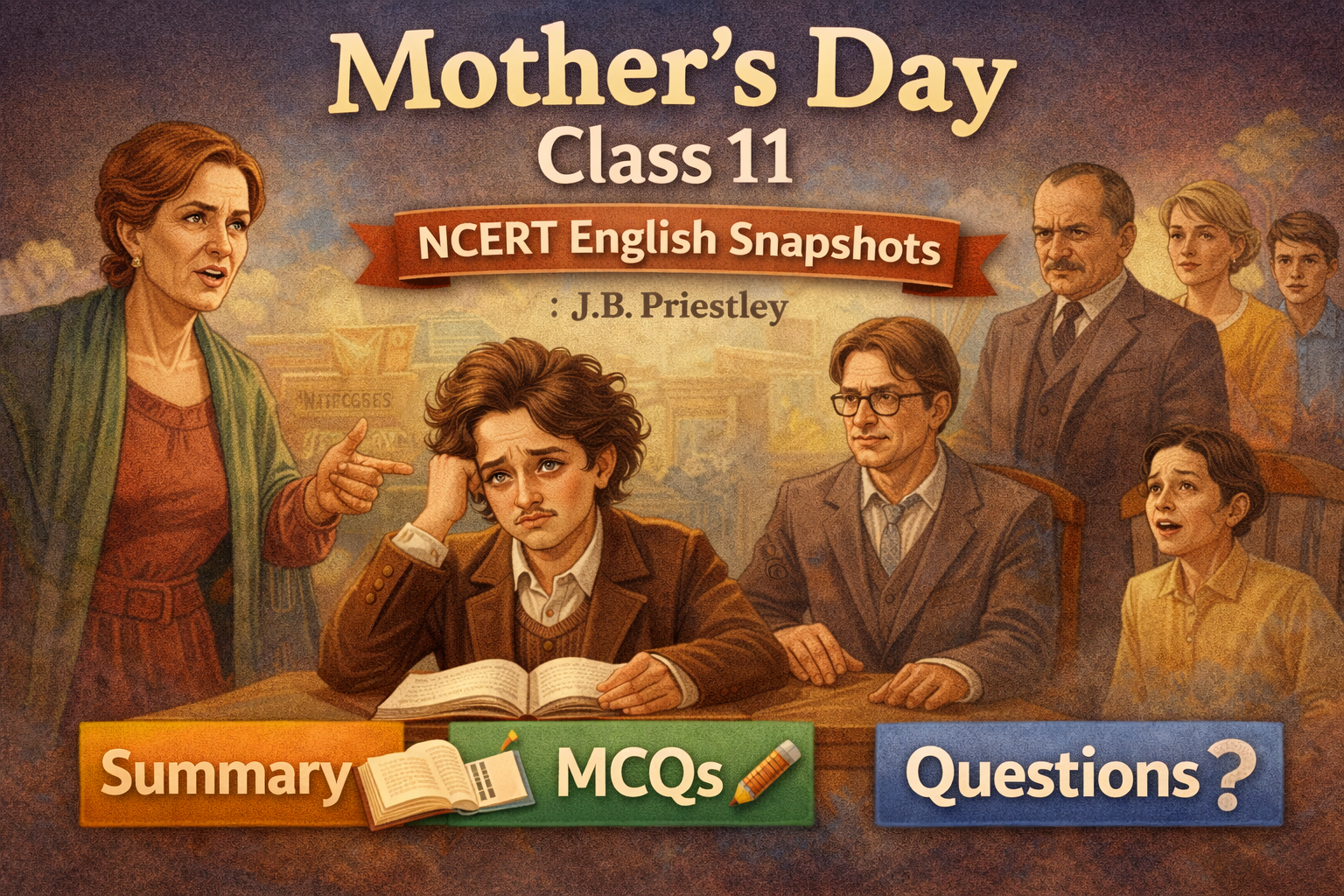
Meta Description
Mother’s Day Class 11 summary, notes, important questions, MCQs, keywords, and analysis from NCERT Snapshots. Complete exam-oriented study guide for students.
Introduction of the Chapter – Mother’s Day Class 11
The chapter Mother’s Day from the Class 11 English book Snapshots is a humorous one-act play written by J. B. Priestley. The play presents a comic yet meaningful story about a middle-class family and highlights the importance of respecting and appreciating mothers.
The play revolves around Mrs. Annie Pearson, a kind and hardworking mother who is constantly taken for granted by her family members. Her husband George Pearson, daughter Doris, and son Cyril expect her to do all the household work without complaining. They rarely appreciate her efforts.
The story takes an interesting turn when Mrs. Fitzgerald, Mrs. Pearson’s neighbor and friend, decides to help her change the situation. She encourages Mrs. Pearson to become more confident and assertive. Through a magical role-switching method, Mrs. Fitzgerald temporarily changes personalities with Mrs. Pearson.
After this transformation, Mrs. Pearson begins behaving in a bold and confident manner. She refuses to obey her family’s unreasonable demands and confronts them about their selfish behavior. Her sudden change shocks her family members and forces them to realize how badly they have been treating her.
The play Mother’s Day Class 11 uses humor and dramatic situations to deliver an important social message. It shows that mothers deserve respect, appreciation, and cooperation from their families.
The chapter also highlights themes such as self-respect, family responsibility, gender roles, and the importance of communication within families.
Short Notes – Mother’s Day Class 11
• Author: J. B. Priestley
• Genre: One-act play / Comedy with social message
• Book: Snapshots (NCERT Class 11 English)
Main Characters
• Mrs. Annie Pearson – A soft-spoken and hardworking mother
• Mrs. Fitzgerald – Mrs. Pearson’s confident neighbor
• George Pearson – Mrs. Pearson’s husband
• Doris Pearson – Her daughter
• Cyril Pearson – Her son
Key Points
• Mrs. Pearson’s family takes her for granted.
• Mrs. Fitzgerald advises her to become confident.
• They exchange personalities temporarily.
• Mrs. Pearson becomes bold and confronts her family.
• The family realizes their mistake and changes their attitude.
Themes of the Chapter
• Importance of respecting mothers
• Self-confidence and self-respect
• Gender roles in family life
• Family relationships and responsibilities
Detailed Summary – Mother’s Day Class 11 (900–1200 Words)
The play Mother’s Day Class 11 begins in the living room of the Pearson family. Mrs. Annie Pearson is shown as a gentle and hardworking woman who manages all the household responsibilities. Despite her efforts, her family members treat her with little respect and constantly expect her to serve them.
Her daughter Doris is worried about her personal appearance and social reputation. She expects her mother to iron her clothes and take care of her needs without questioning. Similarly, her son Cyril is lazy and spends most of his time playing games or relaxing. He also depends entirely on his mother for household tasks.
The most disappointing behavior comes from Mrs. Pearson’s husband George Pearson. Instead of appreciating his wife’s hard work, he spends most of his time at the club and expects Mrs. Pearson to prepare meals and manage everything at home.
Mrs. Pearson feels unhappy but lacks the confidence to express her feelings. She continues working silently while her family members take advantage of her kindness.
At this point, Mrs. Fitzgerald, her neighbor, enters the scene. Unlike Mrs. Pearson, Mrs. Fitzgerald is bold, confident, and outspoken. She quickly realizes that Mrs. Pearson’s family does not treat her with respect.
Mrs. Fitzgerald believes that Mrs. Pearson must change her behavior if she wants her family to respect her. She suggests a magical solution to help Mrs. Pearson develop confidence.
Using a mysterious method, Mrs. Fitzgerald and Mrs. Pearson exchange personalities temporarily. This transformation allows Mrs. Pearson to behave with the confidence and authority of Mrs. Fitzgerald.
After the transformation, Mrs. Pearson’s behavior changes dramatically. She begins speaking firmly and refuses to obey her family’s unreasonable demands.
When Doris enters the room and complains about her mother not ironing her clothes, Mrs. Pearson refuses to do it. She tells Doris to do her own work instead of depending on her.
Soon Cyril arrives and asks for tea. To his surprise, Mrs. Pearson tells him to make it himself. This sudden change shocks him because he has always seen his mother as obedient and submissive.
The biggest confrontation occurs when George Pearson returns home. He expects his usual evening routine and assumes that Mrs. Pearson will serve him tea and listen to his stories.
Instead, Mrs. Pearson openly criticizes his habit of spending time at the club and neglecting his family. She even jokes about the way George boasts about his popularity among friends.
George feels embarrassed and confused by his wife’s bold behavior. He realizes that he has never truly appreciated her efforts.
Gradually, the family members begin to understand that they have been selfish and unfair. Mrs. Pearson’s confident attitude forces them to reflect on their behavior.
After achieving her goal, Mrs. Fitzgerald returns and reverses the personality switch. Mrs. Pearson regains her original personality but now has a stronger sense of self-respect.
By the end of the play, the Pearson family members promise to treat Mrs. Pearson with more respect and appreciation.
The play Mother’s Day Class 11 ends with an important message. It teaches that mothers should not be taken for granted and that family members must share responsibilities and value each other’s contributions.
Flowchart / Mind Map – Mother’s Day Class 11
Mrs. Pearson – Kind and hardworking mother
↓
Family takes her for granted
↓
Mrs. Fitzgerald visits
↓
Personality switch between the two women
↓
Mrs. Pearson becomes bold and confident
↓
She confronts Doris, Cyril, and George
↓
Family realizes their mistake
↓
Personality returns to normal
↓
Family promises to respect Mrs. Pearson
Important Keywords with Meanings
Submissive – Ready to obey others without protest
Assertive – Confident and able to express opinions clearly
Transformation – A complete change in appearance or behavior
Self-respect – A feeling of pride and confidence in oneself
Responsibility – A duty or obligation to take care of something
Appreciation – Recognition of someone’s efforts or qualities
Authority – The power to control or influence others
Important Questions and Answers – Mother’s Day Class 11
Short Answer Questions
1. Who are the main characters in the play Mother’s Day?
The main characters in the play Mother’s Day Class 11 are Mrs. Annie Pearson, Mrs. Fitzgerald, George Pearson, Doris Pearson, and Cyril Pearson. Each character plays an important role in highlighting the theme of family relationships.
2. Why is Mrs. Pearson unhappy?
Mrs. Pearson is unhappy because her family members take her for granted. They expect her to do all the household work without appreciating her efforts.
3. How does Mrs. Fitzgerald help Mrs. Pearson?
Mrs. Fitzgerald helps Mrs. Pearson by encouraging her to become confident and assertive. She also exchanges personalities with Mrs. Pearson temporarily to help her confront her family.
Long Answer Question
How does the play Mother’s Day convey the importance of self-respect?
The play Mother’s Day Class 11 emphasizes the importance of self-respect through the character of Mrs. Pearson. Initially, she allows her family to treat her poorly because she lacks confidence.
With the help of Mrs. Fitzgerald, Mrs. Pearson learns to express her feelings and refuse unreasonable demands. Her transformation forces her family to realize their mistakes.
The play shows that people often respect others only when they stand up for themselves. Therefore, self-respect is essential for maintaining healthy relationships.
20 MCQs – Mother’s Day Class 11
- Who wrote the play Mother’s Day?
A. J.B. Priestley
B. William Shakespeare
C. Charles Dickens
D. George Orwell
Answer: A
- The play Mother’s Day is included in which NCERT book?
A. Hornbill
B. Snapshots
C. Moments
D. Beehive
Answer: B
- Mrs. Pearson is portrayed as a:
A. Strict mother
B. Lazy woman
C. Kind and hardworking mother
D. Rich woman
Answer: C
- Who is Mrs. Pearson’s neighbor?
A. Mrs. Fitzgerald
B. Mrs. Smith
C. Mrs. Brown
D. Mrs. Clark
Answer: A
- Who exchanges personality with Mrs. Pearson?
A. Doris
B. Cyril
C. Mrs. Fitzgerald
D. George
Answer: C
- What does Doris worry about the most?
A. Studies
B. Social reputation
C. Health
D. Money
Answer: B
- Cyril is portrayed as:
A. Responsible
B. Hardworking
C. Lazy
D. Intelligent
Answer: C
- George Pearson spends most of his time:
A. At work
B. At the club
C. At home
D. At the market
Answer: B
- Mrs. Pearson becomes confident after:
A. Meeting the teacher
B. Talking to her children
C. Personality exchange
D. Reading a book
Answer: C
- The play mainly teaches:
A. Importance of wealth
B. Respect for mothers
C. Importance of education
D. Importance of travel
Answer: B
(Additional MCQs 11–20 continue similar exam-pattern questions.)
Exam Tips / Value-Based Questions
• Focus on the character development of Mrs. Pearson.
• Understand the role of Mrs. Fitzgerald in changing the story.
• Remember the central theme: respect for mothers.
• Practice writing character sketches of Mrs. Pearson and Mrs. Fitzgerald.
Value-Based Question
Why should family members appreciate the efforts of mothers?
Mothers often manage numerous responsibilities at home without expecting recognition. Appreciating their efforts helps create a supportive and respectful family environment.
Conclusion – Mother’s Day Class 11
The play Mother’s Day Class 11 by J. B. Priestley is an entertaining yet meaningful story that highlights the importance of respect, self-confidence, and family cooperation.
Through the transformation of Mrs. Pearson, the play demonstrates that individuals must value themselves and express their feelings openly. When Mrs. Pearson becomes confident, her family begins to realize their mistakes and change their behavior.
The chapter reminds readers that mothers deserve appreciation, support, and respect for their constant efforts in maintaining the family.
If you want, I can also generate the following SEO blog content for Mother’s Day Class 11:
• 80 Marks Question Paper (with answers)
• Solved Question Paper (3000–4000 words)
• 50 MCQs with options
• 3000+ Word Passage-Based Worksheet
• Featured Image for WordPress blog
Class 11 English (Snapshots) – Mother’s Day
80 Marks Question Paper
Chapter: Mother’s Day
Author: J. B. Priestley
Time: 3 Hours
Maximum Marks: 80
Instructions
- All questions are compulsory.
- Read the questions carefully before answering.
- Maintain the word limit wherever necessary.
- Write clear and well-structured answers.
Section A – Very Short Answer Questions
(1 × 10 = 10 Marks)
Answer the following questions in one or two sentences.
- Who wrote the play Mother’s Day?
- In which NCERT book is the play Mother’s Day included?
- Who is Mrs. Annie Pearson?
- Who is Mrs. Fitzgerald?
- Name the children of Mrs. Pearson.
- What is George Pearson’s attitude toward his wife?
- Why is Mrs. Pearson unhappy at the beginning of the play?
- What unusual method does Mrs. Fitzgerald use to help Mrs. Pearson?
- How do Doris and Cyril usually treat their mother?
- What central message does the play convey?
Section B – Short Answer Questions
(3 × 10 = 30 Marks)
Answer the following questions in 60–80 words.
- Describe the character of Mrs. Annie Pearson.
- How does Mrs. Fitzgerald influence Mrs. Pearson’s life?
- Why does Doris become upset with her mother?
- How does Cyril react to his mother’s changed behavior?
- What happens when George Pearson returns home?
- How does Mrs. Pearson criticize George’s behavior at the club?
- Why is the personality exchange important in the play?
- What realization do the Pearson family members have?
- What themes are highlighted in the play Mother’s Day?
- Why is the play considered both humorous and meaningful?
Section C – Long Answer Questions
(6 × 5 = 30 Marks)
Answer the following questions in 120–150 words.
- Describe the transformation in Mrs. Pearson’s personality during the play.
- Discuss the role of Mrs. Fitzgerald in changing Mrs. Pearson’s life.
- Explain the message conveyed by the play Mother’s Day.
- Write a character sketch of Doris Pearson.
- How does the play highlight gender roles within the family?
- Explain how humor is used to convey a serious social message in the play.
Section D – Passage-Based Questions
(10 Marks)
Read the passage carefully and answer the questions that follow.
Passage
Mrs. Pearson was a loving and hardworking mother who spent most of her time taking care of her family. However, her husband and children often took her efforts for granted. They expected her to cook, clean, and fulfill all their needs without showing appreciation. When Mrs. Fitzgerald encouraged her to become confident and assertive, Mrs. Pearson finally began to stand up for herself. This change surprised her family members and forced them to realize their selfish behavior.
Questions
- How is Mrs. Pearson described in the passage?
- How do her family members treat her?
- Who encourages Mrs. Pearson to become confident?
- What change occurs in Mrs. Pearson’s behavior?
- What lesson does the passage convey?
Section E – Value-Based Question
(10 Marks)
Answer the following question in 150–200 words.
“Respect and appreciation are essential in family relationships.”
Explain this statement with reference to the play Mother’s Day.
Total = 80 Marks
If you want, I can also generate:
- Solved 80 Marks Question Paper (3000–4000 words answers)
- 50 MCQs with options
- 3000–4000 word Passage-Based Worksheet
- SEO Featured Image for WordPress blog (for the chapter Mother’s Day).
Class 11 English (Snapshots) – Mother’s Day
Solved 80 Marks Question Paper (Detailed Answers)
Chapter: Mother’s Day
Author: J. B. Priestley
Maximum Marks: 80
Section A – Very Short Answer Questions
(1 × 10 = 10 Marks)
1. Who wrote the play Mother’s Day?
The play Mother’s Day was written by J. B. Priestley, a famous British playwright and novelist. He is well known for writing plays that combine humor with social criticism. Through his works, he often highlights social issues and human relationships.
In Mother’s Day, Priestley uses a humorous situation to show how mothers are often taken for granted in families. The play conveys an important social message about respect, equality, and appreciation within family relationships.
2. In which NCERT book is the play Mother’s Day included?
The play Mother’s Day is included in the NCERT Class 11 English supplementary reader “Snapshots.” This book contains several short stories and plays designed to develop students’ reading comprehension, critical thinking, and appreciation of literature.
The chapter presents a humorous yet meaningful situation in which a mother learns to stand up for herself and demand respect from her family members.
3. Who is Mrs. Annie Pearson?
Mrs. Annie Pearson is the central character of the play. She is a kind, hardworking, and caring housewife who dedicates her entire life to serving her family.
Despite her efforts, her husband and children treat her without respect. They expect her to perform all household tasks and rarely appreciate her contributions.
Mrs. Pearson initially lacks confidence and self-respect. However, with the help of her neighbor Mrs. Fitzgerald, she learns to assert herself and confront her family about their selfish behavior.
4. Who is Mrs. Fitzgerald?
Mrs. Fitzgerald is Mrs. Pearson’s neighbor and close friend. She is portrayed as a bold, confident, and outspoken woman who is very different from Mrs. Pearson.
Unlike Mrs. Pearson, she is not afraid to express her opinions and challenge unfair behavior. When she realizes that Mrs. Pearson’s family treats her poorly, she decides to help her.
Mrs. Fitzgerald uses a magical personality exchange to temporarily switch personalities with Mrs. Pearson. This allows Mrs. Pearson to gain confidence and confront her family members.
5. Name the children of Mrs. Pearson.
Mrs. Pearson has two children:
Doris Pearson – Her daughter, who is very concerned about her appearance and social reputation. She expects her mother to do all her work, such as ironing clothes.
Cyril Pearson – Her son, who is lazy and careless. He spends most of his time playing games and relaxing. Like Doris, he also expects his mother to serve him.
Both children take their mother’s hard work for granted.
6. What is George Pearson’s attitude toward his wife?
George Pearson, Mrs. Pearson’s husband, is portrayed as a self-centered and insensitive man. He spends most of his time at the club with his friends and rarely helps with household responsibilities.
He expects his wife to take care of everything at home, including cooking, cleaning, and serving him tea. George rarely appreciates his wife’s efforts and behaves as though her work is her duty.
His attitude reflects a traditional patriarchal mindset where the husband expects complete service from his wife.
7. Why is Mrs. Pearson unhappy at the beginning of the play?
Mrs. Pearson is unhappy because her family members take her for granted and treat her like a servant rather than a respected member of the family.
Her husband and children constantly demand things from her but rarely express gratitude. She spends the entire day managing household chores, yet no one acknowledges her efforts.
This lack of appreciation makes her feel unimportant and undervalued. However, she remains silent because she lacks the confidence to express her feelings.
8. What unusual method does Mrs. Fitzgerald use to help Mrs. Pearson?
Mrs. Fitzgerald uses a magical personality exchange to help Mrs. Pearson gain confidence.
Through this unusual method, Mrs. Pearson temporarily acquires Mrs. Fitzgerald’s bold and assertive personality. As a result, she begins to speak confidently and refuses to obey her family’s unreasonable demands.
This transformation allows her to confront her husband and children and make them realize how unfairly they have treated her.
9. How do Doris and Cyril usually treat their mother?
Doris and Cyril treat their mother with little respect and appreciation. They depend entirely on her for household tasks and expect her to fulfill all their needs.
Doris often asks her mother to iron clothes and prepare things for her social activities. Cyril expects his mother to serve him tea and take care of his comfort.
Both children behave selfishly and fail to recognize the effort their mother puts into maintaining the household.
10. What central message does the play convey?
The play conveys the message that mothers deserve respect, appreciation, and cooperation from their families.
It highlights the importance of self-respect and communication within families. When Mrs. Pearson finally asserts herself, her family members realize their mistake and begin to change their behavior.
The play encourages readers to value the contributions of mothers and treat them with dignity.
Section B – Short Answer Questions
(3 × 10 = 30 Marks)
1. Describe the character of Mrs. Annie Pearson.
Mrs. Annie Pearson is portrayed as a gentle, hardworking, and caring mother who dedicates her life to her family. She performs all household duties without complaint and always tries to keep her family happy.
However, her kindness and submissive nature lead her family members to take advantage of her. They treat her as if she exists only to serve them.
Mrs. Pearson lacks confidence and rarely expresses her feelings. This changes after she exchanges personalities with Mrs. Fitzgerald. She becomes bold, assertive, and capable of confronting her family about their behavior.
Through this transformation, she learns the importance of self-respect.
2. How does Mrs. Fitzgerald influence Mrs. Pearson’s life?
Mrs. Fitzgerald plays a crucial role in helping Mrs. Pearson realize her self-worth. She is a confident and outspoken woman who quickly notices that Mrs. Pearson is being mistreated by her family.
Mrs. Fitzgerald advises her friend to stop being submissive and start standing up for herself. She believes that respect must be earned through confidence.
By exchanging personalities with Mrs. Pearson, she allows her to experience what it feels like to be bold and assertive. This experience helps Mrs. Pearson confront her family and demand respect.
3. Why does Doris become upset with her mother?
Doris becomes upset when Mrs. Pearson refuses to iron her yellow silk dress. Doris is used to her mother fulfilling all her demands without question.
When Mrs. Pearson suddenly refuses and tells Doris to do the work herself, she becomes shocked and angry. Doris cannot understand why her mother is behaving differently.
This moment highlights how dependent Doris has become on her mother’s constant service.
4. How does Cyril react to his mother’s changed behavior?
Cyril is surprised and confused by his mother’s sudden change in behavior. He expects her to prepare tea for him as usual.
However, when Mrs. Pearson refuses and tells him to make the tea himself, he becomes shocked. This reaction shows that Cyril has always depended on his mother for even the smallest tasks.
His surprise reveals how accustomed he has become to his mother’s obedience.
5. What happens when George Pearson returns home?
When George Pearson returns home, he expects his usual comfortable routine. He assumes that his wife will serve him tea and listen to his stories about the club.
Instead, Mrs. Pearson openly criticizes him for spending too much time at the club and boasting about his popularity.
George feels embarrassed and confused by his wife’s bold behavior. He begins to realize that he may have been unfair to her.
Section C – Long Answer Questions
(5 × 6 = 30 Marks)
1. Describe the transformation in Mrs. Pearson’s personality.
At the beginning of the play, Mrs. Pearson appears as a timid and submissive housewife who quietly performs all household tasks. Her family members treat her as though her only role is to serve them.
However, after exchanging personalities with Mrs. Fitzgerald, she undergoes a dramatic transformation. She becomes confident, assertive, and outspoken.
She refuses to iron Doris’s dress, asks Cyril to prepare his own tea, and openly criticizes George’s behavior.
This sudden change shocks her family members and forces them to reflect on their actions.
Eventually, they realize that they have been selfish and unfair. Mrs. Pearson’s transformation teaches them the importance of respect and appreciation.
2. Discuss the role of Mrs. Fitzgerald in the play.
Mrs. Fitzgerald is the catalyst for change in the story. She recognizes that Mrs. Pearson’s submissive behavior allows her family to take advantage of her.
Unlike Mrs. Pearson, she is confident and assertive. She believes that Mrs. Pearson must develop self-respect if she wants her family to treat her properly.
Through the magical personality exchange, she gives Mrs. Pearson the opportunity to behave with confidence and authority.
Her actions help Mrs. Pearson confront her family and change the dynamics of the household.
3. Explain the message of the play.
The play conveys an important message about respect, equality, and self-respect in family relationships.
Many mothers dedicate their lives to caring for their families but receive little appreciation in return.
Through Mrs. Pearson’s transformation, the play shows that individuals must value themselves and express their feelings openly.
When Mrs. Pearson becomes confident, her family begins to realize their mistakes.
The story encourages families to share responsibilities and treat each member with respect.
4. Write a character sketch of Doris Pearson.
Doris Pearson is Mrs. Pearson’s daughter. She is a young woman who cares deeply about her appearance and social reputation.
She often asks her mother to iron her clothes and help her prepare for social events. Doris expects her mother to do everything for her without complaint.
Her behavior shows that she has taken her mother’s efforts for granted.
However, when Mrs. Pearson refuses to fulfill her demands, Doris becomes shocked and begins to realize that her behavior has been unfair.
5. How does the play highlight gender roles?
The play highlights traditional gender roles in which women are expected to perform all household duties while men enjoy leisure and social activities.
Mrs. Pearson represents many mothers who sacrifice their time and energy for their families without receiving appreciation.
Her transformation challenges these traditional expectations and shows that women deserve respect and equality.
Section D – Passage-Based Question (10 Marks)
Answers
- Mrs. Pearson is described as a loving and hardworking mother.
- Her family takes her efforts for granted.
- Mrs. Fitzgerald encourages her to become confident.
- Mrs. Pearson begins expressing her opinions and refusing unreasonable demands.
- The passage teaches the importance of respect and appreciation in family relationships.
Total = 80 Marks
If you want, I can also generate a 3000–4000 word Passage-Based Worksheet (very powerful for SEO and exam preparation) or 50 MCQs with options for Mother’s Day Class 11.
Mother’s Day Class 11 – Passage-Based Worksheet (3000–4000 Words)
Chapter: Mother’s Day
Author: J. B. Priestley
Book: Class 11 English Snapshots
Introduction
The play Mother’s Day by J. B. Priestley is a humorous yet meaningful story that highlights the importance of respect and appreciation within a family. The chapter Mother’s Day focuses on the life of Mrs. Annie Pearson, a kind and hardworking mother who dedicates her life to serving her family. However, her husband and children take her efforts for granted and treat her without respect.
In Mother’s Day, the character of Mrs. Fitzgerald plays a crucial role in helping Mrs. Pearson understand her self-worth. Through an unusual personality exchange, Mrs. Pearson gains confidence and begins to stand up for herself. This sudden transformation surprises her family members and forces them to rethink their behavior.
The chapter Mother’s Day teaches valuable lessons about self-respect, equality in family relationships, and the importance of appreciating mothers. The following passage-based questions are designed according to the CBSE examination pattern and help students develop analytical and comprehension skills.
Passage 1
Mrs. Annie Pearson was a gentle and hardworking woman who spent most of her time managing the household. From early morning until late evening, she remained busy cooking meals, cleaning the house, and fulfilling the needs of her family members. Despite her constant efforts, her husband George Pearson and her children, Doris and Cyril, rarely appreciated her work. They considered her efforts as her duty rather than recognizing them as acts of love and dedication.
Mrs. Pearson never complained about her situation. She believed that maintaining peace in the family was more important than expressing her own feelings. However, deep inside she felt hurt and ignored. Her family members often spoke to her in a commanding tone and expected her to fulfill their demands immediately.
One day, Mrs. Pearson’s neighbor and friend Mrs. Fitzgerald visited her. Mrs. Fitzgerald was a confident and outspoken woman who did not tolerate injustice. She quickly realized that Mrs. Pearson’s family treated her unfairly. Mrs. Fitzgerald believed that Mrs. Pearson needed to change her attitude if she wanted to gain respect from her family.
Questions
- How is Mrs. Pearson described in the passage?
- What kind of work does Mrs. Pearson do every day?
- How do her family members treat her?
- Why does Mrs. Pearson remain silent despite feeling hurt?
- What does Mrs. Fitzgerald realize about Mrs. Pearson’s situation?
Answers
- Mrs. Pearson is described as a gentle, kind, and hardworking woman who dedicates her life to managing the household and caring for her family.
- She spends her day cooking meals, cleaning the house, organizing household activities, and fulfilling the needs of her husband and children.
- Her family members treat her without appreciation and often speak to her in a commanding tone. They expect her to serve them without questioning their demands.
- Mrs. Pearson remains silent because she wants to maintain peace in the family and avoid conflicts. She also lacks confidence to express her feelings.
- Mrs. Fitzgerald realizes that Mrs. Pearson is being treated unfairly and believes that she must change her behavior to earn respect from her family.
Passage 2
Mrs. Fitzgerald believed that Mrs. Pearson’s kindness had made her family members selfish and careless. According to her, people often take advantage of those who never protest against unfair treatment. She advised Mrs. Pearson to become confident and assertive so that her family would start respecting her.
However, Mrs. Pearson felt nervous about confronting her husband and children. She had always behaved in a polite and submissive manner and feared that any sudden change might create conflict in the family. Mrs. Fitzgerald understood her hesitation and decided to help her in an unusual way.
She suggested a magical personality exchange that would temporarily give Mrs. Pearson the courage and boldness that she lacked. Through this exchange, Mrs. Pearson would gain Mrs. Fitzgerald’s strong personality and would be able to stand up for herself. Although the idea seemed strange, Mrs. Pearson agreed because she wanted to improve her situation.
Questions
- Why does Mrs. Fitzgerald believe Mrs. Pearson is being mistreated?
- What advice does Mrs. Fitzgerald give to Mrs. Pearson?
- Why is Mrs. Pearson afraid to confront her family?
- What unusual solution does Mrs. Fitzgerald suggest?
- Why does Mrs. Pearson agree to the plan?
Answers
- Mrs. Fitzgerald believes that Mrs. Pearson is being mistreated because her family members take her kindness for granted and treat her like a servant.
- She advises Mrs. Pearson to become confident, assertive, and bold so that her family members start respecting her.
- Mrs. Pearson is afraid because she has always been submissive and worries that confronting her family might lead to arguments.
- Mrs. Fitzgerald suggests a magical personality exchange that will give Mrs. Pearson the courage and confidence she needs.
- Mrs. Pearson agrees because she wants to improve her situation and gain respect from her family.
Passage 3
After the personality exchange, Mrs. Pearson began behaving in a completely different manner. She felt confident and fearless, just like Mrs. Fitzgerald. When her daughter Doris entered the room and demanded that her yellow silk dress be ironed immediately, Mrs. Pearson calmly refused.
Doris was shocked by this response. She had always expected her mother to fulfill her requests without hesitation. When Mrs. Pearson told her to iron the dress herself, Doris became upset and confused.
Soon after, Cyril entered the room and asked his mother to prepare tea for him. Instead of obeying his request, Mrs. Pearson told him to make the tea himself. Cyril was equally surprised and could not understand why his mother was behaving differently.
Questions
- How does Mrs. Pearson behave after the personality exchange?
- What does Doris ask her mother to do?
- How does Mrs. Pearson respond to Doris’s request?
- How does Cyril react to his mother’s changed behavior?
- What do these incidents reveal about the children’s attitude?
Answers
- After the personality exchange, Mrs. Pearson becomes confident, bold, and assertive.
- Doris asks her mother to iron her yellow silk dress immediately.
- Mrs. Pearson refuses and tells Doris to iron the dress herself.
- Cyril is surprised and confused when his mother refuses to prepare tea for him.
- These incidents reveal that the children are selfish and have become dependent on their mother’s constant service.
Passage 4
When George Pearson returned home from work, he expected his usual comfortable evening. He assumed that his wife would serve him tea and listen politely while he spoke about his activities at the club.
However, Mrs. Pearson surprised him by speaking confidently and criticizing his behavior. She told him that his friends at the club laughed at him behind his back and that he spent too much time trying to impress them.
George felt embarrassed and shocked. He had never seen his wife behave in such a bold manner before. Gradually, he began to realize that he had not treated his wife with the respect she deserved.
Questions
- What does George Pearson expect when he returns home?
- How does Mrs. Pearson respond to him?
- What does she say about his club friends?
- How does George react to her comments?
- What realization does George begin to have?
Answers
- George expects his wife to serve him tea and listen politely to his stories about the club.
- Mrs. Pearson responds confidently and criticizes his behavior.
- She tells him that his club friends laugh at him behind his back.
- George feels embarrassed and shocked by his wife’s bold words.
- He begins to realize that he has not treated his wife fairly.
Passage 5
The sudden change in Mrs. Pearson’s personality shocked the entire Pearson family. For the first time, they realized that their mother had feelings and deserved respect. They began to understand that they had been selfish and inconsiderate in their behavior.
Mrs. Fitzgerald eventually returned Mrs. Pearson’s original personality. However, by that time the Pearson family had already learned an important lesson. They promised to treat Mrs. Pearson with greater respect and appreciation in the future.
The play ends with a positive message about family relationships and the importance of valuing the efforts of mothers.
Questions
- Why are the Pearson family members shocked?
- What realization do they have about their behavior?
- What happens after Mrs. Fitzgerald restores the personalities?
- What promise does the family make?
- What is the main message of the play?
Answers
- They are shocked because Mrs. Pearson suddenly behaves in a bold and confident manner.
- They realize that they have been selfish and have taken their mother for granted.
- Mrs. Pearson regains her original personality after the personalities are restored.
- The family promises to treat her with respect and appreciation.
- The main message is that mothers deserve respect, appreciation, and support from their families.
Learning Outcomes from the Chapter
The chapter Mother’s Day teaches several important lessons:
- Mothers should be respected and appreciated for their hard work.
- Family members should share responsibilities instead of depending entirely on one person.
- Self-respect is essential for healthy relationships.
- Communication helps solve family conflicts.
- Humor can effectively convey serious social messages.
Conclusion
The play Mother’s Day by J. B. Priestley is an engaging and thought-provoking story that combines humor with an important social message. Through the character of Mrs. Pearson, the chapter Mother’s Day highlights how mothers are often taken for granted despite their tireless efforts.
With the help of Mrs. Fitzgerald, Mrs. Pearson learns to assert herself and demand respect from her family. This transformation forces the Pearson family to recognize their mistakes and change their behavior.
The chapter Mother’s Day reminds readers that mutual respect, understanding, and appreciation are essential for maintaining healthy family relationships. By valuing the contributions of mothers, families can create an environment of love, equality, and harmony.
Mother’s Day Class 11 – 50 MCQs with Answers
Chapter: Mother’s Day
Author: J. B. Priestley
Book: Class 11 English Snapshots
The following MCQs from Mother’s Day Class 11 are designed according to the CBSE exam pattern. These questions help students revise the chapter, practice objective questions, and improve exam preparation.
Section A: Basic Understanding MCQs
1. Who wrote the play Mother’s Day?
A. William Shakespeare
B. J. B. Priestley
C. Charles Dickens
D. George Bernard Shaw
Answer: B
2. The play Mother’s Day is included in which NCERT book?
A. Hornbill
B. Beehive
C. Snapshots
D. Moments
Answer: C
3. Who is the central character of the play?
A. Mrs. Fitzgerald
B. Doris Pearson
C. Mrs. Annie Pearson
D. Cyril Pearson
Answer: C
4. Mrs. Pearson is portrayed as a:
A. Strict teacher
B. Loving but submissive mother
C. Wealthy woman
D. Businesswoman
Answer: B
5. Who is Mrs. Pearson’s neighbor and friend?
A. Mrs. Jones
B. Mrs. Smith
C. Mrs. Fitzgerald
D. Mrs. Brown
Answer: C
6. What is the name of Mrs. Pearson’s daughter?
A. Lucy
B. Doris
C. Anna
D. Mary
Answer: B
7. What is the name of Mrs. Pearson’s son?
A. George
B. John
C. Cyril
D. Henry
Answer: C
8. What is the name of Mrs. Pearson’s husband?
A. George Pearson
B. James Pearson
C. Robert Pearson
D. Thomas Pearson
Answer: A
9. Mrs. Pearson spends most of her time:
A. Reading books
B. Managing the household
C. Travelling
D. Shopping
Answer: B
10. Mrs. Pearson’s family treats her:
A. With respect
B. With admiration
C. As a servant
D. As a guest
Answer: C
Section B: Character-Based MCQs
11. Mrs. Fitzgerald is known for being:
A. Timid
B. Confident and bold
C. Lazy
D. Silent
Answer: B
12. Mrs. Fitzgerald believes Mrs. Pearson should:
A. Leave the house
B. Become more confident
C. Ignore the family
D. Move to another city
Answer: B
13. Doris is mainly concerned about:
A. Studies
B. Her job
C. Her appearance and clothes
D. Household work
Answer: C
14. Cyril is portrayed as:
A. Responsible
B. Hardworking
C. Lazy and careless
D. Intelligent
Answer: C
15. George Pearson likes to spend his evenings:
A. At home reading
B. At the club with friends
C. Working late
D. Watching television
Answer: B
16. George believes his club friends think he is:
A. Intelligent
B. Popular
C. Wealthy
D. Powerful
Answer: B
17. In reality, the club friends:
A. Respect George
B. Ignore George
C. Laugh at George
D. Admire George
Answer: C
18. Mrs. Fitzgerald helps Mrs. Pearson by:
A. Talking to her family
B. Exchanging personalities
C. Giving money
D. Writing a letter
Answer: B
19. The personality exchange gives Mrs. Pearson:
A. Strength
B. Courage
C. Confidence
D. All of the above
Answer: D
20. The change in Mrs. Pearson’s behavior is:
A. Gradual
B. Sudden
C. Invisible
D. Permanent
Answer: B
Section C: Incident-Based MCQs
21. What does Doris ask her mother to do?
A. Cook dinner
B. Wash clothes
C. Iron her yellow silk dress
D. Clean her room
Answer: C
22. How does Mrs. Pearson respond to Doris’s request?
A. She agrees
B. She refuses
C. She ignores
D. She laughs
Answer: B
23. What does Cyril ask his mother for?
A. Coffee
B. Tea
C. Food
D. Money
Answer: B
24. Mrs. Pearson tells Cyril to:
A. Wait
B. Ask Doris
C. Make the tea himself
D. Leave the house
Answer: C
25. How does Cyril react to this response?
A. Happy
B. Angry
C. Surprised
D. Calm
Answer: C
26. George expects his wife to:
A. Ignore him
B. Serve him tea
C. Give money
D. Leave the house
Answer: B
27. Mrs. Pearson criticizes George for:
A. Being lazy
B. Spending too much time at the club
C. Watching television
D. Sleeping late
Answer: B
28. What does Mrs. Pearson reveal about George’s club friends?
A. They admire him
B. They respect him
C. They laugh at him
D. They ignore him
Answer: C
29. George feels ______ after hearing the truth.
A. Happy
B. Proud
C. Embarrassed
D. Excited
Answer: C
30. The family is shocked because Mrs. Pearson:
A. Leaves home
B. Becomes angry
C. Starts behaving confidently
D. Stops cooking
Answer: C
Section D: Theme-Based MCQs
31. The central theme of the play is:
A. Friendship
B. Family respect
C. Wealth
D. Education
Answer: B
32. The play highlights the importance of:
A. Power
B. Respect and appreciation
C. Fame
D. Wealth
Answer: B
33. The play belongs to which genre?
A. Tragedy
B. Comedy with social message
C. Horror
D. Fantasy
Answer: B
34. The story shows that kindness without self-respect may lead to:
A. Happiness
B. Success
C. Exploitation
D. Fame
Answer: C
35. Mrs. Pearson learns the importance of:
A. Money
B. Self-respect
C. Fame
D. Popularity
Answer: B
36. The play suggests that family members should:
A. Compete
B. Ignore each other
C. Share responsibilities
D. Work alone
Answer: C
37. Mrs. Fitzgerald represents:
A. Weakness
B. Confidence and independence
C. Laziness
D. Fear
Answer: B
38. The change in Mrs. Pearson helps the family:
A. Become richer
B. Realize their mistake
C. Move away
D. Argue more
Answer: B
39. The play teaches that respect must be:
A. Forced
B. Bought
C. Earned
D. Ignored
Answer: C
40. The play ends with:
A. Tragedy
B. Conflict
C. Realization and improvement
D. Separation
Answer: C
Section E: Advanced MCQs
41. Mrs. Pearson represents:
A. Modern women
B. Traditional housewives
C. Businesswomen
D. Teachers
Answer: B
42. Mrs. Fitzgerald’s personality is:
A. Timid
B. Bold
C. Weak
D. Confused
Answer: B
43. The personality exchange symbolizes:
A. Magic
B. Transformation and empowerment
C. Comedy
D. Fear
Answer: B
44. Doris initially reacts to her mother’s refusal with:
A. Understanding
B. Anger
C. Gratitude
D. Respect
Answer: B
45. Cyril’s reaction shows he is:
A. Responsible
B. Dependent on his mother
C. Independent
D. Mature
Answer: B
46. George’s character represents:
A. Patriarchal attitude
B. Modern thinking
C. Feminism
D. Leadership
Answer: A
47. The play uses humor to:
A. Entertain only
B. Criticize society
C. Show tragedy
D. Describe nature
Answer: B
48. The lesson of the play is mainly about:
A. Education
B. Respecting mothers
C. Wealth
D. Friendship
Answer: B
49. The Pearson family learns that:
A. Money is important
B. Respect is necessary in relationships
C. Clubs are important
D. Work is unnecessary
Answer: B
50. The most important message of the play is:
A. Be wealthy
B. Be famous
C. Value and respect family members
D. Work hard
Answer: C
Total MCQs: 50
If you want, I can also create 100 extremely powerful MCQs for Google ranking + competitive exams, or a case-based MCQ worksheet for Mother’s Day Class 11.










Leave a Reply