


Meta Description
Complete guide to Ranga’s Marriage Class 11 English including summary, notes, important questions, MCQs, keywords, and exam tips for better exam preparation.
Introduction of the Chapter
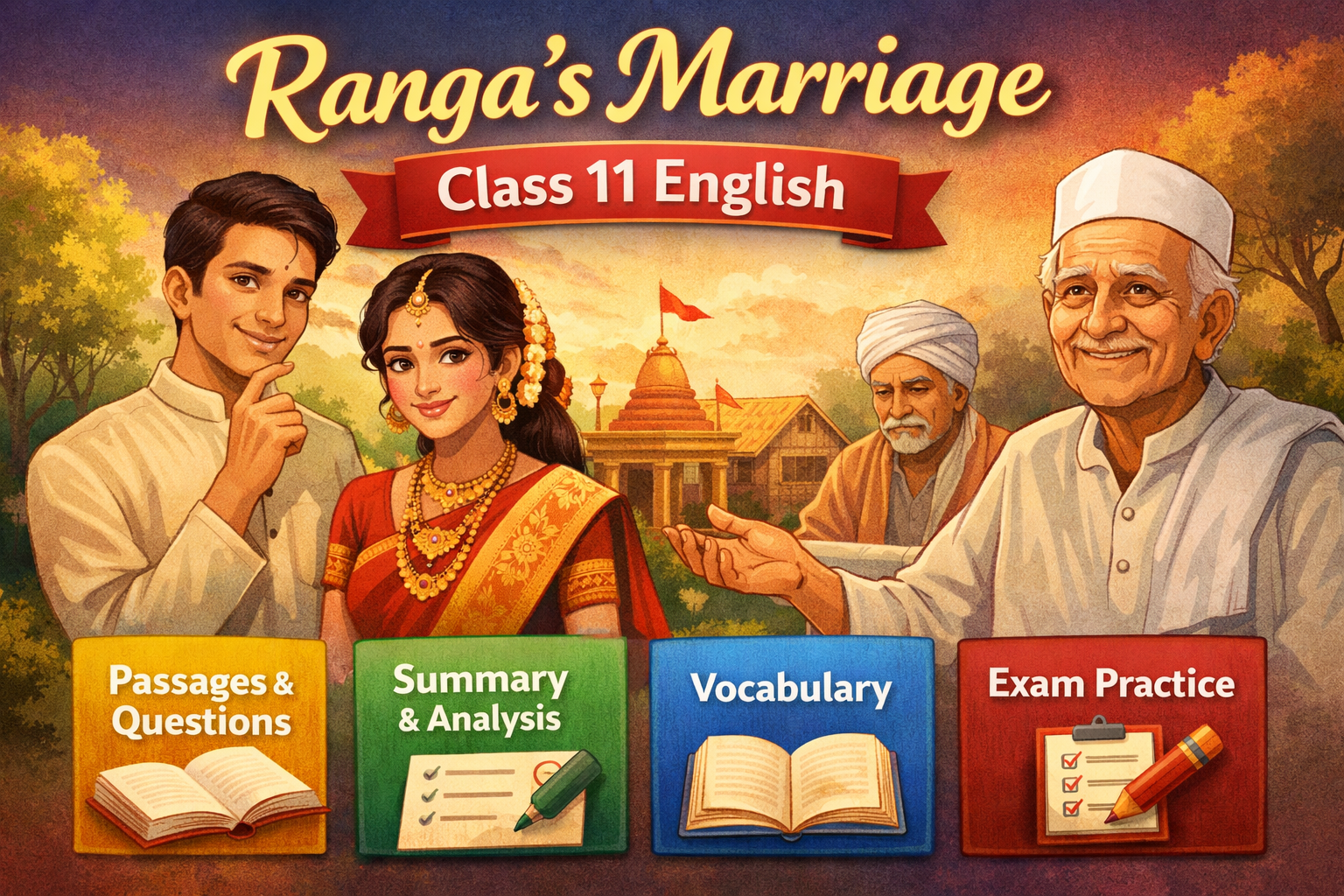
Ranga’s Marriage is an interesting and humorous story written by Masti Venkatesha Iyengar and included in the Class 11 English NCERT Hornbill book. The chapter presents a light-hearted narrative about social customs, traditions, and the changing mindset of young people in villages.
The story Ranga’s Marriage is narrated by the village elder Shyama, who describes how the villagers were excited when Ranga returned from Bangalore after completing his education. At that time, it was rare for people from villages to go to cities for higher studies. The villagers believed that city education often changed people’s attitudes and made them adopt Western culture.
However, the narrator discovers that Ranga has not changed much. He still respects the traditions and customs of the village. The central theme of Ranga’s Marriage revolves around the narrator’s clever plan to help Ranga fall in love with a girl named Ratna, eventually leading to their marriage.
Through humor and simple storytelling, Ranga’s Marriage highlights themes such as tradition, love, social customs, and the influence of education.
Short Notes on Ranga’s Marriage
- Author: Masti Venkatesha Iyengar
- Book: Hornbill (Class 11 English NCERT)
- Narrator: Shyama (village elder)
- Main Characters: Ranga, Ratna, Shyama
Key Points
- Ranga returns to his village after completing education in Bangalore.
- Villagers expect him to behave like Westernized educated youth.
- Ranga remains respectful of traditional customs.
- He initially says he will marry only after finding the right girl.
- The narrator wants Ranga to marry soon and devises a clever plan.
- He introduces Ranga to Ratna through a staged situation.
- Ranga gradually falls in love with Ratna.
- The astrologer confirms the match humorously.
- Eventually, Ranga marries Ratna.
Themes
- Influence of education on tradition
- Marriage customs in Indian villages
- Love and relationships
- Humor and social satire
Detailed Summary of Ranga’s Marriage (900–1200 Words)
Ranga’s Marriage is a humorous and engaging story set in a South Indian village. The narrator, Shyama, recounts the events surrounding the return of a young man named Ranga after his studies in Bangalore.
At that time, very few people from villages went to cities for higher education. Therefore, when Ranga returned from Bangalore, the villagers were very curious to see how he had changed. Many believed that city education made people forget their traditions and adopt Western habits such as wearing boots, smoking, and speaking English frequently.
However, when Ranga arrived in the village, the villagers were pleasantly surprised. Instead of showing arrogance or Westernized behavior, Ranga greeted everyone respectfully. He removed his footwear before entering houses, spoke politely, and maintained the traditional customs of the village. This behavior made the villagers very happy and impressed them greatly.
The narrator, Shyama, particularly liked Ranga and admired his respectful nature. According to village tradition, young men usually married at an early age. However, Ranga stated that he did not want to marry immediately. He said he would only marry if he found a girl who matched his ideals and personality.
Shyama felt that Ranga should get married soon. He believed that marriage would bring stability and happiness to Ranga’s life. Therefore, he decided to take matters into his own hands and find a suitable bride for him.
One day, Shyama noticed a young girl named Ratna. She was the niece of Rama Rao and had come to stay in the village after the death of her parents. Ratna was intelligent, cultured, and talented. She was particularly skilled at singing and playing the veena. Shyama thought she would make a perfect match for Ranga.
To bring Ranga and Ratna together, Shyama devised a clever plan. He invited Ranga to his house at a time when Ratna was also present. Ratna began singing a beautiful song while Ranga was there. When Ranga heard her melodious voice, he became curious and asked about the singer.
Shyama deliberately avoided answering directly and pretended that the girl was already married. This made Ranga slightly disappointed, which confirmed Shyama’s suspicion that Ranga had become interested in her.
Later, Shyama arranged another meeting between Ranga and Ratna. During this meeting, Ranga had the opportunity to talk to Ratna and observe her qualities. Gradually, he began to admire her intelligence, modesty, and musical talent.
To further strengthen his plan, Shyama took Ranga to meet an astrologer named Shastri. The astrologer pretended to study Ranga’s horoscope and predicted that he would soon fall in love with a girl whose name began with the letter “R”. This prediction was actually part of Shyama’s plan.
Hearing this prediction made Ranga think even more about Ratna. Slowly, his admiration for her turned into affection. Eventually, he realized that she was the girl he wanted to marry.
As time passed, the families agreed to the marriage proposal. Ranga married Ratna, and their marriage turned out to be happy and successful. The narrator proudly mentions that their son was named Shyama, after him.
The story Ranga’s Marriage ends on a cheerful note, showing how love, tradition, and a little cleverness can bring people together.
Through humor and gentle satire, Ranga’s Marriage reflects the social customs of Indian villages and the importance of marriage in traditional society. It also shows that education does not necessarily destroy cultural values. Instead, it can coexist with tradition.
Flowchart / Mind Map (Text-Based)
Village Life
↓
Ranga goes to Bangalore for education
↓
Returns to village
↓
Villagers curious about changes
↓
Ranga remains traditional
↓
Narrator wants him to marry
↓
Ratna introduced
↓
Shyama’s clever plan
↓
Astrologer’s prediction
↓
Ranga realizes love
↓
Marriage with Ratna
↓
Happy ending
Important Keywords with Meanings
| Keyword | Meaning |
|---|---|
| Curious | Eager to know something |
| Tradition | Customs followed for generations |
| Horoscope | Chart used in astrology |
| Prediction | Statement about the future |
| Modest | Humble and simple |
| Clever | Intelligent and quick-thinking |
| Cultural Values | Beliefs and customs of a society |
| Admiration | Respect and approval |
| Proposal | Offer of marriage |
| Satire | Use of humor to criticize society |
Important Questions and Answers
Short Answer Questions
1. Why were the villagers curious about Ranga?
The villagers were curious because Ranga had returned after studying in Bangalore. At that time, few villagers went to cities for education, so people wanted to see how city life had changed him.
2. What surprised the villagers about Ranga?
The villagers were surprised that Ranga had not become arrogant or Westernized. Instead, he remained polite, respectful, and traditional.
3. Who was Ratna?
Ratna was a young girl who lived in the village with her uncle Rama Rao. She was talented in music and known for her beauty and intelligence.
4. What plan did Shyama make?
Shyama arranged meetings between Ranga and Ratna and used an astrologer’s prediction to encourage Ranga to think about her.
5. What was the astrologer’s prediction?
The astrologer predicted that Ranga would fall in love with a girl whose name began with the letter “R”.
Long Answer Questions
1. Describe the character of Ranga.
Ranga is a well-educated young man who returns to his village after studying in Bangalore. Despite his city education, he remains humble, respectful, and attached to traditional values.
Unlike many people who adopt Western habits after studying in cities, Ranga respects village customs and greets elders politely. He believes that marriage should not be rushed and wants to marry someone who matches his ideals.
Ranga’s character reflects the balance between education and tradition. He shows that modern education does not necessarily change a person’s cultural values.
2. How did the narrator help Ranga get married?
The narrator, Shyama, believed that Ranga should marry soon. When he saw Ratna, he thought she would be a perfect match for Ranga.
To bring them together, he invited Ranga to his house when Ratna was present. Ratna sang a beautiful song, which impressed Ranga greatly.
Later, Shyama took Ranga to an astrologer who predicted that Ranga would fall in love with a girl whose name started with “R”. This prediction made Ranga think about Ratna.
Gradually, Ranga realized his feelings for Ratna and decided to marry her.
20 MCQs with Answers
- Who wrote Ranga’s Marriage?
A. R.K. Narayan
B. Masti Venkatesha Iyengar
C. Ruskin Bond
D. Khushwant Singh
Answer: B - Where did Ranga go for his studies?
A. Chennai
B. Bangalore
C. Delhi
D. Mumbai
Answer: B - Who narrates the story?
A. Ratna
B. Ranga
C. Shyama
D. Rama Rao
Answer: C - Why were villagers curious about Ranga?
A. He was rich
B. He studied in the city
C. He was famous
D. He was married
Answer: B - Who was Ratna?
A. Narrator’s sister
B. Ranga’s cousin
C. Rama Rao’s niece
D. Teacher
Answer: C - What talent did Ratna have?
A. Painting
B. Singing
C. Dancing
D. Writing
Answer: B - Who predicted Ranga’s marriage?
A. Teacher
B. Priest
C. Astrologer
D. Doctor
Answer: C - What letter did the astrologer mention?
A. R
B. S
C. M
D. P
Answer: A - What instrument did Ratna play?
A. Tabla
B. Guitar
C. Veena
D. Flute
Answer: C - Who planned the meeting of Ranga and Ratna?
A. Rama Rao
B. Shyama
C. Astrologer
D. Villagers
Answer: B - Ranga respected ______.
Answer: traditions - The story is set in a ______ village.
Answer: South Indian - Ratna lived with her ______.
Answer: uncle - The narrator’s name is ______.
Answer: Shyama - Ranga married ______.
Answer: Ratna - What type of story is this?
A. Tragic
B. Humorous
C. Horror
D. Adventure
Answer: B - What was the theme of the story?
A. War
B. Love and tradition
C. Science
D. Politics
Answer: B - Who wrote the story originally in Kannada?
Answer: Masti Venkatesha Iyengar - What did the villagers expect?
Answer: Ranga to become westernized - What is the message of the story?
Answer: Education and tradition can coexist.
Exam Tips / Value-Based Questions
Exam Tips
- Remember the names of characters: Ranga, Ratna, Shyama.
- Focus on the themes of tradition and modern education.
- Practice MCQs and short answers for better exam performance.
- Understand the narrator’s clever role in the marriage.
Value-Based Questions
- Do you think Shyama’s plan to arrange Ranga’s marriage was justified? Explain your opinion.
- What does the story teach about balancing modern education and traditional values?
- Why is respect for culture important even in modern society?
Conclusion
Ranga’s Marriage Class 11 English is a delightful story that combines humor, tradition, and social observation. The chapter shows how education and cultural values can coexist harmoniously.
Through the narrator’s clever actions and Ranga’s respectful nature, Ranga’s Marriage highlights the importance of love, family, and community in traditional Indian society. The story also reminds readers that modern education should not make people forget their roots.
For students preparing for exams, studying Ranga’s Marriage summary, notes, MCQs, and important questions is essential for a complete understanding of the chapter.
Ranga’s Marriage Class 11 – 80 Marks Question Paper (NCERT Hornbill)
Instructions
- All questions are compulsory.
- Read the questions carefully before answering.
- Maintain proper word limits wherever required.
- Write clear and structured answers.
- The question paper is based on the chapter Ranga’s Marriage from Class 11 English (Hornbill).
Maximum Marks: 80
Section A – Very Short Answer Questions
(1 × 10 = 10 Marks)
Answer the following questions in one or two sentences.
- Who is the author of the chapter Ranga’s Marriage?
- Who is the narrator of the story?
- Where had Ranga gone for his studies?
- Why were the villagers curious to see Ranga?
- Who was Ratna in the story?
- What talent did Ratna possess?
- What did Ranga say about his marriage plans initially?
- Who helped Ranga find a bride?
- What prediction did the astrologer make?
- What was the name of Ranga’s son?
Section B – Short Answer Questions
(3 × 10 = 30 Marks)
Answer the following questions in 60–80 words each.
- Why was Ranga’s return to the village considered special?
- How did the villagers expect Ranga to behave after returning from Bangalore?
- Describe the character of Ranga in brief.
- Who was Ratna and why did the narrator think she was suitable for Ranga?
- How did the narrator plan to introduce Ratna to Ranga?
- Why did the narrator pretend that Ratna was already married?
- What role did the astrologer play in the story?
- How did Ranga react when he heard Ratna singing?
- What does the story reveal about marriage customs in villages?
- Why is the story considered humorous?
Section C – Long Answer Questions
(5 × 6 = 30 Marks)
Answer the following questions in 120–150 words each.
- Describe the narrator’s role in bringing Ranga and Ratna together.
- How does the story highlight the conflict between modern education and traditional values?
- Explain how the narrator used clever tricks to influence Ranga’s decision about marriage.
- Discuss the importance of Ratna’s character in the story.
- What message does the story Ranga’s Marriage convey about society and relationships?
Section D – Passage Based Questions
(10 × 1 = 10 Marks)
Read the passage carefully and answer the questions that follow.
When Ranga returned from Bangalore, the whole village was eager to see him. At that time it was rare for villagers to go to cities for higher studies. People believed that those who studied in cities often forgot their traditions and behaved differently. However, when Ranga arrived, everyone was pleased to see that he still respected the customs of the village and greeted elders politely.
Questions
- From which chapter is the passage taken?
- Where had Ranga gone for his education?
- Why were the villagers curious to see him?
- What did villagers think about people who studied in cities?
- How did Ranga behave after returning?
- What quality of Ranga impressed the villagers?
- What does the passage reveal about village society?
- Find a word from the passage that means “rules or traditions followed by society.”
- Was Ranga influenced negatively by city life?
- What theme of the story is reflected in this passage?
Section E – Value-Based / Analytical Question
(1 × 10 = 10 Marks)
Answer the following question in 200–250 words.
Question:
Education often changes people’s attitudes and lifestyle. Do you think Ranga’s education changed him? Explain your answer with examples from the chapter Ranga’s Marriage.
If you want, I can also create:
- Solved 80 Marks Question Paper (3000–4000 word answers)
- 50 MCQs for Ranga’s Marriage
- 3000+ Word Passage-Based Worksheet
- Featured Image for Blog / WordPress
Just tell me.
Ranga’s Marriage Class 11 – Solved 80 Marks Question Paper (NCERT Hornbill)
Instructions
- All questions are compulsory.
- Write answers in clear and structured language.
- The answers below follow the CBSE exam pattern and are detailed for better conceptual understanding.
- The question paper is based on the chapter Ranga’s Marriage from Class 11 English (Hornbill).
Maximum Marks: 80
Section A – Very Short Answer Questions
(1 × 10 = 10 Marks)
1. Who is the author of the chapter Ranga’s Marriage?
The chapter Ranga’s Marriage is written by Masti Venkatesha Iyengar, a well-known Kannada writer and scholar. He was one of the most respected literary figures in Indian literature and received the Jnanpith Award for his contributions to Kannada literature. The story was originally written in Kannada and later translated into English.
2. Who is the narrator of the story?
The story is narrated by Shyama, an elderly man from the village. He plays an important role in the story because he observes the events closely and eventually becomes responsible for bringing Ranga and Ratna together.
3. Where had Ranga gone for his studies?
Ranga had gone to Bangalore for his higher education. At that time, it was uncommon for people from villages to go to cities for education, so his return created great excitement among the villagers.
4. Why were the villagers curious to see Ranga?
The villagers were curious because Ranga had studied in the city, and they believed that city education often changed people’s behavior. They expected him to return with Western habits such as wearing boots, smoking, or speaking English frequently.
5. Who was Ratna in the story?
Ratna was a young girl living in the village with her uncle Rama Rao. She was an intelligent, talented, and cultured girl who had lost her parents at a young age.
6. What talent did Ratna possess?
Ratna was very talented in music. She could sing beautifully and also play the veena, a traditional Indian musical instrument.
7. What did Ranga say about his marriage plans initially?
Ranga initially said that he did not want to marry immediately. He believed that he would marry only when he found a girl who matched his ideals and personality.
8. Who helped Ranga find a bride?
The narrator Shyama played the main role in helping Ranga find a suitable bride by introducing him to Ratna and arranging situations that brought them together.
9. What prediction did the astrologer make?
The astrologer predicted that Ranga would soon fall in love with a girl whose name began with the letter “R.”
10. What was the name of Ranga’s son?
Ranga named his son Shyama, after the narrator, as a sign of gratitude for helping him find his life partner.
Section B – Short Answer Questions
(3 × 10 = 30 Marks)
1. Why was Ranga’s return to the village considered special?
Ranga’s return was considered special because very few villagers had the opportunity to study in cities during that time. Higher education was rare in rural areas, and people believed that those who studied in cities would adopt Western lifestyles.
The villagers gathered eagerly to observe how Ranga had changed after his education. They expected him to behave differently, perhaps becoming arrogant or abandoning traditional customs.
However, when Ranga returned, he behaved politely and respectfully. He removed his footwear before entering houses and greeted elders with respect. This impressed the villagers and reassured them that education had not changed his values.
2. How did the villagers expect Ranga to behave after returning from Bangalore?
The villagers believed that city education would make Ranga adopt Western habits. They thought he would speak English frequently, smoke cigarettes, wear boots, and behave arrogantly.
These expectations were based on the general belief that modern education distanced people from traditional values. The villagers feared that Ranga might forget his cultural roots.
However, Ranga’s behavior surprised everyone. Instead of showing arrogance or Westernized habits, he behaved with humility and respect. He followed village customs and maintained his traditional manners.
3. Describe the character of Ranga in brief.
Ranga is portrayed as an intelligent, well-educated, and humble young man. Despite receiving his education in Bangalore, he remains deeply connected to his village traditions and values.
He respects elders, follows customs, and behaves politely with everyone. Unlike many people who adopt Western lifestyles after studying in cities, Ranga maintains his cultural identity.
Ranga also shows maturity in his views about marriage. He believes that marriage should be based on compatibility rather than pressure from society.
His character represents the ideal balance between modern education and traditional values.
4. Who was Ratna and why did the narrator think she was suitable for Ranga?
Ratna was the niece of Rama Rao and lived in the village after her parents passed away. She was known for her beauty, intelligence, and musical talent.
The narrator noticed that Ratna possessed qualities that would make her an ideal life partner. She was respectful, cultured, and talented.
Since Ranga valued tradition and character, the narrator believed Ratna would be the perfect match for him.
5. How did the narrator plan to introduce Ratna to Ranga?
The narrator cleverly arranged for Ranga to visit his house when Ratna was also present there.
During this visit, Ratna began singing a melodious song. Her voice immediately attracted Ranga’s attention, and he asked about the girl who was singing.
This carefully planned meeting allowed Ranga to notice Ratna’s talent and personality.
6. Why did the narrator pretend that Ratna was already married?
When Ranga asked about the girl singing, the narrator jokingly suggested that she was already married.
This was a psychological trick. By pretending Ratna was unavailable, the narrator wanted to observe Ranga’s reaction.
Ranga’s disappointment confirmed that he had developed an interest in Ratna.
7. What role did the astrologer play in the story?
The astrologer played an important role in strengthening the narrator’s plan.
The narrator took Ranga to the astrologer, who pretended to read his horoscope and predicted that Ranga would fall in love with a girl whose name started with “R.”
This prediction made Ranga think more seriously about Ratna.
8. How did Ranga react when he heard Ratna singing?
When Ranga heard Ratna singing, he was immediately impressed by her beautiful voice.
Her singing created curiosity and admiration in Ranga’s mind. He wanted to know who the girl was and asked the narrator about her.
This moment marked the beginning of his interest in Ratna.
9. What does the story reveal about marriage customs in villages?
The story shows that in traditional villages, marriage was considered an important social responsibility.
Young men and women were expected to marry at an early age, and families or elders often played a role in arranging marriages.
The story also shows how astrology and horoscopes were commonly used in matchmaking.
10. Why is the story considered humorous?
The story contains many humorous situations, especially in the narrator’s clever plans and tricks.
The narrator manipulates situations in a playful way, such as pretending Ratna is married and using the astrologer’s prediction to influence Ranga.
These light-hearted moments create a humorous tone throughout the story.
Section C – Long Answer Questions
(5 × 6 = 30 Marks)
1. Describe the narrator’s role in bringing Ranga and Ratna together.
The narrator, Shyama, plays a central role in the story. He acts as a matchmaker who carefully observes both Ranga and Ratna and believes they would make a good couple.
After noticing Ratna’s talents and character, he decides to introduce her to Ranga. Instead of directly suggesting marriage, he uses clever strategies to make Ranga discover his feelings naturally.
He arranges for Ranga to hear Ratna singing, which immediately attracts his attention. Later, he pretends that Ratna is already married to test Ranga’s reaction.
The narrator also takes Ranga to an astrologer who predicts that he will fall in love with a girl whose name starts with “R.” This prediction further influences Ranga’s thoughts.
Through these carefully planned actions, the narrator successfully brings Ranga and Ratna together.
2. How does the story highlight the conflict between modern education and traditional values?
The story presents an interesting contrast between city education and village traditions.
The villagers believe that modern education changes people and makes them forget their cultural roots. They expect Ranga to adopt Western habits after studying in Bangalore.
However, Ranga proves these assumptions wrong. Despite his education, he respects traditions and behaves politely.
This shows that education does not necessarily destroy cultural values. Instead, it can coexist with traditional beliefs.
3. Explain how the narrator used clever tricks to influence Ranga’s decision about marriage.
The narrator used several clever tricks to influence Ranga’s thoughts about marriage.
First, he arranged a meeting between Ranga and Ratna without revealing his intentions. Ratna’s singing immediately attracted Ranga’s attention.
Second, he pretended that Ratna was already married to see Ranga’s reaction. This made Ranga realize his interest in her.
Third, he took Ranga to an astrologer who predicted that he would fall in love with a girl whose name started with “R.”
These clever strategies gradually influenced Ranga’s feelings and led him to fall in love with Ratna.
4. Discuss the importance of Ratna’s character in the story.
Ratna is an important character because she represents the ideal qualities valued in traditional society.
She is intelligent, talented, respectful, and skilled in music. Her singing and modest behavior impress Ranga and contribute to his growing admiration for her.
Ratna’s character also reflects the traditional expectations of women in rural society.
5. What message does the story Ranga’s Marriage convey about society and relationships?
The story conveys several meaningful messages about society and relationships.
It shows that education should not make people forget their cultural roots. Ranga proves that it is possible to be educated while still respecting traditions.
The story also highlights the importance of love and compatibility in marriage.
Finally, it shows the role of community and elders in shaping relationships in traditional societies.
Section D – Passage Based Questions
(10 Marks)
Answers
- The passage is from the chapter Ranga’s Marriage.
- Ranga had gone to Bangalore for education.
- Villagers were curious because it was rare for someone to study in the city.
- They believed city education made people forget traditions.
- Ranga behaved politely and respectfully.
- His humility and respect impressed the villagers.
- It shows that village society values traditions.
- Customs
- No, he remained traditional.
- The theme is education vs tradition.
Section E – Value-Based Question
(10 Marks)
Education often changes people’s attitudes and lifestyle. Do you think Ranga’s education changed him?
Education has the power to influence people’s thinking and lifestyle. However, in the story Ranga’s Marriage, Ranga’s education does not negatively change him.
When Ranga returns from Bangalore, the villagers expect him to adopt Western habits and forget his traditions. They believe he will behave differently after studying in the city.
However, Ranga proves them wrong. He continues to respect elders, follow cultural customs, and behave politely.
This shows that education should enhance a person’s knowledge without making them forget their cultural identity.
Ranga’s character teaches an important lesson: modern education and traditional values can exist together. Instead of abandoning traditions, educated individuals should respect and preserve them.
Thus, Ranga’s education makes him wiser but does not change his respect for culture and society.
If you want, I can also create a very powerful 3000–4000 word Passage-Based Worksheet for Ranga’s Marriage (extremely good for SEO + CBSE exams).
Ranga’s Marriage Class 11 – 50 MCQs with Answers (NCERT Hornbill)
The following Multiple Choice Questions (MCQs) from the chapter “Ranga’s Marriage” are designed according to the CBSE Class 11 English exam pattern. These questions help students revise the summary, characters, themes, and key concepts of the chapter effectively.
MCQs from Ranga’s Marriage
1. Who is the author of Ranga’s Marriage?
A. R.K. Narayan
B. Masti Venkatesha Iyengar
C. Ruskin Bond
D. Khushwant Singh
Answer: B
2. From which book is the chapter Ranga’s Marriage taken?
A. Snapshots
B. Hornbill
C. Flamingo
D. Beehive
Answer: B
3. In which language was the story originally written?
A. Hindi
B. Tamil
C. Kannada
D. Telugu
Answer: C
4. Who narrates the story Ranga’s Marriage?
A. Ratna
B. Ranga
C. Shyama
D. Rama Rao
Answer: C
5. Where had Ranga gone for his studies?
A. Chennai
B. Bangalore
C. Delhi
D. Hyderabad
Answer: B
6. Why were the villagers eager to see Ranga?
A. He was very rich
B. He studied in the city
C. He became a teacher
D. He was famous
Answer: B
7. What did villagers expect from Ranga after his education?
A. He would be humble
B. He would forget traditions
C. He would become a farmer
D. He would leave the village
Answer: B
8. How did Ranga behave after returning from the city?
A. Arrogant
B. Proud
C. Humble and respectful
D. Silent
Answer: C
9. What did Ranga remove before entering the narrator’s house?
A. Hat
B. Shoes
C. Bag
D. Coat
Answer: B
10. What does Ranga’s behavior show?
A. His anger
B. His respect for traditions
C. His dislike for villagers
D. His pride
Answer: B
11. Who was Ratna?
A. Ranga’s cousin
B. Narrator’s sister
C. Rama Rao’s niece
D. Teacher
Answer: C
12. Why was Ratna living in the village?
A. She was studying
B. She lost her parents
C. She wanted to teach
D. She was married
Answer: B
13. What talent did Ratna have?
A. Painting
B. Dancing
C. Singing
D. Acting
Answer: C
14. Which musical instrument could Ratna play?
A. Tabla
B. Veena
C. Flute
D. Harmonium
Answer: B
15. What did Ranga initially say about marriage?
A. He wanted to marry immediately
B. He did not want to marry
C. He would marry a girl of his choice
D. He was already engaged
Answer: C
16. Who decided to help Ranga get married?
A. Ratna
B. Rama Rao
C. Narrator
D. Villagers
Answer: C
17. What was the narrator’s name?
A. Shyama
B. Mohan
C. Krishna
D. Raju
Answer: A
18. Why did the narrator like Ratna?
A. She was rich
B. She was talented and cultured
C. She was famous
D. She was a teacher
Answer: B
19. How did the narrator introduce Ratna to Ranga?
A. At a market
B. At school
C. At his house
D. At a temple
Answer: C
20. What was Ratna doing when Ranga first noticed her?
A. Dancing
B. Cooking
C. Singing
D. Reading
Answer: C
21. How did Ranga react when he heard Ratna singing?
A. Ignored it
B. Became curious
C. Became angry
D. Left immediately
Answer: B
22. What did the narrator falsely say about Ratna?
A. She was rich
B. She was married
C. She was a teacher
D. She was ill
Answer: B
23. Why did the narrator say Ratna was married?
A. To joke
B. To test Ranga’s feelings
C. To hide the truth
D. To confuse villagers
Answer: B
24. Who was Shastri in the story?
A. Teacher
B. Astrologer
C. Doctor
D. Farmer
Answer: B
25. Where did the narrator take Ranga?
A. School
B. Temple
C. Astrologer
D. Market
Answer: C
26. What did the astrologer predict?
A. Ranga would travel abroad
B. Ranga would fall in love soon
C. Ranga would become rich
D. Ranga would leave the village
Answer: B
27. What letter did the astrologer mention?
A. M
B. S
C. R
D. K
Answer: C
28. Whose name started with the letter “R”?
A. Rama Rao
B. Ratna
C. Ramesh
D. Radha
Answer: B
29. What did the astrologer’s prediction make Ranga think about?
A. City life
B. Ratna
C. Education
D. Village work
Answer: B
30. What kind of story is Ranga’s Marriage?
A. Horror
B. Tragic
C. Humorous
D. Mystery
Answer: C
31. What is the setting of the story?
A. City
B. Village
C. Forest
D. School
Answer: B
32. Which theme is shown in the story?
A. War
B. Love and tradition
C. Crime
D. Adventure
Answer: B
33. What did the villagers believe about city education?
A. It improves character
B. It makes people forget traditions
C. It makes people rich
D. It makes people farmers
Answer: B
34. What impressed the villagers most about Ranga?
A. His wealth
B. His clothes
C. His respect for traditions
D. His English
Answer: C
35. What quality of Ratna attracted Ranga first?
A. Beauty
B. Singing
C. Wealth
D. Education
Answer: B
36. Who arranged the meeting between Ranga and Ratna?
A. Rama Rao
B. Astrologer
C. Narrator
D. Villagers
Answer: C
37. What type of narrator is used in the story?
A. First person
B. Third person
C. Second person
D. Omniscient
Answer: A
38. What does the narrator represent?
A. Youth
B. Tradition
C. City life
D. Wealth
Answer: B
39. What message does the story give?
A. Education destroys culture
B. Education and tradition can coexist
C. Villages are backward
D. Marriage is unnecessary
Answer: B
40. What eventually happened between Ranga and Ratna?
A. They became friends
B. They married
C. They separated
D. They moved to the city
Answer: B
41. What did Ranga name his son?
A. Rama
B. Shyama
C. Ratna
D. Rao
Answer: B
42. Why did Ranga name his son Shyama?
A. Because of tradition
B. To honor the narrator
C. It was popular
D. It was lucky
Answer: B
43. What does Ratna represent in the story?
A. Modern culture
B. Traditional values
C. City life
D. Wealth
Answer: B
44. What role does humor play in the story?
A. Creates fear
B. Makes story entertaining
C. Creates suspense
D. Creates tragedy
Answer: B
45. What role does astrology play in the story?
A. Serious prediction
B. A clever trick by narrator
C. Religious ritual
D. Scientific fact
Answer: B
46. What kind of society is shown in the story?
A. Industrial society
B. Village society
C. Urban society
D. Modern society
Answer: B
47. What quality does Ranga show by respecting elders?
A. Pride
B. Humility
C. Anger
D. Fear
Answer: B
48. What does the narrator believe about marriage?
A. It should happen early
B. It should never happen
C. It is unnecessary
D. It is harmful
Answer: A
49. What literary tone is used in the story?
A. Sad
B. Comic and light-hearted
C. Serious
D. Dark
Answer: B
50. What is the central idea of Ranga’s Marriage?
A. War and politics
B. Friendship
C. Balance between education and tradition
D. Adventure
Answer: C
If you want, I can also create a very powerful “3000+ Word Passage-Based Worksheet for Ranga’s Marriage” which is extremely useful for CBSE exams and high Google SEO ranking.
Ranga’s Marriage Class 11 – 3000+ Word Passage-Based Worksheet (NCERT Hornbill)
Introduction
The passage-based worksheet for Ranga’s Marriage Class 11 is designed according to the CBSE examination pattern. Passage-based questions are an important part of English exams because they test students’ reading comprehension, analytical skills, vocabulary, and understanding of themes.
The chapter Ranga’s Marriage, written by Masti Venkatesha Iyengar, presents a humorous and insightful story about village life, social customs, and the influence of education. The narrator, Shyama, describes how he cleverly helps Ranga find a suitable bride named Ratna.
The following passages from Ranga’s Marriage are accompanied by multiple questions including comprehension questions, vocabulary-based questions, and analytical questions. Practicing these worksheets will help students strengthen their understanding of the chapter and prepare effectively for exams.
Passage 1
Ranga returned to his village after completing his studies in Bangalore. In those days, it was very unusual for someone from a small village to go to a city for higher education. Naturally, the entire village was curious to see how Ranga had changed after spending time in the city.
People gathered near the narrator’s house to catch a glimpse of him. Many villagers believed that those who studied in cities usually forgot their traditions and adopted Western habits. They expected Ranga to wear boots, smoke cigarettes, and speak English frequently.
However, when Ranga arrived, the villagers were pleasantly surprised. He greeted everyone politely and behaved respectfully with elders. Instead of showing arrogance or pride, he remained humble and friendly.
Questions
- Where had Ranga gone for his studies?
- Why were the villagers curious to see him?
- What did villagers expect from Ranga after his education?
- How did Ranga behave when he returned?
- What does Ranga’s behavior reveal about his personality?
- Find a word from the passage that means “interested to know something.”
- Why was higher education rare in villages at that time?
- What qualities of Ranga impressed the villagers?
- How does this passage reflect the theme of tradition versus modern education?
- What message about education is suggested in this passage?
Passage 2
The narrator of the story, Shyama, liked Ranga very much. He admired Ranga’s humility and respect for traditions. However, Shyama believed that Ranga should marry soon because it was customary in the village for young men to get married at an early age.
Ranga, on the other hand, had different ideas about marriage. He said that he would marry only when he found the right girl who matched his ideals and personality. This surprised the narrator because most young men in the village accepted marriage decisions made by their families.
Shyama began to think about finding a suitable bride for Ranga. He wanted someone who would match Ranga’s character and values.
Questions
- Who is the narrator of the story?
- Why did Shyama admire Ranga?
- What was the village custom regarding marriage?
- What was Ranga’s opinion about marriage?
- Why was Ranga’s thinking unusual for the villagers?
- What qualities did Shyama want in Ranga’s future wife?
- Find a word from the passage that means “tradition followed by society.”
- What does this passage reveal about social expectations in villages?
- Do you think Ranga’s opinion about marriage was progressive? Explain briefly.
- What theme of the chapter is reflected in this passage?
Passage 3
One day, the narrator noticed a young girl named Ratna. She lived with her uncle Rama Rao in the village. Ratna had lost her parents at a young age and had come to live with her relatives.
Ratna was known for her beauty, intelligence, and musical talent. She could sing beautifully and play the veena skillfully. The narrator believed that Ratna possessed the qualities that would make her an ideal life partner.
When the narrator saw Ratna’s talents and personality, he immediately thought that she would be a perfect match for Ranga.
Questions
- Who was Ratna?
- Why was Ratna living with Rama Rao?
- What talents did Ratna possess?
- Why did the narrator consider Ratna suitable for Ranga?
- What qualities of Ratna are highlighted in this passage?
- Find a word from the passage that means “a close family member.”
- What role does Ratna play in the story?
- How does this passage introduce the theme of marriage?
- Why did the narrator feel confident about Ratna’s character?
- What impression does Ratna create in the reader’s mind?
Passage 4
The narrator decided to introduce Ranga to Ratna in a clever way. He invited Ranga to his house at a time when Ratna was also present there.
While Ranga was visiting, Ratna began to sing a melodious song. Her voice was sweet and captivating. As soon as Ranga heard her singing, he became curious and asked the narrator about the girl.
The narrator noticed that Ranga was impressed by Ratna’s singing. However, instead of revealing the truth, he jokingly told Ranga that the girl was already married.
Questions
- What plan did the narrator make?
- Why did Ratna sing while Ranga was present?
- How did Ranga react to Ratna’s singing?
- What did the narrator tell Ranga about Ratna?
- Why did the narrator hide the truth about Ratna?
- Find a word from the passage that means “very attractive or charming.”
- How did Ratna’s singing influence Ranga’s feelings?
- What does this passage show about the narrator’s cleverness?
- Do you think the narrator’s trick was justified? Explain briefly.
- How does this passage contribute to the development of the story?
Passage 5
Later, the narrator took Ranga to meet an astrologer named Shastri. Astrology was widely believed in the village, and people often consulted astrologers to predict their future.
The astrologer pretended to study Ranga’s horoscope carefully. After a few moments, he announced that Ranga would soon fall in love with a girl whose name began with the letter “R.”
This prediction was actually part of the narrator’s plan. Hearing this, Ranga began to think about Ratna and gradually realized that he admired her greatly.
Questions
- Who was Shastri?
- Why did people consult astrologers in the village?
- What prediction did the astrologer make?
- What letter did the astrologer mention?
- Why did the narrator involve the astrologer?
- Find a word from the passage that means “forecast about the future.”
- How did the prediction affect Ranga’s thoughts?
- What does this passage reveal about village beliefs?
- Do you think astrology influenced Ranga’s decision? Explain briefly.
- How does this passage show the narrator’s intelligence?
Passage 6
Gradually, Ranga began to realize his feelings for Ratna. Her beauty, talent, and gentle nature impressed him deeply.
As time passed, Ranga decided that Ratna was the girl he wanted to marry. The families eventually agreed to the marriage proposal, and the wedding was arranged according to traditional customs.
The narrator felt proud and happy because his plan had succeeded. Ranga and Ratna lived happily together, and their son was later named Shyama in honor of the narrator.
Questions
- What feelings did Ranga develop for Ratna?
- What qualities of Ratna impressed Ranga?
- What decision did Ranga finally make?
- How did the families react to the marriage proposal?
- Why was the narrator proud of himself?
- What was the name of Ranga’s son?
- Find a word from the passage that means “suggestion for marriage.”
- What does the ending of the story suggest about relationships?
- How does this passage reflect the theme of love and tradition?
- What lesson can readers learn from the story?
Vocabulary and Language Practice
Choose the correct meaning of the following words from the chapter.
- Curious
A. Angry
B. Interested to know
C. Sad
D. Confused - Tradition
A. New idea
B. Cultural custom
C. Scientific theory
D. Habit of animals - Prediction
A. Guess about future
B. Past event
C. Joke
D. Story - Humble
A. Proud
B. Kind and modest
C. Lazy
D. Weak - Admire
A. Hate
B. Respect
C. Ignore
D. Fear
Analytical Questions
- How does the story highlight the difference between village life and city life?
- What role does the narrator play in shaping the events of the story?
- Do you think Ranga’s education influenced his personality positively? Explain.
- How does humor make the story more interesting?
- What values about marriage and relationships are presented in the story?
Long Response Practice
Write answers in 120–150 words each.
- Explain how the narrator’s clever plan helped Ranga realize his love for Ratna.
- Discuss the theme of tradition and modern education in the chapter Ranga’s Marriage.
- Describe the character of Ratna and her importance in the story.
- How does the author use humor to make the story engaging?
- What message does the story convey about social customs and relationships?
Conclusion
The passage-based worksheet for Ranga’s Marriage Class 11 helps students develop a deeper understanding of the chapter through reading comprehension, vocabulary practice, and analytical questions.
By practicing these passages, students can improve their exam performance, critical thinking, and understanding of themes such as tradition, education, love, and social customs. Regular practice of such worksheets is extremely helpful for CBSE exams and competitive examinations.
If you want, I can also create a high-SEO “Featured Image for Ranga’s Marriage (WordPress Blog + Google Discover optimized)” which will increase blog traffic and CTR.




Leave a Reply