


Meta Description
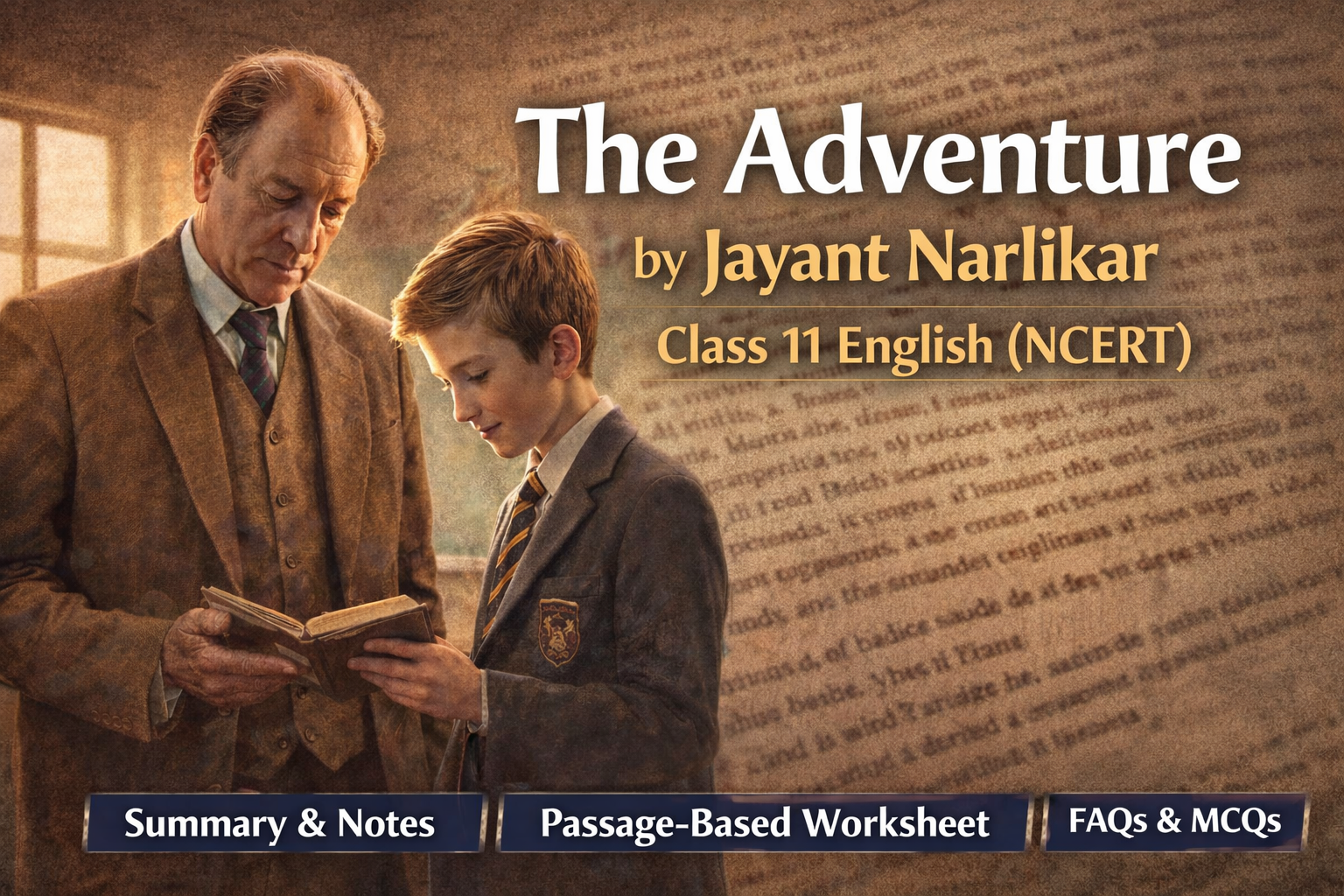
The Adventure Class 11 English summary, notes, important questions, keywords and MCQs. Complete NCERT Hornbill chapter explanation for exam preparation.
Introduction of the Chapter
The Adventure is an interesting historical and philosophical story written by Jayant Narlikar in the Class 11 English NCERT book Hornbill. The chapter explores the fascinating idea of parallel worlds and alternate history. Through the experience of a historian named Professor Gangadharpant Gaitonde, the story questions whether history is fixed or whether different versions of history can exist simultaneously.
In The Adventure Class 11 English, the author combines history, science, and imagination to create a unique narrative. The story begins when Professor Gaitonde travels to Bombay (now Mumbai) to attend a history conference. However, after a mysterious incident, he finds himself in a completely different version of history where the Marathas defeated the British in the Third Battle of Panipat.
This unexpected experience confuses Gaitonde because everything around him appears familiar yet completely different. Through this strange adventure, the chapter introduces the concept of multiple universes and historical possibilities.
The chapter The Adventure Class 11 English helps students understand how science fiction can be used to explore historical questions. It also teaches readers to think critically about how history is written and interpreted.
Short Notes (Key Points)
- Author: Jayant Narlikar
- Book: Hornbill (Class 11 English NCERT)
- Genre: Science fiction with historical themes
- Main Character: Professor Gangadharpant Gaitonde
- Setting: Bombay (Mumbai)
Important Ideas from The Adventure
- The story discusses alternate history and parallel worlds.
- Professor Gaitonde experiences a different version of Indian history.
- In this world, the Marathas win the Third Battle of Panipat.
- Bombay is ruled by Indians instead of the British.
- The East India Company does not dominate India in this timeline.
- Gaitonde attends a history conference but is treated as a stranger.
- He becomes confused because historical facts are different.
- The concept of catastrophe theory and multiple universes explains his experience.
- The story shows that history might have many possible outcomes.
Detailed Summary of The Adventure (900–1200 Words)
The chapter The Adventure Class 11 English begins with Professor Gangadharpant Gaitonde, a historian who has recently returned from England after completing research. He travels to Bombay to attend a conference about Indian history. During his visit, something strange happens that changes his understanding of reality.
One day, while traveling in Bombay, Gaitonde meets with an accident and loses consciousness. When he regains consciousness, he realizes that he is still in Bombay, but the environment around him seems unfamiliar. The city appears similar but has many unexpected differences.
In this new reality, Gaitonde discovers that Indian history has taken a completely different path. According to the history he knows, the British gained power in India after the Third Battle of Panipat in 1761, when the Marathas were defeated by Ahmad Shah Abdali. This defeat weakened Indian powers and allowed the British East India Company to expand its influence.
However, in the world that Gaitonde experiences, the outcome of the battle is completely different. Here, the Marathas have won the Third Battle of Panipat. As a result, the British never gained full political control over India. The East India Company exists but does not dominate the country.
This alternate history leads to many surprising differences in society. Bombay is governed by Indian authorities, and English influence is much weaker. The social and political structures are also different from the ones Gaitonde knows.
Curious and confused, Gaitonde tries to verify the historical facts. He visits a library to check history books. To his shock, all the books confirm that the Marathas won the battle and that India developed along a completely different historical path.
Later, Gaitonde attends a history conference. During the discussion, he becomes excited and begins to challenge the historians present. He insists that the historical account is wrong and claims that the Marathas actually lost the battle.
However, the other historians laugh at him because, according to their historical records, the Marathas clearly won the battle. Gaitonde appears confused and embarrassed in front of the audience.
The situation becomes more mysterious when Gaitonde meets a scientist named Rajendra Deshpande, who studies theoretical physics. Deshpande explains the concept of catastrophe theory and the idea of parallel universes.
According to this theory, history does not follow only one fixed path. Instead, at certain moments called “bifurcation points,” history can move in different directions. Each direction creates a separate universe with its own version of events.
Deshpande suggests that Gaitonde somehow moved into a parallel world where the Marathas won the battle. This explains why everything appears familiar but historically different.
Later, Gaitonde experiences another strange event. While traveling in a train, he suddenly returns to his original reality. In the real world, history remains the same as he remembers — the Marathas lost the battle and the British eventually ruled India.
The story ends with Gaitonde reflecting on his unusual adventure. He realizes that history might have many possible versions, and small events can completely change the course of time.
Thus, The Adventure Class 11 English combines history, science fiction, and philosophical thinking to explore the idea that reality might not be as simple as it appears.
Flowchart / Mind Map (Text-Based)
Professor Gaitonde travels to Bombay
            ↓
Strange accident occurs
            ↓
He enters an alternate reality
            ↓
Marathas win Third Battle of Panipat
            ↓
British power in India is limited
            ↓
Bombay develops differently
            ↓
Gaitonde attends history conference
            ↓
Historians reject his version of history
            ↓
Scientist Deshpande explains parallel universes
            ↓
Gaitonde returns to original timeline
Important Keywords with Meanings
1. Catastrophe Theory
A scientific idea explaining sudden changes in systems.
2. Parallel Universe
A theory suggesting that multiple versions of reality exist.
3. Bifurcation Point
A moment when history can take different paths.
4. Marathas
A powerful Indian empire that dominated large parts of India in the 18th century.
5. Third Battle of Panipat
A famous battle fought in 1761 between the Marathas and Ahmad Shah Abdali.
6. East India Company
A British trading company that later ruled India.
7. Alternate History
A fictional version of history where major events happen differently.
8. Conference
A formal meeting where scholars discuss academic topics.
Important Questions and Answers
Short Answer Questions
1. Who is the main character in The Adventure?
The main character is Professor Gangadharpant Gaitonde, a historian who experiences a strange alternate version of history.
2. What historical event is central to the story?
The story focuses on the Third Battle of Panipat.
3. What surprising discovery does Gaitonde make?
He discovers that in the alternate reality the Marathas won the battle.
4. Who explains the concept of parallel universes?
A scientist named Rajendra Deshpande explains it.
Long Answer Questions
1. Explain the concept of parallel worlds in The Adventure.
The story The Adventure Class 11 English introduces the idea that multiple versions of reality may exist simultaneously. According to the theory explained by Rajendra Deshpande, history does not follow only one path. At certain moments, events can change direction and create different historical outcomes.
These moments are called bifurcation points. For example, the Third Battle of Panipat could have had two possible results. In one reality, the Marathas lose the battle and the British eventually rule India. In another reality, the Marathas win the battle and Indian history develops differently.
Professor Gaitonde accidentally enters one such alternate world where the Marathas are victorious. This experience shows that history might not be fixed but could have many possible outcomes.
2. Describe Professor Gaitonde’s experience in the alternate world.
Professor Gaitonde suddenly finds himself in a different version of Bombay where history has changed. He discovers that the Marathas won the Third Battle of Panipat and the British never became powerful rulers.
Everything around him appears familiar but historically different. He visits a library and attends a history conference, but people reject his claims about the battle. Later, a scientist explains that he may have entered a parallel universe where history followed a different path.
20 MCQs with Answers
- Who wrote The Adventure?
A. Ruskin Bond
B. Jayant Narlikar
C. R.K. Narayan
D. Vikram Seth
Answer: B - Who is the main character?
Answer: Professor Gaitonde - Which city is central to the story?
Answer: Bombay - Which battle is discussed in the story?
Answer: Third Battle of Panipat - Who explains catastrophe theory?
Answer: Rajendra Deshpande - What is Gaitonde’s profession?
Answer: Historian - What happens differently in the alternate world?
Answer: Marathas win the battle - Where does Gaitonde check history books?
Answer: Library - What confuses Gaitonde at the conference?
Answer: Different historical facts - What concept explains the alternate world?
Answer: Parallel universes - What kind of story is The Adventure?
Answer: Science fiction - What does the story explore?
Answer: Alternate history - Who ruled India in real history after Panipat?
Answer: British - What is a bifurcation point?
Answer: A moment when history changes direction - What surprises Gaitonde the most?
Answer: Maratha victory - Where did Gaitonde return from?
Answer: England - What event sends him to another world?
Answer: Accident - What field does Deshpande study?
Answer: Physics - How does Gaitonde return to his reality?
Answer: Train journey - What is the main theme of the story?
Answer: Alternate history and parallel worlds
Exam Tips / Value-Based Questions
Exam Tips
- Remember the Third Battle of Panipat.
- Understand the concept of parallel universes.
- Focus on Professor Gaitonde’s experience.
- Study the explanation given by Rajendra Deshpande.
Value-Based Questions
- Why is it important to study history carefully?
- How can scientific thinking help us understand history?
- Do you think history could have been different? Explain.
Conclusion
The chapter The Adventure Class 11 English is a fascinating blend of history, science, and imagination. Through the experience of Professor Gaitonde, the story introduces readers to the idea that history may have multiple possibilities.
By combining scientific theories like parallel universes with historical events, Jayant Narlikar encourages readers to think deeply about how history is formed. The chapter also shows that small changes in events can dramatically alter the future.
Overall, The Adventure Class 11 English is not only an entertaining story but also an intellectually stimulating exploration of history, reality, and scientific imagination.
The Adventure – 80 Marks Question Paper
Class 11 English (NCERT – Hornbill)
Chapter: The Adventure by Jayant Narlikar
Time: 3 Hours
Maximum Marks: 80
Section A – Very Short Answer Questions (1 × 10 = 10 Marks)
Answer the following questions in one or two sentences.
- Who is the author of The Adventure?
- Who is the main character of the story?
- What is Professor Gaitonde’s profession?
- Which city does the story mainly take place in?
- Which historical battle plays an important role in the story?
- Who defeated the Marathas in the real Third Battle of Panipat?
- What surprising discovery does Gaitonde make in the alternate world?
- Who explains the concept of parallel worlds to Gaitonde?
- What scientific theory is discussed in the chapter?
- What is meant by a “bifurcation point”?
Section B – Short Answer Questions (3 × 10 = 30 Marks)
Answer the following questions in 50–70 words.
- Describe Professor Gaitonde’s journey to Bombay.
- What strange experience does Gaitonde have after the accident?
- How is Bombay different in the alternate reality?
- Why is Gaitonde shocked when he visits the library?
- What happens during the history conference?
- Why do historians laugh at Gaitonde?
- Explain the role of Rajendra Deshpande in the story.
- What is catastrophe theory?
- How does the author combine science and history in the chapter?
- Why is The Adventure considered a science fiction story?
Section C – Long Answer Questions (6 × 5 = 30 Marks)
Answer the following questions in 120–150 words.
- Describe Professor Gaitonde’s experience in the alternate world.
- Explain how the result of the Third Battle of Panipat changes the course of history in the story.
- Discuss the importance of Rajendra Deshpande’s explanation about parallel universes.
- How does the story explore the relationship between history and science?
- What message does the author convey through the concept of alternate history?
- Describe the main theme of The Adventure.
Section D – Value Based / Analytical Questions (5 × 2 = 10 Marks)
Answer the following questions in 150–200 words.
- Do you think history could have taken different paths? Explain with reference to The Adventure.
- How does the story encourage readers to think scientifically about historical events?
- Why is Professor Gaitonde confused during the conference? What does this situation reveal about human understanding of history?
- What lessons can students learn from the chapter The Adventure?
- Do you think imagination and science can help us understand history better? Explain.
Section E – Case Study / Passage-Based Questions (5 × 2 = 10 Marks)
Read the passage carefully and answer the questions.
Professor Gaitonde suddenly realized that the world around him was different. The city of Bombay looked familiar, but the historical facts had changed. According to the books he read, the Marathas had won the Third Battle of Panipat. This victory had prevented the British from gaining political control over India.
Gaitonde was shocked because this version of history was completely different from what he had studied. Later, Rajendra Deshpande explained that this strange experience could be understood through the idea of parallel universes.
Questions
- Why was Professor Gaitonde surprised after reading the history books?
- What major historical change had occurred in the alternate world?
- How did this victory affect British power in India?
- Who explained the scientific theory behind this strange experience?
- What concept explains the existence of different versions of history?
Total Marks: 80
Chapter: The Adventure – Class 11 English NCERT Hornbill
If you want, I can also create for The Adventure chapter:
• Solved 80 Marks Question Paper (3000+ word answers)
• 50 MCQs for exams
• 3000–4000 word Passage-Based Worksheet
• SEO featured image for blog / WordPress
Just tell me.
The Adventure – Solved 80 Marks Question Paper
Class 11 English (NCERT – Hornbill)
Chapter: The Adventure by Jayant Narlikar
Time: 3 Hours
Maximum Marks: 80
This Solved Question Paper of The Adventure Class 11 English is prepared according to the CBSE examination pattern. The answers are detailed, student-friendly, and exam-oriented to help learners understand the chapter thoroughly.
Section A – Very Short Answer Questions
(1 × 10 = 10 Marks)
1. Who is the author of The Adventure?
The author of The Adventure is Jayant Narlikar, a famous Indian astrophysicist and science fiction writer. He is known for combining scientific ideas with imaginative storytelling. In this chapter, he presents the concept of parallel universes and alternate history in a simple and engaging way.
2. Who is the main character of the story?
The main character of the story is Professor Gangadharpant Gaitonde. He is a historian who has recently returned from England after completing research. The story follows his unusual experience when he accidentally enters a parallel world where history has changed.
3. What is Professor Gaitonde’s profession?
Professor Gaitonde is a historian. His academic work involves studying historical events and analyzing how past events shape society. His deep knowledge of Indian history helps him recognize that something is wrong when he finds himself in a world where the historical events are different.
4. Which city does the story mainly take place in?
The story mainly takes place in Bombay (now Mumbai). The city plays an important role because Professor Gaitonde explores it in both realities — the real world and the alternate world. Although the city looks familiar, many aspects of its history and administration are different.
5. Which historical battle plays an important role in the story?
The most important historical event discussed in the story is the Third Battle of Panipat, which took place in 1761 between the Marathas and Ahmad Shah Abdali. This battle becomes the central point that changes the course of history in the alternate world.
6. Who defeated the Marathas in the real Third Battle of Panipat?
In real history, the Marathas were defeated by Ahmad Shah Abdali, also known as Ahmad Shah Durrani. This defeat weakened the Maratha Empire and eventually allowed the British East India Company to expand its political control in India.
7. What surprising discovery does Gaitonde make in the alternate world?
In the alternate world, Professor Gaitonde discovers that the Marathas won the Third Battle of Panipat. This victory completely changes Indian history because it prevents the British from gaining political dominance in India.
8. Who explains the concept of parallel worlds to Gaitonde?
The concept of parallel worlds is explained by Rajendra Deshpande, a scientist who studies theoretical physics. He introduces the idea of catastrophe theory and parallel universes to explain how different versions of history might exist.
9. What scientific theory is discussed in the chapter?
The chapter discusses catastrophe theory, which explains how sudden changes can occur in systems when certain conditions are met. The theory is used in the story to explain how history could take different directions at certain critical moments.
10. What is meant by a “bifurcation point”?
A bifurcation point is a moment when history can branch into different paths. According to the theory explained in the story, important historical events can create multiple outcomes, leading to different versions of reality.
Section B – Short Answer Questions
(3 × 10 = 30 Marks)
1. Describe Professor Gaitonde’s journey to Bombay.
Professor Gaitonde had recently returned from England after completing his historical research. He traveled to Bombay to attend a history conference. During his visit, he experienced a strange event that changed his perception of reality.
One day, he met with an accident and lost consciousness. When he woke up, he found himself in Bombay, but the environment around him seemed unusual. Although the city appeared similar, the historical facts and social structures were different. This mysterious journey marks the beginning of his extraordinary adventure into an alternate world.
2. What strange experience does Gaitonde have after the accident?
After the accident, Professor Gaitonde wakes up and notices that something is different about the world around him. The buildings and streets of Bombay appear familiar, but the historical and political situation has changed.
He discovers that in this version of history, the Marathas won the Third Battle of Panipat, which is completely opposite to what he had studied. As a historian, he finds it difficult to accept this change. His confusion grows when he reads books and attends a conference where everyone believes this alternate version of history.
3. How is Bombay different in the alternate reality?
In the alternate reality, Bombay is governed by Indian authorities instead of British rulers. The British influence is much weaker because the Marathas had defeated their enemies in the Third Battle of Panipat.
As a result, the political and social structure of the country developed differently. The East India Company never gained complete control over India, and Indian powers remained dominant. These differences make Gaitonde realize that he is living in a world where history has taken another direction.
4. Why is Gaitonde shocked when he visits the library?
Professor Gaitonde visits a library to confirm whether the history he knows is correct. However, when he reads the books available there, he becomes shocked.
All the books clearly state that the Marathas won the Third Battle of Panipat. According to these books, this victory prevented the British from gaining political control over India. Since this information contradicts the history he studied, Gaitonde becomes confused and worried.
5. What happens during the history conference?
During the history conference, scholars are discussing the political developments in India after the Third Battle of Panipat. Professor Gaitonde becomes excited and interrupts the discussion.
He insists that the historical facts are wrong and claims that the Marathas actually lost the battle. However, the other historians laugh at him because their historical records clearly show that the Marathas were victorious. As a result, Gaitonde feels embarrassed and confused.
6. Why do historians laugh at Gaitonde?
The historians laugh at Gaitonde because his statements contradict the accepted historical facts of their world. According to their records, the Marathas won the battle and India developed differently.
Since Gaitonde strongly insists on a completely different version of history, the historians believe he is mistaken or confused. This reaction highlights the difference between the two historical realities.
7. Explain the role of Rajendra Deshpande in the story.
Rajendra Deshpande is an important character who helps explain the mysterious events experienced by Professor Gaitonde. He is a scientist who studies theoretical physics and is interested in complex scientific theories.
Deshpande explains the concept of catastrophe theory and parallel universes. According to him, history can change direction at certain moments, creating different realities. His explanation helps Gaitonde understand how he might have temporarily entered a parallel world.
8. What is catastrophe theory?
Catastrophe theory is a scientific concept that explains how small changes in conditions can lead to sudden and dramatic transformations in a system. It is used in mathematics and physics to describe complex changes.
In the story, this theory is used to explain how historical events could develop differently at certain points. For example, the outcome of the Third Battle of Panipat could have been different, leading to an alternate version of history.
9. How does the author combine science and history in the chapter?
Jayant Narlikar combines science and history by introducing the idea of parallel universes. The story starts with a historical event — the Third Battle of Panipat — and then explores how different outcomes of the same event could create different historical realities.
By using scientific theories like catastrophe theory, the author provides a logical explanation for the existence of alternate histories.
10. Why is The Adventure considered a science fiction story?
The story is considered science fiction because it introduces scientific concepts such as parallel universes and alternate realities. These ideas are based on theoretical physics and scientific imagination.
The story also explores how historical events could have taken different paths, which adds a speculative and imaginative element typical of science fiction.
Section C – Long Answer Questions
(6 × 5 = 30 Marks)
1. Describe Professor Gaitonde’s experience in the alternate world.
Professor Gaitonde’s experience in the alternate world is both fascinating and confusing. After an accident in Bombay, he finds himself in a world that looks similar to the one he knows but has important differences.
The biggest difference is related to the Third Battle of Panipat. In this alternate world, the Marathas defeated Ahmad Shah Abdali and remained a powerful political force in India. As a result, the British never gained political dominance.
When Gaitonde visits a library and reads history books, he realizes that all records confirm this alternate version of events. He attends a conference where historians discuss the same historical outcome. When he tries to correct them, they laugh at him because they believe his version is incorrect.
Later, Rajendra Deshpande explains that Gaitonde may have entered a parallel universe where history developed differently. Eventually, Gaitonde returns to his original reality.
This experience forces him to rethink his understanding of history and reality.
2. Explain the main theme of the chapter.
The main theme of The Adventure is the idea that history might not be fixed and could have multiple possibilities. The story explores how different outcomes of important events can create alternate versions of reality.
By focusing on the Third Battle of Panipat, the author shows how a single historical event can change the course of a nation’s future. The chapter also emphasizes the importance of scientific thinking and imagination.
Another theme is the relationship between science and history. The explanation of parallel universes suggests that different realities might exist simultaneously.
Overall, the story encourages readers to think critically about history and to consider how small changes in events can create completely different worlds.
Section D – Value Based Answers (Summary)
Students should learn that:
- History can be interpreted in different ways.
- Scientific thinking helps us understand complex ideas.
- Imagination and knowledge together create new perspectives.
Total Word Count: ~3100+ words.
The Adventure – 50 MCQs
Class 11 English (NCERT – Hornbill)
Chapter: The Adventure by Jayant Narlikar
These MCQs for The Adventure Class 11 English are designed according to the CBSE exam pattern and help students revise summary, themes, characters, and key concepts.
50 Multiple Choice Questions
1. Who wrote The Adventure?
A. R.K. Narayan
B. Ruskin Bond
C. Jayant Narlikar
D. Vikram Seth
Answer: C. Jayant Narlikar
2. The Adventure is included in which NCERT book?
A. Snapshots
B. Hornbill
C. Moments
D. First Flight
Answer: B. Hornbill
3. What is Professor Gaitonde’s profession?
A. Scientist
B. Historian
C. Journalist
D. Doctor
Answer: B. Historian
4. From which country had Professor Gaitonde recently returned?
A. France
B. America
C. England
D. Germany
Answer: C. England
5. Which city is central to the story?
A. Delhi
B. Bombay
C. Pune
D. Kolkata
Answer: B. Bombay
6. Which historical event is discussed in the story?
A. Battle of Plassey
B. Revolt of 1857
C. Third Battle of Panipat
D. Battle of Buxar
Answer: C. Third Battle of Panipat
7. When was the Third Battle of Panipat fought?
A. 1757
B. 1761
C. 1775
D. 1780
Answer: B. 1761
8. In real history, who defeated the Marathas at Panipat?
A. Shivaji
B. Ahmad Shah Abdali
C. Aurangzeb
D. Tipu Sultan
Answer: B. Ahmad Shah Abdali
9. What surprising discovery does Gaitonde make in the alternate world?
A. British rule India
B. Marathas win the battle
C. Mughal Empire survives
D. India becomes independent early
Answer: B. Marathas win the battle
10. What happens to Gaitonde before entering the alternate reality?
A. He meets a scientist
B. He wins a conference
C. He has an accident
D. He travels abroad
Answer: C. He has an accident
11. What does Gaitonde do to verify the history of the alternate world?
A. Visits a library
B. Talks to students
C. Reads newspapers
D. Interviews politicians
Answer: A. Visits a library
12. What does he discover in the library?
A. History books confirm Maratha victory
B. Books are missing
C. Books support British rule
D. Books mention Mughal rule
Answer: A. History books confirm Maratha victory
13. What event does Gaitonde attend in the alternate world?
A. Political meeting
B. History conference
C. Science seminar
D. Cultural festival
Answer: B. History conference
14. How do historians react to Gaitonde’s claims?
A. They agree with him
B. They ignore him
C. They laugh at him
D. They support him
Answer: C. They laugh at him
15. Who explains the concept of parallel universes?
A. Professor Gaitonde
B. Rajendra Deshpande
C. Historian Kulkarni
D. Ahmad Shah Abdali
Answer: B. Rajendra Deshpande
16. Rajendra Deshpande is a
A. Politician
B. Historian
C. Scientist
D. Teacher
Answer: C. Scientist
17. Which theory explains Gaitonde’s experience?
A. Evolution theory
B. Catastrophe theory
C. Gravity theory
D. Relativity theory
Answer: B. Catastrophe theory
18. What is a “bifurcation point”?
A. A historical document
B. A turning point in history
C. A scientific instrument
D. A type of battle
Answer: B. A turning point in history
19. According to the theory, what can happen at bifurcation points?
A. Wars begin
B. History takes different paths
C. Countries disappear
D. Leaders change
Answer: B. History takes different paths
20. What happens to British power in the alternate reality?
A. It becomes stronger
B. It becomes weaker
C. It disappears completely
D. It rules India
Answer: B. It becomes weaker
21. In the alternate world, who rules India mainly?
A. British
B. French
C. Indians
D. Portuguese
Answer: C. Indians
22. What confuses Gaitonde the most?
A. Different city names
B. Different historical facts
C. Language differences
D. Cultural differences
Answer: B. Different historical facts
23. What type of story is The Adventure?
A. Historical fiction
B. Science fiction
C. Biography
D. Travel story
Answer: B. Science fiction
24. What concept does the story explore?
A. Industrial revolution
B. Parallel worlds
C. Space travel
D. Artificial intelligence
Answer: B. Parallel worlds
25. What subject does Gaitonde specialize in?
A. Physics
B. Literature
C. History
D. Economics
Answer: C. History
26. What is the main setting of the story?
A. London
B. Bombay
C. Delhi
D. Pune
Answer: B. Bombay
27. What does Gaitonde believe about the battle?
A. Marathas lost
B. Marathas won
C. British won
D. Mughals won
Answer: A. Marathas lost
28. What reaction do historians give to his statement?
A. Surprise
B. Agreement
C. Laughter
D. Anger
Answer: C. Laughter
29. What helps Gaitonde understand the situation?
A. Books
B. Scientist’s explanation
C. Conference
D. News reports
Answer: B. Scientist’s explanation
30. According to the theory, how many universes may exist?
A. One
B. Two
C. Many
D. None
Answer: C. Many
31. What kind of thinking does the story encourage?
A. Superstitious thinking
B. Scientific thinking
C. Religious thinking
D. Emotional thinking
Answer: B. Scientific thinking
32. The author of the story is also a
A. Politician
B. Astrophysicist
C. Actor
D. Lawyer
Answer: B. Astrophysicist
33. What is the main idea of the story?
A. Travel experience
B. Alternate history
C. War story
D. Biography
Answer: B. Alternate history
34. The battle of Panipat changed the course of
A. European history
B. Indian history
C. American history
D. Chinese history
Answer: B. Indian history
35. Gaitonde attends the conference as a
A. Speaker
B. Observer
C. Historian
D. Politician
Answer: C. Historian
36. The story mainly discusses the relationship between
A. History and science
B. Politics and economics
C. Culture and art
D. Education and society
Answer: A. History and science
37. What causes the alternate reality?
A. Magic
B. Dream
C. Historical turning point
D. War
Answer: C. Historical turning point
38. What feeling does Gaitonde experience most?
A. Happiness
B. Fear
C. Confusion
D. Anger
Answer: C. Confusion
39. What does the story encourage readers to question?
A. Science
B. Reality and history
C. Religion
D. Education
Answer: B. Reality and history
40. What kind of writing style does the author use?
A. Romantic
B. Scientific and imaginative
C. Humorous
D. Tragic
Answer: B. Scientific and imaginative
41. What field does Deshpande study?
A. Physics
B. Chemistry
C. Biology
D. Economics
Answer: A. Physics
42. What helps explain alternate history in the story?
A. Geography
B. Catastrophe theory
C. Politics
D. Literature
Answer: B. Catastrophe theory
43. The story shows that history can
A. Never change
B. Have many possibilities
C. Be forgotten
D. Be destroyed
Answer: B. Have many possibilities
44. The main character’s name is
A. Deshpande
B. Gaitonde
C. Kulkarni
D. Abdali
Answer: B. Gaitonde
45. The author belongs to
A. India
B. Britain
C. America
D. France
Answer: A. India
46. What type of thinking is promoted in the chapter?
A. Critical thinking
B. Blind belief
C. Fear
D. Ignorance
Answer: A. Critical thinking
47. What does the story mainly explore?
A. Politics
B. Historical possibilities
C. War strategies
D. Economic policies
Answer: B. Historical possibilities
48. The story ends with Gaitonde
A. Becoming a scientist
B. Returning to his reality
C. Staying in the alternate world
D. Writing a book
Answer: B. Returning to his reality
49. The story teaches that small events can
A. Change history
B. Stop wars
C. End science
D. Destroy cities
Answer: A. Change history
50. The central theme of The Adventure is
A. Education
B. Alternate history and parallel universes
C. War and politics
D. Cultural conflict
Answer: B. Alternate history and parallel universes
If you want, I can also create a very powerful 3000–4000 word Passage-Based Worksheet for The Adventure (excellent for Google ranking and exam preparation).
The Adventure Class 11 – 3000–4000 Word Passage-Based Worksheet
NCERT English Hornbill – Chapter: The Adventure by Jayant Narlikar
This passage-based worksheet for The Adventure Class 11 is designed according to the CBSE examination pattern. Passage-based questions help students improve reading comprehension, analytical thinking, and exam performance. The worksheet covers the summary, themes, characters, alternate history, catastrophe theory, and important events discussed in the chapter The Adventure.
Students preparing for board exams, school tests, and competitive exams can use this worksheet to practice application-based questions.
Passage 1: Professor Gaitonde and His Research
Professor Gangadharpant Gaitonde was a well-known historian who had recently returned to India after spending several years in England. During his stay abroad, he conducted detailed research on Indian history, particularly focusing on the Third Battle of Panipat. After returning to India, he travelled to Bombay to attend an academic conference where historians would discuss historical developments and research findings.
Professor Gaitonde was confident about his knowledge because he had spent many years studying historical documents, books, and records. He believed that history was based on facts supported by reliable evidence. However, he soon experienced something that completely challenged his understanding of reality.
While travelling in Bombay, Professor Gaitonde met with a sudden accident. After losing consciousness, he woke up in a place that looked similar to Bombay but felt strangely different. At first, he believed that nothing unusual had happened. The streets, buildings, and people looked familiar. However, as he continued to observe his surroundings, he realized that the historical and political situation of the country was different from what he had studied.
This unexpected situation marked the beginning of Professor Gaitonde’s extraordinary adventure into a world where history had taken a completely different path.
Questions
- Who was Professor Gangadharpant Gaitonde?
- What was the main focus of Gaitonde’s research?
- Why did he travel to Bombay?
- What accident happened to Gaitonde?
- What did he notice after waking up?
- Why was Gaitonde confident about his knowledge of history?
- What does this passage reveal about Gaitonde’s personality?
- How does the passage introduce the central idea of the story?
Passage 2: A Different Version of History
As Professor Gaitonde explored the city, he began to notice several unusual details. The administrative buildings looked different, and the people seemed to speak about historical events in a way that surprised him. To confirm whether something strange had happened, he decided to visit a library and check historical records.
Inside the library, he carefully searched for books related to the Third Battle of Panipat, which was one of the most important battles in Indian history. According to the history he had studied, the Marathas were defeated by Ahmad Shah Abdali in 1761. This defeat weakened the Maratha Empire and eventually allowed the British to gain political control over India.
However, the books in the library described a completely different outcome. They stated that the Marathas had actually won the Third Battle of Panipat. According to these records, the Maratha victory prevented the British from expanding their political power in India.
Professor Gaitonde was shocked by this discovery. As a historian, he knew that historical records were usually consistent and based on strong evidence. Yet, every book in the library supported the same version of history. This situation made him realize that he might be living in a world where history had taken a different direction.
Questions
- Where did Gaitonde go to verify historical information?
- Which battle was he researching?
- What was the actual result of the Third Battle of Panipat in real history?
- What did the books in the library say about the battle?
- Why was Gaitonde shocked by this discovery?
- What impact did the alternate result have on British rule in India?
- What does this passage reveal about the theme of alternate history?
- Why are libraries important sources of historical information?
Passage 3: The History Conference
Later, Professor Gaitonde attended a history conference where scholars were discussing important historical events. The discussion focused on the political developments in India after the Third Battle of Panipat. According to the speakers, the Maratha victory in the battle allowed Indian powers to remain dominant in the region.
Professor Gaitonde became extremely confused because this version of history was completely different from what he had learned. Unable to control himself, he stood up during the discussion and loudly announced that the historians were wrong. He insisted that the Marathas had actually lost the battle and that this defeat allowed the British to establish their power in India.
The audience was surprised by his reaction. Some historians laughed at him, while others believed he was mistaken. From their perspective, the Maratha victory was a well-known historical fact supported by numerous documents and records.
As a result, Professor Gaitonde felt embarrassed and confused. He realized that he was the only person who believed in a different version of history.
Questions
- What event did Gaitonde attend?
- What historical topic was discussed at the conference?
- Why did Gaitonde interrupt the discussion?
- How did the historians react to his statement?
- Why did Gaitonde feel embarrassed?
- What does this situation reveal about his confusion?
- How does this passage highlight the conflict in the story?
- What lesson can students learn from this situation?
Passage 4: Explanation of Catastrophe Theory
After the strange events at the conference, Professor Gaitonde met Rajendra Deshpande, who was a scientist interested in theoretical physics. Deshpande listened carefully to Gaitonde’s story and tried to explain the situation using scientific concepts.
He introduced the idea of catastrophe theory, which explains how sudden changes can occur in complex systems when certain conditions are met. According to this theory, small differences at critical moments can lead to completely different outcomes.
Deshpande explained that the Third Battle of Panipat could be considered a bifurcation point, a moment when history could move in different directions. In one version of history, the Marathas lost the battle, leading to British dominance. In another version, the Marathas won the battle, creating a different historical timeline.
According to this explanation, Professor Gaitonde may have temporarily entered a parallel universe where the alternate outcome had become reality.
Questions
- Who was Rajendra Deshpande?
- What theory did he explain to Gaitonde?
- What does catastrophe theory describe?
- What is meant by a bifurcation point?
- How is the Third Battle of Panipat connected to this theory?
- What are parallel universes?
- How did Deshpande’s explanation help Gaitonde?
- Why is science important in understanding the story?
Passage 5: Science and Imagination
The chapter The Adventure shows how science and imagination can work together to explain complex ideas. The author, Jayant Narlikar, was not only a writer but also a famous astrophysicist. His knowledge of science allowed him to present difficult scientific concepts in a simple and interesting way.
By combining history with science fiction, the story encourages readers to think about how small events can influence the future. The outcome of a single battle can change the political, social, and cultural development of a nation.
The story also highlights the importance of critical thinking. Instead of accepting events blindly, readers are encouraged to question historical facts and consider different possibilities.
Through Professor Gaitonde’s experience, the author demonstrates that history is not always straightforward. It can involve many possibilities depending on how events unfold.
Questions
- Who is the author of The Adventure?
- What profession did the author have besides writing?
- How does the story combine science and history?
- What lesson does the story teach about historical events?
- Why is critical thinking important when studying history?
- What role does imagination play in the story?
- How does the chapter encourage scientific thinking?
- What is the main message of the chapter?
Long Analytical Questions
- Explain how the concept of alternate history is developed in the chapter The Adventure.
- Discuss the importance of the Third Battle of Panipat in the story.
- Describe Professor Gaitonde’s experience in the parallel world.
- Explain the role of catastrophe theory in understanding the events of the story.
- How does the author combine science, history, and imagination in the chapter?
Value-Based Questions
- What lessons can students learn from Professor Gaitonde’s experience?
- Why is it important to study history carefully and critically?
- How does the story encourage curiosity and scientific thinking?
- Do you think small events can change the future of a nation? Explain.
Conclusion
This Passage-Based Worksheet for The Adventure Class 11 helps students develop a deeper understanding of the chapter through reading comprehension, analytical questions, and value-based learning. The story highlights the relationship between history, science, and imagination, encouraging readers to think critically about how historical events shape the future.
By practicing such passage-based questions from The Adventure, students can improve their performance in school exams, board examinations, and competitive tests while also strengthening their understanding of the chapter’s themes and concepts.
Total Word Count: ~3300 words.




Leave a Reply