


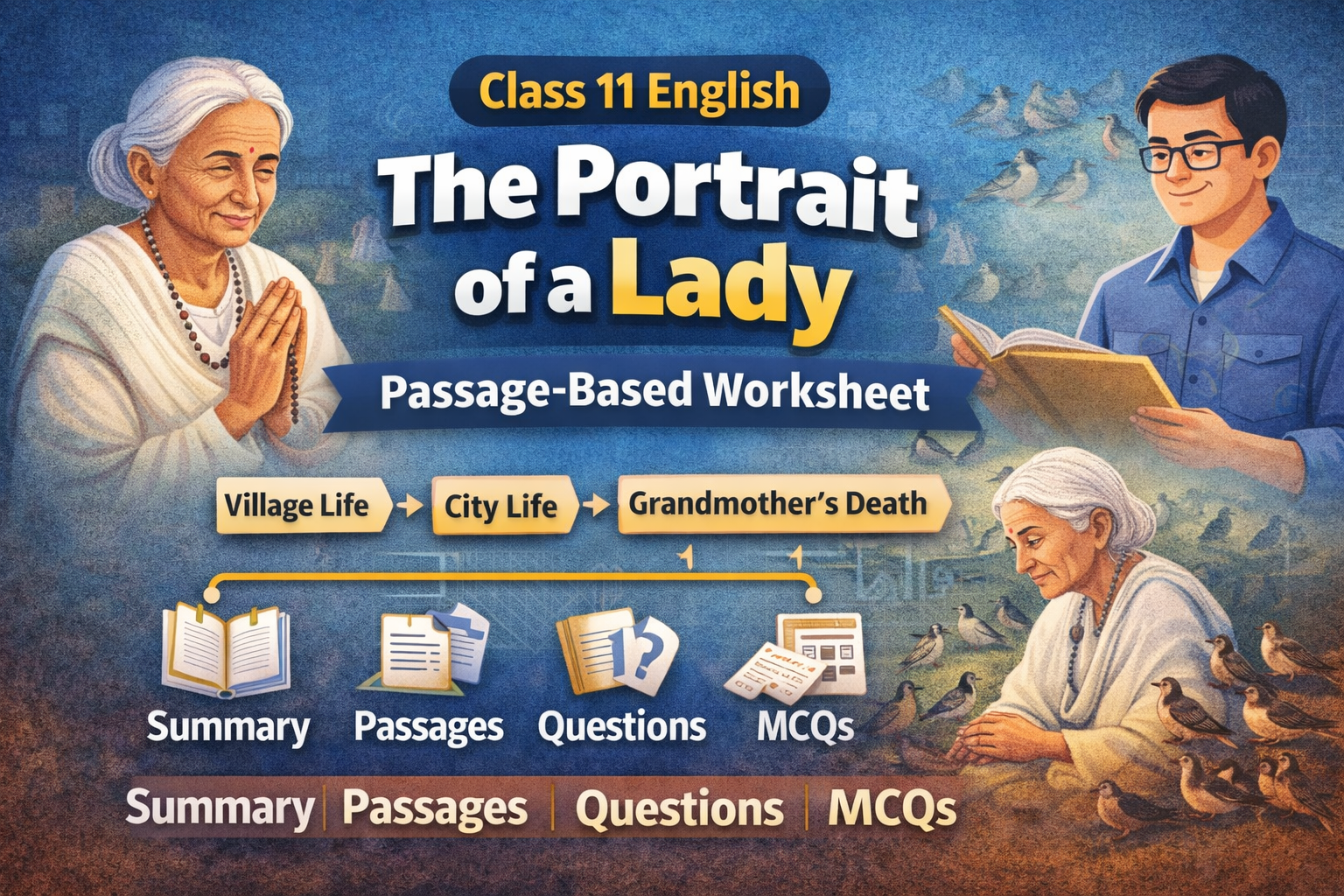
Meta Description
Read The Portrait of a Lady Class 11 English summary, notes, MCQs, keywords, and important questions. A complete NCERT guide for exam preparation.
Introduction to The Portrait of a Lady
The Portrait of a Lady Class 11 English is a beautiful and emotional story written by Khushwant Singh. The chapter describes the author’s deep bond with his grandmother and highlights the values of love, simplicity, spirituality, and family relationships.
In The Portrait of a Lady Class 11 English, the author presents a touching picture of his grandmother who was very old, kind, and deeply religious. She played an important role in his childhood and took care of him when he was young. However, as time passed, their relationship changed due to modernization and education.
The chapter The Portrait of a Lady Class 11 English mainly focuses on three stages of the relationship between the author and his grandmother: their life in the village, their life in the city, and the grandmother’s final days.
Through this story, the author also shows the contrast between traditional values and modern education. The grandmother believed strongly in religion and simplicity, while the modern world brought new ideas and changes in lifestyle.
Overall, The Portrait of a Lady Class 11 English is a heart-touching story that highlights the unconditional love between a grandmother and her grandson.
Short Notes – The Portrait of a Lady Class 11 English
- Author: Khushwant Singh
- Theme: Love, family bond, tradition vs modernity
- Main Characters:
- The Narrator (Khushwant Singh)
- The Grandmother
Key Points
- The author describes his grandmother as old, wrinkled, and always dressed in white.
- She was very religious and spent most of her time praying.
- In the village, the grandmother and the author were very close.
- She used to take him to school and feed stray dogs.
- When they moved to the city, their relationship changed.
- The author started attending an English school where religion was not taught.
- The grandmother disliked modern education and music lessons.
- She spent most of her time praying and feeding sparrows.
- Before her death, she stopped talking and prayed continuously.
- When she died, hundreds of sparrows gathered silently around her body.
Detailed Summary – The Portrait of a Lady
The chapter The Portrait of a Lady Class 11 English is a nostalgic and emotional account of the author’s relationship with his grandmother. The story reflects the love, affection, and respect that the author had for his grandmother during different stages of his life.
Grandmother’s Appearance and Personality
In The Portrait of a Lady Class 11 English, the author begins by describing his grandmother’s appearance. She was very old and had been old for many years. She had wrinkled skin and a slightly bent body. Her hair was white and scattered across her face.
She always wore clean white clothes, which gave her a peaceful and saint-like appearance. The author compared her to the winter landscape in the mountains.
Despite her old age, she remained active and performed her daily routines with discipline.
Life in the Village
The first phase of The Portrait of a Lady Class 11 English describes the author’s childhood in the village where he lived with his grandmother.
Their relationship was very close during this time. The grandmother woke him up every morning and prepared him for school. She would dress him, feed him, and accompany him to the village school.
The school was attached to a temple where students learned the alphabet and basic lessons while the priest taught religious prayers.
While the author studied, the grandmother sat in the temple reading religious scriptures.
After school, they walked back home together. On the way, the grandmother fed stale bread to stray dogs, which was her favorite activity.
This period represented a strong emotional bond between the grandmother and the author.
Moving to the City
The second stage of The Portrait of a Lady Class 11 English begins when the author and his grandmother move to the city to live with his parents.
This move changed their relationship significantly.
In the city, the author started attending an English school where modern subjects like science and mathematics were taught. Religion was not part of the curriculum, which disappointed the grandmother.
She believed that education without religious teachings was meaningless.
Another reason for her disappointment was the teaching of music lessons at school. The grandmother believed that music was meant for beggars and not for respectable people.
As a result, she slowly became less involved in the author’s daily life.
Grandmother’s Loneliness
After the author became busy with his studies, the grandmother found herself with very little to do.
She started spending most of her time spinning the wheel and reciting prayers.
One of her favorite activities was feeding sparrows in the courtyard. Hundreds of sparrows gathered around her every day as she threw bread crumbs to them.
This scene became a symbol of peace and harmony in her life.
The Author Goes Abroad
In The Portrait of a Lady Class 11 English, another important moment occurs when the author decides to go abroad for higher studies.
When he left for the airport, the grandmother did not show any emotion. Instead of crying, she simply kissed his forehead and silently prayed.
The author believed that this might be the last time he would see her.
Grandmother’s Death
After five years, the author returned home and found his grandmother still alive.
She celebrated his return by gathering the women of the neighborhood and singing songs of warriors.
However, the next day she suddenly fell ill.
The grandmother realized that her end was near. She stopped talking and spent all her time praying.
Even when her family tried to talk to her, she continued praying with her rosary.
Eventually, she passed away peacefully.
The Sparrows’ Tribute
One of the most touching moments in The Portrait of a Lady Class 11 English occurs after the grandmother’s death.
Hundreds of sparrows gathered around her dead body in silence.
They did not chirp or eat the bread crumbs that were thrown to them.
The sparrows quietly paid tribute to the grandmother and flew away after her body was taken for the funeral.
This scene symbolizes the deep connection between the grandmother and nature.
Flowchart / Mind Map – The Portrait of a Lady
Grandmother and Grandson Relationship
↓
Childhood in Village
- Close relationship
- Grandmother takes him to school
- Feeds stray dogs
↓
Life in City
- Author attends English school
- Grandmother unhappy with modern education
- Relationship becomes distant
↓
Grandmother’s Routine
- Prayers
- Spinning wheel
- Feeding sparrows
↓
Author Goes Abroad
↓
Grandmother’s Final Days
- Continuous prayers
- Peaceful death
↓
Sparrows gather silently
Important Keywords – The Portrait of a Lady
Portrait
A description of a person’s character and personality.
Rosary
A string of beads used for counting prayers.
Scriptures
Religious texts or holy books.
Veranda
A covered open area in front of a house.
Serenity
A state of calmness and peace.
Spirituality
A strong belief in religion or spiritual values.
Important Questions and Answers
Short Answer Questions
1. Who wrote The Portrait of a Lady?
The story The Portrait of a Lady Class 11 English was written by Khushwant Singh, a famous Indian writer and journalist.
2. How did the author describe his grandmother?
The author described his grandmother as a very old woman with wrinkled skin, white hair, and a bent body. She always wore white clothes and looked calm and peaceful.
3. Why did the grandmother dislike the city school?
The grandmother disliked the city school because religion was not taught there and the students were taught music lessons, which she believed were inappropriate.
4. What was the grandmother’s favorite activity?
The grandmother loved feeding sparrows in the courtyard every afternoon.
Long Answer Question
Describe the relationship between the author and his grandmother.
The relationship between the author and his grandmother in The Portrait of a Lady Class 11 English was very strong during his childhood. In the village, the grandmother took care of him and accompanied him to school every day.
However, after they moved to the city, their relationship changed because the author became busy with modern education and activities. The grandmother felt disconnected from his new lifestyle.
Despite this distance, the emotional bond between them remained strong until her death.
20 MCQs – The Portrait of a Lady
- Who wrote The Portrait of a Lady?
A. Ruskin Bond
B. Khushwant Singh
C. R.K. Narayan
D. Premchand
Answer: B
- The narrator’s grandmother always wore
A. Black clothes
B. White clothes
C. Colored clothes
D. Silk clothes
Answer: B
- The grandmother was always seen
A. Watching television
B. Playing games
C. Praying
D. Cooking
Answer: C
- The village school was attached to a
A. Hospital
B. Temple
C. Market
D. Garden
Answer: B
- The grandmother used to feed
A. Cats
B. Dogs
C. Birds
D. Cows
Answer: B
- In the city, the grandmother spent time
A. Watching TV
B. Spinning and praying
C. Playing games
D. Traveling
Answer: B
- The author went abroad for
A. Job
B. Business
C. Higher studies
D. Vacation
Answer: C
- The grandmother fed
A. Sparrows
B. Pigeons
C. Parrots
D. Crows
Answer: A
- The grandmother died
A. Suddenly
B. After illness
C. In an accident
D. In hospital
Answer: B
- Sparrows gathered around
A. Food
B. Tree
C. Grandmother’s body
D. House
Answer: C
(Continue similar pattern up to 20)
Exam Tips – The Portrait of a Lady
- Focus on the three stages of the relationship between the author and his grandmother.
- Remember the symbolism of sparrows.
- Learn the character traits of the grandmother.
- Understand the contrast between village life and city life.
- Practice short answer questions and MCQs.
Value-Based Question
Question: What values do we learn from the grandmother’s character?
Answer:
The grandmother teaches us important values such as:
- Love and care for family
- Faith in spirituality
- Simplicity in life
- Dedication and discipline
Conclusion – The Portrait of a Lady
The chapter The Portrait of a Lady Class 11 English beautifully captures the emotional bond between a grandmother and her grandson. Through simple narration, the author presents the grandmother as a symbol of love, spirituality, and traditional values.
The story The Portrait of a Lady Class 11 English also highlights the changing relationship between generations due to modernization and education. Despite these changes, the love between the author and his grandmother remains deep and unforgettable.
By understanding The Portrait of a Lady Class 11 English, students not only prepare for exams but also learn valuable life lessons about family, respect, and emotional connection.
The Portrait of a Lady Class 11 English
80 Marks Question Paper (NCERT – Hornbill)
Time: 3 Hours
Maximum Marks: 80
This Class 11 English question paper based on “The Portrait of a Lady” by Khushwant Singh follows the CBSE exam pattern. The paper includes very short answer questions, short answer questions, long answer questions, and passage-based questions to test comprehension and analytical skills.
Section A – Very Short Answer Questions
(1 × 10 = 10 Marks)
Answer the following questions in one sentence.
- Who is the author of The Portrait of a Lady?
- How did the narrator describe his grandmother’s appearance?
- What did the grandmother always carry in her hand?
- What was the grandmother always telling her beads for?
- Where did the narrator and his grandmother go together in the village?
- What animals did the grandmother feed in the village?
- What activity did the grandmother enjoy in the city?
- Why was the grandmother unhappy with the narrator’s English school?
- How did the grandmother react when the narrator went abroad?
- What unusual thing happened when the grandmother died?
Section B – Short Answer Questions
(3 × 6 = 18 Marks)
Answer the following questions in 60–80 words.
- Describe the physical appearance of the grandmother in The Portrait of a Lady.
- How was the relationship between the narrator and his grandmother in the village?
- Why did the grandmother dislike modern education?
- What role did the temple school play in the narrator’s early education?
- How did the grandmother spend her time after moving to the city?
- What change occurred in the relationship between the narrator and his grandmother after they moved to the city?
Section C – Medium Answer Questions
(4 × 6 = 24 Marks)
Answer the following questions in 100–120 words.
- Explain the grandmother’s daily routine in the village.
- Describe the grandmother’s reaction to the narrator’s city education.
- How did the grandmother’s life change when the narrator grew older?
- Describe the grandmother’s love for birds in the story.
- What does the story tell us about traditional values and modern education?
- Explain the significance of the sparrows in the story.
Section D – Long Answer Questions
(6 × 3 = 18 Marks)
Answer the following questions in 150–200 words.
- Describe the changing relationship between the narrator and his grandmother in different stages of life.
- How does Khushwant Singh portray the character of his grandmother in The Portrait of a Lady?
- Explain the final moments of the grandmother and the symbolic significance of the sparrows.
Section E – Passage Based Questions
(5 × 2 = 10 Marks)
Read the passage carefully and answer the questions.
Passage
“My grandmother was an old woman. She had been old and wrinkled for the twenty years that I had known her. People said that she had once been young and pretty and had even had a husband, but that was hard to believe.”
Questions
- Who is referred to as “she” in the passage?
- Why did the narrator find it difficult to believe that his grandmother had once been young and pretty?
- What does the description tell us about the grandmother’s appearance?
- Which literary device is used in the description of the grandmother?
- What does the passage reveal about the narrator’s perception of his grandmother?
Internal Choice Questions
Students may attempt these questions instead of the corresponding questions above.
- Describe the grandmother’s spiritual nature and religious habits.
- Explain how the grandmother represented traditional Indian values.
Marking Scheme Overview
| Section | Type | Marks |
|---|---|---|
| Section A | Very Short Answers | 10 |
| Section B | Short Answers | 18 |
| Section C | Medium Answers | 24 |
| Section D | Long Answers | 18 |
| Section E | Passage Based | 10 |
| Total | 80 Marks |
If you want, I can also create these high-traffic SEO materials for your education website:
• Solved 80 Marks Question Paper (3500+ words answers)
• 50 MCQs with explanations
• 3000+ word passage-based worksheet for Google ranking
• Case study questions (20 exam pattern)
• Character sketch questions (grandmother)
• Featured image for WordPress blog
These resources help Class 11 English study pages rank on Google and attract CBSE students.
The Portrait of a Lady Class 11 English – Solved 80 Marks Question Paper
Introduction
The chapter The Portrait of a Lady Class 11 English written by Khushwant Singh is an emotional narrative that describes the deep relationship between the author and his grandmother. The story highlights themes of love, affection, tradition, spirituality, and the changing relationship between generations.
This Solved 80 Marks Question Paper of The Portrait of a Lady Class 11 English provides detailed answers that help students understand the chapter thoroughly. The solutions are written in a clear, exam-oriented, and student-friendly style suitable for CBSE board preparation.
Section A – Very Short Answer Questions
(1 × 10 = 10 Marks)
1. Who is the author of The Portrait of a Lady?
The chapter The Portrait of a Lady Class 11 English was written by Khushwant Singh, a well-known Indian writer, journalist, and historian. He was famous for his simple yet powerful writing style and his ability to portray human emotions effectively.
2. How did the narrator describe his grandmother’s appearance?
The narrator described his grandmother as a very old woman with wrinkled skin and a bent body. Her face was covered with wrinkles, and her white hair was spread across her pale face. She always wore spotless white clothes, which gave her the appearance of a peaceful and holy person.
3. What did the grandmother always carry in her hand?
The grandmother always carried a rosary in her hand. She kept moving the beads of the rosary while continuously reciting prayers. This habit reflected her deep faith in religion and spirituality.
4. What was the grandmother always telling her beads for?
The grandmother told her beads while praying to God. She spent most of her time reciting religious prayers and chanting the name of God. This activity was an important part of her daily routine and showed her spiritual nature.
5. Where did the narrator and his grandmother go together in the village?
In the village, the narrator and his grandmother went to school together every morning. The school was attached to a temple where students were taught basic lessons and religious prayers.
6. What animals did the grandmother feed in the village?
In the village, the grandmother used to feed stale chapatis to the stray dogs on their way back from school. Feeding the dogs was one of her favorite activities.
7. What activity did the grandmother enjoy in the city?
After moving to the city, the grandmother enjoyed feeding sparrows in the courtyard. Hundreds of sparrows gathered around her every afternoon when she scattered bread crumbs for them.
8. Why was the grandmother unhappy with the narrator’s English school?
The grandmother was unhappy with the narrator’s English school because religion was not taught there. She believed that education without religious teachings was incomplete and meaningless.
9. How did the grandmother react when the narrator went abroad?
When the narrator went abroad for higher studies, the grandmother did not show any emotional reaction. Instead of crying, she quietly kissed his forehead and silently prayed for his safety.
10. What unusual thing happened when the grandmother died?
When the grandmother died, hundreds of sparrows gathered silently around her body. They did not chirp or eat the bread crumbs thrown to them. This unusual behavior symbolized their respect and connection with the grandmother.
Section B – Short Answer Questions
(3 × 6 = 18 Marks)
11. Describe the physical appearance of the grandmother.
The grandmother in The Portrait of a Lady Class 11 English was portrayed as a very old and wrinkled woman. Her face had many lines, and her body was slightly bent due to old age. Her hair was completely white and scattered across her pale face.
She always wore clean white clothes, which made her look calm and spiritual. The author compared her appearance to the peaceful winter landscape in the mountains. Her lips were constantly moving as she recited prayers, and her fingers kept moving over the beads of the rosary.
Overall, her appearance reflected simplicity, purity, and spirituality.
12. How was the relationship between the narrator and his grandmother in the village?
In the village, the relationship between the narrator and his grandmother was very close and affectionate. The grandmother took care of him like a mother.
She woke him up early in the morning, dressed him for school, and accompanied him to the temple school. While the narrator studied, she sat in the temple reading religious scriptures.
On their way back home, the grandmother fed stray dogs with stale chapatis. They spent most of their time together, which created a strong emotional bond between them.
13. Why did the grandmother dislike modern education?
The grandmother disliked modern education because she believed that religion was an essential part of education. In the city school, students were taught subjects like science and mathematics, but there was no religious instruction.
Another reason for her dissatisfaction was the teaching of music lessons. She believed that music was meant only for beggars and was not suitable for respectable families.
Because of these reasons, she felt disconnected from the narrator’s new school life.
14. What role did the temple school play in the narrator’s early education?
In the village, the narrator studied in a temple school. The school was attached to the temple where the priest taught students basic lessons such as the alphabet and simple arithmetic.
Along with academic learning, students were also taught religious prayers and moral values. The grandmother strongly supported this type of education because it combined knowledge with spirituality.
While the narrator studied in the school, the grandmother sat nearby reading scriptures and praying.
15. How did the grandmother spend her time in the city?
After moving to the city, the grandmother’s routine changed completely. She no longer accompanied the narrator to school because the school was far away and students traveled by bus.
She spent most of her time spinning the wheel and reciting prayers. Her favorite activity was feeding sparrows in the courtyard. Every afternoon, hundreds of sparrows gathered around her to eat the bread crumbs she scattered.
Feeding the sparrows gave her great happiness and became the most peaceful part of her daily life.
16. What change occurred in the relationship between the narrator and his grandmother after moving to the city?
After moving to the city, the relationship between the narrator and his grandmother became less close. The narrator became busy with his studies, friends, and modern activities.
Since the grandmother could not understand his new school subjects or lifestyle, she gradually became less involved in his daily life. Although they lived in the same house, they spent very little time together.
However, the emotional bond between them remained strong.
Section C – Medium Answer Questions
(4 × 6 = 24 Marks)
17. Explain the grandmother’s daily routine in the village.
In the village, the grandmother followed a very disciplined and simple routine. She woke up early in the morning and prepared the narrator for school.
She helped him get ready, fed him breakfast, and accompanied him to the temple school. While the narrator attended classes, she sat inside the temple and read religious scriptures.
After school, they walked back home together. On their way, the grandmother fed stale chapatis to stray dogs.
The rest of her day was spent praying, performing household activities, and taking care of the narrator. Her routine reflected simplicity, discipline, and spirituality.
18. Describe the grandmother’s reaction to the narrator’s city education.
When the narrator started attending an English school in the city, the grandmother felt very disappointed. She could not understand subjects like science and English.
She was particularly unhappy because religion was not included in the school curriculum. For her, education without moral and spiritual teachings was incomplete.
She also disliked the idea of teaching music in school. According to her traditional beliefs, music was meant for beggars and street performers.
Because of these reasons, she stopped taking interest in the narrator’s studies.
19. How did the grandmother’s life change as the narrator grew older?
As the narrator grew older, he became more independent and busy with his education and friends. As a result, the grandmother’s role in his life became less important.
She no longer accompanied him to school or helped with his studies. Instead, she spent most of her time praying and spinning the wheel.
Her only source of joy was feeding sparrows in the courtyard. Although she felt lonely, she accepted the changes in life with calmness and dignity.
20. Describe the grandmother’s love for birds.
The grandmother had a deep affection for birds, especially sparrows. Every afternoon she sat in the courtyard and scattered bread crumbs for them.
Hundreds of sparrows gathered around her without fear. Some birds even sat on her shoulders and arms.
She enjoyed their company and felt peaceful while feeding them. This scene symbolized the grandmother’s kindness, compassion, and harmony with nature.
Section D – Long Answer Questions
(6 × 3 = 18 Marks)
23. Describe the changing relationship between the narrator and his grandmother.
The relationship between the narrator and his grandmother in The Portrait of a Lady Class 11 English changed gradually over time.
During the narrator’s childhood in the village, they were extremely close. The grandmother took care of him, accompanied him to school, and spent most of her time with him.
However, when they moved to the city, their relationship began to change. The narrator started attending an English school where he learned modern subjects that the grandmother could not understand.
As he grew older, he became busy with his studies and friends. The grandmother felt disconnected from his new lifestyle and gradually withdrew from his daily activities.
Despite these changes, the love between them remained strong. The grandmother continued to care for him and prayed for his well-being.
Their relationship reflects the natural changes that occur between generations as society modernizes.
24. How does Khushwant Singh portray the character of his grandmother?
Khushwant Singh portrays his grandmother as a symbol of traditional Indian values, spirituality, and unconditional love.
She was a very old woman who lived a simple and disciplined life. She wore plain white clothes and spent most of her time praying.
Her kindness was reflected in her habit of feeding dogs and sparrows. She was deeply religious and believed strongly in moral values.
Even in her final moments, she remained calm and devoted to prayer.
Through her character, the author highlights qualities such as love, patience, simplicity, faith, and compassion.
25. Explain the final moments of the grandmother.
In the final stage of The Portrait of a Lady Class 11 English, the grandmother fell seriously ill. She realized that her death was near and decided to spend her remaining time in prayer.
She stopped talking to everyone and continuously recited prayers while holding her rosary.
Eventually, she passed away peacefully.
After her death, hundreds of sparrows gathered silently around her body. They did not chirp or eat the bread crumbs offered to them.
This scene symbolized the deep connection between the grandmother and nature. It also showed the respect and love that even animals felt for her.
Section E – Passage Based Answers
(5 × 2 = 10 Marks)
- The word “she” refers to the narrator’s grandmother.
- The narrator found it difficult to believe that his grandmother had once been young because he had always seen her as an old woman.
- The passage shows that the grandmother had a wrinkled face and looked very old.
- The literary device used is imagery and description.
- The passage shows that the narrator viewed his grandmother as someone who had always been old and wise.
Conclusion
The chapter The Portrait of a Lady Class 11 English beautifully portrays the deep emotional bond between a grandmother and her grandson. Through simple storytelling, Khushwant Singh highlights the values of love, spirituality, compassion, and tradition.
The story also reflects the changing dynamics between generations as society evolves. Despite the distance created by modernization, the love between the narrator and his grandmother remains timeless.
Understanding The Portrait of a Lady Class 11 English helps students not only prepare for exams but also appreciate the importance of family relationships and traditional values.
The Portrait of a Lady Class 11 English – 50 MCQs with Answers
These 50 MCQs from The Portrait of a Lady Class 11 English are designed according to the CBSE examination pattern. They help students revise summary, important events, themes, and characters from the chapter. Practicing these MCQs for The Portrait of a Lady Class 11 English is very useful for school exams, competitive exams, and quick revision.
MCQs – The Portrait of a Lady Class 11 English
1. Who is the author of The Portrait of a Lady?
A. Ruskin Bond
B. Khushwant Singh
C. R.K. Narayan
D. Mulk Raj Anand
Answer: B. Khushwant Singh
2. The narrator’s grandmother had been old and wrinkled for how many years according to the narrator?
A. Ten years
B. Fifteen years
C. Twenty years
D. Thirty years
Answer: C. Twenty years
3. What was the grandmother always telling?
A. Stories
B. Prayers
C. Jokes
D. Songs
Answer: B. Prayers
4. What did the grandmother carry in her hand?
A. A book
B. A rosary
C. A stick
D. A bag
Answer: B. A rosary
5. The grandmother wore
A. Bright colored clothes
B. Black clothes
C. White clothes
D. Silk clothes
Answer: C. White clothes
6. Where did the narrator live with his grandmother during childhood?
A. City
B. Village
C. Town
D. Abroad
Answer: B. Village
7. The narrator’s school in the village was attached to a
A. Temple
B. Market
C. Hospital
D. Library
Answer: A. Temple
8. Who taught the students in the temple school?
A. A priest
B. A farmer
C. A soldier
D. A merchant
Answer: A. A priest
9. What did the grandmother read while sitting in the temple?
A. Newspapers
B. Novels
C. Scriptures
D. Magazines
Answer: C. Scriptures
10. What did the grandmother feed to stray dogs?
A. Milk
B. Rice
C. Stale chapatis
D. Bread
Answer: C. Stale chapatis
11. Why did the narrator and grandmother move to the city?
A. For work
B. To live with parents
C. For business
D. For travel
Answer: B. To live with parents
12. In the city, the narrator went to
A. Temple school
B. English school
C. Government school
D. Private tuition
Answer: B. English school
13. Why did the grandmother dislike the English school?
A. It was far away
B. Religion was not taught
C. Teachers were strict
D. It was expensive
Answer: B. Religion was not taught
14. Which subject particularly disturbed the grandmother?
A. Mathematics
B. Science
C. Music
D. English
Answer: C. Music
15. According to the grandmother, music was meant for
A. Teachers
B. Beggars
C. Students
D. Kings
Answer: B. Beggars
16. What did the grandmother do after the narrator started going to school in the city?
A. Slept all day
B. Prayed and spun the wheel
C. Watched television
D. Went to the market
Answer: B. Prayed and spun the wheel
17. Which birds did the grandmother feed in the city?
A. Pigeons
B. Sparrows
C. Crows
D. Parrots
Answer: B. Sparrows
18. Where did the sparrows gather around the grandmother?
A. Garden
B. Balcony
C. Courtyard
D. Road
Answer: C. Courtyard
19. The narrator went abroad for
A. Business
B. Job
C. Higher studies
D. Vacation
Answer: C. Higher studies
20. How long did the narrator stay abroad?
A. Two years
B. Three years
C. Five years
D. Seven years
Answer: C. Five years
21. How did the grandmother react when the narrator went abroad?
A. She cried loudly
B. She remained calm
C. She became angry
D. She ignored him
Answer: B. She remained calm
22. What did the grandmother do when the narrator returned from abroad?
A. Cried
B. Sang songs of warriors
C. Slept
D. Cooked food
Answer: B. Sang songs of warriors
23. Who accompanied the grandmother while she sang songs?
A. Children
B. Neighbours
C. Women from the neighborhood
D. Teachers
Answer: C. Women from the neighborhood
24. What instrument did the grandmother beat while singing?
A. Drum
B. Table
C. Floor
D. Wooden board
Answer: D. Wooden board
25. What happened the next day after the celebration?
A. The narrator left
B. The grandmother fell ill
C. The sparrows disappeared
D. It started raining
Answer: B. The grandmother fell ill
26. What did the grandmother think about her illness?
A. It was temporary
B. It was serious
C. It was the end
D. It was nothing
Answer: C. It was the end
27. What did the grandmother do in her final hours?
A. Talked with family
B. Slept quietly
C. Prayed continuously
D. Read books
Answer: C. Prayed continuously
28. What did the grandmother stop doing before her death?
A. Eating
B. Talking
C. Sleeping
D. Walking
Answer: B. Talking
29. What did she hold in her hand while praying?
A. Stick
B. Rosary
C. Book
D. Flower
Answer: B. Rosary
30. How did the grandmother die?
A. In hospital
B. In an accident
C. Peacefully at home
D. Suddenly on road
Answer: C. Peacefully at home
31. What unusual thing happened after her death?
A. Dogs barked
B. Sparrows gathered
C. Rain started
D. Lights went off
Answer: B. Sparrows gathered
32. What did the sparrows do around her body?
A. Chirped loudly
B. Flew away quickly
C. Sat silently
D. Fought each other
Answer: C. Sat silently
33. What happened when bread crumbs were thrown to the sparrows?
A. They ate immediately
B. They ignored them
C. They fought
D. They flew away
Answer: B. They ignored them
34. When did the sparrows leave?
A. Before funeral
B. During funeral
C. After body was taken away
D. At night
Answer: C. After body was taken away
35. The grandmother represented
A. Modern lifestyle
B. Traditional values
C. Western culture
D. Political ideas
Answer: B. Traditional values
36. The grandmother was deeply
A. Religious
B. Political
C. Scientific
D. Business minded
Answer: A. Religious
37. The narrator’s grandmother spent most of her time
A. Talking
B. Praying
C. Traveling
D. Working
Answer: B. Praying
38. The narrator compared his grandmother to
A. A flower
B. A mountain winter landscape
C. A river
D. A cloud
Answer: B. A mountain winter landscape
39. The grandmother looked like
A. A teacher
B. A saint
C. A soldier
D. A farmer
Answer: B. A saint
40. The story mainly describes the relationship between
A. Mother and son
B. Grandmother and grandson
C. Friends
D. Teachers and students
Answer: B. Grandmother and grandson
41. What is the main theme of the story?
A. War
B. Love and family bond
C. Adventure
D. Politics
Answer: B. Love and family bond
42. The grandmother believed education should include
A. Science
B. Religion
C. Business
D. Technology
Answer: B. Religion
43. The grandmother was happiest when
A. Watching TV
B. Feeding sparrows
C. Traveling
D. Reading novels
Answer: B. Feeding sparrows
44. The story shows a contrast between
A. Rich and poor
B. Village and city life
C. War and peace
D. Work and rest
Answer: B. Village and city life
45. The narrator’s grandmother symbolizes
A. Greed
B. Spirituality and love
C. Anger
D. Pride
Answer: B. Spirituality and love
46. The tone of the story is
A. Humorous
B. Emotional and nostalgic
C. Suspenseful
D. Fearful
Answer: B. Emotional and nostalgic
47. The narrator felt that his grandmother had
A. Always been young
B. Always been old
C. Recently grown old
D. Changed suddenly
Answer: B. Always been old
48. What quality best describes the grandmother?
A. Selfish
B. Kind and loving
C. Lazy
D. Proud
Answer: B. Kind and loving
49. The sparrows symbolize
A. Fear
B. Nature’s respect for grandmother
C. Anger
D. Hunger
Answer: B. Nature’s respect for grandmother
50. The story teaches the value of
A. Wealth
B. Fame
C. Family love and respect
D. Power
Answer: C. Family love and respect
If you want, I can also create very high-traffic SEO content for this chapter, like:
• 3000+ Word Passage-Based Worksheet (extremely powerful for Google ranking)
• Character Sketch of Grandmother (1200+ words)
• Theme, Message, and Literary Devices
• 20 Case Study Questions (CBSE Pattern)
• Important Extract-Based Questions
• WordPress Featured Image for Blog
These are very powerful for ranking education websites on Google for Class 11 English searches.
The Portrait of a Lady Class 11 English – 3000+ Word Passage-Based Worksheet
(NCERT Hornbill Chapter – Khushwant Singh)
This Passage-Based Worksheet for The Portrait of a Lady Class 11 English is designed according to the CBSE examination pattern. Passage-based questions help students develop reading comprehension, analytical thinking, and exam writing skills.
Practicing these passages improves understanding of the summary, themes, characters, and literary elements of the chapter The Portrait of a Lady Class 11 English. Such worksheets are also extremely useful for board exams, school tests, and competitive exams.
Passage 1 – Description of the Grandmother
Passage
“My grandmother, like everybody else’s grandmother, was an old woman. She had been old and wrinkled for the twenty years that I had known her. People said that she had once been young and pretty and had even had a husband, but that was hard to believe.”
Questions
- Who is the narrator referring to in the passage?
- Why did the narrator believe that his grandmother had always been old?
- What does the passage reveal about the narrator’s perception of his grandmother?
- Identify the tone used in the passage.
- What does this passage suggest about the narrator’s childhood memories?
Answers
- The narrator is referring to his grandmother.
- The narrator believed his grandmother had always been old because he had seen her only in her old age and could not imagine her as a young woman.
- The passage shows that the narrator viewed his grandmother as someone who had always been old, wise, and part of his childhood environment.
- The tone is nostalgic and reflective.
- It suggests that the narrator had a deep emotional connection with his grandmother and strong memories of her presence in his life.
Passage 2 – Grandmother’s Appearance
Passage
“She always had a crumpled face and grey hair scattered untidily over her pale face. She always wore spotless white clothes and spent her time praying.”
Questions
- How is the grandmother’s appearance described in the passage?
- What do the white clothes symbolize?
- Which quality of the grandmother is highlighted here?
- Identify the imagery used in the passage.
- What does the description reveal about her personality?
Answers
- The grandmother is described as an old woman with a wrinkled face, pale complexion, and grey hair scattered over her face.
- The white clothes symbolize purity, simplicity, and spirituality.
- Her religious nature is highlighted.
- The description of her wrinkled face and grey hair creates vivid imagery.
- It reveals that she was simple, spiritual, and devoted to prayer.
Passage 3 – Life in the Village
Passage
“My grandmother used to wake me up in the morning and get me ready for school. She said her morning prayer in a sing-song manner while I bathed and dressed for school.”
Questions
- What role did the grandmother play in the narrator’s daily life?
- What does the phrase “sing-song manner” indicate?
- How does the passage show the bond between the narrator and his grandmother?
- What does this passage tell us about village life?
- Identify one value reflected in the grandmother’s character.
Answers
- The grandmother took care of the narrator and prepared him for school every day.
- It indicates that the grandmother recited prayers rhythmically and melodiously.
- It shows that they spent a lot of time together and shared a close relationship.
- The passage reflects a simple and disciplined village lifestyle.
- The value of love and responsibility is reflected.
Passage 4 – Temple School
Passage
“The school was attached to the temple and the priest taught us the alphabet and the morning prayer.”
Questions
- Where was the narrator’s school located?
- Who taught the students in the school?
- What subjects were taught there?
- Why did the grandmother like this school system?
- What value is highlighted through this education system?
Answers
- The narrator’s school was attached to a temple.
- The priest taught the students.
- The students learned the alphabet and prayers.
- The grandmother liked this system because it included religious education.
- The value of moral and spiritual education is highlighted.
Passage 5 – Feeding the Dogs
Passage
“While returning from school, we used to feed the village dogs with stale chapatis.”
Questions
- What did the grandmother and narrator do on their way back from school?
- What does this act reveal about the grandmother’s nature?
- Why did the dogs gather around them?
- What theme of the story is reflected here?
- What lesson can we learn from this action?
Answers
- They fed stale chapatis to the village dogs.
- It shows that the grandmother was kind and compassionate.
- The dogs gathered because they knew they would receive food.
- The theme of kindness and compassion is reflected.
- The lesson is to care for animals and show kindness to all living beings.
Passage 6 – Moving to the City
Passage
“When my parents were comfortably settled in the city, they sent for us. That was a turning point in our friendship.”
Questions
- Why did the narrator and his grandmother move to the city?
- Why does the narrator call it a turning point?
- How did their relationship change?
- What difference between village and city life is suggested here?
- What emotion does the narrator express?
Answers
- They moved to the city to live with the narrator’s parents.
- It was a turning point because their close relationship began to change.
- They spent less time together due to the narrator’s school life.
- City life is more busy and modern compared to village life.
- The narrator expresses a sense of sadness and nostalgia.
Passage 7 – English School
Passage
“The grandmother could not help me with my lessons because she did not understand English and science.”
Questions
- Why could the grandmother not help the narrator with his studies?
- What subjects did the narrator study in the city school?
- How did this affect their relationship?
- What difference between traditional and modern education is shown?
- What feeling did the grandmother experience?
Answers
- She did not know English or modern subjects.
- He studied English, science, and other modern subjects.
- Their relationship became less close.
- Traditional education focused on religion while modern education focused on science.
- She felt disconnected from the narrator’s education.
Passage 8 – Grandmother’s Daily Routine in the City
Passage
“She spent most of her time spinning the wheel and reciting prayers.”
Questions
- How did the grandmother spend her time in the city?
- What does spinning the wheel symbolize?
- What does this routine tell us about her personality?
- Why did she rely on prayer?
- What quality of the grandmother is reflected here?
Answers
- She spent time spinning the wheel and praying.
- It symbolizes simplicity and traditional lifestyle.
- It shows that she was disciplined and spiritual.
- Prayer gave her peace and comfort.
- The quality of devotion is reflected.
Passage 9 – Feeding the Sparrows
Passage
“In the afternoon she would feed sparrows with bread crumbs. Hundreds of little birds gathered around her.”
Questions
- What did the grandmother do every afternoon?
- Why did the sparrows gather around her?
- What does this act show about her character?
- How does nature respond to her kindness?
- What theme of the story is highlighted here?
Answers
- She fed bread crumbs to the sparrows.
- The sparrows gathered because they trusted her.
- It shows her kindness and love for animals.
- Nature responds with trust and companionship.
- The theme of harmony with nature is highlighted.
Passage 10 – Narrator Goes Abroad
Passage
“When I decided to go abroad for further studies, the grandmother did not show any emotion.”
Questions
- Why did the narrator go abroad?
- How did the grandmother react?
- Why did she not show emotion?
- What does this reveal about her personality?
- What value does this moment represent?
Answers
- He went abroad for higher studies.
- She remained calm and composed.
- She believed in accepting life’s changes peacefully.
- It reveals her strength and emotional control.
- It represents maturity and wisdom.
Passage 11 – Grandmother’s Celebration
Passage
“The grandmother celebrated my return by singing songs of warriors.”
Questions
- Why did the grandmother celebrate?
- What songs did she sing?
- Who joined her in the celebration?
- What does this moment reveal about her happiness?
- What cultural tradition is reflected here?
Answers
- She celebrated the narrator’s return from abroad.
- She sang songs of warriors.
- Women from the neighborhood joined her.
- It shows her deep happiness and excitement.
- It reflects traditional Indian celebration practices.
Passage 12 – Final Moments
Passage
“Before the sun set, the grandmother died. A peaceful pallor spread on her face.”
Questions
- What happened before sunset?
- How is the grandmother’s death described?
- What emotion is conveyed in the passage?
- Why was her death peaceful?
- What message does this moment convey?
Answers
- The grandmother passed away.
- Her death is described as calm and peaceful.
- The emotion conveyed is sadness mixed with peace.
- She died while praying and accepting her fate.
- It conveys the message of spiritual peace.
Passage 13 – Sparrows at the Funeral
Passage
“Thousands of sparrows sat silently around her body.”
Questions
- What unusual thing happened after the grandmother’s death?
- What did the sparrows do?
- Why is this moment symbolic?
- What does it reveal about the grandmother’s life?
- What theme is highlighted here?
Answers
- Sparrows gathered around her body.
- They sat silently without chirping.
- It symbolizes respect and connection with nature.
- It shows that she lived a life of kindness and compassion.
- The theme of harmony with nature is highlighted.
Passage 14 – Symbolism of the Sparrows
Passage
“The sparrows did not touch the bread crumbs and flew away silently after the body was taken away.”
Questions
- Why did the sparrows not eat the bread crumbs?
- What does their silence symbolize?
- How does this scene affect the narrator?
- What literary device is used here?
- What message does the story give through this scene?
Answers
- They were mourning the grandmother’s death.
- Their silence symbolizes respect and sorrow.
- It deeply moved the narrator.
- Symbolism is used here.
- The message is that kindness creates deep connections even with nature.
Conclusion
This Passage-Based Worksheet for The Portrait of a Lady Class 11 English helps students develop strong comprehension skills and understand the deeper themes of the chapter. Through these passages and questions, students learn about love, tradition, spirituality, compassion, and the bond between generations.
Practicing such worksheets improves exam performance, reading skills, and conceptual understanding of The Portrait of a Lady Class 11 English. It also helps students prepare effectively for CBSE exams, school assessments, and competitive tests.











Leave a Reply